REVIEW 3 major objections 4 minor 43 references
Critical Parameters for Loop and Bernoulli Percolation
T0 review · 3 major / 4 minor · reviewed 2026-08-14 · deepseek-v4-flash
Pith's one-line read Infinite loops arise strictly later than infinite percolation clusters
desk verdict Likely-correct strict inequality for loop vs percolation thresholds on bounded-degree graphs, with a proof that is intricate and needs referee work, but the stress-test's counterexample does not land. read the letter →
The pith
A machine-rendered reading of the paper's core claim, the machinery that carries it, and where it could break.
The reading
What carries the argument
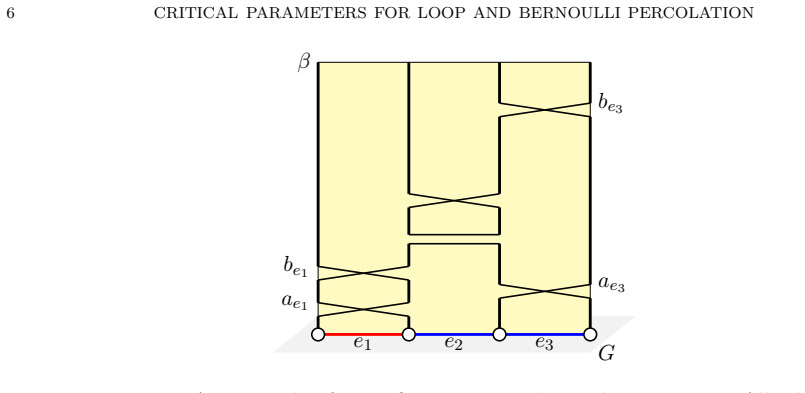
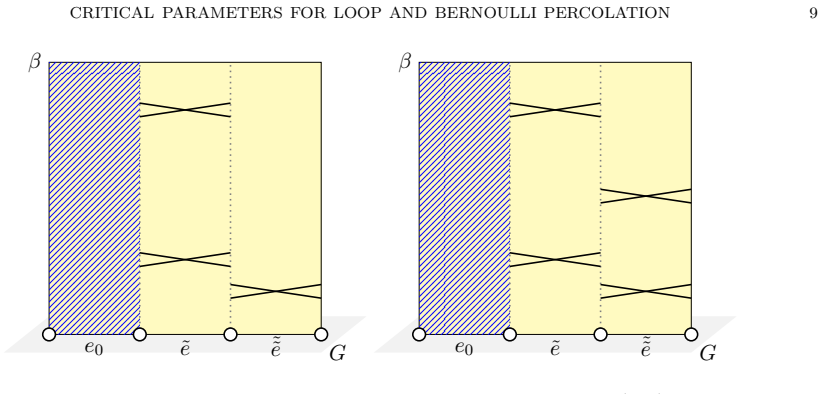
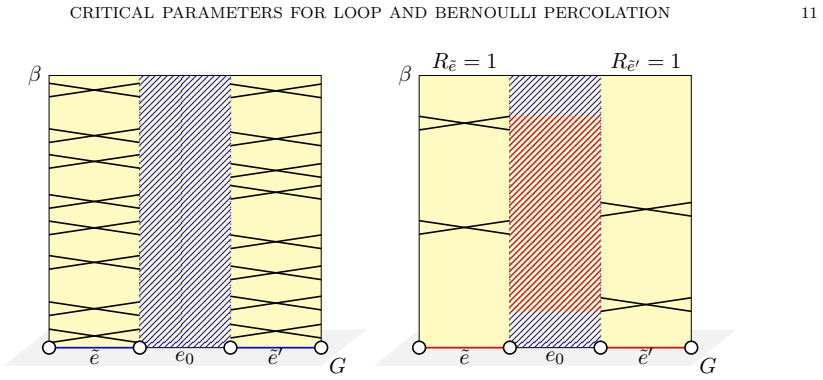
The carrying object is the red-edge process $(R_e)$, a local configuration event on each edge. Proposition 3.1 shows that, conditioned on every edge of any subgraph carrying at least one link, the law of $(R_e)_{e\in E'}$ stochastically dominates a product Bernoulli measure with parameter $\delta>0$ depending only on $\beta$ and the degree bound $\Delta$, uniformly over all admissible boundary conditions. The proof of Proposition 3.1 uses a spatial Markov property to reduce arbitrary conditioning to a two-layer neighbourhood of the edge, a classification of pivotal neighbouring edges, and a final reduction to the law of a Poisson point process on a set of intervals of length at least $\beta/2$; this yields a strictly positive uniform lower bound on the conditional probability that a given edge is red.
What would settle it
Fix $u=1$ on $\mathbb{Z}^2$ and simulate the loop model at $\beta=-\ln(1-p_c(\mathbb{Z}^2))$: if infinite loops occur with positive probability at that $\beta$, Theorem 2.1 is false. Alternatively, construct a sequence of admissible boundary conditions on the two-neighbourhood of an edge $e_0$ for which the conditional probability that $e_0$ is red tends to zero; this would contradict Proposition 3.1 and break the proof.
Extended reading notes
Core claim
Theorem 2.1: for all countably infinite connected graphs $G$ of uniformly bounded degree with $p_c(G,\mathrm{bond})<1$ and all $u\in(0,1]$, the strict inequality $\beta_c(u)>\beta_c^{\mathrm{per}}$ holds, where $\beta_c^{\mathrm{per}}=-\ln(1-p_c)$. The proof couples the loop configuration to bond percolation with $p=1-e^{-\beta}$ and colours each edge red, blue, or uncoloured: an edge is red when it carries exactly two crosses and no neighbouring edge has a link between them; blue when it carries at least one link but is not red. Loops can travel only along blue edges, so if red edges are abundant enough and form an independent-like set, deleting them from a barely supercritical percolation cuts every infinite cluster while the original percolation still percolates. This yields a gap interval on every bounded-degree graph, and in particular on $\mathbb{Z}^d$ an interval with infinite percolation clusters but exponentially small loops.
Load-bearing premise
The proof rests on the claim that conditioned on every edge of a subgraph carrying at least one link, the red-edge indicators stochastically dominate a product Bernoulli measure with a strictly positive parameter $\delta$ that is uniform over all boundary conditions; if that uniform domination failed, deleting red edges from a barely supercritical percolation could leave an infinite cluster of blue edges.
Editorial extensions
If this is right
- On $\mathbb{Z}^d$, $d\ge2$, there exist $0<\beta_1<\beta_2<\infty$ such that for every $\beta\in(\beta_1,\beta_2)$ the loop sizes satisfy $P_{\beta,u}(|L(0)|=k)\le ae^{-bk}$ while the coupled bond percolation with $p=1-e^{-\beta}$ has an infinite cluster with positive probability (Corollary 2.2).
- For sequences of $d$-regular expander graphs with diverging girth, macroscopic loops appear strictly later than macroscopic percolation clusters (Corollary 4.1).
- The strict inequality holds for all $u\in(0,1]$, while the case $u=0$ remains open and appears to require new tools for dependent percolation (Section 4.4).
- For graphs of diverging vertex degree, including complete graphs, hypercubes, and Hamming graphs, known results give equality $\beta_c=\beta_c^{\mathrm{per}}$, so the strict gap is specific to bounded degree (Conjecture 4.2 and the discussion around it).
Reading between the lines
- The uniform domination produced by Proposition 3.1 is quantitative, so the same construction could in principle yield explicit lower bounds on the size of the gap $\beta_c(u)-\beta_c^{\mathrm{per}}$ on lattices, although the paper only proves positivity.
- The red-edge event is an 'essential enhancement' with a built-in independence mechanism; this suggests that similar local cancellation events could be designed for other loop-weighted models once a comparison model is identified, a direction the paper mentions but does not develop beyond $\theta>1$ in an 'appropriate sense'.
- The failure of the argument at $u=0$ points to a qualitative difference between two-cross cancellation (where two crosses on the same edge undo a connection) and double-bar dynamics, where no such cancellation exists; testing numerically whether the gap closes as $u\to0$ on $\mathbb{Z}^2$ would isolate which feature of the model is responsible for the strict inequality.
Signed reviews
Editorial analysis
A structured set of objections, weighed in public.
Referee Report
Summary. The paper studies random loop models on connected, countably infinite graphs of uniformly bounded degree, parametrised by a time parameter beta and a cross/double-bar intensity u. The main result, Theorem 2.1, asserts that for every u in (0,1] the critical loop parameter beta_c(u) is strictly larger than the critical percolation parameter beta_c^per defined by p=1-e^{-beta}; equivalently, there is an interval of beta where infinite percolation clusters occur almost surely while infinite loops do not. The proof constructs a coupled three-colour percolation process: red edges carry exactly two crosses and no neighbouring links between them, blue edges carry at least one link but are not red, and loops are contained in blue clusters. The central technical step, Proposition 3.1, claims that the red-edge process conditioned on all edges being coloured dominates a non-degenerate product Bernoulli measure with parameter delta depending only on beta and the degree bound. From this domination the authors derive that the blue process is subcritical for beta slightly above beta_c^per, yielding the theorem. The paper also contains a corollary for Z^d, an extension to expander graphs, and a discussion of why the u=0 case is not covered.
Significance. If the main theorem is correct, it establishes a strict separation between loop and Bernoulli percolation on all bounded-degree graphs, extending a result previously known for regular trees and providing the first general confirmation that the inequality beta_c >= beta_c^per can be strict outside mean-field settings. The proof idea is attractive and genuinely different from earlier tree arguments: it uses a stochastic domination criterion of Liggett-Schonmann-Stacey to show that the 'cancelling' red edges are sufficiently abundant and sufficiently independent. The claimed uniform dependence of delta only on beta and Delta is exactly the right kind of statement, and Corollary 2.2 is a concrete, falsifiable consequence for Z^d. The paper is self-contained in its derivation and does not disguise fitted parameters as predictions. However, as detailed below, a key inequality in the proof of the uniform domination is false, so the central argument is not yet valid as written.
major comments (3)
- [§3.4, Lemma 3.11, Eq. (3.17)] Inequality (3.17) is false. The text asserts that conditioning on type-1 neighbours of ~e only makes b_~e - a_~e smaller in probability, because X_~e becomes a Poisson point process on a subset of [0, beta] with the same intensity. But deleting an interval from the support can split the support into two components and thereby reduce the probability that two independent uniform points are within a fixed distance c. For beta=10 and c=1.25, two independent uniform points on [0,10] have range less than c with probability 1 - (1 - 1.25/10)^2 = 0.2344; on S = [0,4.9] ∪ [5.1,10] the same probability is 0.5(1 - (1 - 1.25/4.9)^2) ≈ 0.2225, which is strictly smaller. Thus conditioning on a type-1 neighbour can decrease, not increase, the left-hand side of (3.17). This inequality is the only justification for the uniform lower bound in Lemma 3.11, and Lemma 3.11 is used in the chain (3.18) to produce the positive constant in (3.19). The proof of Proposition 3.1, and therefore of Theorem 2.1, is not valid as written.
- [§3.2, reduction to u=1] The claim that it suffices to prove Proposition 3.1 for u=1 because u in (0,1) 'merely decreases the intensity of red edges by a factor u^2 > 0' is not established. Under the measure mu conditioned on n_e > 0, the probability of the red event depends on u through the Poisson intensity u, through the conditioning on at least one link, and through the fact that double bars on neighbouring edges also count in the condition N_~e(a_e,b_e] = 0. A simple factor u^2 does not obviously absorb all of these effects. Since Theorem 2.1 is stated for all u in (0,1], this reduction is load-bearing and requires a proof rather than a heuristic sentence.
- [§3.2, definition of mu; Proposition 3.1] The conditional measure mu = P_{beta,u}( . | n_e > 0 for all e in E') is not defined in the usual sense: for an infinite edge set E', the event {n_e > 0 for all e in E'} has probability zero under the product law, so conditioning on it requires a limiting or regular-conditional construction. Remark 3.2 acknowledges the issue and refers to discretisation of time and taking limits, but no such construction is actually given. Since Proposition 3.1 is used for infinite subgraphs in the proof of Theorem 2.1, this gap should be closed explicitly, for example by proving the domination first for finite subgraphs and then passing to the limit.
minor comments (4)
- [§3.2] The sentence 'cycles must be subsets of percolation clusters' uses 'cycles' where 'loops' is meant; the subsequent notation L(v) ⊆ C^B(v) is clear, but the terminology should be corrected.
- [Remark 3.2] The promise that conditioning on probability-zero events can be avoided by discretising time and taking limits is not followed by an actual limiting argument in the proof; this is related to major comment 3 and should be addressed.
- [Lemma 3.9] The proof by contradiction would be easier to verify if the dependence of epsilon on the outer configuration were made explicit; currently it is not fully clear why the two smallness conditions on the two terms in (3.9) cannot hold simultaneously for all epsilon > 0.
- [Eq. (3.13)] The notation 'η 3.9 ≤' in the displayed inequality is unclear; the intended use of Lemma 3.9 should be written as an explicit factor eta on the left-hand side.
Circularity Check
No significant circularity: the main theorem is derived from an explicit stochastic-domination argument, not from the definitions of the critical parameters.
full rationale
The paper's central claim, beta_c(u) > beta_c^per, is not equivalent to its inputs by construction. The lower bound beta_c >= beta_c^per is obtained from the natural coupling between loop configurations and Bernoulli bond percolation, where an edge is open exactly when it carries at least one link; this is a genuine comparison between two separately defined critical parameters. The strict inequality is then proved by constructing red edges whose removal stochastically dominates deletion by an independent Bernoulli thinning: Proposition 3.1 establishes that, conditioned on all edges carrying at least one link, the red-edge process dominates a product Bernoulli measure with a uniform delta > 0. The proof of Proposition 3.1 proceeds through local lemmas about Poisson point processes on individual edges and their neighbours, using a spatial Markov property and finite boundary conditions; no parameter is fitted to data, and no quantity called a prediction is in fact an input. The paper's citations, including [LSS97] for product-measure domination and [Ham15] for the tree case, are used as external tools or benchmarks rather than as the sole justification of the main theorem. A referee might dispute the validity of inequality (3.17) in Lemma 3.11, but that would be a mathematical correctness gap, not circularity: the lemma is asserted and proved, not assumed as the conclusion. Since no self-definitional reduction, fitted-input-as-prediction, or load-bearing self-citation is present, the appropriate circularity score is 0.
Assumptions & free parameters
assumptions (5)
- standard math Liggett-Schonmann-Stacey domination criterion: a process dominates a product Bernoulli measure if conditional probabilities of success are uniformly bounded below.
- domain assumption Loop clusters are contained in blue clusters, i.e. L(v) subset C^B(v) in equation (3.1).
- standard math beta_c is well-defined and independent of the reference vertex, following Ang03 Proposition 5.
- standard math For p > p_c, Bernoulli bond percolation has an infinite cluster almost surely.
- domain assumption Graphs are connected, countably infinite, uniformly bounded degree, with p_c < 1.
Cite this review
Pith. "Pith review of Critical Parameters for Loop and Bernoulli Percolation." pith.science (2026). https://pith.science/paper/4BECDABH
@misc{pith2026190810213,
  author       = {Pith},
  title        = {Pith review of: Critical Parameters for Loop and Bernoulli Percolation},
  year         = {2026},
  howpublished = {\url{https://pith.science/paper/4BECDABH}},
  note         = {Machine review of arXiv:1908.10213}
}
abstract
We consider a class of random loop models (including the random interchange process) that are parametrised by a time parameter $\beta\geq 0$. Intuitively, larger $\beta$ means more randomness. In particular, at $\beta=0$ we start with loops of length 1 and as $\beta$ crosses a critical value $\beta_c$, infinite loops start to occur almost surely. Our random loop models admit a natural comparison to bond percolation with $p=1-e^{-\beta}$ on the same graph to obtain a lower bound on $\beta_c$. For those graphs of diverging vertex degree where $\beta_c$ and the critical parameter for percolation have been calculated explicitly, that inequality has been found to be an equality. In contrast, we show in this paper that for graphs of bounded degree the inequality is strict, i.e. we show existence of an interval of values of $\beta$ where there are no infinite loops, but infinite percolation clusters almost surely.
Figures

Figures from the paper (1 more)
Reference graph
Works this paper leans on
-
[1]
Percolation on finite graphs and isoperimetric inequalities
Noga Alon, Itai Benjamini, Alan Stacey, et al. Percolation on finite graphs and isoperimetric inequalities. The Annals of Probability , 32(3):1727--1745, 2004
work page 2004
-
[2]
Strict monotonicity for critical points in percolation and ferromagnetic models
Michael Aizenman and Geoffrey Grimmett. Strict monotonicity for critical points in percolation and ferromagnetic models. Journal of Statistical Physics , 63(5-6):817--835, 1991
work page 1991
-
[5]
Geometric aspects of quantum spin states
Michael Aizenman and Bruno Nachtergaele. Geometric aspects of quantum spin states. Communications in Mathematical Physics , 164(1):17--63, 1994
work page 1994
-
[6]
Random infinite permutations and the cyclic time random walk
Omer Angel. Random infinite permutations and the cyclic time random walk. Discrete Mathematics and Theoretical Computer Science AC , pages 9--16, 2003
work page 2003
-
[7]
A numerical study of the 3d random interchange and random loop models
Alessandro Barp, Edoardo Gabriele Barp, Fran c ois-Xavier Briol, and Daniel Ueltschi. A numerical study of the 3d random interchange and random loop models. Journal of Physics A: Mathematical and Theoretical , 48(34):345002, 2015
work page 2015
-
[8]
Sharp threshold for percolation on expanders
Itai Benjamini, St \'e phane Boucheron, G \'a bor Lugosi, Rapha \"e l Rossignol, et al. Sharp threshold for percolation on expanders. The Annals of Probability , 40(1):130--145, 2012
work page 2012
-
[9]
Essential enhancements revisited
Paul Balister, B \'e la Bollob \'a s, and Oliver Riordan. Essential enhancements revisited. arXiv preprint arXiv:1402.0834 , 2014
arXiv 2014
-
[11]
Emergence of giant cycles and slowdown transition in random transpositions and k -cycles
Nathana \"e l Berestycki. Emergence of giant cycles and slowdown transition in random transpositions and k -cycles. Electronic Journal of Probability , 16:152--173, 2010
work page 2010
Show all 43 references
-
[13]
Large cycles in random permutations related to the heisenberg model
Jakob Bj \"o rnberg. Large cycles in random permutations related to the heisenberg model. Electronic Communications in Probability , 20, 2015
2015
-
[14]
The free energy in a class of quantum spin systems and interchange processes
Jakob Bj \"o rnberg. The free energy in a class of quantum spin systems and interchange processes. Journal of Mathematical Physics , 57(7):073303, 2016
2016
-
[16]
Critical parameter of random loop model on trees
Jakob Bj \"o rnberg and Daniel Ueltschi. Critical parameter of random loop model on trees. The Annals of Applied Probability , 28(4):2063--2082, 2018
2018
-
[18]
Statistical Mechanics of Lattice Systems: A Concrete Mathematical Introduction
Sacha Friedli and Yvan Velenik. Statistical Mechanics of Lattice Systems: A Concrete Mathematical Introduction . Cambridge University Press, 2017
2017
-
[19]
Infinite cycles in the random stirring model on trees
Alan Hammond. Infinite cycles in the random stirring model on trees. Bulletin of the Institute of Mathematics Academia Sinica , 8:85--104, 2012
2012
-
[20]
Sharp phase transition in the random stirring model on trees
Alan Hammond. Sharp phase transition in the random stirring model on trees. Probability Theory and Related Fields , 161(3-4):429--448, 2015
2015
-
[21]
Theodore E. Harris. Nearest-neighbor markov interaction processes on multidimensional lattices. Advances in Mathematics , 9(1):66--89, 1972
1972
-
[23]
The random interchange process on the hypercube
Roman Koteck \'y , Piotr Mi o \'s , and Daniel Ueltschi. The random interchange process on the hypercube. Electronic Communications in Probability , 21:1--9, 2016
2016
-
[24]
Domination by product measures
Thomas M Liggett, Roberto H Schonmann, and Alan M Stacey. Domination by product measures. The Annals of Probability , 25(1):71--95, 1997
1997
-
[26]
Compositions of random transpositions
Oded Schramm. Compositions of random transpositions. Israel Journal of Mathematics , 147(1):221--243, 2005
2005
-
[27]
Improved lower bound on the thermodynamic pressure of the spin 1/2 heisenberg ferromagnet
B \'a lint T \'o th. Improved lower bound on the thermodynamic pressure of the spin 1/2 heisenberg ferromagnet. Letters in Mathematical Physics , 28(1):75--84, 1993
1993
-
[28]
Random loop representations for quantum spin systems
Daniel Ueltschi. Random loop representations for quantum spin systems. Journal of Mathematical Physics , 54(8), 2013
2013
-
[29]
Harris, T. E. Nearest-neighbor Markov interaction processes on multidimensional lattices. Advances in Mathematics 9.1 (1972): 66-89
1972
-
[30]
Improved lower bound on the thermodynamic pressure of the spin 1/2 Heisenberg ferromagnet
T\' o th, B. Improved lower bound on the thermodynamic pressure of the spin 1/2 Heisenberg ferromagnet. letters in mathematical physics 28.1 (1993): 75-84
1993
-
[31]
and Nachtergaele, B
Aizenman, M. and Nachtergaele, B. Geometric aspects of quantum spin states. Communications in Mathematical Physics 164.1 (1994): 17-63
1994
-
[32]
Random loop representations for quantum spin systems
Ueltschi, D. Random loop representations for quantum spin systems. Journal of Mathematical Physics 54.8 (2013): 083301
2013
-
[33]
Domination by product measures
Liggett, Thomas M., Schonmann, Roberto H., and Stacey, Alan M. Domination by product measures. The Annals of Probability 25.1 (1997): 71-95
1997
-
[34]
Statistical mechanics of lattice systems: a concrete mathematical introduction
Friedli, Sacha, and Yvan Velenik. Statistical mechanics of lattice systems: a concrete mathematical introduction. Cambridge University Press, 2017
2017
-
[35]
and Barp, E.G
Barp, A. and Barp, E.G. and Briol, F.X. and Ueltschi, D. A numerical study of the 3D random interchange and random loop models. Journal of Physics A: Mathematical and Theoretical 48.34 (2015): 345002
2015
-
[36]
and Kotowski, M
Bj\" o rnberg, J.E. and Kotowski, M. and Lees, B. and Mi o\' s , P. The interchange process with reversals on the complete graph. Preprint. arXiv:1812.03301 (2018)
2018 arXiv
-
[37]
Compositions of random transpositions
Schramm, O. Compositions of random transpositions. Israel Journal of Mathematics 147.1 (2005): 221-243
2005
-
[38]
and Mi o\' s , P
Koteck\' y , R. and Mi o\' s , P. and Ueltschi, D. The random interchange process on the hypercube. Electron. Commun. Probab. 21 (2016): 1-9
2016
-
[39]
Random Infinite Permutations and the Cyclic Time Random Walk
Angel, O. Random Infinite Permutations and the Cyclic Time Random Walk. DRW. 2003
2003
-
[40]
Infinite cycles in the random stirring model on trees
Hammond, A. Infinite cycles in the random stirring model on trees. Bulletin of the Institute of Mathematics Academia Sinica 8 (2012): 85-104
2012
-
[41]
Sharp phase transition in the random stirring model on trees
Hammond, A. Sharp phase transition in the random stirring model on trees. Probability Theory and Related Fields 161.3-4 (2015): 429-448
2015
-
[42]
and Ueltschi, D
Bj\" o rnberg, J.E. and Ueltschi, D. Critical parameter of random loop model on trees. The Annals of Applied Probability 28.4 (2018): 2063-2082
2018
-
[43]
and Hegde, M
Hammond, A. and Hegde, M. Critical point for infinite cycles in a random loop model on trees. Preprint. arXiv:1805.11772 (2018)
2018 arXiv
-
[44]
and Mi o\' s , P
S eng\" u l, B. and Mi o\' s , P. Existence of a phase transition of the interchange process on the Hamming graph. Preprint. arXiv:1605.03548 (2016), accepted to EJP
2016 arXiv
-
[45]
Large cycles in random permutations related to the Heisenberg model
Bj\" o rnberg, J.E. Large cycles in random permutations related to the Heisenberg model. Electronic Communications in Probability 20 (2015)
2015
-
[46]
The free energy in a class of quantum spin systems and interchange processes
Bj\" o rnberg, J.E. The free energy in a class of quantum spin systems and interchange processes. Journal of Mathematical Physics 57.7 (2016): 073303
2016
-
[47]
and Kozma, G
Alon, G. and Kozma, G. The mean-field quantum Heisenberg ferromagnet via representation theory. Preprint. arXiv:1811.10530 (2018)
2018 arXiv
-
[48]
o rnberg, J.E. and Fr\
Bj\" o rnberg, J.E. and Fr\" o hlich, J. and Ueltschi, D. Quantum spins and random loops on the complete graph. Preprint. arXiv:1811.12834 (2018)
2018 arXiv
-
[49]
and Ueltschi, D
Bj\" o rnberg, J.E. and Ueltschi, D. Critical temperature of Heisenberg models on regular trees, via random loops. Preprint. arXiv:1803.11430 (2018)
2018 arXiv
-
[50]
and Ehlert, J
Betz, V. and Ehlert, J. and Lees, B. Phase transition for loop representations of Quantum spin systems on trees. Preprint. arXiv:1804.00860 (2018)
2018 arXiv
-
[51]
and Kotowski, M
Adamczak, R. and Kotowski, M. and Mi o\' s , P. Phase transition for the interchange and quantum Heisenberg models on the Hamming graph. Preprint arXiv:1808.08902 (2018)
2018 arXiv
Reviewed August 14, 2026 · model on record in the stance chip above.
Discussion (0). Continue with ORCID to comment.