REVIEW 2 major objections 6 minor 1 cited by
SeSeMI: Secure Serverless Model Inference on Sensitive Data
T0 review · 2 major / 6 minor · reviewed 2026-08-11 · deepseek-v4-flash
Pith's one-line read SeSeMI claims that serverless model inference can keep models and user requests secret from an untrusted cloud by adding three non-intrusive components to existing serverless platforms, with low latency and cost.
desk verdict A genuinely useful confidential-serverless-inference system with a missing revocation path that undercuts the headline security claim. read the letter →
The pith
A machine-rendered reading of the paper's core claim, the machinery that carries it, and where it could break.
The reading
What carries the argument
The central mechanism is KeyService, an always-on attestation bridge enclave that holds identity keys, model keys, request keys, and access-control tuples, and provisions keys to a SeMIRT enclave only after mutual remote attestation confirms the enclave's MRENCLAVE matches the policy. The companion mechanism is SeMIRT's key/model/runtime cache inside the enclave, which turns cold starts into warm or hot invocations; FnPacker then decides which endpoint should receive each request based on pending work and idle state.
What would settle it
Revoke a user's access by removing her entries from ACM and KS_R at KeyService, then send a fresh request from that user to a warm endpoint that has previously served her; if the endpoint answers without contacting KeyService, the claimed access-control enforcement is disproven.
Extended reading notes
Core claim
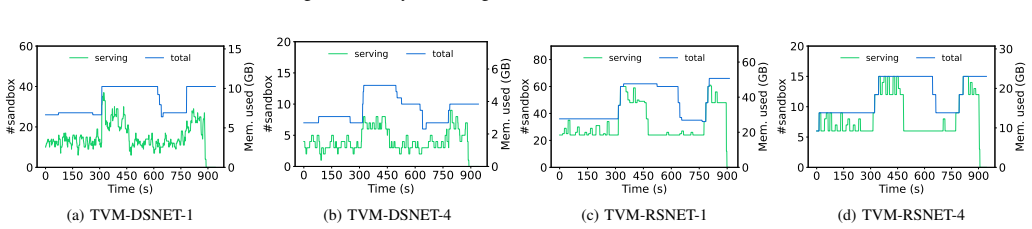
SeSeMI's central claim is that confidentiality and access control for model serving can be achieved on an unmodified serverless platform by moving trust to a KeyService enclave and by making the serving enclaves stateful. The model owner and each user first attest KeyService and register long-term keys; the owner encrypts the model and the user encrypts each request, and KeyService releases the decryption keys only to a SeMIRT enclave whose hardware-measured identity (MRENCLAVE) matches the access-control records ACM and KS_R. SeMIRT then caches the retrieved key pair, the decrypted model, and the initialized inference runtime, so a hot invocation skips enclave initialization, remote attestation, key retrieval, model loading, and runtime initialization, leaving only decryption, inference, and result encryption. FnPacker routes requests to endpoints that can switch among infrequently used models. The evaluation reports that hot invocations give up to 21x speedup over cold ones, that SeMIRT keeps latency near the model-execution cost, and that sharing enclave threads reduces memory cost by roughly 48-59% for TVM models under a bursty MMPP workload.
Load-bearing premise
Access control is enforced only when keys are first fetched: after a SeMIRT enclave has cached a user's decryption keys, it serves that user's subsequent requests without rechecking KeyService, so the system silently assumes that access-control policies never change during an enclave's lifetime.
Editorial extensions
If this is right
- A cloud provider can offer confidential model serving by adding SGX support and deploying SeSeMI's three components, with no changes to the serverless control plane.
- Hot requests, which hit a warm enclave with the right model and keys cached, run at near-plaintext speed, so interactive users and bursty traffic see low latency.
- Under infrequent and unpredictable per-model traffic, FnPacker's packing reduces the number of cold starts and the model owner's memory-based bill.
- Because SeMIRT shares one enclave across concurrent requests, the memory footprint per request drops, allowing smaller instance budgets.
- On SGX2 hardware the bottleneck shifts from enclave memory to CPU, so inference frameworks that reduce compute or memory traffic gain more.
Reading between the lines
- The access-control guarantee is only as strong as the assumption that policies do not change: KeyService has no revocation procedure, and a warm enclave that has cached a key pair will keep serving the user without recontacting KeyService.
- The same three-component pattern — an attestation bridge, a state-reusing enclave runtime, and a model packer — could generalize to other TEE platforms and to stateful serverless workloads beyond inference.
- If TEE cold-start and attestation costs drop in future hardware, the latency advantage of hot invocations will shrink; the durable contribution may become the attestation delegation and access-control design rather than the caching runtime.
- FnPacker's scheduling is heuristic; a predictive version could estimate model-switch costs from arrival statistics and choose between exclusive and packed endpoints accordingly.
Signed reviews
Editorial analysis
A structured set of objections, weighed in public.
Referee Report
Summary. This paper presents SeSeMI, a TEE-based confidential model inference system for serverless platforms. It introduces three components: KeyService, an enclave-based service that performs remote attestation, manages model and request decryption keys, and enforces access-control lists; SeMIRT, an SGX enclave runtime that caches decrypted models and keys, supports concurrent requests, and distinguishes cold, warm, and hot invocation paths; and FnPacker, which packs requests to infrequently used models onto shared endpoints. The system is implemented on Apache OpenWhisk and evaluated with three models (MobileNet, ResNet101, DenseNet121), two inference frameworks (TFLM, TVM), and both SGX1 and SGX2 clusters. The paper claims that SeSeMI achieves four goals: confidentiality against an untrusted cloud and unauthorized users, low latency, low cost, and no intrusive changes to the existing serverless infrastructure.
Significance. The contribution is potentially significant. The paper identifies real challenges in combining SGX with serverless computing and proposes concrete, reasonably engineered mechanisms to address them. The evaluation is extensive: micro-benchmarks of serving stages, single-node and multi-node tests, MMPP workloads, cost integrals, and SGX1/SGX2 comparisons. The code is open-sourced, and the design of SeMIRT's caching and FnPacker's scheduling is described in enough detail to be reproducible. The main weakness is security: the access-control argument is informal and, as written, does not support dynamic revocation, which is required by the stated security goal. This is a central, load-bearing gap rather than a presentation issue.
major comments (2)
- [IV-A, IV-B, IV-D, V] The security claim that SeSeMI "prevents inference executions from unauthorized model users" (Section III) is not supported for dynamic access-control policies. Algorithm 1 defines only USER_REGISTRATION, ADD_MODEL_KEY, GRANT_ACCESS, ADD_REQ_KEY, and KEY_PROVISIONING; it contains no operation to revoke or update ACM or KS_R entries. Section V nevertheless states that clients can "update access control policies" with KeyService, but no such operation is specified in the pseudocode or described in the implementation. Even if an update mechanism were added, Algorithm 2 lines 6-10 make a cache hit on the last (Moid, uid) pair the trigger for using retained keys without contacting KeyService again, so a warm or hot enclave would continue to serve a user whose access has been revoked until the sandbox is destroyed or the cache is evicted. The paper never states that access-control policies are static for the lifetime of warm enclaves; the OpenWhisk container timeout of 3 minutes (Table V) only bounds how long revocation would eventually take effect if a new instance were started. This is a security-relevant correctness gap in the central claim, not a stylistic issue, and should be fixed either by explicitly stating a static-policy assumption or by adding a revocation/expiry/re-check mechanism and evaluating its cost.
- [IV-B and IV-D] The claim in Section IV-D that SeMIRT "avoids potential problems from sharing an enclave across different models and users by running only one model and serving requests from one user per enclave" is not enforced by Algorithm 2. The pseudocode uses a single global key cache KC and caches only the last pair of decryption keys, but there is no lock, admission control, or check that prevents two concurrent EC_MODEL_INF calls with different uid values from executing in the same enclave. Under concurrency, one thread can overwrite KC while another thread is still processing a request with a previously fetched key, so requests from different users can be in flight in the same enclave at overlapping times. This contradicts the stated isolation rationale and can cause requests to be decrypted with the wrong key or to fail. The paper should either specify the concurrency control around KC and the user-association invariant, or restrict the one-user-per-enclave claim to the sequential-processing configuration described in Section V.
minor comments (6)
- [V] The text says clients can "update access control policies" with KeyService, but Algorithm 1 and the implementation section define no such update operation; please align the prose with the pseudocode or add the missing operation.
- [VI] Figures 11-14 report average latencies and cost integrals without error bars, confidence intervals, or repetition counts; please state the number of runs and the observed variance so the comparative claims can be assessed.
- [VI, Baselines] The Iso-reuse baseline is implemented by the authors from the descriptions in prior work because no source code is available; please state whether this implementation has been validated and whether it is released, since baseline fidelity directly affects the performance comparisons in Figures 12 and 13.
- [IV-B, Algorithm 2] The notation for the key cache is underspecified: KC is described as "last pair of decryption keys," but the condition on line 6 tests membership of "Moid∥uid"; please clarify the exact structure of KC and the locking discipline around it.
- [III and Appendix F] The non-intrusiveness claim should be qualified: Appendix F shows that OpenWhisk invokers must be configured to mount the SGX driver and aesmd into containers, which is a platform-level configuration change even if no source-code modification to the serverless platform is required.
- [VI-B, Figure 12a] The Native baseline is omitted from Figure 12a without an explanatory note; please add a caption statement that Native saturates below the plotted request-rate range.
Circularity Check
No circularity found: SeSeMI's security and performance claims rest on SGX attestation, KeyService access checks, and direct experiments rather than on fitted inputs or load-bearing self-citations.
full rationale
SeSeMI is a systems and security paper; there are no fitted parameters, no parametric derivation, and no quantity that is defined in terms of the quantity it claims to predict. The security argument is a protocol argument: model and request keys are generated independently by the owner and user; KeyService stores them only after attestation (Algorithm 1); KEY_PROVISIONING checks ACM and KS_R before releasing keys; SeMIRT fetches keys only after mutual attestation; and model and request data are decrypted only inside the enclave. Each link is anchored in SGX remote attestation rather than in a prior conclusion of this paper. The evaluation compares SeSeMI against Native (standard serverless sandbox behavior) and Iso-reuse (implemented from descriptions of prior work), using standard workloads such as MMPP and MLPerf-derived patterns; no baseline is used to fit a parameter that is later reported as a prediction. The only author-overlap citation is [2], used for background on serverless model serving and as a workload source; it is not load-bearing for SeSeMI's correctness or performance claims. The closest thing to a logical gap is Section IV-D's statement that cached keys imply authorization: Algorithm 2 lines 6-10 serve hot requests from cached keys without re-consulting KeyService, and Algorithm 1 defines no revocation or update procedure for ACM or KS_R even though Section V mentions updating access-control policies. That is a genuine security limitation under dynamic policies, but it is not circular: the hot path inherits the authorization that was checked at the earlier key-provisioning step rather than defining the security predicate as its own output. It should be treated as a correctness/revocation issue, not as circular reasoning.
Assumptions & free parameters
assumptions (5)
- domain assumption Intel SGX correctly implements enclave isolation and remote attestation.
- domain assumption The enclave code, including SeMIRT and KeyService, contains no exploitable vulnerabilities.
- domain assumption Side-channel, physical, and denial-of-service attacks are out of scope.
- ad hoc to paper Access-control policy remains static for the lifetime of warm enclaves.
- domain assumption The expected enclave identity ES can be independently computed by model owners and users from the enclave code.
Cite this review
Pith. "Pith review of SeSeMI: Secure Serverless Model Inference on Sensitive Data." pith.science (2026). https://pith.science/paper/4BQ6NFSK
@misc{pith2026241211640,
  author       = {Pith},
  title        = {Pith review of: SeSeMI: Secure Serverless Model Inference on Sensitive Data},
  year         = {2026},
  howpublished = {\url{https://pith.science/paper/4BQ6NFSK}},
  note         = {Machine review of arXiv:2412.11640}
}
read the original abstract
Model inference systems are essential for implementing end-to-end data analytics pipelines that deliver the benefits of machine learning models to users. Existing cloud-based model inference systems are costly, not easy to scale, and must be trusted in handling the models and user request data. Serverless computing presents a new opportunity, as it provides elasticity and fine-grained pricing. Our goal is to design a serverless model inference system that protects models and user request data from untrusted cloud providers. It offers high performance and low cost, while requiring no intrusive changes to the current serverless platforms. To realize our goal, we leverage trusted hardware. We identify and address three challenges in using trusted hardware for serverless model inference. These challenges arise from the high-level abstraction of serverless computing, the performance overhead of trusted hardware, and the characteristics of model inference workloads. We present SeSeMI, a secure, efficient, and cost-effective serverless model inference system. It adds three novel features non-intrusively to the existing serverless infrastructure and nothing else.The first feature is a key service that establishes secure channels between the user and the serverless instances, which also provides access control to models and users' data. The second is an enclave runtime that allows one enclave to process multiple concurrent requests. The final feature is a model packer that allows multiple models to be executed by one serverless instance. We build SeSeMI on top of Apache OpenWhisk, and conduct extensive experiments with three popular machine learning models. The results show that SeSeMI achieves low latency and low cost at scale for realistic workloads.
Figures


Figures from the paper (13 more)




Forward citations
Cited by 1 Pith paper
-
A Survey on Privacy Risks and Protection in Large Language Models
The paper surveys LLM privacy leaks and attacks, organizes them into a taxonomy, and reviews defenses without adding new empirical results.
Reference graph
Works this paper leans on
-
[1]
Mark: Exploiting cloud services for cost-effective, slo-aware machine learning inference serving,
C. Zhang, M. Yu, W. Wang, and F. Yan, “Mark: Exploiting cloud services for cost-effective, slo-aware machine learning inference serving,” in USENIX ATC, 2019, pp. 1049–1062
work page 2019
-
[2]
Serverless data science - are we there yet? a case study of model serving,
Y . Wu, T. T. A. Dinh, G. Hu, M. Zhang, Y . M. Chee, and B. C. Ooi, “Serverless data science - are we there yet? a case study of model serving,” in SIGMOD, 2022, p. 1866–1875
work page 2022
-
[3]
Membership inference attacks against machine learning models,
R. Shokri, M. Stronati, C. Song, and V . Shmatikov, “Membership inference attacks against machine learning models,” in S&P, 2017, pp. 3–18
work page 2017
-
[4]
Serverless computing: One step forward, two steps back,
J. M. Hellerstein, J. Faleiro, J. E. Gonzalez, J. Schleier-Smith, V . Sreekanti, A. Tumanov, and C. Wu, “Serverless computing: One step forward, two steps back,” in CIDR, 2019
work page 2019
-
[5]
Cloud programming simplified: A berkeley view on serverless computing,
E. Jonas, J. Schleier-Smith, V . Sreekanti, C.-C. Tsai, A. Khandelwal, Q. Pu, V . Shankar, J. Carreira, K. Krauth, N. Yadwadkar, J. E. Gonzalez, R. A. Popa, I. Stoica, and D. A. Patterson, “Cloud programming simplified: A berkeley view on serverless computing,” UC Berkeley, Tech. Rep., 2019
work page 2019
-
[6]
Fsd-inference: Fully serverless distributed inference with scalable cloud communication,
J. Oakley and H. Ferhatosmanoglu, “Fsd-inference: Fully serverless distributed inference with scalable cloud communication,” in 2024 IEEE 40th International Conference on Data Engineering (ICDE) , 2024, pp. 2109–2122
work page 2024
-
[7]
V . Costan and S. Devadas, “Intel sgx explained,” 2016. [Online]. Available: https://eprint.iacr.org/2016/086.pdf
work page 2016
-
[8]
Arm confidential compute architecture
Arm, “Arm confidential compute architecture.” [On- line]. Available: https://www.arm.com/architecture/security-features/ arm-confidential-compute-architecture
Show all 78 references
-
[9]
Amd secure encrypted virtualization (sev)
AMD, “Amd secure encrypted virtualization (sev).” [Online]. Available: https://www.amd.com/en/developer/sev.html
-
[10]
Benchmarking the second generation of intel sgx hardware,
M. El-Hindi, T. Ziegler, M. Heinrich, A. Lutsch, Z. Zhao, and C. Binnig, “Benchmarking the second generation of intel sgx hardware,” in DaMon, 2022
2022
-
[11]
Serverless in the wild: Characterizing and optimizing the serverless workload at a large cloud provider,
M. Shahrad, R. Fonseca, I. Goiri, G. Chaudhry, P. Batum, J. Cooke, E. Laureano, C. Tresness, M. Russinovich, and R. Bianchini, “Serverless in the wild: Characterizing and optimizing the serverless workload at a large cloud provider,” in USENIX ATC, 2020, pp. 205–218
2020
-
[12]
Swayam: Distributed autoscaling to meet slas of machine learning inference services with resource efficiency,
A. Gujarati, S. Elnikety, Y . He, K. S. McKinley, and B. B. Brandenburg, “Swayam: Distributed autoscaling to meet slas of machine learning inference services with resource efficiency,” in Middleware, 2017, p. 109–120
2017
-
[13]
Mlperf inference benchmark,
V . J. Reddi, C. Cheng, D. Kanter, P. Mattson, G. Schmuelling, C.-J. Wu, B. Anderson, M. Breughe, M. Charlebois, W. Chou, R. Chukka, C. Coleman, S. Davis, P. Deng, G. Diamos, J. Duke, D. Fick, J. S. Gardner, I. Hubara, S. Idgunji, T. B. Jablin, J. Jiao, T. S. John, P. Kanwar, ...
2020
-
[14]
S-faas: Trustworthy and accountable function-as-a-service using intel sgx,
F. Alder, N. Asokan, A. Kurnikov, A. Paverd, and M. Steiner, “S-faas: Trustworthy and accountable function-as-a-service using intel sgx,” in CCSW, 2019, p. 185–199
2019
-
[15]
Trust more, serverless,
S. Brenner and R. Kapitza, “Trust more, serverless,” in SYSTOR. Association for Computing Machinery, 2019, p. 33–43
2019
-
[16]
Clemmys: Towards secure remote execution in faas,
B. Trach, O. Oleksenko, F. Gregor, P. Bhatotia, and C. Fetzer, “Clemmys: Towards secure remote execution in faas,” in SYSTOR, 2019, p. 44–54
2019
-
[17]
Reusable enclaves for confidential serverless computing,
S. Zhao, P. Xu, G. Chen, M. Zhang, Y . Zhang, and Z. Lin, “Reusable enclaves for confidential serverless computing,” in 32nd USENIX Se- curity Symposium (USENIX Security 23) . Anaheim, CA: USENIX Association, 2023, pp. 4015–4032
2023
-
[18]
Confidential serverless made efficient with plug-in enclaves,
M. Li, Y . Xia, and H. Chen, “Confidential serverless made efficient with plug-in enclaves,” in ISCA. IEEE Press, 2021, p. 306–318
2021
-
[19]
Intel® trust domain extensions (intel® tdx),
Intel, “Intel® trust domain extensions (intel® tdx),” 2024. [On- line]. Available: https://www.intel.com/content/www/us/en/developer/ tools/trust-domain-extensions/overview.html
2024
-
[20]
Key- stone: An open framework for architecting trusted execution environ- ments,
D. Lee, D. Kohlbrenner, S. Shinde, K. Asanovi ´c, and D. Song, “Key- stone: An open framework for architecting trusted execution environ- ments,” in EuroSys, 2020
2020
-
[21]
Vc3: Trustworthy data analytics in the cloud using sgx,
F. Schuster, M. Costa, C. Fournet, C. Gkantsidis, M. Peinado, G. Mainar- Ruiz, and M. Russinovich, “Vc3: Trustworthy data analytics in the cloud using sgx,” in 2015 IEEE Symposium on Security and Privacy , 2015, pp. 38–54
2015
-
[22]
Opaque: An oblivious and encrypted distributed analytics platform,
W. Zheng, A. Dave, J. G. Beekman, R. A. Popa, J. E. Gonzalez, and I. Stoica, “Opaque: An oblivious and encrypted distributed analytics platform,” in NSDI, 2017, pp. 283–298
2017
-
[23]
Azure sql database always encrypted,
P. Antonopoulos, A. Arasu, K. D. Singh, K. Eguro, N. Gupta, R. Jain, R. Kaushik, H. Kodavalla, D. Kossmann, N. Ogg, R. Ramamurthy, J. Szymaszek, J. Trimmer, K. Vaswani, R. Venkatesan, and M. Zwill- ing, “Azure sql database always encrypted,” in SIGMOD, 2020, p. 1511–1525
2020
-
[24]
Operon: An encrypted database for ownership-preserving data management,
S. Wang, Y . Li, H. Li, F. Li, C. Tian, L. Su, Y . Zhang, Y . Ma, L. Yan, Y . Sun, X. Cheng, X. Xie, and Y . Zou, “Operon: An encrypted database for ownership-preserving data management,” in VLDB, 2022, p. 3332–3345
2022
-
[25]
Veridb: An sgx-based verifiable database,
W. Zhou, Y . Cai, Y . Peng, S. Wang, K. Ma, and F. Li, “Veridb: An sgx-based verifiable database,” in SIGMOD, 2021, p. 2182–2194
2021
-
[26]
Tee-based general- purpose computational backend for secure delegated data processing,
M. Sha, J. Li, S. Wang, F. Li, and K.-L. Tan, “Tee-based general- purpose computational backend for secure delegated data processing,” Proc. ACM Manag. Data , vol. 1, no. 4, dec 2023
2023
-
[27]
Veritxn: Verifiable transactions for cloud-native databases with storage disaggre- gation,
Z. Zhao, H. Pan, G. Chen, X. Du, W. Lu, and B. C. Ooi, “Veritxn: Verifiable transactions for cloud-native databases with storage disaggre- gation,” Proc. ACM Manag. Data , vol. 1, no. 4, dec 2023
2023
-
[28]
Data station: delegated, trustworthy, and auditable computation to enable data-sharing consortia with a data escrow,
S. Xia, Z. Zhu, C. Zhu, J. Zhao, K. Chard, A. J. Elmore, I. Foster, M. Franklin, S. Krishnan, and R. C. Fernandez, “Data station: delegated, trustworthy, and auditable computation to enable data-sharing consortia with a data escrow,” Proc. VLDB Endow., vol. 15, no. 11, p. 3172...
2022
-
[29]
Integrating remote attestation with transport layer security,
T. Knauth, M. Steiner, S. Chakrabarti, L. Lei, C. Xing, and M. Vij, “Integrating remote attestation with transport layer security,” CoRR, vol. abs/1801.05863, 2018
2018 arXiv
-
[30]
Rising to the challenge — data security with intel confidential computing,
Intel, “Rising to the challenge — data security with intel confidential computing,” 2022. [Online]. Available: https://community.intel.com/t5/Blogs/Products-and-Solutions/Security/ Rising-to-the-Challenge-Data-Security-with-Intel-Confidential/post/ 1353141
2022
-
[31]
SCONE: Secure linux containers with intel SGX,
S. Arnautov, B. Trach, F. Gregor, T. Knauth, A. Martin, C. Priebe, J. Lind, D. Muthukumaran, D. O’Keeffe, M. L. Stillwell, D. Goltzsche, D. Eyers, R. Kapitza, P. Pietzuch, and C. Fetzer, “SCONE: Secure linux containers with intel SGX,” in OSDI, 2016, pp. 689–703
2016
-
[32]
Graphene-SGX: A practical library OS for unmodified applications on SGX,
C. che Tsai, D. E. Porter, and M. Vij, “Graphene-SGX: A practical library OS for unmodified applications on SGX,” in USENIX ATC, 2017, pp. 645–658
2017
-
[33]
An evaluation of methods to port legacy code to sgx enclaves,
K. Shanker, A. Joseph, and V . Ganapathy, “An evaluation of methods to port legacy code to sgx enclaves,” in ESEC/FSE, 2020, p. 1077–1088
2020
-
[34]
Asyncshock: Exploiting synchronisation bugs in intel sgx enclaves,
N. Weichbrodt, A. Kurmus, P. Pietzuch, and R. Kapitza, “Asyncshock: Exploiting synchronisation bugs in intel sgx enclaves,” in ESORICS, I. Askoxylakis, S. Ioannidis, S. Katsikas, and C. Meadows, Eds., 2016, pp. 440–457
2016
-
[35]
Coin attacks: On insecurity of enclave untrusted interfaces in sgx,
M. R. Khandaker, Y . Cheng, Z. Wang, and T. Wei, “Coin attacks: On insecurity of enclave untrusted interfaces in sgx,” in ASPLOS, 2020, p. 971–985
2020
-
[36]
A fault-tolerance shim for serverless computing,
V . Sreekanti, C. Wu, S. Chhatrapati, J. E. Gonzalez, J. M. Hellerstein, and J. M. Faleiro, “A fault-tolerance shim for serverless computing,” in EuroSys, 2020
2020
-
[37]
Netherite: Efficient execution of serverless workflows,
S. Burckhardt, B. Chandramouli, C. Gillum, D. Justo, K. Kallas, C. McMahon, C. S. Meiklejohn, and X. Zhu, “Netherite: Efficient execution of serverless workflows,” in VLDB, 2022, p. 1591–1604
2022
-
[38]
Starling: A scalable query engine on cloud functions,
M. Perron, R. C. Fernandez, D. J. DeWitt, and S. Madden, “Starling: A scalable query engine on cloud functions,” in SIGMOD, 2020, pp. 131–141
2020
-
[39]
Lambada: Interactive data analytics on cold data using serverless cloud infrastructure,
I. M ¨uller, R. Marroqu ´ın, and G. Alonso, “Lambada: Interactive data analytics on cold data using serverless cloud infrastructure,” inSIGMOD, 2020, p. 115–130
2020
-
[40]
Cloudburst: Stateful functions-as- a-service,
V . Sreekanti, C. Wu, X. C. Lin, J. Schleier-Smith, J. E. Gonzalez, J. M. Hellerstein, and A. Tumanov, “Cloudburst: Stateful functions-as- a-service,” in VLDB, 2020, p. 2438–2452
2020
-
[41]
Boki: Stateful serverless computing with shared logs,
Z. Jia and E. Witchel, “Boki: Stateful serverless computing with shared logs,” in SOSP, 2021, p. 691–707
2021
-
[42]
Optimizing inference serving on serverless platforms,
A. Ali, R. Pinciroli, F. Yan, and E. Smirni, “Optimizing inference serving on serverless platforms,” in VLDB, 2022, p. 2071–2084
2022
-
[43]
Infless: A native serverless system for low-latency, high-throughput inference,
Y . Yang, L. Zhao, Y . Li, H. Zhang, J. Li, M. Zhao, X. Chen, and K. Li, “Infless: A native serverless system for low-latency, high-throughput inference,” in ASPLOS, 2022, p. 768–781
2022
-
[44]
Enabling se- cure and efficient data analytics pipeline evolution with trusted execution environment,
H. Gao, C. Yue, T. T. A. Dinh, Z. Huang, and B. C. Ooi, “Enabling se- cure and efficient data analytics pipeline evolution with trusted execution environment,” in VLDB, 2023, p. 2485–2498
2023
-
[45]
Slalom: fast, verifiable and private execution of neural networks in trusted hardware,
F. Tram `er and D. Boneh, “Slalom: fast, verifiable and private execution of neural networks in trusted hardware,” in ICLR, 2019
2019
-
[46]
Securetf: A secure tensorflow framework,
D. L. Quoc, F. Gregor, S. Arnautov, R. Kunkel, P. Bhatotia, and C. Fetzer, “Securetf: A secure tensorflow framework,” in Middleware, 2020, p. 44–59
2020
-
[47]
Tensorflow lite micro: Embedded machine learning for tinyml systems,
R. David, J. Duke, A. Jain, V . Janapa Reddi, N. Jeffries, J. Li, N. Kreeger, I. Nappier, M. Natraj, T. Wang et al., “Tensorflow lite micro: Embedded machine learning for tinyml systems,” MLSys, vol. 3, pp. 800–811, 2021
2021
-
[48]
TVM: An automated End-to-End optimizing compiler for deep learning,
T. Chen, T. Moreau, Z. Jiang, L. Zheng, E. Yan, H. Shen, M. Cowan, L. Wang, Y . Hu, L. Ceze, C. Guestrin, and A. Krishnamurthy, “TVM: An automated End-to-End optimizing compiler for deep learning,” in OSDI, 2018, pp. 578–594
2018
-
[49]
SPES: Towards Optimizing Performance-Resource Trade-Off for Serverless Functions ,
C. Lee, Z. Zhu, T. Yang, Y . Huo, Y . Su, P. He, and M. R. Lyu, “ SPES: Towards Optimizing Performance-Resource Trade-Off for Serverless Functions ,” in 2024 IEEE 40th International Conference on Data Engineering (ICDE) , 2024, pp. 165–178
2024
-
[50]
Security vulnerabilities of sgx and countermeasures: A survey,
S. Fei, Z. Yan, W. Ding, and H. Xie, “Security vulnerabilities of sgx and countermeasures: A survey,” ACM Comput. Surv., vol. 54, no. 6, jul 2021
2021
-
[51]
Foreshadow: Extracting the keys to the Intel SGX kingdom with transient out-of-order execution,
J. Van Bulck, M. Minkin, O. Weisse, D. Genkin, B. Kasikci, F. Piessens, M. Silberstein, T. F. Wenisch, Y . Yarom, and R. Strackx, “Foreshadow: Extracting the keys to the Intel SGX kingdom with transient out-of-order execution,” in Proceedings of the 27th USENIX Security Sympos...
2018
-
[52]
Secure and policy-compliant query processing on heterogeneous com- putational storage architectures,
H. Unnibhavi, D. Cerdeira, A. Barbalace, N. Santos, and P. Bhatotia, “Secure and policy-compliant query processing on heterogeneous com- putational storage architectures,” in SIGMOD, 2022, p. 1462–1477
2022
-
[53]
Confidential consortium framework: Secure multiparty applications with confidentiality, integrity, and high availability,
H. Howard, F. Alder, E. Ashton, A. Chamayou, S. Clebsch, M. Costa, A. Delignat-Lavaud, C. Fournet, A. Jeffery, M. Kerner, F. Kounelis, M. A. Kuppe, J. Maffre, M. Russinovich, and C. M. Wintersteiger, “Confidential consortium framework: Secure multiparty applications with confi...
2023
-
[54]
Plundervolt: Software-based fault injection attacks against intel sgx,
K. Murdock, D. Oswald, F. D. Garcia, J. Van Bulck, D. Gruss, and F. Piessens, “Plundervolt: Software-based fault injection attacks against intel sgx,” in 2020 IEEE Symposium on Security and Privacy (SP) , 2020, pp. 1466–1482
2020
-
[55]
Oblivious multi-party machine learning on trusted processors,
O. Ohrimenko, F. Schuster, C. Fournet, A. Mehta, S. Nowozin, K. Vaswani, and M. Costa, “Oblivious multi-party machine learning on trusted processors,” in USENIX Security Symposium, 2016, pp. 619–636
2016
-
[56]
Model inversion attacks that exploit confidence information and basic countermeasures,
M. Fredrikson, S. Jha, and T. Ristenpart, “Model inversion attacks that exploit confidence information and basic countermeasures,” in CCS, I. Ray, N. Li, and C. Kruegel, Eds. ACM, 2015, pp. 1322–1333
2015
-
[57]
Stealing machine learning models via prediction apis,
F. Tram `er, F. Zhang, A. Juels, M. K. Reiter, and T. Ristenpart, “Stealing machine learning models via prediction apis,” in Proceedings of the 25th USENIX Conference on Security Symposium , ser. SEC’16. USA: USENIX Association, 2016, p. 601–618
2016
-
[58]
sgx-ra-tls,
Intel Labs Cloud Security Research Projects, “sgx-ra-tls,” 2022. [On- line]. Available: https://github.com/cloud-security-research/sgx-ra-tls
2022
-
[59]
Open source serverless cloud platform,
OpenWhisk, “Open source serverless cloud platform,” 2023. [Online]. Available: https://openwhisk.apache.org/
2023
-
[60]
Batch: Machine learning inference serving on serverless platforms with adaptive batching,
A. Ali, R. Pinciroli, F. Yan, and E. Smirni, “Batch: Machine learning inference serving on serverless platforms with adaptive batching,” in SC, 2020, pp. 972–986
2020
-
[61]
Ryoan: A distributed sandbox for untrusted computation on secret data,
T. Hunt, Z. Zhu, Y . Xu, S. Peter, and E. Witchel, “Ryoan: A distributed sandbox for untrusted computation on secret data,” in OSDI, 2016, pp. 533–549
2016
-
[62]
Groundhog: Efficient request isolation in faas,
M. Alzayat, J. Mace, P. Druschel, and D. Garg, “Groundhog: Efficient request isolation in faas,” in EuroSys, 2023, p. 398–415
2023
-
[63]
Stealthdb: a scalable encrypted database with full SQL query support,
D. Vinayagamurthy, A. Gribov, and S. Gorbunov, “Stealthdb: a scalable encrypted database with full SQL query support,” Proc. Priv. Enhancing Technol., 2019
2019
-
[64]
Enclavedb: A secure database using sgx,
C. Priebe, K. Vaswani, and M. Costa, “Enclavedb: A secure database using sgx,” in SP, 2018, pp. 264–278
2018
-
[65]
Ch- iron: Privacy-preserving machine learning as a service,
T. Hunt, C. Song, R. Shokri, V . Shmatikov, and E. Witchel, “Ch- iron: Privacy-preserving machine learning as a service,” CoRR, vol. abs/1803.05961, 2018
2018 arXiv
-
[66]
Vessels: efficient and scalable deep learning prediction on trusted processors,
K. Kim, C. H. Kim, J. J. Rhee, X. Yu, H. Chen, D. J. Tian, and B. Lee, “Vessels: efficient and scalable deep learning prediction on trusted processors,” in SoCC, 2020, pp. 462–476
2020
-
[67]
Occlumency: Privacy-preserving remote deep-learning inference using SGX,
T. Lee, Z. Lin, S. Pushp, C. Li, Y . Liu, Y . Lee, F. Xu, C. Xu, L. Zhang, and J. Song, “Occlumency: Privacy-preserving remote deep-learning inference using SGX,” in MobiCom, 2019, pp. 46:1–46:17
2019
-
[68]
Scalable memory protection in the PENGLAI enclave,
E. Feng, X. Lu, D. Du, B. Yang, X. Jiang, Y . Xia, B. Zang, and H. Chen, “Scalable memory protection in the PENGLAI enclave,” in OSDI, 2021, pp. 275–294
2021
-
[69]
Faastlane: Accelerating Function-as-a-Service workflows,
S. Kotni, A. Nayak, V . Ganapathy, and A. Basu, “Faastlane: Accelerating Function-as-a-Service workflows,” in USENIX ATC, 2021, pp. 805–820
2021
-
[70]
Fireworks: A fast, efficient, and safe serverless framework using vm-level post-jit snapshot,
W. Shin, W.-H. Kim, and C. Min, “Fireworks: A fast, efficient, and safe serverless framework using vm-level post-jit snapshot,” in EuroSys, 2022, p. 663–677
2022
-
[71]
Seuss: Skip redundant paths to make serverless fast,
J. Cadden, T. Unger, Y . Awad, H. Dong, O. Krieger, and J. Appavoo, “Seuss: Skip redundant paths to make serverless fast,” in EuroSys, 2020
2020
-
[72]
Replayable execution optimized for page sharing for a managed runtime environment,
K.-T. A. Wang, R. Ho, and P. Wu, “Replayable execution optimized for page sharing for a managed runtime environment,” in EuroSys, 2019
2019
-
[73]
SOCK: Rapid task provisioning with Serverless-Optimized containers,
E. Oakes, L. Yang, D. Zhou, K. Houck, T. Harter, A. Arpaci- Dusseau, and R. Arpaci-Dusseau, “SOCK: Rapid task provisioning with Serverless-Optimized containers,” in USENIX ATC, 2018, pp. 57–70
2018
-
[74]
SAND: Towards High-Performance serverless computing,
I. E. Akkus, R. Chen, I. Rimac, M. Stein, K. Satzke, A. Beck, P. Aditya, and V . Hilt, “SAND: Towards High-Performance serverless computing,” in USENIX ATC, 2018, pp. 923–935
2018
-
[75]
Towards serverless as commodity: A case of knative,
N. Kaviani, D. Kalinin, and M. Maximilien, “Towards serverless as commodity: A case of knative,” in Proceedings of the 5th International Workshop on Serverless Computing . New York, NY , USA: Association for Computing Machinery, 2019, p. 13–18. [Online]. Available: https://doi...
2019
-
[76]
Cloud functions version comparison,
Google, “Cloud functions version comparison,” 2023. [On- line]. Available: https://cloud.google.com/functions/docs/concepts/ version-comparison
2023
-
[77]
Fifer: Tackling resource underutilization in the serverless era,
J. R. Gunasekaran, P. Thinakaran, N. C. Nachiappan, M. T. Kandemir, and C. R. Das, “Fifer: Tackling resource underutilization in the serverless era,” in Middleware, 2020, p. 280–295
2020
-
[78]
Nightcore: Efficient and scalable serverless computing for latency-sensitive, interactive microservices,
Z. Jia and E. Witchel, “Nightcore: Efficient and scalable serverless computing for latency-sensitive, interactive microservices,” in ASPLOS, 2021, p. 152–166. APPENDIX A. Remote Attestation in SeSeMI In SeSeMI, remote attestation is implemented with standard TLS to set up a se...
2021
Reviewed August 11, 2026 · model on record in the stance chip above.
Discussion (0). Continue with ORCID to comment.