REVIEW 3 major objections 5 minor 33 references
An Extended-MHD Model for Handling Low-density Plasmas with Tabular Material Models
T0 review · 3 major / 5 minor · reviewed 2026-08-07 · deepseek-v4-flash
Pith's one-line read This paper shows that liner implosion simulations converge once the vacuum density floor reaches $10^{-10}$ of solid density, and that Hall physics accelerates that convergence.
desk verdict Solid numerical methods paper showing low density floors plus Hall reduce vacuum sensitivity in PERSEUS with tabular EOS, but the central convergence claim is under-tested because the Hall-velocity cap is never swept. read the letter →
The pith
A machine-rendered reading of the paper's core claim, the machinery that carries it, and where it could break.
The reading
What carries the argument
The load-bearing object is the extended-MHD system of equations (1)-(6): displacement current in Ampere's law bounds the Alfven speed by a numerically reduced speed of light, the semi-implicit generalized Ohm's law avoids resolving electron cyclotron and plasma frequencies, and the Hall term contributes a 3x3 conductivity tensor (Appendix A) in which current perpendicular to $\mathbf{B}$ tends to zero as density drops to vacuum levels. The density floor is the control parameter being varied, and tabular SESAME EOS and conductivity, modified with extended low-density ranges and Maxwell constructions, supply the material response. Stabilization comes from a Hall-velocity cap of $2\times10^6$ m/s, a 5 keV temperature ceiling, and an energy-damping term $0.2/\Delta t$, with current-limiting being the main stabilizing mechanism.
What would settle it
Run the 2D r-z Beryllium case again with the Hall-velocity cap doubled to $4\times10^6$ m/s and the temperature ceiling raised to 10 keV while holding the density floor at $10^{-10}\rho_{\rm solid}$; if liner centroid timing or the maximum axial field changes by more than the difference between the $10^{-10}$ and $10^{-9}$ floor cases, the claimed insensitivity to vacuum parameters has not been separated from insensitivity to the caps.
Extended reading notes
Core claim
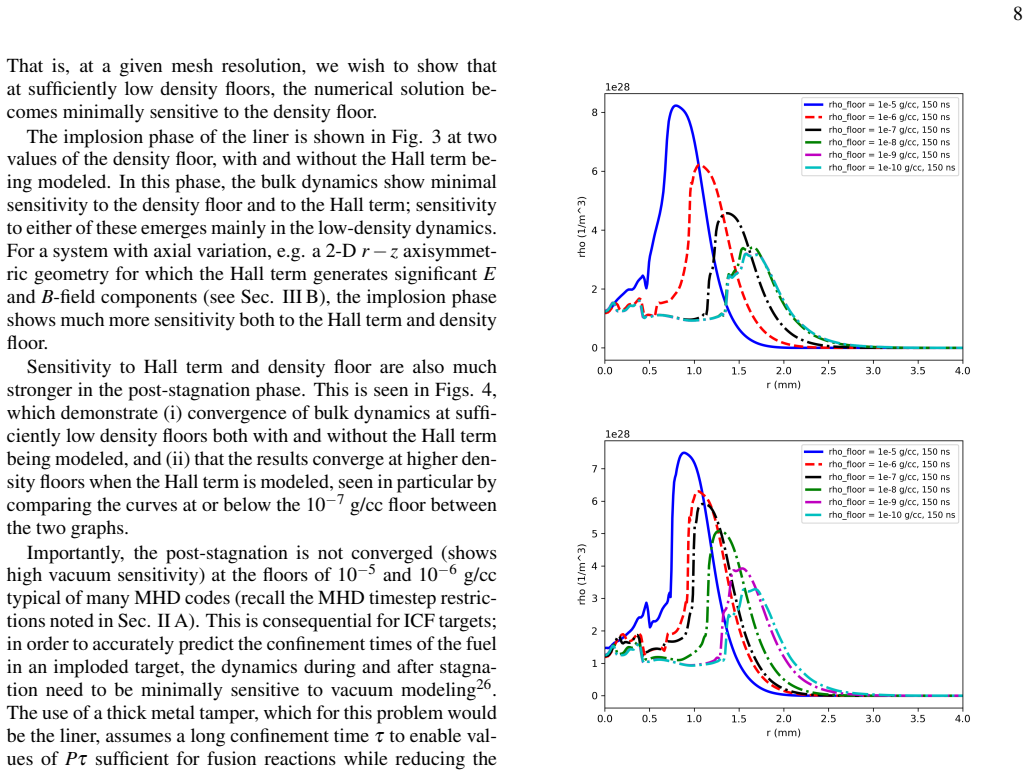
On its own terms, the paper's claim is that the PERSEUS extended-MHD model, with SESAME tables, produces numerical solutions for liner implosions that converge with respect to vacuum-modeling parameters at sufficiently low density floors. In the 1D case, bulk implosion dynamics become insensitive to the floor and to density buffers below about $10^{-10}$ g/cc, with Hall shortening the convergence. In the 2D r-z case, lowering the floor below $5\times10^{-8}$ of solid density exposes vacuum plasma that carries current and compresses axial magnetic flux against the liner, and Hall physics amplifies that flux compression by a factor of 2-5; a density buffer with a floor multiplier typical of MHD codes removes this plasma and artificially shifts the implosion earlier. In the MRT test, floor convergence is achieved at $10^{-10}$ to $10^{-11}$ of solid Copper, while a $10^{-6}$ floor shortens instability spikes and is not converged. The paper also reports that current-limiting and temperature-limiting are needed to stabilize the low-density plasma, with current-limiting preventing a thermal-runaway bifurcation.
Load-bearing premise
The results depend on numerical caps that stop the low-density plasma from running away: a Hall-velocity limit of $2\times10^6$ m/s, a 5 keV temperature ceiling, and a $0.2/\Delta t$ energy-damping term, and the paper does not show that the supposedly converged solutions are insensitive to the values of those caps.
Editorial extensions
If this is right
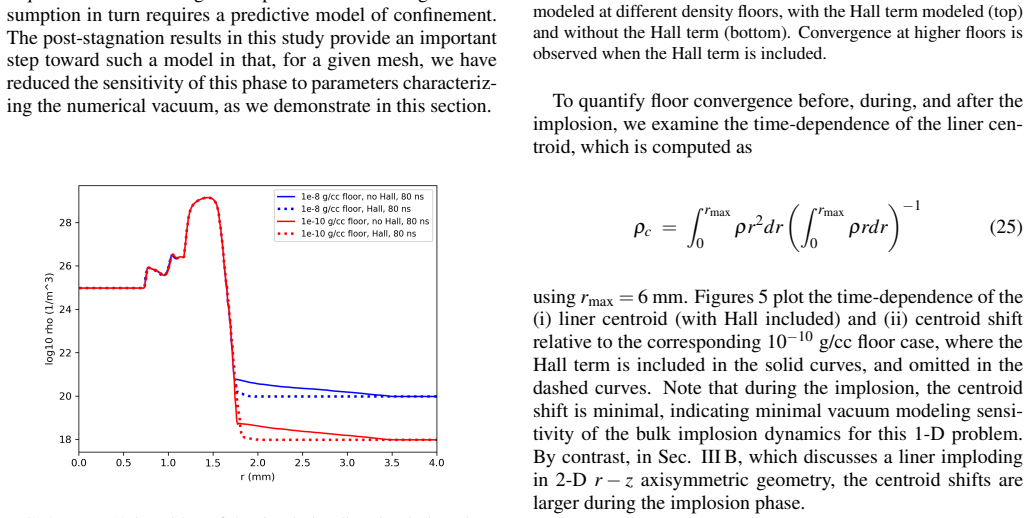
- At a fixed grid, lowering the density floor to about $10^{-10}$ of solid density removes sensitivity to the floor and to density-buffer settings; this holds in all three test problems, though the 2D r-z case retains more sensitivity than the 1D case.
- Hall physics accelerates floor convergence and enables physical vacuum current behavior; omitting it leaves thermal-runaway sensitivity and less axial flux compression.
- Density buffers with floor multipliers typical of MHD codes (around 4) remove current-carrying vacuum plasma, reduce axial flux compression, and shift the liner implosion earlier in time; PERSEUS needs almost no buffer.
- At low floors, vacuum plasma carries current and compresses axial magnetic flux against the liner, amplifying $B_z$ by a factor of 2-5 when Hall is modeled, and floors below $5\times10^{-8}$ of solid density are required to capture this.
- MRT growth at a $10^{-6}$ solid-density floor is not converged, with shorter instability spikes; at $10^{-10}$ and $10^{-11}$ floors the instability development is insensitive to the floor.
Reading between the lines
- A direct test would be to compare predicted axial flux compression and implosion timing against experimental magnetic-field probes on a pulsed-power liner; the paper's mechanism predicts measurably stronger compression when vacuum plasma is included.
- If the thermal-runaway suppression is numerical, the 5 keV temperature cap and the $0.2/\Delta t$ damping could be hiding physical instabilities; particle-in-cell or higher-order transport simulations could test whether the runaway is physical.
- The convergence recipe (floor near $10^{-10}$ solid density, no density buffer, Hall physics on) is transferable to other extended-MHD codes, but the Hall-velocity cap of $2\times10^6$ m/s should itself be scanned before applying the method to machines with stronger fields or faster current rise.
Editorial analysis
A structured set of objections, weighed in public.
Referee Report
Summary. The manuscript presents an extended-MHD model in the PERSEUS code, extended with tabular SESAME equation-of-state and conductivity data, and argues that this model can simulate plasma-vacuum interfaces at density floors far below those used by conventional resistive MHD codes. The central claim is that, for a fixed grid, the numerical solution becomes minimally sensitive to parameters characterizing the numerical vacuum once the density floor is sufficiently low, and that Hall physics accelerates this convergence. This is demonstrated through 1D radially convergent copper liner implosions, 2D r-z beryllium liner implosions with axial field and axial Poynting inflow, and 2D magneto-Rayleigh-Taylor instability growth on copper liners. The paper also reports that low-density vacuum plasma carries current, compresses axial magnetic flux against the liner, and that density buffers typical of MHD codes artificially suppress this plasma and shift implosion timing.
Significance. If the central claim holds, the paper is a useful step toward predictive modeling of current and energy coupling in pulsed-power systems, because it replaces several ad hoc vacuum-modeling knobs with a model whose low-density behavior is governed by extended-MHD physics and tabular material data. The paper provides explicit convergence metrics (centroid shifts, normalized L2 differences, limiting fractions) and compares Hall and no-Hall cases, giving the reader a concrete way to assess the floor-convergence claim. The tabular interface details, including Maxwell constructions and internal-energy limiting, are practical contributions. The strength of the paper is that it demonstrates a trend: in every tested geometry, lower density floors reduce vacuum sensitivity and Hall physics accelerates this reduction. The main limitation is that the low-density solutions are obtained with stabilization caps and damping terms whose values are not swept, so the paper does not yet establish that the 'converged' low-floor solution is independent of those regularization parameters.
major comments (3)
- [Sec. III B (paragraph beginning 'In order to prevent Hall velocities...')] The paper does not demonstrate that the low-floor results are insensitive to the Hall-velocity cap v_H = 2e6 m/s. This cap is not a vacuum-modeling parameter in the sense of density floors or buffers; it is a regularization threshold that is plausibly active in exactly the low-density plasma that carries current and compresses Bz. For the reported vacuum plasma densities of 1e16-1e17 cm^-3 and fields of order 10 T over millimeter gradients, J ~ B/(mu0 L) ~ 8e9 A/m^2 gives Hall speeds J/(n_e e) in the range 5e5-5e6 m/s, so the cap is likely binding in at least part of the domain. If so, the 'converged' low-floor solution is the solution of a regularized model that suppresses the largest Hall velocities and the associated thermal response, not necessarily the extended-MHD solution. Please sweep v_H (e.g., 0.5, 1, 2, 4 x 10^6 m/s) and show that centroid, Bz amplification, and current-density profiles are insensitive, or provide a diagnostic showing where and when the cap is active.
- [Sec. II A (energy damping term)] The energy-damping term 0.2/dt is asserted to have minimal impact, but no sensitivity study is provided. Because this term subtracts internal energy from current-carrying low-density plasma, it directly modifies the thermal runaway behavior that the paper attributes to numerical instability. If the runaway is physical, as suggested by Ref. 9 for cases without Hall, then the damping term suppresses real physics and the 'converged' solution depends on the coefficient 0.2. Please either sweep this coefficient or show that the solutions are insensitive to it, and report the energy removed by the damping term as a fraction of the total internal energy in the low-density plasma.
- [Sec. III B 2 and Conclusion] The abstract's claim of 'minimal sensitivity to parameters characterizing the numerical vacuum' is stronger than what the 2D r-z results show for the density buffer. Figures 18-20 demonstrate that increasing the floor multiplier from 1.01 to 4 changes the axial flux compression and shifts the implosion earlier even at a 10^-10 rho_solid floor, with and without Hall physics. The paper interprets this as removal of physical vacuum plasma, but from a numerical-modeling perspective, the buffer multiplier remains an influential vacuum parameter at the low floors that are claimed to give minimal sensitivity. The claim should be qualified to state that minimal sensitivity is achieved for a fixed, near-unity buffer multiplier, or the paper should demonstrate convergence of the solution as the floor multiplier approaches 1.
minor comments (5)
- [Abstract and Sec. I] The expansion of PERSEUS is inconsistent: the abstract gives 'Physics as an Extended-MHD Relaxation System' while the introduction gives 'Plasma as an Extended-MHD Relaxation System'. Please make the expansion uniform.
- [Sec. III B 1] The text states 'At sufficiently low density floors ( < 5 x 10^8 of solid density)' but the context and figures indicate 5 x 10^-8. The missing minus sign should be corrected.
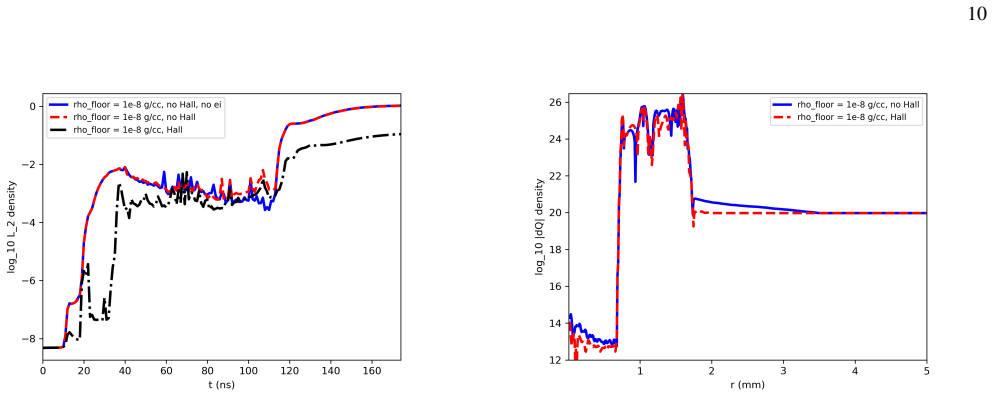
- [Sec. III A 1 / Fig. 6] The L2 difference in Eq. (26) is normalized by the norm of f1, but the three cases in Fig. 6 compare Hall, no-Hall, and no-Hall/no-electron-inertia cases all at the same floors; it would help to state explicitly that the 10^-10 g/cc floor is the reference f1 in all three curves.
- [Sec. II B and Sec. III] The paper does not include a grid-convergence study for the new tabular interface. The authors correctly state that vacuum convergence is separate from grid convergence, and that grid convergence was verified in previous PERSEUS work, but a brief statement or reference confirming that grid convergence also holds with tabular EOS/conductivity at low floors would strengthen the reliability of the quantitative Bz amplification claims.
- [Sec. III C / Fig. 21] The caption and text say the MRT is seeded with a 1% sinusoidal temperature perturbation, while Sec. III B mentions a 1% density perturbation on the liner surface. Please clarify whether these are intentionally different seeding mechanisms for the two problems.
Circularity Check
No significant circularity: the convergence claims are supported by self-contained simulations, and the self-citations and regularization parameters do not reduce the central result to its inputs.
full rationale
The paper's central claim is that the PERSEUS extended-MHD model with tabular SESAME material models yields numerical solutions that become minimally sensitive to vacuum-modeling parameters at sufficiently low density floors, with Hall physics accelerating this convergence. This claim is supported by direct simulation comparisons (e.g., density-floor sweeps in Sec. III A 1, buffer sensitivity in Sec. III A 2, and the 2D r-z and MRT studies in Secs. III B and III C), not by fitting a parameter to the claimed result. The governing equations (1)-(6), the tabular interpolation procedure, and the limiting schemes are stated as the model itself, so the simulations are not predictions equivalent to their inputs by construction. Heavy self-citation is present, but it is not load-bearing: the paper's own new results establish the convergence, and references to prior PERSEUS work (e.g., Ref. 8) are corroborative rather than the sole justification. The adjustable numerical choices, such as the Hall-velocity cap v_H = 2e6 m/s, the 5 keV temperature cap, the energy damping term 0.2/dt, and the GOL relaxation density, are regularization parameters; they are not fitted to the target result and the paper explicitly reports that some of them have little effect. The temperature cap is anchored to external experimental/particle-in-cell values in Ref. 28, not to the paper's own output. The absence of a sweep over v_H is a legitimate validation/robustness concern, but it is not a circular step: there is no exhibited reduction in which a fitted parameter is renamed a prediction, nor a uniqueness theorem imported from the authors' prior work. The derivation chain is self-contained against the presented numerical tests, so the appropriate finding is no significant circularity.
Assumptions & free parameters
free parameters (7)
- Hall velocity cap v_H =
2 x 10^6 m/s
- Temperature limit T_limit =
5 keV
- Energy damping coefficient =
0.2/dt
- GOL relaxation density n_r =
10^-3 of solid density
- Numerical speed of light c_num =
10^7 m/s
- Vacuum temperature T_vac =
116 K
- Density floor rho_floor =
1e-10 g/cm3 (1D) and 1e-10 rho_solid (2D)
assumptions (6)
- domain assumption Quasineutrality Z n ≈ n_e and neglect of the electron pressure gradient (Biermann battery) and electron advection in the generalized Ohm's law.
- domain assumption The SESAME tabular EOS/conductivity models, after extension to lower densities and Maxwell constructions in the vapor dome, faithfully represent the material in the compression regime.
- standard math The bounds-preservation analysis for internal energy with arbitrary tabular EOS follows from replacing P/(gamma-1) with e_int in the total energy expression.
- domain assumption The numerically reduced speed of light is high enough that displacement current remains physically negligible.
- domain assumption Anisotropic transport terms (thermal conduction, radiation, Nernst, Ettinghausen, viscosity) and anisotropic resistivity are not needed for the salient conclusions.
- domain assumption Single-material modeling is sufficient to demonstrate the vacuum-sensitivity properties claimed.
Cite this review
Pith. "Pith review of An Extended-MHD Model for Handling Low-density Plasmas with Tabular Material Models." pith.science (2026). https://pith.science/paper/4BY72JFA
@misc{pith2026250606625,
  author       = {Pith},
  title        = {Pith review of: An Extended-MHD Model for Handling Low-density Plasmas with Tabular Material Models},
  year         = {2026},
  howpublished = {\url{https://pith.science/paper/4BY72JFA}},
  note         = {Machine review of arXiv:2506.06625}
}
read the original abstract
An extended-MHD model, interfaced with tabular equation-of-state and conductivity models, has been developed in PERSEUS (Physics as an Extended-MHD Relaxation System with an Efficient Upwind Scheme) for simulating a plasma-vacuum interface under experimentally-relevant conditions for a pulsed-power system, and with minimal sensitivity to parameters characterizing the numerical vacuum. For several test problems, we demonstrate convergence of this model for sufficiently low density floors and with respect to certain vacuum parameters. This capability is crucial for predictively modeling the coupling of energy and current onto a target in a pulsed-power system.
Figures


Figures from the paper (16 more)



Reference graph
Works this paper leans on
-
[1]
author author M. R. \ Gomez , author S. A. \ Slutz , author A. B. \ Sefkow , author D. B. \ Sinars , author K. D. \ Hahn , author S. B. \ Hansen , author E. C. \ Harding , author P. F. \ Knapp , author P. F. \ Schmit , author C. A. \ Jennings , author T. J. \ Awe , author M. Geissel , author D. C. \ Rovang , author G. A. \ Chandler , author G. W. \ Cooper...
-
[2]
author author J. D. \ Huba ,\ title title Hall Magnetohydrodynamics - A Tutorial , \ in\ @noop booktitle Space Plasma Simulation ,\ series Lecture Notes in Physics, Berlin Springer Verlag , Vol.\ volume 615 ,\ editor edited by\ editor J. B \"u chner , editor C. Dum , \ and\ editor M. Scholer \ ( year 2003 )\ pp.\ pages 166--192 NoStop
work page 2003
-
[3]
author author U. Shumlak \ and\ author J. Loverich ,\ title title Approximate R iemann solver for the two-fluid plasma model , \ 10.1016/S0021-9991(03)00151-7 journal journal J. Comput. Phys. \ volume 187 ,\ pages 620--638 ( year 2003 ) NoStop
-
[4]
author author D. Schnack ,\ http://books.google.com/books?id=Ebon7NTbL0EC title Lectures in Magnetohydrodynamics: With an Appendix on Extended MHD ,\ Lecture Notes in Physics\ ( publisher Springer ,\ year 2009 ) NoStop
work page 2009
-
[5]
author author C. E. \ Seyler \ and\ author M. R. \ Martin ,\ title title Relaxation model for extended magnetohydrodynamics: Comparison to magnetohydrodynamics for dense Z-pinches , \ 10.1063/1.3543799 journal journal Physics of Plasmas (1994-present) \ volume 18 ,\ eid 012703 ( year 2011 ),\ 10.1063/1.3543799 NoStop
-
[6]
author author N. D. \ Hamlin , author C. E. \ Seyler , \ and\ author B. Khiar ,\ title title The influence of the hall term on the development of magnetized laser-produced plasma jets , \ 10.1063/1.5017202 journal journal Physics of Plasmas \ volume 25 ,\ pages 042906 ( year 2018 ) ,\ http://arxiv.org/abs/https://doi.org/10.1063/1.5017202 https://doi.org/...
-
[7]
author author N. D. \ Hamlin \ and\ author C. E. \ Seyler ,\ title title The influence of hall physics on power-flow along a coaxial transmission line , \ 10.1063/1.5042441 journal journal Physics of Plasmas \ volume 25 ,\ pages 102705 ( year 2018 ) ,\ http://arxiv.org/abs/https://doi.org/10.1063/1.5042441 https://doi.org/10.1063/1.5042441 NoStop
-
[8]
author author N. Hamlin \ and\ author C. Seyler ,\ title title Power flow in pulsed-power systems: The influence of hall physics and modeling of the plasma-vacuum interface , \ 10.1109/TPS.2019.2903843 journal journal IEEE Transactions on Plasma Science \ volume PP ,\ pages 1--10 ( year 2019 ) NoStop
arXiv 2019
Show all 33 references
-
[9]
author author C. E. \ Seyler , author M. R. \ Martin , \ and\ author N. D. \ Hamlin ,\ title title Helical instability in maglif due to axial flux compression by low-density plasma , \ 10.1063/1.5028365 journal journal Physics of Plasmas \ volume 25 ,\ pages 062711 ( year 2018...
-
[10]
Zhao \ and\ author C
author author X. Zhao \ and\ author C. Seyler ,\ title title Computational extended magneto-hydrodynamical study of shock structure generated by flows past an obstacle , \ @noop journal journal Physics of Plasmas \ volume 22 ,\ pages 072102 ( year 2015 ) NoStop
2015
-
[11]
author author S. P. \ Lyon \ and\ author J. D. \ Johnson ,\ https://www.lanl.gov/org/ddste/aldsc/theoretical/physics-chemistry-materials/_assets/docs/LAUR-92-3407.pdf title SESAME: The Los Alamos National Laboratory Equation of State Database , \ type Tech. Rep. \ ( institutio...
1992
-
[12]
author author W. Stepniewski ,\ title title Mhd numerical modelling of the plasma focus phenomena , \ https://doi.org/10.1016/j.vacuum.2004.05.019 journal journal Vacuum \ volume 76 ,\ pages 51--55 ( year 2004 ) NoStop
2004 doi
-
[13]
Biskamp \ and\ author R
author author D. Biskamp \ and\ author R. Chodura ,\ title title Computer simulation of anomalous dc resistivity , \ 10.1103/PhysRevLett.27.1553 journal journal Phys. Rev. Lett. \ volume 27 ,\ pages 1553--1556 ( year 1971 ) NoStop
1971 doi
-
[14]
Chodura , author G
author author R. Chodura , author G. Bardotti , \ and\ author F. Engelmann ,\ title title Numerical investigation of the anomalous resistivity due to two-stream instability , \ 10.1088/0032-1028/13/12/002 journal journal Plasma Physics \ volume 13 ,\ pages 1099 ( year 1971 ) NoStop
-
[15]
author author J. P. \ Chittenden ,\ title title The effect of lower hybrid instabilities on plasma confinement in fiber z pinches , \ 10.1063/1.871401 journal journal Physics of Plasmas \ volume 2 ,\ pages 1242--1249 ( year 1995 ) ,\ http://arxiv.org/abs/https://doi.org/10.106...
-
[16]
author author J. P. \ Chittenden , author R. Aliaga Rossel , author S. V. \ Lebedev , author I. H. \ Mitchell , author M. Tatarakis , author A. R. \ Bell , \ and\ author M. G. \ Haines ,\ title title Two-dimensional magneto-hydrodynamic modeling of carbon fiber z-pinch experim...
-
[17]
Subramaniam \ and\ author L
author author V. Subramaniam \ and\ author L. L. \ Raja ,\ title title A plasma–vacuum interface tracking algorithm for magnetohydrodynamic simulations of coaxial plasma accelerators , \ https://doi.org/10.1016/j.jcp.2018.03.041 journal journal Journal of Computational Physics...
2018 doi
-
[18]
Masti , author C
author author R. Masti , author C. Ellison , author J. King , author P. Stoltz , \ and\ author B. Srinivasan ,\ title title Cross-code verification and sensitivity analysis to effectively model the electrothermal instability , \ https://doi.org/10.1016/j.hedp.2021.100925 journ...
-
[19]
Kimura \ and\ author P
author author K. Kimura \ and\ author P. J. \ Morrison ,\ title title On energy conservation in extended magnetohydrodynamics , \ 10.1063/1.4890955 journal journal Physics of Plasmas \ volume 21 ,\ pages 082101 ( year 2014 ) ,\ http://arxiv.org/abs/https://pubs.aip.org/aip/pop...
2014 doi
-
[20]
author author M. M. \ Crockatt \ and\ author J. N. \ Shadid ,\ title title A non-neutral generalized Ohm's law model for magnetohydrodynamics in the two-fluid regime , \ 10.1063/5.0138673 journal journal Physics of Plasmas \ volume 30 ,\ pages 053902 ( year 2023 ) ,\ http://ar...
-
[21]
author author M. Martin ,\ title Generalized Ohm's law at the plasma-vacuum interface ,\ @noop type PhD dissertation ,\ school Cornell University , address School of Electrical and Computer Engineering ( year 2010 ) NoStop
2010
-
[22]
Zhao , author Y
author author X. Zhao , author Y. Yang , \ and\ author C. E. \ Seyler ,\ title title A positivity-preserving semi-implicit discontinuous Galerkin scheme for solving extended magnetohydrodynamics equations , \ http://dx.doi.org/10.1016/j.jcp.2014.08.044 journal journal J. Compu...
-
[23]
Batten , author N
author author P. Batten , author N. Clarke , author C. Lambert , \ and\ author D. M. \ Causon ,\ title title On the choice of wavespeeds for the HLLC Riemann solver , \ 10.1137/S1064827593260140 journal journal SIAM Journal on Scientific Computing \ volume 18 ,\ pages 1553--15...
-
[24]
author author N. D. \ Hamlin \ and\ author C. E. \ Seyler ,\ title title Relativistic modeling capabilities in perseus extended-mhd simulation code for hed plasmas , \ 10.1109/TPS.2016.2565660 journal journal IEEE Transactions on Plasma Science \ volume 44 ,\ pages 1112--1126 ...
2016
-
[25]
author author G. I. \ Kerley ,\ @noop title Rational Function Method of Interpolation , \ type Tech. Rep. \ ( institution Los Alamos National Laboratory ,\ year 1977 ) NoStop
1977
-
[26]
Knapp , author M
author author P. Knapp , author M. Martin , author D. Dolan , author K. Cochrane , author D. Dalton , author J.-P. \ Davis , author C. Jennings , author G. Loisel , author D. Romero , author I. Smith , author E. Yu , author M. Weis , author T. Mattsson , author R. McBride , au...
-
[27]
author author J. M. \ Woolstrum , author D. E. \ Ruiz , author N. D. \ Hamlin , author K. Beckwith , \ and\ author M. R. \ Martin ,\ title title Hall interchange instability as a seed for helical magneto-Rayleigh–Taylor instabilities in magnetized liner inertial fusion Z-Pinch...
-
[28]
Bennett , author D
author author N. Bennett , author D. Welch , author G. Laity , author D. Rose , \ and\ author M. Cuneo ,\ title title Magnetized particle transport in multi-ma accelerators , \ @noop journal journal Physical Review Accelerators and Beams \ volume 24 ,\ pages 060401 ( year 2021...
2021
-
[29]
Sinars , author S
author author D. Sinars , author S. Slutz , author M. Herrmann , author R. McBride , author M. Cuneo , author K. Peterson , author R. Vesey , author C. Nakhleh , author B. Blue , author K. Killebrew , et al. ,\ title title Measurements of magneto-rayleigh-taylor instability gr...
2010
-
[30]
author author D. B. \ Sinars , author S. A. \ Slutz , author M. Herrmann , author R. D. \ McBride , author M. E. \ Cuneo , author C. A. \ Jennings , author J. Chittenden , author A. Velikovich , author K. Peterson , author R. Vesey , et al. ,\ title title Measurements of magne...
2011
-
[31]
Lau , author J
author author Y. Lau , author J. Zier , author I. Rittersdorf , author M. Weis , \ and\ author R. Gilgenbach ,\ title title Anisotropy and feedthrough in magneto-rayleigh-taylor instability , \ @noop journal journal Physical Review E \ volume 83 ,\ pages 066405 ( year 2011 ) NoStop
2011
-
[32]
author author M. R. \ Weis , author P. Zhang , author Y. Y. \ Lau , author P. F. \ Schmit , author K. J. \ Peterson , author M. Hess , \ and\ author R. M. \ Gilgenbach ,\ title title Coupling of sausage, kink, and magneto-Rayleigh-Taylor instabilities in a cylindrical liner , ...
-
[33]
author author J. D. \ Huba \ and\ author D. Winske ,\ title title Rayleigh-Taylor instability: Comparison of hybrid and nonideal magnetohydrodynamic simulations , \ 10.1063/1.872904 journal journal Physics of Plasmas \ volume 5 ,\ pages 2305--2316 ( year 1998 ) NoStop
Reviewed August 7, 2026 · model on record in the stance chip above.
Discussion (0). Sign in to comment.