REVIEW 4 major objections 6 minor 1 cited by
Deep Learning-Based Image Compression for Wireless Communications: Impacts on Reliability,Throughput, and Latency
T0 review · 4 major / 6 minor · reviewed 2026-08-12 · deepseek-v4-flash
Pith's one-line read Progressive-hyperprior posts lowest latency on fading channels, and progressive learned codecs keep weak wireless links usable where Adaptive WebP fails.
desk verdict A sensible but thinly validated application of progressive LIC to wireless links; the reliability claims rest on an unmodeled error-free bit pipe. read the letter →
The pith
A machine-rendered reading of the paper's core claim, the machinery that carries it, and where it could break.
The reading
What carries the argument
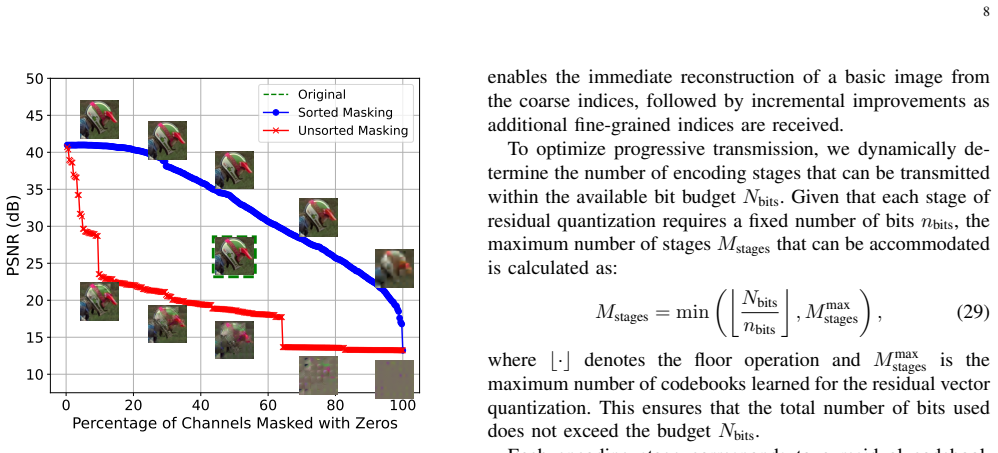
The central mechanism for the hyperprior model is channel-importance ranking of the latent feature maps: each of the 192 bottleneck channels is scored by the average MSE degradation when it is masked, and transmission sends the most important channels first, with the receiver padding the absent channels with zeros and arithmetic-decoding only the received bytes. For VQGAN, the central mechanism is residual vector quantization: a large codebook is clustered into codebooks of increasing bits-per-index, and progressive decoding sums residual codewords stage by stage, so early stages give a coarse image and later stages refine it. Both mechanisms are driven by a bit budget $N_{\text{bits}}$ computed from the Rayleigh channel's current achievable rate, so the amount of data transmitted adapts to the channel in each slot.
What would settle it
Re-run the same Kodak experiment but inject bit errors into the arithmetic-coded hyperprior stream and the VQGAN codebook indices at the bit error rates implied by the Rayleigh channel's SNR, without adding channel coding; if even modest error rates stop the hyperprior decoder or erase its latency and throughput edge over VQGAN, the central reliability claim is refuted.
Extended reading notes
Core claim
The paper claims that progressive, channel-adaptive transmission turns learned image compression into a practical wireless scheme. Instead of shipping the entire bitstream and hoping the channel holds, the system computes a per-slot bit budget from the current SNR and sends only what fits, starting with the most informative portion: for the hyperprior model, that means sorting the latent feature maps by how much reconstruction quality is lost when they are masked, then sending the top fraction; for VQGAN, it means sending indices from a coarse codebook first and then residual codebooks that progressively refine the image. On the Kodak benchmark across 1,000 Rayleigh fading realizations, progressive-hyperprior yields the lowest average and 99.9th-percentile waiting times from -10 to 5 dB, and higher throughput than progressive-VQGAN and Adaptive WebP at low and moderate SNR, while progressive-VQGAN gives the best PSNR and SSIM among the learned models under poor channel conditions, and Adaptive WebP produces the best image quality and throughput only at favorable SNR.
Load-bearing premise
The reliability ordering rests on the assumption that, once the channel has set the per-slot bit budget, the transmitted compressed bytes arrive without bit errors; if they were actually corrupted, the hyperprior's lossless entropy decoder could fail and the VQGAN-versus-hyperprior reliability ranking would need to be tested directly.
Editorial extensions
If this is right
- A receiver using progressive-hyperprior always has a decodable image within a couple of slots, even at -10 dB, because the most important channels arrive first and decode independently of the rest.
- At -10 and -5 dB, progressive-hyperprior transmits roughly 18 and 66 megapixels per second respectively, while Adaptive WebP transmits zero, so the progressive learned schemes extend usable coverage to very low SNR.
- The 99.9th-percentile waiting time of progressive-hyperprior is lower than both baselines at every SNR in the study, which matters for delay-sensitive applications that must meet a deadline almost always.
- Setting the hyperprior parameter $N_{\max}$ to 96 instead of 192 meets the same PSNR and SSIM targets at higher throughput, giving a practical knob for trading image quality against latency.
- Progressive-VQGAN's decoder reconstructs images without relying on lossless compression or channel coding, so it can serve applications where computational simplicity and robustness under poor channels matter more than peak fidelity.
Reading between the lines
- The paper's latency metric counts transmission slots, not encode and decode wall-clock time; an editorial next step is an end-to-end latency budget that includes those compute times, where VQGAN's avoidance of channel coding might change the ranking.
- Because the simulation does not inject bit errors inside the transmitted streams, a direct extension is to re-run the comparison with actual bit errors and no error correction, testing whether the hyperprior's lossless arithmetic decoding stays reliable or whether VQGAN's codebook robustness wins.
- The sorting-by-importance principle for hyperprior channels is not limited to the two codecs tested; the same budget-driven, most-important-first policy could be applied to other learned image codecs with structured latent spaces.
Signed reviews
Editorial analysis
A structured set of objections, weighed in public.
Referee Report
Summary. This manuscript proposes an adaptive and progressive transmission pipeline for learned image compression (LIC) over a simulated Rayleigh fading channel. Two LIC models are adapted: a hyperprior model whose feature maps are masked and progressively transmitted, and a VQGAN model using residual vector quantization with codebook clustering. The channel simulation determines a per-slot bit budget from the current SNR and modulation scheme, and the receiver progressively decodes as more feature maps or residual codebooks arrive. Experiments on the Kodak dataset compare progressive-hyperprior, progressive-VQGAN, and adaptive WebP in terms of PSNR, SSIM, throughput (Mpps), and latency (Tavg and T99.9%). The paper claims that progressive-hyperprior achieves the lowest latency across all SNRs and higher throughput at low SNR, that progressive-VQGAN provides robustness without channel coding, and that adaptive WebP performs best at high SNR.
Significance. The paper addresses a relevant problem: low-latency and reliable image delivery over dynamic wireless channels using learned compression. The use of pretrained models, a publicly available code repository, and a transparent progressive-masking mechanism are strengths that facilitate reproducibility. However, the current evidence does not support the central reliability claims because the channel model only sets a bit budget and never injects bit errors, and the claimed improvement over non-progressive LIC baselines is not measured. The latency and throughput results are also largely a direct consequence of the chosen metric definitions. If the authors add a realistic bit-error model and direct non-progressive baselines, the framework could still be a valuable contribution to the field.
major comments (4)
- [V.F and Eqs. (16)-(18), (23)-(24)] The transmission simulation never injects bit errors: Nbits is computed from the current SNR and modulation scheme, but the receiver decodes exactly the bytes and indices that were encoded. As a result, the reported PSNR/SSIM values measure loss due to truncation and masking, not resilience to channel noise. The abstract's claim that VQGAN is 'robust ... even in the absence of channel coding' and the conclusion that progressive-VQGAN operates 'without the need for channel coding' are therefore not tested. I request an experiment that actually corrupts bits in the ybytes/zbytes streams and in the VQGAN indices, or an equivalent error-sensitivity analysis, so that the reliability claims are directly evidenced.
- [Abstract and Section VI.A (Table II)] The abstract states that the progressive transmission framework maintains or improves throughput 'compared to non-progressive counterparts,' but Table II contains no non-progressive LIC baselines. It only compares progressive-hyperprior, progressive-VQGAN, and adaptive WebP. Without evaluations of the non-progressive hyperprior and non-progressive VQGAN under identical channel conditions, the claimed improvement over non-progressive LIC models is not established. Please add those baselines or explicitly restrict the claim to the three compared methods.
- [V.D and VI.B] Because latency is measured in transmission slots and throughput counts each pixel exactly once, any scheme that transmits fewer bits per image will necessarily appear faster and achieve higher pixel throughput. The latency advantage of progressive-hyperprior at low SNR is thus a direct consequence of transmitting fewer feature maps within the bit budget, and the explanation in Section VI.B that 'compact feature maps' cause the advantage is circular. Please report these metrics as functions of the actual compressed size, or reframe the conclusions in terms of a rate-quality-latency trade-off.
- [VI.B] The text says Adaptive WebP 'cannot transmit at -10, -5, and 0 dB due to channel capacity constraints,' but Table II reports a nonzero throughput and PSNR/SSIM values for Adaptive WebP at 0 dB. This contradiction needs to be corrected and the exact failure condition of WebP clarified.
minor comments (6)
- [Abstract] The final sentence 'where Adaptive WebP fails.' is a sentence fragment attached to the preceding text; please merge it into the previous sentence or remove it.
- [V.A.2.a] The hyperprior model description contains an incomplete sentence: 'and is trained using rate-distortion parameter λ = 0.1, and for using 0-100 % of the channels. This particular model is' — please complete the description.
- [Table II] The numeric formatting is inconsistent (e.g., '272 .00', '26 .20', '34 .00'); please use uniform spacing and define the dash used for missing values.
- [Figure 3] The caption refers to 'observer-based feature masking' while the text describes importance-based sorting; please align the terminology.
- [V.E.1] The word 'Untimately' should be 'Ultimately'.
- [V.D] The unit 'Mpps' is not defined in the notation table; please specify that it means megapixels per second.
Circularity Check
No significant circularity: latency and throughput are direct measurements of compressed bit counts over a rate-limited channel, not predictions derived from the quantities they claim to establish.
full rationale
I found no load-bearing circular step in the manuscript. The latency result is computed from the number of transmission slots needed to deliver the measured compressed bitstream at the channel-limited bit budget (Section V.F), and PSNR/SSIM are reported separately as compression-reconstruction quality. Thus lower bitrate producing lower latency and higher pixel throughput is an empirical consequence of the measured compressed sizes, not a fitted parameter renamed as a prediction. The hyperprior feature-ordering is derived from MSE degradation measured on ImageNet and then applied to Kodak, which is an external transfer rather than a self-defined target. The VQGAN residual-quantization method is taken from external prior work (Zhu et al. and Flowers & Dey), and the progressive-decoding sorting mechanism is attributed to Hojjat et al., none of which are self-citations by the present authors. No uniqueness theorem, ansatz, or central premise is imported from the authors' own prior work. The main weakness is a validity limitation rather than circularity: Section V.F determines Nbits from SNR but never injects actual bit errors, so the claimed robustness of VQGAN 'even in the absence of channel coding' and the low-SNR latency/throughput ordering are not tested against real channel noise. That is missing evidence, not a derivation equivalent to its inputs by construction.
Assumptions & free parameters
free parameters (4)
- Nmax for progressive-hyperprior =
32 feature maps
- Mstages for progressive-VQGAN =
10 residual codebooks
- bpi for residual codebooks =
8 bits per index (256 codewords)
- Importance ordering for feature maps =
derived from averaged MSE degradation over 100 ImageNet batches (batch size 8)
assumptions (4)
- standard math Shannon capacity and finite block length approximations (Eqs. 2, 3) describe the achievable transmission rate.
- domain assumption Rayleigh fading channel model with sum-of-sinusoids generation approximates real wireless dynamics.
- ad hoc to paper The bit budget Nbits per slot is determined by current SNR and a selected modulation scheme, and transmission within that budget is error-free.
- domain assumption Pretrained hyperprior and VQGAN models from prior work perform adequately on the Kodak dataset for transmission evaluation.
Cite this review
Pith. "Pith review of Deep Learning-Based Image Compression for Wireless Communications: Impacts on Reliability,Throughput, and Latency." pith.science (2026). https://pith.science/paper/4BYRQKFL
@misc{pith2026241110650,
  author       = {Pith},
  title        = {Pith review of: Deep Learning-Based Image Compression for Wireless Communications: Impacts on Reliability,Throughput, and Latency},
  year         = {2026},
  howpublished = {\url{https://pith.science/paper/4BYRQKFL}},
  note         = {Machine review of arXiv:2411.10650}
}
read the original abstract
In wireless communications, efficient image transmission must balance reliability, throughput, and latency, especially under dynamic channel conditions. This paper presents an adaptive and progressive pipeline for learned image compression (LIC)-based architectures tailored to such environments. We investigate two state-of-the-art learning-based models: the hyperprior model and Vector Quantized Generative Adversarial Network (VQGAN). The hyperprior model achieves superior compression performance through lossless compression in the bottleneck but is susceptible to bit errors, necessitating the use of error correction or retransmission mechanisms. In contrast, the VQGAN decoder demonstrates robust image reconstruction capabilities even in the absence of channel coding, enhancing reliability in challenging transmission scenarios. We propose progressive versions of both models, enabling partial image transmission and decoding under imperfect channel conditions. This progressive approach not only maintains image integrity under poor channel conditions but also significantly reduces latency by allowing immediate partial image availability. We evaluate our pipeline using the Kodak high-resolution image dataset under a Rayleigh fading wireless channel model simulating dynamic conditions. The results indicate that the progressive transmission framework enhances reliability and latency while maintaining or improving throughput compared to non-progressive counterparts across various Signal-to-Noise Ratio (SNR) levels. Specifically, the progressive-hyperprior model consistently outperforms others in latency metrics, particularly in the 99.9th percentile waiting time-a measure indicating the maximum waiting time experienced by 99.9% of transmission instances-across all SNRs, and achieves higher throughput in low SNR scenarios. where Adaptive WebP fails.
Figures


Figures from the paper (2 more)


Forward citations
Cited by 1 Pith paper
-
Semantic-Aware Visual Information Transmission With Key Information Extraction Over Wireless Networks
A foreground-cropping, background-library image transmission system reports PSNR gains over direct deep JSCC, but the gains are confounded by an unequal transmission workload.
Reference graph
Works this paper leans on
-
[1]
Generative AI-driven semantic communication networks: Architecture, technologies and applications,
C. Liang, H. Du, Y . Sun, D. Niyato, J. Kang, D. Zhao, and M. A. Imran, “Generative AI-driven semantic communication networks: Architecture, technologies and applications,” IEEE Transactions on Cognitive Com- munications and Networking , pp. 1–1, 2024
work page 2024
-
[2]
Exploiting Inter-Image Similarity Prior for Low-Bitrate Remote Sensing Image Compression
J. Li and X. Hou, “Exploiting inter-image similarity prior for low-bitrate remote sensing image compression,” arXiv preprint arXiv:2407.12295 , 2024
work page Pith review arXiv 2024
-
[3]
The JPEG 2000 still image compression standard,
A. Skodras, C. Christopoulos, and T. Ebrahimi, “The JPEG 2000 still image compression standard,” IEEE Signal Processing Magazine , vol. 18, no. 5, pp. 36–58, 2001
2000
-
[4]
Google Developers, “WebP,” https://developers.google.com/speed/webp/ docs/compression, accessed: 2023-02-14
work page 2023
-
[5]
Fabrice Bellard, “BPG Image Format,” https://bellard.org/bpg/, accessed: 2023-02-14
work page 2023
-
[6]
Deep joint source- channel coding for wireless image transmission,
E. Bourtsoulatze, D. B. Kurka, and D. G ¨und¨uz, “Deep joint source- channel coding for wireless image transmission,” IEEE Transactions on Cognitive Communications and Networking , vol. 5, no. 3, pp. 567–579, 2019
2019
-
[7]
Extreme image compression using fine-tuned VQGANs,
Q. Mao, T. Yang, Y . Zhang, Z. Wang, M. Wang, S. Wang, L. Jin, and S. Ma, “Extreme image compression using fine-tuned VQGANs,” in Proceedings ot the IEEE Data Compression Conference (DCC) , 2024, pp. 203–212
work page 2024
-
[8]
Learned image com- pression with discretized gaussian mixture likelihoods and attention modules,
Z. Cheng, H. Sun, M. Takeuchi, and J. Katto, “Learned image com- pression with discretized gaussian mixture likelihoods and attention modules,” in Proceedings of the IEEE/CVF conference on computer vision and pattern recognition , 2020, pp. 7939–7948
2020
Show all 35 references
-
[9]
Vari- ational image compression with a scale hyperprior,
J. Ball ´e, D. Minnen, S. Singh, S. J. Hwang, and N. Johnston, “Vari- ational image compression with a scale hyperprior,” arXiv preprint arXiv:1802.01436, 2018
2018 arXiv
-
[10]
Learned image compression with mixed transformer-CNN architectures,
J. Liu, H. Sun, and J. Katto, “Learned image compression with mixed transformer-CNN architectures,” in Proceedings of the IEEE/CVF con- ference on computer vision and pattern recognition , 2023, pp. 14 388– 14 397
2023
-
[11]
Taming transformers for high- resolution image synthesis,
P. Esser, R. Rombach, and B. Ommer, “Taming transformers for high- resolution image synthesis,” in Proceedings of the IEEE/CVF conference on computer vision and pattern recognition , 2021, pp. 12 873–12 883
2021
-
[12]
SwinJSCC: Taming swin transformer for deep joint source-channel coding,
K. Yang, S. Wang, J. Dai, X. Qin, K. Niu, and P. Zhang, “SwinJSCC: Taming swin transformer for deep joint source-channel coding,” IEEE Transactions on Cognitive Communications and Networking , 2024
2024
-
[13]
Transformer-aided wireless image transmission with channel feedback,
H. Wu, Y . Shao, E. Ozfatura, K. Mikolajczyk, and D. G ¨und¨uz, “Transformer-aided wireless image transmission with channel feedback,” IEEE Transactions on Wireless Communications , 2024
2024
-
[14]
The JPEG still picture compression standard,
G. Wallace, “The JPEG still picture compression standard,” IEEE Transactions on Consumer Electronics , vol. 38, no. 1, pp. xviii–xxxiv, 1992
1992
-
[15]
Overview of the high efficiency video coding (HEVC) standard,
G. J. Sullivan, J.-R. Ohm, W.-J. Han, and T. Wiegand, “Overview of the high efficiency video coding (HEVC) standard,” IEEE Transactions on circuits and systems for video technology , vol. 22, no. 12, pp. 1649– 1668, 2012
2012
-
[16]
Towards flexible blind JPEG artifacts removal,
J. Jiang, K. Zhang, and R. Timofte, “Towards flexible blind JPEG artifacts removal,” in Proceedings of the IEEE/CVF International Con- ference on Computer Vision , 2021, pp. 4997–5006
2021
-
[17]
Variational autoencoder for low bit-rate image compression,
L. Zhou, C. Cai, Y . Gao, S. Su, and J. Wu, “Variational autoencoder for low bit-rate image compression,” in Proceedings of the IEEE conference on computer vision and pattern recognition workshops , 2018, pp. 2617– 2620
2018
-
[18]
Generative adversarial networks for extreme learned image compres- sion,
E. Agustsson, M. Tschannen, F. Mentzer, R. Timofte, and L. V . Gool, “Generative adversarial networks for extreme learned image compres- sion,” in Proceedings of the IEEE/CVF International Conference on Computer Vision, 2019, pp. 221–231
2019
-
[19]
A framework for efficient progressive fine granularity scalable video coding,
F. Wu, S. Li, and Y .-Q. Zhang, “A framework for efficient progressive fine granularity scalable video coding,” IEEE Transactions on Circuits and Systems for Video Technology , vol. 11, no. 3, pp. 332–344, 2001
2001
-
[20]
Layered image com- pression using scalable auto-encoder,
C. Jia, Z. Liu, Y . Wang, S. Ma, and W. Gao, “Layered image com- pression using scalable auto-encoder,” in 2019 IEEE Conference on Multimedia Information Processing and Retrieval (MIPR) . IEEE, 2019, pp. 431–436
2019
-
[21]
Progressive feature transmission for split classification at the wireless edge,
Q. Lan, Q. Zeng, P. Popovski, D. G ¨und¨uz, and K. Huang, “Progressive feature transmission for split classification at the wireless edge,” IEEE Transactions on Wireless Communications , vol. 22, no. 6, pp. 3837– 3852, 2022
2022
-
[22]
Unequal error protection: An information-theoretic perspective,
S. Borade, B. Nakibo ˘glu, and L. Zheng, “Unequal error protection: An information-theoretic perspective,” IEEE Transactions on Information Theory, vol. 55, no. 12, pp. 5511–5539, 2009
2009
-
[23]
Goldsmith, Adaptive Modulation and Coding
A. Goldsmith, Adaptive Modulation and Coding . Cambridge University Press, 2005, p. 283–320
2005
-
[24]
ProgDTD: Progressive learned image compression with double-tail-drop training,
A. Hojjat, J. Haberer, and O. Landsiedel, “ProgDTD: Progressive learned image compression with double-tail-drop training,” in Proceedings of the IEEE/CVF Conference on Computer Vision and Pattern Recognition , 2023, pp. 1130–1139
2023
-
[25]
BRIC: Bottom-up residual vector quantization for learned image compression,
B. Flowers and S. Dey, “BRIC: Bottom-up residual vector quantization for learned image compression,” IEEE Access , 2024
2024
-
[26]
Adaptive finite blocklength for ultra-low latency in wireless communications,
W. Cheng, Y . Xiao, S. Zhang, and J. Wang, “Adaptive finite blocklength for ultra-low latency in wireless communications,” IEEE Transactions on Wireless Communications , vol. 21, no. 6, pp. 4450–4463, 2022
2022
-
[27]
A mathematical theory of communication,
C. E. Shannon, “A mathematical theory of communication,” The Bell system technical journal , vol. 27, no. 3, pp. 379–423, 1948
1948
-
[28]
Conditional probability models for deep image compression,
F. Mentzer, E. Agustsson, M. Tschannen, R. Timofte, and L. Van Gool, “Conditional probability models for deep image compression,” in Pro- ceedings of the IEEE Conference on Computer Vision and Pattern Recognition, 2018, pp. 4394–4402
2018
-
[29]
Learning a deep vector quantization network for image compression,
X. Lu, H. Wang, W. Dong, F. Wu, Z. Zheng, and G. Shi, “Learning a deep vector quantization network for image compression,” IEEE Access, vol. 7, pp. 118 815–118 825, 2019
2019
-
[30]
Vector quantisation for robust segmentation,
A. Santhirasekaram, A. Kori, M. Winkler, A. Rockall, and B. Glocker, “Vector quantisation for robust segmentation,” in International Confer- ence on Medical Image Computing and Computer-Assisted Intervention . Springer, 2022, pp. 663–672
2022
-
[31]
Scaling the codebook size of VQGAN to 100,000 with a utilization rate of 99%,
L. Zhu, F. Wei, Y . Lu, and D. Chen, “Scaling the codebook size of VQGAN to 100,000 with a utilization rate of 99%,” arXiv preprint arXiv:2406.11837, 2024
2024 arXiv
-
[32]
The faiss library,
M. Douze, A. Guzhva, C. Deng, J. Johnson, G. Szilvasy, P.-E. Mazar ´e, M. Lomeli, L. Hosseini, and H. J´egou, “The faiss library,” arXiv preprint arXiv:2401.08281, 2024
2024 arXiv
-
[33]
Kodak lossless true color image suite,
“Kodak lossless true color image suite,” http://r0k.us/graphics/kodak/, 1993, accessed: 2024-10-30
1993
-
[34]
Imagenet: A large-scale hierarchical image database,
J. Deng, W. Dong, R. Socher, L.-J. Li, K. Li, and L. Fei-Fei, “Imagenet: A large-scale hierarchical image database,” in Proceedings of the IEEE conference on computer vision and pattern recognition , 2009, pp. 248– 255
2009
-
[35]
Novel sum-of-sinusoids simulation models for Rayleigh and Rician fading channels,
C. Xiao, Y . R. Zheng, and N. C. Beaulieu, “Novel sum-of-sinusoids simulation models for Rayleigh and Rician fading channels,” IEEE Transactions on Wireless Communications , vol. 5, no. 12, pp. 3667– 3679, 2006
2006
Reviewed August 12, 2026 · model on record in the stance chip above.
Discussion (0). Continue with ORCID to comment.