REVIEW 4 major objections 6 minor 48 references
Estimating the Power of a Quantum Computer
T0 review · 4 major / 6 minor · reviewed 2026-08-09 · deepseek-v4-flash
Pith's one-line read The volumetric class of a quantum computer can be estimated directly from qubit count, connectivity, and physical error rate, without running benchmark circuits.
desk verdict A useful back-of-envelope estimator for QV-k from device parameters, but the prefactors in the depth model and the QEC section need tightening before the specific numbers are relied on. read the letter →
The pith
A machine-rendered reading of the paper's core claim, the machinery that carries it, and where it could break.
The reading
What carries the argument
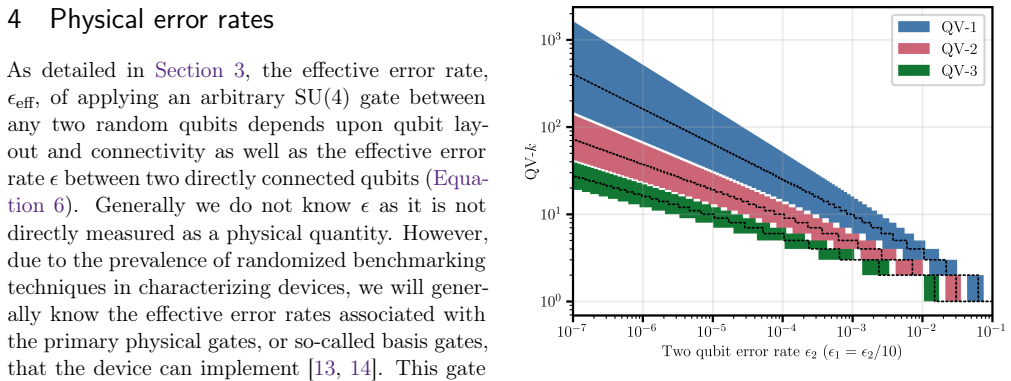
The central object is the effective error rate $\epsilon_{\mathrm{eff}} = n^m \epsilon$: the typical error per two-qubit step on a random pair of qubits, with $m = 0$ for fully connected systems, $m = 1/2$ for a square grid, and $m = 1$ for a linear chain. The load-bearing identity is QV-$k = \min[n_{\max}, \epsilon^{-1/(k+m+1)}]$, obtained by setting the achievable depth equal to the depth at which one error is expected, $d \approx 1/(n \epsilon_{\mathrm{eff}})$, and solving $n = d^{1/k}$. This identity makes every machine either qubit-limited or error-rate-limited, with the crossover at $n_{\mathrm{opt}} = \epsilon^{-1/(k+m+1)}$. A second mechanism is the surface-code trade-off, in which code distance $d_c$ sets both the logical qubit count $n_L = (n_{\max} - n_D)/(1.5(2d_c - 1)^2)$ and the logical error rate $\epsilon_L = \epsilon_{\mathrm{th}}(\epsilon/\epsilon_{\mathrm{th}})^{(d_c+1)/2}$, and these are optimized together with magic-state distillation against the metric.
What would settle it
Run a randomized-circuit benchmark on a device with known $n_{\max}$, connectivity $m$, and two-qubit error $\epsilon$, and compare the measured QV-$k$ with $\min[n_{\max}, \epsilon^{-1/(k+m+1)}]$ across several error rates and qubit counts; if the measured exponent in $\epsilon$ differs from $1/(k+m+1)$, or if the crossover when $n_{\max}$ passes $\epsilon^{-1/(k+m+1)}$ does not appear, the one-error depth assumption fails.
Extended reading notes
Core claim
On the paper's own terms, the central claim is that a device's QV-$k$ class is set, to first order, by three numbers: the number of qubits $n_{\max}$, the connectivity exponent $m$ through $\epsilon_{\mathrm{eff}} = n^m \epsilon$, and the physical two-qubit error rate $\epsilon$. Combining the one-error depth bound $d \sim 1/(n \epsilon_{\mathrm{eff}})$ with the class condition $n = d^{1/k}$ yields $n_{\mathrm{opt}} = \epsilon^{-1/(k+m+1)}$, so QV-$k = \min[n_{\max}, n_{\mathrm{opt}}]$; the metric is therefore qubit-number-limited below $n_{\mathrm{opt}}$ and error-rate-limited above it. The fault-tolerant extension optimizes surface-code distance and magic-state distillation overhead, producing a staircase in QV-$k$ as $n_{\max}$ grows and a crossover near 5,000 physical qubits at $\epsilon = 10^{-3}$. The intended upshot is that a machine's performance class can be forecast from ordinary hardware parameters, and the forecast says which resource, qubits or error rates, is the bottleneck.
Load-bearing premise
The load-bearing premise is that the deepest circuit a machine can run reliably is the one where the expected number of errors equals one, giving $d \sim 1/(n \epsilon_{\mathrm{eff}})$; if real devices tolerate a different number of errors, the predicted power class changes.
Editorial extensions
If this is right
- A machine's QV-$k$ value can be predicted from $n_{\max}$, $m$, and $\epsilon$ without running the randomized benchmark circuits, making the metric usable by non-specialists.
- Every system is either qubit-limited or error-rate-limited; in the error-limited regime, adding qubits will not raise QV-$k$, and only lowering the physical error rate helps.
- Connectivity matters as much as raw error rate: moving from fully connected ($m=0$) to a square grid ($m=1/2$) changes the error exponent from $1/(k+1)$ to $1/(k+3/2)$, shrinking the attainable class for a given $\epsilon$.
- For quantum error correction, the metric is optimized by trading code distance against qubit overhead, producing plateaus in QV-$k$ as $n_{\max}$ grows; at $\epsilon = 10^{-3}$, QEC only improves QV-$k$ once roughly 5,000 physical qubits are available.
- Because QV-3 corresponds to depth scalings like those in Shor's algorithm, the formula gives a quick estimate of the largest factoring instance a device might handle.
Reading between the lines
- Editorial: The one-error depth bound is likely conservative for benchmarks that rely on the heavy-output criterion, which can tolerate some errors; if so, real QV-$k$ values would run higher than the formula at low error rates.
- Editorial: Collapsing connectivity into a single exponent $m$ averages over the full qubit graph; comparing devices with the same $m$ but different topologies would show whether the exponent is a sufficient statistic or whether the detailed layout still matters.
- Editorial: The 5,000-qubit QEC crossover depends on the efficiency of magic-state distillation, so improved distillation schemes would move the crossover down; the number is a snapshot of current overheads, not a fundamental threshold.
- Editorial: The same parameter-based reasoning can be inverted into a planning tool: given a target QV-$k$ for an application, one can solve for the combinations of qubit count, connectivity, and error rate a hardware roadmap must reach.
Editorial analysis
A structured set of objections, weighed in public.
Referee Report
Summary. This paper presents an analytical framework for estimating the quantum volumetric metrics QV-k introduced in the author's previous work (Ref. [1]), starting from coarse hardware parameters rather than full benchmarking. The central step is to replace the single-step error rate by n ε_eff, giving a maximum useful depth d ~ 1/(n ε_eff); substituting into the QV-k definition yields QV-k = min[n_max, ε_eff^{-1/(k+1)}] and, after adding a connectivity exponent m, QV-k = min[n_max, ε^{-1/(k+m+1)}]. The paper then incorporates a physical gate decomposition (Eq. 8), a surface-code error-correction model (Sec. 5.1), and magic-state distillation overhead (Sec. 5.2) to numerically study the crossover where QEC becomes beneficial, reporting a threshold of about 5,000 physical qubits at ε = 10^{-3}.
Significance. If the estimator were calibrated, it would be a valuable back-of-the-envelope tool: the separation of qubit-number-limited from error-limited regimes is clean, the exponents are simple and plausible, and the QEC crossover analysis is a useful first-order sketch. The paper is transparent about many modeling assumptions and explicitly notes in the conclusion that the exact threshold is sensitive to magic-state generation efficiency. The main strengths are the clarity of the derivation and the explicit mapping from hardware parameters to a family of application-oriented metrics. The main shortcomings are the uncalibrated constant prefactors, the unexplained coefficient in Eq. (13), and the absence of any empirical validation; as a result, the quantitative claims should be treated as asymptotic order-of-magnitude estimates rather than reliable predictions.
major comments (4)
- [Section 2, Eqs. (3)-(4)] The estimate d ~ 1/(n ε_eff) is justified as the depth at which 'on average, a single error occurs', but the QV benchmark's success criterion is the heavy-output test (P_heavy > 2/3), not a single-error threshold. For depolarizing noise the passing condition allows a total error probability of roughly 0.52, which changes the crossing point in Eq. (4) by a factor 0.52^{1/(k+1)}. This is a constant prefactor, but because the paper uses the resulting formulas to quote a specific crossover near 5,000 qubits, the prefactor is quantitatively load-bearing. Please derive the prefactor from the heavy-output condition or explicitly state that the estimate is asymptotic only.
- [Sections 3-4, Eqs. (6) and (8)] The connectivity model ε_eff = n^m ε counts each routing SWAP as a single error, but Section 4 states that a SWAP requires three CNOTs. For a not-fully-connected topology the effective error per routing operation is therefore 3ε (plus single-qubit contributions), so ε_eff should be approximately 3 n^m ε, not n^m ε. Combined with the heavy-output prefactor, this shifts n_opt downward by roughly (0.52/3)^{1/(k+m+1)} ≈ 0.5 for k=1, m=0.5. The paper should include this constant or clearly state that all constant prefactors are left unspecified.
- [Section 5.2, Eq. (13)] The coefficient 4.5 in Eq. (13) appears without derivation, and the equation as written, ε_eff ≈ 4.5 ε_P − 4.5*3 log2(ε_P) ε_T + ε_L, is not derived from the stated gate counts. Since log2(ε_P) is negative, the second term is positive, but the expression is dimensionally unclear, and the text in this section says each SU(4) step decomposes into 'nine single qubit rotations' whereas Section 4 and Eq. (8) say seven single-qubit gates. Please provide a derivation or a reference for Eq. (13) and reconcile the gate count.
- [Throughout (validation)] The paper never compares the predictions of Eq. (4) or Eq. (7) with reported QV-k values or with a simulation of the QV benchmark. Because the entire contribution is an estimator, at least a small validation table (for example, two or three published devices with known qubit count, connectivity, and two-qubit error rates) is needed to establish that the prefactors are not off by a large factor. Without such a comparison, the quantitative claims in Figures 6, 8, and 12 are unsupported.
minor comments (6)
- [Section 2, Eq. (2)] Write d(n) explicitly in the min expression of Eq. (2), since d is a function of n; this removes ambiguity in the definition of QV-k.
- [Section 3, Figure 4] The caption should state that the upper boundary of each shaded area corresponds to m=0 (fully connected) and the lower boundary to m=1 (minimally connected).
- [Sections 4 and 5.2] Harmonize the single-qubit gate count for an SU(4) decomposition (seven versus nine) and define all symbols in Eq. (13), including ε_P and ε_T, before first use.
- [Section 5.3] The numerical optimization of Eq. (14) is not described; give the algorithm, grid spacing, and convergence criterion so that Figure 12 can be reproduced.
- [Throughout] Typographical and style errors include 'ALL RIGHTS RIGHTS RESERVED' on page 1, inconsistent article use in 'the QV-k', and missing commas; a careful proofread is needed.
- [References] Reference [3] is a commercial report without a DOI; consider adding a peer-reviewed source or a caveat for the adoption statistics quoted in the introduction.
Circularity Check
No circularity: the QV-k estimates follow from an explicit parameter-based model; the cited metric definitions in Ref. [1] are premises, not fitted predictions.
full rationale
The paper's derivation chain is not circular. It estimates the QV-k metrics defined in Ref. [1] from explicit system parameters: physical error rates, connectivity scaling, gate decomposition, and QEC overhead. The central step, "From Equation 3 we can estimate the circuit depth for which, on average, a single error occurs as d∼ 1/(nϵeff)", is a modeling assumption that connects error rates to depth; it is not a value fitted to QV measurements, nor is it a renamed version of the QV-k definition. Likewise, the connectivity parameterization ϵeff = n^m ε and the QEC formulas (surface-code overhead and logical error scaling) are taken from external literature and stated assumptions, not reverse-engineered from the quantities being predicted. The paper's only self-citations are to Ref. [1] for the definition of the metrics themselves and to the author's own prior convention that metrics are evaluated at the logical level; these are definitional premises rather than load-bearing empirical support. No parameter in the paper is calibrated to QV data, and no result is obtained by substituting the target quantity into its own definition. Any concerns about the accuracy of the depth prefactor or the QEC threshold are correctness or calibration issues, not circularity.
Assumptions & free parameters
free parameters (4)
- connectivity exponent m =
0 (fully connected), 0.5 (square grid), 1 (linear array)
- QEC threshold ε_th =
0.01
- Ancilla overhead fraction =
0.5
- Coefficient 4.5 in Eq 13 =
4.5
assumptions (6)
- domain assumption Single-step error rate scales as n ε_eff (Eq 3)
- domain assumption Maximum depth d corresponding to QV is approximately 1/(n ε_eff)
- domain assumption Surface code physical overhead (2d_c-1)^2 and logical error scaling ε_L = ε_th (ε/ε_th)^((d_c+1)/2)
- domain assumption Magic state distillation overhead follows continuous trade-off from Ref [38]
- standard math Arbitrary SU(4) gate decomposes into at most seven single-qubit gates and three CNOTs
- standard math T gate count for z-rotation approximation is -3 log2(ε_P)
Cite this review
Pith. "Pith review of Estimating the Power of a Quantum Computer." pith.science (2026). https://pith.science/paper/4BZRLPJQ
@misc{pith2026250200113,
  author       = {Pith},
  title        = {Pith review of: Estimating the Power of a Quantum Computer},
  year         = {2026},
  howpublished = {\url{https://pith.science/paper/4BZRLPJQ}},
  note         = {Machine review of arXiv:2502.00113}
}
read the original abstract
Various benchmarking metrics have been developed to quantify the performance of quantum computing hardware and help evaluate development. However, it is not always necessary to know the metric values precisely. This is especially true for potential end-users who may not be experts in the underlying technology itself. In this work, we show how to estimate the quantum volumetric metrics defined in Ref. [1] based on system parameters such as qubit number, qubit layout/connectivity, and physical error rates. As part of this work, we also include an initial analysis of how the overhead required for quantum error correction in systems below the error correction viability threshold affects the metric value of that system.
Figures


Figures from the paper (9 more)



Reference graph
Works this paper leans on
-
[1]
Keith Miller, Charles Broomfield, Ann Cox, Joe Kinast, and Brandon Rodenburg. An Im- proved Volumetric Metric for Quantum Com- puters via more Representative Quantum Cir- cuit Shapes. arXiv:2207.02315 [quant-ph] ,
-
[2]
MacQuarrie, Christoph Simon, Stephanie Simmons, and Elicia Maine
Evan R. MacQuarrie, Christoph Simon, Stephanie Simmons, and Elicia Maine. The emerging commercial landscape of quantum computing. Nature Reviews Physics , 2(11): 596–598, 2020. DOI: 10.1038/s42254-020- 00247-5
-
[3]
The Second Annual Report on Enterprise Quantum Computing Adoption . Zapata, De- cember 2022
work page 2022
-
[4]
Nikolaj Moll, Panagiotis Barkoutsos, Lev S. Bishop, Jerry M. Chow, Andrew Cross, Daniel J. Egger, Stefan Filipp, Andreas Fuhrer, Jay M. Gambetta, Marc Ganzhorn, Abhinav Kandala, Antonio Mezzacapo, Peter Müller, Walter Riess, Gian Salis, John Smolin, Ivano Tavernelli, and Kristan Temme. Quan- tum optimization using variational algorithms on near-term quant...
-
[6]
Yasuhiro Sekino and L. Susskind. Fast scramblers. Journal of High Energy Physics , 2008(10):065–065, 2008. DOI: 10.1088/1126- 6708/2008/10/065
doi:10.1088/1126- 2008
-
[7]
Robin Blume-Kohout and Kevin C. Young. A volumetric framework for quantum computer benchmarks. Quantum, 4:362, 2020. DOI: 10.22331/q-2020-11-15-362
-
[8]
Measuring the capabilities of quan- tum computers
Timothy Proctor, Kenneth Rudinger, Kevin Young, Erik Nielsen, and Robin Blume- Kohout. Measuring the capabilities of quan- tum computers. Nature Physics , pages 1–5,
-
[9]
Baldwin, Karl Mayer, and Timothy Proctor
Thomas Lubinski, Sonika Johri, Paul Varosy, Jeremiah Coleman, Luning Zhao, Jason Necaise, Charles H. Baldwin, Karl Mayer, and Timothy Proctor. Application-Oriented Per- formance Benchmarks for Quantum Comput- ing. IEEE Transactions on Quantum Engi- neering, 4:1–32, 2023. ISSN 2689-1808. DOI: 10.1109/TQE.2023.3253761
Show all 48 references
-
[10]
Hamilton, Nouamane Laanait, Akhil Francis, Sophia E
Kathleen E. Hamilton, Nouamane Laanait, Akhil Francis, Sophia E. Economou, George S. Barron, Kübra Yeter-Aydeniz, Titus Morris, Harrison Cooley, Muhun Kang, Alexander F. Kemper, and Raphael Pooser. An entanglement-based volumet- ric benchmark for near-term quantum hardware. ar...
-
[11]
P. W. Shor. Algorithms for quantum compu- tation: Discrete logarithms and factoring. In Proceedings 35th Annual Symposium on Foun- dations of Computer Science , pages 124–134,
-
[12]
Brown, Jungsang Kim, and Christopher Monroe
Kenneth R. Brown, Jungsang Kim, and Christopher Monroe. Co-designing a scal- able quantum computer with trapped atomic ions. npj Quantum Information, 2:16034, 2016. ISSN 2056-6387. DOI: 10.1038/npjqi.2016.34
2016 doi
-
[14]
Measuring the Capabilities of Quan- tum Computers
Timothy Proctor, Kenneth Rudinger, Kevin Young, Erik Nielsen, and Robin Blume- Kohout. Measuring the Capabilities of Quan- tum Computers. Nature Physics , 18(1):75– 79, 2022. ISSN 1745-2473, 1745-2481. DOI: 10.1038/s41567-021-01409-7
2022 doi
-
[15]
Wallman and Joseph Emerson
Joel J. Wallman and Joseph Emerson. Noise tailoring for scalable quantum computation via randomized compiling. Physical Review A, 94(5):052325, 2016. ISSN 2469-9926, 2469-
2016
-
[16]
Naik, Alexis Morvan, Jean-Loup Ville, Bradley Mitchell, John Mark Kreikebaum, Marc Davis, Ethan Smith, Costin Iancu, Kevin P
Akel Hashim, Ravi K. Naik, Alexis Morvan, Jean-Loup Ville, Bradley Mitchell, John Mark Kreikebaum, Marc Davis, Ethan Smith, Costin Iancu, Kevin P. O’Brien, Ian Hincks, 10 Joel J. Wallman, Joseph Emerson, and Irfan Siddiqi. Randomized compiling for scalable quantum computing on...
2021 doi
-
[17]
Op- timal Quantum Circuits for General Two- Qubit Gates.Physical Review A, 69(3):032315,
Farrokh Vatan and Colin Williams. Op- timal Quantum Circuits for General Two- Qubit Gates.Physical Review A, 69(3):032315,
-
[18]
Smith, Joshua Viszlai, Xin-Chuan Wu, Nikos Hardavellas, MargaretR.Martonosi, andFred- eric T
Teague Tomesh, Pranav Gokhale, Victory Omole, Gokul Subramanian Ravi, Kaitlin N. Smith, Joshua Viszlai, Xin-Chuan Wu, Nikos Hardavellas, MargaretR.Martonosi, andFred- eric T. Chong. SupermarQ: A Scalable Quan- tum Benchmark Suite. In2022 IEEE Interna- tional Symposium on High-...
-
[19]
Robin Harper and Steven T. Flammia. Fault- Tolerant Logical Gates in the IBM Quan- tum Experience. Physical Review Letters , 122(8):080504, 2019. DOI: 10.1103/Phys- RevLett.122.080504
2019 doi
-
[20]
Satzinger, Juan Atalaya, Alexander N
Google Quantum AI, Zijun Chen, Kevin J. Satzinger, Juan Atalaya, Alexander N. Ko- rotkov, Andrew Dunsworth, Daniel Sank, Chris Quintana, Matt McEwen, Rami Barends, Paul V. Klimov, Sabrina Hong, Cody Jones, Andre Petukhov, Dvir Kafri, Sean Demura, Brian Burkett, Craig Gidney, A...
2021
-
[21]
Briegel, Rainer Blatt, Nicolai Friis, and Thomas Monz
Alexander Erhard, Hendrik Poulsen Nautrup, Michael Meth, Lukas Postler, Roman Stricker, Martin Stadler, Vlad Negnevitsky, Martin Ringbauer, Philipp Schindler, Hans J. Briegel, Rainer Blatt, Nicolai Friis, and Thomas Monz. Entangling logical qubits with lat- tice surgery. Natur...
2021 doi
-
[22]
Adcock, Jianwei Wang, Sam Morley-Short, Davide Bacco, Leif K
Caterina Vigliar, Stefano Paesani, Yunhong Ding, Jeremy C. Adcock, Jianwei Wang, Sam Morley-Short, Davide Bacco, Leif K. Oxen- løwe, Mark G. Thompson, John G. Rarity, and Anthony Laing. Error-protected qubits in a sil- icon photonic chip.Nature Physics, pages 1–7,
-
[23]
Debroy, Crystal Noel, Andrew Risinger, Daiwei Zhu, Debopriyo Biswas, Michael Newman, Muyuan Li, Ken- neth R
Laird Egan, Dripto M. Debroy, Crystal Noel, Andrew Risinger, Daiwei Zhu, Debopriyo Biswas, Michael Newman, Muyuan Li, Ken- neth R. Brown, Marko Cetina, and Christo- pher Monroe. Fault-tolerant control of an error-corrected qubit. Nature, pages 1–6, 2021. DOI: 10.1038/s41586-02...
2021 doi
-
[24]
DOI: 10.1109/HPCA53966.2022.00050
2022
-
[25]
Marciniak, Roman Stricker, Martin Ringbauer, Rainer Blatt, Philipp Schindler, Markus Müller, and Thomas Monz
Lukas Postler, Sascha Heußen, Ivan Pogorelov, Manuel Rispler, Thomas Feldker, Michael Meth, Christian D. Marciniak, Roman Stricker, Martin Ringbauer, Rainer Blatt, Philipp Schindler, Markus Müller, and Thomas Monz. Demonstration of fault- tolerant universal quantum gate operat...
2022 doi
-
[26]
Realization of an Error-Correcting Sur- face Code with Superconducting Qubits.Phys- ical Review Letters, 129(3):030501, 2022
Youwei Zhao, Yangsen Ye, He-Liang Huang, Yiming Zhang, Dachao Wu, Huijie Guan, Qin- gling Zhu, Zuolin Wei, Tan He, Sirui Cao, Fusheng Chen, Tung-Hsun Chung, Hui Deng, Daojin Fan, Ming Gong, Cheng Guo, Shaojun Guo, Lianchen Han, Na Li, Shaowei Li, Yuan Li, Futian Liang, Jin Lin...
2022
-
[27]
V. V. Sivak, A. Eickbusch, B. Royer, S. Singh, I. Tsioutsios, S. Ganjam, A. Miano, B. L. Brock, A. Z. Ding, L. Frunzio, S. M. Girvin, R. J. Schoelkopf, and M. H. Devoret. Real- time quantum error correction beyond break- even. Nature, 616(7955):50–55, April 2023. ISSN 1476-468...
2023 doi
-
[28]
Reichardt, Adam Paetznick, David Aasen, Ivan Basov, Juan M
Ben W. Reichardt, Adam Paetznick, David Aasen, Ivan Basov, Juan M. Bello-Rivas, Parsa Bonderson, Rui Chao, Wim van Dam, Matthew B. Hastings, Andres Paz, Marcus P. da Silva, Aarthi Sundaram, Krysta M. Svore, Alexander Vaschillo, Zhenghan Wang, Matt Zanner, William B. Cairncross...
-
[29]
DOI: 10.1038/s41567-021-01333-w
-
[30]
Fowler, Matteo Mariantoni, John M
Austin G. Fowler, Matteo Mariantoni, John M. Martinis, and Andrew N. Cleland. Surface codes: Towards practical large-scale quan- tum computation. Physical Review A , 86(3): 032324, 2012. ISSN 1050-2947, 1094-1622. DOI: 10.1103/PhysRevA.86.032324
2012 doi
-
[31]
Ryan-Anderson, J
C. Ryan-Anderson, J. G. Bohnet, K. Lee, D. Gresh, A. Hankin, J. P. Gaebler, D. Fran- cois, A. Chernoguzov, D. Lucchetti, N. C. Brown, T. M. Gatterman, S. K. Halit, K. Gilmore, J. A. Gerber, B. Neyenhuis, D. Hayes, and R. P. Stutz. Realization of Real- Time Fault-Tolerant Quant...
2021 doi
-
[32]
Restric- tions on Transversal Encoded Quantum Gate Sets
Bryan Eastin and Emanuel Knill. Restric- tions on Transversal Encoded Quantum Gate Sets. Physical Review Letters, 102(11):110502,
- [33]
-
[34]
Campbell, Barbara M
Earl T. Campbell, Barbara M. Terhal, and Christophe Vuillot. Roads towards fault- tolerant universal quantum computation.Na- ture, 549(7671):172–179, 2017. ISSN 0028-
2017
-
[35]
Craig Gidney and Austin G. Fowler. Efficient magic state factories with a catalyzed |CCZ⟩ 13 to2|T⟩transformation. Quantum, 3:135, 2019. ISSN 2521-327X. DOI: 10.22331/q-2019-04-30- 135
2019 doi
-
[36]
Abanin, Laleh Aghababaie-Beni, Igor Aleiner, Trond I
Rajeev Acharya, Dmitry A. Abanin, Laleh Aghababaie-Beni, Igor Aleiner, Trond I. An- dersen, Markus Ansmann, Frank Arute, Ku- nal Arya, Abraham Asfaw, Nikita Astrakhant- sev, Juan Atalaya, Ryan Babbush, Dave Ba- con, Brian Ballard, Joseph C. Bardin, Jo- hannes Bausch, Andreas B...
-
[37]
A Game of Surface Codes: Large-Scale Quantum Computing with Lat- tice Surgery
Daniel Litinski. A Game of Surface Codes: Large-Scale Quantum Computing with Lat- tice Surgery. Quantum, 3:128, 2019. DOI: 10.22331/q-2019-03-05-128
2019 doi
-
[38]
Magic State Distillation: Not as Costly as You Think.Quantum, 3:205, 2019
Daniel Litinski. Magic State Distillation: Not as Costly as You Think.Quantum, 3:205, 2019. DOI: 10.22331/q-2019-12-02-205
2019 doi
- [39]
-
[40]
A magic state’s fidelity can be superior to the operations that created it
Ying Li. A magic state’s fidelity can be superior to the operations that created it. New Journal of Physics , 17(2):023037,
-
[46]
Univer- sal Quantum Computation with ideal Clifford gates and noisy ancillas
Sergei Bravyi and Alexei Kitaev. Univer- sal Quantum Computation with ideal Clifford gates and noisy ancillas. Physical Review A , 71(2), 2005. ISSN 1050-2947, 1094-1622. DOI: 10.1103/PhysRevA.71.022316
2005 doi
-
[49]
Ross and Peter Selinger
Neil J. Ross and Peter Selinger. Optimal ancilla-free Clifford+T approximation of z- rotations, 2016
2016
-
[836]
DOI: 10.1038/nature23460
-
[1994]
DOI: 10.1109/SFCS.1994.365700
1994
- [2004]
-
[2009]
DOI: 10.1103/PhysRevLett.102.110502
ISSN 0031-9007, 1079-7114. DOI: 10.1103/PhysRevLett.102.110502
- [2015]
- [2022]
- [2024]
-
[9934]
DOI: 10.1103/PhysRevA.94.052325
Reviewed August 9, 2026 · model on record in the stance chip above.
Discussion (0). Continue with ORCID to comment.