REVIEW 2 major objections 2 minor 37 references
SR-Prominence: A Crowdsourced Protocol and Dataset Suite for Perceptually-Weighted Super-Resolution Artifact Evaluation
T0 review · 2 major / 2 minor · reviewed 2026-06-30 · grok-4.3
Pith's one-line read Classical full-reference metrics like SSIM and DISTS predict perceptual prominence of super-resolution artifacts more reliably than no-reference methods or specialized detectors.
desk verdict The paper defines artifact prominence via crowdsourcing and finds SSIM/DISTS track it better than other methods, but the labels lack any reported stability checks. read the letter →
The pith
A machine-rendered reading of the paper's core claim, the machinery that carries it, and where it could break.
The reading
What carries the argument
artifact prominence, defined as the fraction of viewers who judge a highlighted region to contain a noticeable artifact, used as the target measure for perceptual impact instead of binary defect presence
What would settle it
A fresh crowdsourced annotation round on the same image regions with a different viewer pool produces prominence values that diverge substantially from the original labels and from the predictions of SSIM or DISTS.
Extended reading notes
Core claim
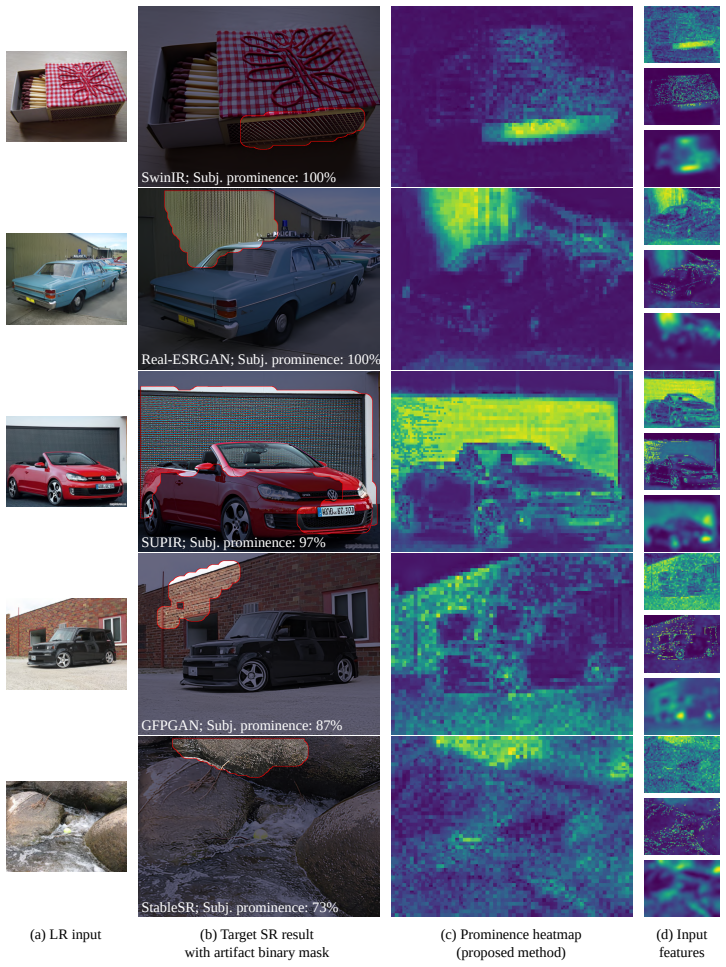
Artifact prominence is defined as the fraction of viewers who judge a highlighted region to contain a noticeable artifact. A crowdsourced protocol produces the SR-Prominence dataset suite with 3,935 masks from DeSRA, Open Images, Urban100, and a no-ground-truth Urban100-HR setting. Re-annotation of DeSRA shows 48.2 percent of its prior binary artifacts are not noticed by a majority of viewers. Classical full-reference metrics, especially SSIM and DISTS, provide strong localized prominence signals while no-reference IQA methods and specialized artifact detectors fail to generalize across datasets and reference settings.
Load-bearing premise
The crowdsourced majority-vote prominence values remain stable when applied to new annotator pools and image sources beyond those used in the study.
Editorial extensions
If this is right
- 48.2 percent of binary artifacts previously labeled in DeSRA are not noticed by a majority of viewers under the new protocol.
- SSIM and DISTS can supply localized predictions of where artifacts will stand out to people.
- The released objective scoring protocol lets any new metric be benchmarked on the suite without further crowdsourcing.
- Super-resolution methods can be compared on the basis of perceptual impact rather than binary defect counts.
Reading between the lines
- Training objectives for future super-resolution networks could use prominence estimates from SSIM or DISTS to suppress only the defects that most viewers notice.
- The crowdsourced protocol could be applied to measure perceptual impact in related tasks such as image denoising or compression artifact evaluation.
- The consistent failure of no-reference methods points to a need for metrics that better capture localized viewer attention without a clean reference image.
Editorial analysis
A structured set of objections, weighed in public.
Referee Report
Summary. The paper introduces artifact prominence as the fraction of viewers who notice an artifact in a highlighted region of a super-resolved image. It presents a crowdsourced annotation protocol and the SR-Prominence dataset suite (3,935 masks from DeSRA, Open Images, Urban100, and no-ground-truth Urban100-HR), re-annotates DeSRA to find 48.2% of its binary artifacts unnoticed by a majority, audits detectors and metrics, and reports that classical full-reference metrics (especially SSIM and DISTS) yield strong localized prominence signals while no-reference IQA methods and specialized artifact detectors often fail to generalize. The suite is released with an objective scoring protocol for benchmarking without new crowdsourcing.
Significance. If the prominence labels are shown to be stable, the dataset and protocol would usefully shift SR artifact evaluation from binary presence to perceptual impact. The reported strength of SSIM and DISTS as localized signals is a concrete, falsifiable observation that could influence metric selection. The public release of the dataset together with a reproducible scoring protocol is a clear strength supporting community benchmarking.
major comments (2)
- [Section 3] Protocol description (Section 3 / Dataset Construction): no annotation instructions, inter-annotator agreement (Fleiss’ κ, Krippendorff’s α), bootstrap stability of majority votes, or cross-pool replication are reported. These checks are load-bearing for treating the prominence fractions as reliable ground truth, especially for the Urban100-HR no-GT subset.
- [Section 5] Metric audit results (Section 5): the claim that SSIM/DISTS provide strong localized signals while other methods fail to generalize rests directly on the crowdsourced prominence values as ground truth. Without the missing agreement and stability statistics, the reported superiority and generalization failures cannot be evaluated for robustness.
minor comments (2)
- [Abstract] Abstract and Section 4: the phrase 'objective scoring protocol' is used without a concrete description or pseudocode; adding a short formal definition would improve clarity.
- [Dataset release] Dataset release statement: confirming that raw per-annotator votes (not only aggregated prominence) are included would strengthen transparency and allow independent re-analysis.
Simulated Author's Rebuttal
We thank the referee for their thoughtful review and for highlighting the importance of validating the crowdsourced protocol. We address each major comment below and commit to revisions that will strengthen the manuscript's claims regarding label reliability and metric evaluation.
read point-by-point responses
-
Referee: [Section 3] Protocol description (Section 3 / Dataset Construction): no annotation instructions, inter-annotator agreement (Fleiss’ κ, Krippendorff’s α), bootstrap stability of majority votes, or cross-pool replication are reported. These checks are load-bearing for treating the prominence fractions as reliable ground truth, especially for the Urban100-HR no-GT subset.
Authors: We agree these statistics are essential to substantiate the prominence labels as reliable ground truth. In the revised manuscript, we will include the complete annotation instructions in Section 3. We will compute and report inter-annotator agreement metrics including Fleiss’ κ and Krippendorff’s α. We will also add analyses of bootstrap stability for the majority votes and cross-pool replication results. For the Urban100-HR no-ground-truth subset, we will provide dedicated replication details to confirm consistency across annotation pools. revision: yes
-
Referee: [Section 5] Metric audit results (Section 5): the claim that SSIM/DISTS provide strong localized signals while other methods fail to generalize rests directly on the crowdsourced prominence values as ground truth. Without the missing agreement and stability statistics, the reported superiority and generalization failures cannot be evaluated for robustness.
Authors: We acknowledge that the metric audit results in Section 5 depend on the quality of the prominence ground truth. Incorporating the agreement, stability, and replication statistics as described in our response to the Section 3 comment will enable a more rigorous evaluation of the robustness of the findings on SSIM, DISTS, and the generalization failures of other methods. The revised manuscript will include these validations to support the claims. revision: yes
Circularity Check
No significant circularity
full rationale
The paper introduces a new crowdsourced protocol and dataset (SR-Prominence) for artifact prominence, defined directly from viewer annotations as the fraction noticing artifacts in highlighted regions. No equations, fitted parameters, or predictions are described that reduce to the same inputs by construction. Central claims about metric performance (SSIM/DISTS vs. others) rest on these independent new labels across multiple datasets, including no-GT settings, without self-definitional loops, load-bearing self-citations, or renaming of known results. The derivation chain is self-contained as empirical data collection followed by external benchmarking.
Assumptions & free parameters
Cite this review
Pith. "Pith review of SR-Prominence: A Crowdsourced Protocol and Dataset Suite for Perceptually-Weighted Super-Resolution Artifact Evaluation." pith.science (2026). https://pith.science/paper/4C76CKFX
@misc{pith2026260514847,
  author       = {Pith},
  title        = {Pith review of: SR-Prominence: A Crowdsourced Protocol and Dataset Suite for Perceptually-Weighted Super-Resolution Artifact Evaluation},
  year         = {2026},
  howpublished = {\url{https://pith.science/paper/4C76CKFX}},
  note         = {Machine review of arXiv:2605.14847}
}
read the original abstract
Modern image super-resolution methods generate detailed, visually appealing results, but they often introduce visual artifacts: unnatural patterns and texture distortions that degrade perceived quality. These defects vary widely in perceptual impact--some are barely noticeable, while others are highly disturbing--yet existing detection methods treat them equally. We propose artifact prominence as an evaluative target, defined as the fraction of viewers who judge a highlighted region to contain a noticeable artifact. We design a crowdsourced annotation protocol and construct SR-Prominence, a dataset suite containing 3,935 artifact masks from DeSRA, Open Images, Urban100, and a realistic no-ground-truth Urban100-HR setting, annotated with prominence. Re-annotating DeSRA reveals that 48.2% of its in-lab binary artifacts are not noticed by a majority of viewers. Across the suite, we audit SR artifact detectors, image-quality metrics, and SR methods. We find that classical full-reference metrics, especially SSIM and DISTS, provide surprisingly strong localized prominence signals, whereas no-reference IQA methods and specialized artifact detectors often fail to generalize across datasets and reference settings. SR-Prominence is released with an objective scoring protocol that allows new metrics to be benchmarked on our suite without further crowdsourcing. Together, the data and protocols enable SR artifact evaluation to move from binary defect presence toward perceptual impact. SR-Prominence is available at https://huggingface.co/datasets/imolodetskikh/sr-artifact-prominence.
Figures


Figures from the paper (5 more)




Reference graph
Works this paper leans on
-
[1]
F. Yu, J. Gu, Z. Li, J. Hu, X. Kong, X. Wang, J. He, Y . Qiao, and C. Dong, “Scaling up to excellence: Practicing model scaling for photo-realistic image restoration in the wild,” in Proceedings of the IEEE/CVF Conference on Computer Vision and Pattern Recognition (CVPR), pp. 25669–25680, June 2024
work page 2024
-
[2]
Exploiting diffusion prior for real-world image super-resolution,
J. Wang, Z. Yue, S. Zhou, K. C. Chan, and C. C. Loy, “Exploiting diffusion prior for real-world image super-resolution,”International Journal of Computer Vision, 2024
work page 2024
-
[3]
J. Liang, H. Zeng, and L. Zhang, “Details or artifacts: A locally discriminative learning approach to realistic image super-resolution,” inProceedings of the IEEE/CVF Conference on Computer Vision and Pattern Recognition, pp. 5657–5666, 2022
work page 2022
-
[4]
arXiv preprint arXiv:2307.02457 , year=
L. Xie, X. Wang, X. Chen, G. Li, Y . Shan, J. Zhou, and C. Dong, “DeSRA: detect and delete the artifacts of gan-based real-world super-resolution models,”arXiv preprint arXiv:2307.02457, 2023
-
[5]
Perceptual artifacts localization for image synthesis tasks,
L. Zhang, Z. Xu, C. Barnes, Y . Zhou, Q. Liu, H. Zhang, S. Amirghodsi, Z. Lin, E. Shechtman, and J. Shi, “Perceptual artifacts localization for image synthesis tasks,” inProceedings of the IEEE/CVF International Conference on Computer Vision (ICCV), pp. 7579–7590, October 2023. 10
work page 2023
-
[6]
Photo-realistic single image super-resolution using a generative adversarial network,
C. Ledig, L. Theis, F. Huszár, J. Caballero, A. Cunningham, A. Acosta, A. Aitken, A. Tejani, J. Totz, Z. Wang,et al., “Photo-realistic single image super-resolution using a generative adversarial network,” inProceedings of the IEEE conference on computer vision and pattern recognition, pp. 4681–4690, 2017
work page 2017
-
[7]
Real-ESRGAN: Training real-world blind super- resolution with pure synthetic data,
X. Wang, L. Xie, C. Dong, and Y . Shan, “Real-ESRGAN: Training real-world blind super- resolution with pure synthetic data,” inProceedings of the IEEE/CVF international conference on computer vision, pp. 1905–1914, 2021
work page 1905
-
[8]
Perceptual artifacts localization for inpainting,
L. Zhang, Y . Zhou, C. Barnes, S. Amirghodsi, Z. Lin, E. Shechtman, and J. Shi, “Perceptual artifacts localization for inpainting,”arXiv preprint arXiv:2208.03357, 2022
Show all 37 references
-
[9]
Hallucination score: Towards mitigating hallucinations in generative image super-resolution,
W. Ren, R. Goyal, Z. Hu, T. T. Aumentado-Armstrong, I. Mohomed, and A. Levinshtein, “Hallucination score: Towards mitigating hallucinations in generative image super-resolution,” 2025
2025
-
[10]
Image quality assessment: from error visibility to structural similarity,
Z. Wang, A. C. Bovik, H. R. Sheikh, and E. P. Simoncelli, “Image quality assessment: from error visibility to structural similarity,”IEEE transactions on image processing, vol. 13, no. 4, pp. 600–612, 2004
2004
-
[11]
The unreasonable effectiveness of deep features as a perceptual metric,
R. Zhang, P. Isola, A. A. Efros, E. Shechtman, and O. Wang, “The unreasonable effectiveness of deep features as a perceptual metric,” inProceedings of the IEEE conference on computer vision and pattern recognition, pp. 586–595, 2018
2018
-
[12]
Image quality assessment: Unifying structure and texture similarity,
K. Ding, K. Ma, S. Wang, and E. P. Simoncelli, “Image quality assessment: Unifying structure and texture similarity,”IEEE Transactions on Pattern Analysis and Machine Intelligence, vol. 44, no. 5, pp. 2567–2581, 2022
2022
-
[13]
ERQA: Edge-restoration quality as- sessment for video super-resolution,
A. Kirillova, E. Lyapustin, A. Antsiferova, and D. Vatolin, “ERQA: Edge-restoration quality as- sessment for video super-resolution,” inProceedings of the 17th International Joint Conference on Computer Vision, Imaging and Computer Graphics Theory and Applications - V olume 4:...
2022
-
[14]
MSU video super-resolution quality metrics bench- mark
A. Borisov, E. Bogatyrev, and D. Vatolin, “MSU video super-resolution quality metrics bench- mark.” https://videoprocessing.ai/benchmarks/super-resolution-metrics. html, 2025. Accessed: 2026-01-28
2025
-
[15]
PIPAL: A large-scale image quality assessment dataset for perceptual image restoration,
G. Jinjin, C. Haoming, C. Haoyu, Y . Xiaoxing, J. S. Ren, and D. Chao, “PIPAL: A large-scale image quality assessment dataset for perceptual image restoration,” inEuropean Conference on Computer Vision, pp. 633–651, 2020
2020
-
[16]
KonIQ-10k: An ecologically valid database for deep learning of blind image quality assessment,
V . Hosu, H. Lin, T. Sziranyi, and D. Saupe, “KonIQ-10k: An ecologically valid database for deep learning of blind image quality assessment,”IEEE Transactions on Image Processing, vol. 29, pp. 4041–4056, 2020
2020
-
[17]
Rich human feedback for text-to-image generation,
Y . Liang, J. He, G. Li, P. Li, A. Klimovskiy, N. Carolan, J. Sun, J. Pont-Tuset, S. Young, F. Yang, et al., “Rich human feedback for text-to-image generation,” inProceedings of the IEEE/CVF Conference on Computer Vision and Pattern Recognition, pp. 19401–19411, 2024
2024
-
[18]
The open images dataset v4: Unified image classification, object detection, and visual relationship detection at scale,
A. Kuznetsova, H. Rom, N. Alldrin, J. Uijlings, I. Krasin, J. Pont-Tuset, S. Kamali, S. Popov, M. Malloci, A. Kolesnikov,et al., “The open images dataset v4: Unified image classification, object detection, and visual relationship detection at scale,”International journal of co...
1956
-
[19]
Single image super-resolution from transformed self- exemplars,
J.-B. Huang, A. Singh, and N. Ahuja, “Single image super-resolution from transformed self- exemplars,” inProceedings of the IEEE Conference on Computer Vision and Pattern Recognition (CVPR), June 2015
2015
-
[20]
SwinIR: Image restoration using swin transformer,
J. Liang, J. Cao, G. Sun, K. Zhang, L. Van Gool, and R. Timofte, “SwinIR: Image restoration using swin transformer,” inProceedings of the IEEE/CVF international conference on computer vision, pp. 1833–1844, 2021. 11
2021
-
[21]
Swift parameter-free attention network for efficient super-resolution,
C. Wan, H. Yu, Z. Li, Y . Chen, Y . Zou, Y . Liu, X. Yin, and K. Zuo, “Swift parameter-free attention network for efficient super-resolution,” inProceedings of the IEEE/CVF Conference on Computer Vision and Pattern Recognition, pp. 6246–6256, 2024
2024
-
[22]
Residual local feature network for efficient super-resolution,
F. Kong, M. Li, S. Liu, D. Liu, J. He, Y . Bai, F. Chen, and L. Fu, “Residual local feature network for efficient super-resolution,” in2022 IEEE/CVF Conference on Computer Vision and Pattern Recognition Workshops (CVPRW), pp. 765–775, 2022
2022
-
[23]
JPEG AI image compression visual artifacts: Detection methods and dataset,
D. Tsereh, M. Mirgaleev, I. Molodetskikh, R. Kazantsev, and D. S. Vatolin, “JPEG AI image compression visual artifacts: Detection methods and dataset,”ArXiv, vol. abs/2411.06810, 2024
2024
-
[24]
Towards real-world blind face restoration with generative facial prior,
X. Wang, Y . Li, H. Zhang, and Y . Shan, “Towards real-world blind face restoration with generative facial prior,” inProceedings of the IEEE/CVF conference on computer vision and pattern recognition, pp. 9168–9178, 2021
2021
-
[25]
One-step effective diffusion network for real-world image super-resolution,
R. Wu, L. Sun, Z. Ma, and L. Zhang, “One-step effective diffusion network for real-world image super-resolution,”Advances in Neural Information Processing Systems, vol. 37, pp. 92529– 92553, 2024
2024
-
[26]
Real-world super-resolution via kernel estimation and noise injection,
X. Ji, Y . Cao, Y . Tai, C. Wang, J. Li, and F. Huang, “Real-world super-resolution via kernel estimation and noise injection,” inThe IEEE/CVF Conference on Computer Vision and Pattern Recognition (CVPR) Workshops, June 2020
2020
-
[27]
Pixel-aware stable diffusion for realistic image super-resolution and personalized stylization,
T. Yang, R. Wu, P. Ren, X. Xie, and L. Zhang, “Pixel-aware stable diffusion for realistic image super-resolution and personalized stylization,” inEuropean conference on computer vision, pp. 74–91, Springer, 2024
2024
-
[28]
SeeSR: Towards semantics-aware real-world image super-resolution,
R. Wu, T. Yang, L. Sun, Z. Zhang, S. Li, and L. Zhang, “SeeSR: Towards semantics-aware real-world image super-resolution,” inProceedings of the IEEE/CVF conference on computer vision and pattern recognition, pp. 25456–25467, 2024
2024
-
[29]
SinSR: diffusion-based image super-resolution in a single step,
Y . Wang, W. Yang, X. Chen, Y . Wang, L. Guo, L.-P. Chau, Z. Liu, Y . Qiao, A. C. Kot, and B. Wen, “SinSR: diffusion-based image super-resolution in a single step,” inProceedings of the IEEE/CVF Conference on Computer Vision and Pattern Recognition, pp. 25796–25805, 2024
2024
-
[30]
ResShift: Efficient diffusion model for image super-resolution by residual shifting,
Z. Yue, J. Wang, and C. C. Loy, “ResShift: Efficient diffusion model for image super-resolution by residual shifting,”Advances in Neural Information Processing Systems, vol. 36, pp. 13294– 13307, 2023
2023
-
[31]
HAT: Hybrid attention transformer for image restoration,
X. Chen, X. Wang, W. Zhang, X. Kong, Y . Qiao, J. Zhou, and C. Dong, “HAT: Hybrid attention transformer for image restoration,”arXiv preprint arXiv:2309.05239, 2023
2023
-
[32]
DRCT: Saving image super-resolution away from information bottleneck,
C.-C. Hsu, C.-M. Lee, and Y .-S. Chou, “DRCT: Saving image super-resolution away from information bottleneck,” inProceedings of the IEEE/CVF Conference on Computer Vision and Pattern Recognition (CVPR) Workshops, pp. 6133–6142, June 2024
2024
-
[33]
BSDS200 dataset
D. Martin, C. Fowlkes, and J. Malik, “BSDS200 dataset.” https://huggingface.co/ datasets/goodfellowliu/BSDS200, 2001. License: Apache 2.0
2001
-
[34]
Historical dataset
X. Wang, K. Yu,et al., “Historical dataset.” https://github.com/xinntao/BasicSR, 2018. Part of BasicSR library (license not explicitly specified)
2018
-
[35]
General-100 dataset
C. Dong and C. C. Loy, “General-100 dataset.”http://mmlab.ie.cuhk.edu.hk/projects/ FSRCNN.html, 2016. License: OpenRail
2016
-
[36]
Set5 and set14 datasets
M. Bevilacqua, A. Roumy, and C. Guillemot, “Set5 and set14 datasets.”https://figshare. com/articles/dataset/BSD100_Set5_Set14_Urban100/21586188, 2012. License: CC0 1.0 Universal
2012
-
[37]
T91 super-resolution dataset
J. Yang, J. Wright, and T. Huang, “T91 super-resolution dataset.” https://github.com/ open-mmlab/mmsr, 2010. License: DbCL 1.0. 12 1 5 101520253035404550556065707580859095100 Assessors, # 0% 0% 20% 20% 40% 40% 60% 60% 80% 80% 100% 100% Artifact Prominence95% confidence interva...
2010
Reviewed June 30, 2026 · model on record in the stance chip above.
Discussion (0). Continue with ORCID to comment.