REVIEW 3 major objections 5 minor 70 references
Superspin Renormalization and Slow Relaxation in Random Spin Systems
T0 review · 3 major / 5 minor · reviewed 2026-08-07 · deepseek-v4-flash
Pith's one-line read For random spin chains, spin survival decays as $B + A/\log^2(t/t_0)$, slower than any power law, and a new superspin renormalization scheme reproduces exact diagonalization at low frequencies.
desk verdict Genuinely new superspin RSRG-X formalism with a solid 1D derivation and honest ED benchmarks; the abstract overstates the long-range chain, which the body itself admits is unconfirmed in the thermodynamic limit. read the letter →
The pith
A machine-rendered reading of the paper's core claim, the machinery that carries it, and where it could break.
The reading
What carries the argument
The central machinery is the superspin RSRG-X update rule: at each step the algorithm identifies the strongest one- or two-superspin coupling, branches into an eigenspace of that coupling, and generates a new effective Hamiltonian on two-level superspins, where a superspin-$m$ is a collective degree of freedom whose two states differ in total magnetization by $2m$. The global U(1) and $\mathbb{Z}_2$ symmetries restrict the allowed couplings to $XX+YY$, $ZZ$, and a dangling $X^{(0)}$ term, making the renormalization scheme self-contained. Each resonant branching creates a coherent flip between $|\uparrow^{\otimes I}\downarrow^{\otimes J}\rangle$ and $|\downarrow^{\otimes I}\uparrow^{\otimes J}\rangle$ at frequency $4\Omega_{n,j}$, and the low-frequency spectral function is the sum over these resonances.
What would settle it
Compute $\omega\overline{S_p}(\omega)$ for a long random nearest-neighbor $XX+YY$ chain with couplings drawn from the fixed-point distribution and compare with the predicted curved form $A[\log(\omega_0/\omega)]^{-3}$; if the low-frequency data follow a straight power-law line instead, the infinite-randomness description of the decay is refuted.
Extended reading notes
Core claim
The central discovery is that for one-dimensional random $XX+YY$ chains with U(1) and $\mathbb{Z}_2$ symmetry, the disorder-averaged infinite-temperature spin survival probability decays as $\overline{S_p}(t) \simeq B + A/\log^2(t/t_0)$ at late times, which is slower than any power law. The paper establishes this by constructing an RSRG-X formalism in which the effective Hamiltonian is expressed in terms of two-level superspins, so that conserved spin density relaxes through coherent collective spin flips. The numerical implementation matches exact diagonalization at low but nonzero frequencies for nearest-neighbor, next-nearest-neighbor, and long-range dipolar chains, and it extends the reachable system sizes to at least $N=40$ in one dimension. For two-dimensional power-law interacting models, the results indicate subdiffusive spin relaxation with a decay exponent that decreases as the interaction becomes more long-ranged.
Load-bearing premise
The argument stands or falls on the strong-randomness premise that, at every renormalization step, the selected dominant one- or two-superspin coupling overwhelms every overlapping coupling and that three-superspin and superspin-0 pair terms remain negligible; the paper reports this premise is satisfied with high but not perfect probability in one dimension and significantly less often in two dimensions, so if those overlaps become strong the effective-Hamiltonian update breaks down.
Editorial extensions
If this is right
- For nearest-neighbor random $XX+YY$ chains, the disorder-averaged spin survival probability has the universal asymptote $\overline{S_p}(t) = B + A/\log^2(t/t_0)$ in the thermodynamic limit, with no power-law tail.
- The same $1/\log^2(t)$ form is consistent with next-nearest-neighbor and long-range dipolar chains at the largest sizes accessible to the method, indicating that logarithmic relaxation is not an artifact of the free-fermion mapping.
- The numerical RSRG-X approach reaches system sizes beyond exact diagonalization while retaining quantitative agreement at low frequencies, allowing tests of late-time asymptotics that ED cannot access.
- In two dimensions, the method predicts subdiffusive power-law decay of the spin survival probability, with the exponent decreasing as the interaction becomes more long-ranged.
- Many-body spin flips involving $n \ge 2$ aligned spins are abundant in interacting chains, so their dynamics differs qualitatively from the two-body spin-flip physics of nearest-neighbor chains.
- The formalism also applies to Hamiltonians with $ZZ$ interactions, since those couplings are generated and renormalized within the same closed set of U(1)- and $\mathbb{Z}_2$-symmetric terms.
Reading between the lines
- A direct experimental test would be to prepare a randomly filled Rydberg chain with dipolar $XX+YY$ interactions and measure the conserved magnetization autocorrelation; if the disorder is strong, the predicted $1/\log^2(t)$ tail should be visible over many orders of magnitude in time.
- The two-dimensional results suggest a dimensional crossover: at small interaction exponent $\alpha$ the late-time decay may be a genuine power law with continuously varying exponent rather than the logarithmic asymptote of one dimension, and a finite-size scaling study at fixed $\alpha$ could separate the two possibilities.
- Because the Monte Carlo branching samples RSRG-X states uniformly, observables dominated by rare strongly resonant eigenstates may require importance sampling; comparing the sampled resonance-energy distribution with exact spectra would test how far the method's quantitative reach extends.
- The picture of independent coherent resonances implies that spin transport in these disordered chains is strongly suppressed and possibly frequency-dependent, which could connect the resonance distribution to rigorous bounds on sub-ballistic or subdiffusive transport in disordered spin systems.
Editorial analysis
A structured set of objections, weighed in public.
Referee Report
Summary. The paper develops an excited-state real-space renormalization group (RSRG-X) formalism for random spin-1/2 systems with U(1) and Z2 symmetries, applied to XYZ? Actually XX+YY chains with nearest-neighbor, next-nearest-neighbor, and long-range dipolar interactions. The formalism represents the effective Hamiltonian in terms of two-level 'superspins' and predicts that the disorder-averaged spin survival probability decays at late times as S_p(t) ≈ B + A/log^2(t/t0), slower than any power law. For nearest-neighbor chains the prediction is derived analytically from the known infinite-randomness fixed point. For interacting chains the paper introduces a numerical RSRG-X algorithm and benchmarks it against exact diagonalization (ED) for N up to 16, finding quantitative agreement at low frequencies for NNN and LR chains. The paper also presents ED and RSRG-X results for two-dimensional power-law interacting models. The central claims are that 1D chains show the 1/log^2 asymptote, that the superspin formalism captures the dynamics, and that 2D systems display slow subdiffusive relaxation.
Significance. If the central claims hold, the paper makes a valuable contribution to the theory of slow dynamics in disordered spin systems: it extends RSRG-X to genuinely interacting long-range chains, gives a physical picture of many-body resonances, and provides a numerical method that reaches sizes beyond ED. The analytical derivation for the nearest-neighbor chain is clean and is supported by ED benchmarks at multiple system sizes. The quantitative ED agreement for the NNN and LR chains at accessible frequencies is a genuine strength, as is the explicit reporting of the RG-quality statistics in Appendix E. The main significance is therefore real, but it is currently weakened by an abstract-level overstatement for the long-range chain and by an unverified RG premise for the interacting case.
major comments (3)
- [Abstract and Sec. V B 3, Fig. 11b] The abstract states that the results 'feature no significant deviation from the ~1/log^2(t) asymptote' for the long-range chain. This is stronger than what the paper establishes. The N=40 RSRG-X data in Fig. 11b show a fit to the universal form (7) only in the frequency window ω ≲ 10^-6, which is below the window 10^-6 ≲ ω ≲ 10^-2 where RSRG-X was benchmarked against ED (Fig. 10b). The text itself says that due to finite-size effects the scaling 'cannot be confirmed in the thermodynamic limit' (Sec. V B 3). Since the asymptotic statement is a central advertised result, the claim must either be supported by a convergence or finite-size scaling analysis, or explicitly downgraded to a tentative suggestion.
- [Sec. V A 3 and Appendix E] The self-contained nature of the superspin RSRG-X formalism rests on the assertion that interactions involving three or more superspins, and X(0)X(0) or Y(0)Y(0) terms, are negligible (Eq. (35) and surrounding text). The evidence provided in Appendix E and Table I is the probability that H0 overlaps with a stronger interaction (Q<0). This is not the same as demonstrating that the norm ratio ||H1||/||H0|| flows to zero, or that the accumulated effect of many weak omitted couplings does not shift resonance frequencies or couple supposedly independent spin flips at late times. The paper's own conclusion states that tracking three-site interactions remains an open problem. This gap directly affects the central prediction of Eq. (39) for the interacting chains, so the manuscript should either provide a flow analysis or clearly limit the claimed regime of validity.
- [Sec. VI and Table I] For the two-dimensional model, Table I shows Q<0 probabilities up to 1.1% (N=16, α=3), and App. Fig. 13 shows that the RG quality distribution is substantially worse than in 1D. The paper acknowledges this and appropriately calls the 2D results preliminary. However, because the same superspin RSRG-X is applied in 2D without a separate validation of the strong-randomness premise, the 2D conclusions (power-law, subdiffusive decay with extracted exponents c) should be presented with a clearer caveat that the RG framework itself is less controlled in that setting. At present, the abstract's mention of 2D results is fair, but Sec. VI should more prominently state that the ED agreement is only qualitative for α ≤ 4 and that the numerical exponents should be regarded as effective rather than asymptotic.
minor comments (5)
- [Appendix D, Eq. (D10)] In Eq. (D10), the expression for V- is identical to that for V+ (both written with a plus sign). This is presumably a typo; the V- state should use the minus sign, as correctly stated in Eq. (32) of the main text.
- [Sec. V B 3 and Abstract] The abstract says 'feature no significant deviation' for the long-range model, whereas Sec. V B 3 says the result is 'inconclusive'; please align the wording with the actual evidence.
- [Sec. V A 3] The term 'self-contained' is used to describe the RSRG-X formalism, but later the text admits that tracking three-site interactions remains open. Please clarify that 'self-contained' refers to the closed set of RG steps within the assumed dominance of one- and two-superspin couplings, not to the full validity of that assumption.
- [Sec. V B 3, Fig. 11b] The fits to the log^3 form and the power-law form are both shown on the same data; it would improve the presentation to state explicitly the fitted frequency ranges and the extracted parameters (A, ω0, c) for each case, so that the reader can assess the discriminative power of the fits.
- [General] The manuscript has several sentences that appear incomplete or run-on (e.g., in the introduction of Sec. V A and in Appendix C 2 b). A careful proofreading pass would improve readability.
Circularity Check
No significant circularity: the 1/log^2 asymptote is derived from the infinite-randomness fixed point, and the RSRG-X numerics are benchmarked against exact diagonalization rather than fitted to it.
full rationale
The derivation chain is self-contained. For the nearest-neighbor chain, Sec. IV A derives the frequency-domain prediction Eq. (24), Sp(ω) = Bδ(ω) + A/(|ω| log^3|ω0/ω|), by averaging the two-body spin-flip spectral function (21) over the energy distribution g(l) = 2ζΓ_c^2/l^3 obtained from the Fisher fixed point (19); Appendix A then transforms this into the time-domain 1/log^2 asymptote Eq. (26). The constants A, B, and ω0 are fixed by distribution parameters, not by matching the target decay. The numerical RSRG-X is benchmarked against ED in Figs. 2, 4, and 10, and that agreement is an independent check rather than a definitional reduction. The extension to next-nearest-neighbor and long-range chains is a numerical method whose dynamical rule Eq. (39) follows from the RSRG-X branching ansatz plus the strong-randomness premise; although the paper fits the universal form (7) to large-N data in Fig. 11, that fit is a test of an externally derived functional form, not a fitted parameter renamed as a prediction. The citations to Refs. [21], [26], [35], and [51] are prior established or self-authored but not load-bearing in a circular way: Ref. [21] supplies the fixed-point distribution, Refs. [26] and [51] independently identified the low-temperature asymptote, and Ref. [35], while sharing an author, is rederived in Sec. III B rather than invoked as an unexamined premise. The paper explicitly acknowledges the approximation's limits in Appendix E, Table I, and Sec. VII, so the residual concerns about two-dimensional strong randomness or the long-range thermodynamic limit are correctness and evidence questions, not circularity.
Assumptions & free parameters
free parameters (6)
- zeta (crossover fraction) =
not determined from microscopic data; effectively fitted
- Gamma_c (crossover RG time) =
not determined from microscopic data; effectively fitted
- A (decay amplitude) =
extracted from fits in Figs. 2, 4, 5, 11
- B (baseline) =
fitted in time-domain fits such as Fig. 5; set to 3/4 only in the NN analytical result
- omega0 / t0 (time scale) =
fitted from data
- Branching probabilities =
chosen by construction, not fitted
assumptions (6)
- standard math Degenerate perturbation theory, Eq. (9), gives the effective Hamiltonian update in every RG step.
- domain assumption Strong randomness premise: ||H0|| >> ||H1|| for the chosen H0 at each step.
- ad hoc to paper The effective Hamiltonian can always be described by the three interaction forms in Eq. (35); three-superspin and X(0)X(0) interactions are negligible.
- domain assumption Global U(1) and Z2 symmetries are inherited by the effective Hamiltonian at every RG step.
- standard math The infinite-randomness fixed-point distribution P^c_Gamma(beta) = (1/Gamma) exp(-beta/Gamma) governs the flow of NN couplings.
- domain assumption Each resonance contributes a simple cos(4*Omega_{n,j} t) term, Eq. (39), with no other wavefunction overlaps.
invented entities (1)
-
Superspin (superspin-m)
independent evidence
Cite this review
Pith. "Pith review of Superspin Renormalization and Slow Relaxation in Random Spin Systems." pith.science (2026). https://pith.science/paper/4CIMVZQW
@misc{pith2026250209612,
  author       = {Pith},
  title        = {Pith review of: Superspin Renormalization and Slow Relaxation in Random Spin Systems},
  year         = {2026},
  howpublished = {\url{https://pith.science/paper/4CIMVZQW}},
  note         = {Machine review of arXiv:2502.09612}
}
abstract
We develop an excited-state real-space renormalization group (RSRG-X) formalism to describe the dynamics of conserved densities in randomly interacting spin-$\frac{1}{2}$ systems. Our formalism is suitable for systems with $\textrm{U}(1)$ and $\mathbb{Z}_2$ symmetries, and we apply it to chains of randomly positioned spins with dipolar $XX+YY$ interactions, as arise in Rydberg quantum simulators and other platforms. The formalism generates a sequence of effective Hamiltonians which provide approximate descriptions for dynamics on successively smaller energy scales. These effective Hamiltonians involve ``superspins'': two-level collective degrees of freedom constructed from (anti)aligned microscopic spins. Conserved densities can then be understood as relaxing via coherent collective spin flips. For the well-studied simpler case of randomly interacting nearest-neighbor $XX+YY$ chains, the superspins reduce to single spins. Our formalism also leads to a numerical method capable of simulating the dynamics up to an otherwise inaccessible combination of large system size and late time. Focusing on disorder-averaged infinite-temperature autocorrelation functions, in particular the local spin survival probability $\overline{S_p}(t)$, we demonstrate quantitative agreement in results between our algorithm and exact diagonalization (ED) at low but nonzero frequencies. Such agreement holds for chains with nearest-neighbor, next-nearest-neighbor, and long-range dipolar interactions. Our results indicate decay of $\overline{S_p}(t)$ slower than any power law and feature no significant deviation from the $\sim 1/ \log^2(t)$ asymptote expected from the infinite-randomness fixed-point of the nearest-neighbor model. We also apply the RSRG-X formalism to two-dimensional long-range systems of moderate size and find slow late-time decay of $\overline{S_p}(t)$.
Figures


Figures from the paper (9 more)




Reference graph
Works this paper leans on
-
[1]
V A 5 a many-body spin-flip picture of the dynamics in the interacting models
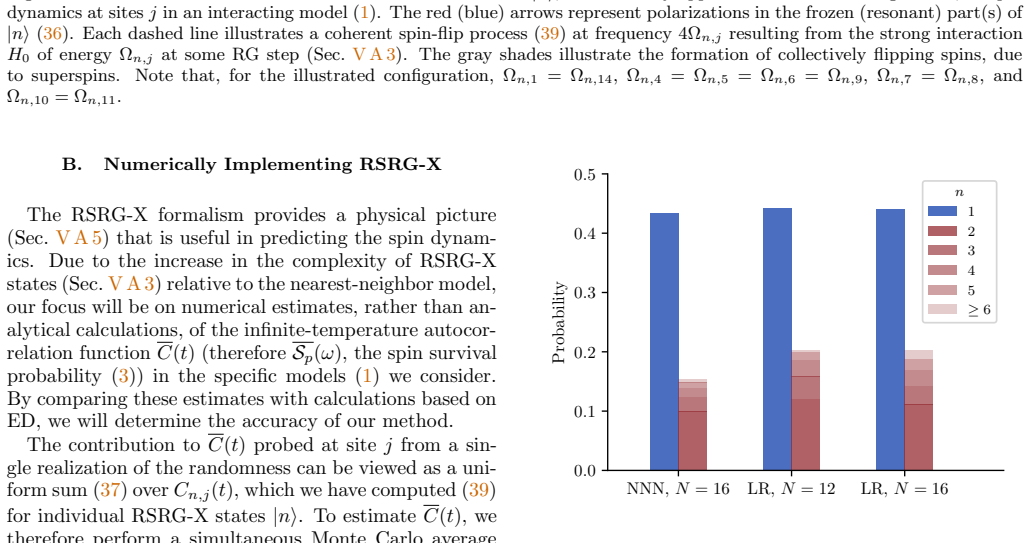
Abundance of Many-Body Spin-Flips Based on our RSRG-X formalism involving superspins, we have proposed in Sec. V A 5 a many-body spin-flip picture of the dynamics in the interacting models. To substantiate this picture, we provide evidence that, for the long-range and next-nearest-neighbor models we con- sider (1), the many-body (as opposed to two-body) s...
-
[2]
Agreement with ED: Ensemble Averaged Sp Having illustrated the qualitative property (Sec. V B 1) of spin dynamics as predicted by RSRG-X, we next con- sider the observable Sp(ω), the disorder-averaged spin survival probability at infinite temperature (3). We ob- tain Sp(ω) results by numerical RSRG-X with the Monte Carlo approach mentioned above in Sec. V...
-
[3]
Computing Sp Beyond ED Capabilities Now with RSRG-X, we attempt to investigate the late-time infinite-temperature spin relaxation dynamics 10−7 10−5 10−3 10−1 10−3 10−2 ωSp(ω) (a) N 12 16 10−7 10−5 10−3 10−1 ω 10−3 10−2 ωSp(ω) (b) N 12 16 Figure 10. Spin survival probability computed with ED (dark) and RSRG-X (light) for (a) the next-nearest-neighbor (b) ...
-
[4]
The RSRG-X States The relative simplicity of the steps (i)–(iii) leads to RSRG-X states (Sec. III B 2) of a simple form |ψ⟩ = O I,J 1√ 2 |↑⊗I↓⊗J⟩ ± |↓⊗I↑⊗J⟩ ⊗ |↑⊗K⟩ ⊗ |↓⊗L⟩ , (36) where K, L and all the I, J are index sets that disjointly cover the sites in the original system (1). The first ten- sor product component in Equ. (36) results from the ...
-
[5]
Dynamics: The Many-Body Spin-Flip Picture The structure of RSRG-X states (36) for the beyond- nearest-neighbor models (1) offers a valuable picture of the spin dynamics. We illustrate this picture by consider- ing C(t), the on-site infinite-temperature autocorrelation function (4) of a local spin in the original system, com- puted with these approximate s...
-
[6]
Exact Diagonalization Throughout this work, we perform numerical ED of the system Hamiltonians (1, 40) at even number of sites. Crucially, we reduce the Hilbert space dimension by the non-interacting nature for the nearest-neighbor models (Appendix C 1 a) and by the U(1) and Z2 sym- metries (2) for the beyond-nearest-neighbor and two- dimensional models (...
-
[7]
Numerical RSRG-X In principle, given a realization of the randomness we can numerically track Heff along all the possible branch- ing choices detailed for the RG steps depending on the specific models (Secs. III B, V A). In this way, we can ob- tain the complete set of RSRG-X states with the corre- sponding approximate eigenenergies. The information so ob...
-
[8]
General Perturbative T reatment We outline our general strategy before detailing the perturbative treatment for every choice of branching sub- space V. Our goal is to describe the updated Hamiltonian H (V) eff due to branching into V, given the Heff an RG step begins with: as in Equ. (8), we separate Heff into the strong interaction H0, the interactions H...
Show all 70 references
-
[9]
We elaborate on the results 24 here, organized according to the three cases of strong in- teraction H0 listed in Sec
Detailed T reatments With the general strategy (Appendix D 1), the deriva- tion of detailed perturbative treatments for every branch- ing choice is straightforward. We elaborate on the results 24 here, organized according to the three cases of strong in- teraction H0 listed in...
-
[10]
J. Choi, S. Choi, G. Kucsko, P. C. Maurer, B. J. Shields, H. Sumiya, S. Onoda, J. Isoya, E. Demler, F. Jelezko, N. Y. Yao, and M. D. Lukin, Depolarization dynamics in a strongly interacting solid-state spin ensemble, Phys. Rev. Lett. 118, 093601 (2017)
2017
-
[11]
Kucsko, S
G. Kucsko, S. Choi, J. Choi, P. C. Maurer, H. Zhou, R. Landig, H. Sumiya, S. Onoda, J. Isoya, F. Jelezko, E. Demler, N. Y. Yao, and M. D. Lukin, Critical thermal- ization of a disordered dipolar spin system in diamond, Phys. Rev. Lett. 121, 023601 (2018)
2018
-
[12]
C. Zu, F. Machado, B. Ye, S. Choi, B. Kobrin, T. Mittiga, S. Hsieh, P. Bhattacharyya, M. Markham, D. Twitchen, 26 A. Jarmola, D. Budker, C. R. Laumann, J. E. Moore, and N. Y. Yao, Emergent hydrodynamics in a strongly interacting dipolar spin ensemble, Nature 597, 45 (2021)
2021
-
[13]
E. J. Davis, B. Ye, F. Machado, S. A. Meynell, W. Wu, T. Mittiga, W. Schenken, M. Joos, B. Kobrin, Y. Lyu, Z. Wang, D. Bluvstein, S. Choi, C. Zu, A. C. B. Jayich, and N. Y. Yao, Probing many-body dynamics in a two- dimensional dipolar spin ensemble, Nat. Phys. 19, 836 (2023)
2023
-
[14]
Browaeys and T
A. Browaeys and T. Lahaye, Many-body physics with individually controlled Rydberg atoms, Nat. Phys. 16, 132 (2020)
2020
-
[15]
L. Su, A. Douglas, M. Szurek, R. Groth, S. F. Ozturk, A. Krahn, A. H. H´ ebert, G. A. Phelps, S. Ebadi, S. Dick- erson, F. Ferlaino, O. Markovi´ c, and M. Greiner, Dipolar quantum solids emerging in a Hubbard quantum simula- tor, Nature 622, 724 (2023)
2023
-
[16]
Bloch, B
D. Bloch, B. Hofer, S. R. Cohen, A. Browaeys, and I. Ferrier-Barbut, Trapping and imaging single Dyspro- sium atoms in optical tweezer arrays, Phys. Rev. Lett. 131, 203401 (2023)
2023
-
[17]
D. S. Gr¨ un, S. J. M. White, A. Ortu, A. Di Carli, H. Edri, M. Lepers, M. J. Mark, and F. Ferlaino, Optical tweezer arrays of Erbium atoms, Phys. Rev. Lett. 133, 223402 (2024)
2024
-
[18]
S. L. Cornish, M. R. Tarbutt, and K. R. Hazzard, Quan- tum computation and quantum simulation with ultracold molecules, Nat. Phys. 20, 730 (2024)
2024
-
[19]
P. Peng, B. Ye, N. Y. Yao, and P. Cappellaro, Exploiting disorder to probe spin and energy hydrodynamics, Nat. Phys. 19, 1027 (2023)
2023
-
[20]
Franz, S
T. Franz, S. Geier, C. Hainaut, A. Braemer, N. Thaicharoen, M. Hornung, E. Braun, M. G¨ arttner, G. Z¨ urn, and M. Weidem¨ uller, Observation of anisotropy- independent magnetization dynamics in spatially disor- dered Heisenberg spin systems, Phys. Rev. Res.6, 033131 (2024)
2024
-
[21]
Barredo, H
D. Barredo, H. Labuhn, S. Ravets, T. Lahaye, A. Browaeys, and C. S. Adams, Coherent excitation transfer in a spin chain of three Rydberg atoms, Phys. Rev. Lett. 114, 113002 (2015)
2015
-
[22]
Igl´ oi and C
F. Igl´ oi and C. Monthus, Strong disorder RG approach of random systems, Phys. Rep. 412, 277 (2005)
2005
-
[23]
Refael and E
G. Refael and E. Altman, Strong disorder renormaliza- tion group primer and the superfluid–insulator transi- tion, C. R. Phys. 14, 725 (2013)
2013
-
[24]
Igl´ oi and C
F. Igl´ oi and C. Monthus, Strong disorder RG approach – a short review of recent developments, Eur. Phys. J. B 91 (2018)
2018
-
[25]
D. A. Huse, Strong-randomness renormalization groups (2023), arXiv:2304.08572 [cond-mat.stat-mech]
2023 arXiv
-
[26]
S.-k. Ma, C. Dasgupta, and C.-k. Hu, Random antiferro- magnetic chain, Phys. Rev. Lett. 43, 1434 (1979)
1979
-
[27]
Dasgupta and S.-k
C. Dasgupta and S.-k. Ma, Low-temperature properties of the random Heisenberg antiferromagnetic chain, Phys. Rev. B 22, 1305 (1980)
1980
-
[28]
R. N. Bhatt and P. A. Lee, Scaling studies of highly disor- dered spin-½ antiferromagnetic systems, Phys. Rev. Lett. 48, 344 (1982)
1982
-
[29]
D. S. Fisher, Random transverse field Ising spin chains, Phys. Rev. Lett. 69, 534 (1992)
1992
-
[30]
D. S. Fisher, Random antiferromagnetic quantum spin chains, Phys. Rev. B 50, 3799 (1994)
1994
-
[31]
Westerberg, A
E. Westerberg, A. Furusaki, M. Sigrist, and P. A. Lee, Random quantum spin chains: A real-space renormal- ization group study, Phys. Rev. Lett. 75, 4302 (1995)
1995
-
[32]
D. S. Fisher, Critical behavior of random transverse-field Ising spin chains, Phys. Rev. B 51, 6411 (1995)
1995
-
[33]
Westerberg, A
E. Westerberg, A. Furusaki, M. Sigrist, and P. A. Lee, Low-energy fixed points of random quantum spin chains, Phys. Rev. B 55, 12578 (1997)
1997
-
[34]
Damle, O
K. Damle, O. Motrunich, and D. A. Huse, Dynamics and transport in random antiferromagnetic spin chains, Phys. Rev. Lett. 84, 3434 (2000)
2000
-
[35]
Motrunich, K
O. Motrunich, K. Damle, and D. A. Huse, Dynamics and transport in random quantum systems governed by strong-randomness fixed points, Phys. Rev. B 63, 134424 (2001)
2001
-
[36]
Refael, S
G. Refael, S. Kehrein, and D. S. Fisher, Spin reduc- tion transition in spin-3 2 random Heisenberg chains, Phys. Rev. B 66, 060402 (2002)
2002
-
[37]
Damle and D
K. Damle and D. A. Huse, Permutation-symmetric mul- ticritical points in random antiferromagnetic spin chains, Phys. Rev. Lett. 89, 277203 (2002)
2002
-
[38]
Refael and J
G. Refael and J. E. Moore, Entanglement entropy of random quantum critical points in one dimension, Phys. Rev. Lett. 93, 260602 (2004)
2004
-
[39]
Mohdeb, J
Y. Mohdeb, J. Vahedi, N. Moure, A. Roshani, H.-Y. Lee, R. N. Bhatt, S. Kettemann, and S. Haas, Entanglement properties of disordered quantum spin chains with long- range antiferromagnetic interactions, Phys. Rev. B 102, 214201 (2020)
2020
-
[40]
Roberts and O
B. Roberts and O. I. Motrunich, Infinite randomness with continuously varying critical exponents in the random XYZ spin chain, Phys. Rev. B 104, 214208 (2021)
2021
-
[41]
Vosk and E
R. Vosk and E. Altman, Many-body localization in one dimension as a dynamical renormalization group fixed point, Phys. Rev. Lett. 110, 067204 (2013)
2013
-
[42]
Pekker, G
D. Pekker, G. Refael, E. Altman, E. Demler, and V. Oganesyan, Hilbert-glass transition: New universal- ity of temperature-tuned many-body dynamical quantum criticality, Phys. Rev. X 4, 011052 (2014)
2014
-
[43]
Vosk and E
R. Vosk and E. Altman, Dynamical quantum phase tran- sitions in random spin chains, Phys. Rev. Lett. 112, 217204 (2014)
2014
-
[44]
Huang and J
Y. Huang and J. E. Moore, Excited-state entanglement and thermal mutual information in random spin chains, Phys. Rev. B 90, 220202 (2014)
2014
-
[45]
Vasseur, A
R. Vasseur, A. C. Potter, and S. A. Parameswaran, Quan- tum criticality of hot random spin chains, Phys. Rev. Lett. 114, 217201 (2015)
2015
-
[46]
You, X.-L
Y.-Z. You, X.-L. Qi, and C. Xu, Entanglement holo- graphic mapping of many-body localized system by spec- trum bifurcation renormalization group, Phys. Rev. B 93, 104205 (2016)
2016
-
[47]
Vasseur, A
R. Vasseur, A. J. Friedman, S. A. Parameswaran, and A. C. Potter, Particle-hole symmetry, many-body local- ization, and topological edge modes, Phys. Rev. B 93, 134207 (2016)
2016
-
[48]
Monthus, Strong disorder real-space renormalization for the many-body-localized phase of random Majorana models, J
C. Monthus, Strong disorder real-space renormalization for the many-body-localized phase of random Majorana models, J. Phys. A: Math. Theor. 51, 115304 (2018)
2018
-
[49]
I. V. Protopopov, R. K. Panda, T. Parolini, A. Scardic- chio, E. Demler, and D. A. Abanin, Non-Abelian sym- metries and disorder: A broad nonergodic regime and anomalous thermalization, Phys. Rev. X 10, 011025 (2020)
2020
-
[50]
Mohdeb, J
Y. Mohdeb, J. Vahedi, and S. Kettemann, Excited- 27 eigenstate entanglement properties of XX spin chains with random long-range interactions, Phys. Rev. B 106, 104201 (2022)
2022
-
[51]
Braemer, T
A. Braemer, T. Franz, M. Weidem¨ uller, and M. G¨ art- tner, Pair localization in dipolar systems with tunable positional disorder, Phys. Rev. B 106, 134212 (2022)
2022
-
[52]
Mohdeb, J
Y. Mohdeb, J. Vahedi, R. N. Bhatt, S. Haas, and S. Ket- temann, Global quench dynamics and the growth of en- tanglement entropy in disordered spin chains with tun- able range interactions, Phys. Rev. B 108, L140203 (2023)
2023
-
[53]
Braemer, J
A. Braemer, J. Vahedi, and M. G¨ arttner, Cluster trun- cated Wigner approximation for bond-disordered Heisen- berg spin models, Phys. Rev. B 110, 054204 (2024)
2024
-
[54]
A. S. Aramthottil, P. Sierant, M. Lewenstein, and J. Zakrzewski, Phenomenology of many-body localization in bond-disordered spin chains, Phys. Rev. Lett. 133, 196302 (2024)
2024
-
[55]
Gopalakrishnan, M
S. Gopalakrishnan, M. M¨ uller, V. Khemani, M. Knap, E. Demler, and D. A. Huse, Low-frequency conductivity in many-body localized systems, Phys. Rev. B92, 104202 (2015)
2015
-
[56]
P. J. D. Crowley and A. Chandran, A constructive the- ory of the numerically accessible many-body localized to thermal crossover, SciPost Phys. 12, 201 (2022)
2022
-
[57]
S. J. Garratt, S. Roy, and J. T. Chalker, Local resonances and parametric level dynamics in the many-body local- ized phase, Phys. Rev. B 104, 184203 (2021)
2021
-
[58]
S. J. Garratt and S. Roy, Resonant energy scales and local observables in the many-body localized phase, Phys. Rev. B 106, 054309 (2022)
2022
-
[59]
D. M. Long, P. J. D. Crowley, V. Khemani, and A. Chan- dran, Phenomenology of the prethermal many-body lo- calized regime, Phys. Rev. Lett. 131, 106301 (2023)
2023
-
[60]
Igl´ oi, R
F. Igl´ oi, R. Juh´ asz, and H. Rieger, Random antiferromag- netic quantum spin chains: Exact results from scaling of rare regions, Phys. Rev. B 61, 11552 (2000)
2000
-
[61]
Sachdev, Quantum Phase Transitions , 2nd ed
S. Sachdev, Quantum Phase Transitions , 2nd ed. (Cam- bridge University Press, 2011)
2011
-
[62]
One can also formulate the RSRG-X and derive the same update rule by directly working with the single particle Hamiltonian in the fermion language
-
[63]
Motrunich, S.-C
O. Motrunich, S.-C. Mau, D. A. Huse, and D. S. Fisher, Infinite-randomness quantum Ising critical fixed points, Phys. Rev. B 61, 1160 (2000)
2000
-
[64]
C. R. Laumann, D. A. Huse, A. W. W. Ludwig, G. Re- fael, S. Trebst, and M. Troyer, Strong-disorder renormal- ization for interacting non-Abelian anyon systems in two dimensions, Phys. Rev. B 85, 224201 (2012)
2012
-
[65]
C. L. Baldwin, A. Ehrenberg, A. Y. Guo, and A. V. Gor- shkov, Disordered Lieb-Robinson bounds in one dimen- sion, PRX Quantum 4, 020349 (2023)
2023
-
[66]
C. L. Baldwin, Sub-ballistic operator growth in spin chains with heavy-tailed random fields (2024), arXiv:2409.17242 [cond-mat.dis-nn]
2024 arXiv
-
[67]
W. D. Roeck, L. Giacomin, F. Huveneers, and O. Prosniak, Absence of normal heat conduction in strongly disordered interacting quantum chains (2024), arXiv:2408.04338 [math-ph]
2024 arXiv
-
[68]
Chen and A
C.-F. Chen and A. Lucas, Finite speed of quantum scram- bling with long range interactions, Phys. Rev. Lett. 123, 250605 (2019)
2019
-
[69]
M. C. Tran, A. Y. Guo, C. L. Baldwin, A. Ehrenberg, A. V. Gorshkov, and A. Lucas, Lieb-Robinson light cone for power-law interactions, Phys. Rev. Lett. 127, 160401 (2021)
2021
-
[70]
Barahona, On the computational complexity of Ising spin glass models, J
F. Barahona, On the computational complexity of Ising spin glass models, J. Phys. A: Math. Gen. 15, 3241 (1982)
1982
Reviewed August 7, 2026 · model on record in the stance chip above.
Discussion (0). Continue with ORCID to comment.