Energy estimation of cosmic rays by air shower radio signals
Pith reviewed 2026-06-30 08:33 UTC · model grok-4.3
The pith
A scale factor from radio signal simulations reconstructs cosmic ray primary energy independent of core location.
A machine-rendered reading of the paper's core claim, the machinery that carries it, and where it could break.
Core claim
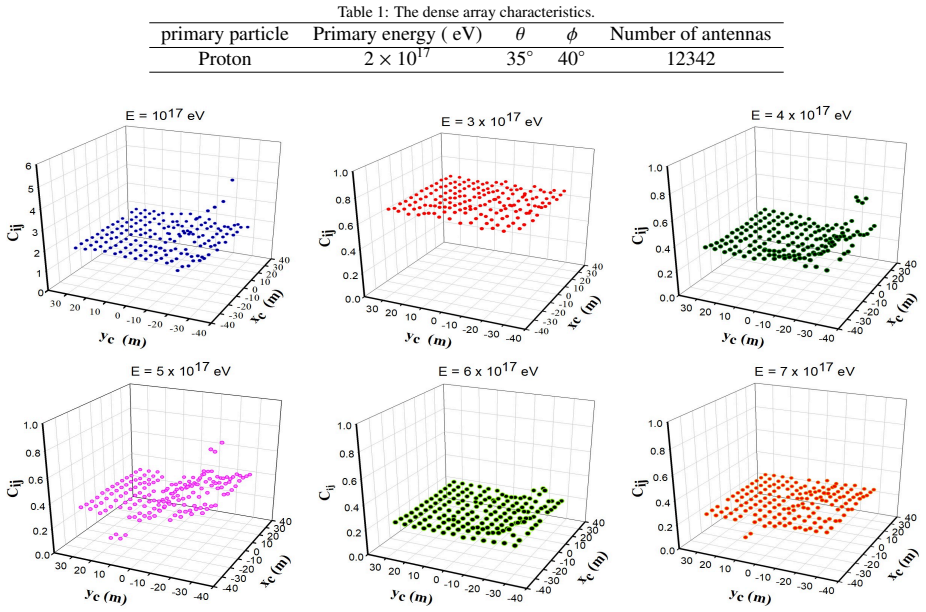
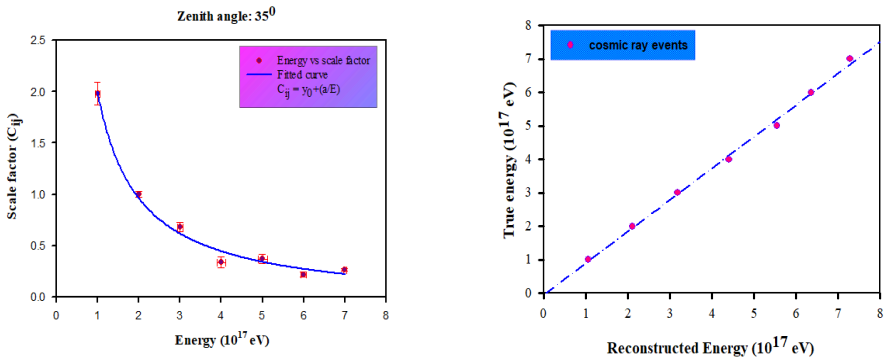
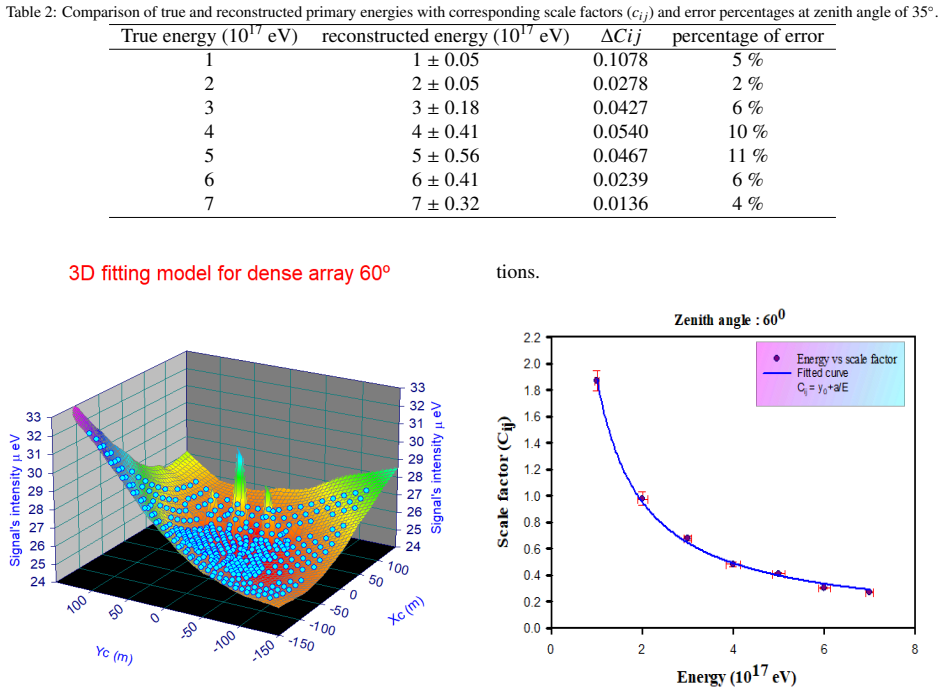
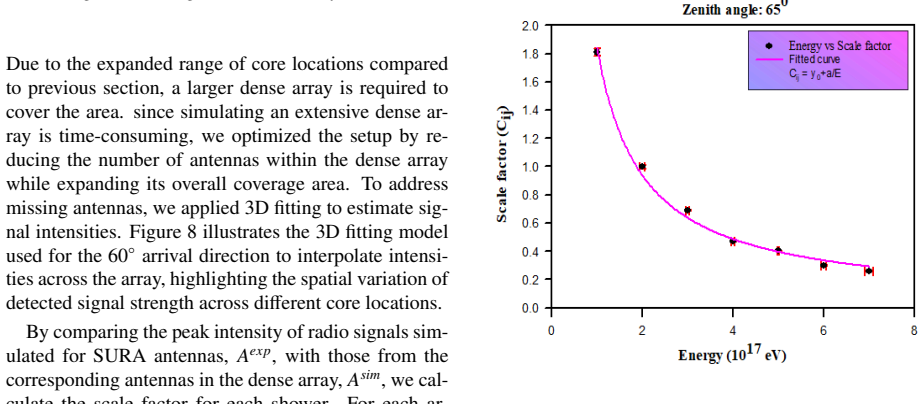
By comparing the simulated electric field intensity from the dense array with that obtained for the SURA configuration, we derive a scale factor (Cij). This scale factor exhibits a correlation with the primary energy, decreasing as energy increases. Unlike previous approaches employed by various experiments, our technique shows limited sensitivity to the shower core location. Even for the farthest core positions allowed by the array, the scale factor remains effectively independent of the core location. We reconstructed the primary energy of cosmic rays using our method with a maximum error of about 11% in our simulation tests.
What carries the argument
The scale factor Cij obtained by comparing simulated electric field intensities between a dense reference array and the SURA antenna configuration.
If this is right
- The scale factor decreases with increasing primary energy.
- The scale factor is largely independent of the shower core location.
- Primary energy reconstruction achieves a maximum error of about 11% in simulation tests.
- The method has limited sensitivity to core location compared to previous techniques.
Where Pith is reading between the lines
- If the scale factor holds for real data, it could enable energy estimates without needing precise core position information.
- Applying this to actual SURA data could test whether simulation-based factors translate to observations.
- The energy correlation might provide a new way to calibrate radio-based energy measurements across experiments.
Load-bearing premise
The scale factor and its energy correlation from CoREAS simulations will apply to real cosmic ray data and not depend on unmodeled shower details.
What would settle it
If measurements from the SURA experiment show the scale factor varying with core location or lacking correlation with independently measured energies, the reconstruction method would not hold.
Figures
read the original abstract
We present a method for reconstructing the primary energy of cosmic ray air showers using radio emission. The approach is based on CoREAS simulations performed for both the SURA experiment and a dense reference array of antennas. By comparing the simulated electric field intensity from the dense array with that obtained for the SURA configuration, we derive a scale factor (Ci j). This scale factor exhibits a correlation with the primary energy, decreasing as energy increases. Unlike previous approaches employed by various experiments, our technique shows limited sensitivity to the shower core location. Even for the farthest core positions allowed by the array, the scale factor remains effectively independent of the core location. We also examined the accuracy and reliability of the reconstruction method. Finally, we reconstructed the primary energy of cosmic rays using our method with a maximum error of about 11% in our simulation tests.
Editorial analysis
A structured set of objections, weighed in public.
Referee Report
Summary. The manuscript proposes a method to reconstruct the primary energy of cosmic-ray air showers from radio signals. CoREAS simulations are run for both the SURA array and a dense reference array; a scale factor Cij is obtained by comparing the simulated electric-field intensities of the two configurations. This factor is reported to decrease with increasing primary energy and to be effectively independent of core location, allowing energy reconstruction with a maximum error of ~11% in the simulation tests.
Significance. If the reported core-location independence and 11% reconstruction accuracy hold beyond the specific simulation set, the approach could offer a practical energy estimator for sparse radio arrays with reduced geometric sensitivity. The explicit use of a dense reference array and the quantitative error bound constitute a clear methodological contribution, though the simulation-only validation restricts immediate applicability.
major comments (3)
- [Abstract] Abstract: the scale factor Cij is obtained by direct comparison of electric-field intensities inside identical CoREAS runs; because both numerator and denominator are generated by the same simulation chain, any mismatch between CoREAS and real radio emission (hadronic model, refractive index, composition) shifts the ratio in a correlated manner and can preserve an artificial energy trend while invalidating the claimed 11% accuracy on real data.
- [Abstract] Abstract: the reconstruction error is stated as “a maximum error of about 11% in our simulation tests,” yet no information is supplied on the number of showers, the energy range, the zenith-angle coverage, or whether the figure is a maximum deviation or an RMS; without these quantities the central performance claim cannot be evaluated.
- [Abstract] Abstract: independence from core location is asserted for “the farthest core positions allowed by the array,” but no equivalent quantitative scan is described for zenith angle, azimuth, or primary mass; these parameters alter the lateral distribution and polarization pattern differently for the dense and SURA geometries and are therefore load-bearing for the claimed advantage.
minor comments (1)
- The abstract would be clearer if it stated the primary-energy interval and the zenith-angle range over which the simulations were performed.
Simulated Author's Rebuttal
We thank the referee for the constructive comments. We address each major comment below.
read point-by-point responses
-
Referee: [Abstract] Abstract: the scale factor Cij is obtained by direct comparison of electric-field intensities inside identical CoREAS runs; because both numerator and denominator are generated by the same simulation chain, any mismatch between CoREAS and real radio emission (hadronic model, refractive index, composition) shifts the ratio in a correlated manner and can preserve an artificial energy trend while invalidating the claimed 11% accuracy on real data.
Authors: We agree this is a substantive limitation. The scale factor is computed inside a single simulation chain precisely to isolate geometric and array-configuration effects. Any common-mode mismatch with real emission would affect the ratio, so the reported energy trend and 11% figure are strictly valid only within the CoREAS framework. In the revised manuscript we will add an explicit statement in the discussion section clarifying that empirical calibration against real data is required before the method can be applied to observations. revision: yes
-
Referee: [Abstract] Abstract: the reconstruction error is stated as “a maximum error of about 11% in our simulation tests,” yet no information is supplied on the number of showers, the energy range, the zenith-angle coverage, or whether the figure is a maximum deviation or an RMS; without these quantities the central performance claim cannot be evaluated.
Authors: The referee correctly identifies missing quantitative context in the abstract. The body of the manuscript specifies the simulation set (energies 10^17–10^19 eV, zenith angles ≤45°, and the 11% value as the largest relative deviation observed). We will revise the abstract to include these details and state that the figure is the maximum deviation across the tested events. revision: yes
-
Referee: [Abstract] Abstract: independence from core location is asserted for “the farthest core positions allowed by the array,” but no equivalent quantitative scan is described for zenith angle, azimuth, or primary mass; these parameters alter the lateral distribution and polarization pattern differently for the dense and SURA geometries and are therefore load-bearing for the claimed advantage.
Authors: The manuscript’s central result concerns core-position independence. The existing simulations already span a range of zenith angles and azimuths representative of the array, but no dedicated, independent scan over these angles or over primary mass was performed. We will add a short paragraph or supplementary figure summarizing the residual dependence on zenith angle and composition, or, if space is limited, an explicit statement of the current validation scope. revision: partial
Circularity Check
Scale factor derived and energy-correlated inside identical CoREAS runs; reconstruction accuracy tested on the same runs
specific steps
-
fitted input called prediction
[Abstract]
"By comparing the simulated electric field intensity from the dense array with that obtained for the SURA configuration, we derive a scale factor (Ci j). This scale factor exhibits a correlation with the primary energy, decreasing as energy increases. [...] we reconstructed the primary energy of cosmic rays using our method with a maximum error of about 11% in our simulation tests."
Ci j is computed inside the same CoREAS simulation set used both to establish its energy correlation and to test the reconstruction; the 11 % error therefore measures how well the fitted energy dependence reproduces the input simulations rather than an out-of-sample prediction.
full rationale
The central reconstruction procedure obtains Ci j directly from paired CoREAS runs (dense array vs. SURA), observes its energy trend inside those runs, and then reports reconstruction error on the identical simulation ensemble. This matches the fitted-input-called-prediction pattern: the reported 11 % figure quantifies consistency with the input simulations rather than an independent test. No other load-bearing steps reduce by construction; the core-location independence claim is also simulation-internal but does not alter the energy reconstruction logic. The method remains self-contained within its simulation framework and does not rely on self-citation chains.
Axiom & Free-Parameter Ledger
free parameters (1)
- scale factor Ci j
axioms (1)
- domain assumption CoREAS simulations accurately represent radio emission from air showers for energy estimation purposes
Reference graph
Works this paper leans on
-
[1]
T. Huege, F. Schlüter, Reconstructing inclined extensive air showers from radio measurements, proceeding of 37th ICRC Conference (2021). doi:10.22323/1.395.0209
-
[2]
G. Rastegarzadeh, L. Rafezi, Energy, al- titude and mass dependance of steepness of the lateral distribution function of elec- trons and muons in extensive air showers, Nucl. phys. Res. A 763 (2014) 197–201. doi:https://doi.org/10.1016/j.nima.2014.06.055
-
[3]
G. Rastegarzadeh, M. Nemati, Study of the extensive air shower mass sensitive parameters in prototype of alborz array, Adv. Space. Res. 55 (2015) 1734–1740. doi:https://doi.org/10.1016/j.asr.2014.12.041
-
[4]
G. Rastegarzadeh, M. sabouhi, Sura: Semnan university radio array, Exp. Astron. 43 (2020) 21–41. URL: https://doi.org/10.1007/s10686-020-09650-3. doi:10.1007/s10686-020-09650-3
-
[5]
F. Latifian, G. Rastegarzadeh, Reconstruc- tion of cosmic rays air shower core position at sura experiment, J. Astrophys. Astr. (2025). doi:10.1007/s12036-025-10098-0
-
[6]
A. Aab, et al., the Pierre Auger Collaboration, Energy estimation of cosmic rays with the en- gineering radio array of the pierre auger ob- servatory, Phys. Rev. D 93 (2016) 122005. doi:10.1103/PhysRevD.93.122005
-
[7]
D. Kostunin, P. Bezyazeekov, R. Hiller, F. Schroder, V . Lenok, E. Levinson, Re- construction of air-shower parameters for large-scale radio detectors using the lateral dis- tribution, Astroparticle Phys. 74 (2016) 79–86. doi:https://doi.org/10.1016/j.astropartphys.2015.10.004
-
[8]
W. Apel, et al., Reconstruction of the energy and depth of maximum of cosmic- ray air-showers from lopes radio measure- ments, Phys. Rev. D 90 (2014) 062001. doi:10.1103/PhysRevD.90.062001
-
[9]
H. Schoorlemmer, et al., Energy and flux measurements of ultra-high energy cos- mic rays observed during the first anita flight, Astropart. Phys. 77 (2016) 32–43. doi:https://doi.org/10.1016/j.astropartphys.2016.01.001
-
[10]
M. Sabouhi, G. Rastegarzadeh, H. Meghdadi, Measuring and deconvolving frequency response of sura-4 as a cosmic-ray radio-array experi- ment, J. Astrophys. Astron 43 (2022) 56. doi:https://doi.org/10.1007/s12036-022-09844-5
-
[11]
F. Gatéa, R. Dalliera, L. Martina, B. Revenu, Re- construction of the parameters of cosmic ray in- duced extensive air showers using radio detection and simulation, proceeding of ICRC conference (2015) 397. doi:10.22323/1.236.0397. 10
discussion (0)
Sign in with ORCID, Apple, or X to comment. Anyone can read and Pith papers without signing in.