REVIEW 3 major objections 5 minor 67 references
UM-Adapt: Unsupervised Multi-Task Adaptation Using Adversarial Cross-Task Distillation
T0 review · 3 major / 5 minor · reviewed 2026-08-14 · deepseek-v4-flash
Pith's one-line read UM-Adapt uses cross-task coherence and contour preservation to adapt multiple dense prediction tasks to a new domain without target labels.
desk verdict The framework and ablations are solid, but the adversarial-energy mechanism and the semi-supervised SOTA claims are not backed by the reported numbers. read the letter →
The pith
A machine-rendered reading of the paper's core claim, the machinery that carries it, and where it could break.
The reading
What carries the argument
The cross-task distillation module is the load-bearing mechanism: for each task $t_i$, a frozen encoder-decoder network $\mathcal{N}_{\to t_i}$ is trained on synthetic ground-truth maps to predict that task from the other tasks' maps, and the distillation loss compares the base model's direct prediction with the transferred prediction, thereby balancing tasks and serving as an energy function in a GAN-style alternating update. The second regularizer, CCR, is a shallow decoder trained to reconstruct the input image's contour map (ground truth from a standard edge-detection algorithm), and its frozen loss preserves spatial content in the target encoder. The architecture is partially shared: source and target encoders share up to Res-4, and only the target's Res-5 parameters are updated during adaptation.
What would settle it
Run the no-adversarial variant on a target domain where the spatial alignment between tasks differs from the synthetic source (for instance, synthetic indoor scenes adapted to real outdoor road scenes) and monitor the distillation loss against held-out task accuracy; if the loss decreases while accuracy stalls or drops, the assumed cross-task energy manifold is not transferring.
Extended reading notes
Core claim
The central claim is that unsupervised domain adaptation for multiple dense prediction tasks can be driven by two regularities: contour-based content regularization (CCR), which preserves the spatial contour structure of the input in the adapted features, and cross-task distillation, where small encoder-decoder task-transfer networks trained only on synthetic ground-truth task maps are reused both to balance task performance and, adversarially, as an energy function that detects domain shift. In this setup only the Res-5 block of a target encoder branch is trainable, with no target annotations. The paper reports that this yields top transfer results on ImageNet classification, comparable PASCAL VOC 2007 detection with a smaller backbone, and that the semi-supervised extension outperforms fully supervised multi-task learning on both NYUD and Cityscapes.
Load-bearing premise
The load-bearing premise is that task-transfer networks trained only on synthetic ground-truth maps define a meaningful energy manifold for target-domain predictions, so minimizing the distillation loss pushes the target encoder toward true task outputs rather than merely satisfying a synthetic-data prior.
Editorial extensions
If this is right
- Only a small set of target encoder parameters needs to be adapted to transfer all three dense prediction tasks to a new domain without labels.
- Contour-based content regularization improves over feature-consistency regularization for structured prediction adaptation.
- Using the frozen task-transfer networks alone, without any extra discriminator, already yields stable unsupervised adaptation in the no-adversarial variant.
- The semi-supervised variant matches or exceeds fully supervised multi-task learning baselines on NYUD and Cityscapes using far fewer target labels.
- The adapted representation transfers to novel tasks such as ImageNet classification and PASCAL VOC detection, even with a smaller backbone.
Reading between the lines
- The design suggests that a domain discriminator can be replaced by task-coherency losses whenever the output tasks share spatial structure, a principle that could generalize to optical flow, edges, keypoints, or other aligned predictions.
- The method's effectiveness likely depends on how correlated the tasks are; adding a task with weak spatial alignment to the others could dilute the distillation signal, and that dependency is testable.
- The contour regularizer could be lifted out and reused as a cheap content-preserving loss in single-task unsupervised adaptation.
- Because the no-adversarial variant is simpler and reported as more stable, the adversarial energy update may be an optional refinement rather than a necessity in production settings.
Signed reviews
Editorial analysis
A structured set of objections, weighed in public.
Referee Report
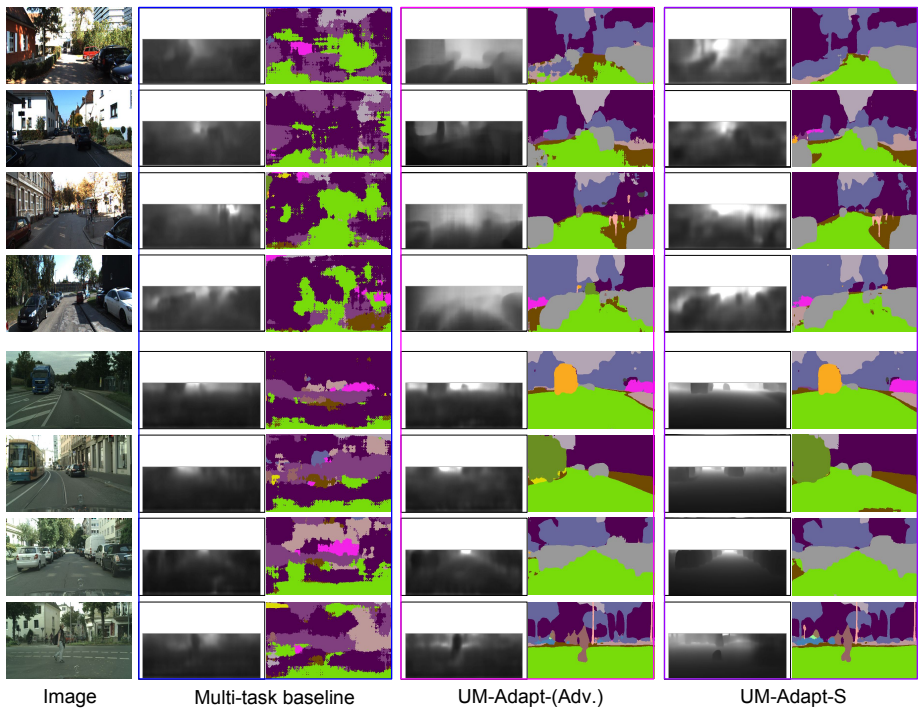
Summary. The paper proposes UM-Adapt, a unified framework for unsupervised multi-task adaptation of spatially-structured tasks (monocular depth, surface normals, semantic segmentation) under synthetic-to-real domain shift. The two proposed regularizers are contour-based content regularization (CCR), which matches contour maps reconstructed from the shared encoder against a contour prior, and cross-task distillation, in which frozen task-transfer networks map one task output to another and the discrepancy between direct and transferred predictions is used as a training signal. The paper additionally proposes an adversarial variant, UM-Adapt-(Adv.), in which the task-transfer networks are treated as energy functions and updated to score source ground-truth tuples low and target prediction tuples high, while the target encoder is updated to produce low-energy tuples. Experiments cover PBRS-to-NYUD adaptation (depth, normals, segmentation), GTA5-to-KITTI/Cityscapes adaptation, a semi-supervised variant UM-Adapt-S, and transfer learning to ImageNet classification and PASCAL VOC detection.
Significance. If the central claims were fully borne out, the paper would make a meaningful contribution: a single multi-task adaptation framework with a simple content regularizer (CCR) that visibly improves over the FCF baseline on all NYUD tasks, and a cross-task distillation objective that improves over the joint-discriminator baseline. The non-adversarial components are coherent and the ablations show consistent gains. However, the paper's distinctive advertised mechanism, the adversarial energy-based cross-task distillation, is not empirically supported: the differences between UM-Adapt-(noAdv.) and UM-Adapt-(Adv.) in Tables 1-3 are within run-to-run noise, with no error bars or multiple seeds. Furthermore, the headline semi-supervised SOTA claims rest on comparisons against fully-supervised baselines using far more labeled target data (30k vs. 795 for NYUD). The transfer-learning SOTA claim is based on a 0.21% top-5 improvement over a different backbone with no significance analysis. The non-adversarial core is credible, but the paper's framing and headline claims overstate what the evidence shows.
major comments (3)
- [Section 3.3.2 / Algorithm 2; Tables 1-3] The adversarial cross-task distillation is the paper's second and third stated contributions, yet the reported data do not demonstrate that it helps. Across Tables 1-3, UM-Adapt-(Adv.) versus UM-Adapt-(noAdv.) differ only by depth rel 0.178 vs. 0.175, normals mean 22.2 vs. 22.2, and segmentation mIoU 0.214 vs. 0.221. These differences are small and no error bars or multiple runs are reported. Section 4.2 itself states that UM-Adapt-(noAdv.) is 'significantly stable and faster' because it avoids updating the task-transfer networks. The paper therefore fails to support the claim that the adversarial energy mechanism drives the reported performance; the gains over UM-Adapt-B(CCR) could be attributed entirely to the non-adversarial distillation loss. Please either provide statistically meaningful evidence (multiple seeds, significance tests) for the advantage of the adversarial update, or reframe the contribution as non-adversarial cross-task distillation plus CCR, which the current numbers support.
- [Section 4.2; Tables 6-7] The claim that UM-Adapt-S 'outperforms the current fully-supervised multi-task learning state-of-the-art' is based on non-comparable supervision budgets. In Table 6, Kendall et al. and GradNorm are trained with 30k labeled NYUD samples, while UM-Adapt-S uses 795 labeled samples; the additional rows in Table 5 indicate UM-Adapt-S uses 500 labeled Cityscapes images, whereas the comparison methods in Table 7 are trained on full supervision. A semi-supervised method with far fewer labels can outperform a fully-supervised method, but the abstract and Section 4.2 present this as an unqualified SOTA result without acknowledging the label-count difference. Please report comparisons under matched label budgets, or clearly qualify the claim and state the supervision counts for each baseline.
- [Section 4.3; Table 8] The transfer-learning claim of 'state-of-the-art ... on ImageNet classification' rests on a 69.51 vs. 69.30 top-5 accuracy difference against Doersch et al. with a ResNet-101 backbone, while UM-Adapt-S uses a ResNet-50. This 0.21-point gap is well within typical run-to-run noise and no error bars or multiple runs are provided. On PASCAL detection UM-Adapt-S is actually lower than the best baseline (70.02 vs. 70.53). The claim should be softened to 'comparable' or supported with more rigorous comparisons including uncertainty estimates and matched backbones.
minor comments (5)
- [Abstract / Section 4.3] The abstract's 'state-of-the-art transfer learning results on ImageNet classification' is not justified by the single comparison against Doersch et al.; the evaluation uses only one prior method family and no significance analysis.
- [Section 3.2] The notation 'GT con.' is introduced without explicitly stating that it is the output of a standard contour detection algorithm (HED); please define it at first use.
- [Section 4.1 / Supplementary] Important hyperparameters appear only in the supplementary: the pseudo-softmax noise scale (truncated normal with std 0.075) and the gradient mask proportion (50%). These are part of the method and should be stated in the main text or at least referenced explicitly in the main experimental section.
- [Throughout] There are numerous typos and inconsistent spellings: 'Muti-task learning' in the introduction, 'sematic' instead of 'semantic' in Tables 3 and 5, and 'Liana et al.' instead of 'Laina et al.' in the experimental setting. These should be corrected in a polished revision.
- [Figure 2] Figure 2 is dense and difficult to read at publication resolution; the task-transfer network architectures are only in the supplementary and should be summarized in the caption or main text.
Circularity Check
No significant circularity: the UM-Adapt objective is a standard adversarial consistency regularizer evaluated on held-out target benchmarks, and no prediction reduces by construction to a fitted input.
full rationale
The paper's unsupervised adaptation (Algorithm 2) is a minimax game rather than a derivation: the task-transfer networks N->ti are trained on synthetic source ground-truth output maps, and the target branch Mt is updated using the transfer-consistency energy L_G^ti = L_ti(Yhat^{->ti}_t, Yhat^ti_t) plus the contour-based self-supervised loss L_CCR. Target labels are never used in the unsupervised variant, and the NYUD, Cityscapes, ImageNet, and PASCAL VOC numbers are measured on held-out target data, so the reported results are not fitted inputs renamed as predictions. CCR uses contour pseudo-labels obtained from the input image by a standard contour detector, and the contour decoder is frozen, so it is a self-supervised regularizer, not a target-label fit. Self-citations to AdaDepth [29] provide architectural initialization and an ablation baseline, but the central claim does not rest on an unverified uniqueness theorem or on a self-citation chain. The paper itself notes that UM-Adapt-(Adv.) gives only minimal improvement over UM-Adapt-(noAdv.) and that noAdv. is 'significantly stable and faster'; this is an effect-size and robustness concern, not a circularity. No equation in the paper reduces to its own input by construction, so no circular step can be exhibited.
Assumptions & free parameters
free parameters (4)
- Distillation loss weight alpha =
10
- CCR loss weight lambda
- Pseudo-softmax noise scale =
truncated Normal std 0.075, mean 1
- Gradient mask proportion =
50%
assumptions (4)
- domain assumption Majority of image contours align with the contours of task-specific output maps.
- domain assumption Task-transfer networks trained on source ground-truth maps approximate the cross-task energy manifold for target predictions.
- domain assumption Adapting only the Res-5 block of the target encoder is sufficient to bridge the domain shift.
- standard math Standard stochastic optimization (Adam, WGAN-GP training) converges to a useful solution.
Cite this review
Pith. "Pith review of UM-Adapt: Unsupervised Multi-Task Adaptation Using Adversarial Cross-Task Distillation." pith.science (2026). https://pith.science/paper/4CP7T3PP
@misc{pith2026190803884,
  author       = {Pith},
  title        = {Pith review of: UM-Adapt: Unsupervised Multi-Task Adaptation Using Adversarial Cross-Task Distillation},
  year         = {2026},
  howpublished = {\url{https://pith.science/paper/4CP7T3PP}},
  note         = {Machine review of arXiv:1908.03884}
}
read the original abstract
Aiming towards human-level generalization, there is a need to explore adaptable representation learning methods with greater transferability. Most existing approaches independently address task-transferability and cross-domain adaptation, resulting in limited generalization. In this paper, we propose UM-Adapt - a unified framework to effectively perform unsupervised domain adaptation for spatially-structured prediction tasks, simultaneously maintaining a balanced performance across individual tasks in a multi-task setting. To realize this, we propose two novel regularization strategies; a) Contour-based content regularization (CCR) and b) exploitation of inter-task coherency using a cross-task distillation module. Furthermore, avoiding a conventional ad-hoc domain discriminator, we re-utilize the cross-task distillation loss as output of an energy function to adversarially minimize the input domain discrepancy. Through extensive experiments, we demonstrate superior generalizability of the learned representations simultaneously for multiple tasks under domain-shifts from synthetic to natural environments. UM-Adapt yields state-of-the-art transfer learning results on ImageNet classification and comparable performance on PASCAL VOC 2007 detection task, even with a smaller backbone-net. Moreover, the resulting semi-supervised framework outperforms the current fully-supervised multi-task learning state-of-the-art on both NYUD and Cityscapes dataset.
Figures


Figures from the paper (3 more)


Reference graph
Works this paper leans on
-
[1]
Amir Atapour-Abarghouei and Toby P Breckon. Real-time monocular depth estimation using synthetic data with do- main adaptation via image style transfer. In CVPR, 2018. 2, 4
work page 2018
-
[2]
Unsupervised pixel- level domain adaptation with generative adversarial net- works
Konstantinos Bousmalis, Nathan Silberman, David Dohan, Dumitru Erhan, and Dilip Krishnan. Unsupervised pixel- level domain adaptation with generative adversarial net- works. In CVPR, 2017. 2
work page 2017
-
[3]
Rich Caruana. Multitask learning. Machine learning , 28(1):41–75, 1997. 3
work page 1997
-
[4]
No more discrimi- nation: Cross city adaptation of road scene segmenters
Yi-Hsin Chen, Wei-Yu Chen, Yu-Ting Chen, Bo-Cheng Tsai, Yu-Chiang Frank Wang, and Min Sun. No more discrimi- nation: Cross city adaptation of road scene segmenters. In ICCV, 2017. 1, 8
work page 2017
-
[5]
The cityscapes dataset for semantic urban scene understanding
Marius Cordts, Mohamed Omran, Sebastian Ramos, Timo Rehfeld, Markus Enzweiler, Rodrigo Benenson, Uwe Franke, Stefan Roth, and Bernt Schiele. The cityscapes dataset for semantic urban scene understanding. In CVPR,
-
[6]
Domain adaptation for visual applications: A comprehensive survey
Gabriela Csurka. Domain adaptation for visual applications: A comprehensive survey. arXiv preprint arXiv:1702.05374,
-
[7]
Multi-task self- supervised visual learning
Carl Doersch and Andrew Zisserman. Multi-task self- supervised visual learning. In ICCV, 2017. 8
work page 2017
-
[8]
David Eigen and Rob Fergus. Predicting depth, surface nor- mals and semantic labels with a common multi-scale convo- lutional architecture. In ICCV, 2015. 1, 3, 6
work page 2015
Show all 67 references
-
[9]
Depth map prediction from a single image using a multi-scale deep net- work
David Eigen, Christian Puhrsch, and Rob Fergus. Depth map prediction from a single image using a multi-scale deep net- work. In NIPS, pages 2366–2374, 2014. 3, 6, 7
2014
-
[10]
Unsupervised domain adaptation by backpropagation
Yaroslav Ganin and Victor Lempitsky. Unsupervised domain adaptation by backpropagation. In ICML, 2015. 2
2015
-
[11]
Domain-adversarial train- ing of neural networks
Yaroslav Ganin, Evgeniya Ustinova, Hana Ajakan, Pas- cal Germain, Hugo Larochelle, Franc ¸ois Laviolette, Mario Marchand, and Victor Lempitsky. Domain-adversarial train- ing of neural networks. The Journal of Machine Learning Research, 17(1):2096–2030, 2016. 2
2016
-
[12]
Bastiaan Kleijn, Mengjie Zhang, and David Balduzzi
Muhammad Ghifary, W. Bastiaan Kleijn, Mengjie Zhang, and David Balduzzi. Domain generalization for object recog- nition with multi-task autoencoders. In ICCV, 2015. 1
2015
-
[13]
Bros- tow
Cl ´ement Godard, Oisin Mac Aodha, and Gabriel J. Bros- tow. Unsupervised monocular depth estimation with left- right consistency. In CVPR, 2017. 7
2017
-
[14]
Generative adversarial nets
Ian Goodfellow, Jean Pouget-Abadie, Mehdi Mirza, Bing Xu, David Warde-Farley, Sherjil Ozair, Aaron Courville, and Yoshua Bengio. Generative adversarial nets. In NIPS, 2014. 2
2014
-
[15]
Gretton, AJ
A. Gretton, AJ. Smola, J. Huang, M. Schmittfull, KM. Borg- wardt, and B. Sch ¨olkopf. Covariate shift and local learning by distribution matching. MIT Press. 2
-
[16]
Heterogeneous face attribute estimation: A deep multi-task learning approach
Hu Han, Anil K Jain, Shiguang Shan, and Xilin Chen. Heterogeneous face attribute estimation: A deep multi-task learning approach. IEEE transactions on pattern analysis and machine intelligence, 2017. 3
2017
-
[17]
A joint many-task model: Growing a neural network for multiple nlp tasks
Kazuma Hashimoto, Caiming Xiong, Yoshimasa Tsuruoka, and Richard Socher. A joint many-task model: Growing a neural network for multiple nlp tasks. arXiv preprint arXiv:1611.01587, 2016. 2
2016 arXiv
-
[18]
Distilling the knowledge in a neural network
Geoffrey Hinton, Oriol Vinyals, and Jeff Dean. Distilling the knowledge in a neural network. 2014. 4
2014
-
[19]
Cycada: Cycle-consistent adversarial domain adapta- tion
Judy Hoffman, Eric Tzeng, Taesung Park, Jun-Yan Zhu, Phillip Isola, Kate Saenko, Alexei A Efros, and Trevor Dar- rell. Cycada: Cycle-consistent adversarial domain adapta- tion. In ICML, 2018. 2, 4, 7
2018
-
[20]
Fcns in the wild: Pixel-level adversarial and constraint-based adaptation
Judy Hoffman, Dequan Wang, Fisher Yu, and Trevor Darrell. Fcns in the wild: Pixel-level adversarial and constraint-based adaptation. arXiv preprint arXiv:1612.02649, 2016. 7
2016 arXiv
-
[21]
Conditional generative adversarial network for struc- tured domain adaptation
Weixiang Hong, Zhenzhen Wang, Ming Yang, and Junsong Yuan. Conditional generative adversarial network for struc- tured domain adaptation. In CVPR, 2018. 2
2018
-
[22]
Phillip Isola, Jun-Yan Zhu, Tinghui Zhou, and Alexei A. Efros. Image-to-image translation with conditional adver- sarial networks. In CVPR, 2017. 2
2017
-
[23]
Analyzing modu- lar cnn architectures for joint depth prediction and semantic segmentation
Omid Hosseini Jafari, Oliver Groth, Alexander Kirillov, Michael Ying Yang, and Carsten Rother. Analyzing modu- lar cnn architectures for joint depth prediction and semantic segmentation. In ICRA, 2017. 6
2017
-
[24]
Multi-task learning using uncertainty to weigh losses for scene geome- try and semantics
Alex Kendall, Yarin Gal, and Roberto Cipolla. Multi-task learning using uncertainty to weigh losses for scene geome- try and semantics. In CVPR, 2018. 2, 3, 8
2018
-
[25]
Adam: A method for stochastic optimization
Diederik Kingma and Jimmy Ba. Adam: A method for stochastic optimization. arXiv preprint arXiv:1412.6980 ,
-
[26]
Recurrent scene parsing with perspective understanding in the loop
Shu Kong and Charless Fowlkes. Recurrent scene parsing with perspective understanding in the loop. arXiv preprint arXiv:1705.07238, 2017. 6
2017 arXiv
-
[27]
Saliency unified: A deep architecture for simultaneous eye fixation prediction and salient object segmentation
Srinivas SS Kruthiventi, Vennela Gudisa, Jaley H Dholakiya, and R Venkatesh Babu. Saliency unified: A deep architecture for simultaneous eye fixation prediction and salient object segmentation. In CVPR, 2016. 3
2016
-
[28]
Unsupervised feature learning of human actions as trajectories in pose embedding manifold
Jogendra Nath Kundu, Maharshi Gor, Phani Krishna Uppala, and Venkatesh Babu Radhakrishnan. Unsupervised feature learning of human actions as trajectories in pose embedding manifold. In WACV, 2019. 1
2019
-
[29]
Adadepth: Unsupervised content congruent adaptation for depth estimation
Jogendra Nath Kundu, Phani Krishna Uppala, Anuj Pahuja, and R Venkatesh Babu. Adadepth: Unsupervised content congruent adaptation for depth estimation. In CVPR, 2018. 1, 2, 3, 4, 5, 7
2018
-
[30]
Deeper depth prediction with fully convolutional residual networks
Iro Laina, Christian Rupprecht, Vasileios Belagiannis, Fed- erico Tombari, and Nassir Navab. Deeper depth prediction with fully convolutional residual networks. In 3DV, 2016. 3, 5, 6
2016
-
[31]
Refinenet: Multi-path refinement networks for high- resolution semantic segmentation
Guosheng Lin, Anton Milan, Chunhua Shen, and Ian D Reid. Refinenet: Multi-path refinement networks for high- resolution semantic segmentation. In CVPR, 2017. 6
2017
-
[32]
Efficient piecewise training of deep structured models for semantic segmentation
Guosheng Lin, Chunhua Shen, Anton Van Den Hengel, and Ian Reid. Efficient piecewise training of deep structured models for semantic segmentation. In CVPR, 2016. 6
2016
-
[33]
Deep con- volutional neural fields for depth estimation from a single image
Fayao Liu, Chunhua Shen, and Guosheng Lin. Deep con- volutional neural fields for depth estimation from a single image. In CVPR, 2015. 6
2015
-
[34]
End- to-end multi-task learning with attention
Shikun Liu, Edward Johns, and Andrew J Davison. End- to-end multi-task learning with attention. arXiv preprint arXiv:1803.10704, 2018. 8
2018 arXiv
-
[35]
Fully convolutional networks for semantic segmentation
Jonathan Long, Evan Shelhamer, and Trevor Darrell. Fully convolutional networks for semantic segmentation. In CVPR, 2015. 6
2015
-
[36]
Learning transferable features with deep adaptation net- works
Mingsheng Long, Yue Cao, Jianmin Wang, and Michael Jor- dan. Learning transferable features with deep adaptation net- works. In ICML, 2015. 2
2015
-
[37]
Unsupervised domain adaptation with residual trans- fer networks
Mingsheng Long, Han Zhu, Jianmin Wang, and Michael I Jordan. Unsupervised domain adaptation with residual trans- fer networks. In NIPS, 2016. 5
2016
-
[38]
Cross-stitch networks for multi-task learning
Ishan Misra, Abhinav Shrivastava, Abhinav Gupta, and Mar- tial Hebert. Cross-stitch networks for multi-task learning. In CVPR, 2016. 2, 3
2016
-
[39]
Joint semantic segmentation and depth estimation with deep convolutional networks
Arsalan Mousavian, Hamed Pirsiavash, and Jana Ko ˇseck´a. Joint semantic segmentation and depth estimation with deep convolutional networks. In 3DV. IEEE, 2016. 6
2016
-
[40]
Image to image translation for domain adaptation
Zak Murez, Soheil Kolouri, David Kriegman, Ravi Ra- mamoorthi, and Kyungnam Kim. Image to image translation for domain adaptation. In CVPR, 2018. 4
2018
-
[41]
Learning features by watching ob- jects move
Deepak Pathak, Ross Girshick, Piotr Dollar, Trevor Darrell, and Bharath Hariharan. Learning features by watching ob- jects move. In CVPR, 2017. 8
2017
-
[42]
Geonet: Geometric neural network for joint depth and surface normal estimation
Xiaojuan Qi, Renjie Liao, Zhengzhe Liu, Raquel Urtasun, and Jiaya Jia. Geonet: Geometric neural network for joint depth and surface normal estimation. In CVPR, 2018. 6
2018
-
[43]
Hy- perface: A deep multi-task learning framework for face de- tection, landmark localization, pose estimation, and gender recognition
Rajeev Ranjan, Vishal M Patel, and Rama Chellappa. Hy- perface: A deep multi-task learning framework for face de- tection, landmark localization, pose estimation, and gender recognition. IEEE Transactions on Pattern Analysis and Ma- chine Intelligence, 2017. 3
2017
-
[44]
Faster r-cnn: Towards real-time object detection with region proposal networks
Shaoqing Ren, Kaiming He, Ross Girshick, and Jian Sun. Faster r-cnn: Towards real-time object detection with region proposal networks. In NIPS, pages 91–99, 2015. 8
2015
-
[45]
Cross-domain self- supervised multi-task feature learning using synthetic im- agery
Zhongzheng Ren and Yong Jae Lee. Cross-domain self- supervised multi-task feature learning using synthetic im- agery. In CVPR, 2018. 2, 3
2018
-
[46]
Playing for data: Ground truth from computer games
Stephan R Richter, Vibhav Vineet, Stefan Roth, and Vladlen Koltun. Playing for data: Ground truth from computer games. In ECCV, 2016. 6
2016
-
[47]
Monocular depth esti- mation using neural regression forest
Anirban Roy and Sinisa Todorovic. Monocular depth esti- mation using neural regression forest. In CVPR, 2016. 6
2016
-
[48]
Imagenet large scale visual recognition challenge
Olga Russakovsky, Jia Deng, Hao Su, Jonathan Krause, San- jeev Satheesh, Sean Ma, Zhiheng Huang, Andrej Karpathy, Aditya Khosla, Michael Bernstein, et al. Imagenet large scale visual recognition challenge. International journal of computer vision, 115(3):211–252, 2015. 8
2015
-
[49]
Improved techniques for training gans
Tim Salimans, Ian Goodfellow, Wojciech Zaremba, Vicki Cheung, Alec Radford, and Xi Chen. Improved techniques for training gans. In NIPS, 2016. 1
2016
-
[50]
Learning from synthetic data: Addressing domain shift for semantic segmentation
Swami Sankaranarayanan, Yogesh Balaji, Arpit Jain, Ser Nam Lim, and Rama Chellappa. Learning from synthetic data: Addressing domain shift for semantic segmentation. In CVPR, 2018. 4
2018
-
[51]
Make3d: Learning 3d scene structure from a single still image
Ashutosh Saxena, Min Sun, and Andrew Y Ng. Make3d: Learning 3d scene structure from a single still image. IEEE Transactions on Pattern Analysis and Machine Intelligence, 31(5):824–840, 2009. 6
2009
-
[52]
Indoor segmentation and support inference from rgbd images
Nathan Silberman, Derek Hoiem, Pushmeet Kohli, and Rob Fergus. Indoor segmentation and support inference from rgbd images. In ECCV. Springer, 2012. 6
2012
-
[53]
Deep coral: Correlation alignment for deep domain adaptation
Baochen Sun and Kate Saenko. Deep coral: Correlation alignment for deep domain adaptation. In ECCV Workshops,
-
[54]
Tsai, W.-C
Y .-H. Tsai, W.-C. Hung, S. Schulter, K. Sohn, M.-H. Yang, and M. Chandraker. Learning to adapt structured output space for semantic segmentation. In CVPR, 2018. 5, 7
2018
-
[55]
Simultaneous deep transfer across domains and tasks
Eric Tzeng, Judy Hoffman, Trevor Darrell, and Kate Saenko. Simultaneous deep transfer across domains and tasks. In ICCV, 2015. 2, 7
2015
-
[56]
Adversarial discriminative domain adaptation
Eric Tzeng, Judy Hoffman, Trevor Darrell, and Kate Saenko. Adversarial discriminative domain adaptation. In CVPR,
-
[57]
Deep domain confusion: Maximizing for domain invariance
Eric Tzeng, Judy Hoffman, Ning Zhang, Kate Saenko, and Trevor Darrell. Deep domain confusion: Maximizing for domain invariance. arXiv preprint arXiv:1412.3474, 2014. 1
2014 arXiv
-
[58]
Towards unified depth and seman- tic prediction from a single image
Peng Wang, Xiaohui Shen, Zhe Lin, Scott Cohen, Brian Price, and Alan L Yuille. Towards unified depth and seman- tic prediction from a single image. In CVPR, 2015. 6
2015
-
[59]
Design- ing deep networks for surface normal estimation
Xiaolong Wang, David Fouhey, and Abhinav Gupta. Design- ing deep networks for surface normal estimation. In CVPR,
-
[60]
Holistically-nested edge detection
Saining ”Xie and Zhuowen” Tu. Holistically-nested edge detection. In ICCV, 2015. 4
2015
-
[61]
Describing the scene as a whole: Joint object detection, scene classification and semantic segmentation
Jian Yao, Sanja Fidler, and Raquel Urtasun. Describing the scene as a whole: Joint object detection, scene classification and semantic segmentation. In CVPR, 2012. 3
2012
-
[62]
Curricu- lum domain adaptation for semantic segmentation of urban scenes
Yang Zhang, Philip David, and Boqing Gong. Curricu- lum domain adaptation for semantic segmentation of urban scenes. In ICCV, 2017. 1, 7
2017
-
[63]
Physically-based rendering for indoor scene understanding using convolutional neural networks
Yinda Zhang, Shuran Song, Ersin Yumer, Manolis Savva, Joon-Young Lee, Hailin Jin, and Thomas Funkhouser. Physically-based rendering for indoor scene understanding using convolutional neural networks. In CVPR, 2017. 6
2017
-
[64]
Energy- based generative adversarial network
Junbo Zhao, Michael Mathieu, and Yann LeCun. Energy- based generative adversarial network. In ICLR, 2017. 2, 5
2017
-
[65]
Gradnorm: Gradient normalization for adaptive loss balancing in deep multitask networks
Chen-Yu Lee Zhao Chen, Vijay Badrinarayanan and Andrew Rabinovich. Gradnorm: Gradient normalization for adaptive loss balancing in deep multitask networks. In ICML, 2018. 3, 8
2018
-
[66]
Unsupervised learning of depth and ego-motion from video
Tinghui Zhou, Matthew Brown, Noah Snavely, and David G Lowe. Unsupervised learning of depth and ego-motion from video. In CVPR, 2017. 7
2017
-
[67]
Unpaired image-to-image translation using cycle- consistent adversarial networks
Jun-Yan Zhu, Taesung Park, Phillip Isola, and Alexei A Efros. Unpaired image-to-image translation using cycle- consistent adversarial networks. In ICCV, 2017. 2
2017
Reviewed August 14, 2026 · model on record in the stance chip above.
Discussion (0). Continue with ORCID to comment.