REVIEW 4 major objections 4 minor 119 references
Close Hyperbolic Encounters In f(R) Gravity
T0 review · 4 major / 4 minor · reviewed 2026-08-06 · deepseek-v4-flash
Pith's one-line read The paper argues that close hyperbolic black-hole encounters in f(R) gravity emit scalar gravitational waves with amplitudes comparable to the tensor modes, producing time delays of up to roughly a hundred seconds, making such bursts a…
desk verdict A recognizable extension of existing f(R) scalar-quadrupole work to hyperbolic encounters, with clean waveform algebra but a load-bearing mistake: the scalar 'radiation' is computed with a static Yukawa Green's function, so the advertised order-unity amplitude ratios do not follow. read the letter →
The pith
A machine-rendered reading of the paper's core claim, the machinery that carries it, and where it could break.
The reading
What carries the argument
The load-bearing object is the scalar quadrupole radiation formula, equation (2.48): $\Phi = \frac{4G\,e^{-m_S R}}{R c^2} M + \frac{2G\,e^{-m_S R}}{R c^4}\ddot{Q}$, which comes from the retarded Green's function of a massive scalar field in equation (2.36). Here $m_S$ is the mass of the scalar mode, $M$ is the total mass, $Q$ is the trace of the quadrupole moment, and the exponential is a Yukawa-like cutoff. Feeding this with Newtonian hyperbolic orbits, and with orbits modified by a precession parameter $\alpha$, yields the waveform expressions (3.10) and (3.17). The $\alpha$-dependent factor $(\alpha-1)^2$ in the scalar formula is what makes the scalar mode decrease as precession increases, and the $r^{-1}e^{-m_S R}$ structure determines both the amplitude ratio and the time-delay estimates. The paper notes in a footnote that different gravitational potentials give different precession relations, and it restricts itself to precession values $\alpha < 3/4$, where the periastron stays outside the Schwarzschild radius.
What would settle it
Re-evaluate the scalar amplitude using the exact retarded Green's function of equation (2.29) (or equation 2.36) at the specific $(m_S, R)$ pairs in Tables I and II, without the constant-propagation-speed approximation. At the galactic-center pair ($R = 10\,\mathrm{kpc}$, $m_S = 10^{-22}\,\mathrm{eV}/c^2$) the factor $e^{-m_S R}$ is astronomically small, so the scalar-to-tensor ratio would drop far below the tabulated 0.5–0.7; reproducing the tabulated values would require a derivation of why the exponential drops out for radiative waves, or a corrected radiative formula.
Extended reading notes
Core claim
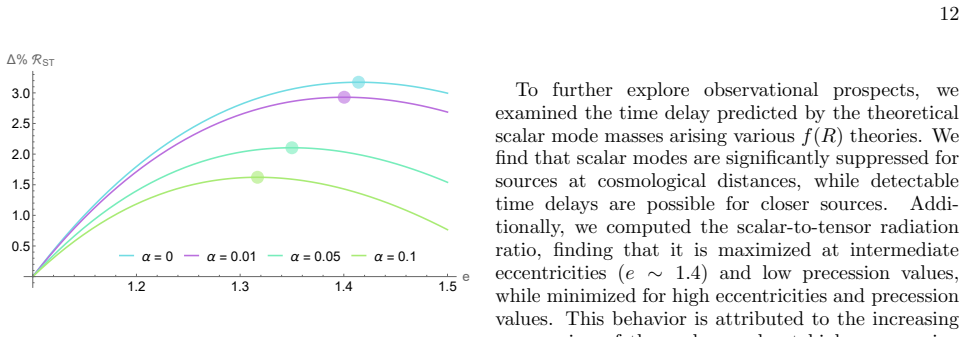
On the paper's own terms, the discovery is that the scalar gravitational-wave mode of $f(R)$ gravity is not negligible in close hyperbolic encounters: the scalar strain peaks at periastron like the tensor modes, and the averaged scalar-to-tensor amplitude ratio $R_{ST}$ ranges between about 0.51 and 0.70 for eccentricities $1.1 \le e \le 1.7$ and precession parameters $0 \le \alpha \le 0.1$, values that are large compared with earlier $f(R)$ expectations of $10^{-3}$ to $10^{-1}$. The authors also derive time delays between the tensor and scalar arrivals that can be as large as $1.2 \times 10^2$ s for the largest scalar mass scale they consider at cosmological distances, and they map how these observables depend on eccentricity and precession: higher eccentricity suppresses all modes, while higher precession suppresses the scalar mode specifically, through the $(\alpha-1)^2$ prefactor in the scalar quadrupole formula. The paper states that these results suggest close hyperbolic encounters are likely to generate detectable $f(R)$ scalar-mode radiation for all combinations of parameter values considered.
Load-bearing premise
The whole detectability prediction rests on one approximation: in the scalar quadrupole formula, the retarded massive-scalar response is replaced by a static Yukawa factor $e^{-m_S R}$, with a constant propagation speed and a source that does not depend on the scalar speed. If that factor really applies across the distances used in the tables, the galactic-center and globular-cluster scalar amplitudes would be exponentially tiny, not comparable to tensor waves; if it does not apply to radiating waves, then the formula used to compute those amplitudes is not the correct radiative formula.
Editorial extensions
If this is right
- If the scalar quadrupole formula is correct, close hyperbolic encounters add a new class of burst sources whose scalar-mode amplitude rivals the tensor strain, so detectors that see these bursts could measure $f(R)$ deviations from general relativity without waiting for a merger.
- The predicted time delays, up to about $10^2$ s at cosmological distances for the heaviest scalar masses considered, give an observable signature that could separate a massive scalar mode from a luminal tensor mode in the same event.
- The finding that the scalar-to-tensor ratio peaks near $e \approx 1.4$ and drops with increasing precession gives an orbital-shape preference: searches should target intermediate-eccentricity, low-precession encounters.
- Higher eccentricity suppresses all three polarization amplitudes, making detection most likely for encounters with $e$ close to $1.1$\textendash$1.3$, where the interaction time is longer.
- The three source environments—galactic center, globular clusters, and primordial black-hole populations—yield a wide spread of expected time delays, so a non-detection in one environment but detection in another could already constrain the scalar mass scale.
Reading between the lines
- A natural extension the paper leaves implicit is to convert the time-domain waveforms into a frequency-domain power spectrum; if the radiation is dominated by low frequencies, space-based observatories rather than ground-based ones would be the natural follow-up.
- Because the same quadrupole machinery works for any theory with one massive scalar polarization, the waveform templates could be adapted to scalar-tensor and other modified-gravity models with minimal changes, giving a common framework for burst searches.
- The paper's $e \approx 1.4$ optimum is a population-level prediction: if $f(R)$ scalar bursts exist, the detected close-encounter population should show a detection-efficiency peak at intermediate eccentricities and low precession, a statistical signature that general-relativity-only templates would not produce.
- The scalar-mode memory effect and total radiated energy, both flagged as future work, would provide independent observables; a memory measurement could distinguish the massive scalar's long-range behavior from a massless one.
Editorial analysis
A structured set of objections, weighed in public.
Referee Report
Summary. The paper studies gravitational-wave emission from close hyperbolic encounters (CHEs) of black holes in f(R) gravity. It derives quadrupole-order waveforms for the tensor polarizations and the scalar longitudinal polarization, first for Newtonian hyperbolic orbits and then for orbits modified by a precession parameter. Using masses associated with Starobinsky, Hu-Sawicki, and Exponential f(R) models, it estimates scalar-to-tensor time delays and amplitude ratios for galactic-centre, globular-cluster, and primordial-black-hole distances, and concludes that CHEs are a promising probe of f(R) gravity.
Significance. The topic is timely: CHEs are plausible burst sources, and the f(R) scalar polarization is a concrete beyond-GR prediction. The paper's main conceptual contribution would be a first systematic treatment of scalar-mode bremsstrahlung from unbound encounters, with explicit waveform formulas and tabulated observables. However, the central quantitative claims rest on an incorrect treatment of the massive-scalar radiative Green's function, and the tables are internally inconsistent with the stated formulas. As it stands, the detectability conclusions are not supported; the useful parts are the tensor waveform algebra and the outline of a framework that could be repaired with a proper radiative derivation.
major comments (4)
- [II.B.2, Eq. (2.47)] Equation (2.47) is obtained from the retarded solution (2.36) by assuming that T is independent of cosh ξ and that the scalar propagation speed cS is constant. This is the static/Yukawa limit, not the radiative limit. For a CHE source varying on the orbital timescale, the relevant Fourier components satisfy ω ≫ mS c^2/ħ for all masses in Tables I and II, so the massive Green's function (2.25) gives a propagating wave with amplitude proportional to 1/R and phase kR with k = sqrt(ω^2/c^2 - mS^2 c^2/ħ^2), with no exponential factor e^{-mS R}. Consequently the scalar waveforms (3.10) and (3.17), and every observable derived from them, do not follow from the equations presented.
- [Table II, Eqs. (3.17) and (5.1)] Table II is internally inconsistent with the stated scalar amplitude. For mS = 10^-22 eV/c^2 and R = 10 kpc, the factor e^{-mS R} equals e^{-1.5×10^5}; for mS = 10^-24 eV/c^2 and R = 100 kpc, it equals e^{-1.5×10^4}. The table reports RST ≈ 0.69-0.70 in both columns. If the exponential factor is retained, these entries should be astronomically small; if it is omitted, then Eq. (2.47) is not being used and the tabulated values are not derived from the paper's formulas. Either way, the order-unity RST values that support the detectability claim are unsupported.
- [§5, Eq. (5.2)] The definition of RST is incomplete. It is written as <|Q|>/<|h|>, but the relation of these averages to the scalar and tensor strains in Eqs. (3.15)-(3.17) is not shown, and it is unclear how the constant M/R term in Eq. (2.48), which is not radiative, is treated. Without this derivation the reader cannot verify the tabulated ratios, especially their near-independence of mS.
- [§IV, Eqs. (4.7)-(4.8)] The time-delay estimates assume a monochromatic wave at f = 1 Hz and a single group velocity. A CHE burst has a broadband spectrum, and for a massive scalar the group delay is frequency dependent; for frequencies characteristic of the encounters considered here, the delay can be orders of magnitude larger than the f = 1 Hz estimate. The detectability statement should be based on a frequency-dependent arrival-time analysis over the relevant signal band.
minor comments (4)
- [Section IV heading] The heading 'CONSTRAINS ON SCALAR MASSIVE MODE TIME DELAY' should read 'CONSTRAINTS ON SCALAR MASSIVE MODE TIME DELAY'.
- [Eq. (2.21)] The Fourier representation of the tensor Green's function appears to contain misplaced 1/√π^3 factors; the equation should be cleaned up.
- [Fig. 5 caption] The caption states that the cross-polarization strain is scaled by Gµv0^2/R, but Eq. (3.9) has prefactor Gµv0^2/(R c^4); the c^4 is missing.
- [Eq. (3.12) and surrounding text] The statement that valid precession values satisfy α < 3/4 is loose: the condition Rs < rmin gives α < 3/[2(e+1)], which depends on eccentricity and is tighter for large e. The text should state this dependence explicitly.
Circularity Check
No significant circularity: scalar-mode inputs (mS) come from external f(R) models and observables are computed from stated formulae.
full rationale
The paper's derivation chain uses as inputs the f(R) action (2.1), the scalar-mass definition (2.16), external mS values from Starobinsky, Hu-Sawicki and Exponential models, and orbital parameters. The tensor and scalar waveforms are obtained by substituting a Newtonian or precessing hyperbolic trajectory into the quadrupole formulae (2.41)-(2.43) and (2.48). No parameter is fitted to the quantity it is later claimed to predict: time delays in Table I follow directly from the dispersion relation (4.3) and the distance R, while the RST values in Table II follow from the amplitude ratio (5.1) applied to the derived strains. The scalar formula (2.47) is an explicitly stated approximation drawn from Ref. [60] (Inagaki and Taniguchi), an external work rather than a self-citation; the assumptions of constant scalar propagation speed and a source independent of cosh xi are stated openly in the text. Self-citations [38,41,61,62] appear only for background f(R) perturbation theory and are not load-bearing for the observational conclusions. The possible physical objection that Eq. (2.47) replaces a retarded massive Green's function with a static Yukawa factor, or that Table II appears not to include e^{-mS R}, is a correctness and validity concern rather than circularity: it does not make the output equivalent to the input by construction. No uniqueness theorem is imported from the authors' prior work, and no known result is merely renamed. Accordingly, the circularity burden is not met, and the paper is assigned score 0.
Assumptions & free parameters
free parameters (2)
- scalar mode mass mS =
case values 10^-22, 10^-24, 10^-33 eV/c^2
- effective gravitational constant G/f'(0) =
G with f'(0) implicitly set to 1
assumptions (5)
- domain assumption Linearization around Minkowski with R=0, f(R)=f(0)+f'(0)δR
- domain assumption Non-relativistic quadrupole approximation and distant-observer limit |Δx|~R
- domain assumption Scalar Green's function approximated by a static Yukawa e^{-mS R}/R with constant cS and T independent of cosh ξ
- domain assumption Precession parameter α = 3G^2M^2/(c^2 L^2) with orbit r_pr(φ), Eqs. (3.11)-(3.12), taken from [22]
- standard math Trace source decomposition T = -T^0_0 + T^i_i and ∫ T^0_0 d^3x = M c^2
Cite this review
Pith. "Pith review of Close Hyperbolic Encounters In f(R) Gravity." pith.science (2026). https://pith.science/paper/4CS3RQ67
@misc{pith2026250620787,
  author       = {Pith},
  title        = {Pith review of: Close Hyperbolic Encounters In f(R) Gravity},
  year         = {2026},
  howpublished = {\url{https://pith.science/paper/4CS3RQ67}},
  note         = {Machine review of arXiv:2506.20787}
}
read the original abstract
We explore the dynamics and gravitational-wave emission from black hole pairs on unbound orbits undergoing close hyperbolic encounters (CHEs) in dense astrophysical environments. While General Relativity predicts gravitational Bremsstrahlung radiation occurring at periastron, the contribution of the scalar gravitational-wave mode in fully general f(R) gravity remains largely unexplored. We characterize the f(R) scalar mode gravitational radiation for both non-precessing and precessing hyperbolic orbits, identifying potential detection signatures for advanced gravitational wave observatories. By systematically varying orbital precession and eccentricity, we examine their influence on the emitted gravitational waves. We derive potentially detectable time delay and scalar-to-tensor amplitude ratio estimates for representative astrophysical environments and determine optimal orbital configurations for the detection of f(R) scalar gravitational waves from hyperbolic encounters. Our results provide a theoretical framework for scalar-mode signals and observables, establishing CHEs as a promising probe of f(R) gravity with future detectors.
Figures


Figures from the paper (7 more)


Reference graph
Works this paper leans on
-
[60]
A. A. Starobinsky, JETP Letters 86, 157–163 (2007)
2007
-
[22]
Dimmelmeier, C
H. Dimmelmeier, C. D. Ott, A. Marek, and H.-T. Janka, Physical Review D 78, 064056 (2008)
2008
-
[1]
(2.18) The Fourier representation of ˜hµν is given by ˜hµν(x, t) = 1√ 2π Z dk0 ˜hµν(x, k0) e−ik0t, (2.19) where k0 ≡ ω c
Solution of the tensor mode wave equation We begin by introducing the energy-momentum tensor as a source to (2.13) [64], □˜hµν = 8πG c4 Tµν , (2.17) where G is the effective f (R) gravitational constant defined as G/f ′(0), and introduce a Green’s function as the solution to this sourced wave equation, □GT(x) = δ(x) . (2.18) The Fourier representation of ...
-
[2]
(2.23) To solve this wave equation we use the retarded Green’s function, GS, satisfying (□ − m2 S) GS(x) = δ(x)
Solution of the scalar mode wave equation Similarly, (2.15) is sourced by the trace of the energy-momentum tensor, (□ − m2 S)Φ = 8πG c4 T . (2.23) To solve this wave equation we use the retarded Green’s function, GS, satisfying (□ − m2 S) GS(x) = δ(x) . (2.24) Note that the inclusion of the mass mS in (2.24) differentiates this Green’s function from that ...
-
[3]
B. P. Abbott, R. Abbott, et al. , Living Reviews in Relativity 23, 3 (2020)
2020
-
[4]
This assumption leads to the simplification |∆x| ∼ |x| ≡ R, (2.37) Thus, to leading order, (2.22) can be expressed as ˜hij(x, t) ∼ 4G Rc4 Z T ij(x′, t− R) d3x′
Tensor mode quadrupole radiation We begin by integrating (2.22), assuming that the source and observer are significantly distant and that the source is non-relativistic. This assumption leads to the simplification |∆x| ∼ |x| ≡ R, (2.37) Thus, to leading order, (2.22) can be expressed as ˜hij(x, t) ∼ 4G Rc4 Z T ij(x′, t− R) d3x′ . (2.38) Using conservation...
-
[5]
Scalar mode quadrupole radiation For the scalar mode formula, we begin with a variable change that simplifies the integration of the Bessel function in (2.36) [60], w ≡ mSR sinh ξ . (2.44) 5 It follows then that the second integration term be- comes Z ∞ 0 dξ mSJ1(mSR sinh ξ) = Z ∞ 0 dw mSJ1(w)p w2 + (mSR)2 , (2.45) with Z ∞ 0 dw mSJ1(w)p w2 + (mSR)2 = mS ...
-
[6]
F. S. Broekgaarden, S. Banagiri, and E. Payne, The Astrophysical Journal 969, 108 (2024)
2024
Show all 119 references
-
[7]
DePergola and A
N. DePergola and A. Stuver, American Astro- nomical Society 243, 456.18 (2024), aDS Bibcode: 2024AAS...24345618D
2024
-
[8]
Garc ´ ıa-Bellido and S
J. Garc ´ ıa-Bellido and S. Nesseris, Physics of the Dark Universe 18, 123–126 (2017)
2017
-
[9]
Dandapat, M
S. Dandapat, M. Ebersold, A. Susobhanan, P. Rana, A. Gopakumar, S. Tiwari, M. Haney, H. M. Lee, and N. Kolhe, Phys. Rev. D 108, 024013 (2023)
2023
-
[10]
Abbott, R
B. Abbott, R. Abbott, R. Adhikari, A. Ageev, B. Allen, et al. (LIGO Scientific Collaboration), Phys. Rev. D 69, 102001 (2004)
2004
-
[11]
Wu, Y.-M
Z. Wu, Y.-M. Hu, H.-M. Fan, and I. S. Heng, Phys. Rev. D 109, 103004 (2024)
2024
- [12]
-
[13]
Abadie, B
J. Abadie, B. P. Abbott, R. Abbott, et al. , The As- trophysical Journal Letters 734, L35 (2011)
2011
-
[14]
R. M. O’Leary, B. Kocsis, and A. Loeb, Monthly Notices of the Royal Astronomical Society 395, 2127–2146 (2009)
2009
-
[15]
S. Bini, S. Tiwari, Y. Xu, L. Smith, M. Ebersold, G. Principe, M. Haney, P. Jetzer, and G. A. Prodi, Phys. Rev. D 109, 042009 (2024)
2024
-
[16]
Garc ´ ıa-Bellido and S
J. Garc ´ ıa-Bellido and S. Nesseris, Physics of the Dark Universe 21, 61–69 (2018)
2018
-
[17]
Schmidt, S
S. Schmidt, S. Caudill, J. D. E. Creighton, Tsukada, et al. , Phys. Rev. Lett. 133, 201401 (2024)
2024
-
[18]
Christensen, Reports on Progress in Physics 82, 016903 (2018)
N. Christensen, Reports on Progress in Physics 82, 016903 (2018)
2018
-
[20]
Mukherjee, S
S. Mukherjee, S. Mitra, and S. Chatterjee, Monthly Notices of the Royal Astronomical Society 508, 5064–5073 (2021)
2021
-
[21]
M. J. Szczepa´ nczyk, Y. Zheng, J. M. Antelis, et al. , Phys. Rev. D 110, 042007 (2024)
2024
-
[23]
A. M. Knee, J. McIver, S. Naoz, I. M. Romero- Shaw, B.-M. Hoang, and E. Grishin, The Astrophys- ical Journal Letters 971, L38 (2024)
2024
-
[24]
Damour and A
T. Damour and A. Vilenkin, Phys. Rev. Lett. 85, 3761 (2000)
2000
-
[25]
Damour and A
T. Damour and A. Vilenkin, Phys. Rev. D 64, 064008 (2001)
2001
-
[26]
Y. Cui, M. Lewicki, and D. E. Morrissey, Phys. Rev. Lett. 125, 211302 (2020)
2020
-
[27]
Caldarola, S
M. Caldarola, S. Kuroyanagi, S. Nesseris, and J. Garcia-Bellido, Phys. Rev. D 109, 064001 (2024)
2024
- [28]
-
[29]
Z. Xuan, S. Naoz, B. Kocsis, and E. Michaely, The Astrophysical Journal 965, 148 (2024)
2024
-
[30]
M. E. Lower, E. Thrane, P. D. Lasky, and R. Smith, Physical Review D 98, 10.1103/physrevd.98.083028 (2018)
2018 doi
-
[31]
Morscher, B
M. Morscher, B. Pattabiraman, C. Rodriguez, F. A. Rasio, and S. Umbreit, The Astrophysical Journal 800, 9 (2015)
2015
-
[32]
K. S. Thorne, ArXiv Print 10.48550/arXiv.gr- qc/9506086 (1995), arXiv:gr-qc/9506086
1995 doi
-
[33]
Chowdhuri, R
A. Chowdhuri, R. K. Singh, K. Kangsabanik, and A. Bhattacharyya, Physical Review D 109, 10.1103/physrevd.109.124056 (2024)
2024 doi
-
[34]
Capozziello, M
S. Capozziello, M. De Laurentis, F. De Paolis, G. In- grosso, and A. Nucita, Modern Physics Letters A23, 99–107 (2008)
2008
-
[35]
Jaraba and J
S. Jaraba and J. Garc ´ ıa-Bellido, Physics of the Dark Universe 34, 100882 (2021)
2021
- [36]
-
[37]
Caldarola, S
M. Caldarola, S. Kuroyanagi, S. Nesseris, and J. Garcia-Bellido, Physical Review D 109, 10.1103/physrevd.109.064001 (2024)
2024 doi
-
[38]
K. N. Ananda, S. Carloni, and P. K. S. Dunsby, Phys. Rev. D 77, 024033 (2008)
2008
-
[39]
Turner, The Astrophysical Journal 216, 610–619 (1977), aDS Bibcode: 1977ApJ...216..610T
M. Turner, The Astrophysical Journal 216, 610–619 (1977), aDS Bibcode: 1977ApJ...216..610T
1977
-
[40]
Turner and C
M. Turner and C. M. Will, The Astrophysi- cal Journal 220, 1107–1124 (1978), aDS Bibcode: 1978ApJ...220.1107T
1978
-
[41]
Amaro-Seoane, Living Reviews in Relativity 21, 4 (2018)
P. Amaro-Seoane, Living Reviews in Relativity 21, 4 (2018)
2018
-
[42]
Zhang, The European Physical Journal Plus 135, 104 (2020)
F. Zhang, The European Physical Journal Plus 135, 104 (2020)
2020
-
[43]
Nishizawa and H
A. Nishizawa and H. Motohashi, Phys. Rev. D 89, 063541 (2014), arXiv:1401.1023 [astro-ph.CO]
2014 arXiv
-
[44]
Yamada, T
K. Yamada, T. Narikawa, and T. Tanaka, Progress of Theoretical and Experimental Physics 2019, 103E01 (2019)
2019
-
[45]
Aparicio Resco, A
M. Aparicio Resco, A. de la Cruz-Dombriz, F. J. Llanes Estrada, and V. Zapatero Castrillo, Phys. Dark Univ. 13, 147 (2016), arXiv:1602.03880 [gr-qc]
2016 arXiv
-
[46]
K. N. Ananda, S. Carloni, and P. K. S. Dunsby, Phys. Rev. D 77, 024033 (2008), arXiv:0708.2258 [gr-qc]
2008 arXiv
-
[47]
Capozziello, M
S. Capozziello, M. De Laurentis, S. Nojiri, and S. D. Odintsov, Gen. Rel. Grav. 41, 2313 (2009), arXiv:0808.1335 [hep-th]
2009 arXiv
-
[48]
N¨ af and P
J. N¨ af and P. Jetzer, Physical Review D84, 024027 (2011), arXiv:1104.2200 [gr-qc]
2011 arXiv
-
[49]
Bouhmadi-Lopez, J
M. Bouhmadi-Lopez, J. Morais, and A. B. Henriques, Phys. Rev. D 87, 103528 (2013), arXiv:1210.1761 [astro-ph.CO]
2013 arXiv
-
[50]
Faraoni and E
V. Faraoni and E. Gunzig, Astron. Astrophys. 332, 1154 (1998), arXiv:astro-ph/9801172
1998 arXiv
-
[51]
Capozziello, C
S. Capozziello, C. Corda, and M. F. De Laurentis, Physics Letters B 669, 255–259 (2008)
2008
-
[52]
[53, 54] for comprehensive reviews on f (R) )
(c.f. [53, 54] for comprehensive reviews on f (R) ). Since f (R) models provide a compelling alternative arXiv:2506.20787v1 [gr-qc] 25 Jun 2025 2 explanation to late-time cosmic acceleration without the need of either ad-hoc dark energy or a cosmo- logical constant [55–57], in...
2025 arXiv
-
[53]
Liang, Y
D. Liang, Y. Gong, S. Hou, and Y. Liu, Physical Review D 95, 104034 (2017)
2017
-
[54]
Fan, X.-B
Y.-Z. Fan, X.-B. Lai, Y.-Q. Dong, and Y.-X. Liu, Polarization modes of gravitational waves in rastall- scalar-tensor theory (2024), arXiv:2409.18503 [gr- qc]
2024 arXiv
- [55]
- [56]
-
[57]
Clifton and P
T. Clifton and P. K. S. Dunsby, Phys. Rev. D 91, 103528 (2015)
2015
- [58]
- [59]
-
[61]
Nojiri and S
S. Nojiri and S. D. Odintsov, Phys. Rev. D 74, 086005 (2006)
2006
-
[62]
F. S. N. Lobo, The dark side of gravity: Modified theories of gravity (2008), arXiv:0807.1640 [gr-qc]
2008 arXiv
-
[63]
Vainio and I
J. Vainio and I. Vilja, General Relativity and Grav- itation 49, 99 (2017)
2017
- [64]
-
[65]
Inagaki and M
T. Inagaki and M. Taniguchi, Phys. Rev. D 108, 024003 (2023)
2023
-
[66]
Casado-Turri´ on, A
A. Casado-Turri´ on, A. de la Cruz-Dombriz, and A. Dobado, Phys. Rev. D 111, 044030 (2025), arXiv:2412.09366 [gr-qc]
2025 arXiv
-
[67]
Casado-Turri´ on, A
A. Casado-Turri´ on, A. de la Cruz-Dombriz, and A. Dobado, Phys. Rev. D 108, 064006 (2023), arXiv:2303.02103 [gr-qc]
2023 arXiv
-
[68]
Faraoni, Scalar-tensor gravity, in Cosmology in Scalar-Tensor Gravity , edited by V
V. Faraoni, Scalar-tensor gravity, in Cosmology in Scalar-Tensor Gravity , edited by V. Faraoni (Springer Netherlands, Dordrecht, 2004) p. 1–53
2004
-
[69]
Maggiore, Gravitational Waves: Volume 1: The- ory and Experiments (OUP Oxford, 2007)
M. Maggiore, Gravitational Waves: Volume 1: The- ory and Experiments (OUP Oxford, 2007)
2007
-
[70]
Creminelli and F
P. Creminelli and F. Vernizzi, Phys. Rev. Lett. 119, 251302 (2017), arXiv:1710.05877 [astro-ph.CO]
2017 arXiv
-
[71]
J. M. Ezquiaga and M. Zumalac´ arregui, Phys. Rev. Lett. 119, 251304 (2017), arXiv:1710.05901 [astro- ph.CO]
2017 arXiv
-
[72]
G. B. Arfken, H. J. Weber, and F. E. Harris, Chap- ter 10 - green’s functions, in Mathematical Methods for Physicists (Seventh Edition) , edited by G. B. Ar- fken, H. J. Weber, and F. E. Harris (Academic Press, Boston, 2013) p. 447–467
2013
-
[73]
D’Eath, in Sources of Gravitational Radiation (1979) pp
P. D’Eath, in Sources of Gravitational Radiation (1979) pp. 293–309
1979
-
[74]
I. D. Martino, R. Lazkoz, and M. D. Laurentis, Phys- ical Review D 97, 104067 (2018), arXiv:1801.08135 [gr-qc]
2018 arXiv
-
[75]
Tedesco, A
A. Tedesco, A. Capolupo, and G. Lambiase, The Eu- ropean Physical Journal C 84, 811 (2024)
2024
-
[76]
De Martino, R
I. De Martino, R. della Monica, and M. De Laurentis, Physical Review D 104, L101502 (2021)
2021
-
[77]
Harko, F
T. Harko, F. S. N. Lobo, S. Nojiri, and S. D. Odintsov, Phys. Rev. D 84, 024020 (2011)
2011
-
[78]
D’Addio, Physics of the Dark Universe 33, 100871 (2021)
A. D’Addio, Physics of the Dark Universe 33, 100871 (2021)
2021
-
[79]
Borka, P
D. Borka, P. Jovanovi´ c, V. B. Jovanovi´ c, and A. F. Zakharov, Phys. Rev. D 85, 124004 (2012)
2012
-
[80]
M. D. Laurentis, I. D. Martino, and R. Lazkoz, Phys- ical Review D 97, 104068 (2018), arXiv:1801.08136 [gr-qc]
2018 arXiv
-
[81]
Damour, F
T. Damour, F. Guercilena, I. Hinder, S. Hopper, A. Nagar, and L. Rezzolla, Phys. Rev. D 89, 081503 (2014)
2014
-
[82]
P. E. Nelson, Z. B. Etienne, S. T. McWilliams, and V. Nguyen, Physical Review D 100, 10.1103/phys- revd.100.124045 (2019)
2019 doi
-
[83]
Rettegno, G
P. Rettegno, G. Pratten, L. M. Thomas, P. Schmidt, and T. Damour, Phys. Rev. D 108, 124016 (2023)
2023
-
[84]
U. K. B. Vinckers, A. de la Cruz-Dombriz, and D. Pollney, Class. Quant. Grav. 40, 175009 (2023), [Erratum: Class.Quant.Grav. 40, 249503 (2023)], arXiv:2304.03794 [gr-qc]
2023 arXiv
-
[85]
Fontbut´ e, T
J. Fontbut´ e, T. Andrade, R. Luna, J. C. Bustillo, G. Morr´ as, S. Jaraba, J. Garc ´ ıa-Bellido, and G. L. Izquierdo, A numerical-relativity surrogate model for hyperbolic encounters of black holes: challenges in parameter estimation (2024), arXiv:2409.16742 [gr- qc]
2024 arXiv
-
[86]
Teuscher, A
M. Teuscher, A. Barrau, and K. Martineau, General Relativity and Gravitation 56, 89 (2024)
2024
- [87]
-
[88]
S. Bini, S. Tiwari, Y. Xu, L. Smith, M. Ebersold, G. Principe, M. Haney, P. Jetzer, and G. A. Prodi, Search for hyperbolic encounters of compact objects in the third ligo-virgo-kagra observing run (2024), arXiv:2311.06630 [gr-qc]
2024 arXiv
-
[89]
Bini and T
D. Bini and T. Damour, Phys. Rev. D 96, 064021 (2017)
2017
-
[90]
Roskill, M
A. Roskill, M. Caldarola, S. Kuroyanagi, and S. Nesseris, Classical and Quantum Gravity 41, 235002 (2024)
2024
-
[91]
Jain, Physical Review D 108, 104071 (2023)
T. Jain, Physical Review D 108, 104071 (2023)
2023
-
[92]
B. P. Abbott, R. Abbott, T. D. Abbott, F. Acernese, et al. , The Astrophysical Journal Letters 848, L13 (2017)
2017
-
[93]
Bailes, B
M. Bailes, B. K. Berger, P. R. Brady, Branchesi, et al. , Nature Reviews Physics 3, 344–366 (2021)
2021
-
[94]
Baker, G
T. Baker, G. Calcagni, A. Chen, M. Fasiello, L. Lom- briser, K. Martinovic, M. Pieroni, M. Sakellariadou, G. Tasinato, D. Bertacca, I. D. Saltas, and f. t. L. C. W. Group, Journal of Cosmology and Astropar- ticle Physics 2022 (08), 031
2022
-
[95]
Vitale, Science 372, eabc7397 (2021)
S. Vitale, Science 372, eabc7397 (2021)
2021
- [96]
-
[97]
Lambiase, M
G. Lambiase, M. Sakellariadou, and A. Stabile, Jour- nal of Cosmology and Astroparticle Physics 2021 (03), 014
2021
-
[98]
Parbin and U
N. Parbin and U. D. Goswami, Modern Physics Let- ters A 36, 2150265 (2021), arXiv:2007.07480 [gr-qc]
2021 arXiv
-
[99]
Hu and I
W. Hu and I. Sawicki, Physical Review D 76, 064004 (2007), arXiv:0705.1158 [astro-ph]
2007 arXiv
-
[100]
S. A. Appleby and R. A. Battye, Journal of Cosmol- ogy and Astroparticle Physics 2008 (05), 019
2008
-
[101]
Nojiri and S
S. Nojiri and S. D. Odintsov, Physics Reports 505, 59–144 (2011)
2011
-
[102]
R. H. Dejrah, f (r) gravity: Gravitational waves tests (2025), arXiv:2502.17519 [gr-qc]
2025 arXiv
-
[103]
Katsuragawa, T
T. Katsuragawa, T. Nakamura, T. Ikeda, and S. Capozziello, Physical Review D99, 124050 (2019)
2019
-
[104]
Takeda, Y
H. Takeda, Y. Manita, H. Omiya, and T. Tanaka, PTEP (2023)
2023
-
[105]
Yang, C.-C
L. Yang, C.-C. Lee, and C.-Q. Geng, Journal of Cos- mology and Astroparticle Physics 2011 (08), 029
2011
-
[106]
Katsuragawa, T
T. Katsuragawa, T. Nakamura, T. Ikeda, and S. Capozziello, Phys. Rev. D 99, 124050 (2019)
2019
-
[107]
Punturo, M
M. Punturo, M. Abernathy, Acernese, et al. , Classi- cal and Quantum Gravity 27, 194002 (2010)
2010
- [108]
-
[109]
Favata, Classical and Quantum Gravity 27, 084036 (2010)
M. Favata, Classical and Quantum Gravity 27, 084036 (2010)
2010
-
[110]
Dandapat, A
S. Dandapat, A. Susobhanan, L. Dey, A. Gopaku- mar, P. T. Baker, and P. Jetzer, Physical Review D 109, 103018 (2024)
2024
-
[111]
S. M. Du and A. Nishizawa, Physical Review D 94, 104063 (2016)
2016
-
[112]
Heisenberg, N
L. Heisenberg, N. Yunes, and J. Zosso, Physical Re- view D 108, 024010 (2023)
2023
-
[113]
P. Ky, N. Vˆ an, and N. Ky, The European Physical Journal C 84 (2024)
2024
-
[114]
M. D. Laurentis and I. D. Martino, Emission of gravitational radiation in scalar-tensor and f(r)- theories, in Handbook of Gravitational Wave As- tronomy, edited by C. Bambi, S. Katsanevas, and K. D. Kokkotas (Springer Nature Singapore, Singa- pore, 2022) p. 1553–1590
2022
- [115]
-
[116]
Kalita and B
S. Kalita and B. Mukhopadhyay, The Astrophysical Journal 909, 65 (2021)
2021
-
[117]
Zhou, Y.-T
J.-Z. Zhou, Y.-T. Kuang, D. Wu, F.-Y. Chen, H. L¨ u, and Z. Chang, Scalar induced gravitational waves in f(r) gravity (2024), arXiv:2409.07702 [gr-qc]
2024 arXiv
-
[118]
Seraj, Journal of High Energy Physics 2021, 283 (2021)
A. Seraj, Journal of High Energy Physics 2021, 283 (2021)
2021
-
[119]
Heisenberg, N
L. Heisenberg, N. Yunes, and J. Zosso, Phys. Rev. D 108, 024010 (2023)
2023
-
[120]
J. B. Achour, M. A. Gorji, and H. Roussille, Journal of Cosmology and Astroparticle Physics 2024 (05), 026
2024
Reviewed August 6, 2026 · model on record in the stance chip above.
Discussion (0). Sign in to comment.