REVIEW 3 major objections 5 minor 37 references
Jointly Modeling Hierarchical and Horizontal Features for Relational Triple Extraction
T0 review · 3 major / 5 minor · reviewed 2026-08-14 · deepseek-v4-flash
Pith's one-line read Hierarchical multi-task tagging, feeding entity-extraction features into a joint triple tagger, raises F1 to 0.660 on NYT10 and 0.599 on NYT11, beating the strongest neural baseline by 1.6 and 6.1 points.
desk verdict A solid empirical MTL paper for joint triple extraction with plausible F1 gains, but the ablation doesn't isolate the claimed hierarchical mechanism—needs a flat multi-task control. read the letter →
The pith
A machine-rendered reading of the paper's core claim, the machinery that carries it, and where it could break.
The reading
What carries the argument
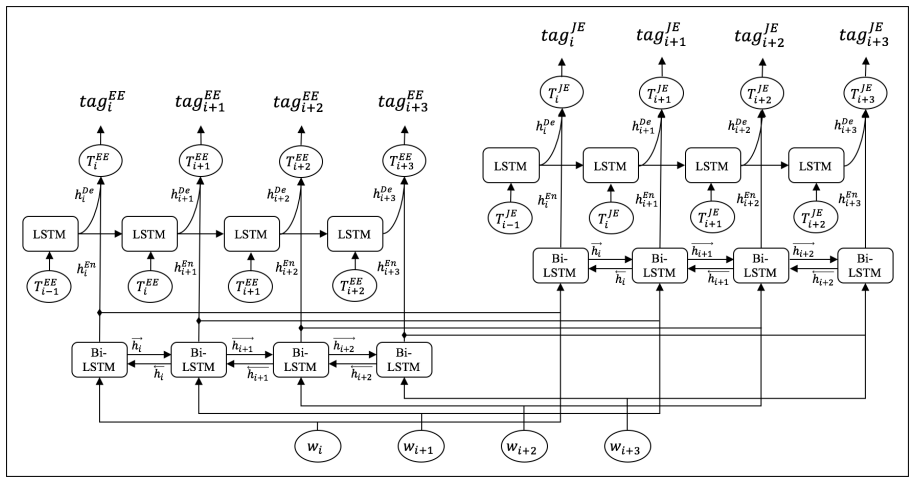
The load-bearing mechanism is the hierarchical multi-task tagging architecture: two sequence taggers, each an encoder-decoder built from long short-term memory (LSTM) layers, are aligned word-by-word so that the entity-extraction encoder's output vector for each word is concatenated with that word's embedding and fed as input to the joint-extraction encoder. Each decoder feeds the previous predicted tag vector back into the LSTM at every time step, so tag interactions shape predictions. Parameter sharing is neither hard nor soft in the usual sense: the two tasks keep independent parameters, while the lower encoder's representation is reused by the upper encoder, and the training objective is the sum of the two task log-likelihoods. The joint-extraction tagger uses a begin/inside/outside (BIO) scheme over relation-role-position tags, a choice the paper reports beating the richer Begin-Inside-Outside-End-Single scheme because the smaller tag set helps the joint task.
What would settle it
Train a flat multi-task tagger with the same two tasks, the same summed objective, and the same hyperparameters, but with a single shared encoder feeding both decoders instead of the hierarchical concatenation; if it reaches or exceeds F1 of 0.660 on NYT10 and 0.599 on NYT11, the specific hierarchy claim is falsified.
Extended reading notes
Core claim
The central discovery claimed is that a joint extraction tagger can exploit entity-type information without ever consuming predicted entity tags: the lower entity-extraction (EE) task is aligned with the upper joint-extraction (JE) task position by position, and the learned semantic representation from the EE encoder is passed into the JE encoder, so entity-type knowledge is shared through the representation rather than through hard decisions. In the author's framing, EE compensates for JE's blind spot—JE identifies entity boundaries and relations but not entity types—and both tasks partially overlap on boundaries. With this hierarchical parameter-sharing design, the model outperforms all compared joint and pipelined methods on NYT10 and NYT11, with the largest margin on the manually annotated NYT11 test set, where precision rises to 0.676.
Load-bearing premise
The load-bearing premise is that the reported F1 gains come from the hierarchical transfer of learned entity features, not just from training a larger model with an extra task, because the ablation removes the whole entity-extraction branch and no flat multi-task comparison is reported.
Editorial extensions
If this is right
- Joint triple extraction outperforms the strongest neural baseline by 1.6 F1 points on NYT10 and 6.1 points on NYT11.
- Entity-type information reaches the triple tagger through the shared representation, not through predicted entity tags, so the joint decoder stays end-to-end and avoids error propagation.
- Removing the entity-extraction branch lowers F1 to 0.649 on NYT10 and 0.571 on NYT11, indicating that the auxiliary task accounts for the gain in the model as configured.
- The model improves recall on the noisy distant-supervised NYT10 test set and precision on the manually annotated NYT11 test set, relative to the compared methods.
Reading between the lines
- Editorial inference: because the ablation removes the entire entity-extraction branch, a flat multi-task model that shares a single encoder between the two tagging tasks would be needed to prove that the hierarchy itself, rather than extra parameters or multi-task regularization, causes the gains.
- Editorial inference: the architecture suggests a general recipe—placing a coarse type/role tagger beneath a fine relation tagger and letting the lower encoder's vector feed the upper encoder—that could be tested on other structured prediction pairs, such as named-entity recognition above semantic role labeling.
- Editorial inference: the reported failure on directed relations, where two relation labels denote the same undirected relation in opposite directions, implies that encoding relation direction more explicitly in the tag set or decoder is a natural next step for the hierarchy.
- Editorial inference: if the entity-encoder representation is what carries the benefit, then ablations that vary the width or depth of the entity-extraction encoder would clarify whether the hierarchy is transferring semantic entity types or merely useful boundary features.
Signed reviews
Editorial analysis
A structured set of objections, weighed in public.
Referee Report
Summary. The paper proposes HMT, a hierarchical multi-task tagging model for joint extraction of entities and relations. Entity extraction (EE) is treated as a bottom-layer Bi-LSTM encoder-decoder tagging task, and joint extraction (JE) as a top-layer task whose Bi-LSTM encoder receives the concatenation of the word embedding and the EE encoder's hidden vector. Both tasks are trained jointly by summing their log-likelihood objectives. On the NYT10 and NYT11 datasets, using the preprocessing of Takanobu et al. (2019), the model reports F1 scores of 0.660 and 0.599, respectively, outperforming the HRL baseline by 1.6 and 6.1 F1 points. The authors argue that this improvement comes from hierarchical sharing of entity-feature representations into the joint extraction tagger, and they support this with an ablation that removes the EE module entirely.
Significance. If the hierarchical feature-sharing mechanism is genuinely responsible for the reported gains, the paper makes a useful contribution: it demonstrates that an auxiliary entity-tagging task can be organized beneath a joint extraction task in a way that improves triple extraction on standard benchmarks, and it does so with a clean tagging formulation and a strong comparison to the HRL baseline on the same preprocessed data. The use of ten runs with reported standard deviations on the main results is a strength, and the case study is honest about the model's limitation with directed relations. However, the central attribution of the improvement to hierarchical transfer is not empirically established by the presented ablation, because removing the EE branch removes several factors at once: the hierarchical feature feeding, the auxiliary loss, extra model parameters, and multi-task regularization. The paper's own footnote 3, noting that the JE module alone already beats most baselines on NYT11, further weakens the claim that the observed gains are specifically due to the hierarchical interdependency.
major comments (3)
- [Section 4.2, Table 3; Section 3.2.1; Eq. (7)] The ablation in Table 3 removes the entire EE task module, which simultaneously eliminates (a) the concatenation of the EE encoder vector h^En_t into the JE encoder input, (b) the auxiliary J_EE loss term in Eq. (7) and its multi-task regularization effect, and (c) the parameters of the EE Bi-LSTM encoder. The observed F1 drops from 0.660 to 0.649 on NYT10 and 0.599 to 0.571 on NYT11 therefore cannot be attributed specifically to hierarchical feature sharing; they could stem from added model capacity, generic multi-task regularization, or optimization effects. To support the paper's central claim that the hierarchical parameter-sharing architecture is the cause, the authors should compare against a flat multi-task baseline, for example a single shared encoder feeding both EE and JE decoders with the same joint loss, or a JE-only model that retains the extra parameters and auxiliary loss but without feeding EE encoder states into the JE encoder.
- [Section 4.2, Table 3] The statistical evidence for the ablation is incomplete. The main results in Table 1 report standard deviations over ten runs, but Table 3 reports only average precision, recall, and F1 for the W/o EE condition. Given that the NYT10 F1 difference between HMT and W/o EE is only 0.011, with HMT's own standard deviation at 0.003, the paper needs to report the variance of the ablation and conduct a significance test (e.g., a paired bootstrap or t-test) to show that this difference is reliable. Without that, the central empirical claim on NYT10 is not fully supported.
- [Section 4.2, footnote 3] Footnote 3 states that the JE-only model still outperforms most baselines on NYT11, which the authors attribute to the LSTM decoder and the BIO tagging scheme. This is a further confound: the HMT advantage over HRL on NYT11 (0.599 vs. 0.538) may be due largely to these decoder/tagging design choices rather than the hierarchical EE feature sharing. The manuscript should include an ablation that isolates the decoder and tagging scheme from the EE branch, or at least discuss this decomposition quantitatively, since the paper's novelty claim is specifically about the hierarchical setting, not about the decoder architecture.
minor comments (5)
- [Title/Abstract] The arXiv metadata title, 'Jointly Modeling Hierarchical and Horizontal Features for Relational Triple Extraction,' does not match the manuscript title, 'Joint Extraction of Entities and Relations with a Hierarchical Multi-task Tagging Model.' Additionally, the abstract mentions 'horizontal commonality between the two levels,' but the model described in Section 3 does not explicitly model horizontal features; the term should either be defined and operationalized or removed to avoid overclaiming.
- [Section 4.1] The authors state that they use only the NYT datasets because other datasets are 'beyond the scope of tagging-based methods' citing Zheng et al. (2017). It would be clearer to state explicitly which datasets were considered and why the chosen evaluation is sufficient to support the generality of the claim, especially because the paper's title and abstract emphasize a general modeling principle.
- [Section 4.2, Table 2] The case study's second example illustrates a known limitation with directed relations. The paper should note more prominently that the tagging formulation cannot distinguish reversed relation directions, since this is a substantive limitation for relation extraction, not merely an incidental failure case.
- [Section 3.3, Eq. (6)] Equation (6) is written as a maximization over the training data of the sum of per-token log probabilities; the notation is slightly ambiguous because it does not make explicit that the decoder is conditionally independent given the gold tags at previous positions during training. Clarifying this would improve readability.
- [General] The paper does not mention whether code or hyperparameter configurations will be released. Given that the preprocessing of Takanobu et al. is reused, releasing code would strengthen reproducibility, especially for the ablation experiments.
Circularity Check
No circularity: the paper reports empirical benchmark results with an external dataset and no fitted constants or predictions that reduce to their inputs.
full rationale
This paper is an empirical machine-learning paper. The central claim is that the proposed HMT model outperforms baselines on the NYT10 and NYT11 benchmarks, with F1 gains of 1.6% and 6.1% over HRL. There are no closed-form derivations, no fitted parameters that are later called predictions, and no uniqueness theorems imported from the authors' prior work. The model is trained and evaluated on standard external datasets released by Takanobu et al. (2019), and the comparison is against independently published baselines. The multi-task objective (Equation 7) sums the EE and JE log-likelihoods, but this is an architectural/training choice, not a circular definition: the JE task still learns from gold JE tags, and at inference the JE decoder does not consume predicted EE tags. The only self-referential design element is the choice of BIO over BIOES for the JE tag scheme, justified by 'observation (from our empirical experiments)' (Section 3), which is an ordinary model-selection decision, not a load-bearing prediction. The ablation (Section 4.2, Table 3) removes the entire EE branch and therefore conflates hierarchical feature sharing with added capacity and multi-task regularization, and the paper's footnote 3 admits the JE decoder alone already beats most baselines on NYT11; these are legitimate concerns about attribution of the gain, but they are concerns about experimental confounds and external validity, not circularity. The claimed improvement is measured against external benchmarks and is not equivalent by construction to any input of the paper. Accordingly, the circularity score is 0.
Assumptions & free parameters
free parameters (5)
- hidden_size =
300
- tag_vector_dim =
300
- dropout_rate =
0.5
- batch_size =
32
- word_embedding_dim =
300
assumptions (4)
- domain assumption Entity type constraints of a relation help identify head and tail entities in a triple.
- domain assumption The EE encoder's representation, concatenated with word embeddings, transfers useful information to JE.
- domain assumption BIO tagging for JE is better than BIOES for JE.
- domain assumption Distant supervision labels and the Takanobu et al. preprocessing are a fair basis for comparison.
Cite this review
Pith. "Pith review of Jointly Modeling Hierarchical and Horizontal Features for Relational Triple Extraction." pith.science (2026). https://pith.science/paper/4CWKJ7CL
@misc{pith2026190808672,
  author       = {Pith},
  title        = {Pith review of: Jointly Modeling Hierarchical and Horizontal Features for Relational Triple Extraction},
  year         = {2026},
  howpublished = {\url{https://pith.science/paper/4CWKJ7CL}},
  note         = {Machine review of arXiv:1908.08672}
}
read the original abstract
Recent works on relational triple extraction have shown the superiority of jointly extracting entities and relations over the pipelined extraction manner. However, most existing joint models fail to balance the modeling of entity features and the joint decoding strategy, and thus the interactions between the entity level and triple level are not fully investigated. In this work, we first introduce the hierarchical dependency and horizontal commonality between the two levels, and then propose an entity-enhanced dual tagging framework that enables the triple extraction (TE) task to utilize such interactions with self-learned entity features through an auxiliary entity extraction (EE) task, without breaking the joint decoding of relational triples. Specifically, we align the EE and TE tasks in a position-wise manner by formulating them as two sequence labeling problems with identical encoder-decoder structure. Moreover, the two tasks are organized in a carefully designed parameter sharing setting so that the learned entity features could be naturally shared via multi-task learning. Empirical experiments on the NYT benchmark demonstrate the effectiveness of the proposed framework compared to the state-of-the-art methods.
Figures


Reference graph
Works this paper leans on
-
[1]
URL: " 'urlintro :=
ENTRY address author booktitle chapter edition editor howpublished institution journal key month note number organization pages publisher school series title type volume year eprint doi pubmed url lastchecked label extra.label sort.label short.list INTEGERS output.state before.all mid.sentence after.sentence after.block STRINGS urlintro eprinturl eprintpr...
-
[2]
write newline
" write newline "" before.all 'output.state := FUNCTION n.dashify 't := "" t empty not t #1 #1 substring "-" = t #1 #2 substring "--" = not "--" * t #2 global.max substring 't := t #1 #1 substring "-" = "-" * t #2 global.max substring 't := while if t #1 #1 substring * t #2 global.max substring 't := if while FUNCTION word.in bbl.in capitalize " " * FUNCT...
-
[3]
S\" o ren Auer, Christian Bizer, Georgi Kobilarov, Jens Lehmann, Richard Cyganiak, and Zachary Ives. 2007. Dbpedia: A nucleus for a web of open data. In Proceedings of the 6th International The Semantic Web and 2nd Asian Conference on Asian Semantic Web Conference, pages 722--735
work page 2007
-
[4]
Kurt Bollacker, Colin Evans, Praveen Paritosh, Tim Sturge, and Jamie Taylor. 2008. Freebase: a collaboratively created graph database for structuring human knowledge. In Proceedings of the 2008 ACM SIGMOD international conference on Management of data, pages 1247--1250
2008
-
[5]
Richard Caruana. 1993. Multitask learning: A knowledge-based source of inductive bias. In Proceedings of the Tenth International Conference on Machine Learning, pages 41--48. Morgan Kaufmann
work page 1993
-
[6]
Richard Caruana. 1997. Multitask learning. Machine learning, 28(1):41--75
work page 1997
-
[7]
Hong-Jie Dai, Po-Ting Lai, Yung-Chun Chang, and Richard Tzong-Han Tsai. 2015. Enhancing of chemical compound and drug name recognition using representative tag scheme and fine-grained tokenization. Journal of cheminformatics, 7(S1):S14
work page 2015
-
[8]
Xin Dong, Evgeniy Gabrilovich, Geremy Heitz, Wilko Horn, Ni Lao, Kevin Murphy, Thomas Strohmann, Shaohua Sun, and Wei Zhang. 2014. Knowledge vault: A web-scale approach to probabilistic knowledge fusion. In Proceedings of the 20th ACM SIGKDD international conference on Knowledge discovery and data mining, pages 601--610
2014
Show all 37 references
-
[9]
Felix A Gers and J \"u rgen Schmidhuber. 2000. Recurrent nets that time and count. In Proceedings of the IEEE-INNS-ENNS International Joint Conference on Neural Networks, volume 3, pages 189--194
2000
-
[10]
Matthew R Gormley, Mo Yu, and Mark Dredze. 2015. Improved relation extraction with feature-rich compositional embedding models. In Proceedings of the 2015 Conference on Empirical Methods in Natural Language Processing (EMNLP), pages 1774--1784
2015
-
[11]
Geoffrey E Hinton. 1986. Learning distributed representations of concepts. In Proceedings of the 8th Annual Conference of the Cognitive Science Society, volume 1, page 12
1986
-
[12]
Raphael Hoffmann, Congle Zhang, Xiao Ling, Luke Zettlemoyer, and Daniel S Weld. 2011. Knowledge-based weak supervision for information extraction of overlapping relations. In Proceedings of the 49th Annual Meeting of the Association for Computational Linguistics: Human Languag...
2011
-
[13]
Jing Jiang. 2009. Multi-task transfer learning for weakly-supervised relation extraction. In Proceedings of the Joint Conference of the 47th Annual Meeting of the ACL and the 4th International Joint Conference on Natural Language Processing of the AFNLP, pages 1012--1020
2009
-
[14]
Guillaume Lample, Miguel Ballesteros, Sandeep Subramanian, Kazuya Kawakami, and Chris Dyer. 2016. Neural architectures for named entity recognition. In Proceedings of NAACL-HLT, pages 260--270
2016
-
[15]
Qi Li and Heng Ji. 2014. Incremental joint extraction of entity mentions and relations. In Proceedings of the 52nd Annual Meeting of the Association for Computational Linguistics (Volume 1: Long Papers), volume 1, pages 402--412
2014
-
[16]
Xiaodong Liu, Pengcheng He, Weizhu Chen, and Jianfeng Gao. 2019. Multi-task deep neural networks for natural language understanding. arXiv preprint arXiv:1901.11504
2019 arXiv
-
[17]
Mike Mintz, Steven Bills, Rion Snow, and Dan Jurafsky. 2009. Distant supervision for relation extraction without labeled data. In Proceedings of the Joint Conference of the 47th Annual Meeting of the ACL and the 4th International Joint Conference on Natural Language Processing...
2009
-
[18]
Makoto Miwa and Mohit Bansal. 2016. End-to-end relation extraction using lstms on sequences and tree structures. In Proceedings of the 54th Annual Meeting of the Association for Computational Linguistics (Volume 1: Long Papers), volume 1, pages 1105--1116
2016
-
[19]
Makoto Miwa and Yutaka Sasaki. 2014. Modeling joint entity and relation extraction with table representation. In Proceedings of the 2014 Conference on Empirical Methods in Natural Language Processing (EMNLP), pages 1858--1869
2014
-
[20]
Jeffrey Pennington, Richard Socher, and Christopher Manning. 2014. Glove: Global vectors for word representation. In Proceedings of the 2014 Conference on Empirical Methods in Natural Language Processing (EMNLP), pages 1532--1543
2014
-
[21]
Alec Radford, Jeffrey Wu, Rewon Child, David Luan, Dario Amodei, and Ilya Sutskever. 2019. Language models are unsupervised multitask learners. OpenAI Blog, 1:8
2019
-
[22]
Marek Rei. 2017. Semi-supervised multitask learning for sequence labeling. In Proceedings of the 55th Annual Meeting of the Association for Computational Linguistics (Volume 1: Long Papers), pages 2121--2130
2017
-
[23]
Xiang Ren, Zeqiu Wu, Wenqi He, Meng Qu, Clare R Voss, Heng Ji, Tarek F Abdelzaher, and Jiawei Han. 2017. Cotype: Joint extraction of typed entities and relations with knowledge bases. In Proceedings of the 26th International Conference on World Wide Web, pages 1015--1024
2017
-
[24]
Sebastian Riedel, Limin Yao, and Andrew McCallum. 2010. Modeling relations and their mentions without labeled text. In Joint European Conference on Machine Learning and Knowledge Discovery in Databases, pages 148--163
2010
-
[25]
Sebastian Ruder. 2017. An overview of multi-task learning in deep neural networks. arXiv preprint arXiv:1706.05098
2017 arXiv
-
[26]
Victor Sanh, Thomas Wolf, and Sebastian Ruder. 2019. A hierarchical multi-task approach for learning embeddings from semantic tasks. In AAAI
2019
-
[27]
Amit Singhal. 2012. Introducing the knowledge graph: things, not strings. Official google blog, 5
2012
-
[28]
Fabian M Suchanek, Gjergji Kasneci, and Gerhard Weikum. 2007. Yago: a core of semantic knowledge. In Proceedings of the 16th International Conference on World Wide Web, pages 697--706
2007
-
[29]
Ryuichi Takanobu, Tianyang Zhang, Jiexi Liu, and Minlie Huang. 2019. A hierarchical framework for relation extraction with reinforcement learning. In AAAI
2019
-
[30]
Jian Tang, Meng Qu, Mingzhe Wang, Ming Zhang, Jun Yan, and Qiaozhu Mei. 2015. LINE: large-scale information network embedding. In Proceedings of the 24th International Conference on World Wide Web, pages 1067--1077
2015
-
[31]
Tijmen Tieleman and Geoffrey Hinton. 2012. Lecture 6.5-rmsprop: Divide the gradient by a running average of its recent magnitude. COURSERA: Neural networks for machine learning, 4(2):26--31
2012
-
[32]
Ashish Vaswani, Yonatan Bisk, Kenji Sagae, and Ryan Musa. 2016. Supertagging with lstms. In Proceedings of the 2016 Conference of the North American Chapter of the Association for Computational Linguistics: Human Language Technologies, pages 232--237
2016
-
[33]
Shaolei Wang, Yue Zhang, Wanxiang Che, and Ting Liu. 2018. Joint extraction of entities and relations based on a novel graph scheme. In Proceedings of the 27th International Joint Conference on Artificial Intelligence, pages 4461--4467
2018
-
[34]
Jie Yang, Shuailong Liang, and Yue Zhang. 2018. Design challenges and misconceptions in neural sequence labeling. In Proceedings of the 27th International Conference on Computational Linguistics, pages 3879--3889
2018
-
[35]
Zhilin Yang, Ruslan Salakhutdinov, and William W Cohen. 2017. Transfer learning for sequence tagging with hierarchical recurrent networks. In ICLR
2017
-
[36]
Xiangrong Zeng, Daojian Zeng, Shizhu He, Kang Liu, and Jun Zhao. 2018. Extracting relational facts by an end-to-end neural model with copy mechanism. In Proceedings of the 56th Annual Meeting of the Association for Computational Linguistics (Volume 1: Long Papers), volume 1, p...
2018
-
[37]
Suncong Zheng, Feng Wang, Hongyun Bao, Yuexing Hao, Peng Zhou, and Bo Xu. 2017. Joint extraction of entities and relations based on a novel tagging scheme. In Proceedings of the 55th Annual Meeting of the Association for Computational Linguistics (Volume 1: Long Papers), volum...
2017
Reviewed August 14, 2026 · model on record in the stance chip above.
Discussion (0). Continue with ORCID to comment.