Berezinskii-Kosterlitz-Thouless-type Transition in Site Percolation on the Diamond Hierarchical Lattice
Pith reviewed 2026-05-22 04:28 UTC · model grok-4.3
The pith
Site percolation on the diamond hierarchical lattice shows a Berezinskii-Kosterlitz-Thouless-type transition with an essential singularity in the correlation length.
A machine-rendered reading of the paper's core claim, the machinery that carries it, and where it could break.
Core claim
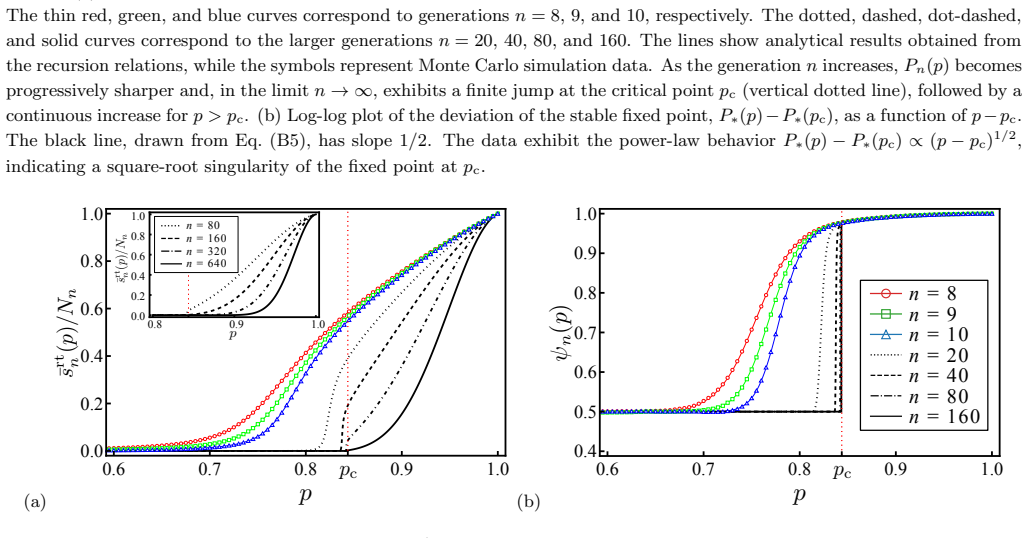
The central claim is that site percolation on the diamond hierarchical lattice exhibits a nonpercolating phase for p < p_c and a critical phase for p > p_c, in which the largest cluster size scales subextensively as N^{ψ(p)} with ψ(p) varying continuously with p. The correlation length displays a Berezinskii-Kosterlitz-Thouless-type essential singularity ξ(p) ∼ exp(const / √(p_c − p)) for p → p_c^−, derived from the renormalization-group recursion relation and confirmed through finite-size scaling analyses.
What carries the argument
The renormalization-group recursion relation obtained from the exact generating-function analysis, which governs the flow of the percolation probability and reveals the essential singularity near p_c.
If this is right
- The largest cluster remains subextensive in the critical phase, scaling with a p-dependent fractal exponent.
- Critical phases in percolation can occur on finite-dimensional networks without requiring exponential volume growth.
- The transition is driven by site dilution remaining relevant under renormalization-group transformations.
- Finite-size scaling shows excellent data collapse consistent with the essential singularity.
Where Pith is reading between the lines
- This behavior may generalize to other hierarchical lattices where site and bond percolation differ in their fixed-point structure.
- Similar essential singularities could be searched for in percolation on other fractals or disordered media to test the role of dilution relevance.
- Extensions to dynamics or other critical exponents might reveal more about the nature of this critical phase.
Load-bearing premise
The derived renormalization-group recursion relation accurately captures the leading behavior near p_c without being altered by higher-order corrections or lattice-specific effects.
What would settle it
Numerical computation of the correlation length on successively larger diamond hierarchical lattices for p slightly below p_c, checking whether it follows the predicted exp(const/sqrt(delta p)) form or deviates to a power-law divergence.
Figures




read the original abstract
We study site percolation on the diamond hierarchical lattice, a finite-dimensional fractal network, using an exact generating-function analysis. In contrast to bond percolation, site percolation on this lattice does not undergo a transition from a nonpercolating phase to a percolating phase. Instead, the system exhibits a nonpercolating phase for $p<p_{\rm c}$ and a critical phase for $p>p_{\rm c}$. In the critical phase, the size of the largest cluster remains subextensive, scaling as $N^{\psi(p)}$, where the fractal exponent $\psi(p)$ varies continuously with $p$. By analyzing the renormalization-group recursion relation in the vicinity of $p_{\rm c}$, we show that the correlation length exhibits a Berezinskii-Kosterlitz-Thouless-type essential singularity, $\xi(p)\sim \exp \left({\rm const}/\sqrt{p_{\rm c}-p}\right)$ for $p \to p_{\rm c}^-$, which is further confirmed by finite-size scaling analyses showing excellent data collapse. These results demonstrate that critical phases in percolation can emerge even on finite-dimensional networks and that exponential volume growth is not necessary for such phases to appear. We argue that the critical phase on the diamond hierarchical lattice stems from site dilution remaining relevant under renormalization.
Editorial analysis
A structured set of objections, weighed in public.
Referee Report
Summary. The paper analyzes site percolation on the diamond hierarchical lattice via exact generating functions and renormalization-group recursions. It reports that, unlike bond percolation, there is no percolation transition; instead a non-percolating phase exists for p < p_c and a critical phase for p > p_c in which the largest cluster is sub-extensive (N^ψ(p) with continuously varying ψ(p)). Near p_c the correlation length is claimed to exhibit a BKT-type essential singularity ξ(p) ∼ exp(const/√(p_c−p)) for p → p_c^−, supported by finite-size scaling and data collapse. The authors attribute the critical phase to site dilution remaining relevant under renormalization.
Significance. If the RG analysis is confirmed, the result shows that BKT-like essential singularities can appear in percolation on finite-dimensional hierarchical lattices without requiring exponential volume growth, and that critical phases with continuously varying exponents are possible in site percolation. The exact generating-function derivation and the explicit recursion provide a clean, parameter-free route to the singularity; the reported data collapse adds numerical support. This would be a notable addition to the literature on percolation on fractals and on the conditions for BKT-type transitions in disordered systems.
major comments (2)
- [RG recursion analysis near p_c] § on RG flow near p_c (the paragraph containing the expansion of p′=f(p)): the derivation of the BKT singularity assumes that the leading nonlinearity after the fixed point p_c (where f′(p_c)=1) is quadratic with the correct sign and that higher-order (cubic and beyond) terms generated by the site-percolation generating functions are irrelevant. An explicit Taylor expansion of the recursion up to at least cubic order, together with the numerical values of the coefficients, is needed to confirm that the quadratic term indeed dominates the flow and produces the claimed essential singularity.
- [Finite-size scaling analyses] Finite-size scaling section (the data-collapse figures and the associated scaling ansatz): the collapse is performed assuming the BKT form ξ ∼ exp(c/√(p_c−p)). While visually excellent, the collapse alone does not independently establish the asymptotic singularity; a direct numerical extraction of the correlation length from the generating functions for successively larger generations, followed by a fit to the essential-singularity form, would strengthen the claim.
minor comments (2)
- [Methods] The definition of the correlation length ξ in terms of the generating functions should be stated explicitly (e.g., via the second moment or the cluster-size distribution) so that the connection to the RG flow is unambiguous.
- [Introduction] Notation: the fractal exponent ψ(p) is introduced without an equation number; adding a numbered definition would improve readability when it is later compared with the RG predictions.
Simulated Author's Rebuttal
We thank the referee for the careful reading of our manuscript and the constructive comments. We address each of the major comments point by point below.
read point-by-point responses
-
Referee: [RG recursion analysis near p_c] § on RG flow near p_c (the paragraph containing the expansion of p′=f(p)): the derivation of the BKT singularity assumes that the leading nonlinearity after the fixed point p_c (where f′(p_c)=1) is quadratic with the correct sign and that higher-order (cubic and beyond) terms generated by the site-percolation generating functions are irrelevant. An explicit Taylor expansion of the recursion up to at least cubic order, together with the numerical values of the coefficients, is needed to confirm that the quadratic term indeed dominates the flow and produces the claimed essential singularity.
Authors: We agree with the referee that an explicit Taylor expansion up to cubic order, including numerical coefficients, is important to confirm the dominance of the quadratic nonlinearity. We have performed this expansion based on the site-percolation generating functions and included the results, along with the coefficient values, in the revised manuscript. This addition verifies that the quadratic term dominates and supports the BKT-type singularity. revision: yes
-
Referee: [Finite-size scaling analyses] Finite-size scaling section (the data-collapse figures and the associated scaling ansatz): the collapse is performed assuming the BKT form ξ ∼ exp(c/√(p_c−p)). While visually excellent, the collapse alone does not independently establish the asymptotic singularity; a direct numerical extraction of the correlation length from the generating functions for successively larger generations, followed by a fit to the essential-singularity form, would strengthen the claim.
Authors: We thank the referee for this recommendation. To provide independent confirmation of the asymptotic form, we have extracted the correlation length directly from the generating functions for successively larger generations and fitted it to the essential-singularity expression. The results of this analysis have been added to the revised finite-size scaling section, complementing the data-collapse analysis. revision: yes
Circularity Check
No circularity: singularity emerges from exact RG flow on hierarchical lattice
full rationale
The recursion relation is obtained directly by composing the site-percolation generating functions on the diamond hierarchical lattice geometry; the fixed-point condition f'(p_c)=1 and the leading quadratic nonlinearity are computed from those same functions. Integration of the resulting differential RG equation then produces the essential singularity without any fitted parameters, ansatz, or self-citation that carries the central claim. Finite-size scaling collapse is presented as numerical corroboration rather than as the source of the functional form. The derivation is therefore self-contained against the lattice definition and does not reduce to its own inputs.
Axiom & Free-Parameter Ledger
free parameters (1)
- p_c
axioms (1)
- domain assumption The diamond hierarchical lattice admits an exact generating-function representation that closes under renormalization.
Lean theorems connected to this paper
-
IndisputableMonolith/Cost/FunctionalEquation.leanwashburn_uniqueness_aczel unclear?
unclearRelation between the paper passage and the cited Recognition theorem.
By analyzing the renormalization-group recursion relation in the vicinity of p_c, we show that the correlation length exhibits a Berezinskii-Kosterlitz-Thouless-type essential singularity, ξ(p)∼exp(const/√(p_c−p)) for p→p_c^−
-
IndisputableMonolith/Foundation/AlexanderDuality.leanalexander_duality_circle_linking unclear?
unclearRelation between the paper passage and the cited Recognition theorem.
the site-percolation critical point p_c as the point at which the nontrivial stable and unstable fixed points merge and become marginal: dR/dP|_{P=P^*}=1
What do these tags mean?
- matches
- The paper's claim is directly supported by a theorem in the formal canon.
- supports
- The theorem supports part of the paper's argument, but the paper may add assumptions or extra steps.
- extends
- The paper goes beyond the formal theorem; the theorem is a base layer rather than the whole result.
- uses
- The paper appears to rely on the theorem as machinery.
- contradicts
- The paper's claim conflicts with a theorem or certificate in the canon.
- unclear
- Pith found a possible connection, but the passage is too broad, indirect, or ambiguous to say the theorem truly supports the claim.
Reference graph
Works this paper leans on
-
[1]
The correlation lengthξ(p) is assumed to take the form given in Eq. (29). All data collapse onto universal curves, providing strong evidence that the correlation length diverges with an essential singularity at the critical pointp c. consistent with the saddle-node nature of the RG fixed point. In fact, this functional form can also be derived analyticall...
-
[2]
Mean root-cluster size We define the first derivatives of the generating functions (7)–(9) atx= 1 as ¯tn = d dx Tn(x) x=1 ,¯w n = d dx Wn(x,1) x=1 = d dx Wn(1, x) x=1 = 1 2 d dx Wn(x, x) x=1 ,¯v n = d dx Vn(x) x=1 . By differentiating Eqs. (11)–(13) with respect toxand evaluating them atx= 1, we obtain the recursion relations for ¯tn, ¯wn, and ¯vn: ¯tn+1 ...
-
[3]
Cluster-size distribution The cluster-size distributionP n(s) is obtained from the generating functionU n(x) defined in Eq. (22). To evaluate Un(x), we decompose it according to the states of the two roots as Un(x) =p 2Uoo n (x) + 2pqUou n (x) +q 2Uuu n (x).(A5) Here,U oo n (x) is the generating function for the number of clusters of sizesunder the condit...
-
[4]
Susceptibility The susceptibility is given by χn = X s s2Pn(s) = 1 Nn [U ′′ n(1) +U ′ n(1)]. We decomposeU ′ n(1) andU ′′ n(1) as U ′ n(1) =p 2¯uoo n + 2pq¯uou n +q 2¯uuu n ,andU ′′ n(1) =p 2¯uoo(2) n + 2pq¯uou(2) n +q 2¯uuu(2) n ,(A11) respectively. Here, ¯uoo n = d dx Uoo n (x) x=1 ,¯u ou n = d dx Uou n (x) x=1 ,¯u uu n = d dx Uuu n (x) x=1 ,(A12) and ¯...
work page 2048
-
[5]
D. Stauffer and A. Aharony,Introduction to Percolation Theory(Taylor & Francis, 2018)
work page 2018
- [6]
-
[7]
Newman,Networks(Oxford University Press, 2018)
M. Newman,Networks(Oxford University Press, 2018)
work page 2018
-
[8]
S. N. Dorogovtsev and J. F. Mendes,The Nature of Complex Networks(Oxford University Press, 2022)
work page 2022
- [9]
-
[10]
S. N. Dorogovtsev, A. V. Goltsev, and J. F. F. Mendes, Physical Review E65, 066122 (2002)
work page 2002
-
[11]
H. D. Rozenfeld and D. Ben-Avraham, Physical Review E75, 061102 (2007)
work page 2007
-
[12]
S. N. Dorogovtsev, Physical Review E67, 045102 (2003)
work page 2003
-
[13]
T. Nogawa and T. Hasegawa, Journal of Physics A: Mathematical and Theoretical42, 145001 (2009)
work page 2009
-
[14]
T. Hasegawa, T. Nogawa, and K. Nemoto, Europhysics Letters104, 16006 (2013)
work page 2013
-
[15]
T. Hasegawa, T. Nogawa, and K. Nemoto, Discontinuity, Nonlinearity, and Complexity3, 319 (2014)
work page 2014
-
[16]
S. Boettcher, J. L. Cook, and R. M. Ziff, Physical Review E80, 041115 (2009)
work page 2009
- [17]
- [18]
-
[19]
S. Boettcher, V. Singh, and R. M. Ziff, Nature Communications3, 787 (2012)
work page 2012
- [20]
-
[21]
Nogawa, Journal of Physics A: Mathematical and Theoretical51, 505003 (2018)
T. Nogawa, Journal of Physics A: Mathematical and Theoretical51, 505003 (2018)
work page 2018
-
[22]
A. N. Berker, M. Hinczewski, and R. R. Netz, Physical Review E80, 041118 (2009)
work page 2009
-
[23]
S. K. Baek, P. Minnhagen, and B. J. Kim, Journal of Physics A: Mathematical and Theoretical42, 478001 (2009)
work page 2009
-
[24]
T. Nogawa and T. Hasegawa, Journal of Physics A: Mathematical and Theoretical42, 478002 (2009)
work page 2009
-
[25]
I. Benjamini and O. Schramm, Electronic Communications in Probability1, 71 (1996)
work page 1996
-
[26]
I. Benjamini and O. Schramm, Journal of the American Mathematical Society14, 487 (2001)
work page 2001
- [27]
- [28]
- [29]
- [30]
-
[31]
K. Wataya and T. Hasegawa, Journal of Statistical Mechanics: Theory and Experiment2025, 103402 (2025)
work page 2025
- [32]
- [33]
-
[34]
Berezinskii, Soviet Physics JETP32, 493 (1971)
V. Berezinskii, Soviet Physics JETP32, 493 (1971)
work page 1971
-
[35]
J. M. Kosterlitz and D. J. Thouless, Journal of Physics C: Solid State Physics6, 1181 (1973)
work page 1973
-
[36]
M. E. Newman and R. M. Ziff, Physical Review E64, 016706 (2001)
work page 2001
- [37]
-
[38]
A. S. Balankin, M. Mart´ ınez-Cruz, O. Susarrey-Huerta, and L. D. Adame, Physics Letters A382, 12 (2018)
work page 2018
-
[39]
M.- ´A. M. Cruz, J. P. Ortiz, M. P. Ortiz, and A. Balankin, Fractal and Fractional7, 231 (2023)
work page 2023
-
[40]
A heuristic way to derive this relation is to focus on the connection between the root and the degree-2 nodes, which constitute the majority of the nodes inG n. On the DHL, the number of degree-2 nodes at each odd distance from the root vA is always exactly 2 n−1, which scales as √Nn. Assuming a power-law decay of the correlation function,C(r)∼r −η, the e...
discussion (0)
Sign in with ORCID, Apple, or X to comment. Anyone can read and Pith papers without signing in.