Notes on generative modeling: flow matching, diffusion, optimal transport and Schr{\"o}dinger bridge
Pith reviewed 2026-06-30 04:08 UTC · model grok-4.3
The pith
Optimal transport connects flow matching, diffusion, and Schrödinger bridge in generative modeling.
A machine-rendered reading of the paper's core claim, the machinery that carries it, and where it could break.
Core claim
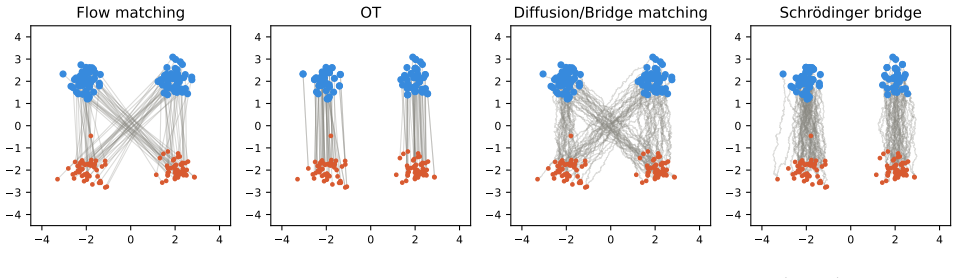
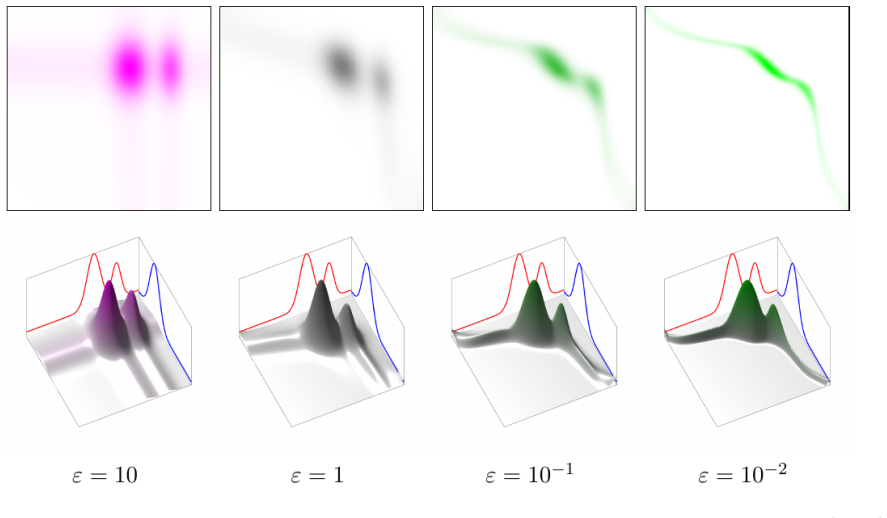
These notes recapitulate the high level mathematical principles behind different techniques for generative modeling and show the connections between optimal transport and standard techniques such as Schrödinger bridge and flow matching.
What carries the argument
Optimal transport as the framework that links the generative modeling methods.
If this is right
- Schrödinger bridge arises as a variant or extension within an optimal transport setting.
- Flow matching shares foundational transport-based elements with diffusion processes.
- Viewing generative models through optimal transport yields a common perspective on their dynamics.
- The connections allow principles from one technique to inform the others.
Where Pith is reading between the lines
- This unification could guide the creation of hybrid generative algorithms that blend elements from each method.
- Insights from optimal transport variants might improve sampling efficiency across the connected techniques.
- The perspective suggests testing whether performance differences between methods trace back to specific transport costs.
Load-bearing premise
That high-level mathematical principles behind these techniques can be recapitulated in notes to meaningfully demonstrate connections between optimal transport and the other methods.
What would settle it
A clear demonstration that the core principles of flow matching or the Schrödinger bridge have no substantive overlap with optimal transport would falsify the claimed connections.
Figures
read the original abstract
These notes recapitulate the high level mathematical principles behind different techniques for generative modeling. I show the connections between optimal transport and standard techniques such as Schr{\"o}dinger bridge and flow matching.
Editorial analysis
A structured set of objections, weighed in public.
Referee Report
Summary. The manuscript consists of notes that claim to recapitulate high-level mathematical principles behind generative modeling techniques and to demonstrate connections between optimal transport and methods such as the Schrödinger bridge and flow matching.
Significance. If the notes contained explicit derivations linking these areas, they could serve as a useful reference for unifying perspectives in generative modeling; however, the provided abstract contains no equations, derivations, or specific results, so no assessment of significance is possible.
minor comments (1)
- [Abstract] Abstract: the stated goal of showing connections is not accompanied by any outline, equations, or preview of the claimed links, preventing evaluation of whether the notes achieve their purpose.
Simulated Author's Rebuttal
We thank the referee for their review. The manuscript is a set of notes whose abstract summarizes the intended scope; we address the assessment concern below.
read point-by-point responses
-
Referee: If the notes contained explicit derivations linking these areas, they could serve as a useful reference for unifying perspectives in generative modeling; however, the provided abstract contains no equations, derivations, or specific results, so no assessment of significance is possible.
Authors: We agree that the abstract is high-level and contains no equations or derivations, which prevents a detailed assessment from the abstract alone. The notes focus on recapitulating principles and connections at a conceptual level rather than providing full derivations. To improve clarity for readers and referees, we will revise the abstract to include a brief indication of the specific connections (e.g., between optimal transport and flow matching) that are developed in the notes. revision: yes
Circularity Check
No circularity; abstract provides no derivations to inspect
full rationale
The document consists only of an abstract stating that the notes recapitulate high-level principles and show connections between optimal transport, Schrödinger bridge, and flow matching. No equations, derivations, self-citations, or load-bearing steps are present, so no reduction to inputs by construction can be exhibited. Per the rules, an honest non-finding is required when the paper supplies no content that could trigger any of the enumerated circularity patterns.
Axiom & Free-Parameter Ledger
Reference graph
Works this paper leans on
-
[1]
Flow matching for applied mathematicians
Emile Pierret, Valentine Tosel, Julie Delon, and Alasdair Newson. Flow matching for applied mathematicians. 2026
2026
-
[2]
Optimal and diffusion transports in machine learning, 2026
Gabriel Peyré. Optimal and diffusion transports in machine learning, 2026
2026
-
[3]
A visual dive into conditional flow matching
Anne Gagneux, S \'e gol \`e ne Tiffany Martin, R \'e mi Emonet, Quentin Bertrand, and Mathurin Massias. A visual dive into conditional flow matching. In The Fourth Blogpost Track at ICLR 2025, 2025. URL https://openreview.net/forum?id=M6MTUQc4um
2025
-
[4]
Optimal Transport for Applied Mathematicians: Calculus of Variations, PDEs, and Modeling
Filippo Santambrogio. Optimal Transport for Applied Mathematicians: Calculus of Variations, PDEs, and Modeling. 2015
2015
-
[5]
Flow Matching for Generative Modeling
Yaron Lipman, Ricky TQ Chen, Heli Ben-Hamu, Maximilian Nickel, and Matt Le. Flow matching for generative modeling. arXiv preprint arXiv:2210.02747, 2022
work page internal anchor Pith review Pith/arXiv arXiv 2022
-
[6]
Building Normalizing Flows with Stochastic Interpolants
Michael S Albergo and Eric Vanden-Eijnden. Building normalizing flows with stochastic interpolants. arXiv preprint arXiv:2209.15571, 2022
work page internal anchor Pith review Pith/arXiv arXiv 2022
-
[7]
A computational fluid mechanics solution to the monge-kantorovich mass transfer problem
Jean-David Benamou and Yann Brenier. A computational fluid mechanics solution to the monge-kantorovich mass transfer problem. Numerische Mathematik, 84 0 (3): 0 375--393, 2000
2000
-
[8]
Computational optimal transport: With applications to data science
Gabriel Peyr \'e , Marco Cuturi, et al. Computational optimal transport: With applications to data science. Foundations and Trends in Machine Learning , 11 0 (5-6): 0 355--607, 2019
2019
-
[9]
Sinkhorn distances: Lightspeed computation of optimal transport
Marco Cuturi. Sinkhorn distances: Lightspeed computation of optimal transport. Advances in neural information processing systems, 26, 2013
2013
-
[10]
o dinger. \
Erwin Schr \"o dinger. \"U ber die umkehrung der naturgesetze . Verlag der Akademie der Wissenschaften in Kommission bei Walter De Gruyter, 1931
1931
-
[11]
A survey of the schrödinger problem and some of its connections with optimal transport
Christian L \'e onard. A survey of the schrödinger problem and some of its connections with optimal transport. arXiv preprint arXiv:1308.0215, 2013
-
[12]
Score-Based Generative Modeling through Stochastic Differential Equations
Yang Song, Jascha Sohl-Dickstein, Diederik P Kingma, Abhishek Kumar, Stefano Ermon, and Ben Poole. Score-based generative modeling through stochastic differential equations. arXiv preprint arXiv:2011.13456, 2020
work page internal anchor Pith review Pith/arXiv arXiv 2011
-
[13]
Denoising diffusion probabilistic models
Jonathan Ho, Ajay Jain, and Pieter Abbeel. Denoising diffusion probabilistic models. Advances in neural information processing systems, 33: 0 6840--6851, 2020
2020
-
[14]
Let us build bridges: Understanding and extending diffusion generative models
Xingchao Liu, Lemeng Wu, Mao Ye, and Qiang Liu. Let us build bridges: Understanding and extending diffusion generative models. arXiv preprint arXiv:2208.14699, 2022 a
-
[15]
Non-denoising forward-time diffusions
Stefano Peluchetti. Non-denoising forward-time diffusions. arXiv preprint arXiv:2312.14589, 2023
-
[16]
Random fields and diffusion processes
Hans F \"o llmer. Random fields and diffusion processes. In \'E cole d' \'E t \'e de Probabilit \'e s de Saint-Flour XV--XVII, 1985--87 , pages 101--203. Springer, 2006
1985
-
[17]
Stochastic differential equations
Bernt ksendal. Stochastic differential equations. In Stochastic differential equations: an introduction with applications, pages 38--50. Springer, 2003
2003
-
[18]
Diffusion schr \"o dinger bridge matching
Yuyang Shi, Valentin De Bortoli, Andrew Campbell, and Arnaud Doucet. Diffusion schr \"o dinger bridge matching. Advances in neural information processing systems, 36: 0 62183--62223, 2023
2023
-
[19]
Flow Straight and Fast: Learning to Generate and Transfer Data with Rectified Flow
Xingchao Liu, Chengyue Gong, and Qiang Liu. Flow straight and fast: Learning to generate and transfer data with rectified flow. arXiv preprint arXiv:2209.03003, 2022 b
work page internal anchor Pith review Pith/arXiv arXiv 2022
discussion (0)
Sign in with ORCID, Apple, or X to comment. Anyone can read and Pith papers without signing in.