Globular cluster formation with multiple stellar populations: A comprehensive overview of a star-cloud interaction scenario
Pith reviewed 2026-06-30 05:42 UTC · model grok-4.3
The pith
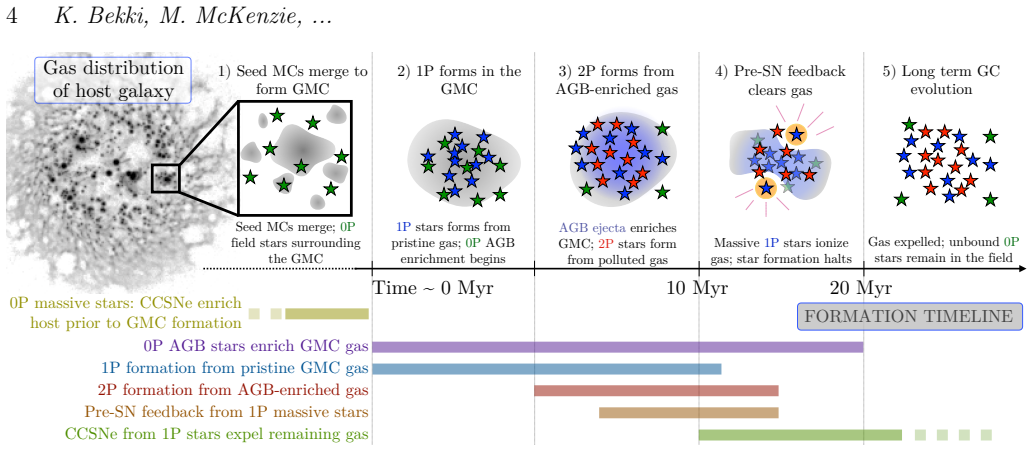
A new globular cluster formation scenario using AGB pollution of giant molecular clouds reproduces observed multiple stellar populations and chemical patterns.
A machine-rendered reading of the paper's core claim, the machinery that carries it, and where it could break.
Core claim
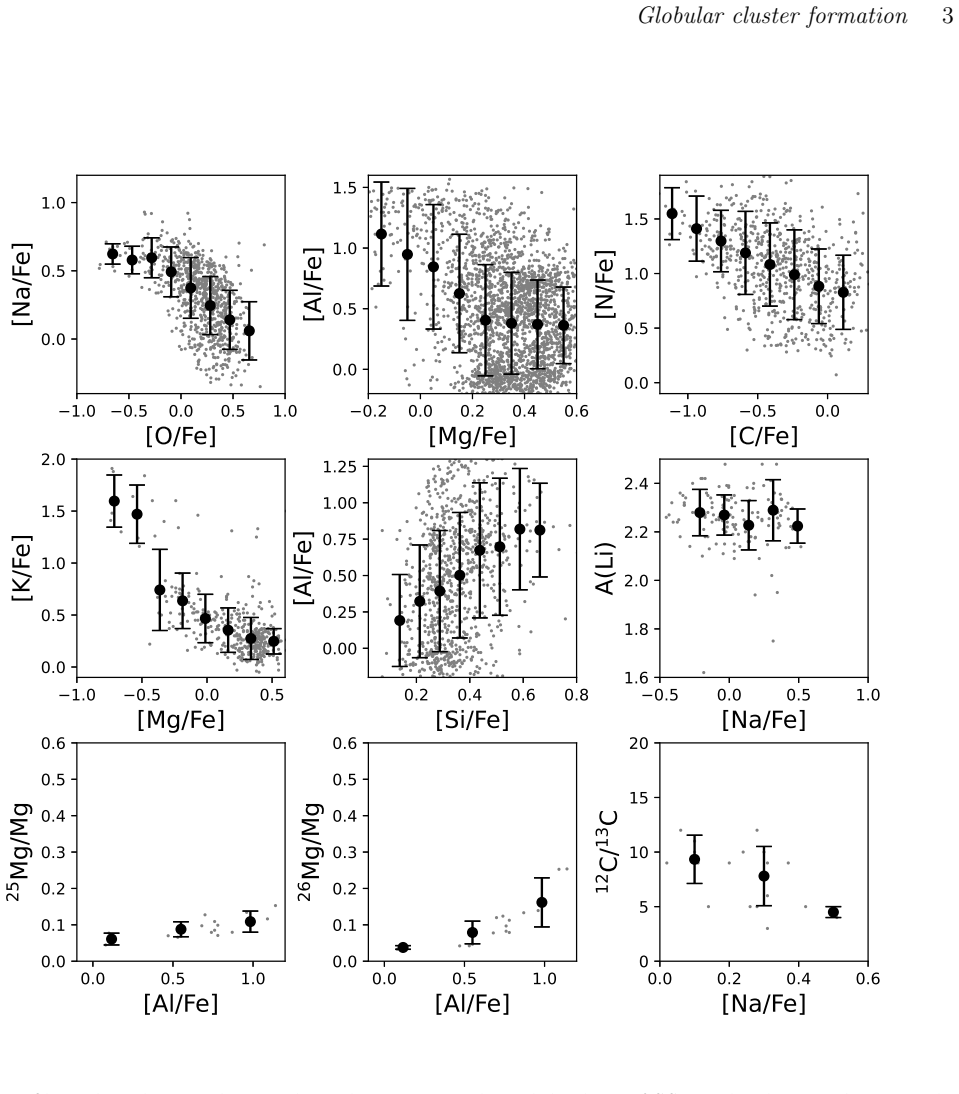
In this scenario both the first and second populations of stars form from giant molecular clouds polluted by asymptotic giant branch stars within and around the clouds. Unlike previous scenarios with AGB stars as primary polluters, it alleviates the mass-budget and dilution-timing problems. The principal results based on idealized analytic models are that the observed fraction of 1P stars and the helium abundance spreads between the 1P and 2P as a function of GC masses can be well reproduced, the modelled GCs show O-Na, C-N, and Mg-Al anticorrelations and Si-Al, 25Mg-Al, 26Mg-Al correlations, and additional predictions hold for iron-complex GCs, young clusters, and specific abundance ratios.
What carries the argument
The star-cloud interaction scenario in which 1P and 2P stars form from GMCs polluted by AGB stars, implemented through idealized analytic models.
If this is right
- The observed fraction of 1P stars and helium abundance spreads as a function of GC mass are reproduced.
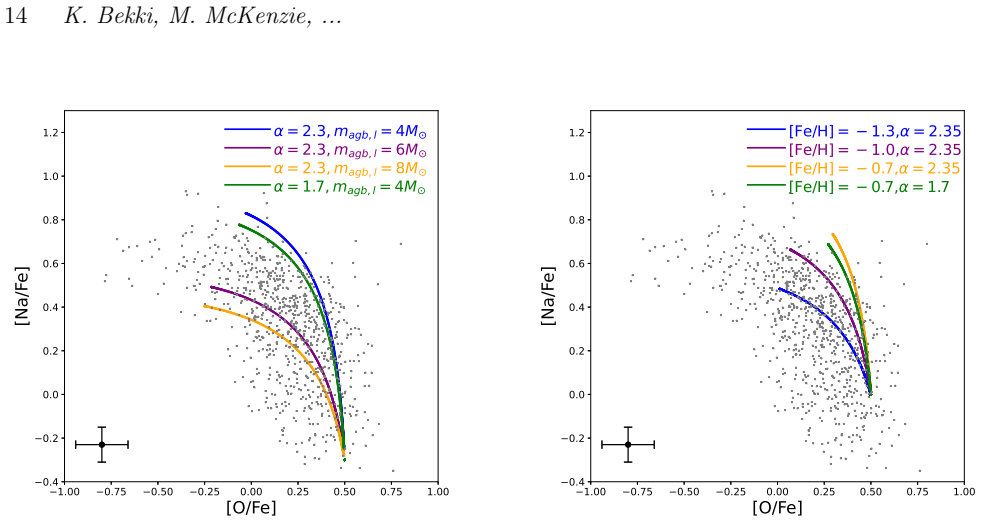
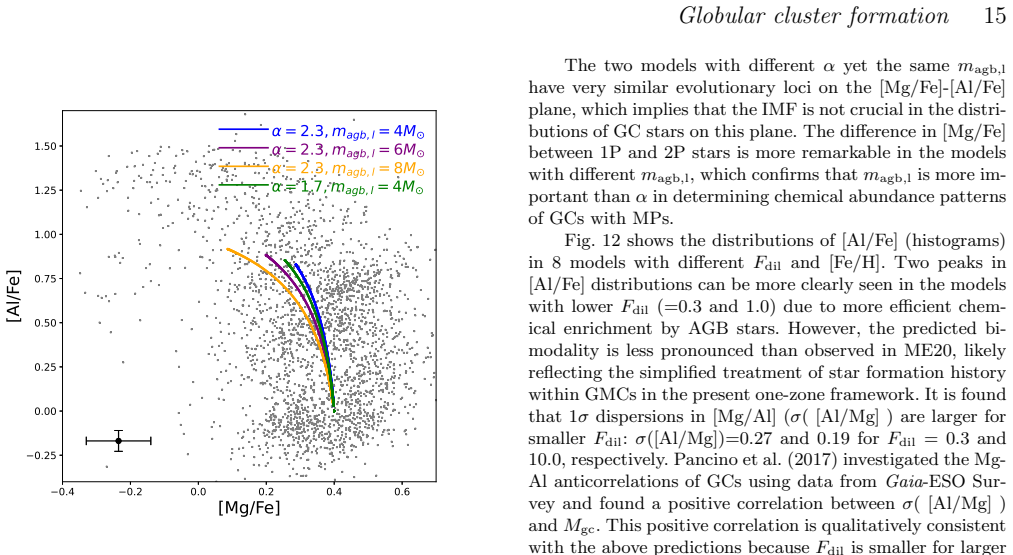
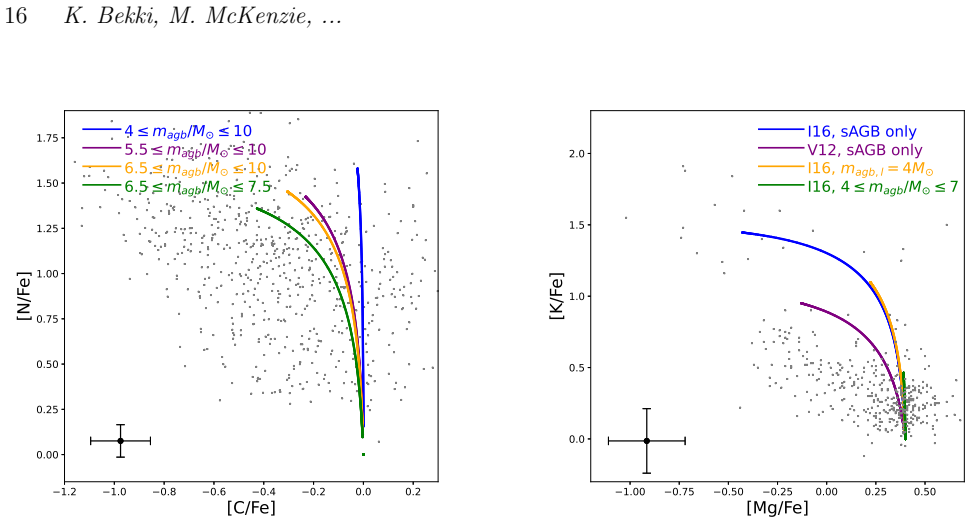
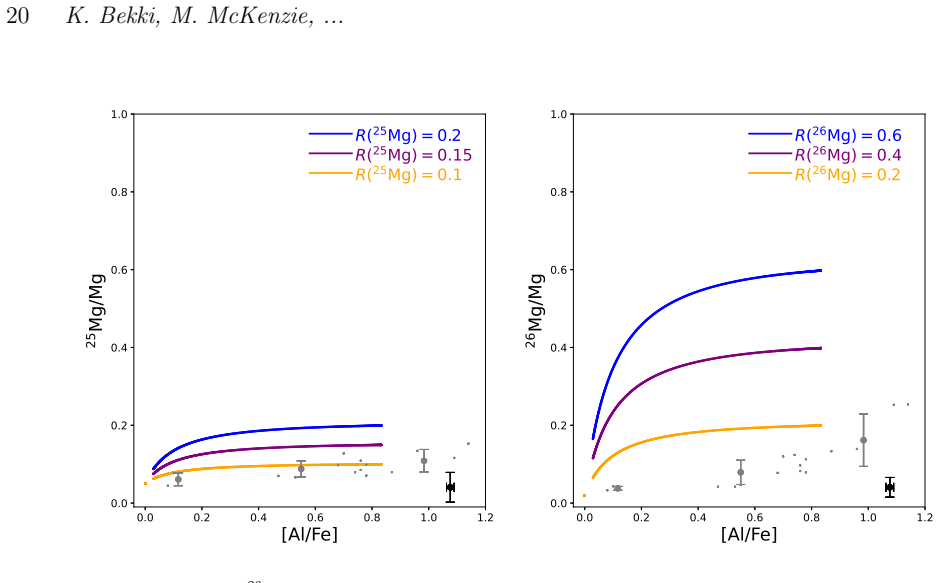
- Modelled GCs exhibit O-Na, C-N, and Mg-Al anticorrelations along with Si-Al, 25Mg-Al, and 26Mg-Al correlations.
- Iron-complex Type-II GCs form through merging of two GCs from two GMCs at different epochs in a host dwarf galaxy.
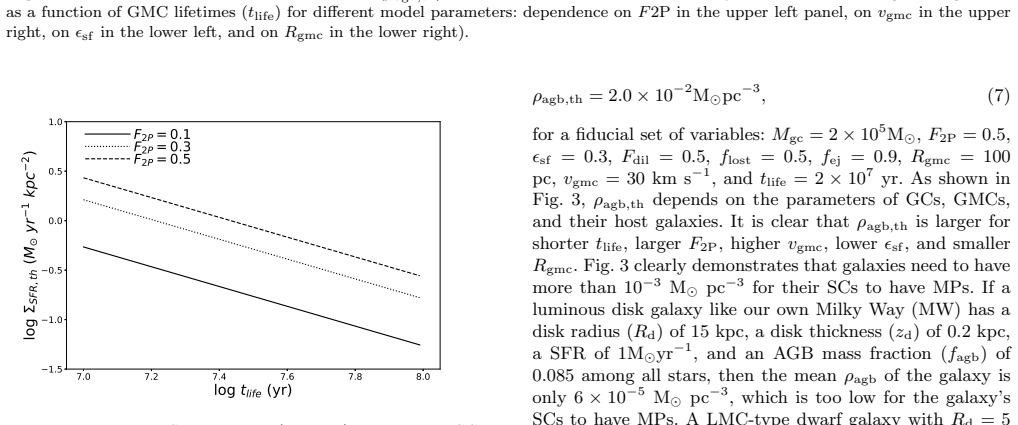
- Young massive clusters in environments with surface star formation rate densities below 1 solar mass per year per square kiloparsec are unlikely to evolve into GCs with multiple populations.
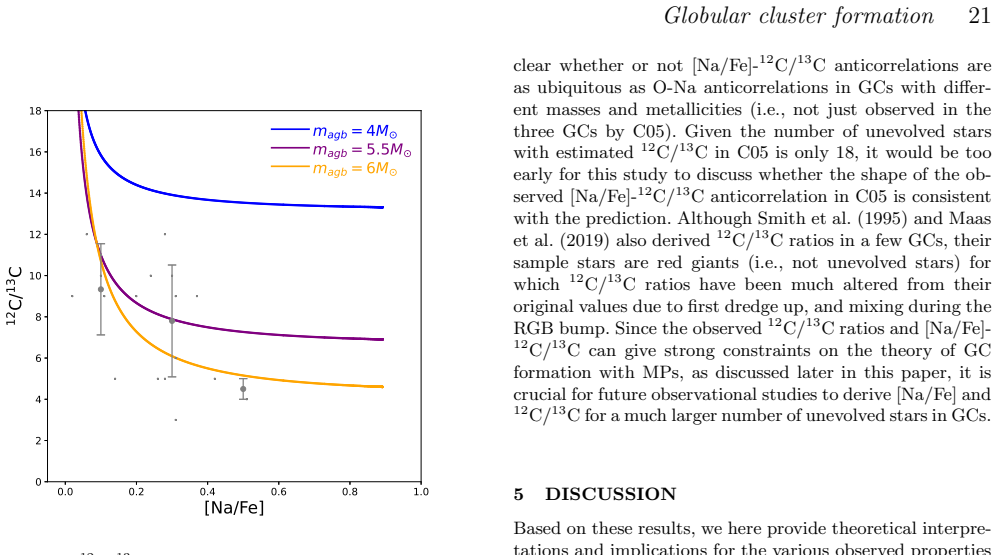
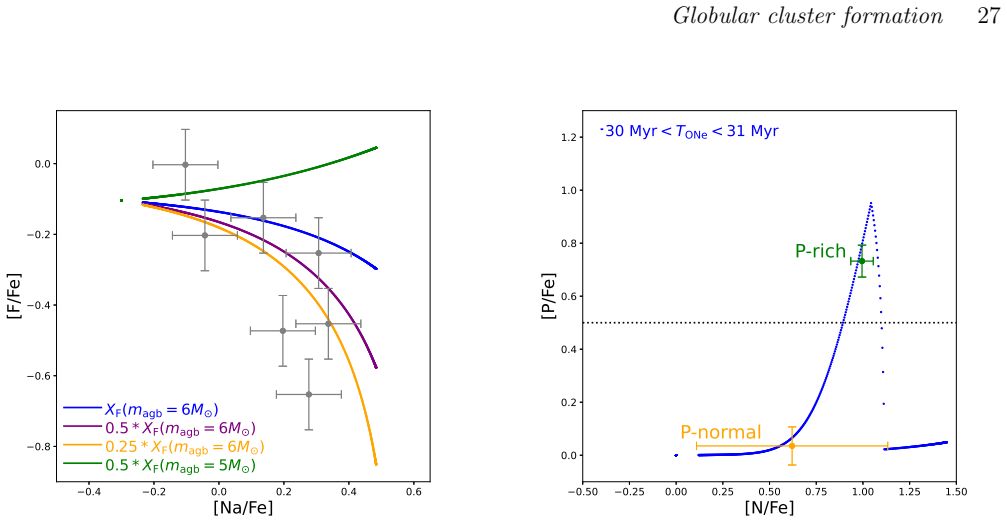
- Specific predictions include low 12C/13C ratios around 5 for 2P stars, a [Na/Fe]-[F/Fe] anticorrelation, and P-rich stars with [P/Fe] > 0.5 and [N/Fe] > 0.5.
Where Pith is reading between the lines
- If the models hold, full hydrodynamical simulations may not be required to capture the main chemical outcomes of AGB pollution in GMCs.
- The scenario connects GC formation to chemical evolution processes in dwarf galaxies through the proposed merging mechanism for iron-complex clusters.
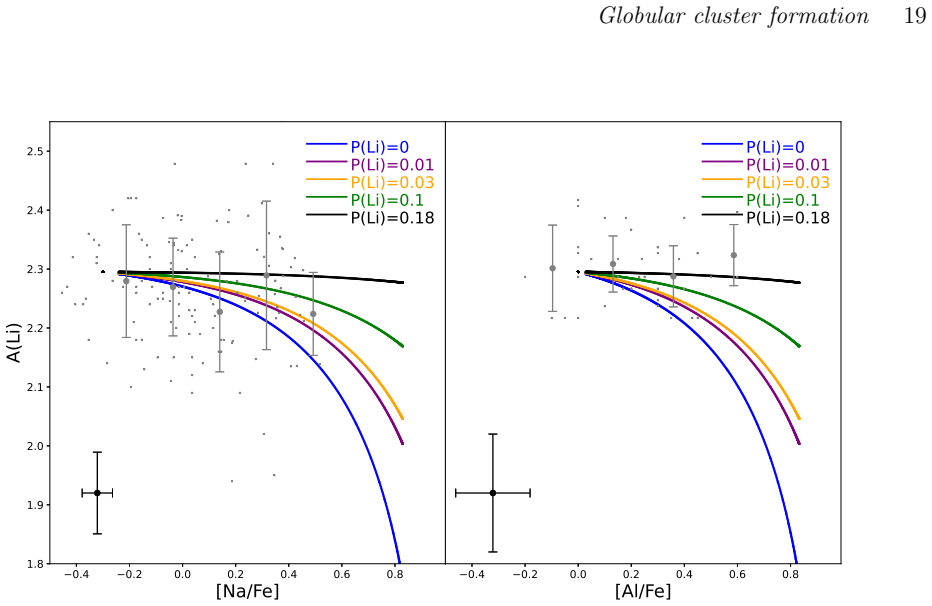
- The requirement that about 20 percent of AGB stars produce Li-rich ejecta to match Li abundance observations could be tested by targeted abundance surveys in additional clusters.
Load-bearing premise
The idealized analytic models of star-cloud interactions accurately capture the timing and efficiency of AGB pollution within and around GMCs without requiring full hydrodynamical simulations or additional physics.
What would settle it
Checking whether young massive clusters formed in galaxy environments with surface star formation rate densities well below 1 solar mass per year per square kiloparsec exhibit multiple populations or chemical spreads would directly test one of the scenario's key predictions.
Figures
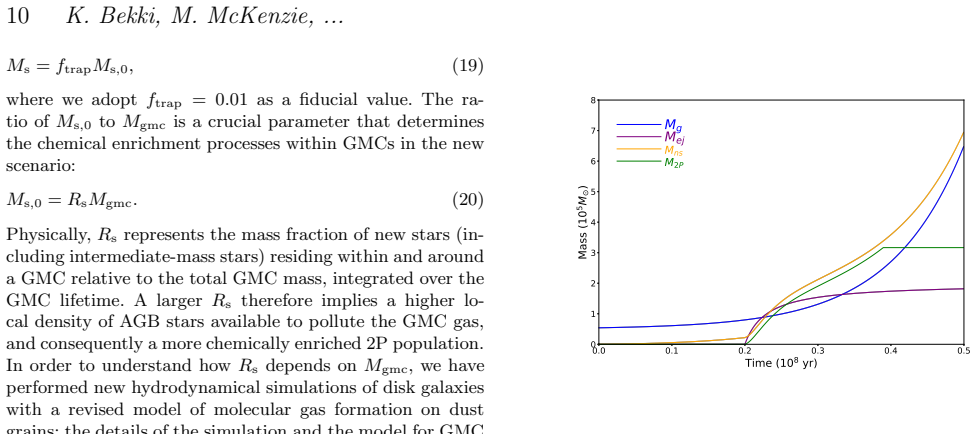
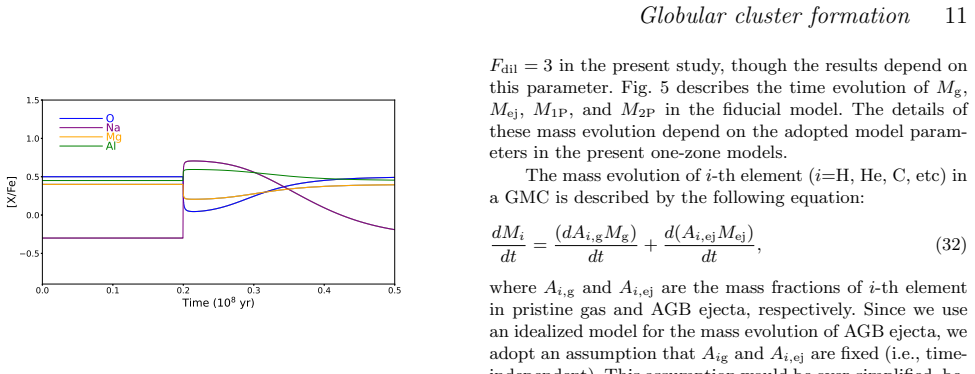
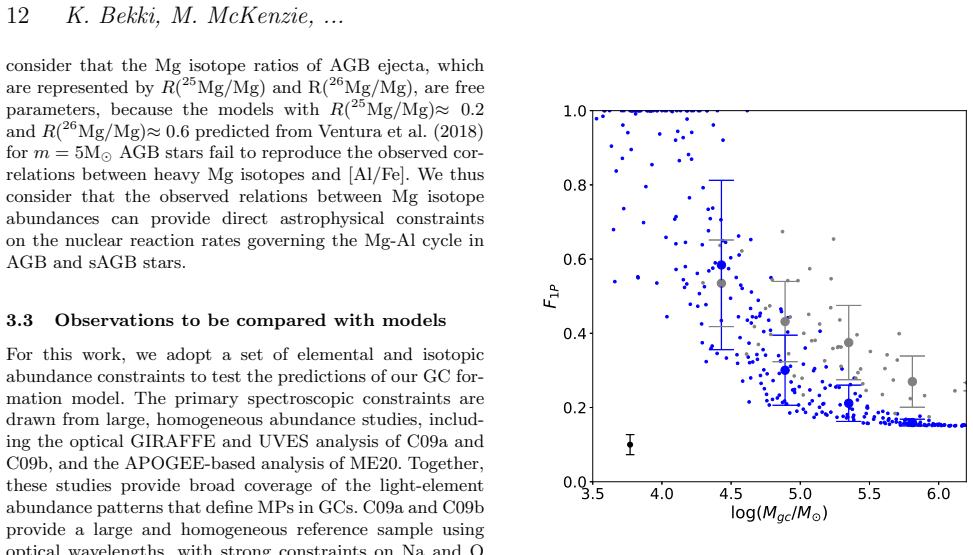
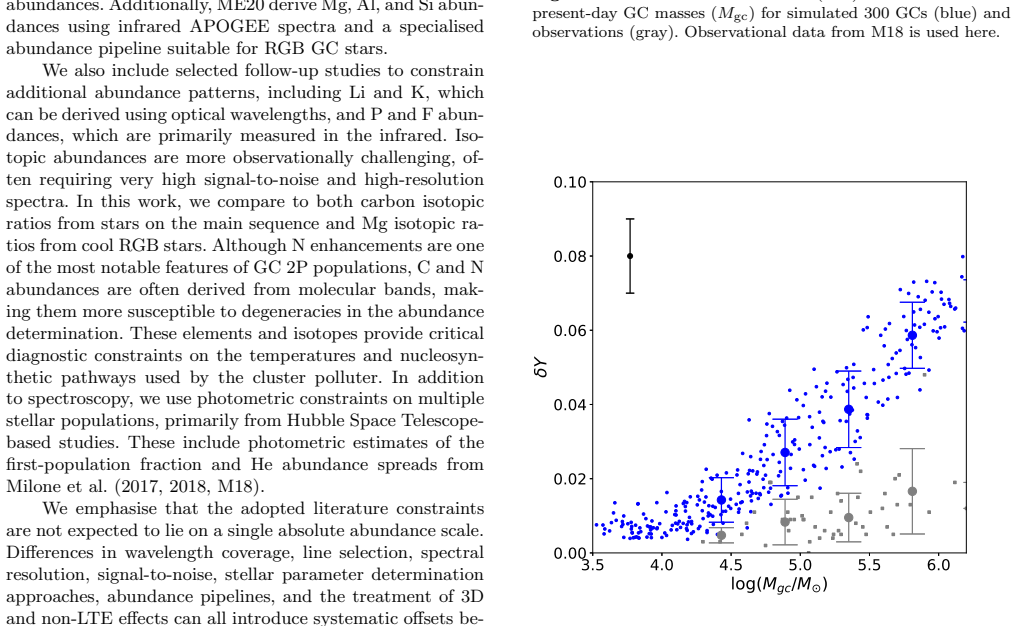
read the original abstract
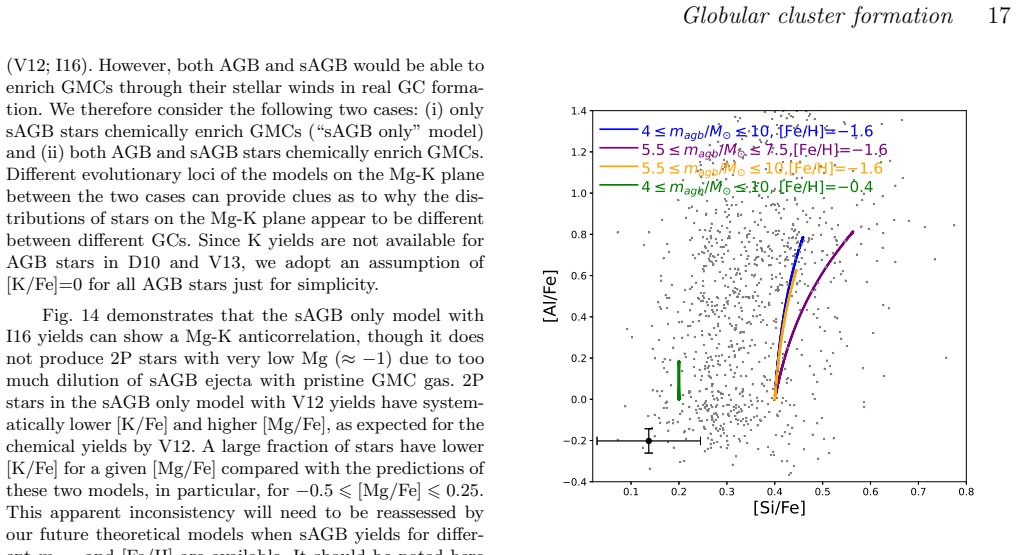
We present a new scenario of globular cluster (GC) formation with multiple stellar populations (MPs) in which both the first and second populations (1P and 2P, respectively) of stars form from giant molecular clouds (GMCs) polluted by asymptotic giant branch (AGB) stars within and around the GMCs. Unlike previous GC formation scenarios with AGB stars being the primary polluters, the new scenario alleviates tensions with the mass-budget and dilution-timing problems The principal results based on idealized analytic models of the formation scenario are as follows. The observed fraction of 1P stars and the helium abundance spreads between the 1P and 2P as a function of GC masses can be well reproduced. The modelled GCs show O-Na, C-N, and Mg-Al anticorrelations and Si-Al, 25Mg-Al, 26Mg-Al correlations. The observed Mg-K anticorrelation can be reproduced, only if super AGB stars make a significant contribution to chemical enrichment within GMCs. The lack of correlations of Li abundances with [Na/Fe] and [Al/Fe] can be reproduced, only if about 20% of the polluting AGB stars produce Li-rich ejecta, which disfavours scenarios with polluters incapable of Li production. Iron-complex, Type-II GCs can be formed through merging of two GCs formed from two GMCs within a host dwarf galaxy at different epochs. The new scenario predicts young massive clusters formed in galaxy environments with surface star formation rate densities well below 1 M_sun/yr/kpc^2 are unlikely to evolve into GCs with MPs. It also predicts low 12C/13C ratios of 2P (~5), a [Na/Fe]-[F/Fe] anticorrelation, and P-rich star formation with [P/Fe]$>0.5$ and [N/Fe]>0.5. These predictions are tested against more than 30 observed properties of GCs with MPs, representing one of the most comprehensive observational benchmarks against a specific GC formation scenario to date.
Editorial analysis
A structured set of objections, weighed in public.
Referee Report
Summary. The paper proposes a new globular cluster formation scenario with multiple stellar populations in which both 1P and 2P stars form from giant molecular clouds polluted by AGB stars via star-cloud interactions. Using idealized analytic models, it claims to reproduce the observed 1P star fractions and helium abundance spreads as a function of GC mass, O-Na/C-N/Mg-Al anticorrelations, Si-Al and Mg-Al correlations, and (with additional conditions) the Mg-K anticorrelation and lack of Li correlations. It further claims to explain iron-complex GCs via mergers, make several testable predictions (e.g., low 12C/13C in 2P stars, P-rich stars), and pass a benchmark of >30 observed GC properties while alleviating mass-budget and dilution-timing issues in prior AGB scenarios.
Significance. If the idealized analytic models prove robust and the parameter choices are shown to be non-circular, the work would offer a comprehensive, observationally benchmarked framework for GC formation with MPs that resolves longstanding tensions and generates falsifiable predictions across chemical patterns and cluster demographics.
major comments (2)
- [Abstract] Abstract: reproduction of the Mg-K anticorrelation is stated to require 'significant contribution' from super AGB stars, and reproduction of the lack of Li-[Na/Fe] and Li-[Al/Fe] correlations requires that 'about 20% of the polluting AGB stars produce Li-rich ejecta'; these are post-hoc conditions introduced to match specific observations rather than derived from the model, directly affecting the claimed success on multiple chemical patterns.
- [Abstract] Abstract: the central quantitative claims (1P fractions, He spreads vs. GC mass, multiple anticorrelations) rest on idealized analytic models of star-cloud interactions, yet the abstract provides no derivation details, error bars on the fits, or direct comparison to hydrodynamical simulations; any mismatch in assumed cloud structure, mixing efficiency, or feedback geometry would alter the predicted 1P/2P ratios and abundance spreads.
minor comments (1)
- [Abstract] The assertion that the scenario is tested against 'one of the most comprehensive observational benchmarks' is subjective and should be qualified or supported by an explicit enumeration of the 30+ properties.
Simulated Author's Rebuttal
We thank the referee for their thoughtful review and recommendation for major revision. We address each major comment on the abstract point by point below, providing clarifications on the model conditions and the scope of the idealized analytic approach while noting where revisions to the manuscript can improve clarity.
read point-by-point responses
-
Referee: [Abstract] Abstract: reproduction of the Mg-K anticorrelation is stated to require 'significant contribution' from super AGB stars, and reproduction of the lack of Li-[Na/Fe] and Li-[Al/Fe] correlations requires that 'about 20% of the polluting AGB stars produce Li-rich ejecta'; these are post-hoc conditions introduced to match specific observations rather than derived from the model, directly affecting the claimed success on multiple chemical patterns.
Authors: The abstract already qualifies these as necessary conditions ('only if') for reproducing the Mg-K anticorrelation and the absence of Li correlations. These requirements are not arbitrary post-hoc adjustments but follow directly from applying published AGB nucleosynthesis yields (including super-AGB models) to match the full set of observed abundance patterns while remaining consistent with independent constraints on AGB star populations. The manuscript uses these conditions to generate further predictions (e.g., disfavouring polluters unable to produce Li) and to benchmark against >30 GC properties. We agree the abstract could more explicitly note that the fractions are motivated by stellar evolution calculations rather than free parameters, and we will revise the wording accordingly for improved transparency. revision: partial
-
Referee: [Abstract] Abstract: the central quantitative claims (1P fractions, He spreads vs. GC mass, multiple anticorrelations) rest on idealized analytic models of star-cloud interactions, yet the abstract provides no derivation details, error bars on the fits, or direct comparison to hydrodynamical simulations; any mismatch in assumed cloud structure, mixing efficiency, or feedback geometry would alter the predicted 1P/2P ratios and abundance spreads.
Authors: The abstract explicitly describes the results as coming from 'idealized analytic models' and the main text supplies the full derivations, including the assumed GMC density profiles, star-cloud interaction geometry, mixing prescriptions, and feedback assumptions, together with direct comparisons to the observed 1P fractions, He spreads, and abundance anticorrelations. Because the models are deterministic analytic expressions rather than statistical fits, formal error bars are not applicable; parameter sensitivities are instead explored and discussed in the manuscript. We acknowledge that hydrodynamical simulations would provide valuable cross-checks on the mixing and geometry assumptions, but such comparisons lie beyond the present scope of this analytic framework. We will add a brief clarifying phrase in the abstract to emphasize the idealized character and refer readers to the detailed model sections. revision: partial
Circularity Check
Reproduction of Li correlations and other patterns requires tuned polluter fractions chosen to match observations
specific steps
-
fitted input called prediction
[Abstract]
"The lack of correlations of Li abundances with [Na/Fe] and [Al/Fe] can be reproduced, only if about 20% of the polluting AGB stars produce Li-rich ejecta, which disfavours scenarios with polluters incapable of Li production."
The 20% fraction is introduced as a condition required to reproduce the observed lack of Li correlations; the match is therefore obtained by setting the input parameter to the value that produces the target output rather than emerging as a model prediction.
-
fitted input called prediction
[Abstract]
"The observed Mg-K anticorrelation can be reproduced, only if super AGB stars make a significant contribution to chemical enrichment within GMCs."
The requirement for significant super-AGB contribution is stated as necessary to reproduce the Mg-K anticorrelation, indicating that the parameter is adjusted to fit the observation rather than predicted independently by the star-cloud interaction scenario.
full rationale
The paper's central results on reproducing observed GC properties (1P fractions, He spreads, Li lack of correlation, Mg-K anticorrelation) are achieved by selecting specific parameter values (20% Li-rich AGB fraction, significant super-AGB contribution) that are explicitly conditioned on matching those same observations. This reduces the claimed reproductions to fits by construction rather than independent predictions from the analytic models. No equations or self-citations are shown to create further circularity, and the models are presented as new, so the circularity is partial and limited to the fitted inputs.
Axiom & Free-Parameter Ledger
free parameters (2)
- fraction of polluting AGB stars producing Li-rich ejecta
- contribution of super AGB stars to chemical enrichment
axioms (1)
- domain assumption AGB stars are the primary polluters of GMCs both within and around the clouds
Reference graph
Works this paper leans on
-
[1]
Adamo, A., et al., 2020, MNRAS, 499, 3267
2020
-
[2]
C., 2010, ARA&A, 48, 47 Alvarez Garay, D
Adams, F. C., 2010, ARA&A, 48, 47 Alvarez Garay, D. A., et al., 2022, ApJ, 928 L11 Alvarez Garay, D. A., et al., 2025, A&A, 704, 114 Alvarez Garay, D. A., et al., 2026, A&A, 707, 280
2010
-
[3]
Bailin, J., 2018, ApJ, 863, 99
2018
-
[4]
Barbuy, B., et al., 2025, AJ, 170, 245
2025
-
[5]
S., 2013, MNRAS, 436, 2852
Bastian, N., Cabrera-Ziri, I., Davies, B., Larsen, S. S., 2013, MNRAS, 436, 2852
2013
-
[6]
Bastian, N., Lamers, H. J. G. L. M., de Mink, S. E., et al. 2013, MNRAS, 436, 2398
2013
-
[7]
2015, MNRAS, 449, 3333
Bastian, N., Cabrera-Ziri, I., & Salaris, M. 2015, MNRAS, 449, 3333
2015
-
[8]
Bastian, N., Lardo, C., 2018, ARA&A, 56, 83
2018
-
[9]
Baumgardt, H., & Kroupa, P., 2007, MNRAS, 380, 1589
2007
-
[10]
A., et al., 2019, MNRAS, 487, 1986
Beasley, M. A., et al., 2019, MNRAS, 487, 1986
2019
-
[11]
R., Piotto, G., Anderson, J., et al., 2004, ApJ, 605, L125
Bedin, L. R., Piotto, G., Anderson, J., et al., 2004, ApJ, 605, L125
2004
-
[12]
Bekki, K., 2010, ApJ, 724, L99
2010
-
[13]
Bekki, K., 2011, MNRAS, 412, 2241
2011
-
[14]
Bekki, K., 2015, MNRAS, 449, 1625
2015
-
[15]
Bekki, K., 2019, A&A, 622, 53 (2019a)
2019
-
[16]
Bekki, K., 2019, MNRAS, 486, 2570 (2019b)
2019
-
[17]
Bekki, K., 2019, MNRAS, 490, 4007 (2019c)
2019
-
[18]
Bekki, K., 2023, MNRAS, 518, 3274
2023
-
[19]
E., 2006, ApJ, 637, L109
Bekki, K., Norris, J. E., 2006, ApJ, 637, L109
2006
-
[20]
Bekki, K., et al., 2007, MNRAS, 377, 335
2007
-
[21]
D., 2009, MNRAS, 394, 124
Bekki, K., Mackey, A. D., 2009, MNRAS, 394, 124
2009
-
[22]
Bekki, K., Tsujimoto, T., 2012, ApJ, 761, 180 (BT12)
2012
-
[23]
Bekki, K., Yong, D., 2012, MNRAS, 419, 2063 (BY12)
2012
-
[24]
Bekki, K., Tsujimoto, T., 2016, ApJ, 831, 70 (BT16)
2016
-
[25]
Bekki, K., Tsujimoto, T., 2017, ApJ, 844, 34
2017
-
[26]
Bekki, K., Tsujimoto, T., 2024, ApJ, 937, L1
2024
-
[27]
Bekki, K., Furuya, K., Shimonishi, T., 2025, MNRAS, 543, 2997
2025
- [28]
-
[29]
B., 2025, MNRAS, 544 3601
Bobrick, A., Davies, M, B., Perets, H. B., 2025, MNRAS, 544 3601
2025
-
[30]
et al., 2007 A&A, 470, 153
Bonifacio, P. et al., 2007 A&A, 470, 153
2007
-
[31]
Brauner, M., et al., 2023, A&A, 637, 123
2023
-
[32]
Bragaglia, A., et al., 2017, A&A, 607, 44
2017
-
[33]
Buder, S., et al., 2025, PASA, 42, 51
2025
-
[34]
L., et al., 2025, A&A, 695, 124
Buzzo, M. L., et al., 2025, A&A, 695, 124
2025
-
[35]
Bruzual, G., Schweizer, F., 2014, MNRAS, 441, 2754
2014
-
[36]
Cameron, A. G. W., Fowler, W. A., 1971, ApJ, 164, 111
1971
-
[37]
Carretta, E., 2014, ApJ, 795, L28
2014
-
[38]
Carretta, E., et al., 2005, A&A, 433, 597
2005
-
[39]
Carretta, E., et al., 2009, A&A, 505, 117 (C09a)
2009
-
[40]
G., Lucatello, S., 2009, A&A, 505, 117 (C09b)
Carretta, E., Bragaglia, A., Gratton, R. G., Lucatello, S., 2009, A&A, 505, 117 (C09b)
2009
-
[41]
Carretta, E., et al., 2010, ApJ, 722, L1
2010
-
[42]
G., Lucatello, S., D’Orazi, V., 2012, ApJ, 750, L14
Carretta, E., Bragaglia, A., Gratton, R. G., Lucatello, S., D’Orazi, V., 2012, ApJ, 750, L14
2012
-
[43]
Carretta, E., Bragaglia, A., 2025, A&A, 696, 120
2025
-
[44]
Chevance, M., et al., 2020, Space Science Reviews, 216, 50
2020
-
[45]
V., 1979, ApJS, 41, 743
Cohen, M., Kuhi, L. V., 1979, ApJS, 41, 743
1979
-
[46]
& Spergel, D
Conroy, C. & Spergel, D. N. 2011, ApJ, 726, 36
2011
-
[47]
L.; Da Costa, G
Cottrell, P. L.; Da Costa, G. S., 1981, ApJL, 245, 79
1981
-
[48]
Cristallo, S., et al., 2011, ApJS, 197, 17
2011
-
[49]
S., Norris, J
Cunha, K., et al., 2003, AJ, 126, 1305 Da Costa, G. S., Norris, J. E., Yong, D., 2003, ApJ, 769, 8
2003
-
[50]
2018, ApJ, 864, 33 D’Antona, F., & Caloi, V
Dalessandro, E., Mucciarelli, A., Bellazzini, M., et al. 2018, ApJ, 864, 33 D’Antona, F., & Caloi, V. 2004, ApJ, 611, 871 D’Antona, F., et al. 2012, 426, 1710 D’Antona, F., Vesperini, E., D’Ercole, A., Ventura, P.,
2018
-
[51]
P., Marino, A
Milone, A. P., Marino, A. F., & Tailo, M. 2016, MNRAS, 458, 2122
2016
-
[52]
& Ekstr¨ om, S
Decressin, T., Meynet, G., Charbonnel, C., Prantzos, N. & Ekstr¨ om, S. 2007, A&A, 464, 1029 Dell’Agli, F., et al., 2018, 475, 3098 (D18) de Mink, S. E., Pols, O. R., Langer, N., 2009, A&A, 507, L1
2007
-
[53]
A., Hartwick
Denissenkov, P. A., Hartwick. F. D. A., 2014, MNRAS, 437, L21 D’Ercole, A., Vesperini, E., D’Antona, F., McMillan, S. L. W., & Recchi, S. 2008, MNRAS, 391, 825 (D08) D’Ercole, A., D’Antona, F., Ventura, P., Vesperini, E.,
2014
-
[54]
McMillan, S. L. W., 2010, MNRAS, 407, 854 (D10) D’Orazi, V., Marino, A. F., 2010, ApJ, 716, L166 D’Orazi, V., et al., 2014, ApJ, 791, 39
2010
-
[55]
Dobrovolskas, V., et al., 2014, A&A, 565, 121
2014
-
[56]
L., et al., 2015, 446, 2599 ©2005 RAS, MNRAS000, 1–?? 36K
Doherty, C. L., et al., 2015, 446, 2599 ©2005 RAS, MNRAS000, 1–?? 36K. Bekki, M. McKenzie,
2015
-
[57]
L., et al., 2017, PASA, 34, 56 Elmegreen B
Doherty, C. L., et al., 2017, PASA, 34, 56 Elmegreen B. G., & Efremov, Y. N., 1997, ApJ, 480, 235 Elmegreen B. G., 2017, ApJ, 836, 80
2017
-
[58]
K., 2004, MNRAS, 353, 789 Fern´ andez-Trincado, J
Gibson, B. K., 2004, MNRAS, 353, 789 Fern´ andez-Trincado, J. G., et al., 2019, A&A, 631, 97
2004
-
[59]
R., 2009, Nat, 462, 483
Ferraro, F. R., 2009, Nat, 462, 483
2009
-
[60]
Forestini, M., Goriely, S., Jorissen, A., Arnould, M., 1992, A&A, 261, 157
1992
-
[61]
2024, PhRvL, 132, 2701
Fox, W., et al. 2024, PhRvL, 132, 2701
2024
-
[62]
Grasha, K., et al., 2019, MNRAS, 483, 4707
2019
-
[63]
Gavagnin, E., Mapelli, E., Lake, G., 2016, MNRAS, 461, 1276
2016
-
[64]
P., Burkert, A., 2001, MNRAS, 323, 988
Geyer, M. P., Burkert, A., 2001, MNRAS, 323, 988
2001
-
[65]
Gieles, M., et al., 2025, MNRAS, 544, 483
2025
-
[66]
G., Carretta, E., Bragaglia, A., 2012, A&ARv, 20, 50
Gratton, R. G., Carretta, E., Bragaglia, A., 2012, A&ARv, 20, 50
2012
-
[67]
G., et al., 2019, ARA&A, 27, 8
Gratton, R. G., et al., 2019, ARA&A, 27, 8
2019
-
[68]
Goudfrooij, P., 2018, ApJ, 857, 16
2018
-
[69]
Goudfrooij, P., et al., 2026, accepted by MNRAS (arXiv.2606.07751)
work page internal anchor Pith review Pith/arXiv arXiv 2026
-
[70]
Harris, J., Zaritsky, D., 2009, AJ, 138, 1243
2009
-
[71]
E., Pudritz, R
Harris, W. E., Pudritz, R. E., 1994, ApJ, 429, 177
1994
-
[72]
E., Gerasimov, R., Kirby, E
Henderson, L. E., Gerasimov, R., Kirby, E. N., 2025, ApJ, 992, L14
2025
-
[73]
G., 1980, 235, 986 K
Hills, J. G., 1980, 235, 986 K. Hollyhead, K., et al., 2018, MNRAS, 476, 114
1980
-
[74]
2016, ApJ, 818, 98
Iliadis, C., et al. 2016, ApJ, 818, 98
2016
-
[75]
G., et al., 2026, MNRAS, 546, 2272
Kane, S. G., et al., 2026, MNRAS, 546, 2272
2026
-
[76]
I., 2010, MNRAS, 403, 1413
Karakas, A. I., 2010, MNRAS, 403, 1413
2010
-
[77]
I., Lattanzio, J
Karakas, A. I., Lattanzio, J. C., 2014, PASA, 31, 30
2014
-
[78]
Kawamura, A., et al., 2009, ApJS, 181, 1
2009
-
[79]
Kemp, A., et al., 2022, MNRAS, 509, 1175
2022
-
[80]
N., Ji, A
Kirby, E. N., Ji, A. P., Kovalev, M., 2023, ApJ, 958, 45
2023
discussion (0)
Sign in with ORCID, Apple, or X to comment. Anyone can read and Pith papers without signing in.