A Colour-colour Fingerprint Links the UV Upturn in Early-type Galaxies to Second-generation Stars from Dissolved Globular Clusters
Pith reviewed 2026-06-27 21:09 UTC · model grok-4.3
The pith
F275W-F390W color increases outward in early-type galaxies, tracing more He- and N-enhanced stars at larger radii with steeper gradients in FUV-bright systems.
A machine-rendered reading of the paper's core claim, the machinery that carries it, and where it could break.
Core claim
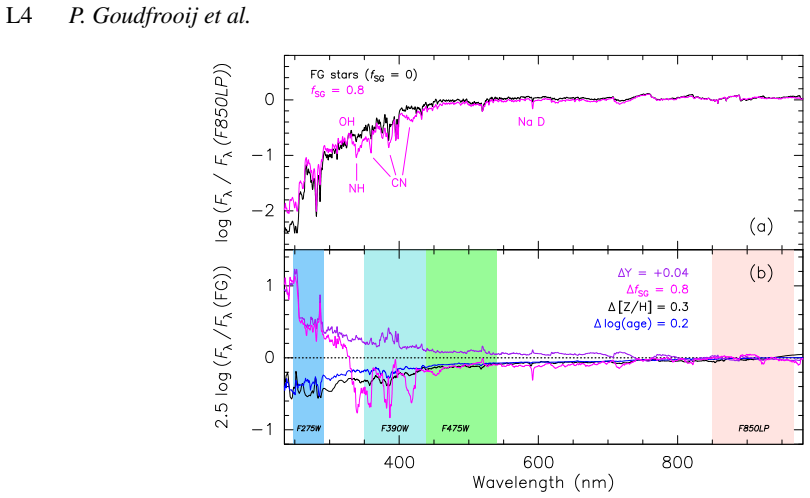
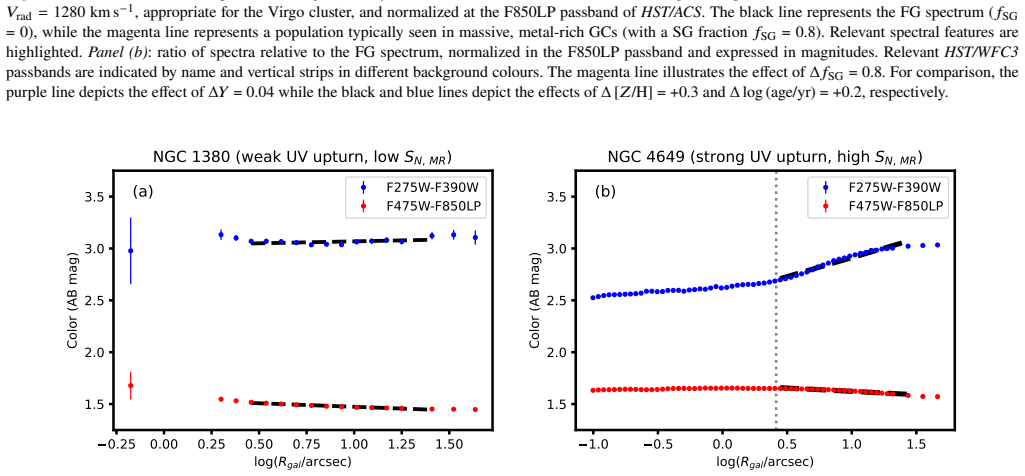
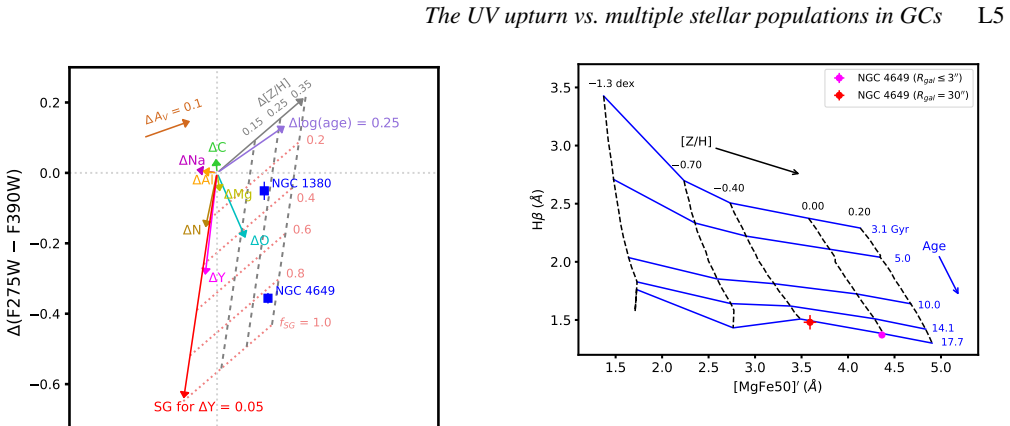
Passbands F275W and F390W are uniquely sensitive to correlated changes in helium abundance Y and [N/Fe] in integrated-light photometry of early-type galaxies. When combined with F475W and F850LP data, the observed radial increase in F275W-F390W indicates a growing contribution from He- and N-enhanced stars at larger radii, and this gradient is significantly stronger in the FUV-bright galaxy than in the FUV-weak one, as required by the multiple-populations scenario in which these stars originate in metal-rich globular clusters.
What carries the argument
The F275W-F390W color as a tracer of correlated supersolar Y and [N/Fe] in the integrated light of early-type galaxies.
If this is right
- The UV upturn is produced by extreme horizontal-branch stars belonging to the second-generation population.
- Mass-dependent [N/Fe] and [Na/Fe] variations across early-type galaxies arise from the same dissolved-cluster material.
- The contribution of second-generation stars to the total stellar mass is higher in FUV-bright galaxies.
- Radial profiles of helium and nitrogen enhancements are steeper in galaxies with stronger central UV upturns.
Where Pith is reading between the lines
- If the color fingerprint holds, it predicts that sodium-enhanced stars should also show a similar outward increase in fraction.
- The scenario implies that the total mass in dissolved globular clusters scales with the strength of the UV upturn across the early-type galaxy population.
- Extending the same color combination to lower-mass early-type galaxies could test whether the mechanism operates below the current sample range.
Load-bearing premise
Any observed radial change in F275W-F390W must be produced by second-generation stars with enhanced helium and nitrogen rather than by other stellar-population variations or observational effects.
What would settle it
A larger sample of FUV-weak and FUV-bright early-type galaxies in which the radial gradient in F275W-F390W shows no systematic difference between the two classes would falsify the claimed link.
Figures
read the original abstract
We address two mass-dependent properties among early-type galaxies (ETGs): (1) abundance ratios [N/Fe] and [Na/Fe], and (2) the centrally concentrated "UV upturn" at far-UV (FUV) wavelengths, which is likely produced by extreme horizontal branch stars with supersolar helium abundances. Using new HST/WFC3 observations of one FUV-weak and one FUV-bright ETG, we probe the "MP scenario" by Goudfrooij who posited that the UV upturn and the mass-dependent abundance variations of N and Na within and among ETGs are physically connected and produced by dissolution of metal-rich globular clusters, which represent the only galactic environment where mass-dependent enrichment of He, N, and Na is known to occur (i.e., second-generation stars of the "multiple stellar populations" (MPs) phenomenon). We show that passbands F275W and F390W are uniquely sensitive to correlated changes in $Y$ and [N/Fe] in integrated-light photometry when combined with archival data in F475W and F850LP. While F475W-F850LP is found to decrease with increasing radius in both galaxies, consistent with known metallicity gradients, F275W-F390W increases with increasing radius, as expected if the UV upturn is caused by second-generation stars with supersolar $Y$ and [N/Fe]. Furthermore, the radial gradient in F275W-F390W and the implied fractions of He- and N-enhanced stars are found to be significantly larger in the FUV-bright ETG than in the FUV-weak one, consistent with the predictions of the MP scenario.
Editorial analysis
A structured set of objections, weighed in public.
Referee Report
Summary. The manuscript presents new HST/WFC3 photometry of one FUV-weak and one FUV-bright early-type galaxy. It reports that F475W-F850LP decreases with radius (consistent with metallicity gradients) while F275W-F390W increases with radius, with the latter gradient significantly steeper in the FUV-bright galaxy. These trends are interpreted as evidence supporting the multiple-populations (MP) scenario, in which the UV upturn arises from second-generation stars with supersolar helium and nitrogen abundances originating from dissolved globular clusters, with the chosen passbands asserted to be uniquely sensitive to correlated Y and [N/Fe] variations.
Significance. If the passband-sensitivity claim is substantiated and alternative drivers of the F275W-F390W gradient are quantitatively excluded, the result would connect two mass-dependent ETG properties (abundance ratios and the UV upturn) through a shared origin in globular-cluster dissolution, offering a concrete observational test of the MP scenario with potential implications for chemical-enrichment models of massive galaxies.
major comments (2)
- [Abstract] Abstract: the claim that F275W and F390W are 'uniquely sensitive' to correlated changes in Y and [N/Fe] in integrated-light photometry of ETGs is load-bearing for the central interpretation, yet the text provides no quantitative comparison showing that other effects (age gradients, dust, CNO variations, or horizontal-branch morphology changes independent of Y) cannot produce comparable radial shifts in F275W-F390W.
- [Abstract] Abstract: the statement that the radial gradient in F275W-F390W 'is found to be significantly larger' in the FUV-bright ETG lacks reported uncertainties, number of radial bins, or statistical significance tests, preventing assessment of whether the difference robustly supports the MP-scenario prediction.
minor comments (1)
- The abstract would be clearer if it explicitly stated the sample consists of only two galaxies and specified the radial range over which the gradients are measured.
Simulated Author's Rebuttal
We thank the referee for their careful and constructive review. We address the two major comments point by point below, agreeing where revisions are needed to strengthen the manuscript.
read point-by-point responses
-
Referee: [Abstract] Abstract: the claim that F275W and F390W are 'uniquely sensitive' to correlated changes in Y and [N/Fe] in integrated-light photometry of ETGs is load-bearing for the central interpretation, yet the text provides no quantitative comparison showing that other effects (age gradients, dust, CNO variations, or horizontal-branch morphology changes independent of Y) cannot produce comparable radial shifts in F275W-F390W.
Authors: We agree that the abstract claim requires stronger quantitative support to be fully convincing. The manuscript uses stellar population models to argue for the sensitivity of the F275W-F390W color to correlated Y and [N/Fe] variations, but it does not present a side-by-side quantitative assessment of the expected color shifts from alternative effects such as age gradients, dust, or HB morphology changes independent of Y. We will revise the manuscript by adding a dedicated subsection (or expanded figure) that uses the same models to compute and compare the magnitude of F275W-F390W changes induced by each alternative driver, thereby demonstrating that the observed radial gradient is most consistent with the MP scenario. This constitutes a major addition. revision: yes
-
Referee: [Abstract] Abstract: the statement that the radial gradient in F275W-F390W 'is found to be significantly larger' in the FUV-bright ETG lacks reported uncertainties, number of radial bins, or statistical significance tests, preventing assessment of whether the difference robustly supports the MP-scenario prediction.
Authors: The referee is correct that the abstract statement would be more robust with explicit statistical details. The full manuscript derives the gradients from radial profiles using multiple bins (six bins per galaxy) and reports photometric uncertainties, but does not include a formal statistical test of the difference between the two galaxies nor quote the uncertainties on the gradient slopes themselves. We will revise both the abstract (where space permits) and the results section to report the number of bins, the measured gradient values with uncertainties, and the outcome of a statistical comparison (e.g., a t-test on the slopes yielding >3σ significance). This will allow readers to evaluate the robustness directly. revision: yes
Circularity Check
Minor self-citation to MP scenario; observational derivation remains independent
full rationale
The paper reports new HST/WFC3 photometry yielding radial gradients in F275W-F390W (increasing) and F475W-F850LP (decreasing) for one FUV-weak and one FUV-bright ETG, with the former gradient larger in the FUV-bright object. These measurements are derived directly from the new data. The MP scenario is referenced as prior work by the first author to provide interpretive context and predicted trends, but the paper does not derive its gradients or the difference between galaxies from that prior work; it compares the new measurements to the scenario's expectations. The claim that F275W/F390W are 'uniquely sensitive' is presented as shown within this manuscript. No equation, result, or central claim reduces by construction to the inputs or to a load-bearing self-citation chain. This is a normal case of citing prior context while presenting independent observational content.
Axiom & Free-Parameter Ledger
axioms (2)
- domain assumption F275W and F390W are uniquely sensitive to correlated changes in Y and [N/Fe] in integrated-light photometry when combined with F475W and F850LP
- domain assumption The UV upturn is produced by extreme horizontal branch stars with supersolar helium abundances from multiple stellar populations in globular clusters
Reference graph
Works this paper leans on
-
[1]
Wide-Field Hubble Space Telescope Observations of the Globular Cluster System in NGC1399
Wide-field Hubble Space Telescope Observations of the Globular Cluster System in NGC 1399. , keywords =. doi:10.1088/0004-637X/786/2/78 , archivePrefix =. 1402.6714 , primaryClass =
work page internal anchor Pith review Pith/arXiv arXiv doi:10.1088/0004-637x/786/2/78
-
[2]
2003, PASP, 115, 763, doi: 10.1086/376392
Galactic Stellar and Substellar Initial Mass Function. , keywords =. doi:10.1086/376392 , archivePrefix =. astro-ph/0304382 , primaryClass =
work page internal anchor Pith review Pith/arXiv arXiv doi:10.1086/376392
-
[3]
A systematic comparison with results from colour-magnitude diagrams
On the precision of full-spectrum fitting of simple stellar populations - IV. A systematic comparison with results from colour-magnitude diagrams. , keywords =. doi:10.1093/mnras/stac566 , archivePrefix =. 2203.09985 , primaryClass =
-
[4]
On the precision of full-spectrum fitting of stellar populations - III. Identifying age spreads. , keywords =. doi:10.1093/mnras/stab969 , archivePrefix =. 2104.11873 , primaryClass =
-
[5]
The Spectroscopic Age of 47 Tuc
The Spectroscopic Age of 47 Tucanae. , keywords =. doi:10.1086/301013 , archivePrefix =. astro-ph/9906095 , primaryClass =
work page internal anchor Pith review Pith/arXiv arXiv doi:10.1086/301013
-
[6]
Auto-consistent metallicity and star formation history of the nearest blue compact dwarf galaxy NGC 6789. , keywords =. doi:10.1111/j.1365-2966.2012.20885.x , archivePrefix =. 1203.2186 , primaryClass =
-
[7]
Recovering star formation histories: Integrated-light analyses vs stellar colour-magnitude diagrams
Recovering star formation histories: Integrated-light analyses vs. stellar colour-magnitude diagrams. , keywords =. doi:10.1051/0004-6361/201526752 , archivePrefix =. 1509.02414 , primaryClass =
work page internal anchor Pith review Pith/arXiv arXiv doi:10.1051/0004-6361/201526752
-
[9]
Unresolved versus resolved: testing the validity of young simple stellar population models with VLT/MUSE observations of NGC 3603. , keywords =. doi:10.1051/0004-6361/201628813 , archivePrefix =. 1607.03446 , primaryClass =
work page internal anchor Pith review Pith/arXiv arXiv doi:10.1051/0004-6361/201628813
-
[10]
How well can we determine ages and chemical abundances from spectral fitting of integrated light spectra?. , keywords =. doi:10.1093/mnras/staa3051 , archivePrefix =. 2010.02940 , primaryClass =
-
[11]
Populations of rotating stars. III. SYCLIST, the new Geneva population synthesis code. , keywords =. doi:10.1051/0004-6361/201423881 , archivePrefix =. 1404.6952 , primaryClass =
work page internal anchor Pith review Pith/arXiv arXiv doi:10.1051/0004-6361/201423881
-
[12]
Grids of stellar models with rotation. I. Models from 0.8 to 120 M _ ☉ at solar metallicity (Z = 0.014). , keywords =. doi:10.1051/0004-6361/201117751 , archivePrefix =. 1110.5049 , primaryClass =
work page internal anchor Pith review Pith/arXiv arXiv doi:10.1051/0004-6361/201117751
-
[13]
Monthly Notices of the Royal Astronomical Society , volume =
Can rotation explain the multiple main-sequence turn-offs of Magellanic Cloud star clusters?. , keywords =. doi:10.1111/j.1745-3933.2011.01013.x , archivePrefix =. 1101.1880 , primaryClass =
-
[14]
On the photometric signature of fast rotators
On the photometric signature of fast rotators. , keywords =. doi:10.1093/mnras/stz1767 , archivePrefix =. 1907.00688 , primaryClass =
work page internal anchor Pith review Pith/arXiv arXiv doi:10.1093/mnras/stz1767 1907
-
[15]
Mixing by overshooting and rotation in intermediate mass stars
Mixing by overshooting and rotation in intermediate-mass stars. , keywords =. doi:10.1093/mnras/stz728 , archivePrefix =. 1903.04368 , primaryClass =
work page internal anchor Pith review Pith/arXiv arXiv doi:10.1093/mnras/stz728 1903
-
[16]
New clues from Cepheids and colour-magnitude diagram
Multiple stellar populations in NGC 1866. New clues from Cepheids and colour-magnitude diagram. , keywords =. doi:10.1051/0004-6361/201936409 , archivePrefix =. 1909.01907 , primaryClass =
-
[17]
The Goodman spectrograph. Ground-based Instrumentation for Astronomy , year = 2004, editor =. doi:10.1117/12.550069 , adsurl =
-
[19]
Stellar rotation and the extended main sequence turnoff in the open cluster NGC 5822
Stellar Rotation and the Extended Main-sequence Turnoff in the Open Cluster NGC 5822. , keywords =. doi:10.3847/1538-4357/ab16e4 , archivePrefix =. 1904.03547 , primaryClass =
work page internal anchor Pith review Pith/arXiv arXiv doi:10.3847/1538-4357/ab16e4 1904
-
[20]
Extended main sequence turnoffs in open clusters as seen by Gaia - I. NGC 2818 and the role of stellar rotation. , keywords =. doi:10.1093/mnras/sty2100 , archivePrefix =. 1807.10779 , primaryClass =
work page internal anchor Pith review Pith/arXiv arXiv doi:10.1093/mnras/sty2100
-
[21]
Extended main sequence turnoff as a common feature of Milky Way open clusters
Extended Main-sequence Turnoff as a Common Feature of Milky Way Open Clusters. , keywords =. doi:10.3847/1538-4357/aaedc1 , archivePrefix =. 1811.01192 , primaryClass =
work page internal anchor Pith review Pith/arXiv arXiv doi:10.3847/1538-4357/aaedc1
-
[22]
No Evidence of Significant Chemical Variations in Main-sequence Stars of NGC 419
When Does the Onset of Multiple Stellar Populations in Star Clusters Occur? III. No Evidence of Significant Chemical Variations in Main-sequence Stars of NGC 419. , keywords =. doi:10.3847/1538-4357/ab7b64 , archivePrefix =. 2003.00159 , primaryClass =
-
[23]
Searching for globular cluster chemical anomalies on the main sequence of a young massive cluster. , keywords =. doi:10.1093/mnras/staa1185 , archivePrefix =. 2004.09636 , primaryClass =
-
[24]
Analysis of Red Supergiants in VDBH 222. , keywords =. doi:10.3847/1538-4357/aba439 , archivePrefix =. 2007.06583 , primaryClass =
-
[25]
Combined Effects of Rotation and Age Spreads on Extended Main-Sequence Turn Offs. , keywords =. doi:10.3847/1538-4357/ab5717 , archivePrefix =. 1907.11251 , primaryClass =
-
[26]
The dependence on star cluster mass in the wavelength range 0.3-5.0 m
On the precision of full-spectrum fitting of simple stellar populations - II. The dependence on star cluster mass in the wavelength range 0.3-5.0 m. , keywords =. doi:10.1093/mnras/staa3617 , archivePrefix =. 2011.08244 , primaryClass =
-
[27]
NGC 1866: First Spectroscopic Detection of Fast Rotating Stars in a Young LMC Cluster
NGC 1866: First Spectroscopic Detection of Fast-rotating Stars in a Young LMC Cluster. , keywords =. 2017. doi:10.3847/2041-8213/aa85dd , archivePrefix =. 1708.03386 , primaryClass =
work page internal anchor Pith review Pith/arXiv arXiv doi:10.3847/2041-8213/aa85dd 2017
-
[28]
Different Stellar Rotations in the Two Main Sequences of the Young Globular Cluster NGC 1818: The First Direct Spectroscopic Evidence. , keywords =. 2018. doi:10.3847/1538-3881/aad3cd , archivePrefix =. 1807.04493 , primaryClass =
work page internal anchor Pith review Pith/arXiv arXiv doi:10.3847/1538-3881/aad3cd 2018
-
[29]
Multiple populations in globular clusters and their parent galaxies. , keywords =. doi:10.1093/mnras/stz2999 , archivePrefix =. 1910.09683 , primaryClass =
-
[30]
On the precision of full-spectrum fitting of simple stellar populations - I. Well-sampled populations. , keywords =. doi:10.1093/mnras/staa2515 , archivePrefix =. 2008.07582 , primaryClass =
-
[31]
Massive Stellar Clusters , year = 2000, editor =
Stochastic Fluctuations in the Spectrophotometric Properties of Star Clusters. Massive Stellar Clusters , year = 2000, editor =
2000
-
[32]
A library of 0.5 to 2.5 mu m spectra of luminous cool stars. , keywords =. doi:10.1051/aas:2000269 , adsurl =
-
[33]
The modelling of intermediate-age stellar populations. II. Average spectra for upper AGB stars, and their use. , keywords =. doi:10.1051/0004-6361:20020585 , archivePrefix =. astro-ph/0206252 , primaryClass =
work page internal anchor Pith review Pith/arXiv arXiv doi:10.1051/0004-6361:20020585
-
[34]
Why Simple Stellar Population models do not reproduce the colours of Galactic open clusters
Why simple stellar population models do not reproduce the colours of Galactic open clusters. , keywords =. doi:10.1051/0004-6361/200913270 , archivePrefix =. 0910.0730 , primaryClass =
work page internal anchor Pith review Pith/arXiv arXiv doi:10.1051/0004-6361/200913270
-
[35]
Near-IR observations of NGC 6822: AGB stars, distance, metallicity and structure
Near-IR observations of NGC 6822: AGB stars, distance, metallicity and structure. , keywords =. doi:10.1051/0004-6361:20041608 , archivePrefix =. astro-ph/0409294 , primaryClass =
work page internal anchor Pith review Pith/arXiv arXiv doi:10.1051/0004-6361:20041608
-
[36]
A Dramatic Decrease in Carbon Star Formation in M31
A Dramatic Decrease in Carbon Star Formation in M31. , keywords =. doi:10.3847/1538-4357/ab24e2 , archivePrefix =. 1904.02172 , primaryClass =
work page internal anchor Pith review Pith/arXiv arXiv doi:10.3847/1538-4357/ab24e2 1904
-
[37]
Carbon stars in the X-shooter Spectral Library
Carbon stars in the X-Shooter Spectral Library. , keywords =. doi:10.1051/0004-6361/201526292 , archivePrefix =. 1602.00887 , primaryClass =
work page internal anchor Pith review Pith/arXiv arXiv doi:10.1051/0004-6361/201526292
-
[38]
Philosophical Transactions of the Royal Society of London Series A , keywords =
Models of very-low-mass stars, brown dwarfs and exoplanets. Philosophical Transactions of the Royal Society of London Series A , keywords =. doi:10.1098/rsta.2011.0269 , archivePrefix =. 1112.3591 , primaryClass =
-
[39]
Carbon stars in the X-shooter Spectral Library. II. Comparison with models. , keywords =. doi:10.1051/0004-6361/201629750 , archivePrefix =. 1702.00819 , primaryClass =
work page internal anchor Pith review Pith/arXiv arXiv doi:10.1051/0004-6361/201629750
-
[40]
Spectral Evolution of Galaxies , year = 1986, editor =
Global properties of stellar populations and the spectral evolution of galaxies. Spectral Evolution of Galaxies , year = 1986, editor =. doi:10.1007/978-94-009-4598-2_19 , adsurl =
-
[41]
Evolutionary synthesis of stellar populations: a modular tool. , keywords =. doi:10.1046/j.1365-8711.1998.01947.x , archivePrefix =. astro-ph/9807338 , primaryClass =
-
[42]
A comparison of optical and near-infrared colours of Magellanic Cloud star clusters with predictions of simple stellar population models. , keywords =. doi:10.1111/j.1365-2966.2008.12935.x , archivePrefix =. 0801.2375 , primaryClass =
-
[43]
Detection and Photometry of Hot Horizontal Branch Stars in the Core of M32
Detection and Photometry of Hot Horizontal Branch Stars in the Core of M32. , keywords =. doi:10.1086/308566 , archivePrefix =. astro-ph/9909391 , primaryClass =
work page internal anchor Pith review Pith/arXiv arXiv doi:10.1086/308566
-
[44]
The ATLAS ^ 3D Project - XXX. Star formation histories and stellar population scaling relations of early-type galaxies. , keywords =. doi:10.1093/mnras/stv105 , archivePrefix =. 1501.03723 , primaryClass =
work page internal anchor Pith review Pith/arXiv arXiv doi:10.1093/mnras/stv105
-
[45]
Population Parameters of Intermediate-age Star Clusters in the Large Magellanic Cloud. II. New Insights from Extended Main-sequence Turnoffs in Seven Star Clusters. , keywords =. doi:10.1088/0004-637X/737/1/3 , archivePrefix =. 1105.1337 , primaryClass =
work page internal anchor Pith review Pith/arXiv arXiv doi:10.1088/0004-637x/737/1/3
-
[46]
VLT spectroscopy of globular cluster systems. II. Spectroscopic ages, metallicities, and [ /Fe] ratios of globular clusters in early-type galaxies. , keywords =. doi:10.1051/0004-6361:20047012 , archivePrefix =. astro-ph/0505453 , primaryClass =
work page internal anchor Pith review Pith/arXiv arXiv doi:10.1051/0004-6361:20047012
-
[47]
Extremely -Enriched Globular Clusters in Early-Type Galaxies:A Step toward the Dawn of Stellar Populations?. , keywords =. doi:10.1086/505679 , archivePrefix =. astro-ph/0605210 , primaryClass =
work page internal anchor Pith review Pith/arXiv arXiv doi:10.1086/505679
-
[48]
Multiple Stellar Populations in Globular Clusters
Multiple Stellar Populations in Globular Clusters. , keywords =. doi:10.1146/annurev-astro-081817-051839 , archivePrefix =. 1712.01286 , primaryClass =
work page internal anchor Pith review Pith/arXiv arXiv doi:10.1146/annurev-astro-081817-051839
-
[49]
Chemical abundances of two extragalactic young massive clusters
Chemical abundances of two extragalactic young massive clusters. , keywords =. doi:10.1051/0004-6361/201730550 , archivePrefix =. 1705.01897 , primaryClass =
work page internal anchor Pith review Pith/arXiv arXiv doi:10.1051/0004-6361/201730550
-
[50]
Extragalactic Globular Clusters and Galaxy Formation. , keywords =. doi:10.1146/annurev.astro.44.051905.092441 , archivePrefix =. astro-ph/0602601 , primaryClass =
-
[51]
Detailed abundance analysis from integrated high-dispersion spectroscopy: globular clusters in the Fornax dwarf spheroidal. , keywords =. doi:10.1051/0004-6361/201219895 , archivePrefix =. 1209.1092 , primaryClass =
work page internal anchor Pith review Pith/arXiv arXiv doi:10.1051/0004-6361/201219895
-
[52]
NBursts: Simultaneous Extraction of Internal Kinematics and Parametrized SFH from Integrated Light Spectra. Stellar Populations as Building Blocks of Galaxies , year = 2007, editor =. doi:10.1017/S1743921307007752 , archivePrefix =. 0709.3047 , primaryClass =
work page internal anchor Pith review Pith/arXiv arXiv doi:10.1017/s1743921307007752 2007
-
[53]
doi:10.5281/zenodo.12157 , url =
Dan Foreman-Mackey and Jonathan Sick and Ben Johnson , title =. doi:10.5281/zenodo.12157 , url =
-
[54]
The Propagation of Uncertainties in Stellar Population Synthesis Modeling. I. The Relevance of Uncertain Aspects of Stellar Evolution and the Initial Mass Function to the Derived Physical Properties of Galaxies. , keywords =. doi:10.1088/0004-637X/699/1/486 , archivePrefix =. 0809.4261 , primaryClass =
work page internal anchor Pith review Pith/arXiv arXiv doi:10.1088/0004-637x/699/1/486
-
[55]
Early-type Galaxy Archeology: Ages, Abundance Ratios, and Effective Temperatures from Full-spectrum Fitting. , keywords =. doi:10.1088/0004-637X/780/1/33 , archivePrefix =. 1303.6629 , primaryClass =
work page internal anchor Pith review Pith/arXiv arXiv doi:10.1088/0004-637x/780/1/33
-
[56]
Integrated-light analyses vs. colour-magnitude diagrams. II. Leo A: an extremely young dwarf in the Local Group. , keywords =. 2018. doi:10.1051/0004-6361/201732398 , archivePrefix =. 1805.04323 , primaryClass =
work page internal anchor Pith review Pith/arXiv arXiv doi:10.1051/0004-6361/201732398 2018
-
[57]
, archivePrefix = "arXiv", eprint =
On the Recovery of Galaxy Properties from SED Fitting Solutions. , archivePrefix = "arXiv", eprint =. doi:10.1086/679742 , adsurl =
-
[58]
, archivePrefix = "arXiv", eprint =
Using Star Clusters as Tracers of Star Formation and Chemical Evolution: The Chemical Enrichment History of the Large Magellanic Cloud. , archivePrefix = "arXiv", eprint =. doi:10.3847/1538-4357/aaba77 , adsurl =
-
[59]
, archivePrefix = "arXiv", eprint =
A New Approach to Convective Core Overshooting: Probabilistic Constraints from Color-Magnitude Diagrams of LMC Clusters. , archivePrefix = "arXiv", eprint =. doi:10.3847/1538-4357/aa70a2 , adsurl =
-
[60]
, archivePrefix = "arXiv", eprint =
Is the escape velocity in star clusters linked to extended star formation histories? Using NGC 7252: W3 as a test case. , archivePrefix = "arXiv", eprint =. doi:10.1093/mnras/stv2977 , adsurl =
-
[61]
No evidence for younger stellar generations within the intermediate-age massive clusters NGC 1783, NGC 1806 and NGC 411. , keywords =. doi:10.1093/mnras/stw966 , archivePrefix =. 1604.06106 , primaryClass =
work page internal anchor Pith review Pith/arXiv arXiv doi:10.1093/mnras/stw966
-
[62]
Coeval multiple stellar populations in the young star cluster NGC 1978
The search for multiple populations in Magellanic Cloud clusters - IV. Coeval multiple stellar populations in the young star cluster NGC 1978. , archivePrefix = "arXiv", eprint =. doi:10.1093/mnras/sty916 , adsurl =
-
[63]
2016, ApJS, 222, 8, doi: 10.3847/0067-0049/222/1/8 Duchˆ ene, G., & Kraus, A
MESA Isochrones and Stellar Tracks (MIST) 0: Methods for the Construction of Stellar Isochrones. , archivePrefix = "arXiv", eprint =. doi:10.3847/0067-0049/222/1/8 , adsurl =
work page internal anchor Pith review doi:10.3847/0067-0049/222/1/8
-
[64]
Mesa Isochrones and Stellar Tracks (MIST). I. Solar-scaled Models. , archivePrefix = "arXiv", eprint =. doi:10.3847/0004-637X/823/2/102 , adsurl =
work page internal anchor Pith review doi:10.3847/0004-637x/823/2/102
-
[65]
, archivePrefix = "arXiv", eprint =
Rotating Stellar Models Can Account for the Extended Main-sequence Turnoffs in Intermediate-age Clusters. , archivePrefix = "arXiv", eprint =. doi:10.1088/0004-637X/807/1/25 , adsurl =
-
[66]
The Photometric Performance and Calibration of the Hubble Space Telescope Advanced Camera for Surveys. , eprint =. doi:10.1086/444553 , adsurl =
-
[67]
The center of the core-cusp globular cluster M15: CFHT and HST Observations, ALLFRAME reductions. , keywords =. doi:10.1086/133378 , adsurl =
-
[68]
DAOPHOT - A computer program for crowded-field stellar photometry. , keywords =. doi:10.1086/131977 , adsurl =
-
[69]
, archivePrefix = "arXiv", eprint =
Constraining the True Nature of an Exotic Binary in the Core of NGC 6624. , archivePrefix = "arXiv", eprint =. doi:10.1088/2041-8205/784/2/L29 , adsurl =
-
[70]
Cosmic-Ray Rejection by Laplacian Edge Detection. , eprint =. doi:10.1086/323894 , adsurl =
-
[71]
, archivePrefix = "arXiv", eprint =
A high fraction of Be stars in young massive clusters: evidence for a large population of near-critically rotating stars. , archivePrefix = "arXiv", eprint =. doi:10.1093/mnras/stw3042 , adsurl =
-
[72]
ArXiv e-prints , archivePrefix = "arXiv", eprint =
Multiple Stellar Populations in Globular Clusters. ArXiv e-prints , archivePrefix = "arXiv", eprint =
-
[73]
, archivePrefix = "arXiv", eprint =
The Evolution and Properties of Rotating Massive Star Populations. , archivePrefix = "arXiv", eprint =. doi:10.3847/1538-4357/aa679f , adsurl =
-
[74]
, archivePrefix = "arXiv", eprint =
Extended Main-sequence Turn-offs in Intermediate-age Star Clusters: Stellar Rotation Diminishes, but Does Not Eliminate, Age Spreads. , archivePrefix = "arXiv", eprint =. doi:10.3847/1538-4357/aa7fb7 , adsurl =
-
[75]
, archivePrefix = "arXiv", eprint =
New Clues to the Cause of Extended Main-Sequence Turnoffs in Intermediate-age Star Clusters in the Magellanic Clouds. , archivePrefix = "arXiv", eprint =. doi:10.1088/0004-637X/793/2/121 , adsurl =
-
[76]
, archivePrefix = "arXiv", eprint =
Gemini/GMOS photometry of intermediate-age star clusters in the Large Magellanic Cloud. , archivePrefix = "arXiv", eprint =. doi:10.1093/mnras/stu1535 , adsurl =
-
[77]
, archivePrefix = "arXiv", eprint =
An Analysis of the Population of Extended Main Sequence Turn-off Clusters in the Large Magellanic Cloud. , archivePrefix = "arXiv", eprint =. doi:10.1093/mnras/stw2071 , adsurl =
-
[78]
Testing Intermediate-Age Stellar Evolution Models with VLT Photometry of Large Magellanic Cloud Clusters. III. Padova Results. , eprint =. doi:10.1086/345961 , adsurl =
-
[79]
, archivePrefix = "arXiv", eprint =
A young cluster with an extended main-sequence turnoff: confirmation of a prediction of the stellar rotation scenario. , archivePrefix = "arXiv", eprint =. doi:10.1093/mnrasl/slw067 , adsurl =
-
[80]
, archivePrefix = "arXiv", eprint =
The Chemical Composition of Red Giant Stars in Four Intermediate-Age Clusters of the Large Magellanic Cloud. , archivePrefix = "arXiv", eprint =. doi:10.1088/0004-6256/136/1/375 , adsurl =
-
[81]
, archivePrefix = "arXiv", eprint =
Controversial age spreads from the main sequence turn-off and red clump in intermediate-age clusters in the LMC. , archivePrefix = "arXiv", eprint =. doi:10.1051/0004-6361/201526484 , adsurl =
-
[82]
, archivePrefix = "arXiv", eprint =
Explanation of a Special Color-Magnitude Diagram of Star Cluster NGC 1651 from Different Models. , archivePrefix = "arXiv", eprint =. doi:10.1088/0004-637X/802/1/44 , adsurl =
discussion (0)
Sign in with ORCID, Apple, or X to comment. Anyone can read and Pith papers without signing in.