REVIEW 3 major objections 7 minor 60 references
Beyond Appearance: Geometric Cues for Robust Video Instance Segmentation
T0 review · 3 major / 7 minor · reviewed 2026-08-06 · deepseek-v4-flash
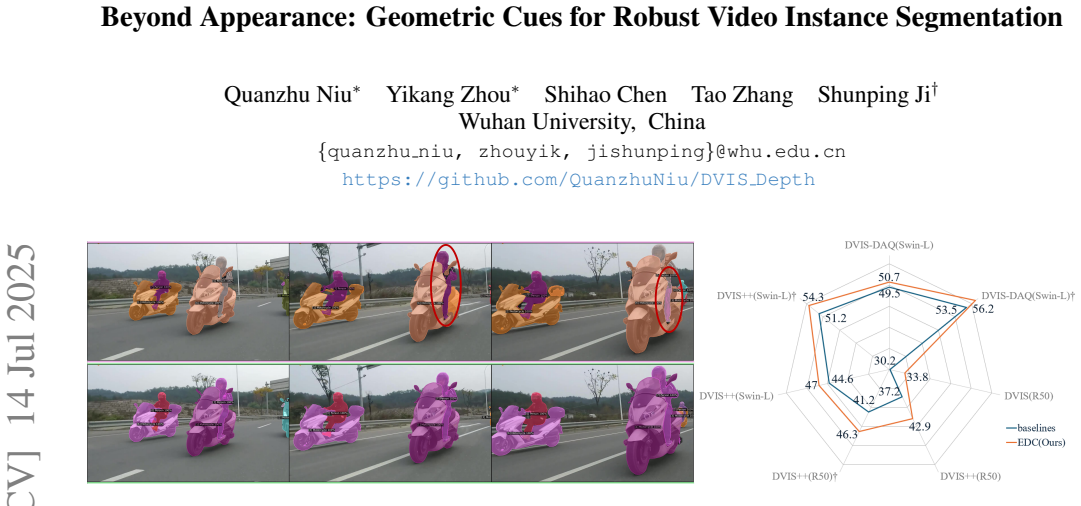
Pith's one-line read Adding estimated depth as a fourth input channel systematically improves video instance segmentation, reaching 56.2 AP on OVIS and cutting identity-swap failures under occlusion.
desk verdict Solid empirical study of depth fusion for VIS with a new OVIS SOTA, but the 'depth cues are critical' claim is underdetermined without a non-geometric control channel and error bars. read the letter →
The pith
A machine-rendered reading of the paper's core claim, the machinery that carries it, and where it could break.
The reading
What carries the argument
The load-bearing mechanism is the Expanding Depth Channel (EDC): a monocular depth estimator produces a relative depth map $D \in \mathbb{R}^{H\times W}$ that is concatenated with each RGB frame to form a four-channel RGBD video, and the segmentation backbone's first layer is expanded to accept four channels while preserving the pretrained RGB weights. Sharing ViT (SV) instead couples a frozen ViT backbone from the depth estimator to the segmentation stream via a ViT-Adapter, feeding the predicted depth as a fourth channel into the adapter's spatial-prior module. Depth Supervision (DS) trains an auxiliary depth head with pseudo-depth labels as supervision but, by the paper's own results, does not improve segmentation. The ablation linking depth-map quality to AP gain is what makes EDC the paper's central mechanism rather than an incidental channel trick.
What would settle it
Run the EDC configuration on OVIS replacing each estimated depth map with a fixed constant, random noise with matched statistics, or spatially scrambled depth values while keeping everything else identical. If AP does not drop materially below the reported gains, the improvements come from something other than geometry; if AP falls to baseline or below, the paper's causal story is supported.
Extended reading notes
Core claim
The central claim is that early fusion of monocular depth into query-based, decoupled video instance segmentation frameworks resolves identity ambiguities that defeat RGB-only matching. The strongest quantitative evidence is on OVIS, where EDC beats the DVIS++ baseline by 5.7 AP with an R50 backbone and, combined with DVIS-DAQ and the Swin-L backbone, sets a new state of the art at 56.2 AP. Gains are also reported on YouTube-VIS 2019 and 2021. The paper attributes the improvement to geometric disambiguation: depth ordering separates objects at different distances, making physically implausible ID swaps, such as a disappeared panda reappearing in a faraway region, evident to the model. The ablation study shows that replacing the large depth estimator with a small one costs 3.0 to 3.2 AP, so the strength of the claim is tied to depth-map quality.
Load-bearing premise
The headline gains rest on the assumption that the external monocular depth estimator produces depth maps accurate and stable enough to act as a geometric prior; if those maps are wrong or jitter across frames, the identity disambiguation the paper relies on disappears.
Editorial extensions
If this is right
- EDC-style early fusion can be dropped into any query-based video instance segmentation framework by expanding the first layer, and should improve robustness whenever the depth estimator is accurate.
- On occlusion-heavy benchmarks like OVIS, geometric cues directly correct identity swaps that appearance-only trackers make, so similar gains should appear on other crowded-scene datasets.
- The demonstrated dependence on depth-map quality implies that future improvements in monocular depth estimation will transfer to video instance segmentation without changing the segmentation architecture.
- Because depth supervision alone failed to help, geometry must enter through input or feature fusion rather than only as an auxiliary loss.
- Deployment requires no new labels or sensors: a single forward pass of an off-the-shelf depth estimator produces the fourth channel at inference time.
Reading between the lines
- The paper leaves open whether temporal consistency of the depth maps, rather than their per-frame accuracy, drives the gains; perturbing depth maps across frames in an ablation would separate these two effects and could motivate a cheap depth-smoothing preprocessor.
- A natural extension the authors do not test is joint video depth estimation and segmentation, using a video-based depth model, which could sharpen depth at moving-object boundaries and boost EDC further.
- Since depth supervision failed in the current framework, geometric awareness may need to enter during pretraining of the backbone rather than during the video segmentation fine-tuning phase.
- If the central claim is right, a general recipe emerges: any tracking-by-matching system can gain robustness by augmenting appearance features with an auxiliary geometric channel, a hypothesis that could be tested on multi-object tracking beyond instance segmentation.
Editorial analysis
A structured set of objections, weighed in public.
Referee Report
Summary. The paper proposes three methods to integrate monocular depth information into video instance segmentation (VIS) frameworks built on the DVIS series: Expanding Depth Channel (EDC), which concatenates a depth map as a fourth input channel; Sharing ViT (SV), which shares a frozen ViT backbone between depth estimation and segmentation; and Depth Supervision (DS), which uses depth prediction as an auxiliary training signal. Experiments on OVIS, YouTube-VIS 2019, and YouTube-VIS 2021 report consistent AP improvements for EDC and SV over appearance-only baselines, with EDC achieving 56.2 AP on OVIS with a Swin-L backbone. The authors conclude that geometric cues are critical for robust VIS.
Significance. If the reported gains are indeed attributable to geometric information, the work offers a simple and broadly applicable recipe for improving VIS robustness, and the systematic comparison of three integration paradigms is a useful contribution. The paper ships a code link and provides a reproducible experimental protocol consistent with the DVIS baselines. The negative result for DS is also informative. However, the central claim that depth cues, rather than any strong auxiliary input, drive the improvements needs additional evidence; the current experiments do not rule out alternative interpretations.
major comments (3)
- [Sec. 3.2, Tab. 3] The central conclusion that depth cues are critical is underdetermined because no non-geometric control is tested. EDC concatenates the depth map as a fourth input channel, and the ablation in Tab. 3 varies only the size/quality of the depth estimator. This does not rule out the possibility that any informative auxiliary channel (e.g., edge maps, optical flow magnitude, image gradients, or even a fixed random feature) would yield comparable gains. A control experiment replacing the depth channel with a non-geometric cue is necessary; if such a control also improves AP, the geometric interpretation is not supported.
- [Tabs. 1-4] All reported results are single runs with no error bars or multiple seeds. The headline gains include small increments such as +0.5 AP for SV with ViT-L and +1.2 AP for EDC with DVIS-DAQ online; without variance estimates or significance testing, these could be within run-to-run noise. The phrase 'statistically validating' in Sec. 4.2 is not supported by the presented evidence. The authors should report multiple seeds or provide a variance estimate for at least the main comparisons.
- [Sec. 3.2] The depth maps from Depth Anything V2 are relative, computed per frame, and are concatenated without normalization or temporal alignment. Since the scale and shift of these relative maps can vary across frames, the network may exploit per-frame statistics rather than temporally coherent geometry. The paper should either normalize the depth channel (per-frame or per-sequence) or provide evidence that the depth maps are temporally consistent and that the method benefits from this consistency, to support the claim that EDC improves cross-frame matching through geometric priors.
minor comments (7)
- [Sec. 2.1] Typo: 'video sementic segmentation' should be 'video semantic segmentation'.
- [Sec. 3.3] Typo: 'a efficient version' should be 'an efficient version'.
- [Sec. 4.2] The section heading contains a stray space: 'Y ouTube' should be 'YouTube'.
- [Sec. 3.2] Please specify how the newly added depth channel weights in the first backbone layer are initialized and whether depth values are rescaled (e.g., to [0,1] or z-scored) before concatenation.
- [Abstract and Sec. 5] The claim that the work 'conclusively establishes' depth cues as critical is too strong given the missing control and single-run nature of the experiments; a more cautious conclusion would be appropriate.
- [Sec. 4.4 and Tab. 1] The statement that DS shows a 'marginal but consistent improvement AP 75' is misleading: while AP75 increases slightly, overall AP is unchanged or slightly lower. Please report the results more neutrally.
- [Tab. 1] DS results are reported only for OVIS; clarify whether DS was evaluated on YouTube-VIS and, if not, why.
Circularity Check
No significant circularity: the depth signal is an external model input, and the claimed gains are measured against standard baselines rather than derived from the method's own assumptions.
full rationale
The central derivation chain is empirically self-contained rather than circular. EDC (Sec. 3.2) takes depth maps from the external Depth Anything V2 model [51] and concatenates them as a fourth input channel; the paper explicitly states it 'leverage[s] monocular depth estimation model [51] to derive additional depth features,' so the geometric signal is not fitted to the VIS target or defined in terms of the reported AP. The SV method (Sec. 3.3) reuses the same frozen external backbone and is likewise an architectural integration, not a renamed fit. The DS method (Sec. 3.4) trains an auxiliary depth head with pseudo-labels from the same external model, but the paper honestly reports that DS yields 'marginal' gains, so no prediction is forced by construction. The baselines (DVIS, DVIS++, DVIS-DAQ) are the authors' own prior systems, but outperforming one's own previous work on public benchmarks is not circular reasoning, and no load-bearing uniqueness theorem or self-citation chain is invoked. The main weakness is experimental underdetermination: since no non-geometric fourth-channel control (e.g., edge map, flow magnitude, or random channel) is tested, the claim that 'depth cues are critical enablers' is stronger than the evidence uniquely supports. That is a correctness or experimental-design concern, not a circularity concern, because the observed AP differences come from benchmark measurements with an externally supplied depth model. No fitted parameter is relabeled as a prediction, and no equation reduces to its own inputs. Therefore the circularity score is 0.
Assumptions & free parameters
assumptions (4)
- domain assumption Monocular depth maps estimated by Depth Anything V2 are accurate and temporally consistent enough to act as a geometric prior for segmentation and tracking.
- domain assumption The DVIS decoupled framework (image segmenter, tracker, optional refiner) is an appropriate and strong baseline for VIS.
- ad hoc to paper Relative depth values can be concatenated with RGB without normalization or scale alignment.
- domain assumption Benchmark annotations on OVIS and YouTube-VIS are correct and scores are comparable across reported runs.
Cite this review
Pith. "Pith review of Beyond Appearance: Geometric Cues for Robust Video Instance Segmentation." pith.science (2026). https://pith.science/paper/4ES4VUQR
@misc{pith2026250705948,
  author       = {Pith},
  title        = {Pith review of: Beyond Appearance: Geometric Cues for Robust Video Instance Segmentation},
  year         = {2026},
  howpublished = {\url{https://pith.science/paper/4ES4VUQR}},
  note         = {Machine review of arXiv:2507.05948}
}
read the original abstract
Video Instance Segmentation (VIS) fundamentally struggles with pervasive challenges including object occlusions, motion blur, and appearance variations during temporal association. To overcome these limitations, this work introduces geometric awareness to enhance VIS robustness by strategically leveraging monocular depth estimation. We systematically investigate three distinct integration paradigms. Expanding Depth Channel (EDC) method concatenates the depth map as input channel to segmentation networks; Sharing ViT (SV) designs a uniform ViT backbone, shared between depth estimation and segmentation branches; Depth Supervision (DS) makes use of depth prediction as an auxiliary training guide for feature learning. Though DS exhibits limited effectiveness, benchmark evaluations demonstrate that EDC and SV significantly enhance the robustness of VIS. When with Swin-L backbone, our EDC method gets 56.2 AP, which sets a new state-of-the-art result on OVIS benchmark. This work conclusively establishes depth cues as critical enablers for robust video understanding.
Figures


Figures from the paper (2 more)


Reference graph
Works this paper leans on
-
[1]
Stem-seg: Spatio-temporal em- beddings for instance segmentation in videos
Ali Athar, Sabarinath Mahadevan, Aljosa Osep, Laura Leal- Taix´e, and Bastian Leibe. Stem-seg: Spatio-temporal em- beddings for instance segmentation in videos. In European Conference on Computer Vision, 2020. 2
work page 2020
-
[2]
Gedas Bertasius, Heng Wang, and Lorenzo Torresani. Is space-time attention all you need for video understanding? In International Conference on Machine Learning, 2021. 1
work page 2021
-
[3]
Midas v3.1 – a model zoo for robust monocular relative depth estimation
Reiner Birkl, Diana Wofk, and Matthias M ¨uller. Midas v3.1 – a model zoo for robust monocular relative depth estimation. arXiv preprint arXiv:2307.14460, 2023. 3
arXiv 2023
-
[4]
Stable video diffusion: Scaling la- tent video diffusion models to large datasets
Andreas Blattmann, Tim Dockhorn, Sumith Kulal, Daniel Mendelevitch, Maciej Kilian, Dominik Lorenz, Yam Levi, 8 Zion English, Vikram V oleti, Adam Letts, Varun Jampani, and Robin Rombach. Stable video diffusion: Scaling la- tent video diffusion models to large datasets. arXiv preprint arXiv:2311.15127, 2023. 3
arXiv 2023
-
[5]
End-to- end object detection with transformers
Nicolas Carion, Francisco Massa, Gabriel Synnaeve, Nicolas Usunier, Alexander Kirillov, and Sergey Zagoruyko. End-to- end object detection with transformers. In European Confer- ence on Computer vision, 2020. 2
work page 2020
-
[6]
Liu, Yen-Cheng Liu, and Yu- Chiang Frank Wang
Po-Yi Chen, Alexander H. Liu, Yen-Cheng Liu, and Yu- Chiang Frank Wang. Towards scene understanding: Un- supervised monocular depth estimation with semantic-aware representation. In Conference on Computer Vision and Pat- tern Recognition, 2019. 3
work page 2019
-
[7]
Vision transformer adapter for dense predictions
Zhe Chen, Yuchen Duan, Wenhai Wang, Junjun He, Tong Lu, Jifeng Dai, and Yu Qiao. Vision transformer adapter for dense predictions. arXiv preprint arXiv:2205.08534, 2022. 4, 6
arXiv 2022
-
[8]
Collins, Yukun Zhu, Ting Liu, Thomas S
Bowen Cheng, Maxwell D. Collins, Yukun Zhu, Ting Liu, Thomas S. Huang, Hartwig Adam, and Liang-Chieh Chen. Panoptic-deeplab: A simple, strong, and fast baseline for bottom-up panoptic segmentation. In Conference on Com- puter Vision and Pattern Recognition, 2020. 3
work page 2020
Show all 60 references
-
[9]
Bowen Cheng, Anwesa Choudhuri, Ishan Misra, Alexan- der Kirillov, Rohit Girdhar, and Alexander G. Schwing. Mask2former for video instance segmentation. arXiv preprint arXiv:2112.10764, 2021. 2
2021 arXiv
-
[10]
Per- pixel classification is not all you need for semantic segmen- tation
Bowen Cheng, Alex Schwing, and Alexander Kirillov. Per- pixel classification is not all you need for semantic segmen- tation. Advances in Neural Information Processing Systems,
-
[11]
Masked-attention mask transformer for universal image segmentation
Bowen Cheng, Ishan Misra, Alexander G Schwing, Alexan- der Kirillov, and Rohit Girdhar. Masked-attention mask transformer for universal image segmentation. In Confer- ence on Computer Vision and Pattern Recognition, 2022. 2, 3, 5
2022
-
[12]
MeViS: A large-scale benchmark for video segmentation with motion expressions
Henghui Ding, Chang Liu, Shuting He, Xudong Jiang, and Chen Change Loy. MeViS: A large-scale benchmark for video segmentation with motion expressions. In Interna- tional Conference on Computer Vision, 2023. 2
2023
-
[13]
MOSE: A new dataset for video object segmentation in complex scenes
Henghui Ding, Chang Liu, Shuting He, Xudong Jiang, Philip HS Torr, and Song Bai. MOSE: A new dataset for video object segmentation in complex scenes. In Interna- tional Conference on Computer Vision, 2023. 2
2023
-
[14]
An image is worth 16x16 words: Transformers for image recognition at scale
Alexey Dosovitskiy, Lucas Beyer, Alexander Kolesnikov, Dirk Weissenborn, Xiaohua Zhai, Thomas Unterthiner, Mostafa Dehghani, Matthias Minderer, Georg Heigold, Syl- vain Gelly, Jakob Uszkoreit, and Neil Houlsby. An image is worth 16x16 words: Transformers for image recognition ...
2021
-
[15]
Depth map prediction from a single image using a multi-scale deep net- work
David Eigen, Christian Puhrsch, and Rob Fergus. Depth map prediction from a single image using a multi-scale deep net- work. In Advances in Neural Information Processing Sys- tems, 2014. 3
2014
-
[16]
Deep Ordinal Regression Network for Monocular Depth Estimation
Huan Fu, Mingming Gong, Chaohui Wang, Kayhan Bat- manghelich, and Dacheng Tao. Deep Ordinal Regression Network for Monocular Depth Estimation. In Conference on Computer Vision and Pattern Recognition, 2018. 3
2018
-
[17]
Gratt-vis: Gated residual atten- tion for video instance segmentation
Tanveer Hannan, Rajat Koner, Maximilian Bernhard, Suprosanna Shit, Bjoern Menze, V olker Tresp, Matthias Schubert, and Thomas Seidl. Gratt-vis: Gated residual atten- tion for video instance segmentation. InPattern Recognition,
-
[18]
Deep residual learning for image recognition
Kaiming He, Xiangyu Zhang, Shaoqing Ren, and Jian Sun. Deep residual learning for image recognition. In Conference on Computer Vision and Pattern Recognition, 2016. 2, 5, 6, 7
2016
-
[19]
Vita: Video instance segmentation via object token association
Miran Heo, Sukjun Hwang, Seoung Wug Oh, Joon-Young Lee, and Seon Joo Kim. Vita: Video instance segmentation via object token association. In Advances in Neural Informa- tion Processing Systems, 2022. 2
2022
-
[20]
A generalized framework for video instance segmentation
Miran Heo, Sukjun Hwang, Jeongseok Hyun, Hanjung Kim, Seoung Wug Oh, Joon-Young Lee, and Seon Joo Kim. A generalized framework for video instance segmentation. In Conference on Computer Vision and Pattern Recognition ,
-
[21]
Metric3d v2: A versatile monocular geomet- ric foundation model for zero-shot metric depth and surface normal estimation
Mu Hu, Wei Yin, Chi Zhang, Zhipeng Cai, Xiaoxiao Long, Hao Chen, Kaixuan Wang, Gang Yu, Chunhua Shen, and Shaojie Shen. Metric3d v2: A versatile monocular geomet- ric foundation model for zero-shot metric depth and surface normal estimation. IEEE Transactions on Pattern Analys...
2024
-
[22]
Min- vis: A minimal video instance segmentation framework without video-based training
De-An Huang, Zhiding Yu, and Anima Anandkumar. Min- vis: A minimal video instance segmentation framework without video-based training. In Advances in Neural Infor- mation Processing Systems, 2022. 2, 5
2022
-
[23]
Video object segmentation with language referring expressions
Anna Khoreva, Anna Rohrbach, and Bernt Schiele. Video object segmentation with language referring expressions. In Asian Conference on Computer Vision, 2018. 2
2018
-
[24]
Self-Supervised Monocular Depth Es- timation: Solving the Dynamic Object Problem by Seman- tic Guidance
Marvin Klingner, Jan-Aike Term ¨ohlen, Jonas Mikolajczyk, and Tim Fingscheidt. Self-Supervised Monocular Depth Es- timation: Solving the Dynamic Object Problem by Seman- tic Guidance. In European Conference on Computer Vision,
-
[25]
Context-aware video instance segmentation
Seunghun Lee, Jiwan Seo, Kiljoon Han, Minwoo Choi, and Sunghoon Im. Context-aware video instance segmentation. arXiv preprint arXiv:2407.03010, 2024. 2, 4
2024 arXiv
-
[26]
Tcovis: Temporally consistent online video instance seg- mentation
Junlong Li, Bingyao Yu, Yongming Rao, Jie Zhou, and Jiwen Lu. Tcovis: Temporally consistent online video instance seg- mentation. In International Conference on Computer Vision,
-
[27]
Video k-net: A simple, strong, and unified baseline for video segmentation
Xiangtai Li, Wenwei Zhang, Jiangmiao Pang, Kai Chen, Guangliang Cheng, Yunhai Tong, and Chen Change Loy. Video k-net: A simple, strong, and unified baseline for video segmentation. In Conference on Computer Vision and Pat- tern Recognition, 2022. 2
2022
-
[28]
Transformer-based visual segmenta- tion: A survey
Xiangtai Li, Henghui Ding, Haobo Yuan, Wenwei Zhang, Jiangmiao Pang, Guangliang Cheng, Kai Chen, Ziwei Liu, and Chen Change Loy. Transformer-based visual segmenta- tion: A survey. IEEE Transactions on Pattern Analysis and Machine Intelligence, 2024. 1, 2, 3
2024
-
[29]
Omg-seg: Is one model good enough for all segmentation? In Conference on Computer Vision and Pattern Recognition,
Xiangtai Li, Haobo Yuan, Wei Li, Henghui Ding, Size Wu, Wenwei Zhang, Yining Li, Kai Chen, and Chen Change Loy. Omg-seg: Is one model good enough for all segmentation? In Conference on Computer Vision and Pattern Recognition,
-
[30]
Lawrence Zitnick
Tsung-Yi Lin, Michael Maire, Serge Belongie, James Hays, Pietro Perona, Deva Ramanan, Piotr Doll´ar, and C. Lawrence Zitnick. Microsoft coco: Common objects in context. In European Conference on Computer Vision, 2014. 5
2014
-
[31]
Swin transformer: Hierarchical vision transformer using shifted windows
Ze Liu, Yutong Lin, Yue Cao, Han Hu, Yixuan Wei, Zheng Zhang, Stephen Lin, and Baining Guo. Swin transformer: Hierarchical vision transformer using shifted windows. In International Conference on Computer Vision, 2021. 2, 5, 6, 7
2021
-
[32]
Decoupled weight de- cay regularization
Ilya Loshchilov and Frank Hutter. Decoupled weight de- cay regularization. In International Conference on Learning Representations, 2019. 5
2019
-
[33]
Maxime Oquab, Timoth ´ee Darcet, Th´eo Moutakanni, Huy V . V o, Marc Szafraniec, Vasil Khalidov, Pierre Fernandez, Daniel HAZIZA, Francisco Massa, Alaaeldin El-Nouby, Mido Assran, Nicolas Ballas, Wojciech Galuba, Russell Howes, Po-Yao Huang, Shang-Wen Li, Ishan Misra, Michael ...
2024
-
[34]
Keeping your eye on the ball: Trajec- tory attention in video transformers
Mandela Patrick, Dylan Campbell, Yuki Asano, Ishan Misra, Florian Metze, Christoph Feichtenhofer, Andrea Vedaldi, and Joao F Henriques. Keeping your eye on the ball: Trajec- tory attention in video transformers. In Advances in Neural Information Processing Systems, 2021. 1
2021
-
[35]
A benchmark dataset and evaluation methodology for video object segmentation
Federico Perazzi, Jordi Pont-Tuset, Brian McWilliams, Luc Van Gool, Markus Gross, and Alexander Sorkine- Hornung. A benchmark dataset and evaluation methodology for video object segmentation. In Conference on Computer Vision and Pattern Recognition, 2016. 2
2016
-
[36]
Occluded video instance segmentation: A bench- mark
Jiyang Qi, Yan Gao, Yao Hu, Xinggang Wang, Xiaoyu Liu, Xiang Bai, Serge Belongie, Alan Yuille, Philip Torr, and Song Bai. Occluded video instance segmentation: A bench- mark. International Journal of Computer Vision, 2022. 1, 2, 5, 7, 8
2022
-
[37]
Vip-deeplab: Learning visual percep- tion with depth-aware video panoptic segmentation
Siyuan Qiao, Yukun Zhu, Hartwig Adam, Alan Yuille, and Liang-Chieh Chen. Vip-deeplab: Learning visual percep- tion with depth-aware video panoptic segmentation. arXiv preprint arXiv:2012.05258, 2020. 2, 3
2012 arXiv
-
[38]
Vi- sion transformers for dense prediction
Ren ´e Ranftl, Alexey Bochkovskiy, and Vladlen Koltun. Vi- sion transformers for dense prediction. InInternational Con- ference on Computer Vision, 2021. 2, 3, 4
2021
-
[39]
Towards robust monocular depth estimation: Mixing datasets for zero-shot cross-dataset transfer
Ren ´e Ranftl, Katrin Lasinger, David Hafner, Konrad Schindler, and Vladlen Koltun. Towards robust monocular depth estimation: Mixing datasets for zero-shot cross-dataset transfer. IEEE Transactions on Pattern Analysis and Ma- chine Intelligence, 2022. 3
2022
-
[40]
Boosting monocular depth with panoptic segmentation maps
Faraz Saeedan and Stefan Roth. Boosting monocular depth with panoptic segmentation maps. In Winter Conference on Applications of Computer Vision, 2021. 3
2021
-
[41]
Gomez, Łukasz Kaiser, and Illia Polosukhin
Ashish Vaswani, Noam Shazeer, Niki Parmar, Jakob Uszko- reit, Llion Jones, Aidan N. Gomez, Łukasz Kaiser, and Illia Polosukhin. Attention is all you need. In Advances in Neural Information Processing Systems, 2017. 2
2017
-
[42]
Sigma: Siamese mamba network for multi-modal semantic segmentation
Zifu Wan, Pingping Zhang, Yuhao Wang, Silong Yong, Si- mon Stepputtis, Katia Sycara, and Yaqi Xie. Sigma: Siamese mamba network for multi-modal semantic segmentation. In Winter Conference on Applications of Computer Vision ,
-
[43]
Sdc-depth: Semantic divide-and-conquer net- work for monocular depth estimation
Lijun Wang, Jianming Zhang, Oliver Wang, Zhe Lin, and Huchuan Lu. Sdc-depth: Semantic divide-and-conquer net- work for monocular depth estimation. In Conference on Computer Vision and Pattern Recognition, 2020. 3
2020
-
[44]
End-to-end video instance segmentation with transformers
Yuqing Wang, Zhaoliang Xu, Xinlong Wang, Chunhua Shen, Baoshan Cheng, Hao Shen, and Huaxia Xia. End-to-end video instance segmentation with transformers. In Confer- ence on Computer Vision and Pattern Recognition, 2021. 2
2021
-
[45]
Metric3d: Towards zero-shot metric 3d prediction from a single image
Yin Wei, Zhang Chi, Chen Hao, Cai Zhipeng, Yu Gang, Wang Kaixuan, Chen Xiaozhi, and Shen Chunhua. Metric3d: Towards zero-shot metric 3d prediction from a single image. In International Conference on Computer Vision, 2023. 3
2023
-
[46]
Seqformer: Sequential transformer for video instance segmentation
Junfeng Wu, Yi Jiang, Song Bai, Wenqing Zhang, and Xiang Bai. Seqformer: Sequential transformer for video instance segmentation. In European Conference on Computer Vision,
-
[47]
In defense of online models for video instance segmentation
Junfeng Wu, Qihao Liu, Yi Jiang, Song Bai, Alan Yuille, and Xiang Bai. In defense of online models for video instance segmentation. In European Conference on Computer Vision,
-
[48]
Depth any video with scalable synthetic data
Honghui Yang, Di Huang, Wei Yin, Chunhua Shen, Haifeng Liu, Xiaofei He, Binbin Lin, Wanli Ouyang, and Tong He. Depth any video with scalable synthetic data. arXiv preprint arXiv:2410.10815, 2024. 2, 3
2024 arXiv
-
[49]
Video instance seg- mentation
Linjie Yang, Yuchen Fan, and Ning Xu. Video instance seg- mentation. In International Conference on Computer Vision,
-
[50]
Depth anything: Unleashing the power of large-scale unlabeled data
Lihe Yang, Bingyi Kang, Zilong Huang, Xiaogang Xu, Jiashi Feng, and Hengshuang Zhao. Depth anything: Unleashing the power of large-scale unlabeled data. In Conference on Computer Vision and Pattern Recognition, 2024. 2, 3
2024
-
[51]
Depth any- thing v2
Lihe Yang, Bingyi Kang, Zilong Huang, Zhen Zhao, Xiao- gang Xu, Jiashi Feng, and Hengshuang Zhao. Depth any- thing v2. In Advances in Neural Information Processing Sys- tems, 2024. 2, 3, 4, 5, 7
2024
-
[52]
Ctvis: Consistent train- ing for online video instance segmentation
Kaining Ying, Qing Zhong, Weian Mao, Zhenhua Wang, Hao Chen, Lin Yuanbo Wu, Yifan Liu, Chengxiang Fan, Yunzhi Zhuge, and Chunhua Shen. Ctvis: Consistent train- ing for online video instance segmentation. In International Conference on Computer Vision, 2023. 2, 5
2023
-
[53]
Polyphonicformer: Unified query learning for depth-aware video panoptic segmentation
Haobo Yuan, Xiangtai Li, Yibo Yang, Guangliang Cheng, Jing Zhang, Yunhai Tong, Lefei Zhang, and Dacheng Tao. Polyphonicformer: Unified query learning for depth-aware video panoptic segmentation. In European Conference on Computer Vision, 2022. 2, 3
2022
-
[54]
Geometry meets semantic for semi-supervised monocular depth estimation
Pierluigi Zama Ramirez, Matteo Poggi, Fabio Tosi, Stefano Mattoccia, and Luigi Di Stefano. Geometry meets semantic for semi-supervised monocular depth estimation. In Asian Conference on Computer Vision, 2018. 3
2018
-
[55]
Cmx: Cross-modal fusion for rgb-x semantic segmentation with transformers
Jiaming Zhang, Huayao Liu, Kailun Yang, Xinxin Hu, Ruip- ing Liu, and Rainer Stiefelhagen. Cmx: Cross-modal fusion for rgb-x semantic segmentation with transformers. IEEE Transactions on Intelligent Transportation Systems, 2023. 3
2023
-
[56]
Delivering arbitrary-modal semantic segmentation
Jiaming Zhang, Ruiping Liu, Hao Shi, Kailun Yang, Si- mon Reiß, Kunyu Peng, Haodong Fu, Kaiwei Wang, and 10 Rainer Stiefelhagen. Delivering arbitrary-modal semantic segmentation. In Conference on Computer Vision and Pat- tern Recognition, 2023. 3
2023
-
[57]
Dvis: Decoupled video in- stance segmentation framework
Tao Zhang, Xingye Tian, Yu Wu, Shunping Ji, Xuebo Wang, Yuan Zhang, and Pengfei Wan. Dvis: Decoupled video in- stance segmentation framework. InInternational Conference on Computer Vision, 2023. 1, 2, 3, 5, 6, 7
2023
-
[58]
Dvis++: Improved decoupled frame- work for universal video segmentation
Tao Zhang, Xingye Tian, Yikang Zhou, Shunping Ji, Xuebo Wang, Xin Tao, Yuan Zhang, Pengfei Wan, Zhongyuan Wang, and Yu Wu. Dvis++: Improved decoupled frame- work for universal video segmentation. IEEE Transactions on Pattern Analysis and Machine Intelligence, 2025. 2, 4, 5, 6, 7
2025
-
[59]
Dvis-daq: Improving video segmentation via dynamic anchor queries
Yikang Zhou, Tao Zhang, Shunping Ji, Shuicheng Yan, and Xiangtai Li. Dvis-daq: Improving video segmentation via dynamic anchor queries. In European Conference on Com- puter Vision, 2024. 1, 2, 4, 5, 6, 7, 8
2024
-
[60]
Deformable detr: Deformable transformers for end-to-end object detection
Xizhou Zhu, Weijie Su, Lewei Lu, Bin Li, Xiaogang Wang, and Jifeng Dai. Deformable detr: Deformable transformers for end-to-end object detection. In International Conference on Learning Representations, 2021. 2 11
2021
Reviewed August 6, 2026 · model on record in the stance chip above.
Discussion (0). Sign in to comment.