A New Self-Dual Gravitational Instanton Solution on a Local Conformal K\"ahlerian Manifold in a Brane World Model
Pith reviewed 2026-06-29 20:56 UTC · model grok-4.3
The pith
An exact self-dual gravitational instanton solution is derived from a first-order PDE on a locally conformal Kähler manifold in brane-world gravity.
A machine-rendered reading of the paper's core claim, the machinery that carries it, and where it could break.
Core claim
The central claim is that an exact gravitational instanton solution exists on a vacuum Kerr-like warped spacetime in conformal dilaton gravity, resulting from a first-order PDE that allows connection with self-duality. The singular points are determined by a quintic polynomial, suggesting this is the highest possible polynomial for describing singularities of black holes of Petrov type D axially symmetric manifolds, unlike the Plebanski-Demianski classification which uses a fourth order polynomial. The solution is described by a locally conformal Kählerian manifold with Euclidean signature and a Kähler potential in the effective 4D theory, despite Kähler manifolds not being modelable in 5D,
What carries the argument
The first-order PDE whose solution yields the self-dual metric on the locally conformal Kählerian manifold induced by the 5D Weyl tensor projection.
If this is right
- The quintic polynomial determines the singular points, implying a new classification beyond standard fourth-order ones for such black holes.
- The solution admits a Kähler potential on the effective 4D manifold.
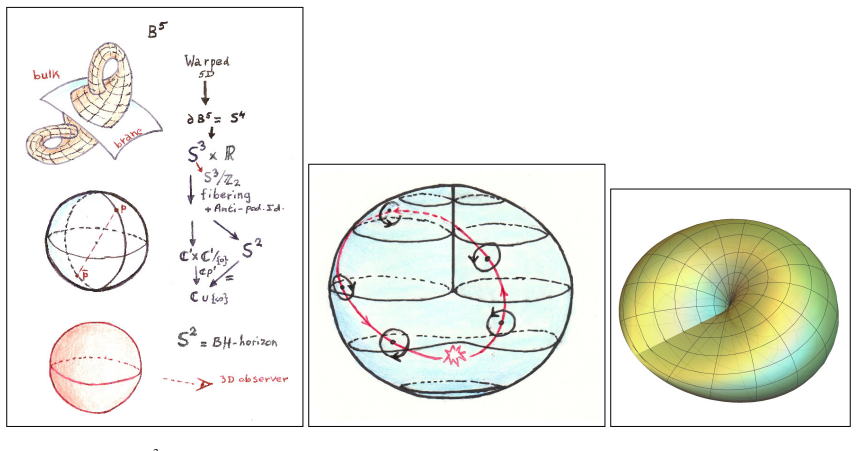
- The topology S^3 × R/Z_2 with Klein bottle horizon enables description of Hawking evaporation with antipodal identification.
- The interior connects to the Janis-Newman-Winicour model of Schwarzschild in complex coordinates with zero rest mass scalar field.
- No cut and paste is needed for the Hawking particles to remain pure.
Where Pith is reading between the lines
- If the projection mechanism is general, similar self-dual structures might appear in other brane-world models with warped spacetimes.
- The use of the Klein bottle for the horizon could offer a topological model for horizons in evaporation processes.
- The connection to the first-order PDE may allow generalization to other Petrov types in modified gravity.
Load-bearing premise
The projection of the 5D Weyl tensor onto the brane creates a recurrent conformal structure that permits a locally conformal Kähler manifold with Euclidean signature in the effective 4D theory.
What would settle it
A direct verification that the derived metric does not satisfy the self-duality condition or that the polynomial equation for singularities is not quintic would disprove the central claim.
Figures
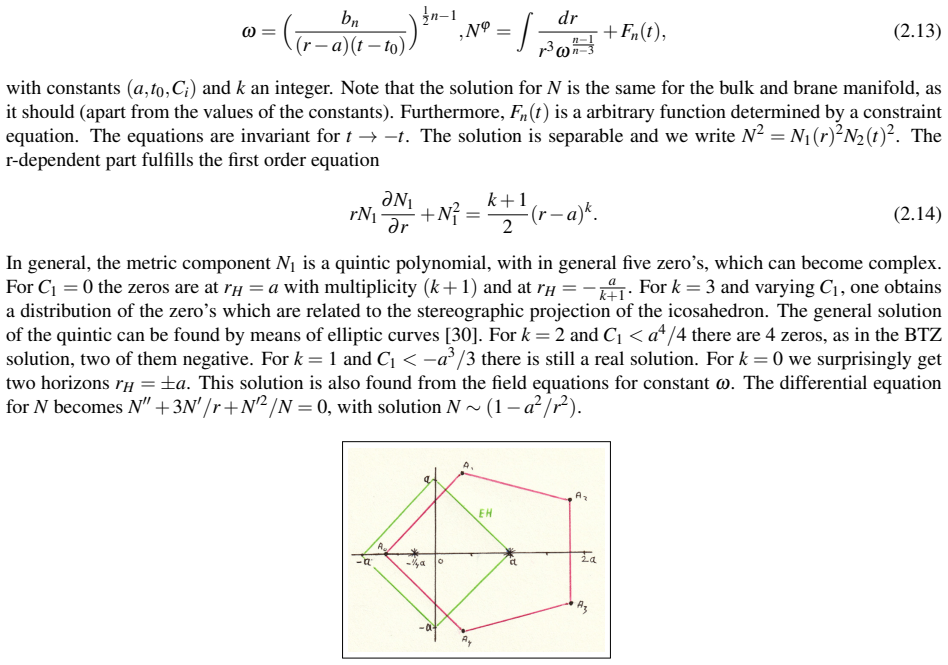
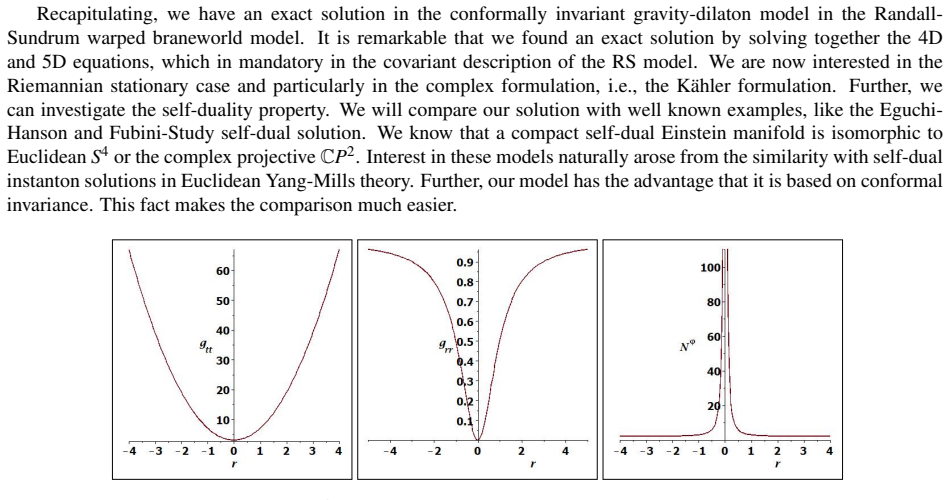
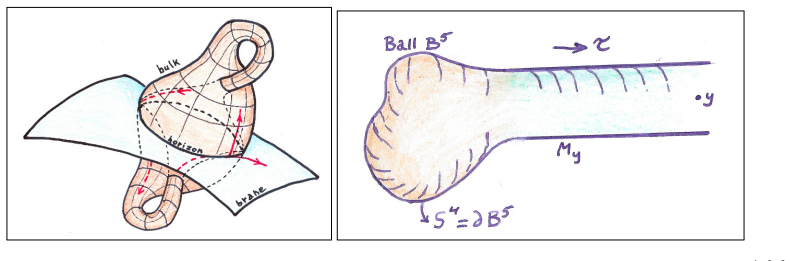
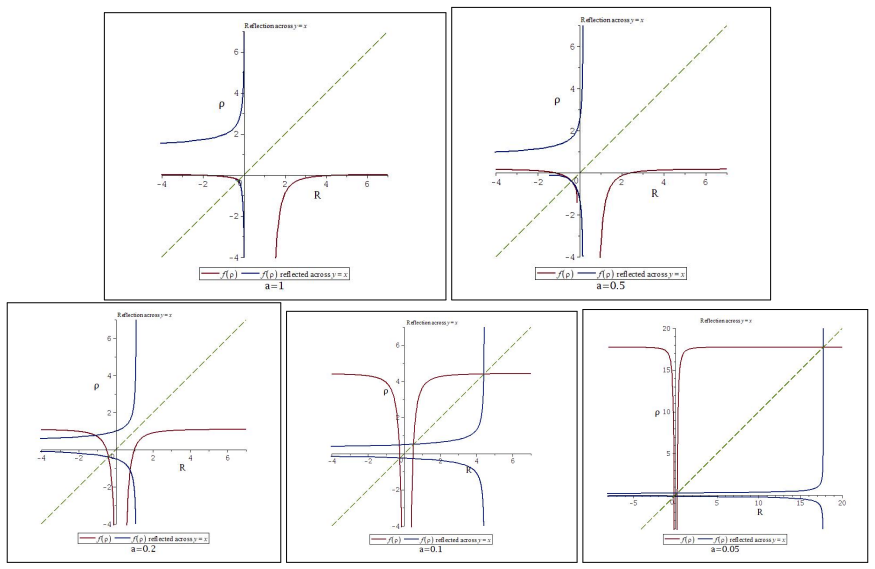
read the original abstract
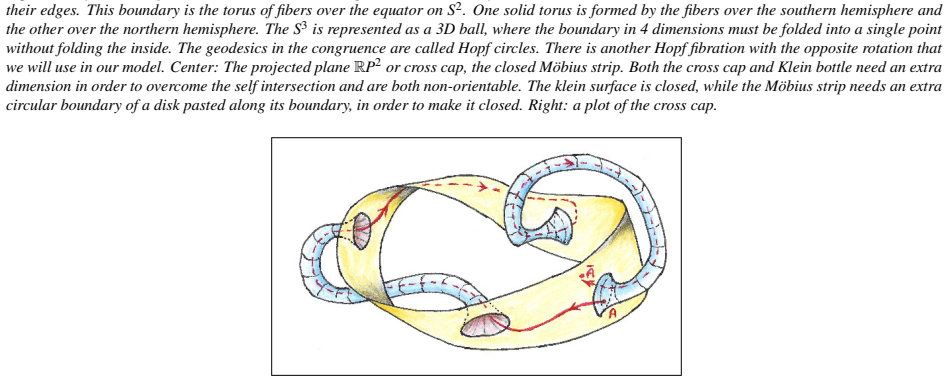
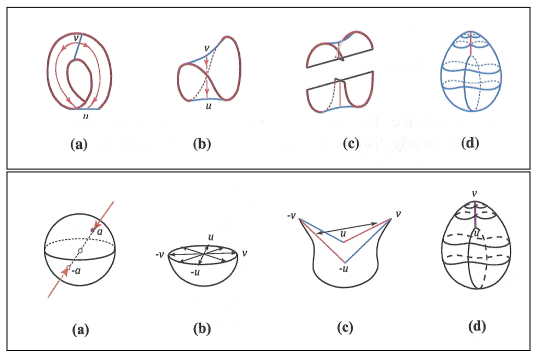
An exact gravitational instanton solution on a vacuum Kerr-like warped spacetime in conformal dilaton gravity is found. Remarkably, the metric solution results from a first-order PDE, allowing the connection with self-duality. The singular points are determined by a quintic polynomial. This suggests that this is the highest possible polynomial in describing the singularities of black holes of Petrov type D axially symmetric manifolds and don't fits the Plebanski-Demianski classification of black holes which is determined by a fourth order polynomial. The solution can be described by a locally conformal K\"ahlerian manifold with Euclidean signature and a K\"ahler potential. This is possible for the effective 4D manifold, despite the fact that a K\"ahler manifold in 5D cannot be modelled. We are dealing with an effective 4D self-dual K\"ahler manifold with a recurrent conformal structure. This happened by the projected Weyl tensor of 5D on the brane. The topology of the gravitational instanton would be $S^3\times \mathbb{R}/\mathbb{Z}_2$. The antipodal boundary condition on the hyper-surface of a Klein bottle $\sim \mathbb{C}^1\times\mathbb{C}^1$ is applied to describe the Hawking particles during the evaporation process. We used the Hopf fibration to get $S^2$ as the black hole horizon, where the centrix is not in a torus but in the Klein bottle. The twist fits very well with the antipodal identification of the points on the horizon. No 'cut and past' is necessary, so the Hawing particles remain pure without instantaneous information transport. Finally, we reveal a connection between the description of the interior of our new black hole solution and the similar model proposed by Janis, Newman and Winicour some time ago of the Schwarzschild solution in complex coordinates with a zero rest mass scalar field, which develops an anomalous asymmetry.
Editorial analysis
A structured set of objections, weighed in public.
Referee Report
Summary. The manuscript claims to present an exact gravitational instanton solution on a vacuum Kerr-like warped spacetime in conformal dilaton gravity within a brane world model. The solution is asserted to arise from a first-order PDE that connects to self-duality, with singular points fixed by a quintic polynomial (claimed to be the highest order possible for Petrov type D axially symmetric manifolds, unlike the fourth-order Plebanski-Demianski case). The effective 4D geometry is described as a locally conformal Kähler manifold with Euclidean signature and recurrent conformal structure induced by the projected 5D Weyl tensor, with topology S³ × ℝ/ℤ₂, antipodal identifications on a Klein bottle for Hawking radiation, and a link to the Janis-Newman-Winicour model.
Significance. If the explicit metric, PDE derivation, Weyl projection, and algebraic verification were supplied and confirmed, the result would constitute a notable contribution by furnishing a self-dual instanton outside standard classifications and suggesting a mechanism for pure Hawking states without cut-and-paste. No machine-checked proofs, reproducible code, or parameter-free derivations are exhibited in the manuscript, so these potential strengths cannot be credited at present.
major comments (3)
- [Abstract] Abstract: the central claim that 'the metric solution results from a first-order PDE, allowing the connection with self-duality' is unsupported because neither the PDE, the metric ansatz, nor any derivation from the 5D field equations is exhibited; without these steps the asserted self-duality cannot be checked and the circularity noted in the axiom ledger cannot be ruled out.
- [Abstract] Abstract: the statement that 'the singular points are determined by a quintic polynomial' and that this is 'the highest possible polynomial' for Petrov type D manifolds is presented without the explicit quintic, the algebraic steps showing why the order must be five rather than chosen, or a demonstration that the roots correspond to physical singularities rather than artifacts of normalization.
- [Abstract] Abstract: the claim that 'the projected Weyl tensor of 5D on the brane' produces a recurrent conformal structure permitting a locally conformal Kähler manifold (despite Kähler manifolds not being modellable in 5D) supplies no projection formula, no components of the projected Weyl tensor, and no verification that the resulting 4D curvature satisfies the self-dual condition (vanishing of the anti-self-dual part) or admits a Kähler potential compatible with Euclidean signature.
minor comments (1)
- [Abstract] The abstract contains the grammatical error 'don't fits' (should read 'does not fit').
Simulated Author's Rebuttal
We thank the referee for the thorough review and valuable feedback on our manuscript. We address each of the major comments point by point below. We agree that the current version lacks the explicit derivations and verifications necessary to fully support the claims, and we will incorporate these in a revised version of the manuscript.
read point-by-point responses
-
Referee: [Abstract] Abstract: the central claim that 'the metric solution results from a first-order PDE, allowing the connection with self-duality' is unsupported because neither the PDE, the metric ansatz, nor any derivation from the 5D field equations is exhibited; without these steps the asserted self-duality cannot be checked and the circularity noted in the axiom ledger cannot be ruled out.
Authors: We agree with the referee that the abstract states the claim without providing the supporting details. In the revised manuscript, we will explicitly present the metric ansatz, derive the first-order PDE from the 5D field equations in conformal dilaton gravity, and show the connection to self-duality. This will allow independent verification and address any concerns about circularity. revision: yes
-
Referee: [Abstract] Abstract: the statement that 'the singular points are determined by a quintic polynomial' and that this is 'the highest possible polynomial' for Petrov type D manifolds is presented without the explicit quintic, the algebraic steps showing why the order must be five rather than chosen, or a demonstration that the roots correspond to physical singularities rather than artifacts of normalization.
Authors: We acknowledge that the explicit quintic polynomial and the reasoning for its order are not included. We will add the quintic equation, the algebraic steps demonstrating why fifth order is required for this class of Petrov type D axially symmetric solutions (contrasting with the fourth-order Plebanski-Demianski case), and verify that the roots correspond to physical singularities. revision: yes
-
Referee: [Abstract] Abstract: the claim that 'the projected Weyl tensor of 5D on the brane' produces a recurrent conformal structure permitting a locally conformal Kähler manifold (despite Kähler manifolds not being modellable in 5D) supplies no projection formula, no components of the projected Weyl tensor, and no verification that the resulting 4D curvature satisfies the self-dual condition (vanishing of the anti-self-dual part) or admits a Kähler potential compatible with Euclidean signature.
Authors: We agree that the projection details are missing from the current manuscript. In the revision, we will provide the formula for projecting the 5D Weyl tensor onto the brane, the explicit components of the projected tensor, and the verification that the 4D geometry satisfies the self-dual condition and admits a Kähler potential consistent with the Euclidean signature and recurrent conformal structure. revision: yes
Circularity Check
No significant circularity; derivation presented as independent from first-order PDE and projection.
full rationale
The paper claims an exact solution obtained from a first-order PDE in the effective 4D theory after 5D Weyl projection, with self-duality and local conformal Kähler structure asserted to follow from that PDE and the recurrent conformal structure. No quoted equations or steps in the provided text reduce the claimed properties to a definition of themselves, a fitted parameter renamed as prediction, or a self-citation chain that bears the central load. The quintic singularity polynomial and topology claims are presented as consequences rather than inputs. Absent explicit reduction (e.g., the PDE solution or Weyl components shown to be equivalent to the asserted self-duality by construction), the derivation chain is treated as self-contained.
Axiom & Free-Parameter Ledger
axioms (2)
- domain assumption The 5D Weyl tensor projection onto the brane yields a recurrent conformal structure permitting a locally conformal Kähler manifold in effective 4D.
- ad hoc to paper The metric solution of the first-order PDE is self-dual by virtue of the PDE order itself.
invented entities (1)
-
Quintic polynomial determining black-hole singularities in Petrov type D axially symmetric manifolds
no independent evidence
Reference graph
Works this paper leans on
-
[1]
and Loeb, A.,Cosmic Outliers: Low-spin Halos Explain the Abundance, Compactness, and Redshift Evolution of the Little Red Dots, The Astrophysical J
Pacucci1, F. and Loeb, A.,Cosmic Outliers: Low-spin Halos Explain the Abundance, Compactness, and Redshift Evolution of the Little Red Dots, The Astrophysical J. Lett.L19, 989 (2025)
2025
-
[2]
Hawking, S.,Particle Creation by Black Holes, Comm. Math. Phys.43, 199 (1975)
1975
-
[3]
Nuovo C.,11467 (1974)
Bekenstein, A.,The Quantum Mass Spectrum of the Kerr Black Hole, Lett. Nuovo C.,11467 (1974)
1974
-
[4]
Bekenstein, A., inAdvances in the Interplay Between Quantum and Gravity Physics, Bergmann, P.G., De Sab- bata, V ., Eds.; Kluwer: Dordrecht, The Netherlands (2002)
2002
- [5]
-
[6]
and Hanson, J.,Self-Dual Solutions to Euclidean Gravity, Ann
Eguchi, T. and Hanson, J.,Self-Dual Solutions to Euclidean Gravity, Ann. Phys.120, 82 (1979)
1979
-
[7]
and Hawking, S.W.,Euclidean Quantum Gravity, World Scientific: Singapore (1993)
Gibbons, G.W. and Hawking, S.W.,Euclidean Quantum Gravity, World Scientific: Singapore (1993)
1993
-
[8]
D.,Explicit Construction of Self-Dual -Manifolds, Duke Math
Joyce, D. D.,Explicit Construction of Self-Dual -Manifolds, Duke Math. J.77, 519 (1995)
1995
-
[9]
F., Hitchin, N.J
Atiyah, M. F., Hitchin, N.J. and Singer, I.M.,Self-duality in Four-Dimensional Riemannian Geometry, Proc. R. Soc. Lond. A362, 425 (1978)
1978
-
[10]
F., Hitchin and Ward, R
Atiyah, M. F., Hitchin and Ward, R. S.,Instantons and Algebraic Geometry, Commun. math. Phys.55,117 (1977)
1977
-
[11]
S.; Uhlenbeck, K.K.Instantons and Four-Manifolds; Springer: New York, NY , USA, (1984)
Freed, D. S.; Uhlenbeck, K.K.Instantons and Four-Manifolds; Springer: New York, NY , USA, (1984)
1984
-
[12]
Phys., Cambridge, UK, (2020)
Krasnov, K.,Formulations of General Relativity; Cambridge Monograms of Math. Phys., Cambridge, UK, (2020)
2020
-
[13]
and Verbitsky, M.,Principles of Locally Conformally Kahler Geometry, arXiv: 220807188 (2022)
Ornea, L. and Verbitsky, M.,Principles of Locally Conformally Kahler Geometry, arXiv: 220807188 (2022)
2022
-
[14]
Aneva, B.,Symmetry of the Riemann Operator, arXiv: 08041618V1 (2008)
2008
-
[15]
and Anderson, L., Gravitational Instantons and Special Geometry, arXiv: gr-qc/21121186, (2022)
Aksteiner, S. and Anderson, L., Gravitational Instantons and Special Geometry, arXiv: gr-qc/21121186, (2022)
-
[16]
and Araneda, B.K ¨ahler Geometry of Black Holes and Gravitational Instantons, Phys
Aksteiner, S. and Araneda, B.K ¨ahler Geometry of Black Holes and Gravitational Instantons, Phys. Rev. Lett. 130, 161502 (2022)
2022
-
[17]
J., Hermitian and K ¨ahlerian Geometry in Relativity, Lecture notes in Physics, Springer, Berlin (1976)
Flaherty, E. J., Hermitian and K ¨ahlerian Geometry in Relativity, Lecture notes in Physics, Springer, Berlin (1976)
1976
-
[18]
and Vines, J., it A Worldsheet for Kerr, arXiv: hep- th/201211570 (2021)
Guevara, A., Maybee, B., Ochirov, A., O’Connell, D. and Vines, J., it A Worldsheet for Kerr, arXiv: hep- th/201211570 (2021)
-
[19]
, Gilkey, P
Eguchi, T. , Gilkey, P. B. and Hanson, A. J.,Gravitation, Gauge Theories and Differential Geometry, Phys. Rep. 66, 213 (1980)
1980
-
[20]
Slagter, R.J.,Everything You Need to Know About Black Holes: Shadow of an Extra Dimension, Cambridge Scholar Publ.: Newcastle upon Tyne, UK, (2025)
2025
-
[21]
I., Newman, E
Janis, A. I., Newman, E. T. and Winicour, J.,Reality of the Schwarzschild Singularity, Phys. Rev. Lett.,20, 878 (1968)
1968
-
[22]
Newman, E. T. and Janis, A. I., Note on the Kerr Spinning Particle Metric, J. Math. Phys.,6, 915 (1965)
1965
-
[23]
Slagter, R.J.,Alternative for Black Hole Paradoxes, Int. J. Mod. Phys. A37, 2250176 (2022)
2022
-
[24]
Slagter, R.J.,Quantum Black Holes in Conformal Dilaton–Higgs Gravity on Warped Spacetimes, Universe9, 383 (2023). 68
2023
-
[25]
Slagter, R.J.Black Holes and Cosmic Strings Revisited; Amazon Publishing: Seattle, W A, USA, (2024)
2024
-
[26]
Slagter, R.J.,Primordial Black Holes and Instantons: Shadow of an Extra Dimension, Universe12, 26 (2026)
2026
-
[27]
and Sundrum, R.,A Large Mass Hierarchy from a Small Extra Dimension, Phys
Randall, L. and Sundrum, R.,A Large Mass Hierarchy from a Small Extra Dimension, Phys. Rev. Lett.,83, 3370 (1999)
1999
-
[28]
and Sundrum, R.,An Alternative to Compactification, Phys
Randall, L. and Sundrum, R.,An Alternative to Compactification, Phys. Rev. Lett.,83, 4690 (1999)
1999
-
[29]
and Sasaki, M.,The Einstein Equations on the 3-Brane World, Phys
Shiromizu, T., Maeda, K. and Sasaki, M.,The Einstein Equations on the 3-Brane World, Phys. Rev. D62, 024012 (2000)
2000
-
[30]
Bartlett, B.,The Quintic, the Icosahedron and Elliptic Curves, Not. Amer. Math. Soc.,71, 444 (2024)
2024
-
[31]
and Pan, S.,A New Fate of a Warped 5D FLRW Model with a U(1) Scalar Gauge Field, Found
Slagter, R.J. and Pan, S.,A New Fate of a Warped 5D FLRW Model with a U(1) Scalar Gauge Field, Found. Phys.46, 1075 (2016)
2016
-
[32]
Hartle, J.B.,Gravity; Pearson Education, Inc.: London, UK, (2003)
2003
-
[33]
Comp `ere, G.,Advanced Lectures on General Relativity, Springer (2017)
2017
-
[34]
and Zanelli, T.,The black Hole in Three Dimensional Space Time, Phys
Ba ˘nados, M., Teitelboim, C. and Zanelli, T.,The black Hole in Three Dimensional Space Time, Phys. Rev. Lett. 69, 849 (1992)
1992
-
[35]
Alling, N. L. and Greenleaf, N.,Foundations of the Theory of Klein Surfaces, Springer (1971)
1971
-
[36]
H.,Self-Dual Connections on 4-Manifolds, J
Taubes, C. H.,Self-Dual Connections on 4-Manifolds, J. Differential Geom.,36, 163 (1992)
1992
-
[37]
H.,The Existence of Anti-Dual Conformal Structures, J
Taubes, C. H.,The Existence of Anti-Dual Conformal Structures, J. Differential Geom.,36, 163 (1992)
1992
-
[38]
M.,General Relativity, Univ
Wald, R. M.,General Relativity, Univ. Chicago Press, (1984)
1984
-
[39]
K.,A Topological Picture Book, Springer, (1987)
Francis, G. K.,A Topological Picture Book, Springer, (1987)
1987
-
[40]
Marar, T.,A Ludic Journey into Geometric Topology, Springer, (2017)
2017
-
[41]
Berger, M.,Geometry I and II, Springer, (1987)
1987
-
[42]
M.,Topology from a Differentiable Point of View, The Univ
Milnor, J. M.,Topology from a Differentiable Point of View, The Univ. Press of Virginia, (1965)
1965
-
[43]
A., Herczeg, G., Manton, T
Easson, D. A., Herczeg, G., Manton, T. and Pezzelle, M.,Isometries and Double Copy, ArXiv: gr-qc/ 230613687, (2024)
2024
-
[44]
and Nomizu, K.,Foundation of Differential Geometry, Part I and II, Wiley, New York, USA, (1969)
Kobayishi, S. and Nomizu, K.,Foundation of Differential Geometry, Part I and II, Wiley, New York, USA, (1969)
1969
-
[45]
and Harris, J.,Principles of Algebraic Geometry, John Wiley and sons, New York, (1994)
Griffiths, P. and Harris, J.,Principles of Algebraic Geometry, John Wiley and sons, New York, (1994)
1994
-
[46]
G.,General Relativity via Differential Forms-Explorations in Plebanski’s Formalism for GR, thesis Univ
Shaw, A. G.,General Relativity via Differential Forms-Explorations in Plebanski’s Formalism for GR, thesis Univ. Nottingham (2026)
2026
-
[47]
Calabi, E.,M ´etriques K¨ahl´eriennes et fibr´es holomorphes, Ann. Sc. de l’E.N.S. 4e s´erie, tome12, 269, (1979)
1979
-
[48]
’t Hooft, G.Local Conformal Symmetry: The Missing Symmetry Component for Space and Time, Int. J. of Mod. Phys. D.,24, 1543001, (2015)
2015
-
[49]
Phys.46, 1185, (2016)
’t Hooft, G.Black Hole Unitarity and Antipodal Entanglement, Found. Phys.46, 1185, (2016)
2016
-
[50]
’t Hooft, G.The Black Hole Firewall Transformation and Realism in Quantum Mechanics, Universe,7, 298, (2021)
2021
-
[51]
H.,Newman-Janis Algorithm from Taub-NUT Instantons, ArXiv: gr-qc/241219611 (2024)
Kim, J. H.,Newman-Janis Algorithm from Taub-NUT Instantons, ArXiv: gr-qc/241219611 (2024)
-
[52]
and Richter, O.,Ernst Equation and Riemann Surfaces, Springer: Heidelberg, Germany, (2004)
Klein, C. and Richter, O.,Ernst Equation and Riemann Surfaces, Springer: Heidelberg, Germany, (2004). 69
2004
-
[53]
N.,Rotating Fields in General Relativity, Cambridge Univ
Islam, J. N.,Rotating Fields in General Relativity, Cambridge Univ. Press (1985)
1985
-
[54]
W., and Hawking, S
Gibbons, G. W., and Hawking, S. W.,Euclidean Quantum Gravity, World Scientific, London (1993)
1993
-
[55]
and Zedda, M.,K ¨ahler Immersions of K¨ahler Manifolds into Complex Space Forms, Springer, (2017)
Loi, A. and Zedda, M.,K ¨ahler Immersions of K¨ahler Manifolds into Complex Space Forms, Springer, (2017)
2017
- [56]
-
[57]
Differential Geometry,34, 223 (1991)
Lebrun, C.,Explicit Self-Dual Metrics 0nCP 2#CP2, J. Differential Geometry,34, 223 (1991)
1991
-
[58]
Lebrun, C.,Counter Examples to the Generalized Positive Action Conjecture, Commun. Math. Phys.118, 591 (1988)
1988
-
[59]
Geom.,11624 (2025)
Olsen Lye, J.,A Detailed Look at the Calabi-Eguchi-Hanson Spaces, J. Geom.,11624 (2025)
2025
-
[60]
W., and Pope, C
Gibbons, G. W., and Pope, C. N.,The Positive Action Conjecture and Asymptotically Euclidean Metrics in Quantum Gravity, Commun. Math. Phys.,66267 (1979)
1979
-
[61]
and O’Connell, D.,Kerr Black Holes as elementary Particles, JHEP0146, (2020)
Arkani-Hamed, N., Huang, Y . and O’Connell, D.,Kerr Black Holes as elementary Particles, JHEP0146, (2020). ArXiv: hep-th/190610100n (2020)
-
[62]
Gao, C, and Qiu, J.,From the Jenis-Newman-Winicour Naked Singularities to the Einstein-Maxwell Phantom Wormholes, Universe,10, 10080328 (2024). arXiv:gr-qc/240714184, (2024)
-
[63]
and Teo, E.,Rod-Structure Classifications of Gravitational Instanton Symmetries, Nucl
Chen, Y . and Teo, E.,Rod-Structure Classifications of Gravitational Instanton Symmetries, Nucl. Phys. B838, 207 (2010)
2010
-
[64]
Witten, L.,Static Axially Symmetric Solutions of Self-Dual SU(2) Gauge Fields in Euclidean Four-Dimensional Space, Phys. Rev. D19, 718 (1979)
1979
-
[65]
N.,Condition of Self-Duality for SU(2) Gauge Fields on Euclidean Four-Dimensional Space, Phys
Yang, C. N.,Condition of Self-Duality for SU(2) Gauge Fields on Euclidean Four-Dimensional Space, Phys. Rev. Lett.38, 1377 (1977)
1977
-
[66]
Araneda, B.,Hidden Symmetries of Generalized Gravitational Instantons, Annales Henri Poincar ´e,26, 4021 (2023). arXiv: gr-qc/230905617 (2023)
-
[67]
B.,Physical Interpretation of Vacuum Solutions of Einstein’s Equations: Part I, Gen
Bonner, W. B.,Physical Interpretation of Vacuum Solutions of Einstein’s Equations: Part I, Gen. Rel. Grav.24, 551 (1991)
1991
-
[68]
B.,Physical Interpretation of Vacuum Solutions of Einstein’s Equations: Part II, Gen
Bonner, W. B.,Physical Interpretation of Vacuum Solutions of Einstein’s Equations: Part II, Gen. Rel. Grav.26, 687 (1994)
1994
-
[69]
Rev.,119, 2082 (1960)
Rindler, W.,Hyperbolic Motion in Curved Spacetime, Phys. Rev.,119, 2082 (1960)
2082
-
[70]
Garfinkle, D.,General Relativistic Strings, Phys. Rev. D.,32, 1323 (1987)
1987
-
[71]
and Traschen, J.,Strings and other Distributional Sources in General Relativity, Phys
Geroch, R. and Traschen, J.,Strings and other Distributional Sources in General Relativity, Phys. Rev. D.36, 1017 (1987)
1987
-
[72]
and Zhiboedov, A.,Super Rotations and Black Hole Pair Production, ArXiv: hep-th/161000639 (2016)
Strominger, A. and Zhiboedov, A.,Super Rotations and Black Hole Pair Production, ArXiv: hep-th/161000639 (2016)
-
[73]
J.,New Formulation of the Axially Symmetric Gravitational Field Problem, Physical Review,167, 1175 (1968)
Ernst, F. J.,New Formulation of the Axially Symmetric Gravitational Field Problem, Physical Review,167, 1175 (1968)
1968
-
[74]
J.,New Formulation of the Axially Symmetric Gravitational Field Problem
Ernst, F. J.,New Formulation of the Axially Symmetric Gravitational Field Problem. II, Phys. Rev.168, 1415 (1968) Erratum Phys. Rev. 172, 1850 (1968)
1968
-
[75]
Griffiths, J. B., Krtous, P. and Podolsky, J.,Interpreting the C-Metric, Class. Quantum Grav.23, 6745 (2006). arXiv: gr-qc/0609056 (2006). 70
work page internal anchor Pith review Pith/arXiv arXiv 2006
-
[76]
and Shellard, E
Vilenkin, A. and Shellard, E. P. S.,Cosmic Strings and Other Topological Defects, Cambridge Univ. Press, (1994)
1994
- [77]
-
[78]
Pol.,24, 735 (1963)
Staruszkiewicz, A.,Gravitation Theory in Three-Dimensional Space, Acta Phys. Pol.,24, 735 (1963)
1963
-
[79]
R.,Closed Timelike Curves Produced by Pairs of Moving Cosmic Strings: Exact Solution, Phys
Gott, J. R.,Closed Timelike Curves Produced by Pairs of Moving Cosmic Strings: Exact Solution, Phys. Rev. Lett,66, 1126 (1991)
1991
-
[80]
S., Jackiw, R
Deser. S., Jackiw, R. and ’t Hooft, G.,Physical Cosmic Strings Do Not Generate Closed Timelike Curves, Phys. Rev. Lett.68, 267 (1992)
1992
discussion (0)
Sign in with ORCID, Apple, or X to comment. Anyone can read and Pith papers without signing in.