REVIEW 3 major objections 5 minor 1 cited by
VirtualSet turns LLM database queries into type-checked expressions that fail before they touch the data, and still beats direct SQL on BIRD.
Reviewed by Pith at T0; open to challenge. T0 means a machine referee read the full paper against a public rubric. the ladder, T0–T4 →
T0 review · deepseek-v4-flash
2026-08-01 14:11 UTC pith:4GCPF5TW
load-bearing objection A carefully scoped system paper whose read-side result is plausible but hinges on an unverifiable inference substrate from a companion report. the 3 major comments →
VirtualSet: Typed Ontology Worlds as an LLM Generation Target for Grounded Queries and Guarded Decisions
The pith
A machine-rendered reading of the paper's core claim, the machinery that carries it, and where it could break.
Core claim
The paper claims that a live, receiver-typed expression language over entity-edge worlds — VirtualSet — can serve as an LLM generation target that is both accurate on SQL's home benchmark and able to intercept hallucinated actions before any database effect. Using Generic Constraint Projection and a 'future this' rule, VirtualSet preserves the concrete entity type through fluent collection chains, so invalid fields, edges, receivers, and actions become token-anchored type errors with the legal receiver closure attached. On the frozen 1,072-question BIRD split, VirtualSet answers 724 questions versus 681 for glossary-matched direct SQL with repair and voting (McNemar exact p = 0.00117), and a
What carries the argument
The central mechanism is the pairing of Generic Constraint Projection (GCP) with the 'future this' rule over lazy VirtualSet expressions. GCP projects type constraints against the live receiver type for each chain prefix, rejecting symbols outside that receiver's legal closure, while future-this keeps the concrete entity dimension (e.g., Employee) flowing through inherited collection operators like filter and order_by so that entity-specific edges remain visible. This pre-execution type guard is what converts hallucinated database symbols from silent runtime failures into token-anchored repair signals. The same expression substrate then executes through a dual-mode runtime — a SQL pushdown f
Load-bearing premise
The whole system depends on the soundness of the type-inference substrate (GCP projection and future-this) imported from a companion report; if that substrate is wrong or incomplete on live, runtime-evolved ontologies, the pre-execution error signal and the claimed BIRD advantage would collapse even if the point estimate is reproducible.
What would settle it
A concrete counterexample would be a single type-clean VirtualSet expression in the exercised operator space whose executed result differs from the gold SQL result due to an engine bug — the paper explicitly reports a full-corpus sweep finding zero such cases. To attempt falsification, take any type-clean expression from the BIRD corpus, run it through both the SQL and stream interpreters, compare with the gold result, and look for divergence in null handling, extrema over text, or arithmetic propagation; if any divergence causes a wrong answer, the execution-substrate audit claim is false.
If this is right
- If the type guard is sound, an LLM query pipeline can repair queries from pre-execution typed diagnostics instead of post-hoc database errors, shifting failure detection earlier in the loop.
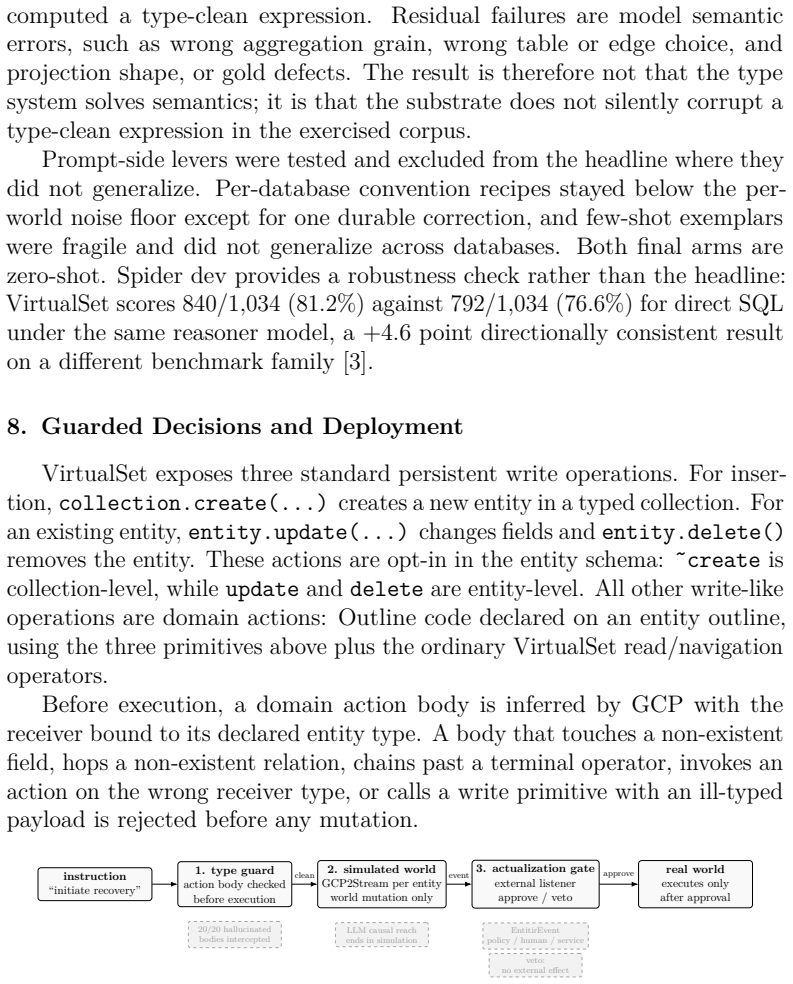
- The same typed expression language can serve as a guarded write channel, so actions are simulated and event-gated before any external effect occurs.
- Because VirtualSet is the generation IR and GCP2SQL is a pluggable lowering, prompts and exemplars can stay dialect-agnostic across database backends.
- The parity oracle and failure sweep suggest that, within the claimed operator space, a type-clean expression will compute the same result as compiled SQL, making engine mis-computation a diagnosable, separable failure class.
Where Pith is reading between the lines
- The approach suggests a broader design rule: any LLM-generated artifact that can be type-checked against a live, evolving schema should be type-checked before execution, not validated by running it, when the artifact can have irreversible effects.
- A natural extension is to apply the same typed-world target to text-to-SQL benchmarks beyond BIRD and Spider, where the type guard might show larger margins on schemas with many undeclared foreign keys or legacy naming.
- The guard corpus is small and author-constructed; a more convincing test would sample hallucinated action bodies from an actual LLM in the wild, though the paper's deterministic check already isolates the guard mechanics.
- One could test whether the pre-execution error signal reduces the number of LLM repair rounds compared to SQL execution feedback, which would quantify how much of the paired margin comes from the 'type-clean-first-generation' subset.
Editorial analysis
A structured set of objections, weighed in public.
Referee Report
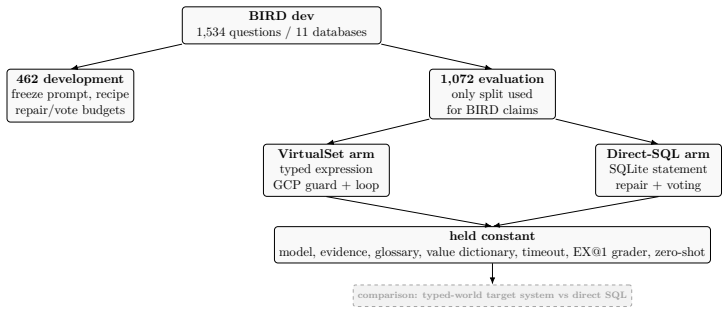
Summary. The paper proposes VirtualSet, a typed ontology-world interface as an LLM generation target. Instead of emitting SQL strings, the model emits set expressions over entity-edge worlds; Generic Constraint Projection (GCP) provides pre-execution type checking, and a dual-mode runtime executes type-clean reads via SQL pushdown or bounded stream interpretation. The same substrate is used for guarded actions: action bodies are type-checked, run in a simulated world, and only actualized through an approval gate. The central empirical claim is a controlled BIRD comparison: on a frozen 1,072-question split, VirtualSet achieves 67.5% accuracy versus 63.5% for glossary-matched direct SQL with repair/voting, a +4.0 point paired margin with McNemar exact p=0.00117, and a full-corpus audit finds no engine mis-computation of type-clean expressions. Additionally, a 30-body guard corpus reports 20/20 interception of hallucinated action bodies with zero false positives.
Significance. If correct, the paper makes a meaningful contribution to text-to-SQL and LLM-tool safety: it demonstrates that a typed, ontology-oriented generation target can remain competitive on a relational benchmark while providing pre-execution error signals that SQL lacks. The empirical design is unusually careful — it holds the model, evidence, glossary, value dictionary, timeout, and grader constant across arms, reports McNemar exact tests, and discloses earlier contamination of the evaluation split. The paper is also honest in its limitations, explicitly scoping the write-chain evidence and the parity oracle. However, the central differentiator rests on GCP soundness, which is imported from an unpublished companion report, and no code or data are released. These gaps prevent independent verification of the load-bearing mechanism and weaken the reproducibility of the headline result.
major comments (3)
- [§3, §8] The entire pre-execution type-error guarantee and the 20/20 guarded-action intercept depend on three substrate properties—OEM structural matching, GCP projection, and future-this—which §3 states are used 'without re-proving them' from companion report [1]. This is a load-bearing gap: GCP is what converts hallucinated members into token-anchored errors (Fig. 2, §5), and the same inference validates action bodies before simulation. The reported empirical audit only checks that type-clean expressions compute correctly; it cannot detect an unsound acceptance path because a wrongly accepted chain would be classified as type-clean and executed. The 30-body guard corpus is far too small to probe GCP's projection boundaries, and the BIRD lift uses static relational schemas, so the paper's stated regime of runtime-evolved ontologies is never exercised. The authors should provide at least a formal
- [§6, §7] The evaluation split is disclosed as not virgin to the project: 'earlier superseded development campaigns had touched overlapping BIRD questions' (p. 12). Although the paper states that no per-question artifact survives, the possibility remains that system development was implicitly influenced by exposure to these questions. Given the headline margin is +4.0 points with p=0.00117, even modest leakage could account for the advantage. The paper would be substantially strengthened by (a) a truly untouched held-out benchmark (e.g., BIRD test set or a fresh split from another benchmark), or (b) a clear account of how the frozen split was selected and why earlier exposure could not have influenced the final prompts or system. As it stands, the statistical claim is concerning.
- [§6, Appendix A.5] No code, data, or evaluation artifacts are released. The paper describes the system and the lift in prose, but a systems/empirical claim of this specificity—the exact prompts, repair budgets, vote counts, and the generated VirtualSet expressions per question—is not independently verifiable. The paper even reports a 'deepseek-chat machinery audit' with different margins, but the raw outputs are absent. For a serious journal, this is a reproducibility blocker. The authors should release at least the evaluation harness, the lift code, and the per-question outcomes (anonymized if needed), ideally with the companion report [1] and the GCP implementation.
minor comments (5)
- [§3, Fig. A.9] The term 'future-this' is sometimes written as 'futurethis' (e.g., §3 heading and Appendix A.2). Unify the notation for clarity.
- [Fig. 2] The architecture figure is dense and the L4/L3/L2/L1/L0 layer labels are not explained in the caption as clearly as they could be. Consider adding a one-sentence description of each layer.
- [§2] The motivating example says 'eligibility as age > 65 when the rule is inclusive' but then the VirtualSet expression uses age >= 65. Clarify whether the inclusive boundary is handled by evidence/metadata and how that is represented.
- [§8] The write guard corpus of 30 bodies is tiny; the paper already acknowledges this, but it would be helpful to state explicitly that the 20/20 result has a 95% confidence interval of roughly [83%, 100%] (exact binomial), to prevent overreading.
- [§10] The limitations section is admirably candid. It could additionally mention the absence of a privacy/security analysis for the event-gated actualization boundary, though that is beyond the current scope.
Circularity Check
GCP soundness is the load-bearing self-citation: the pre-execution type-error and write-guard claims rest on the same-author companion report [1], though the BIRD comparison itself is independent.
specific steps
-
self citation load bearing
[§3 Substrate and Abstraction; relied on in §5 Generation and Repair Loop and §8 Guarded Decisions]
"VirtualSet is implemented on Outline, an expression-oriented dynamic language whose type inference substrate is described in a companion technical report [1]. This paper uses three substrate properties without re-proving them. ... GCP projection. Generic Constraint Projection accumulates constraints on unresolved generic values and projects them against actual receiver types. ... A hallucinated member becomes a failed inference obligation rather than a database event."
The paper's central pre-execution guarantee—invalid fields, edges, receivers, and actions become token-anchored type errors—and the 20/20 write-guard result depend on the soundness of GCP, yet GCP is not derived or tested here; it is imported from the same-author companion report [1]. The paper explicitly declines to re-prove it, and the failure sweep only examines expressions already labeled type-clean by GCP, so an unsound GCP acceptance path would be invisible: the bad expression would still count as type-clean and the resulting wrong answer would be attributed to model semantics or gold defects. Thus the advertised differentiator reduces to an unverified self-citation rather than to evidence in this paper.
full rationale
The BIRD comparison is an external benchmark against glossary-matched SQL with repair and voting; the +4.0-point margin is a measured outcome, not a fitted parameter or a quantity defined in terms of VirtualSet's own outputs. The guard corpus is small and author-constructed, but it is presented at its actual scale and does not claim to be a benchmark. No fitted-input-called-prediction or renaming pattern applies. The only load-bearing circularity is the self-citation of the GCP substrate. Section 3 states that VirtualSet 'uses three substrate properties without re-proving them' from companion report [1] by the same author: OEM structural matching, GCP projection, and future this. Every advertised pre-execution guarantee—invalid fields/edges/receivers/actions become type errors, and the 20/20 hallucinated action-body interception—depends on GCP's soundness on live, runtime-evolved ontologies. The present text supplies no formal proof, machine-checked artifact, or external test of GCP; the failure sweep only audits expressions GCP accepted, so it cannot detect unsound acceptance. This is reliance on an unverified same-author citation, which raises the circularity score to 4. The central BIRD result still has independent empirical content, so the score is not higher.
Axiom & Free-Parameter Ledger
free parameters (3)
- repair_budget =
2 regenerations
- voting_sample_count =
K=3
- stream_safety_limit =
10,000 rows
axioms (6)
- domain assumption OEM structural matching and GCP projection are sound for live runtime ontologies
- domain assumption Future-this preserves the concrete receiver type through inherited collection operators
- domain assumption BIRD gold SQL and execution grader are correct ground truth; WELL-POSED mask only removes clear gold defects
- domain assumption The mechanical relational-to-ontology lift and glossary rendering give both arms informationally comparable inputs
- domain assumption The parity oracle's exercised operator space is representative of the failure-relevant code paths
- domain assumption The 1,072-question evaluation split is contamination-free despite earlier dev campaigns touching overlapping questions
read the original abstract
Large language models increasingly read and act on enterprise data, but SQL gives a late error signal: hallucinated fields or relations can execute and return plausible wrong answers, while incorrect writes cannot be safely assessed after execution. We present VirtualSet, a live, receiver-typed ontology-world interface and generation target for LLMs. Instead of SQL, the model emits set expressions over entity-edge worlds. Generic Constraint Projection (GCP) checks expressions before execution, while future this preserves concrete receiver types through collection chains, turning invalid fields, edges, receivers, and actions into token-anchored type errors. Type-clean reads use a SQL fast path or bounded stream interpretation, with a parity oracle checking both paths over the exercised operator space. The same substrate supports guarded decisions: actions run first in a simulated world, and world-change events require external approval before actualization. On BIRD, we lift relational schemas into typed worlds and compare VirtualSet with direct SQL while holding the model, evidence, values, zero-shot setting, timeout, glossary, repair/voting, and grader constant where possible. On a frozen 1,072-question split, VirtualSet achieves 67.5% accuracy versus 63.5% for glossary-matched direct SQL with repair and voting (+4.0 points; McNemar exact p = 0.00117) using deepseek-reasoner. Full-corpus analysis finds no engine mis-computation of a type-clean expression; remaining errors arise from model semantics or gold defects. In a 30-body guard corpus, the write chain intercepts 20/20 hallucinated action bodies with zero false positives. VirtualSet thus remains competitive on SQL's home benchmark while providing pre-execution semantics for guarded decisions.
Figures



Forward citations
Cited by 1 Pith paper
-
Generic Constraints Projection: Four-Dimensional Type Inference for Dynamic Languages
GCP stores four evidence sources in separate slots on a stable template and projects each call in a fresh session, claiming 513/513 exact type recovery on adapted TypeEvalPy ports.
Reference graph
Works this paper leans on
-
[1]
and Huang, Fei and Cheng, Reynold and Li, Yongbin , title =
Li, Jinyang and Hui, Binyuan and Qu, Ge and Yang, Jiaxi and Li, Binhua and Li, Bowen and Wang, Bailin and Qin, Bowen and Geng, Ruiying and Huo, Nan and Zhou, Xuanhe and Ma, Chenhao and Li, Guoliang and Chang, Kevin C.C. and Huang, Fei and Cheng, Reynold and Li, Yongbin , title =. Advances in Neural Information Processing Systems (NeurIPS), Datasets and Be...
-
[2]
Proceedings of EMNLP , year =
Yu, Tao and Zhang, Rui and Yang, Kai and Yasunaga, Michihiro and Wang, Dongxu and Li, Zifan and Ma, James and Li, Irene and Yao, Qingning and Roman, Shanelle and Zhang, Zilin and Radev, Dragomir , title =. Proceedings of EMNLP , year =
-
[3]
arXiv preprint arXiv:1709.00103 , year =
Zhong, Victor and Xiong, Caiming and Socher, Richard , title =. arXiv preprint arXiv:1709.00103 , year =
-
[4]
arXiv preprint arXiv:1711.04436 , year =
Xu, Xiaojun and Liu, Chang and Song, Dawn , title =. arXiv preprint arXiv:1711.04436 , year =
-
[5]
Proceedings of EMNLP , year =
Scholak, Torsten and Schucher, Nathan and Bahdanau, Dzmitry , title =. Proceedings of EMNLP , year =
-
[6]
Advances in Neural Information Processing Systems (NeurIPS) , year =
Pourreza, Mohammadreza and Rafiei, Davood , title =. Advances in Neural Information Processing Systems (NeurIPS) , year =
-
[7]
Proceedings of COLING , year =
Wang, Bing and Ren, Changyu and Yang, Jian and Liang, Xinnian and Bai, Jiaqi and Chai, Linzheng and Yan, Zhao and Zhang, Qian-Wen and Yin, Di and Sun, Xing and Li, Zhoujun , title =. Proceedings of COLING , year =
-
[8]
Proceedings of the VLDB Endowment , volume =
Gao, Dawei and Wang, Haibin and Li, Yaliang and Sun, Xiuyu and Qian, Yichen and Ding, Bolin and Zhou, Jingren , title =. Proceedings of the VLDB Endowment , volume =
-
[9]
arXiv preprint arXiv:2405.16755 , year =
Talaei, Shayan and Pourreza, Mohammadreza and Chang, Yu-Chen and Mirhoseini, Azalia and Saberi, Amin , title =. arXiv preprint arXiv:2405.16755 , year =
-
[10]
arXiv preprint arXiv:2411.08599 , year =
Gao, Yingqi and Liu, Yifu and Li, Xiaoxia and Shi, Xiaorong and Zhu, Yin and Wang, Yiming and Li, Shiqi and Li, Wei and Hong, Yuntao and Luo, Zhiling and Gao, Jinyang and Mou, Liyu and Li, Yu , title =. arXiv preprint arXiv:2411.08599 , year =
-
[11]
Proceedings of ICLR , year =
Wang, Xuezhi and Wei, Jason and Schuurmans, Dale and Le, Quoc and Chi, Ed and Narang, Sharan and Chowdhery, Aakanksha and Zhou, Denny , title =. Proceedings of ICLR , year =
-
[12]
Proceedings of EMNLP , year =
Zhong, Ruiqi and Yu, Tao and Klein, Dan , title =. Proceedings of EMNLP , year =
-
[13]
Proceedings of PLDI , year =
Beurer-Kellner, Luca and Fischer, Marc and Vechev, Martin , title =. Proceedings of PLDI , year =
-
[14]
and Louf, R
Willard, Brandon T. and Louf, R. Efficient Guided Generation for Large Language Models , journal =
-
[15]
Proceedings of ICLR , year =
Poesia, Gabriel and Polozov, Oleksandr and Le, Vu and Tiwari, Ashish and Soares, Gustavo and Meek, Christopher and Gulwani, Sumit , title =. Proceedings of ICLR , year =
-
[16]
2023 , howpublished =
2023
-
[17]
Proceedings of SIGMOD , pages =
Meijer, Erik and Beckman, Brian and Bierman, Gavin , title =. Proceedings of SIGMOD , pages =
-
[18]
2026 , author =
Malloy: An Experimental Language for Data , howpublished =. 2026 , author =
2026
-
[19]
2026 , author =
Cube: Universal Semantic Layer , howpublished =. 2026 , author =
2026
-
[20]
2026 , author =
The dbt Semantic Layer , howpublished =. 2026 , author =
2026
-
[21]
Generic Constraints Projection: Four-Dimensional Type Inference for Dynamic Languages
Zhang, Qunhui , title =. 2026 , eprint =. doi:10.48550/arXiv.2607.19693 , url =
work page internal anchor Pith review Pith/arXiv arXiv doi:10.48550/arxiv.2607.19693 2026
discussion (0)
Sign in with ORCID, Apple, or X to comment. Anyone can read and Pith papers without signing in.