REVIEW 3 major objections 5 minor 72 references
Hybrid Foveated Path Tracing with Peripheral Gaussians for Immersive Anatomy
T0 review · 3 major / 5 minor · reviewed 2026-08-03 · deepseek-v4-flash
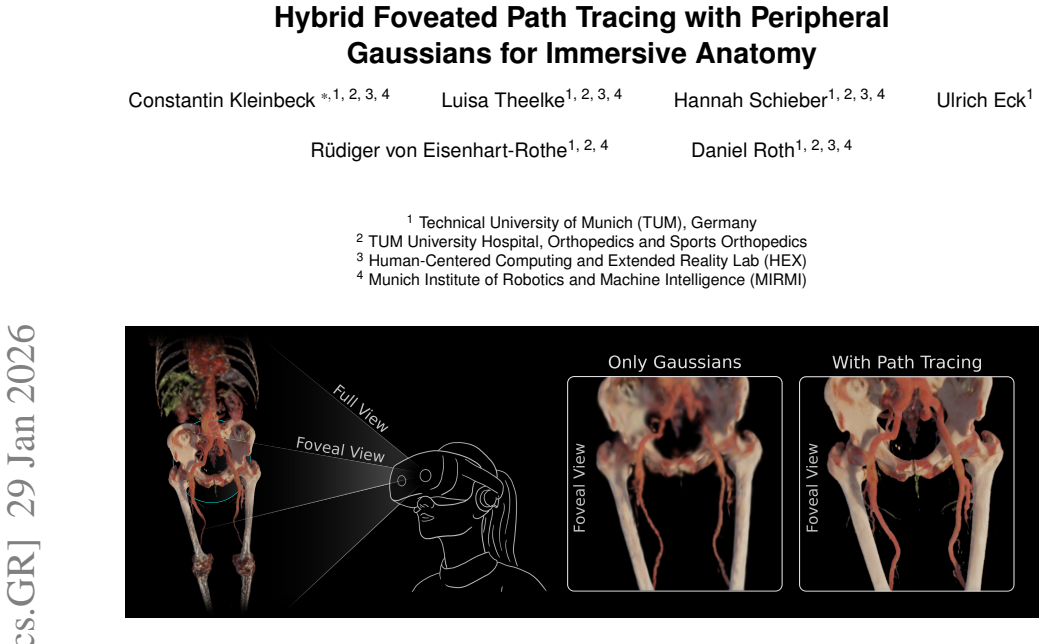
Pith's one-line read Foveated path tracing plus a regenerating peripheral Gaussian cloud makes CT and MRI volumes explorable in VR at interactive rates.
desk verdict Honest component feasibility study, but the headline closed-loop self-refinement claim is not yet validated. read the letter →
The pith
A machine-rendered reading of the paper's core claim, the machinery that carries it, and where it could break.
The reading
What carries the argument
The load-bearing object is the hybrid composition loop: a 3D Gaussian Splatting (3DGS) cloud—a scene represented as oriented Gaussian splats that rasterize quickly—serves as the peripheral model, while a streamed path-traced image with per-pixel depth covers the fovea. Depth-guided reprojection (reconstructing world position from linear depth and re-projecting with the newest head pose) masks latency and decouples render rate from display rate. The continual-training mechanism feeds the same foveated frames back into the Gaussian optimizer, gated by a novelty heuristic on head position and direction, so refinement costs no extra rendering. The volume-derived initial point cloud supplies surf
What would settle it
Run an eye-tracked VR session on a CT volume, record the foveated views the heuristic admits, and measure peripheral-model masked PSNR and LPIPS over a few minutes of natural exploration; if quality in regions the user actually inspected fails to improve beyond the initial one-second model, or improves slower than the paper's refinement table, the continuous-refinement claim is refuted.
Extended reading notes
Core claim
The paper's central claim is that a path tracer and a Gaussian-splatting model do not have to be alternatives: the same volumetric data can drive both, with each doing what it is good at. The path tracer produces high-quality posed images and depth for the central 20-degree field of view; those images are depth-projected into the viewer and simultaneously handed to the Gaussian optimizer as training views. The peripheral cloud is initialized from surface-aligned points cast from the volume and colored with the same path-tracing logic, so no separate depth-estimation network is needed. With roughly ten thousand Gaussians trained for about seven hundred iterations, an initial peripheral model
Load-bearing premise
The loop's continuous refinement rests on the unvalidated assumption that a view is worth adding to the training set only when the head has moved more than 0.05 units or turned more than 5 degrees—thresholds set empirically and never tested with real users, leaving the claimed interactive improvement dependent on an unmeasured gaze distribution.
Editorial extensions
If this is right
- An anatomical VR session can start from raw CT or MRI data in about a second rather than after minutes of precomputation.
- Transfer-function changes, clipping planes, and zoom operations become interactive because the peripheral cloud regenerates on demand.
- Because the same foveated frames train the periphery, continuous refinement adds no rendering overhead beyond the path tracer the system already runs.
- Depth-guided reprojection lets display refresh proceed asynchronously from the renderer, so users can raise sample counts and accept slower foveal updates without breaking the VR frame rate.
- Mobile standalone headsets become plausible targets: the viewer only composites a small path-traced patch with a tiny Gaussian cloud, while heavy computation stays on a remote machine.
Reading between the lines
- A natural next test is to run the loop with real eye-tracked gaze: the paper's view-selection thresholds were chosen empirically and not validated with users, so the refinement claim is conditional on real head and gaze dynamics admitting enough novel views.
- The same closed-loop idea—using the interactive render stream as the training signal—should transfer to other bounded, renderable scenes where a depth-capable path tracer exists, such as endoscopic or intraoperative video.
- Boundary seams between the foveal patch and peripheral cloud suggest that a perceptual training loss (luminance- or contrast-aware) could remove the most visible artifact without changing the pipeline's architecture; the paper notes the seam but does not optimize it.
- If regeneration really stays under a second, the approach could make cinematic rendering a live clinical interaction rather than a precomputed still, shifting how transfer functions and clipping are used in surgical planning.
Editorial analysis
A structured set of objections, weighed in public.
Referee Report
Summary. The paper proposes a hybrid VR rendering system for volumetric medical data. It combines a streamed foveated path-traced image (512×512, 20° FOV) with a peripheral 3D Gaussian Splatting model that is generated in under a second from the volume and intended to be continuously refined from foveal renderings during use. The system includes depth-guided reprojection in a Unity viewer, and the evaluation compares component quality (LPIPS, masked PSNR/SSIM) against standalone path tracing and 3DGS on two CT volumes with three transfer functions. The authors report initial model construction in 300–400 ms, full reconstruction in about a second, and improved foveal quality at similar frame times to path-tracing baselines.
Significance. If the closed-loop claims held, the contribution would be significant for interactive medical visualization on mobile VR: it would remove the preprocessing burden of 3DGS and preserve path-traced fidelity where it matters perceptually. The paper is honest about limitations, releases code and data, and the component-level evaluation is careful: six scenes, median with p10/p90, comparisons against independent baselines. However, the flagship 'continuously refined using streamed foveal renderings' loop is not implemented or evaluated; the evidence supports only the components, not the integrated system.
major comments (3)
- [§1, §3, §4.4, §6.1] The load-bearing claim that the peripheral model is 'continuously refined using streamed foveal renderings' is not supported by the evaluation. §4.4 states that real-time streaming/updating of improved peripheral models is not implemented and was done manually for testing; §6.1 states the system is not in a state to run end-to-end tests with users; §5.1 states the training image sets were pre-created with randomly sampled cameras and do not use Eq. (1). Table 1 therefore evaluates continual training on synthetic view sets, not the closed loop described in the abstract. Please either implement and evaluate the loop, or reframe the central claim as a proposed architecture with component-level evidence.
- [§4.2, Eq. (1)] The view-selection heuristic is central to resource management during continuous refinement, but the thresholds δ_pos=0.05 and θ_view=5° are empirically set and the method is acknowledged in §6 as not extensively tested. Real gaze behavior may produce concentrated views that starve off-focus regions; the paper's own discussion concedes this risk. Because Table 1 uses random pre-created views, there is no evidence that Eq. (1) with these thresholds would provide the coverage needed for the refinement claim. Please provide experiments with realistic gaze distributions or at least a sensitivity/ablation study of the thresholds.
- [§5.3] The claim 'our method usually renders at above 72 FPS standalone on a Meta Quest 3 HMD' is not backed by reported measurements; the same section states mobile performance is 'very variable and viewpoint-dependent due to fill-rate limitations, making it hard to give exact numbers.' The viewer was run on the desktop machine for the evaluation. This performance statement is central to the mobile-VR positioning and should either be measured and reported (frame times, variance, scenes) or removed/qualified.
minor comments (5)
- [§5.2.1] The text refers to 'Figure 4' when discussing time-to-initial-model and render times; this appears to describe Figure 5. Please correct the cross-reference.
- [Table 3] MSSIM and MPSNR abbreviations are used, but only MPSNR is defined in the note. Please define masked SSIM as well.
- [Table 1] The stacked p10/p90 notation is difficult to parse. Consider explicit columns or clearer spacing for p50/p10/p90.
- [§4.3, Eqs. (2)–(4)] The notation pfar and pworld would benefit from a sentence explaining the homogeneous-coordinate normalization and the role of the w component.
- [Figure 6 caption] The phrase 'suffers fewer artifacts' is vague; specify which baseline the hybrid method is compared against.
Circularity Check
No circular derivation: the paper is an engineering evaluation with external baselines and honest limitations, not a fitted prediction renamed as a finding.
full rationale
No significant circularity found. The paper does not derive a formal prediction from fitted inputs; it evaluates an engineering pipeline against external baselines (path tracing and 3DGS) using standard metrics (MPSNR, MSSIM, LPIPS) on rendered views. The peripheral 3DGS model is trained on path-traced images and evaluated against ground-truth path-traced views of the same volume; this is the usual NVS train/test setup, and the evaluation views differ from the training views, so the comparison is not forced by construction. The view-selection heuristic in Eq. (1) is explicitly not used in the evaluation: Section 5.1 states the training image sets were created without 'requiring or using a view selection method as presented in subsection 4.2', so no fitted threshold is being counted as a prediction. The paper's central claim about continuous refinement from streamed foveal renderings is not validated end-to-end: Section 4.4 says 'Real-time streaming and updating of improved peripheral models are not implemented in this prototype but were done manually for testing and evaluations', and Section 6.1 says the system is 'not in a state to run end-to-end tests with users'. This is a validation gap and a limitation of the evidence, not a circular reduction: the component-level results are what they claim to be, and the missing integration is openly acknowledged. Self-citations such as [29] support peripheral rendering performance and dataset choices, but they are not load-bearing derivations and the main quality comparisons are independent of them. Thus the paper is not circular; its weaknesses are insufficient validation of the closed-loop claim, which is a correctness/evaluation concern rather than a circularity concern.
Assumptions & free parameters
free parameters (7)
- View-selection distance threshold δ_pos =
0.05
- View-selection angle threshold θ_view =
5 degrees
- Learning-rate increase for scale/opacity/color =
~50%
- Splat scale/opacity boost in viewer =
10%
- Initial point cloud density =
20,000 points, 64 samples each
- Training iteration counts =
95 steps before simplification; 700-4000 iterations for model training
- Quality presets for initial views =
Normal: 12 views at 8 spp; High: 16 views at 16 spp
assumptions (6)
- domain assumption The GPU volumetric path tracer faithfully simulates light transport in DICOM volumes according to the supplied transfer function.
- domain assumption The OptiX denoiser produces sufficiently clean images for both training and interactive use at 4-8 SPP.
- domain assumption Mini-Splatting2/Taming 3DGS optimization can reconstruct clinically meaningful anatomy from roughly 12 sparse, mostly distant views without densification.
- domain assumption Masked PSNR/SSIM and LPIPS computed on non-zero-alpha pixels are adequate proxies for perceptual quality in VR.
- domain assumption First-significant-hit depth from the volume path tracer is a valid proxy for surface depth for reprojection.
- domain assumption Two CT volumes with three transfer functions each are representative of anatomical visualization workloads.
Cite this review
Pith. "Pith review of Hybrid Foveated Path Tracing with Peripheral Gaussians for Immersive Anatomy." pith.science (2026). https://pith.science/paper/4GID4TP7
@misc{pith2026260122026,
  author       = {Pith},
  title        = {Pith review of: Hybrid Foveated Path Tracing with Peripheral Gaussians for Immersive Anatomy},
  year         = {2026},
  howpublished = {\url{https://pith.science/paper/4GID4TP7}},
  note         = {Machine review of arXiv:2601.22026}
}
read the original abstract
Volumetric medical imaging offers great potential for understanding complex pathologies. Yet, traditional 2D slices provide little support for interpreting spatial relationships, forcing users to mentally reconstruct anatomy into three dimensions. Direct volumetric path tracing and VR rendering can improve perception but are computationally expensive, while precomputed representations, like Gaussian Splatting, require planning ahead. Both approaches limit interactive use. We propose a hybrid rendering approach for high-quality, interactive, and immersive anatomical visualization. Our method combines streamed foveated path tracing with a lightweight Gaussian Splatting approximation of the periphery. The peripheral model generation is optimized with volume data and continuously refined using foveal renderings, enabling interactive updates. Depth-guided reprojection further improves robustness to latency and allows users to balance fidelity with refresh rate. We compare our method against direct path tracing and Gaussian Splatting. Our results highlight how their combination can preserve strengths in visual quality while re-generating the peripheral model in under a second, eliminating extensive preprocessing and approximations. This opens new options for interactive medical visualization.
Figures


Figures from the paper (3 more)


Reference graph
Works this paper leans on
-
[1]
J. Ackermann, J. Kulhanek, S. Cai, H. Xu, M. Pollefeys, G. Wetzstein, L. Guibas, and S. Peng. CL-Splats: Continual Learning of Gaussian Splatting with Local Optimization, June 2025. doi:10.48550/arXiv.2506 .211172, 9
-
[2]
R. Albert, A. Patney, D. Luebke, and J. Kim. Latency Requirements for Foveated Rendering in Virtual Reality.ACM Transactions on Ap- plied Perception, 14(4):1–13, Oct. 2017. doi:10.1145/31275893
-
[3]
M. T. Bagdasarian, P. Knoll, Y . Li, F. Barthel, A. Hilsmann, P. Eisert, and W. Morgenstern. 3DGS.zip: A survey on 3D Gaussian Splatting Compression Methods.Computer Graphics Forum, 44(2):e70078,
-
[4]
B. Battulga, T. Konishi, Y . Tamura, and H. Moriguchi. The Effec- tiveness of an Interactive 3-Dimensional Computer Graphics Model for Medical Education.Interactive Journal of Medical Research, 1(2):e2172, July 2012. doi:10.2196/ijmr.21721
-
[5]
J. S. Binder, M. Scholz, S. Ellmann, M. Uder, R. Gr¨utzmann, G. F. We- ber, and C. Krautz. Cinematic Rendering in Anatomy: A Crossover Study Comparing a Novel 3D Reconstruction Technique to Con- ventional Computed Tomography.Anatomical Sciences Education, 14(1):22–31, 2021. doi:10.1002/ase.19891
-
[6]
P. S. Calhoun, B. S. Kuszyk, D. G. Heath, J. C. Carley, and E. K. Fish- man. Three-dimensional volume rendering of spiral CT data: theory and method.Radiographics: A Review Publication of the Radiologi- cal Society of North America, Inc, 19(3):745–764, June 1999. doi:10. 1148/radiographics.19.3.g99ma147451
1999
-
[7]
N. Cardobi, R. Nocini, G. Molteni, V . Favero, A. Fior, D. Marchioni, S. Montemezzi, and M. D’Onofrio. Path Tracing vs. V olume Render- ing Technique in Post-Surgical Assessment of Bone Flap in Oncologic Head and Neck Reconstructive Surgery: A Preliminary Study.Jour- nal of Imaging, 9(2):24, Feb. 2023. doi:10.3390/jimaging90200241
-
[8]
M. T. Caton Jr., W. F. Wiggins, and D. Nunez. Three-Dimensional Cinematic Rendering to Optimize Visualization of Cerebrovascular Anatomy and Disease in CT Angiography.Journal of Neuroimaging, 30(3):286–296, 2020. doi:10.1111/jon.126971
Show all 72 references
-
[9]
C. R. A. Chaitanya, A. S. Kaplanyan, C. Schied, M. Salvi, A. Lefohn, D. Nowrouzezahrai, and T. Aila. Interactive reconstruction of Monte Carlo image sequences using a recurrent denoising autoencoder.ACM Trans. Graph., 36(4):98:1–98:12, July 2017. doi:10.1145/3072959. 30736012, 4
2017 doi
-
[10]
Y . Chen, H. Xu, C. Zheng, B. Zhuang, M. Pollefeys, A. Geiger, T.-J. Cham, and J. Cai. MVSplat: Efficient 3D Gaussian Splatting from Sparse Multi-view Images. InComputer Vision – ECCV 2024, pp. 370–386. Springer Nature Switzerland, Cham, 2025. doi:10.1007/ 978-3-031-72664-4 212, 7
2024
-
[11]
Dappa, K
E. Dappa, K. Higashigaito, J. Fornaro, S. Leschka, S. Wildermuth, and H. Alkadhi. Cinematic rendering – an alternative to volume ren- dering for 3D computed tomography imaging.Insights into Imaging, 7(6):849–856, Dec. 2016. doi:10.1007/s13244-016-0518-12
2016 doi
-
[12]
Elshafei, J
M. Elshafei, J. Binder, J. Baecker, M. Brunner, M. Uder, G. F. Weber, R. Gr ¨utzmann, and C. Krautz. Comparison of Cinematic Rendering and Computed Tomography for Speed and Comprehension of Surgical Anatomy.JAMA Surgery, 154(8):738–744, Aug. 2019. doi:10.1001/ jamasurg.2019.11681
2019
-
[13]
Engel, M
K. Engel, M. Hadwiger, J. M. Kniss, A. E. Lefohn, C. R. Salama, and D. Weiskopf. Real-time volume graphics. InACM SIGGRAPH 2004 Course Notes, SIGGRAPH ’04, pp. 29–es. Association for Computing Machinery, New York, NY , USA, Aug. 2004. doi:10.1145/1103900. 11039291
2004 doi
- [14]
-
[15]
Fang and B
G. Fang and B. Wang. Mini-splatting2: Building 360 scenes within minutes via aggressive gaussian densification. doi:10.48550/arXiv.2411 .127882, 4, 6
-
[16]
Fang and B
G. Fang and B. Wang. Mini-Splatting: Representing Scenes with a Constrained Number of Gaussians. InComputer Vision – ECCV 2024, pp. 165–181. Springer Nature Switzerland, Cham, 2024. doi:10 .1007/978-3-031-72980-5102
2024
- [17]
- [18]
-
[19]
Henriques, A
H. Henriques, A. D. Oliveira, E. Oliveira, D. Trevisan, and E. Clua. Foveated Path Culling: A mixed path tracing and radiance field ap- proach for optimizing rendering in XR Displays.Journal on Inter- active Systems, 15(1):576–590, June 2024. doi:10.5753/jis.2024.4352 3
2024
-
[20]
Hladky, M
J. Hladky, M. Stengel, N. Vining, B. Kerbl, H.-P. Seidel, and M. Stein- berger. QuadStream: A Quad-Based Scene Streaming Architec- ture for Novel Viewpoint Reconstruction.ACM Trans. Graph., 41(6):233:1–233:13, Nov. 2022. doi:10.1145/3550454.35555243
2022
-
[21]
Hofmann and A
N. Hofmann and A. Evans. Efficient Unbiased V olume Path Tracing on the GPU. InRay Tracing Gems II, pp. 699–711. Apress, Berkeley, CA, 2021. doi:10.1007/978-1-4842-7185-8 438
2021 doi
-
[22]
Hofmann, J
N. Hofmann, J. Hasselgren, and J. Munkberg. Joint Neural Denois- ing of Surfaces and V olumes.Proceedings of the ACM on Computer Graphics and Interactive Techniques, 6(1):1–16, May 2023. doi:10. 1145/35854972
2023
-
[23]
Hofmann, J
N. Hofmann, J. Martschinke, K. Engel, and M. Stamminger. Neural Denoising for Path Tracing of Medical V olumetric Data.Proceed- ings of the ACM on Computer Graphics and Interactive Techniques, 3(2):1–18, Aug. 2020. doi:10.1145/34061812
2020 doi
-
[24]
Huang, J
L. Huang, J. Bai, J. Guo, Y . Li, and Y . Guo. On the Error Analysis of 3D Gaussian Splatting and an Optimal Projection Strategy. InCom- puter Vision – ECCV 2024, pp. 247–263. Springer Nature Switzerland, Cham, 2025. doi:10.1007/978-3-031-72643-9 153, 9
2024 doi
-
[25]
J. A. Iglesias-Guitian, P. Mane, and B. Moon. Real-Time Denoising of V olumetric Path Tracing for Direct V olume Rendering.IEEE Trans- actions on Visualization and Computer Graphics, 28(7):2734–2747, July 2022. doi:10.1109/TVCG.2020.30376802, 4
2022
-
[26]
Jiang, Y
L. Jiang, Y . Mao, L. Xu, T. Lu, K. Ren, Y . Jin, X. Xu, M. Yu, J. Pang, F. Zhao, D. Lin, and B. Dai. AnySplat: Feed-forward 3D Gaussian Splatting from Unconstrained Views, May 2025. doi:10.48550/arXiv. 2505.237162, 7
2025 doi
-
[27]
Kerbl, G
B. Kerbl, G. Kopanas, T. Leimkuehler, and G. Drettakis. 3D Gaussian Splatting for Real-Time Radiance Field Rendering.ACM Transactions on Graphics, 42(4):1–14, Aug. 2023. doi:10.1145/35924331, 2
2023 doi
-
[28]
Kergaßner, T
S. Kergaßner, T. Tariq, and P. Didyk. Towards Understanding Depth Perception in Foveated Rendering. InProceedings of the Special In- terest Group on Computer Graphics and Interactive Techniques Con- ference Conference Papers, pp. 1–9, Aug. 2025. doi:10.1145/3721238. 37306092
2025 doi
-
[29]
Kleinbeck, H
C. Kleinbeck, H. Schieber, K. Engel, R. Gutjahr, and D. Roth. Multi- Layer Gaussian Splatting for Immersive Anatomy Visualization.IEEE Transactions on Visualization and Computer Graphics, pp. 1–11,
-
[30]
Kroes, F
T. Kroes, F. H. Post, and C. P. Botha. Exposure Render: An Inter- active Photo-Realistic V olume Rendering Framework.PLOS ONE, 7(7):e38586, July 2012. doi:10.1371/journal.pone.00385862
2012 doi
-
[31]
doi:10.1109/TVCG.2025.35498821, 2, 4, 5, 6, 8
2025
- [32]
-
[33]
C. Li, B. Y . Feng, Y . Liu, H. Liu, C. Wang, W. Yu, and Y . Yuan. EndoSparse: Real-Time Sparse View Synthesis of Endoscopic Scenes using Gaussian Splatting. InMedical Image Computing and Computer Assisted Intervention – MICCAI 2024, pp. 252–262. Springer Nature Switzerland, C...
2024 doi
-
[34]
J.-J. Lim, M. S. Treder, A. Chadha, and Y . Andreopoulos. Adap- tive Render-Video Streaming for Virtual Environments. In2024 IEEE/CVF Conference on Computer Vision and Pattern Recognition Workshops (CVPRW), pp. 5742–5751. IEEE, Seattle, W A, USA, June
- [35]
-
[36]
T. Liu, G. Wang, S. Hu, L. Shen, X. Ye, Y . Zang, Z. Cao, W. Li, and Z. Liu. MVSGaussian: Fast Generalizable Gaussian Splatting Reconstruction from Multi-View Stereo. InComputer Vision – ECCV 2024, pp. 37–53. Springer-Verlag, Berlin, Heidelberg, Sept. 2024. doi: 10.1007/978-3-...
2024 doi
-
[37]
Ljung, J
P. Ljung, J. Kr ¨uger, E. Groller, M. Hadwiger, C. D. Hansen, and A. Ynnerman. State of the Art in Transfer Functions for Direct V ol- ume Rendering.Computer Graphics Forum, 35(3):669–691, 2016. doi:10.1111/cgf.129342
2016 doi
-
[38]
W. Lin, Y . Feng, and Y . Zhu. MetaSapiens: Real-Time Neural Render- ing with Efficiency-Aware Pruning and Accelerated Foveated Render- ing. InProceedings of the ACM International Conference on Archi- tectural Support for Programming Languages and Operating Systems, ASPLOS ’25...
2025
-
[39]
S. S. Mallick, R. Goel, B. Kerbl, M. Steinberger, F. V . Carrasco, and F. De La Torre. Taming 3dgs: High-quality radiance fields with lim- ited resources. InSIGGRAPH Asia 2024 Conference Papers, SA ’24. Association for Computing Machinery, New York, NY , USA, 2024. doi:10.1145...
2024
-
[40]
W. R. Mark, L. McMillan, and G. Bishop. Post-rendering 3D warping. InProceedings of the 1997 symposium on Interactive 3D graphics - SI3D ’97, pp. 7–ff. ACM Press, Providence, Rhode Island, United States, 1997. doi:10.1145/253284.2532923, 5
1997
- [41]
-
[42]
Meuleman, I
A. Meuleman, I. Shah, A. Lanvin, B. Kerbl, and G. Drettakis. On- the-fly Reconstruction for Large-Scale Novel View Synthesis from Unposed Images.ACM Transactions on Graphics, 44(4):1–14, Aug
-
[43]
Mohanto, A
B. Mohanto, A. T. Islam, E. Gobbetti, and O. Staadt. An integrative view of foveated rendering.Computers & Graphics, 102:474–501, Feb. 2022. doi:10.1016/j.cag.2021.10.0102, 3
2022 doi
-
[44]
Matsuki, R
H. Matsuki, R. Murai, P. H. J. Kelly, and A. J. Davison. Gaussian Splatting SLAM. In2024 IEEE/CVF Conference on Computer Vision and Pattern Recognition (CVPR), pp. 18039–18048. IEEE, Seattle, W A, USA, June 2024. doi:10.1109/CVPR52733.2024.017082
2024
-
[45]
Niedermayr, C
S. Niedermayr, C. Neuhauser, K. Petkov, K. Engel, and R. Wester- mann. Application of 3D Gaussian Splatting for Cinematic Anatomy on Consumer Class Devices.Vision, Modeling, and Visualization,
-
[46]
doi:10.1145/37309132
-
[47]
Patney, M
A. Patney, M. Salvi, J. Kim, A. Kaplanyan, C. Wyman, N. Benty, D. Luebke, and A. Lefohn. Towards foveated rendering for gaze- tracked virtual reality.ACM Transactions on Graphics, 35(6):1–12, Nov. 2016. doi:10.1145/2980179.29802463, 9
2016
-
[48]
J. H. Mueller, P. V oglreiter, M. Dokter, T. Neff, M. Makar, M. Stein- berger, and D. Schmalstieg. Shading atlas streaming.ACM Trans. Graph., 37(6):199:1–199:16, Dec. 2018. doi:10.1145/3272127.3275087 3
2018
-
[49]
K. Ren, L. Jiang, T. Lu, M. Yu, L. Xu, Z. Ni, and B. Dai. Octree- GS: Towards Consistent Real-time Rendering with LOD-Structured 3D Gaussians.IEEE Transactions on Pattern Analysis and Machine Intelligence, pp. 1–15, 2025. doi:10.1109/TPAMI.2025.35682012
2025
-
[50]
doi:10.2312/VMV.202411951, 2, 4, 9
-
[51]
Nov ´ak, I
J. Nov ´ak, I. Georgiev, J. Hanika, and W. Jarosz. Monte Carlo Meth- ods for V olumetric Light Transport Simulation.Computer Graphics Forum, 37(2):551–576, 2018. doi:10.1111/cgf.133832
2018 doi
-
[52]
Schied, A
C. Schied, A. Kaplanyan, C. Wyman, A. Patney, C. R. A. Chai- tanya, J. Burgess, S. Liu, C. Dachsbacher, A. Lefohn, and M. Salvi. Spatiotemporal variance-guided filtering: real-time reconstruction for path-traced global illumination. InProceedings of High Performance Graphics, ...
2017
-
[53]
L. Radl, M. Steiner, M. Parger, A. Weinrauch, B. Kerbl, and M. Stein- berger. StopThePop: Sorted Gaussian Splatting for View-Consistent Real-time Rendering.ACM Trans. Graph., 43(4):64:1–64:17, July
-
[54]
doi:10.1145/36581873, 9
-
[55]
X. Tu, L. Radl, M. Steiner, M. Steinberger, B. Kerbl, and F. De La Torre. VRSplat: Fast and Robust Gaussian Splatting for Virtual Reality.Proceedings of the ACM on Computer Graphics and Interactive Techniques, 8(1):1–22, May 2025. doi:10.1145/37283113
2025 doi
-
[56]
S. P. Rowe, L. C. Chu, A. R. Meyer, M. A. Gorin, and E. K. Fish- man. The application of cinematic rendering to CT evaluation of upper tract urothelial tumors: principles and practice.Abdominal Radiology, 44(12):3886–3892, Dec. 2019. doi:10.1007/s00261-019-02154-51
2019 doi
-
[57]
Schieber, J
H. Schieber, J. Young, T. Langlotz, S. Zollmann, and D. Roth. Semantics-Controlled Gaussian Splatting for Outdoor Scene Recon- struction and Rendering in Virtual Reality. In2025 IEEE Conference Virtual Reality and 3D User Interfaces (VR), pp. 318–328. IEEE, Saint Malo, France,...
2025
-
[58]
Wasserthal, H.-C
J. Wasserthal, H.-C. Breit, M. T. Meyer, M. Pradella, D. Hinck, A. W. Sauter, T. Heye, D. T. Boll, J. Cyriac, S. Yang, M. Bach, and M. Segeroth. TotalSegmentator: Robust Segmentation of 104 Anatomic Structures in CT Images.Radiology: Artificial Intelligence, 5(5):e230024, Sept...
2023 doi
-
[59]
Stengel, Z
M. Stengel, Z. Majercik, B. Boudaoud, and M. McGuire. A dis- tributed, decoupled system for losslessly streaming dynamic light probes to thin clients. InProceedings of the 12th ACM Multimedia Systems Conference, pp. 159–172. ACM, Istanbul Turkey, July 2021. doi:10.1145/3458305...
2021
-
[60]
Taibo and J
J. Taibo and J. A. Iglesias-Guitian. Immersive 3D Medical Visualiza- tion in Virtual Reality using Stereoscopic V olumetric Path Tracing. In 2024 IEEE Conference Virtual Reality and 3D User Interfaces (VR), pp. 1044–1053. IEEE, Orlando, FL, USA, Mar. 2024. doi:10.1109/ VR58804...
2024
-
[61]
J. Yan, R. Peng, Z. Wang, L. Tang, J. Yang, J. Liang, J. Wu, and R. Wang. Instant Gaussian Stream: Fast and Generalizable Streaming of Dynamic Scene Reconstruction via Gaussian Splatting. InProceed- ings of the Computer Vision and Pattern Recognition Conference, pp. 16520–1653...
2025
-
[62]
J. M. P. Van Waveren. The asynchronous time warp for virtual reality on consumer hardware. InProceedings of the 22nd ACM Conference on Virtual Reality Software and Technology, pp. 37–46. ACM, Munich Germany, Nov. 2016. doi:10.1145/2993369.29933753
2016
-
[63]
Waldow, L
K. Waldow, L. Decker, M. Mi ˇsiak, A. Fuhrmann, D. Roth, and M. E. Latoschik. Investigating incoherent depth perception features in vir- tual reality using stereoscopic impostor-based rendering. In2024 IEEE Conference on Virtual Reality and 3D User Interfaces Abstracts and Wor...
2024
-
[64]
L. Zhou, M. Fan, C. Hansen, C. R. Johnson, and D. Weiskopf. A review of three-dimensional medical image visualization.Health Data Science, 2022:9840519, 2022. doi:10.34133/2022/98405191
2022 doi
-
[65]
Weier, T
M. Weier, T. Roth, E. Kruijff, A. Hinkenjann, A. P ´erard-Gayot, P. Slusallek, and Y . Li. Foveated Real-Time Ray Tracing for Head- Mounted Displays.Computer Graphics Forum, 35(7):289–298, Oct
-
[67]
Weier, M
M. Weier, M. Stengel, T. Roth, P. Didyk, E. Eisemann, M. Eisemann, S. Grogorick, A. Hinkenjann, E. Kruijff, M. Magnor, K. Myszkowski, and P. Slusallek. Perception-driven Accelerated Rendering.Computer Graphics Forum, 36(2):611–643, May 2017. doi:10.1111/cgf.131502
2017 doi
-
[69]
Zhang, R
Q. Zhang, R. Eagleson, and T. M. Peters. V olume Visualization: A Technical Overview with a Focus on Medical Applications.Journal of Digital Imaging, 24(4):640–664, Aug. 2011. doi:10.1007/s10278 -010-9321-62
2011 doi
-
[70]
Zhang, P
R. Zhang, P. Isola, A. A. Efros, E. Shechtman, and O. Wang. The Un- reasonable Effectiveness of Deep Features as a Perceptual Metric. In 2018 IEEE/CVF Conference on Computer Vision and Pattern Recog- nition, pp. 586–595, June 2018. doi:10.1109/CVPR.2018.000686
2018
-
[72]
M. L. Zuley, R. Jarosz, S. Kirk, Y . Lee, R. Colen, K. Garcia, D. Del- beke, M. Pham, P. Nagy, G. Sevinc, M. Goldsmith, S. Khan, J. M. Net, F. R. Lucchesi, and N. D. Aredes. The Cancer Genome Atlas Head- Neck Squamous Cell Carcinoma Collection (TCGA-HNSC), 2016. doi:10.7937/K9...
2016 doi
-
[2016]
doi:10.1111/cgf.130263
-
[2024]
doi:10.1109/CVPRW63382.2024.005833
2024
-
[2025]
doi:10.1111/cgf.700782
Reviewed August 3, 2026 · model on record in the stance chip above.
Discussion (0). Continue with ORCID to comment.