REVIEW 4 major objections 4 minor 45 references
MultiFluxAI Enhancing Platform Engineering with Advanced Agent-Orchestrated Retrieval Systems
T0 review · 4 major / 4 minor · reviewed 2026-08-05 · deepseek-v4-flash
Pith's one-line read MultiFluxAI claims an orchestration layer of rules, graph stores, and caching can automate service selection and achieve 95% accuracy on a banking case study.
desk verdict Plausible architecture, but the 95% accuracy claim rests on a single hand-authored query that can't produce that number, and the trace is internally inconsistent. read the letter →
The pith
A machine-rendered reading of the paper's core claim, the machinery that carries it, and where it could break.
The reading
What carries the argument
The orchestration engine is the load-bearing component: it parses the user prompt into sub-prompts, applies the rule engine's context rules to each sub-prompt, consults graph knowledge stores for relevant context, chooses whether to call AI services in parallel or in sequence, and consolidates the responses. The accompanying cache stores successful sub-prompt/response pairs as key-value data, so repeated queries bypass retrieval entirely; that cache, not the LLM, is the main source of the latency reduction.
What would settle it
Re-run the reported transfer query on a held-out set of at least 50–100 banking questions with pre-registered correct answers, blind scoring, and latency measured with and without cache preloading; if MultiFluxAI's accuracy does not exceed standard RAG by a reproducible margin, or if the latency reduction requires preloaded cache, the central claim is not supported.
Extended reading notes
Core claim
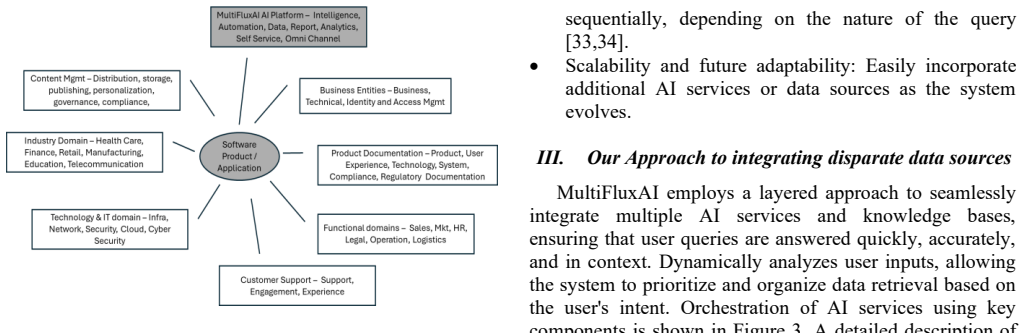
On its own terms, MultiFluxAI is a platform architecture rather than a single algorithm. Its discovery is that orchestration can be layered on top of multiple domain-specific RAG services: a rule engine (Rule1, Rule2, ...) matches query context to knowledge bases; a graph store (KG1, KG2, ...) links product documentation, metadata, and business data as nodes and edges; a cache stores each sub-prompt response as a key-value pair; and an orchestration engine decides the order and parallelism of service calls. The worked banking example walks through three sub-prompts that retrieve account summary, active FD details, and transfer-fee policy, and the system composes the final answer. The paper's
Load-bearing premise
The central performance claim rests on one hand-authored banking query whose rule sets and knowledge-graph contents were written by the authors, with no specified question set, ground-truth answers, sample size, or independent scoring; if those rules and graph entries do not reflect real service conditions, the 95%-versus-85% accuracy gap could disappear.
Editorial extensions
If this is right
- Users no longer need to know which internal AI service handles savings, deposits, limits, or fees; the orchestration engine selects and sequences services automatically.
- Frequently asked cross-service questions can be answered from cache, cutting latency by more than 80% in the reported case (roughly 100 ms to 0–10 ms).
- Because knowledge is stored as a graph of product nodes and business relationships, a single query can span domains that separate RAG services handle in isolation.
- Adding a new service or data source becomes a matter of adding a knowledge store and rules, not reworking the user interface.
- The stated accuracy advantage (95% vs 85% for standard RAG) is the platform's main differentiator over simpler caching-only designs.
Reading between the lines
- The latency gain in the table appears to come mostly from caching (92% with cache alone, 95% with cache plus rules), so the rule engine's marginal contribution is accuracy and context, not speed.
- The same sub-prompt decomposition could be benchmarked on open question sets in other domains, e.g., healthcare or retail, which the paper itself lists as future work.
- A reader should expect the 10-point accuracy gap to be tested with blind scoring; the current evidence is one author-built example.
- If the pattern generalizes, product-engineering teams could treat service orchestration as a reusable layer above existing RAG deployments rather than rebuilding retrieval per service.
Editorial analysis
A structured set of objections, weighed in public.
Referee Report
Summary. The paper presents MultiFluxAI, an agent-orchestrated retrieval platform that combines a rule engine, a caching service, a graph-based knowledge store, and an orchestration engine to route user queries across multiple AI services and knowledge bases. The intended contribution is to remove the need for manual service selection in multi-service RAG systems and to improve accuracy and latency. The paper reports a financial-application case study with a single worked query and claims that MultiFluxAI with cache and rules achieves 95% accuracy versus 85% for standard RAG, with latency reduced by over 80% (Table 1).
Significance. If the performance claims were substantiated, the architecture would be a useful practical contribution: it packages known components (rule-based routing, caching, graph knowledge stores) into a coherent orchestration pipeline that could reduce user effort and response time in multi-domain product engineering. The paper also makes a falsifiable empirical prediction (95% vs 85% accuracy, latency reduction). However, the only reported evaluation is a single hand-authored example with no measurement protocol, no ground-truth definition, and no reproducibility artifacts. The contribution is therefore an architectural sketch whose central quantitative claims are unsupported as written.
major comments (4)
- [IV, Table 1] The central accuracy claim is not supported by any measurable protocol. The paper describes exactly one example query, and no question set, ground-truth answers, sample size, or scoring rubric is reported. A single query scored binary yields only 0% or 100%, so the reported 92% and 95% are arithmetically impossible for that one trace; if they come from a larger test set, that set is absent. The comparison baseline 'Traditional RAG' is also unspecified (retriever, LLM, chunking, parameters). This is load-bearing because the abstract and conclusions rest on the 95%-vs-85% claim.
- [IV, Steps 0-3 and Final Result] The worked example is internally inconsistent. Step 0 defines KG3 as containing only transfer fees ('Within bank transfer: fees 1% via RTGS, 1% via NEFT, Outside bank transfer: fees 2%...'). Step 3 retrieves CKG3 = 'Within bank transfer fees'. The Final Result, however, states 'The daily limit is ₹100,000' — no node or edge in the described KG1, KG2, or KG3 contains a transfer limit. The only ₹100,000 values in R1 and R2 are the savings balance and the minimum FD deposit, neither of which is a daily limit. The trace thus shows retrieval of information absent from the stated knowledge stores.
- [IV, Table 1 (latency rows)] The latency comparison (100 ms vs 20 ms vs 0*-10 ms) is asserted without a measurement methodology. No hardware, model, cache warm-up, cache hit rate, query distribution, or number of runs is given. The footnote 'Knowledge is reused from cache' explains the 0* entry but does not state the hit rate or how it was measured. The claimed 'over 80%' latency reduction is therefore not a measured result but a stated outcome.
- [II and III (novelty/positioning)] The paper motivates MultiFluxAI by contrasting with 'traditional RAG' where users manually select services, but it does not compare against existing agentic RAG or orchestration frameworks (e.g., the surveys cited as [19]/[22]) on any concrete task. The architecture description is high-level and lacks algorithmic details for rule creation, sub-prompt decomposition, orchestration sequencing, and cache eviction. As a result, the claimed novelty is not crisply delineated from prior agentic-RAG work.
minor comments (4)
- [References] References [19] and [22] appear to be the same paper (both 'Agentic Retrieval-Augmented Generation: A Survey on Agentic RAG') with different author lists. Reference [7] has an odd author list ('Lewis, M., Piktus, A., Xu, K., & Stoyanov, V.'); the canonical citation should include the full author team.
- [V (Conclusions)] The conclusion says 'MutiFluxAI' (typo) and the introductory paragraphs contain 'Th is platform'. The full text has numerous spacing/capitalization inconsistencies (e.g., 'Th is', 'Servicing as data points' should likely be 'Serving').
- [III (Caching service)] The cache section mentions 'older, unused Keys and KV pairs are removed' but gives no eviction policy or similarity threshold for grouping semantically similar keys. A sentence or pseudocode would make the design testable.
- [V (Conclusions)] The conclusion mentions future work on 'the integration of CAG [13]' (citing RAGCache) but 'CAG' is never defined. Define the acronym or spell out the intended concept.
Circularity Check
No circularity found: the reported 95% accuracy is not derived from the rules/KG by construction; the evaluation is under-specified but not circular.
full rationale
I examined the only quantitative claim (Section IV, Table 1: 'MultiFluxAI with Cache and Rule ... 95' accuracy; 'Very High (0*-10ms)') against the described derivation chain. The paper's pipeline (Rule1-Rule3, sub-prompts P1-P3, knowledge graphs KG1-KG3) is an input specification, not a fitted model; no parameter is inferred from data and then renamed a prediction. The reference list contains no citations by the current authors, so there is no load-bearing self-citation or imported uniqueness theorem. The case-study trace is author-constructed (e.g., 'Rule1 = Saving account {KG1 - Public Saving account}'), but the paper never defines accuracy as a function of these inputs, so the reported percentages are not forced by construction. The final answer's 'daily limit is ₹100,000' is not found in the stated KG3 contents, and the singular 'Example query considered is...' cannot arithmetically support 92-95% accuracy without a described question set, ground-truth answers, or scoring rubric; these are evaluation defects and internal inconsistencies, not circular reductions. Because no equation-level equivalence or fitted-input-as-prediction step can be exhibited, the circularity score is 0.
Assumptions & free parameters
assumptions (4)
- ad hoc to paper The hand-authored rules (Rule1, Rule2, Rule3) are complete and correct for routing user queries to knowledge bases.
- domain assumption Knowledge graphs KG1-KG3 contain accurate and sufficient bank data (account types, FD rates, fees).
- domain assumption User prompts can be split into independent sub-prompts whose answers can be safely concatenated.
- domain assumption The accuracy values in Table 1 are measured against a well-defined ground truth.
Cite this review
Pith. "Pith review of MultiFluxAI Enhancing Platform Engineering with Advanced Agent-Orchestrated Retrieval Systems." pith.science (2026). https://pith.science/paper/4GT2AIHB
@misc{pith2026250821307,
  author       = {Pith},
  title        = {Pith review of: MultiFluxAI Enhancing Platform Engineering with Advanced Agent-Orchestrated Retrieval Systems},
  year         = {2026},
  howpublished = {\url{https://pith.science/paper/4GT2AIHB}},
  note         = {Machine review of arXiv:2508.21307}
}
read the original abstract
MultiFluxAI is an innovative AI platform developed to address the challenges of managing and integrating vast, disparate data sources in product engineering across application domains. It addresses both current and new service related queries that enhance user engagement in the digital ecosystem. This platform leverages advanced AI techniques, such as Generative AI, vectorization, and agentic orchestration to provide dynamic and context-aware responses to complex user queries.
Figures

Reference graph
Works this paper leans on
-
[22]
Agentic Retrieval-Augmented Generation: A Survey on Agentic RAG
Singh, A., Ehtesham, A., Kumar, S., and Khoei, T. T. (2025), "Agentic Retrieval-Augmented Generation: A Survey on Agentic RAG", https://arxiv.org/abs/2501.09136
arXiv 2025
-
[1]
AI-Driven Innovations in Software Engineering: A Review of Current Practices and Future Directions
Alenezi, M., & Akour, M. (2025), "AI-Driven Innovations in Software Engineering: A Review of Current Practices and Future Directions", https://www.mdpi.com/2076-3417/15/3/1344
work page 2025
-
[2]
The impact of AI and machine learning on software product engineering
Crudu, A., & MoldStud Research Team (2024), "The impact of AI and machine learning on software product engineering", https://moldstud.com/articles/p-the-impact-of-ai-and-machine- learning-on-software-product-engineering
work page 2024
-
[3]
20+ Product Engineering Challenges Engineers Face (With Possible Solutions)
Dhaduk, H. (2023), "20+ Product Engineering Challenges Engineers Face (With Possible Solutions)", https://www.simform.com/blog/product-engineering-challenges/
work page 2023
-
[4]
Top Product Engineering Challenges Faced by Teams
Promact Info Team (2023), "Top Product Engineering Challenges Faced by Teams", https://promactinfo.com/blogs/top -product- engineering-challenges-faced-by-teams/
work page 2023
-
[5]
17+ Product Engineering Challenges and Solutions
Upsquare CS Team (2023), "17+ Product Engineering Challenges and Solutions", https://upsquarecs.com/product-engineering-challenges- and-solutions/
work page 2023
-
[6]
Orchestration Frameworks for Agentic Systems: Strategic Insights Automation
MahoutAI Team (2024), "Orchestration Frameworks for Agentic Systems: Strategic Insights Automation", https://mahoutai.com/orchestration-frameworks-for-agentic-systems- strategic-insights-automation/
work page 2024
-
[7]
Lewis, M., Piktus, A., Xu, K., & Stoyanov, V. (2020). Retrieval- Augmented Generation for Knowledge-Intensive NLP Tasks. [https://arxiv.org/abs/2005.11401]
arXiv 2020
Show all 45 references
-
[8]
Text vectorization via transformer -based language models and n -gram perplexities
Škorić, M. (2023), "Text vectorization via transformer -based language models and n -gram perplexities", https://arxiv.org/abs/2307.09255
2023 arXiv
-
[9]
RETVec: Resilient and Efficient Text Vectorizer
Bursztein, E., Zhang, M., Vallis, O., Jia, X., & Kurakin, A. (2023), "RETVec: Resilient and Efficient Text Vectorizer", https://arxiv.org/pdf/2302.09207v2
2023 arXiv
-
[10]
A Method for Parsing and Vectorization of Semi- structured Data used in Retrieval Augmented Generation
Yang, H., Guo, J., Qi, J., Xie, J., Zhang, S., Yang, S., Li, N., & Xu, M. (2024), "A Method for Parsing and Vectorization of Semi- structured Data used in Retrieval Augmented Generation", https://arxiv.org/abs/2405.03989
2024 arXiv
-
[11]
Towards Layer -wise Image Vectorization
Ma, X., Zhou, Y., Xu, X., Sun, B., Filev, V., Orlov, N., Fu, Y., & Shi, H. (2022), "Towards Layer -wise Image Vectorization", https://arxiv.org/abs/2206.04655
2022 arXiv
-
[12]
Image Vectorization: a Review
Dziuba, M., Jarsky, I., Efimova, V., & Filchenkov, A. (2023), "Image Vectorization: a Review", https://arxiv.org/abs/2306.06441
2023 arXiv
-
[13]
(Apr 2024)
Chao Jin, Zili Zhang, Xuanlin Jiang, Fangyue Liu, Xin Liu, Xuanzhe Liu, Xin Jin. (Apr 2024). RAGCache: Efficient Knowledge Caching for Retrieval-Augmented Generation. [https://arxiv.org/abs/2404.12457]
2024 arXiv
-
[14]
Oct 2023 CacheGen: KV Cache Compression and Streaming for Fast Large Language Model Serving [https://arxiv.org/abs/2310.07240]
Yuhan Liu, Hanchen Li, Yihua Cheng, Siddhant Ray, Yuyang Huang, Qizheng Zhang, Kuntai Du, Jiayi Yao, Shan Lu, Ganesh Ananthanarayanan, Michael Maire, Henry Hoffmann, Ari Holtzman, Junchen Jiang, et al. Oct 2023 CacheGen: KV Cache Compression and Streaming for Fast Large Langua...
2023 arXiv
-
[15]
Hamza Landolsi, Kais Letaief, Nizar Taghouti, Ines Abdeljaoued-Tej et al. Jan 2025, CAPRAG: A Large Language Model Solution for Customer Service and Automatic Reporting using Vector and Graph Retrieval-Augmented Generation [https://arxiv.org/abs/2501.13993]
2025 arXiv
-
[16]
Murugan Sankaradas, Ravi K.Rajendran, Srimat T.Chakradhar (Jan
-
[17]
Large Language Models: A Survey
Minaee, S., Kalchbrenner, N., Iandola, F., and Liang, P. (2024), "Large Language Models: A Survey", https://arxiv.org/abs/2402.06196
2024 arXiv
-
[18]
A Comprehensive Overview of Large Language Models
Naveed, H., Narayanan, P., Ramesh, A., and Fan, J. (2024), "A Comprehensive Overview of Large Language Models", https://arxiv.org/abs/2307.06435
2024 arXiv
-
[20]
A Comprehensive Survey of Retrieval-Augmented Generation (RAG): Evolution, Current Landscape and Future Directions
Gupta, S., Rao, K., Desai, M., and Shah, N. (2024), "A Comprehensive Survey of Retrieval-Augmented Generation (RAG): Evolution, Current Landscape and Future Directions", https://arxiv.org/abs/2410.12837
2024 arXiv
-
[21]
Searching for Best Practices in Retrieval-Augmented Generation
Wang, X., Li, Q., Chen, Z., and Zhang, Y. (2024), "Searching for Best Practices in Retrieval-Augmented Generation", https://arxiv.org/abs/2407.01219
2024 arXiv
-
[23]
A Study on the Implementation Method of an Agent-Based Advanced RAG System Using Graph
Jeong, C., and Jeong, P. (2024), "A Study on the Implementation Method of an Agent-Based Advanced RAG System Using Graph", https://arxiv.org/pdf/2407.19994
2024 arXiv
-
[24]
Automating Customer Service using LangChain
Pandya, K., & Holia, M. (2023), "Automating Customer Service using LangChain", https://arxiv.org/pdf/2310.05421
2023 arXiv
-
[25]
Revolutionizing Mental Health Care through LangChain: A Journey with a Large Language Model
Singh, A., Ehtesham, A., Mahmud, S., & Kim, J.-H. (2024), "Revolutionizing Mental Health Care through LangChain: A Journey with a Large Language Model", https://arxiv.org/abs/2403.05568
2024 arXiv
-
[26]
Investigating Explainability of Generative AI for Code through Scenario-based Design
Jiao Sun, Q. Vera Liao, Michael Muller, Mayank Agarwal, Stephanie Houde, Kartik Talamadupula, Justin D. Weisz ( Feb 2022), “Investigating Explainability of Generative AI for Code through Scenario-based Design” https://arxiv.org/abs/2202.04903
2022 arXiv
-
[27]
Fine-Grained Human Feedback Gives Better Rewards for Language Model Training
Zeqiu Wu, Yushi Hu, Weijia Shi, Nouha Dziri, Alane Suhr, Prithviraj Ammanabrolu, Noah A. Smith, Mari Ostendorf, Hannaneh Hajishirzi, (Jun 2023), “Fine-Grained Human Feedback Gives Better Rewards for Language Model Training”, https://arxiv.org/abs/2306.01693
2023 arXiv
-
[28]
Generative AI at Work
Erik Brynjolfsson, Danielle Li, Lindsey Raymond, (Apr 2023), “Generative AI at Work” , https://arxiv.org/abs/2304.11771
2023 arXiv
-
[29]
Improving Language Understanding by Generative Pre-Training
Alec Radford ,Karthik Narasimhan , Tim Salimans , Ilya Sutskever, “Improving Language Understanding by Generative Pre-Training”, https://cdn.openai.com/research-covers/language- unsupervised/language_understanding_paper.pdf
-
[30]
Reinforcement Learning with Human Feedback: Learning Dynamic Choices via Pessimism
Zihao Li, Zhuoran Yang, Mengdi Wang, (May 2023) , “Reinforcement Learning with Human Feedback: Learning Dynamic Choices via Pessimism” , https://arxiv.org/abs/2305.18438
2023 arXiv
-
[31]
BEST: A Unified Business Process Enactment via Streams and Tables for Service Computing
Awad, A., Awaysheh, F., & López, H. A. (2025), "BEST: A Unified Business Process Enactment via Streams and Tables for Service Computing", https://arxiv.org/abs/2501.14848
2025 arXiv
-
[32]
Adaptive-RAG: Learning to Adapt Retrieval-Augmented Large Language Models through Question Complexity
Jeong, S., Baek, J., Cho, S., et al. (2024), "Adaptive-RAG: Learning to Adapt Retrieval-Augmented Large Language Models through Question Complexity", https://arxiv.org/abs/2403.14403
2024 arXiv
-
[33]
CARING -AI: Towards Authoring Context -aware Augmented Reality INstruction through Generative Artificial Intelligence
Shi, J., Jain, R., Chi, S., Doh, H., Chi, H., Quinn, A. J., & Ramani, K. (2025), "CARING -AI: Towards Authoring Context -aware Augmented Reality INstruction through Generative Artificial Intelligence", https://arxiv.org/abs/2501.16557
2025 arXiv
-
[34]
Context-Aware Semantic Recomposition Mechanism for Large Language Models
Katrix, R., Carroway, Q., Hawkesbury, R., & Heathfield, M. (2025), "Context-Aware Semantic Recomposition Mechanism for Large Language Models", https://arxiv.org/abs/2501.17386
2025 arXiv
-
[35]
WALL-E: World Alignment by Rule Learning Improves World Model -based LLM Agents
Siyu Zhou, Tianyi Zhou, Yijun Yang, Guodong Long, Deheng Ye, Jing Jiang, Chengqi Zhang, (Oct 2024), “WALL-E: World Alignment by Rule Learning Improves World Model -based LLM Agents ”, https://arxiv.org/abs/2410.07484
2024 arXiv
-
[36]
Comprehensive Study on Sentiment Analysis: From Rule-based to modern LLM based system
Shailja Gupta, Rajesh Ranjan, Surya Narayan Singh, (Sept 2024), “Comprehensive Study on Sentiment Analysis: From Rule-based to modern LLM based system” , https://arxiv.org/abs/2409.09989
2024 arXiv
-
[37]
GPT Semantic Cache: Reducing LLM Costs and Latency via Semantic Embedding Caching
Sajal Regmi, Chetan Phakami Pun, (Nov 2024), “GPT Semantic Cache: Reducing LLM Costs and Latency via Semantic Embedding Caching”, https://arxiv.org/abs/2411.05276
2024 arXiv
-
[38]
LLM-dCache: Improving Tool- Augmented LLMs with GPT-Driven Localized Data Caching
Simranjit Singh, Michael Fore, Andreas Karatzas, Chaehong Lee, Yanan Jian, Longfei Shangguan, Fuxun Yu, Iraklis Anagnostopoulos, Dimitrios Stamoulis, (Jun 2024), “LLM-dCache: Improving Tool- Augmented LLMs with GPT-Driven Localized Data Caching”, https://arxiv.org/abs/2406.06799
2024 arXiv
-
[39]
Each Graph is a New Language: Graph Learning with LLMs
Huachi Zhou, Jiahe Du, Chuang Zhou, Chang Yang, Yilin Xiao, Yuxuan Xie, Xiao Huang, (Jan 2025), “Each Graph is a New Language: Graph Learning with LLMs”, https://arxiv.org/abs/2501.11478
2025 arXiv
-
[40]
Knowledge Graph Retrieval-Augmented Generation for LLM-based Recommendation
Shijie Wang, Wenqi Fan, Yue Feng, Xinyu Ma, Shuaiqiang Wang, Dawei Yin, (Jan 2025), “Knowledge Graph Retrieval-Augmented Generation for LLM-based Recommendation”, https://arxiv.org/abs/2501.02226
2025 arXiv
-
[41]
A Multi-LLM Orchestration Engine for Personalized, Context-Rich Assistance
Sumedh Rasal, (Oct 2024), “A Multi-LLM Orchestration Engine for Personalized, Context-Rich Assistance”, https://arxiv.org/abs/2410.10039
2024 arXiv
-
[42]
The Internet of Large Language Models: An Orchestration Framework for LLM Training and Knowledge Exchange Toward Artificial General Intelligence
Wilson Wei, Nicholas Chen, Yuxuan Li, (Jan 2025), “The Internet of Large Language Models: An Orchestration Framework for LLM Training and Knowledge Exchange Toward Artificial General Intelligence” https://arxiv.org/abs/2501.06471
2025 arXiv
-
[43]
Improving alignment of dialogue agents via targeted human judgements
Amelia Glaese, Nat McAleese, Maja Trebacz, John Aslanides, Vlad Firoiu, Timo Ewalds, Maribeth Rauh, (Sept 2022), “Improving alignment of dialogue agents via targeted human judgements”, https://arxiv.org/pdf/2209.14375
2022 arXiv
-
[44]
Training language models to follow instructions with human feedback
Long Ouyang, Jeff Wu, Xu Jiang, Diogo Almeida, Carroll L. Wainwright, Pamela Mishkin, Chong Zhang, Sandhini Agarwal, (May 2022), “Training language models to follow instructions with human feedback”, https://arxiv.org/abs/2203.02155
2022 arXiv
-
[45]
Formal Algorithms for Transformers
Mary Phuong, Marcus Hutter (Jul 2022) , “Formal Algorithms for Transformers” , https://arxiv.org/abs/2207.09238
2022 arXiv
-
[2025]
StreamingRAG: Real-time Contextual Retrieval and Generation Framework [https://arxiv.org/abs/2501.14101]
Reviewed August 5, 2026 · model on record in the stance chip above.
Discussion (0). Sign in to comment.