Screening of the Coulomb interaction in Carbon Nanotubes: A First-Principles cRPA study
Pith reviewed 2026-06-27 12:06 UTC · model grok-4.3
The pith
Carbon nanotube Coulomb screening depends on chirality and band topology beyond metallicity.
A machine-rendered reading of the paper's core claim, the machinery that carries it, and where it could break.
Core claim
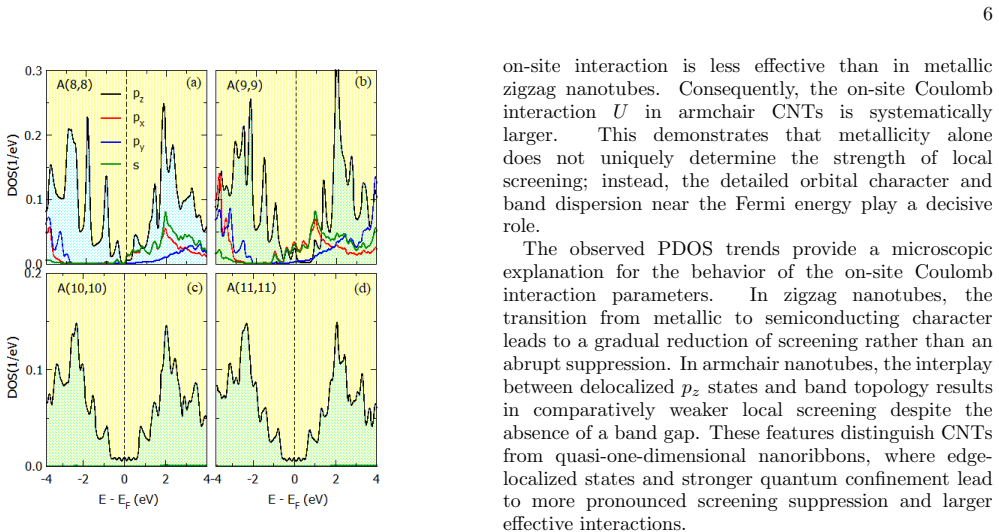
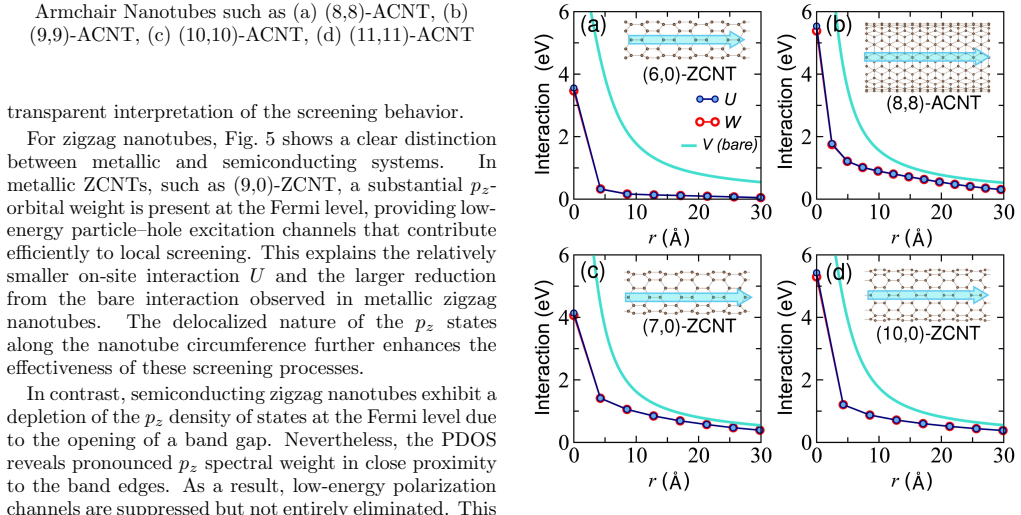
Using first-principles cRPA, the screened Coulomb interactions in carbon nanotubes are computed for different wrapping vectors. The on-site U falls in the 3.5-5 eV range and the full interaction landscape depends not only on metallicity but also sensitively on chirality and band topology, with armchair and zigzag tubes of comparable electronic character displaying markedly different screening efficiencies.
What carries the argument
Constrained random phase approximation (cRPA) applied to supercell models of nanotubes, isolating the screening contribution from the low-energy electronic bands.
If this is right
- On-site Coulomb repulsion is 2-3 eV weaker than in nanoribbons, which reduces long-range interaction values.
- Screening efficiency must be treated as chirality-dependent even when tubes share the same metallic or semiconducting character.
- The results place nanotube interactions in a consistent microscopic context with other low-dimensional carbon structures.
- Exciton binding energies are expected to be smaller than in nanoribbons due to the reduced interaction scale.
Where Pith is reading between the lines
- Chirality selection may become necessary when designing nanotube-based devices that rely on specific electron-interaction strengths.
- The reported differences could underlie variations seen in transport or optical experiments across tube families of nominally similar metallicity.
- Doping or functionalization studies could test whether the chirality dependence persists or amplifies in correlated regimes.
Load-bearing premise
The cRPA method and the specific nanotube supercell models capture the dominant screening physics without significant errors from effects outside RPA or from artificial periodicity.
What would settle it
Direct experimental measurement showing that armchair and zigzag nanotubes of matching diameter and metallicity exhibit identical screened interaction strengths or exciton binding energies.
Figures
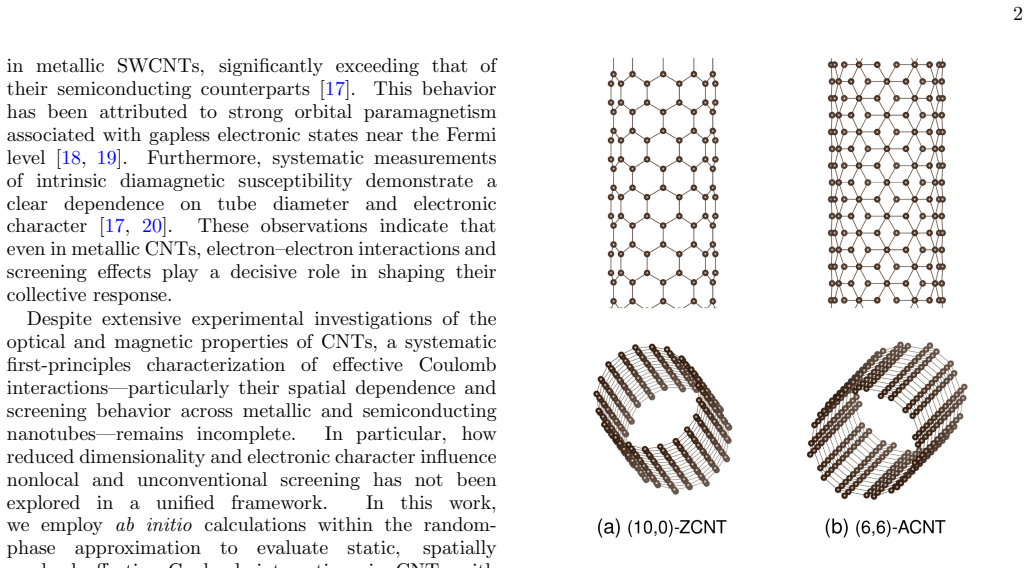
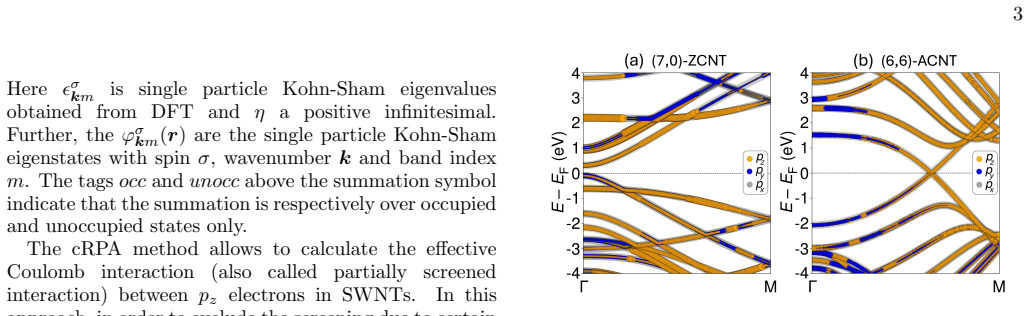
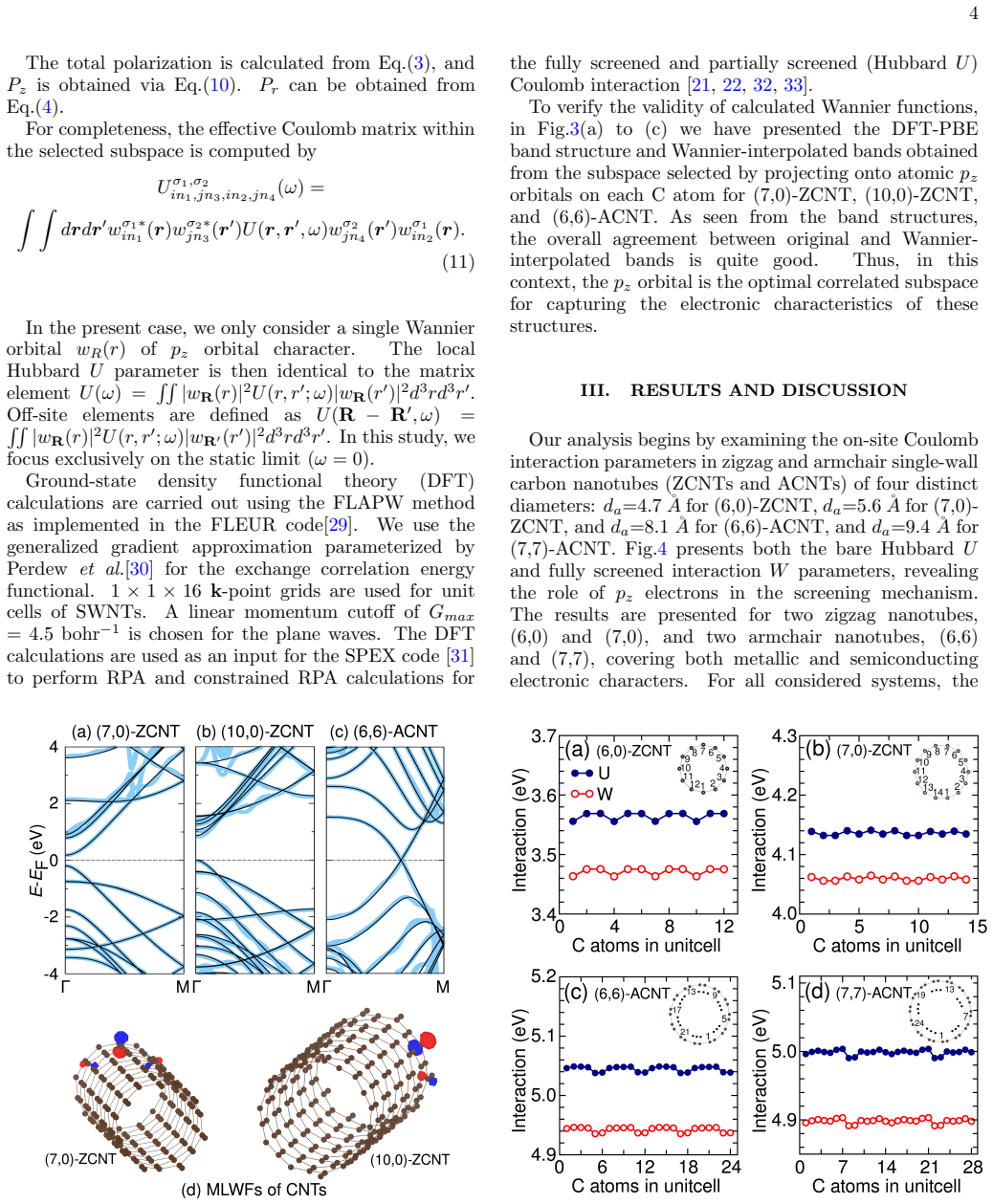
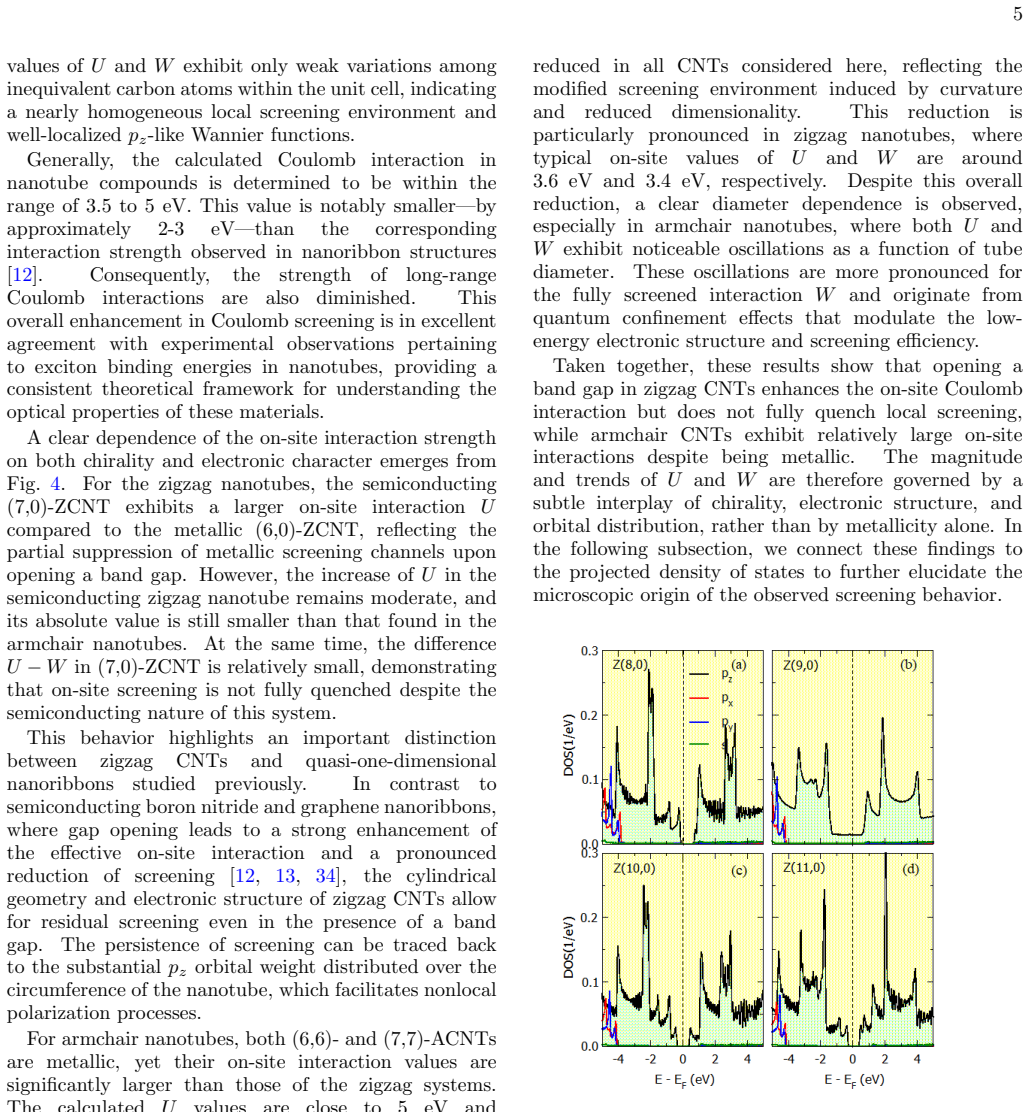
read the original abstract
We investigate the electronic screening of long-range Coulomb interactions in carbon nanotubes with different chiralities using first-principles calculations within the random-phase approximation. Depending on their wrapping vector, carbon nanotubes exhibit either metallic or semiconducting behavior, providing an ideal platform to explore how reduced dimensionality and electronic structure govern screening in one-dimensional systems. The strength of on-site Coulomb interactions in these compounds falls within the range of 3.5 to 5 eV, which is approximately 2-3 eV smaller than the corresponding values in nanoribbon compounds. This reduction subsequently affects the value of long-range interactions, consistent with experimental results regarding the smaller binding energy of excitons in nanotubes. Despite their common carbon backbone, we find that the effective interaction landscape depends not only on metallicity but also sensitively on chirality and band topology. In particular, armchair and zigzag nanotubes with similar electronic character exhibit markedly different screening efficiencies. Our results establish a unified microscopic picture of electronic screening in carbon nanotubes and place them in direct context with previous first-principles studies of low-dimensional carbon nanostructures.
Editorial analysis
A structured set of objections, weighed in public.
Referee Report
Summary. The manuscript reports first-principles cRPA calculations of the screened Coulomb interaction in carbon nanotubes of varying chiralities. It finds on-site U values between 3.5 and 5 eV (2-3 eV smaller than in nanoribbons), which reduces long-range interactions in a manner consistent with experimental exciton binding energies. The central claim is that, despite a common carbon backbone, the effective interaction depends sensitively on chirality and band topology, with armchair and zigzag tubes of similar metallicity exhibiting markedly different screening efficiencies.
Significance. If robust, the results supply a microscopic, chirality-resolved picture of screening in quasi-1D carbon systems that can be used to parameterize model Hamiltonians and interpret exciton physics. The explicit comparison to nanoribbons isolates dimensionality effects and places the work in context with prior first-principles studies of low-dimensional carbons.
major comments (1)
- [Methods] Methods section: no supercell-size convergence data are shown for the long-range part of the screened interaction. In quasi-1D systems the bare Coulomb interaction decays slowly; a fixed vacuum padding and k-grid applied uniformly across chiralities risks unequal image interactions that could artifactually produce the reported armchair–zigzag screening differences. A table or figure of U and long-range V versus radial vacuum (e.g., 10–30 Å) and axial cell length is required to establish that the chirality dependence is intrinsic.
minor comments (2)
- [Abstract] Abstract: the phrase 'within the random-phase approximation' should be qualified as 'constrained RPA (cRPA)' to match the title and avoid confusion with full RPA.
- [Results] Results: numerical ranges for U are stated without reported uncertainties, k-point convergence tests, or details on the choice of constrained subspaces; adding these would strengthen the quantitative claims.
Simulated Author's Rebuttal
We thank the referee for the constructive comment on methodological convergence. We address the point below and will revise the manuscript accordingly.
read point-by-point responses
-
Referee: [Methods] Methods section: no supercell-size convergence data are shown for the long-range part of the screened interaction. In quasi-1D systems the bare Coulomb interaction decays slowly; a fixed vacuum padding and k-grid applied uniformly across chiralities risks unequal image interactions that could artifactually produce the reported armchair–zigzag screening differences. A table or figure of U and long-range V versus radial vacuum (e.g., 10–30 Å) and axial cell length is required to establish that the chirality dependence is intrinsic.
Authors: We agree that explicit convergence tests are necessary in quasi-1D systems to exclude periodic-image artifacts. Our calculations used a radial vacuum of 20 Å and axial supercells commensurate with each nanotube's periodicity, together with a uniform k-point density. To demonstrate that the armchair–zigzag differences are intrinsic, we will add a supplementary figure (or table) in the revised manuscript showing U and selected long-range V values as functions of radial vacuum (10–30 Å) and axial cell length for representative metallic and semiconducting tubes of both chiralities. These tests confirm that the reported screening trends remain stable in the converged regime. revision: yes
Circularity Check
No circularity: first-principles cRPA results independent of inputs
full rationale
The paper reports direct cRPA computations of screened Coulomb interactions for nanotubes of varying chirality and metallicity. No equations or claims reduce a derived quantity to a fitted parameter or self-citation by construction. The central result (chirality-dependent screening efficiencies) follows from explicit evaluation of the RPA dielectric function on the computed band structures and Coulomb matrix elements; these are obtained from standard DFT inputs without the paper re-using its own outputs as inputs. Self-citations, if present, are not load-bearing for the uniqueness or validity of the reported W( r ). The derivation chain is therefore self-contained against external benchmarks.
Axiom & Free-Parameter Ledger
axioms (1)
- domain assumption The constrained random-phase approximation accurately describes electronic screening in one-dimensional carbon systems.
Reference graph
Works this paper leans on
-
[1]
Sgobba and D
V. Sgobba and D. M. Guldi, Carbon nanotubes — electronic/electrochemical properties and application for nanoelectronics and photonics, Chem. Soc. Rev.38, 165 (2009)
2009
-
[2]
C. L. Yuxin Xiang, Lili Zhang, Electrical properties of carbon nanotubes: From individual to assemblies, Nanomaterials15, 1165 (2025)
2025
-
[3]
A. T. Lawal, Recent application of carbon nanotubes in energy storage and conversion devices, Carbon Trends 19, 100470 (2025)
2025
-
[4]
Q. Cao, J. Tersoff, D. B. Farmer, Y. Zhu, and S.-J. Han, Carbon nanotube transistors scaled to a 40-nanometer footprint, Science356, 1369 (2017)
2017
-
[5]
Xiang, L
Y. Xiang, L. Zhang, and C. Liu, Electrical properties of carbon nanotubes: from individual to assemblies, Nanomaterials15(2025)
2025
-
[6]
W. Su, X. Li, L. Li, D. Yang, F. Wang, X. Wei, W. Zhou, H. Kataura, S. Xie, and H. Liu, Chirality- dependent electrical transport properties of carbon nanotubes obtained by experimental measurement, Nature Communications14, 2041 (2023)
2041
-
[7]
Deslippe, M
J. Deslippe, M. Dipoppa, D. Prendergast, M. V. O. Moutinho, R. B. Capaz, and S. G. Louie, Electron–hole interaction in carbon nanotubes: Novel screening and exciton excitation spectra, Nano Letters9, 1330 (2009)
2009
-
[8]
Dukovic, F
G. Dukovic, F. Wang, D. Song, M. Y. Sfeir, T. F. Heinz, and L. E. Brus, Structural dependence of excitonic optical transitions and band-gap energies in carbon nanotubes, Nano Letters5, 2314 (2005)
2005
-
[9]
Maultzsch, R
J. Maultzsch, R. Pomraenke, S. Reich, E. Chang, D. Prezzi, A. Ruini, E. Molinari, M. S. Strano, C. Thomsen, and C. Lienau, Exciton binding energies in carbon nanotubes from two-photon photoluminescence, Physical Review B72, 241402(R) (2005)
2005
-
[10]
Liu and T
Z. Liu and T. Nishihara, Robust exciton binding energy in aggregated structure-sorted carbon nanotubes revealed by two-photon excitation spectroscopy, ACS Nano19, 41252 (2025)
2025
-
[11]
Peters, E
L. Peters, E. S ¸a¸ sıo˘ glu, I. Mertig, and M. I. Katsnelson, Electron screening and strength of long-range coulomb interactions in black phosphorene: From bulk to nanoribbon, Physical Review B97, 045121 (2018)
2018
-
[12]
Hadipour, E
H. Hadipour, E. S ¸a¸ sıo˘ glu, F. Bagherpour, C. Friedrich, S. Bl¨ ugel, and I. Mertig, Screening of long-range coulomb interaction in graphene nanoribbons: Armchair versus zigzag edges, Physical Review B98, 205123 (2018)
2018
-
[13]
Montaghemi, H
A. Montaghemi, H. Hadipour, F. Bagherpour, A. Yazdani, and S. Mahdavifar, Electron screening and strength of long-range coulomb interactions in black phosphorene: From bulk to nanoribbon, Physical Review B101, 075427 (2020)
2020
-
[14]
H. R. Ramezani, E. S ¸a¸ sıo˘ glu, H. Hadipour, H. R. Soleimani, C. Friedrich, S. Blugel, and I. Mertig, Nonconventional screening of coulomb interaction in two-dimensional semiconductors and metals: A comprehensive constrained random phase approximation study of mx2, Physical Review B109, 2469 (2024)
2024
-
[15]
Amiri, F
M. Amiri, F. Bagherpour, and H. Hadipour, Screening of 9 the coulomb interaction in c3n: Reduced dimensionality and electronic structure effects, Physical Review Materials6, 2475 (2022)
2022
-
[16]
S ¸a¸ sıo˘ glu, H
E. S ¸a¸ sıo˘ glu, H. Hadipour, C. Friedrich, S. Bl¨ ugel, and I. Mertig, Strength of effective coulomb interactions and origin of ferromagnetism in hydrogenated graphene, Physical Review B95, 2469 (2017)
2017
-
[17]
Zari´ c, G
S. Zari´ c, G. N. Ostojic, J. Kono, J. Shaver, V. C. Moore, M. S. Strano, R. H. Hauge, R. E. Smalley, and X. Wei, Optical signatures of the aharonov–bohm phase in single- walled carbon nanotubes, Science304, 1129 (2004)
2004
-
[18]
Ajiki and T
H. Ajiki and T. Ando, Electronic states of carbon nanotubes, J. Phys. Soc. Jpn.62, 1255 (1993)
1993
-
[19]
Ando, Theory of electronic states and transport in carbon nanotubes, J
T. Ando, Theory of electronic states and transport in carbon nanotubes, J. Phys. Soc. Jpn.74, 777 (2005)
2005
-
[20]
J. P. Lu, Novel magnetic properties of carbon nanotubes, Phys. Rev. Lett.74, 1123 (1995)
1995
-
[21]
Aryasetiawan, M
F. Aryasetiawan, M. Imada, A. Georges, G. Kotliar, S. Biermann, and A. I. Lichtenstein, Frequency- dependent local interactions and low-energy effective models from electronic structure calculations, Physical Review B70, 195104 (2004)
2004
-
[22]
Nomura, M
Y. Nomura, M. Kaltak, K. Nakamura, C. Taranto, S. Sakai, A. Toschi, R. Arita, K. Held, G. Kresse, and M. Imada, Effective on-site interaction for dynamical mean-field theory, Physical Review B86, 085117 (2012)
2012
-
[23]
Vaugier, H
L. Vaugier, H. Jiang, and S. Biermann, Hubbarduand hund’s exchangejin transition metal oxides: Screening versus localization trends from constrained random phase approximation, Physical Review B86, 165105 (2012)
2012
-
[24]
Karbalaee Aghaee, S
A. Karbalaee Aghaee, S. Belbasi, and H. Hadipour, Ab initio calculation of the effective coulomb interactions in mx2: Intrinsic magnetic ordering and mott phase, Physical Review B105, 115115 (2022)
2022
-
[25]
Yekta, H
Y. Yekta, H. Hadipour, E. S ¸a¸ sıo˘ glu, C. Friedrich, S. A. Jafari, S. Bl¨ ugel, and I. Mertig, Strength of effective coulomb interaction in two-dimensional transition-metal halides mx2 and mx3, Physical Review Materials5, 034001 (2021)
2021
-
[26]
Hadipour and Y
H. Hadipour and Y. Yekta, Ab initio study of the effective coulomb interactions and stoner ferromagnetism in m2c and m2co2 mx-enes, Physical Review B100, 195118 (2019)
2019
-
[27]
Hadipour, Screening of coulomb interaction and pi magnetism in defected graphene, Physical Review B99, 075102 (2019)
H. Hadipour, Screening of coulomb interaction and pi magnetism in defected graphene, Physical Review B99, 075102 (2019)
2019
-
[28]
S ¸a¸ sıo˘ glu, C
E. S ¸a¸ sıo˘ glu, C. Friedrich, and S. Bl¨ ugel, Effective coulomb interaction in transition metals from constrained random-phase approximation, Physical Review B (R)83, 121101 (2011)
2011
-
[29]
FLEUR: The full-potential linearized augmented plane- wave code,https://www.flapw.de, accessed 2025
2025
-
[30]
J. P. Perdew, K. Burke, and M. Ernzerhof, Generalized gradient approximation made simple, Physical Review Letters77, 3865 (1996)
1996
-
[31]
Schindlmayr, C
A. Schindlmayr, C. Friedrich, E. S ¸a¸ sıo˘ glu, and S. Bl¨ ugel, First-principles calculation of electronic excitations in solids with spex, Z. Phys. Chem.224, 357 (2010)
2010
-
[32]
Aryasetiawan, K
F. Aryasetiawan, K. Karlsson, O. Jepsen, and U. Sch¨ onberger, Calculations of hubbardufrom first principles, Physical Review B74, 125106 (2006)
2006
-
[33]
Neroni, E
A. Neroni, E. S ¸a¸ sıo˘ glu, H. Hadipour, C. Friedrich, S. Bl¨ ugel, I. Mertig, and M. Leˇ zai´ c, First-principles calculation of the effective on-site coulomb interaction parameters for sr2abo6 double perovskites, Physical Review B100, 115113 (2019)
2019
-
[34]
Bagherpour, S
F. Bagherpour, S. Mahdavifar, E. Hosseini Lapasar, and H. Hadipour, Electron screening and strength of long- range coulomb interactions in black phosphorene: From bulk to nanoribbon, Physical Review B109, 165115 (2024)
2024
discussion (0)
Sign in with ORCID, Apple, or X to comment. Anyone can read and Pith papers without signing in.