REVIEW 4 major objections 5 minor 16 references
Towards Reducing Biases in Combining Multiple Experts Online
T0 review · 4 major / 5 minor · reviewed 2026-08-14 · deepseek-v4-flash
Pith's one-line read G-FORCE is an online expert-combining algorithm that achieves approximate equalized odds between protected groups while keeping regret close to the best fixed expert.
desk verdict Novel per-(group, label) multiplicative-weights construction with useful experiments, but the central fairness bound is invalid as proven; the paper is a strong empirical heuristic that needs a corrected proof. read the letter →
The pith
A machine-rendered reading of the paper's core claim, the machinery that carries it, and where it could break.
The reading
What carries the argument
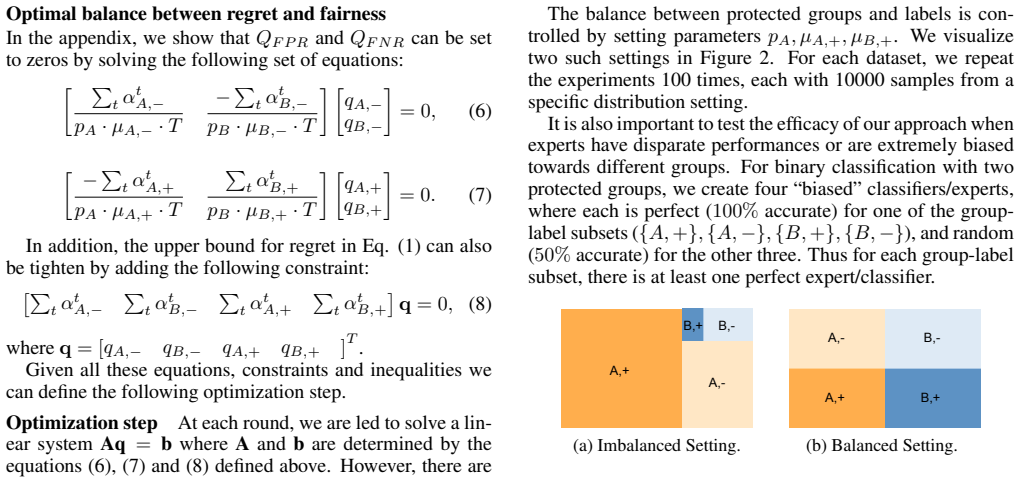
The object carrying the argument is G-FORCE, a randomized multiplicative-weights algorithm that keeps a separate expert-weight instance for each tuple $(z,y)$ of protected group and true label, rather than one instance per group. At each round it chooses between the two label-specific instances for the observed group with a meta-probability $q_{z,y}$, and the chosen instance then samples one classifier. The fairness analysis is carried by the cross-instance cost $\alpha^t_{z,y'}$, the expected loss difference between using the wrong label-specific instance and the right one, which appears in both the regret and fairness bounds. The optimization step solves a linear system $Aq=b$ (relaxed to a least-squares problem) built from estimates of group rates $p_z$, label base rates $\mu_{z,y}$, and cross-instance costs, and this choice of $q$ is what shrinks $Q_{FPR}$ and $Q_{FNR}$.
What would settle it
On a synthetic stream where the best expert for one group-label subset changes periodically rather than converging, record the cross-instance costs $\alpha^t_{z,y}$ and the empirical $|FPR_A-FPR_B|$ after many rounds; if the gap stays substantially above $|G_{FPR}|$ as $T$ grows, the convergence assumption behind $Q_{FPR}\to 0$ is violated.
Extended reading notes
Core claim
The central discovery is a fairness bound that separates unavoidable, problem-intrinsic terms from terms the algorithm can control. For any base classifiers satisfying an $\epsilon$-fairness condition, G-FORCE's equalized false-positive and false-negative violations satisfy $|FPR_A - FPR_B| \le |G_{FPR} + Q_{FPR}|$ and $|FNR_A - FNR_B| \le |G_{FNR} + Q_{FNR}|$, where $G_{FPR}$ and $G_{FNR}$ depend only on the data distribution and the experts' error rates, and $Q_{FPR}$, $Q_{FNR}$ are functions of the meta-probabilities $q_{z,y}$. The optimization step is designed to drive the $Q$ terms to zero (or minimize them via least squares when the exact linear system is infeasible), so the remaining disparity is essentially the disparity of the best expert plus the base classifiers' $\epsilon$-fairness slack. On the regret side, the expected cumulative loss is bounded by $(1+\eta)L_{f^*} + 4\ln d/\eta + \alpha$, with $\alpha$ summing the cross-instance costs, so the price of fairness is a multiplicative factor $(1+\eta)$ plus small additive terms.
Load-bearing premise
The guarantee depends on the online statistics the algorithm feeds back into its own choices converging, so that the controllable part of the fairness gap disappears over time.
Editorial extensions
If this is right
- Approximate equalized odds is achievable in a stochastic online setting where the base classifiers are fixed black boxes, so fairness can be enforced without retraining them.
- The fairness violation is controlled by a sum of an intrinsic constant and an adjustable term; when the linear system is solvable, the adjustable term can be driven to zero.
- The regret penalty for enforcing fairness is bounded: taking $\eta$ small gives expected loss within a $(1+\eta)$ factor of the best expert plus $O(\log d/\eta)$ and cross-instance costs.
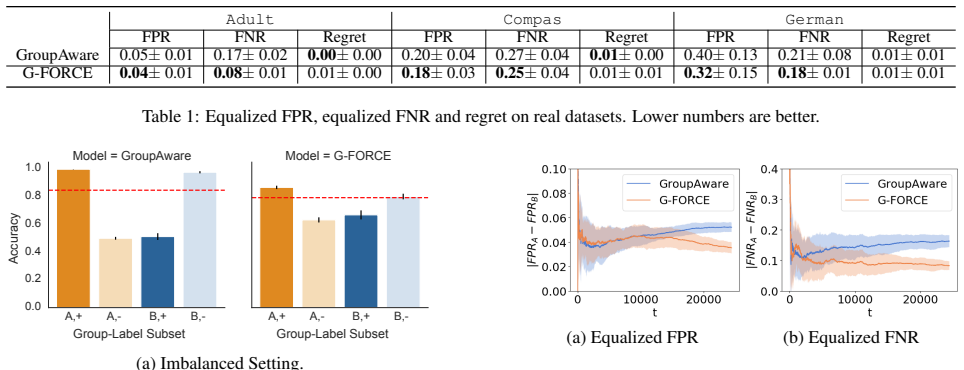
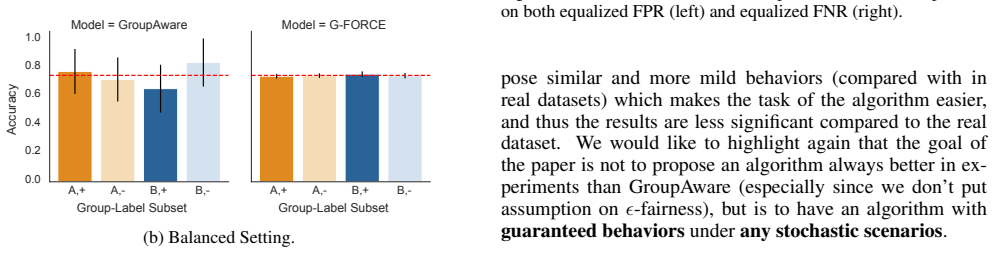
- On the Adult, German Credit, and COMPAS datasets, the algorithm reduces equalized FPR and FNR compared with GroupAware while incurring only a small increase in regret.
- Because the algorithm only needs expert predictions and true labels, it applies to human decision makers and arbitrary rules as well as trained classifiers.
Reading between the lines
- An extension the authors leave implicit is that the same $\lambda$-weighted least-squares step can be tuned to equal opportunity or other error-based fairness metrics, since the proof machinery is organized around FPR and FNR separately.
- The i.i.d. stochastic assumption is load-bearing; an adversarial arrival process would bypass the central-limit convergence argument for the $Q$ terms, so adapting the proof to non-stationary or adversarial streams would require a different argument.
- A direct field test is to deploy G-FORCE with human reviewers in a hiring or lending pipeline and track the empirical FPR/FNR gaps against the claimed bounds, since the algorithm only requires expert predictions and true labels.
- A testable extension is delayed feedback: if true labels arrive many rounds after the decision, as in loan default or college graduation, one can ask whether the convergence of $\alpha$ and the regret bound degrade gracefully.
Signed reviews
Editorial analysis
A structured set of objections, weighed in public.
Referee Report
Summary. The paper proposes G-FORCE, an online algorithm for combining a fixed set of black-box classifiers so that the combined predictor approximately satisfies equalized odds while retaining sublinear regret. The algorithm maintains multiplicative-weights instances for each sensitive-group/label pair and uses a meta-probability q to choose between the label-specific instances; q is selected by a least-squares optimization intended to zero terms Q_FPR and Q_FNR in the fairness bound. The main theoretical result (Theorem 2) claims bounds on |FPR_A−FPR_B| and |FNR_A−FNR_B|, and Lemma 1 gives a regret bound. Experiments on synthetic data, Adult, German Credit, and COMPAS compare G-FORCE to GroupAware and report lower equalized FPR/FNR with a modest regret increase.
Significance. If the theorems were correct, the paper would be a useful contribution: an online, black-box-only method for equalized odds with an explicit fairness-regret trade-off, complementing prior work that only achieves equalized error rates. The algorithm design—separate MW instances per group-label and an optimization-driven combination—is natural, and the experimental comparisons, including Pareto curves, are informative. However, the central fairness guarantee rests on an invalid absolute-value argument and on unproven convergence and feasibility of the optimization step; the theoretical contribution is therefore not currently supported.
major comments (4)
- [Appendix 7.3, Eqs. (27)-(29)] The proof of Theorem 2 bounds the absolute difference |E[L_{A,-}/C_{A,-}] - E[L_{B,-}/C_{B,-}]| by substituting the upper bound of Lemma 1 for the first term and the lower bound of Lemma 2 for the second. From X ≤ U and Y ≥ L one can infer X − Y ≤ U − L, but this does not imply |X − Y| ≤ |U − L|; the latter also requires a lower bound on the signed difference, or an upper bound on Y − X. Consequently Eq. (29) only bounds positive values of FPR_A − FPR_B, and the claimed absolute-value guarantee is not proven. The 'without loss of generality' step replacing E[L_{f^*(A,-),A,-}/C_{A,-}] by E[L_{f^*(B,-),B,-}/C_{B,-}] + ε is also not WLOG: the best expert for group A can have a genuinely different FPR on group A than the best expert for group B has on group B, so the substitution changes the quantity being bounded.
- [Section 4.2, Eqs. (6)-(8) and optimization step (9)] The assertion that Q_FPR and Q_FNR can be driven to zero by choosing q is not established. Equations (6)-(8) define a homogeneous linear system A q = 0, but no proof is given that a probability vector q (with q_{z,y} ∈ [0,1] and q_{z,+} + q_{z,-} = 1) satisfying the system exists. In fact the proposed optimization step solves min_q ||λ(Aq − b)||_2^2 as a least-squares relaxation, so the residuals, and hence Q_FPR and Q_FNR, may be nonzero. Since Theorem 2's fairness bound depends on these Q terms, the paper must either prove zero feasibility under the stated assumptions or include the residual in the bound. Without this, the asymptotic equalized-odds guarantee is incomplete.
- [Appendix 7.3, paragraph after Eq. (28)] The sublinearity of the cumulative cross-instance cost α in Lemma 1 is justified by a CLT argument on the estimation errors δ_t = q_t − q, but the variables involved are not i.i.d.: the cross-instance costs α_t are computed from the algorithm's own evolving weights, which depend on the history of data and selections. The classical CLT invoked requires (near-)independence or a martingale structure, neither of which is stated or proved. Consequently the claim that Σ_t δ_t α_t / T → 0 (and hence that Σ_t q_t α_t is sublinear) is unsupported. This also undermines the regret bound in Lemma 1, which contains the α term.
- [Appendix 7.3, transition from Eq. (28) to Eq. (29)] In the step from Eq. (28) to Eq. (29), the random quantities C_{A,-} and C_{B,-} in the denominators are replaced by their expectations p_A(1−μ_{A,+})T and p_B(1−μ_{B,+})T with no concentration argument. The cardinalities C_{z,y} are data-dependent; bounding the difference of ratios requires a justification such as a Bernstein-type bound or an explicit a.s.-convergence argument. As written, this is an additional unproven approximation in the main fairness theorem.
minor comments (5)
- [Section 4.2, Theorem 2 statement] The theorem statement in Eqs. (4)-(5) uses G_FPR, G_FNR, Q_FPR, and Q_FNR, but these are not defined until the proof in the appendix; the theorem should be self-contained.
- [Lemma 2] The definition of γ(η) is given as ln(1−η)/ln(1−η(1+η)) without a domain; the proof requires η < η_max = (√5−1)/2. Although this is satisfied for η∈(0,1/2), the condition should be stated explicitly.
- [Table 5] The entry for α_t_{z,-} contains a typo: it refers to 'right π_t_{f,z,-} probabilities' where the right instance should be π_t_{f,z,+}.
- [Appendix 7.1] The appendix headings are inconsistent: Section 7.1 contains unnumbered subsections 'Additional Experiments: Pareto Curve...' and 'Additional Experiments: different distribution...' while Section 7.2 is empty; please renumber.
- [Figure 1 caption] The caption says 'G-FORCE samples from PMF [qB,+, qB,−]' but the optimization step outputs q parameters; clarify whether a sample is drawn or whether the instance with probability q is selected.
Circularity Check
No significant circularity: the G-FORCE fairness bound is conditional on an explicit optimization of q, not a prediction fitted from the target quantity.
full rationale
The paper's derivation chain is not circular. Theorem 2 bounds |FPR_A - FPR_B| by |G_FPR + Q_FPR|, where Q_FPR is an explicit function of the algorithm's choice probabilities q and the estimated cross-instance costs alpha (Appendix 7.3, eqs. 27-29). The optimization step (eq. 9) then chooses q to make Q_FPR and Q_FNR small by solving eqs. (6)-(7). This is a designed control variable, not an input secretly defined in terms of the output: the bound holds for any q, and the reported equalized FPR/FNR values in Table 1 are measured directly from the algorithm's predictions rather than computed from the bound. The remaining constant G_FPR depends on the data distribution and base-classifier fairness (epsilon, FPR_f*), not on fitted parameters. No self-citation is load-bearing: the cited MW theorem (Arora et al., 2012) and GroupAware result (Blum et al., 2018) are external and their assumptions do not include the target fairness claim. The paper does contain a genuine proof gap -- the absolute-value step from eq. (27) to eq. (29) is not valid in general, and no existence proof is given for a q that makes eqs. (6)-(8) zero -- but these are correctness and rigor concerns, not circularity. Because no prediction reduces by construction to an input, the circularity score is 0.
Assumptions & free parameters
free parameters (2)
- eta (multiplicative weights learning rate) =
0.35
- lambda (balancing vector in the optimization step) =
1.0 for all three components
assumptions (4)
- domain assumption Each base classifier f satisfies epsilon-fairness: |E[L_{f,A,y}/C_{A,y}] - E[L_{f,B,y}/C_{B,y}]| <= epsilon for y in {+,-}.
- domain assumption Examples arrive i.i.d. from a fixed distribution over (x, z, y).
- ad hoc to paper The optimization step can approximately zero Q_FPR, Q_FNR, and the cumulative cross-instance cost term.
- domain assumption The estimation errors delta^t = q^t - q* converge at rate O(1/sqrt(t)).
Cite this review
Pith. "Pith review of Towards Reducing Biases in Combining Multiple Experts Online." pith.science (2026). https://pith.science/paper/4H3NNSQ3
@misc{pith2026190807009,
  author       = {Pith},
  title        = {Pith review of: Towards Reducing Biases in Combining Multiple Experts Online},
  year         = {2026},
  howpublished = {\url{https://pith.science/paper/4H3NNSQ3}},
  note         = {Machine review of arXiv:1908.07009}
}
read the original abstract
In many real life situations, including job and loan applications, gatekeepers must make justified and fair real-time decisions about a person's fitness for a particular opportunity. In this paper, we aim to accomplish approximate group fairness in an online stochastic decision-making process, where the fairness metric we consider is equalized odds. Our work follows from the classical learning-from-experts scheme, assuming a finite set of classifiers (human experts, rules, options, etc) that cannot be modified. We run separate instances of the algorithm for each label class as well as sensitive groups, where the probability of choosing each instance is optimized for both fairness and regret. Our theoretical results show that approximately equalized odds can be achieved without sacrificing much regret. We also demonstrate the performance of the algorithm on real data sets commonly used by the fairness community.
Figures

Figures from the paper (2 more)

Reference graph
Works this paper leans on
-
[1]
[Angwin et al., 2016] Julia Angwin, Jeff Larson, Surya Mattu, and Lauren Kirchner. Machine bias. ProPublica, May 23rd,
work page 2016
-
[6]
Fair pre- diction with disparate impact: A study of bias in recidi- vism prediction instruments
[Chouldechova, 2017] Alexandra Chouldechova. Fair pre- diction with disparate impact: A study of bias in recidi- vism prediction instruments. Big data, 5 2:153–163,
work page 2017
-
[8]
Empirical risk minimization under fairness constraints
[Donini et al., 2018] Michele Donini, Luca Oneto, Shai Ben- David, John S Shawe-Taylor, and Massimiliano Pontil. Empirical risk minimization under fairness constraints. In NeurIPS, 31, pages 2791–2801,
work page 2018
-
[9]
[Dwork et al., 2012] Cynthia Dwork, Moritz Hardt, Toniann Pitassi, Omer Reingold, and Richard Zemel. Fairness through awareness. In Proc. of the 3rd Innovations in The- oretical Computer Science Confe. , ITCS ’12, pages 214– 226,
work page 2012
-
[10]
Online learning with an unknown fairness metric
[Gillen et al., 2018] Stephen Gillen, Christopher Jung, Michael Kearns, and Aaron Roth. Online learning with an unknown fairness metric. In NeurIPS, 31 , pages 2600–2609
work page 2018
-
[11]
Equality of opportunity in supervised learning
[Hardt et al., 2016] Moritz Hardt, Eric Price, and Nathan Srebro. Equality of opportunity in supervised learning. In NeurIPS, 29, pp. 3315–3323,
work page 2016
-
[12]
[Joseph et al., 2016] Matthew Joseph, Michael Kearns, Jamie H. Morgenstern, and Aaron Roth. Fairness in learning: Classic and contextual bandits. In NeurIPS, pages 325–333,
work page 2016
-
[13]
Inherent trade-offs in the fair determination of risk scores
[Kleinberg et al., 2017] Jon Kleinberg, Sendhil Mul- lainathan, and Manish Raghavan. Inherent trade-offs in the fair determination of risk scores. Innovations in Theoretical Computer Science,
work page 2017
Show all 16 references
-
[14]
[Liu et al., 2017] Yang Liu, Goran Radanovic, Christos Dimitrakakis, Debmalya Mandal, and David C. Parkes. Calibrated fairness in bandits. In Proceedings of the 4th Workshop on Fairness, Accountability, and Transparency in Machine Learning (Fat/ML 2017),
2017
-
[15]
Fair- ness constraints: Mechanisms for fair classification
[Zafar et al., 2015] Muhammad Bilal Zafar, Isabel Valera, Manuel Gomez Rodriguez, and Krishna P Gummadi. Fair- ness constraints: Mechanisms for fair classification. arXiv preprint arXiv:1507.05259,
2015 arXiv
-
[2012]
[Bechavod et al., 2019] Yahav Bechavod, Katrina Ligett, Aaron Roth, Bo Waggoner, and Steven Z. Wu. Equal op- portunity in online classification with partial feedback. In NeurIPS, 32, pages 8972–8982
2019
-
[2015]
[Zafar et al., 2017] Muhammad Bilal Zafar, Isabel Valera, Manuel Gomez-Rodriguez, and Krishna P. Gummadi. Fairness beyond disparate treatment and disparate impact: Learning classification without disparate mistreatment. In Proc. of the 26th Int. Conf. on World Wide Web , pages ...
2017
-
[2016]
The multiplicative weights update method: a meta- algorithm and applications
[Arora et al., 2012] Sanjeev Arora, Elad Hazan, and Satyen Kale. The multiplicative weights update method: a meta- algorithm and applications. Theory of Computing, 8:121– 164,
2012
-
[2017]
Algo- rithmic decision making and the cost of fairness
[Corbett-Davies et al., 2017] Sam Corbett-Davies, Emma Pierson, Avi Feller, Sharad Goel, and Aziz Huq. Algo- rithmic decision making and the cost of fairness. In KDD,
2017
-
[2018]
Elisa Celis, Lingxiao Huang, Vijay Keswani, and Nisheeth K
[Celis et al., 2019] L. Elisa Celis, Lingxiao Huang, Vijay Keswani, and Nisheeth K. Vishnoi. Classification with fairness constraints: A meta-algorithm with provable guar- antees. In Proc. of the Conf. on Fairness, Accountability, and Transparency, pages 319–328,
2019
-
[2019]
On preserving non-discrimination when combining expert advice
[Blum et al., 2018] Avrim Blum, Suriya Gunasekar, Thodoris Lykouris, and Nati Srebro. On preserving non-discrimination when combining expert advice. In NeurIPS, 31, pages 8376–8387
2018
Reviewed August 14, 2026 · model on record in the stance chip above.
Discussion (0). Continue with ORCID to comment.