REVIEW 3 major objections 5 minor 75 references
Neural network extraction of chromo-electric and chromo-magnetic gluon masses
T0 review · 3 major / 5 minor · reviewed 2026-08-06 · deepseek-v4-flash
Pith's one-line read Two neural networks separately extract the masses of chromo-electric and chromo-magnetic gluons from lattice QCD thermodynamics.
desk verdict A transparent but underdetermined extraction: the dual gluon masses are fixed more by the regularization than by the lattice thermodynamics. read the letter →
The pith
A machine-rendered reading of the paper's core claim, the machinery that carries it, and where it could break.
The reading
What carries the argument
The dual residual network quasiparticle model: two ResNets, each with seven hidden layers of 32 neurons and Swish activations, map the temperature to $m_e(T)$ and $m_m(T)$. These masses enter the ideal-gas partition function $\ln Z = \ln Z_e + \ln Z_m$, with Bose\textendash Einstein momentum integrals and fixed degeneracies $d_e = 8$ for the static chromo-electric gluon and $d_m = 16$ for the two polarizations of the chromo-magnetic gluon. The loss is the mean-squared error on pressure and trace anomaly plus a soft regularization $L_{\mathrm{MC}} = \lambda\,\omega(T)\,(m_e/m_m - 2)^2$, whose sigmoid weight $\omega(T)$ switches on above $6T_c$, so the high-temperature mass ratio is guided without constraining the low-temperature region.
What would settle it
Generate two known mass functions, compute the exact pressure and trace anomaly from the quasiparticle partition function, and check whether the dual-ResNet pipeline recovers both masses from those thermodynamic data alone; if it cannot, the claim that the lattice equation of state determines two distinct thermal gluon masses is falsified.
Extended reading notes
Core claim
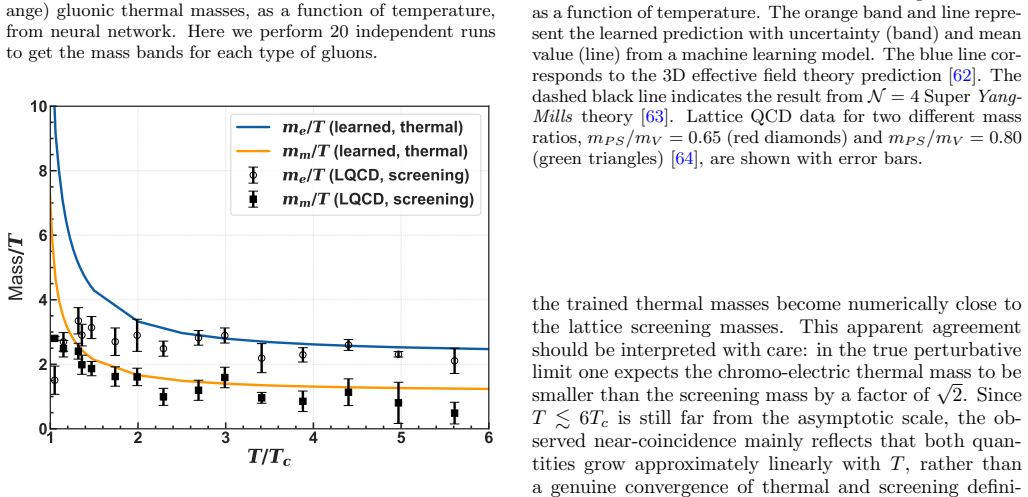
The central discovery is that a two-species ideal quasiparticle gas, with $m_e(T)$ and $m_m(T)$ parameterized by independent residual networks, reproduces the continuum-extrapolated SU(3) lattice pressure $p/T^4$ and trace anomaly $\Delta$ over the whole range $T/T_c \in [1,10]$. The learned masses decrease sharply near $T_c$, reach a minimum, and then grow approximately linearly; the ratio $m_e/m_m$ approaches 2 at high temperature, in line with 3D effective field theory and $N=4$ super Yang-Mills expectations. The paper also finds that the thermal masses differ significantly from lattice screening masses near $T_c$, while above roughly $2T_c$ the two definitions become numerically close only because both grow linearly, not because of genuine perturbative convergence.
Load-bearing premise
The load-bearing premise is that the gluon plasma is faithfully represented as two non-interacting ideal Bose gases with fixed degeneracies 8 and 16, so that every interaction effect is absorbed into the temperature-dependent masses; if that representation is wrong, the learned mass functions are fitting artifacts rather than physical thermal masses.
Editorial extensions
If this is right
- A direct corollary is that the same thermodynamic data can be used to compute the shear viscosity to entropy density ratio $\eta/s$ in the relaxation-time approximation, giving a minimum near $T_c$ close to the KSS bound.
- The method extends to full QCD with dynamical quarks and finite chemical potential, where separating electric and magnetic gluonic contributions could improve equation-of-state parametrization.
- The sharp dip of the thermal masses near $T_c$ followed by linear growth is presented as the physical mass pattern of the two gluonic modes across the crossover.
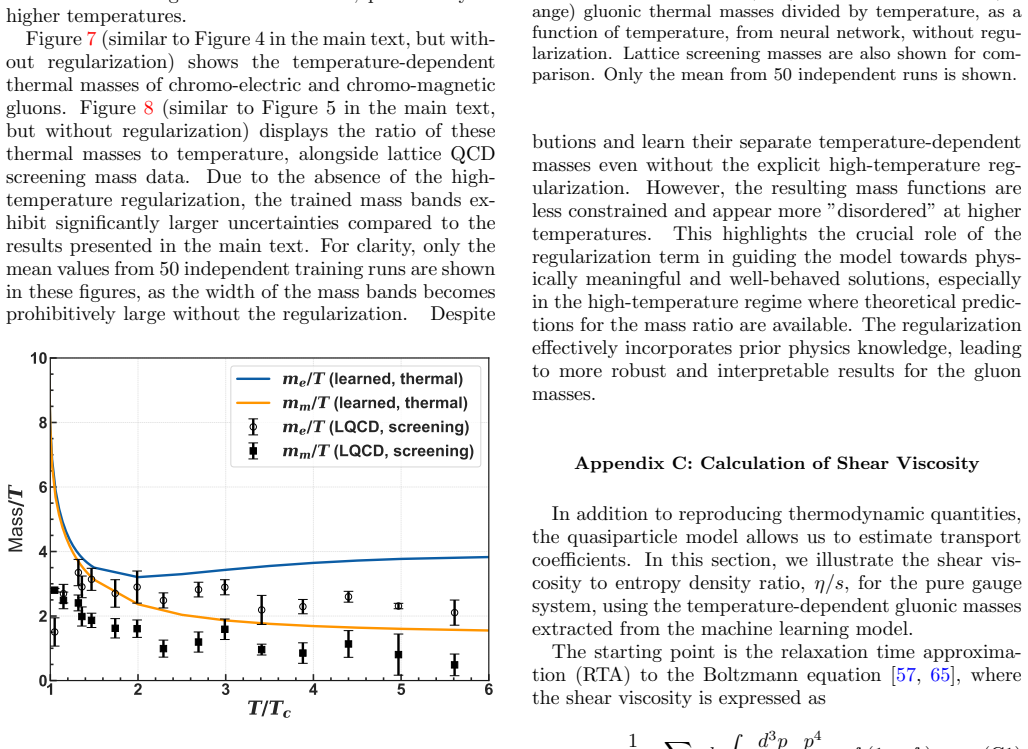
- The large spread of the unregularized mass bands shows that the two functions are not pinned down by thermodynamics alone, so the regularization is a necessary part of the extraction.
Reading between the lines
- A clean identifiability test would be to generate synthetic $p/T^4$ and $\Delta$ from two known mass functions, add noise, and see whether the dual-ResNet pipeline recovers both functions; the answer would tell us how much of the result is imposed by the soft constraint.
- Because the degeneracies $d_e=8$ and $d_m=16$ are fixed inputs, any missing interaction physics is folded into the masses; rerunning the extraction with different degeneracy assignments would reveal how much of the extracted pattern is an artifact of that choice.
- The near-coincidence of thermal and screening masses above $2T_c$ is explicitly a pre-asymptotic effect in the paper; if this interpretation is right, pushing lattice screening-mass data to higher $T$ should show the expected $\sqrt{2}$ offset rather than continued convergence.
Editorial analysis
A structured set of objections, weighed in public.
Referee Report
Summary. The paper proposes a neural-network-based quasiparticle model for the SU(3) gluon plasma, in which the chromo-electric (longitudinal, degeneracy 8) and chromo-magnetic (transverse, degeneracy 16) gluons have separate temperature-dependent masses me(T) and mm(T). The mass functions are represented by two residual neural networks and are trained to reproduce the lattice pressure p/T^4 and trace anomaly Δ from Borsanyi et al. over T/Tc in [1,10], with a soft regularization term that enforces me/mm approximately 2 above T=6Tc. The authors report accurate reproduction of the lattice thermodynamics, masses that decrease sharply near Tc and then grow approximately linearly, and a mass ratio compatible with 3D effective field theory, N=4 SYM, and two-flavor lattice screening masses. Appendix B shows that omitting the regularization leaves the mass bands very wide, and Appendix C extends the model to a shear-viscosity estimate with a tuned interaction constant.
Significance. If the inversion were well posed, this would be a useful physics-informed machine-learning application for separating electric and magnetic gluon quasiparticle contributions from lattice thermodynamics. The paper is notably transparent: it explicitly acknowledges that the lattice pressure is obtained by integrating the trace anomaly, that the two data terms are not statistically independent, and that the high-temperature mass ratio is imposed by the regularization. It also gives an honest caveat that the apparent agreement between thermal and screening masses at moderate T is pre-asymptotic. These are strengths. However, the central claim that thermodynamics plus a soft high-T constraint determines two distinct gluon thermal mass functions is not established, because the data provide only one independent thermodynamic function while the model has two unknown mass functions at each temperature. The narrow bands with regularization largely reflect the regularizer and network smoothness, not lattice information.
major comments (3)
- [Sec. II.A/II.B and Appendix B] The two fitted observables in Eq. (6) are not independent: for a thermodynamically consistent model, the trace anomaly Δ/T^4 is obtained from the pressure by a temperature derivative, and in the lattice reference [61] the pressure is itself obtained by integrating the trace anomaly. Thus the data supply one function of temperature, while the model has two unknown functions me(T) and mm(T). Appendix B confirms the resulting underdetermination: without the regularization term, 50 independent runs produce mass bands that are prohibitively wide. The statement in Sec. III that the regularized masses 'converge well with negligible uncertainties' is therefore a property of the chosen regularizer and network architecture, not of the lattice data. To support the central extraction claim, the authors should include a synthetic recovery test in which lattice-like data are generated from known mass functions and the training procedure is shown to recover them (or at least that the credible intervals cover the truth), and should quantify the dependence of the mass bands on the regularization strength λ.
- [Eq. (A1) and Fig. 5] The ratio me/mm approaching 2 at high temperature is imposed by the regularization term LMC in Eq. (A1), not extracted from the data. The text itself states that 'this asymptotic constraint is built into the training objective,' so presenting the resulting curve in Fig. 5 as compatible with 3D effective field theory and N=4 Super Yang-Mills is partly circular. The agreement mainly demonstrates that the regularizer was implemented successfully. To make this a meaningful check, the authors should show how much the data alone constrain the ratio, for example by varying λ or the threshold Tthreshold and reporting the resulting me/mm profile, and should also discuss whether the asymptotic SU(3) expectation is really me/mm about 2, given that hard-thermal-loop power counting suggests me ~ gT and mm ~ g^2T with a ratio that is not a fixed constant deep in the weak-coupling regime.
- [Sec. III, Fig. 5] The comparison in Fig. 5 uses two-flavor lattice QCD screening-mass ratios from WHOT-QCD [64] with mPS/mV = 0.65 and 0.80, while the model is for pure SU(3) gauge theory. Quark-loop effects can modify screening masses, especially near Tc, so this comparison is suggestive rather than a direct test. The authors should either use pure-gauge lattice data for the ratio or explicitly state that the two-flavor results are used only as an approximate phenomenological guide.
minor comments (5)
- [Eq. (6)] The loss term is written with p/T^3, while the figures and text consistently use p/T^4. Please clarify which normalized observable was actually used in the training, since the difference changes the relative weighting of the pressure and trace-anomaly terms.
- [Fig. 2 and Sec. III] The text mentions reproducing s/T^3, but no entropy-density plot is shown. Either add the entropy-density comparison or remove the statement, since s/T^3 is not an independent observable once p and Δ are fitted.
- [Figs. 3-5] The figure labels in the rendered text are garbled (appearing as '/uni00000014...' glyphs). The final version should ensure all axis labels and legends are legible, especially the distinction between the trained thermal masses and the lattice screening masses in Fig. 4.
- [Appendix C] The entropy density used in η/s is taken directly from lattice data rather than from the quasiparticle model, while the shear viscosity is computed from the model masses with a tuned parameter k=5.4. This hybrid procedure should be stated more prominently in the main text, and the tuning of k to approach the KSS bound should be flagged as an additional assumption.
- [Abstract and Sec. IV] The word 'extract' in the abstract is too strong given the demonstrated dependence on the regularization. Consider replacing it with language such as 'determine within a regularized quasiparticle model' or 'infer under the stated priors.'
Circularity Check
The high-T me/mm ~ 2 curve is imposed by the LMC regularizer and then reported as a prediction; the thermodynamic data alone underdetermine two mass functions (Appendix B).
-
fitted input called prediction
[Section III (Fig. 5); Appendix A, Eq. (A1)]
"The orange curve and uncertainty band represent the model prediction, trained with a soft regularization term that enforces the known asymptotic behavior me/mm → 2 at high temperatures. Although this asymptotic constraint is built into the training objective, the resulting curve exhibits excellent compatibility with both lattice QCD results at intermediate temperatures and theoretical predictions from 3D effective field theory and N = 4 Super Yang-Mills theory."
Equation (A1) is LMC = λ·ω(T)·(me/T·mm − 2)^2 with ω(T) = σ(100(T − 6Tc)), so above about 6Tc the objective explicitly penalizes any deviation of me/mm from 2. The Figure 5 curve approaching 2 is therefore the regularization target being reproduced, not a quantity independently extracted from lattice data. Presenting this curve as 'excellent compatibility' with 3D effective field theory and N = 4 Super Yang-Mills is comparing the trained output with the constraint that was put into the loss function by construction. Appendix B confirms the point: without this term the mass bands become 'prohibitively large', showing that the data alone do not fix the ratio.
-
other
[Section II (loss function Eq. (6)); Appendix B]
"the pressure is not directly computed but is obtained by integrating the trace anomaly over temperature. As a result, the pressure and trace anomaly are not statistically independent."
The two lattice-derived inputs in LMSE are not independent thermodynamic constraints: for the quasiparticle model built from Eqs. (3)-(4), Δ/T^4 = T d(p/T^4)/dT is an identity, so fitting both p/T^4 and Δ supplies only one independent function of temperature. The model has two unknown functions, me(T) and mm(T), making the inversion underdetermined. Appendix B shows that without the LMC regularizer, 50 independent runs yield mass bands that are 'prohibitively large'. Thus the narrow, apparently well-determined mass functions presented in the main text are substantially constructed by the regularization and network smoothness rather than by thermodynamic data.
full rationale
The paper is not circular through self-citation: the cited quasiparticle and deep-learning precedents are external work, and the comparison of extracted thermal masses with lattice screening masses is an independent, non-circular check. The genuine circularity is internal to the objective function. The high-temperature claim me/mm → 2 is written into Eq. (A1) as a soft constraint, while Figure 5 and Section IV treat the resulting ratio as a successful prediction compatible with 3D effective theory and N = 4 Super Yang-Mills. That is a fitted input being reported as an output. The underdetermination is structural: pressure and trace anomaly are related by a thermodynamic identity, so the two data terms in the loss provide essentially one constraint for two mass functions; Appendix B openly shows that without the regularizer the extracted masses are not pinned down. The paper does reproduce the lattice equation of state accurately, and the low-temperature shape of the masses is partially data-driven, so this is not a case where the entire derivation is equivalent to its input; the central high-temperature mass-ratio conclusion, however, reduces by construction to the regularizer target. Score 6 reflects one or more predictions being forced by construction, without a self-citation chain or total definitional equivalence.
Assumptions & free parameters
free parameters (5)
- Neural network weights for me(T) and mm(T) =
not reported
- Regularization strength lambda =
0.2
- Regularization threshold T_threshold =
6 Tc
- Regularization sharpness alpha =
100
- Shear viscosity interaction constant k =
5.4
assumptions (5)
- domain assumption The SU(3) gluon plasma can be described as an ideal gas of two non-interacting quasiparticle species.
- domain assumption The degeneracy split d_e=8 and d_m=16 is the correct counting for longitudinal and transverse gluonic modes.
- domain assumption The high-temperature mass ratio me/mm approaches 2, as suggested by 3D effective theory and N=4 SYM.
- standard math Gauss-Laguerre quadrature with 25 points accurately evaluates the momentum integrals.
- domain assumption The lattice pressure and trace anomaly from Ref. [61] are precise and mutually consistent inputs for the extraction.
Cite this review
Pith. "Pith review of Neural network extraction of chromo-electric and chromo-magnetic gluon masses." pith.science (2026). https://pith.science/paper/4H6NLFTJ
@misc{pith2026250722012,
  author       = {Pith},
  title        = {Pith review of: Neural network extraction of chromo-electric and chromo-magnetic gluon masses},
  year         = {2026},
  howpublished = {\url{https://pith.science/paper/4H6NLFTJ}},
  note         = {Machine review of arXiv:2507.22012}
}
abstract
We present a neural network-based quasi-particle model to separate the contributions of chromo-electric and chromo-magnetic gluons. Using dual residual networks, we extract temperature-dependent masses from SU(3) lattice thermodynamic data of pressure and trace anomaly. After incorporating physics regularizations, the trained models reproduce lattice results with high accuracy over $T/T_c \in [1,10]$, capturing both the crossover behavior near $T_c$ and linear scaling at high temperatures. The extracted masses exhibit a physically reasonable behavior: they decrease sharply around $T_c$ and increase linearly thereafter. We find significant differences between thermal and screening masses near $T_c$, reflecting non-perturbative dynamics, while they converge at $T \gtrsim 2T_c$.
Figures


Figures from the paper (5 more)



Reference graph
Works this paper leans on
-
[61]
K. He, X. Zhang, S. Ren, and J. Sun, Deep residual learning for image recognition, in 2016 IEEE Conference on CVPR (2016) pp. 770–778
work page 2016
-
[64]
A. Hart, M. Laine, and O. Philipsen, Static correlation lengths in QCD at high temperatures and finite densities, Nucl. Phys. B 586, 443 (2000), arXiv:hep-ph/0004060
work page Pith review arXiv 2000
-
[1]
Bazavov (HotQCD), The QCD equation of state, Nucl
A. Bazavov (HotQCD), The QCD equation of state, Nucl. Phys. A 931, 867 (2014)
work page 2014
-
[2]
Regularization term, which incorporates the ex- pected high-temperature behavior of gluonic masses. From calculations of 3 dimensional(3D) effective theory and N = 4 Super Yang-Mills theory, the mass ratio me/mm is estimated to be around 1 .8 − 2.2 in the high- temperature limit. To incorporate this theoretical expec- tation, we introduce a soft constrain...
-
[3]
Since T ≲ 6Tc is still far from the asymptotic scale, the ob- served near-coincidence mainly reflects that both quan- tities grow approximately linearly with T , rather than a genuine convergence of thermal and screening defini- tions. To further assess the physical consistency of the learned quasi-particle model, we examine the ratio of the electric to m...
-
[4]
C. R. Allton, S. Ejiri, S. J. Hands, O. Kaczmarek, F. Karsch, E. Laermann, C. Schmidt, and L. Scorzato, The QCD thermal phase transition in the presence of a small chemical potential, Phys. Rev. D 66, 074507 (2002), arXiv:hep-lat/0204010
arXiv 2002
-
[5]
G. Boyd, J. Engels, F. Karsch, E. Laermann, C. Lege- land, M. Lutgemeier, and B. Petersson, Thermodynam- ics of SU(3) lattice gauge theory, Nucl. Phys. B 469, 419 (1996), arXiv:hep-lat/9602007
arXiv 1996
-
[6]
A. Peshier, B. Kampfer, O. P. Pavlenko, and G. Soff, A Massive quasiparticle model of the SU(3) gluon plasma, Phys. Rev. D 54, 2399 (1996)
work page 1996
Show all 75 references
-
[7]
Dirks, A
M. Dirks, A. Niegawa, and K. Okano, A Slavnov-Taylor identity and equality of damping rates for static trans- verse and longitudinal gluons in hot QCD, Phys. Lett. B 461, 131 (1999), arXiv:hep-ph/9907439
1999 arXiv
-
[8]
P. N. Meisinger, M. C. Ogilvie, and T. R. Miller, Gluon quasiparticles and the polyakov loop, Phys. Lett. B 585, 149 (2004), arXiv:hep-ph/0312272
2004 arXiv
-
[9]
Hatsuda and T
T. Hatsuda and T. Kunihiro, QCD phenomenology based on a chiral effective Lagrangian, Phys. Rept. 247, 221 (1994), arXiv:hep-ph/9401310
1994 arXiv
-
[10]
S. P. Klevansky, The Nambu-Jona-Lasinio model of quantum chromodynamics, Rev. Mod. Phys. 64, 649 (1992)
1992
-
[11]
Mei and S
J. Mei and S. Mao, Inverse catalysis effect of the quark anomalous magnetic moment to chiral restoration and deconfinement phase transitions, Phys. Rev. D 102, 114035 (2020), arXiv:2008.12123 [hep-ph]
2020 arXiv
-
[12]
J. Mei, T. Xia, and S. Mao, Mass spectra of neutral mesons K0, π0,η,η’ at finite magnetic field, temperature and quark chemical potential, Phys. Rev. D 107, 074018 (2023), arXiv:2212.04778 [hep-ph]
2023 arXiv
-
[13]
J. Mei, R. Wen, S. Mao, M. Huang, and K. Xu, Magnetic catalysis and diamagnetism from pion fluctuations, Phys. Rev. D 110, 034024 (2024), arXiv:2402.19193 [hep-ph]
2024 arXiv
-
[14]
Fukushima, Chiral effective model with the Polyakov loop, Phys
K. Fukushima, Chiral effective model with the Polyakov loop, Phys. Lett. B 591, 277 (2004), arXiv:hep- ph/0310121
2004
-
[15]
Ratti, M
C. Ratti, M. A. Thaler, and W. Weise, Phases of QCD: Lattice thermodynamics and a field theoretical model, Phys. Rev. D 73, 014019 (2006), arXiv:hep-ph/0506234
2006 arXiv
-
[16]
Roessner, C
S. Roessner, C. Ratti, and W. Weise, Polyakov loop, di- quarks and the two-flavour phase diagram, Phys. Rev. D 75, 034007 (2007), arXiv:hep-ph/0609281
2007 arXiv
-
[17]
Schaefer, J
B.-J. Schaefer, J. M. Pawlowski, and J. Wambach, The Phase Structure of the Polyakov–Quark-Meson Model, Phys. Rev. D 76, 074023 (2007), arXiv:0704.3234 [hep- ph]
2007 arXiv
-
[18]
Bhattacharyya, P
A. Bhattacharyya, P. Deb, S. K. Ghosh, R. Ray, and S. Sur, Thermodynamic Properties of Strongly Inter- acting Matter in Finite Volume using Polyakov-Nambu- Jona-Lasinio Model, Phys. Rev. D 87, 054009 (2013), arXiv:1212.5893 [hep-ph]. 9
2013 arXiv
-
[19]
R. Wen, C. Huang, and W.-J. Fu, Baryon number fluctu- ations in the 2+1 flavor low energy effective model, Phys. Rev. D 99, 094019 (2019), arXiv:1809.04233 [hep-ph]
2019 arXiv
-
[20]
Wen and W.-j
R. Wen and W.-j. Fu, Correlations of conserved charges and QCD phase structure, Chin. Phys. C 45, 044112 (2021), arXiv:1909.12564 [hep-ph]
2021 arXiv
-
[21]
Xu and M
F. Xu and M. Huang, Electric and magnetic screenings of gluons in a model with dimension-2 gluon condensate, Chin. Phys. C 37, 014103 (2013), arXiv:1111.5152 [hep- ph]
2013 arXiv
-
[22]
T. K. Herbst, M. Mitter, J. M. Pawlowski, B.-J. Schae- fer, and R. Stiele, Thermodynamics of QCD at vanishing density, Phys. Lett. B 731, 248 (2014), arXiv:1308.3621 [hep-ph]
2014 arXiv
-
[23]
P. J. Gunkel and C. S. Fischer, Locating the critical end- point of QCD: Mesonic backcoupling effects, Phys. Rev. D 104, 054022 (2021), arXiv:2106.08356 [hep-ph]
2021 arXiv
-
[24]
Nakamura, T
A. Nakamura, T. Saito, and S. Sakai, Lattice calcula- tion of gluon screening masses, Phys. Rev. D 69, 014506 (2004), arXiv:hep-lat/0311024
2004 arXiv
-
[25]
Blaizot, E
J.-P. Blaizot, E. Iancu, and A. Rebhan, Thermodynamics of the high temperature quark gluon plasma (2003) pp. 60–122, arXiv:hep-ph/0303185
2003 arXiv
-
[26]
Kraemmer and A
U. Kraemmer and A. Rebhan, Advances in perturbative thermal field theory, Rept. Prog. Phys. 67, 351 (2004), arXiv:hep-ph/0310337
2004 arXiv
-
[27]
J. O. Andersen and M. Strickland, Resummation in hot field theories, Annals Phys. 317, 281 (2005), arXiv:hep- ph/0404164
2005
-
[28]
Su and K
N. Su and K. Tywoniuk, Massless Mode and Positivity Violation in Hot QCD, Phys. Rev. Lett. 114, 161601 (2015), arXiv:1409.3203 [hep-ph]
2015 arXiv
-
[29]
J. I. Kapusta and C. Gale, Finite-temperature field theory: Principles and applications, Cambridge Monographs on Mathematical Physics (Cam- bridge University Press, 2011)
2011
-
[30]
R. A. Schneider and W. Weise, On the quasiparticle de- scription of lattice QCD thermodynamics, Phys. Rev. C 64, 055201 (2001), arXiv:hep-ph/0105242
2001 arXiv
-
[31]
Peshier, B
A. Peshier, B. Kampfer, and G. Soff, From QCD lat- tice calculations to the equation of state of quark matter, Phys. Rev. D 66, 094003 (2002), arXiv:hep-ph/0206229
2002 arXiv
-
[32]
Bluhm, B
M. Bluhm, B. Kampfer, R. Schulze, and D. Seipt, QCD equation of state: Physical quark masses and asymptotic temperatures, Prog. Part. Nucl. Phys. 62, 512 (2009), arXiv:0901.0472 [hep-ph]
2009 arXiv
-
[33]
P. Alba, W. Alberico, M. Bluhm, V. Greco, C. Ratti, and M. Ruggieri, Polyakov loop and gluon quasiparticles: A self-consistent approach to Yang–Mills thermodynamics, Nucl. Phys. A 934, 41 (2014), arXiv:1402.6213 [hep-ph]
2014 arXiv
-
[34]
Koothottil and V
S. Koothottil and V. M. Bannur, Thermodynamic be- havior of magnetized quark-gluon plasma within the self- consistent quasiparticle model, Phys. Rev. C 99, 035210 (2019), arXiv:1811.05377 [nucl-th]
2019 arXiv
-
[35]
Cybenko, Approximation by superpositions of a sig- moidal function, Mathematics of control, signals and sys- tems 2, 303 (1989)
G. Cybenko, Approximation by superpositions of a sig- moidal function, Mathematics of control, signals and sys- tems 2, 303 (1989)
1989
-
[36]
Hornik, M
K. Hornik, M. Stinchcombe, and H. White, Multilayer feedforward networks are universal approximators, Neu- ral networks 2, 359 (1989)
1989
-
[37]
Raissi, P
M. Raissi, P. Perdikaris, and G. E. Karniadakis, Physics- informed neural networks: A deep learning framework for solving forward and inverse problems involving nonlinear partial differential equations, Journal of Computational physics 378, 686 (2019)
2019
-
[38]
Aarts, K
G. Aarts, K. Fukushima, T. Hatsuda, A. Ipp, S. Shi, L. Wang, and K. Zhou, Physics-driven learning for in- verse problems in quantum chromodynamics, Nature Rev. Phys. 7, 154 (2025), arXiv:2501.05580 [hep-lat]
2025 arXiv
-
[39]
L.-G. Pang, K. Zhou, N. Su, H. Petersen, H. St¨ ocker, and X.-N. Wang, An equation-of-state-meter of quantum chromodynamics transition from deep learning, Nature communications 9, 210 (2018)
2018
-
[40]
Z. Liu, W. Zhao, and H. Song, Principal component anal- ysis of collective flow in relativistic heavy-ion collisions, The European Physical Journal C 79, 870 (2019)
2019
-
[41]
Huang, B
H. Huang, B. Xiao, Z. Liu, Z. Wu, Y. Mu, and H. Song, Applications of deep learning to relativistic hydrodynam- ics, Physical Review Research 3, 023256 (2021)
2021
-
[42]
S. Shi, K. Zhou, J. Zhao, S. Mukherjee, and P. Zhuang, Heavy quark potential in the quark-gluon plasma: Deep neural network meets lattice quantum chromodynamics, Physical Review D 105, 014017 (2022)
2022
-
[43]
L. Wang, S. Shi, and K. Zhou, Reconstructing spectral functions via automatic differentiation, Physical Review D 106, L051502 (2022)
2022
-
[44]
Wang, Deep learning for exploring hadron–hadron in- teractions, J
L. Wang, Deep learning for exploring hadron–hadron in- teractions, J. Subatomic Part. Cosmol. 3, 100024 (2025), arXiv:2501.00374 [nucl-th]
2025 arXiv
-
[45]
Wang and J
L. Wang and J. Zhao, Learning Hadron Emitting Sources with Deep Neural Networks (2024), arXiv:2411.16343 [nucl-th]
2024 arXiv
-
[46]
L. Wang, T. Doi, T. Hatsuda, and Y. Lyu, Build- ing Hadron Potentials from Lattice QCD with Deep Neural Networks, PoS LA TTICE2024, 076 (2025), arXiv:2410.03082 [hep-lat]
2025 arXiv
-
[47]
K. Zhou, L. Wang, L.-G. Pang, and S. Shi, Explor- ing QCD matter in extreme conditions with Machine Learning, Prog. Part. Nucl. Phys. 135, 104084 (2024), arXiv:2303.15136 [hep-ph]
2024 arXiv
-
[48]
X. Chen, Y. Chen, and K. Zhou, Data-Driven Einstein- Dilaton Model for Pure Yang-Mills Thermodynamics and Glueball Spectrum, (2025), arXiv:2507.06729 [hep-ph]
2025
-
[49]
Dai, O.-Y
W.-C. Dai, O.-Y. Luo, B. Chen, X. Chen, X.-Y. Zhu, and X.-H. Li, Extracting Transport Properties of Quark- Gluon Plasma from the Heavy-Quark Potential With Neural Networks in a Holographic Model, (2025), arXiv:2503.10213 [hep-ph]
2025 arXiv
-
[50]
Mansouri, K
M. Mansouri, K. Bitaghsir Fadafan, and X. Chen, Holo- graphic complex potential of a quarkonium from deep learning, (2024), arXiv:2406.06285 [hep-ph]
2024 arXiv
-
[51]
Baldi, P
P. Baldi, P. Sadowski, and D. Whiteson, Searching for exotic particles in high-energy physics with deep learning, Nature communications 5, 4308 (2014)
2014
-
[52]
Baldi, P
P. Baldi, P. Sadowski, and D. Whiteson, Enhanced higgs boson to τ + τ -search with deep learning, Physical review letters 114, 111801 (2015)
2015
-
[53]
Barnard, E
J. Barnard, E. N. Dawe, M. J. Dolan, and N. Rajcic, Parton shower uncertainties in jet substructure analyses with deep neural networks, Physical Review D95, 014018 (2017)
2017
-
[54]
Broecker, J
P. Broecker, J. Carrasquilla, R. G. Melko, and S. Trebst, Machine learning quantum phases of matter beyond the fermion sign problem, Scientific reports 7, 8823 (2017)
2017
-
[55]
Radovic, M
A. Radovic, M. Williams, D. Rousseau, M. Kagan, D. Bonacorsi, A. Himmel, A. Aurisano, K. Terao, and T. Wongjirad, Machine learning at the energy and inten- sity frontiers of particle physics, Nature 560, 41 (2018). 10
2018
-
[56]
L. Wang, G. Aarts, and K. Zhou, Diffusion models as stochastic quantization in lattice field theory, JHEP 05, 060, arXiv:2309.17082 [hep-lat]
-
[57]
Carrasquilla and R
J. Carrasquilla and R. G. Melko, Machine learning phases of matter, Nature Physics 13, 431 (2017)
2017
-
[58]
Carleo, I
G. Carleo, I. Cirac, K. Cranmer, L. Daudet, M. Schuld, N. Tishby, L. Vogt-Maranto, and L. Zdeborov´ a, Machine learning and the physical sciences, Reviews of Modern Physics 91, 045002 (2019)
2019
-
[59]
Li, H.-L
F.-P. Li, H.-L. L¨ u, L.-G. Pang, and G.-Y. Qin, Deep-learning quasi-particle masses from QCD equa- tion of state, Phys. Lett. B 844, 138088 (2023), arXiv:2211.07994 [hep-ph]
2023 arXiv
-
[60]
Li, L.-G
F.-P. Li, L.-G. Pang, and G.-Y. Qin, QCD equa- tion of state at finite µB using deep learning assisted quasi-parton model, Phys. Lett. B 868, 139692 (2025), arXiv:2501.10012 [nucl-th]
2025 arXiv
-
[62]
X. Yu, Z. Yu, and S. Ramalingam, Learning strict identity mappings in deep residual networks, in 2018 IEEE Conference on CVPR (2018) pp. 4432–4440
2018
-
[63]
Borsanyi, G
S. Borsanyi, G. Endrodi, Z. Fodor, S. D. Katz, and K. K. Szabo, Precision SU(3) lattice thermodynamics for a large temperature range, JHEP 07, 056, arXiv:1204.6184 [hep-lat]
-
[65]
D. Bak, A. Karch, and L. G. Yaffe, Debye screen- ing in strongly coupled N=4 supersymmetric Yang-Mills plasma, JHEP 08, 049, arXiv:0705.0994 [hep-th]
-
[66]
Maezawa, S
Y. Maezawa, S. Aoki, S. Ejiri, T. Hatsuda, N. Ishii, K. Kanaya, N. Ukita, and T. Umeda (WHOT-QCD), Electric and Magnetic Screening Masses at Finite Tem- perature from Generalized Polyakov-Line Correlations in Two-flavor Lattice QCD, Phys. Rev. D 81, 091501 (2010), arXiv:1003.1...
2010 arXiv
-
[67]
Plumari, W
S. Plumari, W. M. Alberico, V. Greco, and C. Ratti, Re- cent thermodynamic results from lattice QCD analyzed within a quasi-particle model, Phys. Rev. D 84, 094004 (2011), arXiv:1103.5611 [hep-ph]
2011 arXiv
-
[68]
Kovtun, D
P. Kovtun, D. T. Son, and A. O. Starinets, Viscos- ity in strongly interacting quantum field theories from black hole physics, Phys. Rev. Lett. 94, 111601 (2005), arXiv:hep-th/0405231
2005 arXiv
-
[69]
Altenkort, A
L. Altenkort, A. M. Eller, A. Francis, O. Kaczmarek, L. Mazur, G. D. Moore, and H.-T. Shu, Viscosity of pure- glue QCD from the lattice, Phys. Rev. D 108, 014503 (2023), arXiv:2211.08230 [hep-lat]
2023 arXiv
-
[70]
Astrakhantsev, V
N. Astrakhantsev, V. Braguta, and A. Kotov, Tem- perature dependence of shear viscosity of SU (3)– gluodynamics within lattice simulation, JHEP 04, 101, arXiv:1701.02266 [hep-lat]
-
[71]
H. B. Meyer, A Calculation of the shear viscosity in SU(3) gluodynamics, Phys. Rev. D 76, 101701 (2007), arXiv:0704.1801 [hep-lat]
2007 arXiv
-
[72]
Bors´ anyi, Z
S. Bors´ anyi, Z. Fodor, M. Giordano, S. D. Katz, A. Pasz- tor, C. Ratti, A. Sch¨ afer, K. K. Szabo, and B. T´ oth, High statistics lattice study of stress tensor correlators in pure SU (3) gauge theory, Phys. Rev. D 98, 014512 (2018), arXiv:1802.07718 [hep-lat]
2018 arXiv
-
[73]
Zhang, H.-T
C. Zhang, H.-T. Ding, and H.-T. Shu, Shear and bulk viscosities of gluon plasma across the transition tempera- ture from lattice qcd, Talk at Spicy Gluon 2025, Qingdao, Shandong (2025)
2025
-
[74]
Marty, E
R. Marty, E. Bratkovskaya, W. Cassing, J. Aichelin, and H. Berrehrah, Transport coefficients from the Nambu- Jona-Lasinio model for SU (3)f , Phys. Rev. C 88, 045204 (2013), arXiv:1305.7180 [hep-ph]
2013 arXiv
-
[75]
Ghiglieri, G
J. Ghiglieri, G. D. Moore, and D. Teaney, QCD Shear Viscosity at (almost) NLO, JHEP 03, 179, arXiv:1802.09535 [hep-ph]
Reviewed August 6, 2026 · model on record in the stance chip above.
Discussion (0). Sign in to comment.