A Generic Multi-dimensional Symbol Construction for Digital Over-the-Air Computation and Practical Aspects
Pith reviewed 2026-06-26 22:48 UTC · model grok-4.3
The pith
A single set of multi-dimensional symbols computes any symmetric digital function through over-the-air aggregation.
A machine-rendered reading of the paper's core claim, the machinery that carries it, and where it could break.
Core claim
By representing a symmetric function categorically and invoking the fact that the histogram of the received symbols is a sufficient statistic, a single fixed set of multi-dimensional OAC symbols can be designed that computes any chosen symmetric digital function; the same symbol set is then shown to remain effective when the composite channel is characterized by the phase and amplitude statistics measured on a low-cost coherent test platform.
What carries the argument
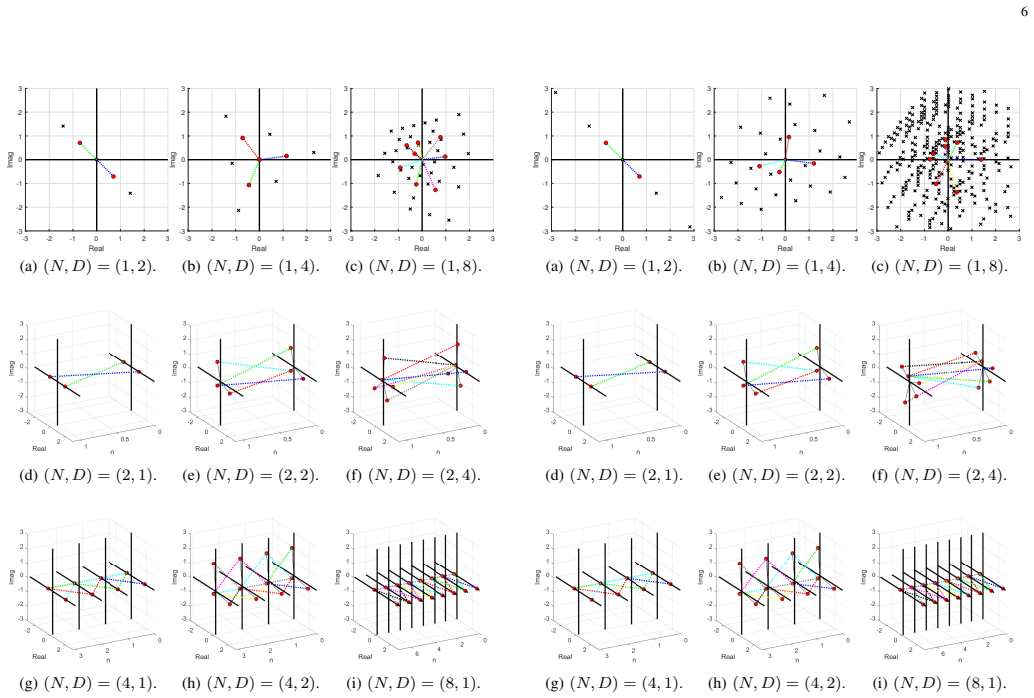
multi-dimensional OAC symbol construction that encodes the categorical representation of a symmetric function so that histogram statistics of the aggregate signal recover the function value
If this is right
- One fixed symbol alphabet works for every symmetric function instead of requiring a new alphabet per function.
- Coherent aggregation remains usable on inexpensive hardware once time-frequency-phase-amplitude synchronization is maintained by a trigger mechanism.
- An impairment model derived from measured phase and amplitude statistics of the composite channel can be used to predict performance without assuming ideal channels.
- The scheme continues to compute the target function correctly when the measured impairments are inserted into the analysis.
- Practical deployment of digital OAC becomes feasible without cable or GPS synchronization.
Where Pith is reading between the lines
- The same histogram-based construction might be extended to functions that are symmetric only within known partitions of the input space.
- If the measured impairment statistics vary slowly, the symbol mapping could be updated infrequently while still preserving correctness.
- The approach could reduce the number of distinct waveforms that must be stored at each transmitter in large-scale sensor networks.
Load-bearing premise
The histogram of the received symbols is sufficient to determine the value of any symmetric function.
What would settle it
An experiment in which two distinct symmetric functions produce indistinguishable histograms under the proposed symbol construction and measured impairment statistics.
Figures
read the original abstract
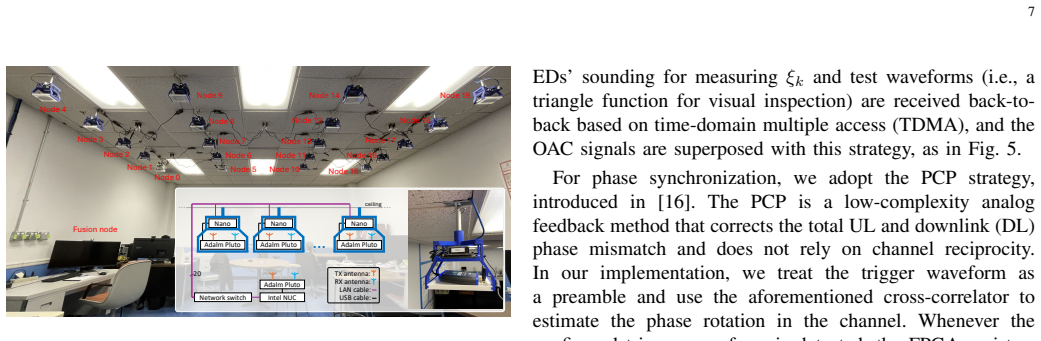
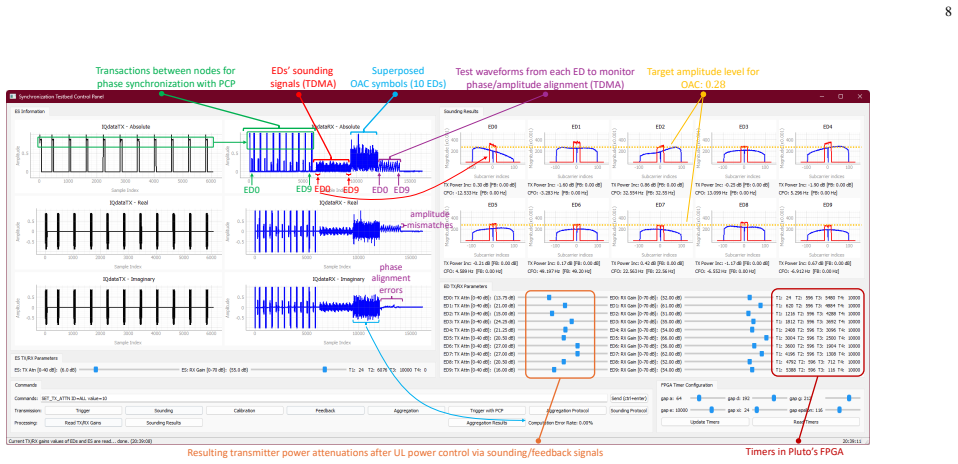
In this paper, we propose a general-purpose multi-dimensional symbol construction for computing an arbitrary symmetric function with digital over-the-air computation (OAC) and discuss the practical aspects of coherent aggregation. For our first contribution, we discuss the categorical representation of a symmetric function. By using this representation and leveraging the sufficiency of the histogram to evaluate a symmetric function, i.e., inspired by type-based multiple access (TBMA), we introduce a general approach to design a single set of OAC symbols to compute any digital function. For our second contribution, we use a comprehensive platform based on low-cost nodes that maintain synchronization in time, frequency, phase, and amplitude via a trigger mechanism, enabling coherent OAC experiments without Global Positioning System (GPS) or cable-based synchronization. Using measurements from the platform, we characterize the phase and amplitude statistics of the composite channel to derive a realistic impairment model for coherent OAC. Through a comprehensive analysis, we demonstrate the effectiveness of the proposed scheme under impairments captured by the proposed model
Editorial analysis
A structured set of objections, weighed in public.
Referee Report
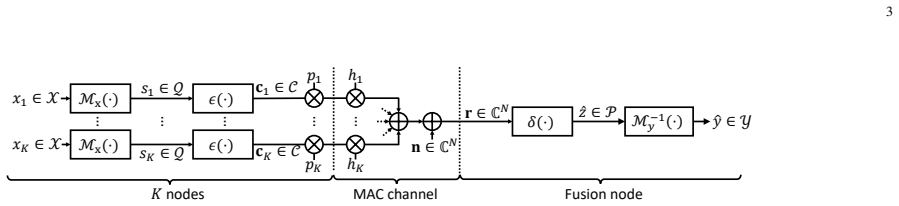
Summary. The paper proposes a general multi-dimensional symbol construction for digital over-the-air computation (OAC) of arbitrary symmetric functions. It leverages the categorical representation of symmetric functions together with the fact that any such function is fully determined by the empirical histogram (type) of the inputs, inspired by type-based multiple access (TBMA). A single fixed set of OAC symbols is designed so that coherent superposition at the receiver yields the histogram, from which the function value can be recovered. The second part describes a low-cost hardware platform that achieves time/frequency/phase/amplitude synchronization without GPS or cabling, reports measured phase and amplitude statistics of the composite channel, derives a realistic impairment model, and evaluates the scheme under that model.
Significance. If the symbol construction is correctly derived, it supplies a parameter-free, function-agnostic method for OAC of any symmetric digital function, which is a clear conceptual advance over function-specific designs. The experimental platform and impairment characterization constitute a concrete, reproducible contribution to the practical side of coherent OAC. These elements together address both the theoretical generality and the synchronization/impairment questions that have limited prior OAC work.
major comments (2)
- [Section on symbol construction (likely §3 or §4)] The central construction relies on the claim that a fixed multi-dimensional symbol set realizes histogram estimation via coherent superposition for any symmetric function. The manuscript should explicitly show (in the section presenting the construction) the mapping from the categorical representation to the symbol vectors and the exact superposition operation that recovers the type; without this derivation the generality claim cannot be verified.
- [Impairment model and performance analysis sections] The impairment model is derived from platform measurements and then used to analyze performance. The manuscript must state the precise statistical model (e.g., the joint distribution of phase and amplitude errors) and demonstrate that the reported error rates or success probabilities remain valid when this model is substituted into the theoretical error analysis; otherwise the practical-effectiveness claim rests on an unclosed loop between measurement and analysis.
minor comments (3)
- Notation for the multi-dimensional symbols and the histogram estimator should be introduced once and used consistently; several passages reuse the same symbol for distinct quantities.
- The abstract states that the platform enables experiments “without GPS or cable-based synchronization,” yet the trigger mechanism description should clarify whether any external reference (e.g., a shared clock line) is still required; this affects the claimed practicality.
- Figure captions for the platform photographs and the measured phase/amplitude histograms should include the number of independent realizations and the exact measurement conditions.
Simulated Author's Rebuttal
We thank the referee for the positive assessment and the recommendation of minor revision. The two major comments identify opportunities to improve explicitness in the symbol construction derivation and the integration of the impairment model with the performance analysis. We address each comment below and will incorporate the suggested clarifications.
read point-by-point responses
-
Referee: [Section on symbol construction (likely §3 or §4)] The central construction relies on the claim that a fixed multi-dimensional symbol set realizes histogram estimation via coherent superposition for any symmetric function. The manuscript should explicitly show (in the section presenting the construction) the mapping from the categorical representation to the symbol vectors and the exact superposition operation that recovers the type; without this derivation the generality claim cannot be verified.
Authors: We agree that an explicit derivation strengthens verifiability. The construction begins from the categorical representation of a symmetric function, where the function value depends only on the empirical type (histogram) of the inputs. Each category is mapped to a distinct orthogonal dimension in the multi-dimensional symbol space, so that the symbol vector for an input is a scaled unit vector in its category dimension. Coherent superposition at the receiver then produces a vector whose entries are exactly the category counts (the type). In the revised manuscript we will add a dedicated paragraph (or short subsection) in the construction section that writes this mapping and the superposition step explicitly, confirming that any symmetric function can be recovered from the received type. revision: yes
-
Referee: [Impairment model and performance analysis sections] The impairment model is derived from platform measurements and then used to analyze performance. The manuscript must state the precise statistical model (e.g., the joint distribution of phase and amplitude errors) and demonstrate that the reported error rates or success probabilities remain valid when this model is substituted into the theoretical error analysis; otherwise the practical-effectiveness claim rests on an unclosed loop between measurement and analysis.
Authors: We accept the need for a closed loop. The manuscript already derives the impairment model from measured phase and amplitude statistics of the composite channel. In revision we will state the precise joint distribution (parameters fitted to the empirical data, e.g., a bivariate Gaussian or other distribution capturing the observed correlation). We will then substitute this distribution into the theoretical error-probability expressions and verify that the resulting analytical or semi-analytical success probabilities match the values reported under the impairment model. These additions will appear in the impairment-model and performance-analysis sections. revision: yes
Circularity Check
No significant circularity; central construction is independent of inputs
full rationale
The paper's derivation begins from the categorical representation of symmetric functions and the standard information-theoretic fact that any symmetric function is fully determined by the input histogram (type), a property drawn from TBMA literature rather than derived or fitted inside the paper. The multi-dimensional OAC symbol construction is then presented as a direct realization of histogram estimation via superposition; no equation reduces a prediction to a fitted parameter, no uniqueness theorem is imported from the authors' prior work, and no ansatz is smuggled via self-citation. The impairment model and experimental platform constitute a separate practical contribution. The derivation is therefore self-contained against external benchmarks.
Axiom & Free-Parameter Ledger
axioms (1)
- domain assumption Histogram is sufficient to evaluate any symmetric function
Reference graph
Works this paper leans on
-
[1]
Computation over multiple-access channels,
B. Nazer and M. Gastpar, “Computation over multiple-access channels,” IEEE Trans. Inf. Theory, vol. 53, no. 10, pp. 3498–3516, Oct. 2007
2007
-
[2]
A survey on over-the-air computation,
A. S ¸ahin and R. Yang, “A survey on over-the-air computation,”IEEE Commun. Surveys Tuts., vol. 25, no. 3, pp. 1877–1908, Apr. 2023
1908
-
[3]
Waveforms for computing over the air: A groundbreak- ing approach that redefines data aggregation,
A. P ´erez-Neira, M. Martinez-Gost, A. S ¸ahin, S. Razavikia, C. Fischione, and K. Huang, “Waveforms for computing over the air: A groundbreak- ing approach that redefines data aggregation,”IEEE Signal Processing Magazine, vol. 42, no. 2, pp. 57–77, 2025
2025
-
[4]
Distributed learning over a wireless network with non- coherent majority vote computation,
A. S ¸ahin, “Distributed learning over a wireless network with non- coherent majority vote computation,”IEEE Trans. Wireless Commun., vol. 22, no. 11, pp. 8020–8034, 2023
2023
-
[5]
Nomographic functions: Efficient computation in clustered Gaussian sensor networks,
M. Goldenbaum, H. Boche, and S. Sta ´nczak, “Nomographic functions: Efficient computation in clustered Gaussian sensor networks,”IEEE Trans. Wireless Commun., vol. 14, no. 4, pp. 2093–2105, 2015
2093
-
[6]
ChannelComp: A general method for computation by communications,
S. Razavikia, J. M. Barros da Silva, and C. Fischione, “ChannelComp: A general method for computation by communications,”IEEE Trans. Commun., vol. 72, no. 2, pp. 692–706, 2024
2024
-
[7]
A unified framework for unbiased non-coherent over-the-air computation,
M. Dahl, Z. Chen, and E. G. Larsson, “A unified framework for unbiased non-coherent over-the-air computation,” 2026. [Online]. Available: https://arxiv.org/abs/2605.28453
Pith/arXiv arXiv 2026
-
[8]
Robust analog function computation via wireless multiple-access channels,
M. Goldenbaum and S. Stanczak, “Robust analog function computation via wireless multiple-access channels,”IEEE Trans. Commun., vol. 61, no. 9, pp. 3863–3877, 2013
2013
-
[9]
On the representation of continuous functions of several variables by superposition of continuous functions of one variable and addition,
A. K. Kolmogorov, “On the representation of continuous functions of several variables by superposition of continuous functions of one variable and addition,”Doklady Akademii Nauk SSSR, vol. 114, pp. 953– 956, 1957
1957
-
[10]
SumComp: Coding for digital over-the-air computation via the ring of integers,
S. Razavikia, J. M. B. da Silva, and C. Fischione, “SumComp: Coding for digital over-the-air computation via the ring of integers,”IEEE Trans. Commun., vol. 73, no. 2, pp. 752–767, 2025
2025
-
[11]
Optimal QAM constellation for over-the-air computation in the presence of heavy-tailed channel noise,
S. Razavikia, D. G ¨und¨uz, and C. Fischione, “Optimal QAM constellation for over-the-air computation in the presence of heavy-tailed channel noise,” inProc. IEEE International Conference on Acoustics, Speech and Signal Processing (ICASSP), 2026, pp. 21 381–21 385
2026
-
[12]
Out-of-air computation: Enabling structured extraction from wireless superposition,
S. M. Azimi-Abarghouyi, “Out-of-air computation: Enabling structured extraction from wireless superposition,” 2026. [Online]. Available: https://arxiv.org/abs/2604.04312
Pith/arXiv arXiv 2026
-
[13]
Performance comparison between coherent and non-coherent approaches for over-the- air computation,
Y . Lee, J. Hwang, I.-H. Lee, H. Jung, and T. Q. Duong, “Performance comparison between coherent and non-coherent approaches for over-the- air computation,”IEEE Transactions on Vehicular Technology, vol. 73, no. 10, pp. 15 826–15 831, 2024
2024
-
[14]
An impairment model and a generic scheme for coherent digital over-the-air computation based on empirical measurements,
A. S ¸ahin, “An impairment model and a generic scheme for coherent digital over-the-air computation based on empirical measurements,” in Proc. IEEE Military Communications Conference (MILCOM) - under review, Oct. 2026, pp. 1–6
2026
-
[15]
Type based estimation over multiaccess channels,
G. Mergen and L. Tong, “Type based estimation over multiaccess channels,”IEEE Trans. Signal Process., vol. 54, no. 2, pp. 613–626, 2006
2006
-
[16]
On the feasibility of distributed phase synchronization for coherent signal superposition,
A. S ¸ahin, “On the feasibility of distributed phase synchronization for coherent signal superposition,” inProc. IEEE Int. Symposium on Personal, Indoor and Mobile Radio Commun. (PIMRC), 2025, pp. 1–6
2025
-
[17]
One-bit over-the-air aggregation for communication-efficient federated edge learning: Design and convergence analysis,
G. Zhu, Y . Du, D. G ¨und¨uz, and K. Huang, “One-bit over-the-air aggregation for communication-efficient federated edge learning: Design and convergence analysis,”IEEE Trans. Wireless Commun., vol. 20, no. 3, pp. 2120–2135, Nov. 2021
2021
-
[18]
Radix-partition-based over-the-air aggregation and low-complexity state estimation for IoT systems over wireless fading channels,
M. Tang, S. Cai, and V . K. N. Lau, “Radix-partition-based over-the-air aggregation and low-complexity state estimation for IoT systems over wireless fading channels,”IEEE Trans. Signal Process., pp. 1–14, 2022
2022
-
[19]
Fundamental limits of over-the- air optimization: Are analog schemes optimal?
S. K. Jha, P. Mayekar, and H. Tyagi, “Fundamental limits of over-the- air optimization: Are analog schemes optimal?” inProc. IEEE Global Communications Conference (GLOBECOM), 2021, pp. 1–6
2021
-
[20]
Energy and spectrum efficient federated learning via high-precision over-the-air computation,
L. Li, C. Huang, D. Shi, H. Wang, X. Zhou, M. Shu, and M. Pan, “Energy and spectrum efficient federated learning via high-precision over-the-air computation,”arXiv preprint arXiv:2208.07237, 2022
arXiv 2022
-
[21]
Multi-symbol digital aircomp via modulation design and power adaptation,
X. Yan, S. Razavikia, and C. Fischione, “Multi-symbol digital aircomp via modulation design and power adaptation,”IEEE Commun. Lett., vol. 30, pp. 602–606, 2026
2026
-
[22]
STAC: Simultaneous transmitting and air computing in wireless data center networks,
X. Wu, S. Zhang, and A. ¨Ozg¨ur, “STAC: Simultaneous transmitting and air computing in wireless data center networks,”IEEE J. Sel. Areas Commun., vol. 34, no. 12, pp. 4024–4034, 2016
2016
-
[23]
Over-the-air computation based on balanced number systems for federated edge learning,
A. S ¸ahin, “Over-the-air computation based on balanced number systems for federated edge learning,”IEEE Trans. Wireless Commun., pp. 1–16, Oct. 2023
2023
-
[24]
Digitalizing over-the- air computation via the novel complement coded modulation,
Z. Wang, J. Yao, W. Xu, W. Shi, and K. Huang, “Digitalizing over-the- air computation via the novel complement coded modulation,”IEEE Commun. Lett., vol. 30, pp. 812–816, 2026
2026
-
[25]
Robust over- the-air computation with type-based multiple access,
M. Martinez-Gost, A. P ´erez-Neira, and M. A. Lagunas, “Robust over- the-air computation with type-based multiple access,” inProc. European Signal Processing Conference (EUSIPCO), 2025, pp. 2042–2046
2025
-
[26]
Joint Wyner–Ziv/dirty-paper coding by modulo-lattice modulation,
Y . Kochman and R. Zamir, “Joint Wyner–Ziv/dirty-paper coding by modulo-lattice modulation,”IEEE Trans. Inf. Theory, vol. 55, no. 11, pp. 4878–4889, 2009
2009
-
[27]
Communication-efficient federated learning for resource-constrained edge devices,
G. Lan, X.-Y . Liu, Y . Zhang, and X. Wang, “Communication-efficient federated learning for resource-constrained edge devices,”IEEE Trans. Machine Learning in Commun. and Netw., pp. 210–224, Aug. 2023
2023
-
[28]
Compute-update feder- ated learning: A lattice coding approach,
S. M. Azimi-Abarghouyi and L. R. Varshney, “Compute-update feder- ated learning: A lattice coding approach,”IEEE Trans. Signal Process., vol. 72, pp. 5213–5227, 2024
2024
-
[29]
Analog computation over the wireless channel: A proof of concept,
A. Kortke, M. Goldenbaum, and S. Sta ´nczak, “Analog computation over the wireless channel: A proof of concept,” inProc. IEEE Sensors, 2014, pp. 1224–1227
2014
-
[30]
Over-the-air function computation in sensor networks,
O. Abari, H. Rahul, and D. Katabi, “Over-the-air function computation in sensor networks,” 2016. [Online]. Available: https://arxiv.org/abs/ 1612.02307
Pith/arXiv arXiv 2016
-
[31]
Over-the-air aggregation for federated learning: Waveform superposition and prototype validation,
H. Guo, Y . Zhu, H. Ma, V . K. N. Lau, K. Huang, X. Li, H. Nong, and M. Zhou, “Over-the-air aggregation for federated learning: Waveform superposition and prototype validation,”Journal of Communications and Information Networks, vol. 6, no. 4, pp. 429–442, 2021
2021
-
[32]
A demonstration of over-the-air-computation for FEEL,
A. S ¸ahin, “A demonstration of over-the-air-computation for FEEL,” in Proc. IEEE GLOBECOM Workshops - Edge Learning over 5G Mobile Networks and Beyond, Dec. 2022, pp. 1821–1827
2022
-
[33]
AirCon: Over-the-air consensus for wireless blockchain networks,
X. Xie, C. Hua, J. Hong, P. Gu, and W. Xu, “AirCon: Over-the-air consensus for wireless blockchain networks,”IEEE Transactions on Mobile Computing, vol. 23, no. 5, pp. 4566–4582, 2024
2024
-
[34]
Timely parameter updating in over-the-air federated learning,
J. Zhu, Z. Zhao, X. Li, R. Du, S. Jin, and H. H. Yang, “Timely parameter updating in over-the-air federated learning,” 2025. [Online]. Available: https://arxiv.org/abs/2512.19103
arXiv 2025
-
[35]
Airshare: Distributed coherent transmission made seamless,
O. Abari, H. Rahul, D. Katabi, and M. Pant, “Airshare: Distributed coherent transmission made seamless,” inProc. IEEE Conference on Computer Communications (INFOCOM), 2015, pp. 1742–1750
2015
-
[36]
Exponential numbers,
E. T. Bell, “Exponential numbers,”The American Mathematical Monthly, vol. 41, no. 7, pp. 411–419, 1934
1934
-
[37]
Proakis and M
J. Proakis and M. Salehi,Digital Communications, ser. McGraw-Hill International Edition. McGraw-Hill, 2008
2008
-
[38]
Zamir, B
R. Zamir, B. Nazer, Y . Kochman, and I. Bistritz,Lattice Coding for Signals and Networks: A Structured Coding Approach to Quantization, Modulation and Multiuser Information Theory. Cambridge University Press, 2014
2014
-
[39]
Real interference alignment: Exploiting the potential of single antenna systems,
A. S. Motahari, S. Oveis-Gharan, M.-A. Maddah-Ali, and A. K. Khan- dani, “Real interference alignment: Exploiting the potential of single antenna systems,”IEEE Trans. Inf. Theory, vol. 60, no. 8, pp. 4799– 4810, 2014
2014
-
[40]
A millimeter-wave software- defined radio for wireless experimentation,
A. S ¸ahin, M. L. Sichitiu, and I. G ¨uvenc ¸, “A millimeter-wave software- defined radio for wireless experimentation,” inProc. IEEE Conference on Comp. Commun. Workshops (INFOCOM WKSHPS), 2023, pp. 1–6
2023
-
[41]
DFT-Spread-OFDM-based chirp transmission,
A. S ¸ahin, N. Hosseini, H. Jamal, S. S. M. Hoque, and D. W. Matolak, “DFT-Spread-OFDM-based chirp transmission,”IEEE Commun. Lett., vol. 25, no. 3, pp. 902–906, 2021
2021
-
[42]
A mmWave software-defined array platform for wireless experimentation at 24-29.5 GHz,
A. P. Ganesh, A. Perre, A. S ¸ahin, I. G ¨uvenc ¸, and B. A. Floyd, “A mmWave software-defined array platform for wireless experimentation at 24-29.5 GHz,” inProc. IEEE Military Communications Conference (MILCOM), 2024, pp. 1–6
2024
-
[43]
Flex- ible DFT-S-OFDM: Solutions and challenges,
A. S ¸ahin, R. Yang, E. Bala, M. C. Beluri, and R. L. Olesen, “Flex- ible DFT-S-OFDM: Solutions and challenges,”IEEE Communications Magazine, vol. 54, no. 11, pp. 106–112, 2016
2016
-
[44]
Modulo sampling of FRI signals,
S. Mulleti and Y . C. Eldar, “Modulo sampling of FRI signals,”IEEE Access, vol. 12, pp. 60 369–60 384, 2024
2024
discussion (0)
Sign in with ORCID, Apple, or X to comment. Anyone can read and Pith papers without signing in.