REVIEW 3 major objections 5 minor 72 references
Continuous-Variable Quantum Key Distribution with Rateless Reconciliation Protocol
T0 review · 3 major / 5 minor · reviewed 2026-08-14 · deepseek-v4-flash
Pith's one-line read This paper claims that a Raptor-code-based rateless reconciliation protocol keeps CV-QKD reconciliation efficiency above 95% from -20 dB to 0 dB SNR and yields a secret key rate of about $5\times10^{-4}$ bits per pulse at 132 km.
desk verdict First Raptor-code rateless reconciliation for CV-QKD, with useful simulations, but the security argument doesn't cover the feedback/stop messages, and the 'one degree distribution' line oversells four adaptive distributions. read the letter →
The pith
A machine-rendered reading of the paper's core claim, the machinery that carries it, and where it could break.
The reading
What carries the argument
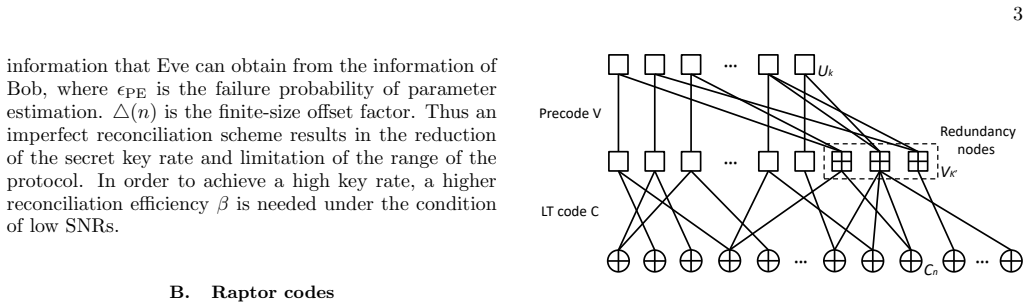
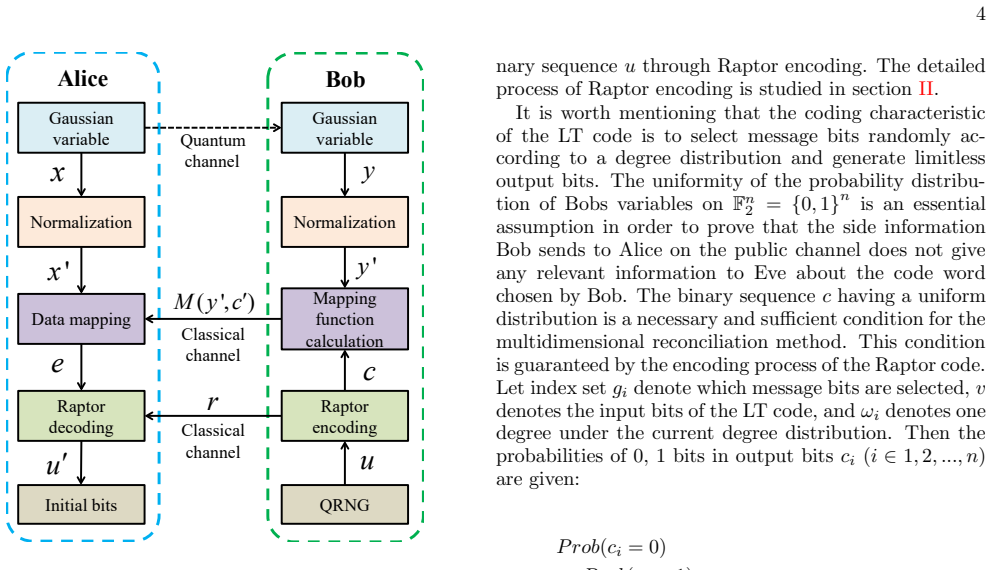
The load-bearing object is the Raptor code, a rateless fountain code in which an LT code generates unlimited output symbols from a message first protected by a high-rate LDPC precoder; its degree distribution $\Omega(x)$ controls the probabilities of output-node degrees. The protocol feeds the Raptor output through multidimensional reconciliation: Bob maps each $d$-dimensional block of normalized Gaussian data to a binary spherical code via a random orthogonal transformation $M(y',c')$, converting the physical Gaussian channel into a virtual binary-input AWGN channel on which Raptor decoding runs. The rateless feedback loop, in which Bob sends more mapping functions and Alice decodes again until the LDPC check equations pass, is what makes one design cover a wide SNR range. The four degree distributions, each optimized for part of the SNR range by the EXIT-chart method, are combined into one adaptive envelope.
What would settle it
Run the proposed protocol at a mid-envelope SNR such as -10 dB with k=9900 and measure the realized Raptor rate $R(\gamma)$: if $\beta=R(\gamma)/C(\gamma)$ falls below 95% at any point in [-20, 0] dB, the efficiency claim fails. Alternatively, compute the mutual information $I(c';M(y',c'))$ across a degree-distribution switch; a nonzero value would break the security argument.
Extended reading notes
Core claim
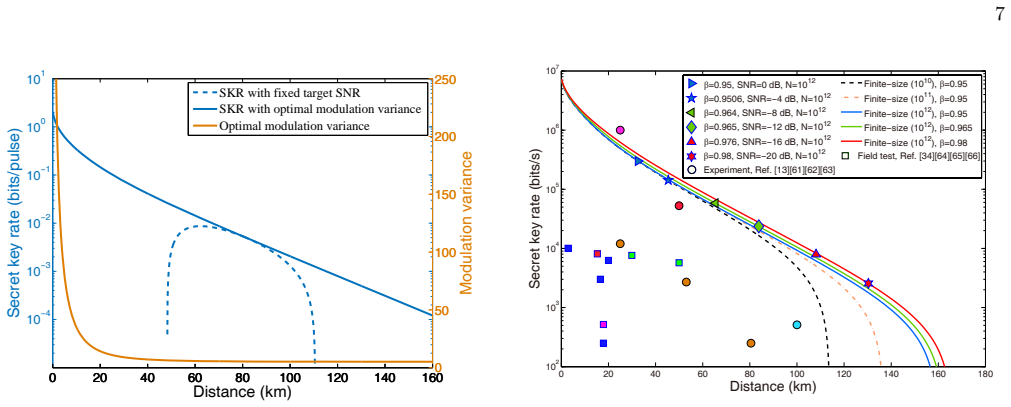
The central claim is that multidimensional reconciliation and Raptor codes can be combined into a rateless reconciliation protocol for CV-QKD that keeps the reconciliation efficiency $\beta = R(\gamma)/C(\gamma)$ above 95% for every SNR in [-20, 0] dB, reaching 98% at the lowest end. The protocol relies on Bob generating Raptor-coded spherical sequences $c'$, computing mapping functions $M(y',c')$ that rotate his normalized Gaussian data $y'$ into $c'$, and sending those mappings to Alice until her Raptor decoder succeeds; extra check bits guard against false success. Four optimized degree distributions, switched according to the SNR, form an efficiency envelope that behaves like a single rateless code. Because the realized code rate adapts to the channel, the modulation variance can stay at the value that maximizes the secret key rate, and the simulations report secret key rates of about 300 kbit/s at 32 km, 2.5 kbit/s at 130 km, and roughly $5\times10^{-4}$ bits per pulse at 132 km, exceeding the fixed-rate results compared in the paper.
Load-bearing premise
The entire scheme rests on the assumption that SNR-driven switching among four degree distributions leaves Bob's code word uniformly distributed and independent of the public mapping function $M(y',c')$, the condition under which the no-leakage step of the proof holds; the switching behavior itself is not analyzed.
Editorial extensions
If this is right
- A single rateless code with adaptive degree distribution can replace a bank of fixed-rate LDPC codes, so the reconciliation layer no longer needs to be re-optimized for each channel SNR.
- Keeping the modulation variance at its optimum removes the key-rate penalty that fixed-rate systems pay when they tune variance to a code threshold.
- The simulation predicts finite-size secret key rates of about 300 kbit/s at 32 km and 2.5 kbit/s at 130 km at 5 MHz repetition, with about $5\times10^{-4}$ bits per pulse at 132 km.
- The same protocol is expected in theory to work at even lower SNRs (-25 to -30 dB), extending reach, and to support free-space links and one-to-many QKD networks where SNR varies quickly.
Reading between the lines
- If the efficiency envelope persists at longer block lengths, a CV-QKD system could self-tune to unknown channel loss without storing many code-rate tables, a step toward unattended QKD networks that goes beyond this paper's offline simulations.
- The no-leakage proof is given for a fixed encoding; an explicit test of the independence between $M(y',c')$ and $c'$ under the SNR-driven switch would close the gap between the rateless envelope and the security claim.
- The eight-dimensional reconciliation map carries a capacity penalty that grows with SNR, so the same Raptor envelope should not be assumed to extend above 0 dB into short-distance, high-rate operation without further design.
Signed reviews
Editorial analysis
A structured set of objections, weighed in public.
Referee Report
Summary. The paper proposes a rateless information reconciliation protocol for continuous-variable quantum key distribution (CV-QKD), combining multidimensional reconciliation with Raptor codes. The authors claim that the protocol achieves reconciliation efficiency above 95% over a SNR range from -20 dB to 0 dB, allows the modulation variance to remain at its optimal value, and yields finite-size secret key rates up to a distance of 132 km at a 5-MHz repetition rate. The protocol works by having Bob generate Raptor-encoded bits, map them onto binary spherical codes, send the corresponding orthogonal mapping functions to Alice, and then feed back a stop signal and additional check bits upon successful decoding. The paper reports simulation results for four Raptor degree distributions and an adaptive switching ("DD-adaptive") envelope that selects the best distribution at each SNR.
Significance. If the security and efficiency claims hold, this work would be a practical step forward: a single rateless reconciliation framework could replace multiple fixed-rate LDPC codes, simplify code optimization for variable channel conditions, and remove the need to sacrifice the optimal modulation variance. The paper builds on established multidimensional reconciliation (Ref. [40]) and Raptor-code design (Refs. [49-52]), provides concrete degree distribution polynomials in Table I, and compares finite-size key rates with published experiments and field tests in Fig. 6. However, the security argument is incomplete, the "just one degree distribution" claim is contradicted by the adaptive switching method in Section IV, and the simulation evidence is presented without error bars, trial counts, or code release. The central efficiency claim is therefore plausible but not fully established as stated.
major comments (3)
- [Section III, Eq. (9) and Fig. 2] The independence proof for the mapping function M(y',c') and the codeword c' applies only to a single M(y',c') under a random orthogonal transformation. The rateless protocol additionally transmits, over the authenticated public channel, the stop/ACK signal upon successful decoding, the number of mapping functions n(gamma) sent before success, and the additional check bits r (Fig. 2 and Section III). The paper does not analyze whether any of these public messages are independent of c'. If the stopping time T or the check bits r have even a small correlation with the particular codeword c', then Eq. (9)'s per-mapping independence does not bound Eve's total information about c', and the reconciliation leakage in Eq. (1) (captured only through beta I(A:B)) would be underestimated. This gap directly affects the validity of the finite-size secret key rates in Fig. 6, and it must be closed by an explicit security analysis of the feedback and check-bit messages, or by reference to a published proof covering rateless feedback in this setting.
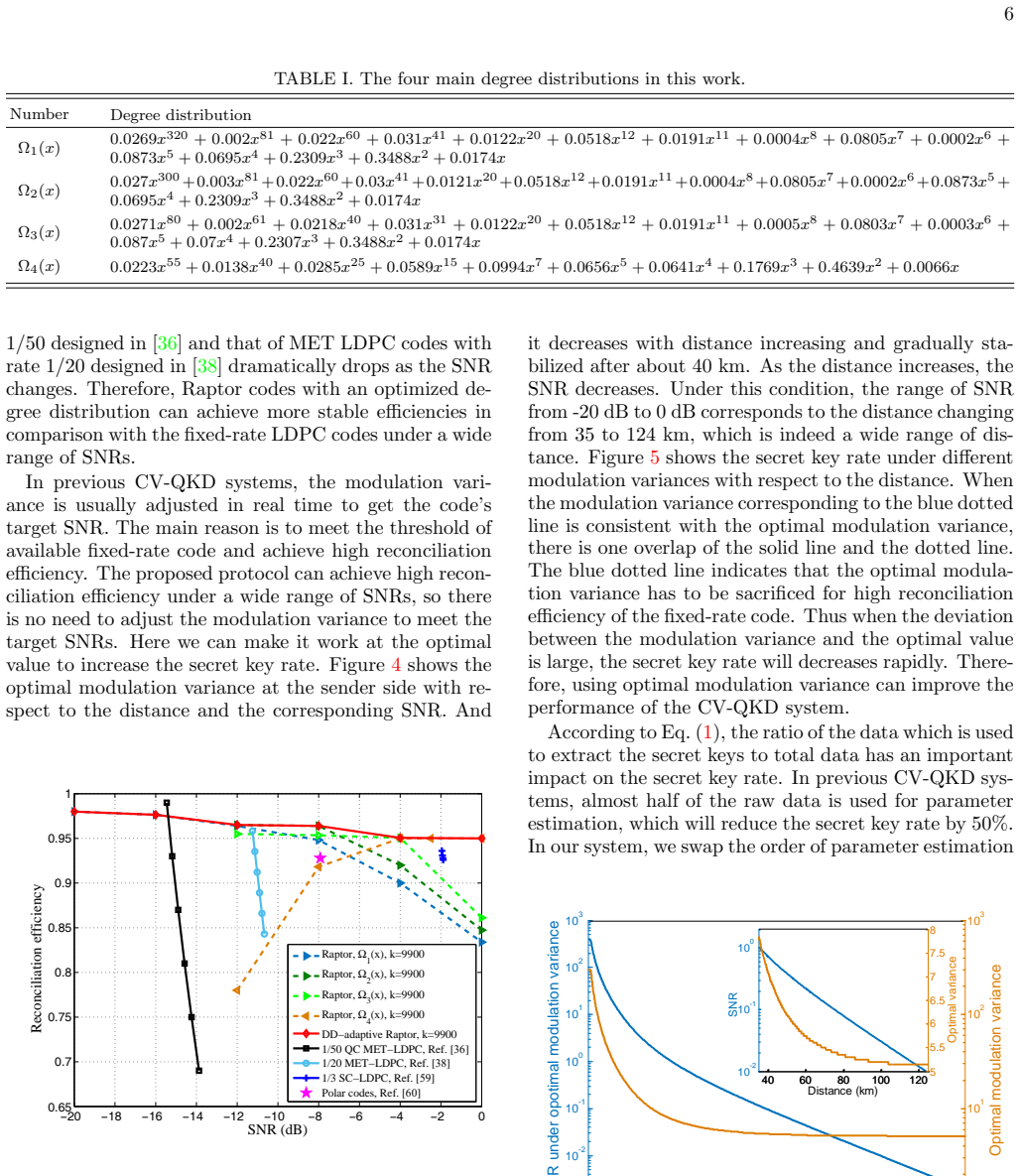
- [Abstract, Section IV, Fig. 3 and Table I] The abstract and the conclusion state that the protocol achieves high efficiency using "just one degree distribution," but Section IV uses four distinct degree distributions Ω1(x) through Ω4(x) (Table I) with an adaptive switching method, and the reported >95% efficiency is the envelope over these four distributions. This is not a single-distribution result. The wording should be corrected, and if the authors wish to claim single-distribution performance, they must provide results for a single Ω(x) covering the full −20 to 0 dB range. As it stands, the efficiency envelope is the maximum over four separately optimized distributions, which weakens the stated reduction in optimization complexity.
- [Section III, EXIT-chart derivation, and Section IV, Fig. 3 and Fig. 6] The degree distributions are obtained by EXIT-chart optimization (Section III) for the very SNR range in which the protocol is then evaluated, and the final efficiency curve in Fig. 3 is the best of four fitted distributions. Consequently, the >95% values are partly the output of the optimization procedure rather than an independent predictive test. The simulation results also lack error bars, the number of Monte Carlo trials, and the exact decoding failure criteria, and no code or detailed simulation parameters are released. Finally, it is unclear whether the β values used in the finite-size points of Fig. 6 are obtained from actual Raptor encoding/decoding runs at each SNR or from the theoretical formulas in Eqs. (10)-(11) combined with the Fig. 3 envelope. Please clarify the simulation methodology and provide statistical uncertainty so that the efficiency claims can be independently assessed.
minor comments (5)
- [Section IV, Fig. 4 caption and text] The text says the −20 dB to 0 dB range corresponds to distances from 35 to 124 km, while the Fig. 4 caption says the enlargement is from 34 to 124 km; please make these values consistent.
- [Section III, after Eq. (13)] The sentence "In order to satisfy the requirement that the secure key rate is greater than zero, a higher reconciliation efficiency is needed under the condition of low SNRs" is somewhat vague; it would be clearer to state that βmin is determined by the condition K_finite(βmin)=0 and that nval is the corresponding maximum block length.
- [Section III, Eq. (6)] Equation (6) writes Prob(ci=0)=Prob(ci=1)=1/2 as a single equality chain; this is correct only if the precoded bits are uniform and the degree selection is independent, so please add a brief note stating these conditions explicitly.
- [Section IV, Fig. 5] The figure caption says "The blue solid line is the secret key rate for optimal modulation variance..." but the body text refers to blue and orange lines in a way that could mislead readers about which curve corresponds to which strategy; please align the color descriptions in text and caption.
- [Section V, Discussion] The claim that "the rateless reconciliation protocol can achieve error-correction under lower SNRs (-25 or -30 dB)" is not supported by the simulations in Section IV; if this is a conjecture, please state it as such and avoid presenting it as a demonstrated property.
Circularity Check
The 'one degree distribution' and >95% efficiency results are the adaptive envelope of four fitted Raptor distributions, reducing the central performance claim to its inputs by construction.
-
self definitional
[Section IV, after Table I and Fig. 3]
"Therefore, the degree distribution adaptive method is used to automatically switch the degree distribution of Raptor codes with the change of SNR. This method is equivalent to using one degree distribution to keep the reconciliation efficiency high. In other words, the red line segment is an envelope that covers all the hightest reconciliation efficiency in different SNRs."
The central claim of 'just one degree distribution' (Abstract, Sec. I, Sec. V) is made true by definition: Table I lists four degree distributions, and Section IV describes an adaptive switch among them. Calling the switch 'equivalent to using one degree distribution' redefines the multi-distribution protocol as a single distribution, so the claimed unification is not derived but asserted. The >95% curve is the upper envelope of the four separately fitted curves, i.e., the result is constructed by selecting the best of the inputs.
-
fitted input called prediction
[Section IV, Fig. 3 paragraph and preceding design paragraph]
"In this Paper, we obtain the degree distribution by the EXIT chart approach [50, 52] ... Four mainly degree distributions are used for Raptor codes in this work and their descriptions are shown in Table I. ... As can be seen in Fig. 3, the efficiencies in our work are larger than 95% in the range of SNR from -20 to 0 dB."
The degree distributions are optimized via EXIT chart for the BIAWGN channel at the same low-SNR operating points for which the paper then reports >95% efficiency. The reported number is the pointwise maximum (the red envelope) of these four optimized distributions, so the headline prediction is a selected maximum of fitted inputs rather than an independent consequence of the rateless protocol. This is the fitted-input-called-prediction pattern.
full rationale
The paper's core combination of Raptor codes with multidimensional reconciliation is largely an application of known, externally grounded components: the EXIT-chart design method from Refs. [50,52] and the multidimensional-reconciliation security lemma from Ref. [40]. The finite-size key-rate curves in Fig. 6 use measured beta values from Fig. 3, which is an evaluation rather than a derivation, and the self-citation to Ref. [37] for reordering parameter estimation is supporting but not load-bearing in a way that makes the derivation circular. However, the abstract and Section V repeatedly claim 'just one degree distribution,' while Table I explicitly gives four degree distributions and Section IV describes a degree-distribution adaptive switch. The text makes this claim true by declaring the switch 'equivalent to using one degree distribution,' which is a definitional move rather than a derivation. Relatedly, the headline >95% efficiency over -20 to 0 dB is the red-line envelope of the four individually optimized curves, so the central performance claim is a selected maximum of fitted inputs rather than an independent prediction of a single rateless code. The security argument in Eq. (9) covers only individual mapping functions M(y',c'), while the public stop signal, the additional check code r, and the number of mapping functions n(gamma) are not shown independent of c'; that is a correctness gap, not a circularity, and does not affect the circularity score. Overall, the circularity is partial: the rateless protocol and its simulations are real, but the central 'one distribution / >95%' framing reduces to the envelope of four fitted distributions, justifying a score of 6 rather than a higher score.
Assumptions & free parameters
free parameters (6)
- Raptor degree distributions Ω1(x)-Ω4(x) =
Table I coefficients
- Information block size k =
9900 bits
- LDPC precoder rate =
0.99
- System noise parameters (excess noise ξ, detection efficiency η, electric noise ν_el) =
ξ=0.01, η=0.6, ν_el=0.015
- Fiber loss α =
0.2 dB/km
- Repetition rate =
5 MHz
assumptions (7)
- standard math Gaussian optimality theorem: the output two-mode state is fully characterized by VA, T, ξ
- domain assumption Composable security of CV-QKD with coherent states against arbitrary attacks
- domain assumption Multidimensional reconciliation converts the Gaussian channel into a virtual BIAWGN channel with negligible capacity loss at low SNR
- domain assumption The mapping function M(y',c') does not reveal c' to Eve
- domain assumption EXIT chart approximations: incoming messages are independent and Gaussian
- domain assumption BIAWGN capacity C(γ)=0.5 log2(1+γ) is the appropriate benchmark for efficiency
- standard math Finite-size key rate formula Eq. (1) from Ref. [41]
Cite this review
Pith. "Pith review of Continuous-Variable Quantum Key Distribution with Rateless Reconciliation Protocol." pith.science (2026). https://pith.science/paper/4HNQQHMB
@misc{pith2026190804526,
  author       = {Pith},
  title        = {Pith review of: Continuous-Variable Quantum Key Distribution with Rateless Reconciliation Protocol},
  year         = {2026},
  howpublished = {\url{https://pith.science/paper/4HNQQHMB}},
  note         = {Machine review of arXiv:1908.04526}
}
read the original abstract
Information reconciliation is crucial for continuous-variable quantum key distribution (CV-QKD) because its performance affects the secret key rate and maximal secure transmission distance. Fixed-rate error correction codes limit the potential applications of the CV-QKD because of the difficulty of optimizing such codes for different low SNRs. In this paper, we propose a rateless reconciliation protocol combined multidimensional scheme with Raptor codes that not only maintains the rateless property but also achieves high efficiency in different SNRs using just one degree distribution. It significantly decreases the complexity of optimization and increases the robustness of the system. Using this protocol, the CV-QKD system can operate with the optimal modulation variance which maximizes the secret key rate. Simulation results show that the proposed protocol can achieve reconciliation efficiency of more than 95% within the range of SNR from -20 dB to 0 dB. It also shows that we can obtain a high secret key rate at arbitrary distances in a certain range and achieve a secret key rate of about 5*10^(-4) bits/pulse at a maximum distance of 132 km (corresponding SNR is -20dB) that is higher than previous works. The proposed protocol can maintain high efficient key extraction under the wide range of SNRs and paves the way toward the practical application of CV-QKD systems in flexible scenarios.
Figures
Figures from the paper (1 more)
Reference graph
Works this paper leans on
-
[40]
Y. Zhang, Z. Li, Z. Chen, C. Weedbrook, Y. Zhao, X. Wang, Y. Huang, C. Xu, X. Zhang, Z. Wang, M. Li, X. Zhang, Z. Zheng, B. Chu, X. Gao, N. Meng, W. Cai, Z. Wang, G. Wang, S. Yu, and H. Guo, Continuous- variable QKD over 50 km commercial fiber, Quantum Sci. Technol. 4, 035006 (2019)
work page 2019
-
[1]
Through the LDPC encoding, k′ bits is generated
A high-rate check matrix is selected and converted into a generator matrix, which is used to encode the initial k bits. Through the LDPC encoding, k′ bits is generated
-
[2]
From a given degree distribution Ω( x), randomly select a degree ωi{0<i<n } for the output bit ci
-
[3]
Use an index set Gi to denote which message bits are selected
Choose ωi distinct message bits, uniformly at ran- dom. Use an index set Gi to denote which message bits are selected
-
[4]
Calculate the final value of the output bit ci by XOR operations of ωi message bits, i.e., ci = vgi,1 ⨁vgi,2 ⨁... ⨁vgi,ωi
-
[5]
Repeat the above steps 2)-4) until enough output bits are generated. For the convenience of analysis, the output bits c1,c 2,...,c n are sent to the receiver through a given bi- nary input AWGN (BIAWGN) channel. After enough bits y1,y 2,...,y n have been received, the receiver starts decoding, where yj = (−1)cj +zj andzj is the zero mean Gaussian noise wi...
-
[6]
Therefore a further conversion is needed such as the following: (c1,c 2,...,c d)→ ((−1)c1 √ d , (−1)c2 √ d ,..., (−1)cd √ d ). (7) After binary sequencec is converted into binary spher- ical sequence c′, the mapping function M(y′,c′) is calcu- lated by Bob with sequence y′ and sent to Alice. The mapping function M(y′,c′) satisfies: M(y′,c′)·y′ =c′. (8) The...
-
[7]
Gisin, G
N. Gisin, G. Ribordy, W. Tittel, and H. Zbinden, Quan- tum cryptography, Rev. Mod. Phys. 74, 145 (2002)
2002
Show all 72 references
-
[8]
Scarani, H
V. Scarani, H. Bechmann-Pasquinucci, N. J. Cerf, M. Duˇ sek, N. L¨ utkenhaus, and M. Peev, The security of practical quantum key distribution, Rev. Mod. Phys. 81, 1301 (2009)
2009
-
[9]
Pirandola, U
S. Pirandola, U. Andersen, L. Banchi, M. Berta, D. Bunandar, R. Colbeck, D. Englund, T. Gehring, C. Lupo, C. Ottaviani, et al., Advances in quantum cryp- tography, arXiv preprint arXiv:1906.01645 (2019)
2019 arXiv
-
[10]
Diamanti, H.-K
E. Diamanti, H.-K. Lo, B. Qi, and Z. Yuan, Practical challenges in quantum key distribution, npj Quantum In- form. 2, 16025 (2016)
2016
-
[11]
C. H. Bennett and G. Brassard, Quantum cryptography: public key distribution and coin tossing., Theor. Comput. Sci. 560, 7 (2014)
2014
-
[12]
S. L. Braunstein and P. Van Loock, Quantum informa- tion with continuous variables, Rev. Mod. Phys. 77, 513 (2005)
2005
-
[13]
Weedbrook, S
C. Weedbrook, S. Pirandola, R. Garc´ ıa-Patr´ on, N. J. Cerf, T. C. Ralph, J. H. Shapiro, and S. Lloyd, Gaussian quantum information, Rev. Mod. Phys. 84, 621 (2012)
2012
-
[14]
Diamanti and A
E. Diamanti and A. Leverrier, Distributing secret keys with quantum continuous variables: principle, security and implementations, Entropy 17, 6072 (2015)
2015
-
[15]
Grosshans and P
F. Grosshans and P. Grangier, Continuous variable quan- tum cryptography using coherent states, Phys. Rev. Lett. 88, 057902 (2002)
2002
-
[16]
Grosshans, G
F. Grosshans, G. Van Assche, J. Wenger, R. Brouri, N. J. Cerf, and P. Grangier, Quantum key distribution using gaussian-modulated coherent states, Nature 421, 238 (2003)
2003
-
[17]
Lodewyck, M
J. Lodewyck, M. Bloch, R. Garca-Patrn, S. Fossier, E. Karpov, E. Diamanti, T. Debuisschert, N. J. Cerf, R. Tualle-Brouri, and S. W. Mclaughlin, Quantum key distribution over 25km with an all-fiber continuous- variable system, Phys. Rev. A 76, 042305 (2007)
2007
-
[18]
I. Khan, C. Wittmann, N. Jain, N. Killoran, N. L¨ utkenhaus, C. Marquardt, and G. Leuchs, Optimal working points for continuous-variable quantum chan- nels, Phys. Rev. A 88, 010302 (2013)
2013
-
[19]
Jouguet, S
P. Jouguet, S. Kunz-Jacques, A. Leverrier, P. Grangier, and E. Diamanti, Experimental demonstration of long- distance continuous-variable quantum key distribution, Nat. Photonics 7, 378 (2013)
2013
-
[20]
Weedbrook, C
C. Weedbrook, C. Ottaviani, and S. Pirandola, Two-way quantum cryptography at different wavelengths, Phys. Rev. A 89, 012309 (2014)
2014
-
[21]
Pirandola, C
S. Pirandola, C. Ottaviani, G. Spedalieri, C. Weedbrook, S. L. Braunstein, S. Lloyd, T. Gehring, C. S. Jacob- sen, and U. L. Andersen, High-rate measurement-device- independent quantum cryptography, Nat. Photonics 9, 397 (2015)
2015
-
[22]
D. B. Soh, C. Brif, P. J. Coles, N. L¨ utkenhaus, R. M. Camacho, J. Urayama, and M. Sarovar, Self-referenced continuous-variable quantum key distribution protocol, Phys. Rev. X 5, 041010 (2015)
2015
-
[23]
B. Qi, P. Lougovski, R. Pooser, W. Grice, and M. Bobrek, Generating the local oscillator locally in continuous- variable quantum key distribution based on coherent de- tection, Phys. Rev. X 5, 041009 (2015)
2015
-
[24]
V. C. Usenko and F. Grosshans, Unidimensional continuous-variable quantum key distribution, Phys. Rev. A 92, 062337 (2015)
2015
-
[25]
X. Wang, W. Liu, P. Wang, and Y. Li, Experimen- tal study on all-fiber-based unidimensional continuous- variable quantum key distribution, Phys. Rev. A 95, 062330 (2017)
2017
-
[26]
N. Wang, S. Du, W. Liu, X. Wang, Y. Li, and K. Peng, Long-distance continuous-variable quantum key distri- bution with entangled states, Phys. Rev. Applied 10, 064028 (2018)
2018
-
[27]
Qi and C
B. Qi and C. C. W. Lim, Noise analysis of simultaneous quantum key distribution and classical communication scheme using a true local oscillator, Phys. Rev. Applied 9, 054008 (2018)
2018
-
[28]
Karinou, H
F. Karinou, H. H. Brunner, C. F. Fung, L. C. Comandar, S. Bettelli, D. Hillerkuss, M. Kuschnerov, S. Mikroulis, D. Wang, C. Xie, M. Peev, and A. Poppe, Toward the integration of cv quantum key distribution in deployed optical networks, IEEE Photonics Technol. Lett. 30, 650 (2018)
2018
-
[29]
Aguado, V
A. Aguado, V. Lopez, D. Lopez, M. Peev, A. Poppe, A. Pastor, J. Folgueira, and V. Martin, The engineering 9 of software-defined quantum key distribution networks, IEEE Commun. Mag. 57, 20 (2019)
2019
-
[30]
T. A. Eriksson, T. Hirano, B. J. Puttnam, G. Rademacher, R. S. Lu´ ıs, M. Fujiwara, R. Namiki, Y. Awaji, M. Takeoka, N. Wada, et al. , Wavelength division multiplexing of continuous variable quan- tum key distribution and 18.3 tbit/s data channels, Communications Physics 2, 9 (2019)
2019
-
[31]
W. Ye, H. Zhong, Q. Liao, D. Huang, L. Hu, and Y. Guo, Improvement of self-referenced continuous-variable quan- tum key distribution with quantum photon catalysis, Opt. Express 27, 17186 (2019)
2019
-
[32]
Y. Guo, W. Ye, H. Zhong, and Q. Liao, Continuous- variable quantum key distribution with non-gaussian quantum catalysis, Phys. Rev. A 99, 032327 (2019)
2019
-
[33]
Ghorai, P
S. Ghorai, P. Grangier, E. Diamanti, and A. Leverrier, Asymptotic security of continuous-variable quantum key distribution with a discrete modulation, Phys. Rev. X 9, 021059 (2019)
2019
-
[34]
X. Wang, S. Guo, P. Wang, W. Liu, and Y. Li, Realistic rate-distance limit of continuous-variable quantum key distribution, Opt. Express 27, 13372 (2019)
2019
-
[35]
Zhang, Y
Y.-C. Zhang, Y. Huang, Z. Chen, Z. Li, S. Yu, and H. Guo, One-time shot-noise unit calibration method for continuous-variable quantum key distribution, arXiv preprint arXiv:1908.06230 (2019)
2019 arXiv
-
[36]
Pirandola, S
S. Pirandola, S. L. Braunstein, and S. Lloyd, Charac- terization of collective gaussian attacks and security of coherent-state quantum cryptography, Phys. Rev. Lett. 101, 200504 (2008)
2008
-
[37]
Pirandola, R
S. Pirandola, R. Garc´ ıa-Patr´ on, S. L. Braunstein, and S. Lloyd, Direct and reverse secret-key capacities of a quantum channel, Phys. Rev. Lett. 102, 050503 (2009)
2009
-
[38]
Leverrier, Composable security proof for continuous- variable quantum key distribution with coherent states, Phys
A. Leverrier, Composable security proof for continuous- variable quantum key distribution with coherent states, Phys. Rev. Lett. 114, 070501 (2015)
2015
-
[39]
Leverrier, Security of continuous-variable quantum key distribution via a gaussian de finetti reduction, Phys
A. Leverrier, Security of continuous-variable quantum key distribution via a gaussian de finetti reduction, Phys. Rev. Lett. 118, 200501 (2017)
2017
-
[41]
Zhang, J
G. Zhang, J. Haw, H. Cai, F. Xu, S. Assad, J. Fitzsimons, X. Zhou, Y. Zhang, S. Yu, J. Wu,et al., An integrated sil- icon photonic chip platform for continuous-variable quan- tum key distribution, Nat. Photonics , 1 (2019)
2019
-
[42]
Milicevic, C
M. Milicevic, C. Feng, L. M. Zhang, and P. G. Gu- lak, Quasi-cyclic multi-edge ldpc codes for long-distance quantum cryptography, npj Quantum Information 4, 21 (2018)
2018
-
[43]
X. Wang, Y. Zhang, S. Yu, and H. Guo, High effi- ciency postprocessing for continuous-variable quantum key distribution: using all raw keys for parameter es- timation and key extraction, Quantum Inf. Process. 18, 264 (2019)
2019
-
[44]
Jouguet, S
P. Jouguet, S. Kunz-Jacques, and A. Leverrier, Long- distance continuous-variable quantum key distribution with a gaussian modulation, Phys. Rev. A 84, 062317 (2011)
2011
-
[45]
Van Assche, J
G. Van Assche, J. Cardinal, and N. J. Cerf, Reconcilia- tion of a quantum-distributed gaussian key, IEEE Trans. Inf. Theory 50, 394 (2004)
2004
-
[46]
Leverrier, R
A. Leverrier, R. All´ eaume, J. Boutros, G. Z´ emor, and P. Grangier, Multidimensional reconciliation for a continuous-variable quantum key distribution, Phys. Rev. A 77, 042325 (2008)
2008
-
[47]
Leverrier, F
A. Leverrier, F. Grosshans, and P. Grangier, Finite-size analysis of continuous-variable quantum key distribution, Phys. Rev. A 81, 062343 (2010)
2010
-
[48]
Chung, G
S.-Y. Chung, G. D. Forney, T. J. Richardson, and R. Ur- banke, On the design of low-density parity-check codes within 0.0045 db of the shannon limit, IEEE Commun. Lett. 5, 58 (2001)
2001
-
[49]
Richardson, R
T. Richardson, R. Urbanke, et al. , Multi-edge type ldpc codes, in Workshop honoring Prof. Bob McEliece on his 60th birthday, California Institute of Technology, Pasadena, California (2002) pp. 24–25
2002
-
[50]
T. J. Richardson, M. A. Shokrollahi, and R. L. Ur- banke, Design of capacity-approaching irregular low- density parity-check codes, IEEE Trans. Inf. Theory 47, 619 (2001)
2001
-
[51]
X. Wang, Y. Zhang, S. Yu, and H. Guo, High speed error correction for continuous-variable quantum key distribu- tion with multi-edge type ldpc code, Sci. Rep. 8, 10543 (2018)
2018
-
[52]
Leverrier and P
A. Leverrier and P. Grangier, Unconditional security proof of long-distance continuous-variable quantum key distribution with discrete modulation, Phys. Rev. Lett. 102, 180504 (2009)
2009
-
[53]
X. Wang, Y. Zhang, S. Yu, B. Xu, Z. Li, and H. Guo, Effi- cient rate-adaptive reconciliation for continuous-variable quantum key distribution, Quantum Inf. Comput. 17, 1123 (2017)
2017
-
[54]
Shokrollahi, Raptor codes, IEEE/ACM Transactions on Networking (TON) 14, 2551 (2006)
A. Shokrollahi, Raptor codes, IEEE/ACM Transactions on Networking (TON) 14, 2551 (2006)
2006
-
[55]
Etesami and A
O. Etesami and A. Shokrollahi, Raptor codes on binary memoryless symmetric channels, IEEE Trans. Inf. The- ory 52, 2033 (2006)
2006
-
[56]
Cheng, J
Z. Cheng, J. Castura, and Y. Mao, On the design of raptor codes for binary-input gaussian channels, IEEE Trans. Commun. 57, 3269 (2009)
2009
-
[57]
S.-H. Kuo, Y. L. Guan, S.-K. Lee, and M.-C. Lin, A design of physical-layer raptor codes for wide snr ranges, IEEE Commun. Lett. 18, 491 (2014)
2014
-
[58]
Shirvanimoghaddam and S
M. Shirvanimoghaddam and S. Johnson, Raptor codes in the low snr regime, IEEE Trans. Commun. 64, 4449 (2016)
2016
-
[59]
Jouguet, S
P. Jouguet, S. Kunz-Jacques, E. Diamanti, and A. Lev- errier, Analysis of imperfections in practical continuous- variable quantum key distribution, Phys. Rev. A 86, 032309 (2012)
2012
-
[60]
Grosshans, N
F. Grosshans, N. J. Cerf, J. Wenger, R. Tualle-Brouri, and P. Grangier, Virtual entanglement and reconcilia- tion protocols for quantum cryptography with continuous variables, Quantum Inf. Comput. 3, 535 (2003)
2003
-
[61]
Jiang, P
X.-Q. Jiang, P. Huang, D. Huang, D. Lin, and G. Zeng, Secret information reconciliation based on punctured low-density parity-check codes for continuous-variable quantum key distribution, Phys. Rev. A 95, 022318 (2017)
2017
-
[62]
C. H. Bennett, G. Brassard, C. Cr´ epeau, and U. M. Mau- rer, Generalized privacy amplification, IEEE Trans. Inf. Theory 41, 1915 (1995)
1995
-
[63]
Deutsch, A
D. Deutsch, A. Ekert, R. Jozsa, C. Macchiavello, S. Popescu, and A. Sanpera, Quantum privacy ampli- 10 fication and the security of quantum cryptography over noisy channels, Phys. Rev. Lett. 77, 2818 (1996)
1996
-
[64]
X. Wang, Y. Zhang, S. Yu, and H. Guo, High-speed im- plementation of length-compatible privacy amplification in continuous-variable quantum key distribution, IEEE Photonics J. 10, 1 (2018)
2018
-
[65]
Jiang, S
X.-Q. Jiang, S. Yang, P. Huang, and G. Zeng, High-speed reconciliation for cvqkd based on spatially coupled ldpc codes, IEEE Photonics J. 10, 1 (2018)
2018
-
[66]
Jouguet and S
P. Jouguet and S. Kunz-Jacques, High performance er- ror correction for quantum key distribution using polar codes, Quantum Inf. Comput. 14, 329 (2014)
2014
-
[67]
Huang, P
D. Huang, P. Huang, D. Lin, and G. Zeng, Long-distance continuous-variable quantum key distribution by control- ling excess noise, Sci. Rep. 84, 062317 (2016)
2016
-
[68]
C. Wang, D. Huang, P. Huang, D. Lin, J. Peng, and G. Zeng, 25 mhz clock continuous-variable quantum key distribution system over 50 km fiber channel, Sci. Rep. 5, 14607 (2015)
2015
-
[69]
Huang, D
D. Huang, D. Lin, C. Wang, W. Liu, S. Fang, J. Peng, P. Huang, and G. Zeng, Continuous-variable quantum key distribution with 1 mbps secure key rate, Opt. Ex- press 23, 17511 (2015)
2015
-
[70]
Huang, P
D. Huang, P. Huang, H. Li, T. Wang, Y. Zhou, and G. Zeng, Field demonstration of a continuous-variable quantum key distribution network, Opt. Lett. 41, 3511 (2016)
2016
-
[71]
Jouguet, S
P. Jouguet, S. Kunz-Jacques, T. Debuisschert, S. Fossier, E. Diamanti, R. All´ eaume, R. Tualle-Brouri, P. Grang- ier, A. Leverrier, P. Pache, and P. Painchault, Field test of classical symmetric encryption with continuous vari- ables quantum key distribution, Opt. Express 20,...
2012
-
[72]
Fossier, E
S. Fossier, E. Diamanti, T. Debuisschert, A. Villing, R. Tualle-Brouri, and P. Grangier, Field test of a continuous-variable quantum key distribution prototype, New J. Phys. 11, 045023 (2009)
2009
Reviewed August 14, 2026 · model on record in the stance chip above.
Discussion (0). Continue with ORCID to comment.