REVIEW 3 major objections 5 minor 39 references
STAGE: Segmentation-oriented Industrial Anomaly Synthesis via Graded Diffusion with Explicit Mask Alignment
T0 review · 3 major / 5 minor · reviewed 2026-08-04 · deepseek-v4-flash
Pith's one-line read Synthetic industrial defects that stay inside their masks improve pixel-level anomaly segmentation.
desk verdict STAGE's large mIoU gains look real, but the paper never says where the synthesis masks come from—that protocol gap has to be closed before the SOTA claim lands. read the letter →
The pith
A machine-rendered reading of the paper's core claim, the machinery that carries it, and where it could break.
The reading
What carries the argument
Three interacting mechanisms: (1) Anomaly Inference (AIF), which replaces the standard DDPM posterior with a spatial mixture of two Gaussians—one conditioned on predicted anomaly content, one on fixed clean background (Eq. 6); (2) Graded Diffusion (GD), a dual-branch schedule in which an anomaly-only branch trained on masked latents is activated in selected timestep intervals so small defects are not suppressed by the dominant background; (3) Explicit Mask Alignment (EMA), a time-dependent soft mask M^p_t = ζ(t) M_c + M_0 whose linear schedule lets global context dominate early and sharpens to the annotation later, with a theorem bounding its blending error by O(1/T^2). A Mask Guidance Adapt
What would settle it
Measure the cross-correlation of predicted noise between pixels inside the mask and pixels outside the mask in the frozen latent across timesteps; if the correlation is clearly nonzero at any stage, Eq. 6's independence assumption is violated. Alternatively, run STAGE on a mask that lies mostly over background (as in the screw and grid classes the paper itself reports as underperforming) and check whether boundary bleed or segmentation loss appears.
Extended reading notes
Core claim
STAGE's central claim is that segmentation-oriented anomaly synthesis should be formulated as mask-aligned diffusion inference, not free-form generation. The paper decomposes the latent image into anomaly content and background, fixes the background through the whole trajectory, and treats the reverse denoising distribution as a spatial mixture of two conditionally independent Gaussians—one inside the mask, one outside—so the model only has to invent what is abnormal while known normal pixels are recycled unchanged. To stop tiny anomalies from being statistically drowned, a dedicated anomaly-only branch is trained on masked latents and periodically reactivated during generation. To handle th
Load-bearing premise
The load-bearing premise is that, in the frozen latent space used by the diffusion model, the noise in the anomaly region and the noise in the background remain statistically independent at every timestep, so the denoising posterior really splits into two clean Gaussians; if latent features bleed across the mask boundary, background leakage and misalignment would degrade exactly what the method promises.
Editorial extensions
If this is right
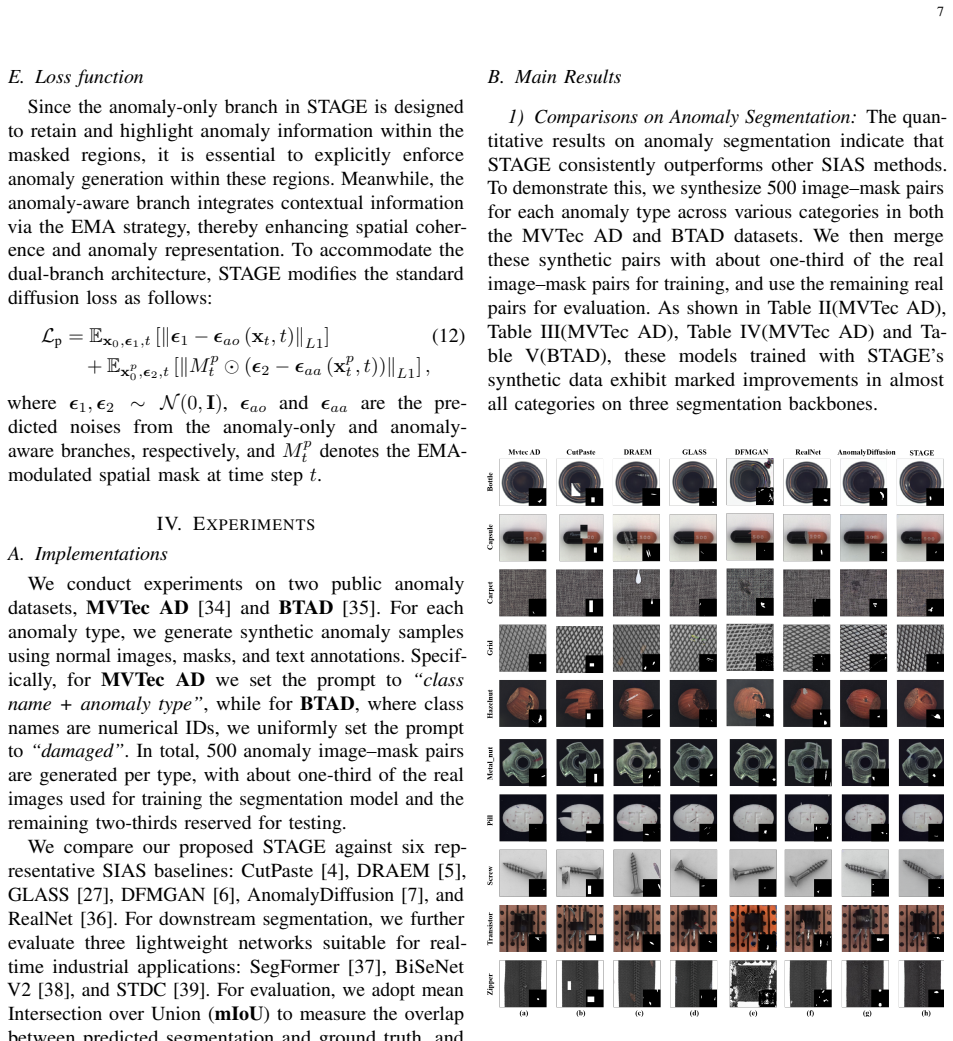
- Anomaly segmentation models trained on STAGE's synthetic pairs reach an average mIoU of 75.45% on MVTec AD with SegFormer, 7.74 points above the best baseline, with consistent gains across three real-time backbones.
- Small, low-contrast defects benefit most: capsule segmentation mIoU rises by 8.57–13.04 points depending on backbone, arguing that the graded branch directly addresses the small-defect failure mode.
- STAGE yields detector-independent improvement: AUROC, PRO, AP, and F1 computed from segmentation logits also improve, indicating that synthesis quality itself is better, not a downstream artifact.
- The EMA near-optimality result implies the mask schedule can be made progressively sharper with no asymptotic loss as diffusion steps increase, giving a theoretical guarantee for smooth anomaly–background transitions.
- Because STAGE is mask-driven, it gives operators direct control over where defects appear, so synthetic training sets can be built to cover rare defect geometries.
Reading between the lines
- If the independence assumption in Eq. 6 fails in a given latent space, the clean split into anomaly and background Gaussians is what breaks; a direct test is to measure cross-mask correlation of predicted noise in the frozen latent, and STAGE's gains should degrade on classes where the latent couples distant regions.
- The paper's own reported weak spot—screw and grid classes, where small objects make masks land on background—suggests a natural extension: adapt the EMA schedule per mask, for example using edge density or object-aware masks, rather than a global linear schedule.
- Given that 500 synthetic pairs per anomaly type plus one-third of real images suffice for strong segmentation, STAGE-type synthesis may also reduce annotation cost in other dense prediction tasks where masks exist but labeled images are scarce.
- Because the method builds on a frozen latent diffusion backbone, it could be repurposed for other mask-conditional generation tasks, such as defect editing or part-level texture synthesis, without retraining the base model.
Editorial analysis
A structured set of objections, weighed in public.
Referee Report
Summary. The paper proposes STAGE, a latent-diffusion-based synthesis method that generates anomaly image-mask pairs for training pixel-level anomaly segmentation. Three components are introduced: Anomaly Inference (background-conditioned denoising with mask-wise Gaussian mixture), Graded Diffusion (a dual-branch anomaly-only/anomaly-aware sampling schedule), and Explicit Mask Alignment (a time-dependent soft mask that interpolates from an all-one mask to the ground-truth mask). A Mask Guidance Adapter is also added. Extensive experiments on MVTec AD and BTAD combine 500 synthetic pairs per class with a subset of real images to train SegFormer, BiSeNet V2, and STDC, reporting average mIoU gains up to +7.74 over DFMGAN, as well as AUROC/PRO/F1/AP comparisons and component ablations. A theoretical claim (Theorem 1) asserts O(1/T^2) near-optimality of EMA.
Significance. If the empirical protocol is clean, this is a practically valuable result: a mask-guided diffusion synthesizer that substantially improves downstream segmentation, especially for small defects. The comparison is broad (six baselines, three backbones, two datasets) and includes per-category tables and ablations, and code availability is promised. However, the central claim currently rests on an under-specified training-data protocol, and the accompanying optimality proof is not valid as written. The contribution is therefore promising but not yet fully established.
major comments (3)
- [§IV-A, Tables II–V] The central empirical claim rests on an under-specified protocol. The text states only that synthetic samples are generated using normal images, masks, and text annotations, and that about one-third of the real images are used for training and two-thirds for testing. It never states where the masks come from. Because MVTec AD provides ground-truth masks only for test anomalies, the reported gains would be invalidated if the synthesis masks coincide with test masks. The ablations in Fig. 6 use the same setup and cannot rule this out. Please specify the exact mask source, the split of real images, and, if any test-derived masks are used, rerun all tables with masks disjoint from test labels.
- [§III-C, Theorem 1, Eq. (11)] The proof of Theorem 1 asserts the key bound epsilon_i(t)=|w*_i(t)-M^p_{t,i}|<=C/T. This does not follow from the preceding Lipschitz-continuity argument: a Lipschitz function w*(t) can remain far from the fixed linear schedule M^p_t even when both change by O(1/T) per step. The bound is essentially the statement to be proved. In addition, g(x,y)=-y/(x-y) is not smooth when delta_p,i(t)=delta_b,i(t), a case not excluded. The O(1/T^2) claim is therefore unsupported; EMA should either be given a valid proof under explicit assumptions or be presented as a heuristic.
- [§III-A, Eqs. (4)–(6)] The derivation of the reverse distribution is flawed as written. The first line of Eq. (4) uses unmasked sums of xp_hat and xback, whereas Eq. (3) and the second line require M0⊙xp_hat+(1-M0)⊙xback. The first line is not a consequence of Eq. (2). Moreover, Eq. (6) assumes pixelwise independence of the noise in disjoint mask regions along the entire trajectory of a frozen Stable Diffusion latent space. This is a strong spatial-independence assumption that should be validated; if it fails, background leakage or mask misalignment can undermine synthesis quality.
minor comments (5)
- [Fig. 5] The caption uses PMA and PD without defining them; these are likely EMA and a binary-mask fusion variant. Please define all abbreviations.
- [Algorithm 1, Eq. (8)] The notation M^p_{t-1} ← EMA(M^p_t,t) is not defined; Eq. (8) defines M^p_t directly as a function of t and M0. Please clarify the recursive update or remove the arrow notation.
- [Eq. (7)] The symbol xp_hat_{t-1} is used on both sides with different meanings (branch output vs updated latent). Use distinct symbols for clarity.
- [Table VI, Fig. 2] Table VI says Extended MVTec AD but no extension is described. Figure 2 also contains typos 'Anomoly-only' and 'Anomoly-aware'.
- [References [31]–[33]] The cited papers concern convergence of score-based and consistency models and do not directly support the claim that per-pixel prediction errors are Lipschitz in t. Either cite more specific evidence or state this explicitly as an assumption.
Circularity Check
EMA near-optimality proof assumes the small-deviation bound it needs to establish; main SOTA claim is empirical and not circular, though the mask-source protocol in §IV-A needs clarification.
-
other
[Section III-C, Theorem 1 and proof (Eq. (11), pages 5-6)]
"Concretely, if the deviation of the linear EMA schedule from the optimal weight satisfies ϵi(t) = |w∗_i(t)−M^p_{t,i}| ≤ C/T ... Meanwhile, the linear EMA schedule ζ(t) decreases by at most 1/(T−t_s) ≤ 1/T per timestep, so the deviation ϵi(t) = |w∗_i(t)−M^p_{t,i}| ≤ L′/T ≡ C/T."
The theorem's conclusion is that EMA is near-optimal (excess error O(1/T^2)). That conclusion follows only from the assumed bound on the deviation ϵ_i(t) between the EMA weight and the optimal weight. The proof's Step 2 claims to derive this deviation bound from Lipschitzness of w* and the small per-step decrement of the linear schedule, but two Lipschitz functions can be separated by an O(1) offset at every t; Lipschitzness plus a 1/T per-step change does not imply |w*(t)-M^p_t| ≤ O(1/T). Thus the proof re-asserts the theorem's near-optimality hypothesis rather than deriving it. The claimed O(1/T^2) excess error is, by Eq. (11), just a restatement of that assumed deviation.
full rationale
The central empirical claim (STAGE raises segmentation mIoU over DFMGAN etc. on MVTec/BTAD) is benchmark-based, compares against independent baselines, and is not circular; nothing in the tables reduces to a fitted parameter renamed as a prediction. No load-bearing self-citation or imported uniqueness theorem is present. The one genuine circularity is the supporting Theorem 1: its proof of EMA near-optimality assumes the deviation bound ϵ_i(t) ≤ C/T that is equivalent to the near-optimality it claims to prove, and the attempted derivation from Lipschitz continuity is invalid. This is a moderate flaw in a peripheral theoretical justification, not in the main empirical derivation. Separately, §IV-A does not state whether the masks used to synthesize 500 pairs per type come from training or test splits; if test ground-truth masks are used for training synthesis, the SOTA numbers would be contaminated, but this is a data-protocol risk that cannot be scored as circularity without a shown reduction.
Assumptions & free parameters
free parameters (4)
- EMA threshold ts =
200
- Graded diffusion activation intervals =
[1000,800] and [400,300]
- Number of synthetic pairs per anomaly type =
500
- Prompt token count =
8
assumptions (4)
- domain assumption Statistical independence of noise across disjoint mask regions
- ad hoc to paper Per-pixel prediction errors delta_p,i(t) and delta_b,i(t) are L-Lipschitz-continuous in t
- domain assumption Ground-truth anomaly masks are available for the normal images used in synthesis
- domain assumption Frozen Stable Diffusion latent space is locally faithful to spatial image regions
Cite this review
Pith. "Pith review of STAGE: Segmentation-oriented Industrial Anomaly Synthesis via Graded Diffusion with Explicit Mask Alignment." pith.science (2026). https://pith.science/paper/4HWCPAMW
@misc{pith2026250906693,
  author       = {Pith},
  title        = {Pith review of: STAGE: Segmentation-oriented Industrial Anomaly Synthesis via Graded Diffusion with Explicit Mask Alignment},
  year         = {2026},
  howpublished = {\url{https://pith.science/paper/4HWCPAMW}},
  note         = {Machine review of arXiv:2509.06693}
}
read the original abstract
Segmentation-oriented Industrial Anomaly Synthesis (SIAS) plays a pivotal role in enhancing the performance of downstream anomaly segmentation, as it provides an effective means of expanding abnormal data. However, existing SIAS methods face several critical limitations: (i) the synthesized anomalies often lack intricate texture details and fail to align precisely with the surrounding background, and (ii) they struggle to generate fine-grained, pixel-level anomalies. To address these challenges, we propose Segmentation-oriented Anomaly synthesis via Graded diffusion with Explicit mask alignment, termed STAGE. STAGE introduces a novel anomaly inference strategy that incorporates clean background information as a prior to guide the denoising distribution, enabling the model to more effectively distinguish and highlight abnormal foregrounds. Furthermore, it employs a graded diffusion framework with an anomaly-only branch to explicitly record local anomalies during both the forward and reverse processes, ensuring that subtle anomalies are not overlooked. Finally, STAGE incorporates the explicit mask alignment (EMA) strategy to progressively align the synthesized anomalies with the background, resulting in context-consistent and structurally coherent generations. Extensive experiments on the MVTec and BTAD datasets demonstrate that STAGE achieves state-of-the-art performance in SIAS, which in turn enhances downstream anomaly segmentation.
Figures


Figures from the paper (3 more)


Reference graph
Works this paper leans on
-
[1]
Supervised anomaly detection for complex industrial images,
A. Baitieva, D. Hurych, V . Besnier, and O. Bernard, “Supervised anomaly detection for complex industrial images,” inProceedings of the IEEE/CVF Conference on Computer Vision and Pattern Recognition (CVPR), June 2024, pp. 17 754–17 762
work page 2024
-
[2]
Shape-guided dual-memory learning for 3D anomaly detection,
Y .-M. Chu, C. Liu, T.-I. Hsieh, H.-T. Chen, and T.-L. Liu, “Shape-guided dual-memory learning for 3D anomaly detection,” inProceedings of the 40th International Conference on Machine Learning, ser. Proceedings of Machine Learning Research, A. Krause, E. Brunskill, K. Cho, B. Engelhardt, S. Sabato, and J. Scarlett, Eds., vol. 202. PMLR, 23– 29 Jul 2023, p...
work page 2023
-
[3]
Latent outlier exposure for anomaly detection with contaminated data,
C. Qiu, A. Li, M. Kloft, M. Rudolph, and S. Mandt, “Latent outlier exposure for anomaly detection with contaminated data,” inInternational conference on machine learning. PMLR, 2022, pp. 18 153–18 167
work page 2022
-
[4]
Cutpaste: Self- supervised learning for anomaly detection and localization,
C.-L. Li, K. Sohn, J. Yoon, and T. Pfister, “Cutpaste: Self- supervised learning for anomaly detection and localization,” in Proceedings of the IEEE/CVF conference on computer vision and pattern recognition, 2021, pp. 9664–9674
work page 2021
-
[5]
Draem-a discrimi- natively trained reconstruction embedding for surface anomaly detection,
V . Zavrtanik, M. Kristan, and D. Sko ˇcaj, “Draem-a discrimi- natively trained reconstruction embedding for surface anomaly detection,” inProceedings of the IEEE/CVF international confer- ence on computer vision, 2021, pp. 8330–8339
work page 2021
-
[6]
Few-shot defect image generation via defect-aware feature manipulation,
Y . Duan, Y . Hong, L. Niu, and L. Zhang, “Few-shot defect image generation via defect-aware feature manipulation,” inProceedings of the AAAI Conference on Artificial Intelligence, vol. 37, no. 1, 2023, pp. 571–578
work page 2023
-
[7]
Anomalydiffusion: Few-shot anomaly image generation with diffusion model,
T. Hu, J. Zhang, R. Yi, Y . Du, X. Chen, L. Liu, Y . Wang, and C. Wang, “Anomalydiffusion: Few-shot anomaly image generation with diffusion model,” inProceedings of the AAAI Conference on Artificial Intelligence, vol. 38, no. 8, 2024, pp. 8526–8534
work page 2024
-
[8]
Defect image sample generation with gan for improving defect recognition,
S. Niu, B. Li, X. Wang, and H. Lin, “Defect image sample generation with gan for improving defect recognition,”IEEE Transactions on Automation Science and Engineering, vol. 17, no. 3, pp. 1611–1622, 2020
work page 2020
Show all 39 references
-
[9]
Multistage gan for fabric defect detection,
J. Liu, C. Wang, H. Su, B. Du, and D. Tao, “Multistage gan for fabric defect detection,”IEEE Transactions on Image Processing, vol. 29, pp. 3388–3400, 2019
2019
-
[10]
Repaint: Inpainting using denoising diffusion probabilistic models,
A. Lugmayr, M. Danelljan, A. Romero, F. Yu, R. Timofte, and L. Van Gool, “Repaint: Inpainting using denoising diffusion probabilistic models,” inProceedings of the IEEE/CVF conference on computer vision and pattern recognition, 2022, pp. 11 461– 11 471
2022
-
[11]
Dualanodiff: Dual-interrelated diffusion model for few-shot anomaly image generation,
Y . Jin, J. Peng, Q. He, T. Hu, H. Chen, J. Wu, W. Zhu, M. Chi, J. Liu, Y . Wanget al., “Dualanodiff: Dual-interrelated diffusion model for few-shot anomaly image generation,”arXiv preprint arXiv:2408.13509
-
[12]
Defect spectrum: a granular look of large-scale defect datasets with rich semantics,
S. Yang, Z. Chen, P. Chen, X. Fang, Y . Liang, S. Liu, and Y . Chen, “Defect spectrum: a granular look of large-scale defect datasets with rich semantics,” inEuropean Conference on Computer Vision. Springer, 2025, pp. 187–203
2025
-
[13]
Reb: Reducing biases in representation for industrial anomaly detection,
S. Lyu, D. Mo, and W. keung Wong, “Reb: Reducing biases in representation for industrial anomaly detection,”Knowledge-Based Systems, vol. 290, p. 111563, 2024
2024
-
[14]
Destseg: Segmentation guided denoising student-teacher for anomaly detection,
X. Zhang, S. Li, X. Li, P. Huang, J. Shan, and T. Chen, “Destseg: Segmentation guided denoising student-teacher for anomaly detection,” inProceedings of the IEEE/CVF Conference on Computer Vision and Pattern Recognition, 2023, pp. 3914– 3923
2023
-
[15]
Defect-gan: High- fidelity defect synthesis for automated defect inspection,
G. Zhang, K. Cui, T.-Y . Hung, and S. Lu, “Defect-gan: High- fidelity defect synthesis for automated defect inspection,” in Proceedings of the IEEE/CVF Winter Conference on Applications of Computer Vision, 2021, pp. 2524–2534
2021
-
[16]
A new contrastive gan with data augmentation for surface defect recognition under limited data,
Z. Du, L. Gao, and X. Li, “A new contrastive gan with data augmentation for surface defect recognition under limited data,” IEEE Transactions on Instrumentation and Measurement, vol. 72, pp. 1–13, 2022
2022
-
[17]
Seas: Few-shot industrial anomaly image generation with separation and sharing fine-tuning,
Z. Dai, S. Zeng, H. Liu, X. Li, F. Xue, and Y . Zhou, “Seas: Few-shot industrial anomaly image generation with separation and sharing fine-tuning,”arXiv preprint arXiv:2410.14987, 2024
2024 arXiv
-
[18]
Cut: A controllable, universal, and training-free visual anomaly generation framework,
H. Sun, Y . Cao, and O. Fink, “Cut: A controllable, universal, and training-free visual anomaly generation framework,”arXiv preprint arXiv:2406.01078, 2024
2024 arXiv
-
[19]
Few-shot defect image generation based on consistency modeling,
Q. Shi, J. Wei, F. Shen, and Z. Zhang, “Few-shot defect image generation based on consistency modeling,” inEuropean Conference on Computer Vision. Springer, 2025, pp. 360–376
2025
-
[20]
Dictas: A framework for class-generalizable few-shot anomaly segmentation via dictionary lookup,
Z. Qu, X. Tao, X. Gong, S. Qu, X. Zhang, X. Wang, F. Shen, Z. Zhang, M. Prasad, and G. Ding, “Dictas: A framework for class-generalizable few-shot anomaly segmentation via dictionary lookup,”arXiv preprint arXiv:2508.13560, 2025
2025 arXiv
-
[21]
Fascinating supervisory signals and where to find them: Deep anomaly 13 detection with scale learning,
H. Xu, Y . Wang, J. Wei, S. Jian, Y . Li, and N. Liu, “Fascinating supervisory signals and where to find them: Deep anomaly 13 detection with scale learning,” inInternational Conference on Machine Learning. PMLR, 2023, pp. 38 655–38 673
2023
-
[22]
Reconstruction by inpainting for visual anomaly detection,
V . Zavrtanik, M. Kristan, and D. Sko ˇcaj, “Reconstruction by inpainting for visual anomaly detection,”Pattern Recognition, vol. 112, p. 107706, 2021
2021
-
[23]
Rethinking reconstruction autoencoder-based out-of- distribution detection,
Y . Zhou, “Rethinking reconstruction autoencoder-based out-of- distribution detection,” inProceedings of the IEEE/CVF Con- ference on Computer Vision and Pattern Recognition, 2022, pp. 7379–7387
2022
-
[24]
Dual-modeling decouple distillation for unsupervised anomaly detection,
X. Liu, J. Wang, B. Leng, and S. Zhang, “Dual-modeling decouple distillation for unsupervised anomaly detection,” inProceedings of the 32nd ACM International Conference on Multimedia, 2024, pp. 5035–5044
2024
-
[25]
Slsg: Industrial image anomaly detection with improved feature embeddings and one- class classification,
M. Yang, J. Liu, Z. Yang, and Z. Wu, “Slsg: Industrial image anomaly detection with improved feature embeddings and one- class classification,”Pattern Recognition, vol. 156, p. 110862, 2024
2024
-
[26]
Progressive boundary guided anomaly synthesis for industrial anomaly de- tection,
Q. Chen, H. Luo, H. Gao, C. Lv, and Z. Zhang, “Progressive boundary guided anomaly synthesis for industrial anomaly de- tection,”IEEE Transactions on Circuits and Systems for Video Technology, 2024
2024
-
[27]
A unified anomaly synthesis strategy with gradient ascent for industrial anomaly detection and localization,
Q. Chen, H. Luo, C. Lv, and Z. Zhang, “A unified anomaly synthesis strategy with gradient ascent for industrial anomaly detection and localization,” inEuropean Conference on Computer Vision. Springer, 2025, pp. 37–54
2025
-
[28]
Synth4seg–learning defect data synthesis for defect segmentation using bi-level optimization,
S. Mou, R. Vemulapalli, S. Li, Y . Liu, C. Thomas, M. Cao, H. Bai, O. Tuzel, P. Huang, J. Shanet al., “Synth4seg–learning defect data synthesis for defect segmentation using bi-level optimization,” arXiv preprint arXiv:2410.18490, 2024
2024 arXiv
-
[29]
High-resolution image synthesis with latent diffusion models,
R. Rombach, A. Blattmann, D. Lorenz, P. Esser, and B. Ommer, “High-resolution image synthesis with latent diffusion models,” in Proceedings of the IEEE/CVF conference on computer vision and pattern recognition, 2022, pp. 10 684–10 695
2022
-
[30]
Score-based generative modeling through stochastic differential equations,
Y . Song, J. Sohl-Dickstein, D. P. Kingma, A. Kumar, S. Ermon, and B. Poole, “Score-based generative modeling through stochastic differential equations,” inInternational Conference on Learning Representations, 2021. [Online]. Available: https://openreview.net/forum?id=PxTIG12RRHS
2021
-
[31]
Convergence of score-based gener- ative modeling for general data distributions,
H. Lee, J. Lu, and Y . Tan, “Convergence of score-based gener- ative modeling for general data distributions,” inInternational Conference on Algorithmic Learning Theory. PMLR, 2023, pp. 946–985
2023
-
[32]
Theory of consistency diffusion models: Distribution estimation meets fast sampling,
Z. Dou, M. Chen, M. Wang, and Z. Yang, “Theory of consistency diffusion models: Distribution estimation meets fast sampling,” in Forty-first International Conference on Machine Learning, 2024
2024
-
[33]
Sampling is as easy as keeping the consistency: convergence guarantee for consistency models,
J. Lyu, Z. Chen, and S. Feng, “Sampling is as easy as keeping the consistency: convergence guarantee for consistency models,” in Forty-first International Conference on Machine Learning, 2024
2024
-
[34]
Mvtec ad– a comprehensive real-world dataset for unsupervised anomaly detection,
P. Bergmann, M. Fauser, D. Sattlegger, and C. Steger, “Mvtec ad– a comprehensive real-world dataset for unsupervised anomaly detection,” inProceedings of the IEEE/CVF conference on computer vision and pattern recognition, 2019, pp. 9592–9600
2019
-
[35]
VT-ADL: A vision transformer network for image anomaly detection and localization,
P. Mishra, R. Verk, D. Fornasier, C. Piciarelli, and G. L. Foresti, “VT-ADL: A vision transformer network for image anomaly detection and localization,” in30th IEEE/IES International Symposium on Industrial Electronics (ISIE), June 2021
2021
-
[36]
Realnet: A feature selection network with realistic synthetic anomaly for anomaly detection,
X. Zhang, M. Xu, and X. Zhou, “Realnet: A feature selection network with realistic synthetic anomaly for anomaly detection,” inProceedings of the IEEE/CVF Conference on Computer Vision and Pattern Recognition, 2024, pp. 16 699–16 708
2024
-
[37]
Segformer: Simple and efficient design for semantic segmentation with transformers,
E. Xie, W. Wang, Z. Yu, A. Anandkumar, J. M. Alvarez, and P. Luo, “Segformer: Simple and efficient design for semantic segmentation with transformers,”Advances in neural information processing systems, vol. 34, pp. 12 077–12 090, 2021
2021
-
[38]
Bisenet v2: Bilateral network with guided aggregation for real-time semantic segmentation,
C. Yu, C. Gao, J. Wang, G. Yu, C. Shen, and N. Sang, “Bisenet v2: Bilateral network with guided aggregation for real-time semantic segmentation,”International journal of computer vision, vol. 129, pp. 3051–3068, 2021
2021
-
[39]
Rethinking bisenet for real-time semantic segmentation,
M. Fan, S. Lai, J. Huang, X. Wei, Z. Chai, J. Luo, and X. Wei, “Rethinking bisenet for real-time semantic segmentation,” in Proceedings of the IEEE/CVF conference on computer vision and pattern recognition, 2021, pp. 9716–9725
2021
Reviewed August 4, 2026 · model on record in the stance chip above.
Discussion (0). Sign in to comment.