REVIEW 4 major objections 6 minor 54 references
Person Re-identification in Aerial Imagery
T0 review · 4 major / 6 minor · reviewed 2026-08-14 · deepseek-v4-flash
Pith's one-line read This paper introduces PRAI-1581, a 39,461-image drone-view person re-identification benchmark, and claims that a subspace pooling layer built from the top singular vectors of CNN feature maps improves matching accuracy and beats several…
desk verdict The PRAI-1581 dataset is a genuine contribution, but the paper's central SOTA claim is contradicted by its own Table II, so it needs revision before acceptance. read the letter →
The pith
A machine-rendered reading of the paper's core claim, the machinery that carries it, and where it could break.
The reading
What carries the argument
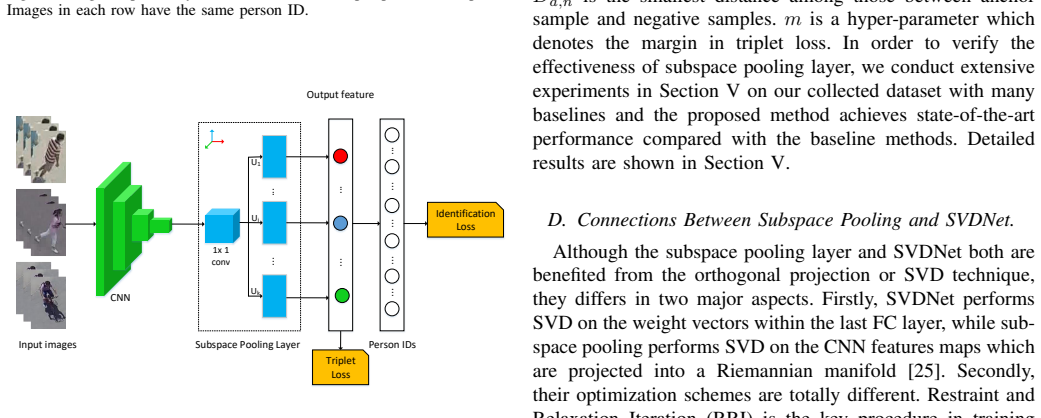
The load-bearing object is the subspace pooling layer, defined as the map from convolutional feature maps $A \in \mathbb{R}^{c \times hw}$ to the $k$ leading left singular vectors of $A$, i.e. $f(A) = [u_1,\ldots,u_k]$ from the SVD $A = U\Sigma V^T$. Geometrically, $f(A)$ is a point on the Grassmann manifold of $k$-dimensional subspaces, so the descriptor represents the dominant subspace of the local feature vectors rather than individual correlated channels. The layer is placed after a $1\times1$ convolution that reduces the channel dimension, followed by an identification classifier and a batch-hard triplet loss; because $U_k$ depends differentiably on $A$, the entire pipeline trains end-to-end by back-propagation. This is the mechanism that is supposed to remove feature redundancy that a fully connected layer would leave in place, and it is the component whose addition to a backbone produces the reported gains. The dataset PRAI-1581 is the second load-bearing component: its 1,581 identities were obtained by manually searching and grouping the same person across two non-overlapping drone videos, and every evaluation in the paper inherits the correctness of that grouping.
What would settle it
Re-annotate a random sample of PRAI-1581's identity groups with independent annotators and compute the cross-view mismatch rate; if even a few percent of the 1,581 identities are paired incorrectly across the two drone videos, the reported accuracy gaps (1–6 points) fall inside the label-noise band, and the benchmark's rankings would need to be re-derived from corrected labels.
Extended reading notes
Core claim
On its own terms, the paper's central discovery is that the matrix of final convolutional feature maps contains enough identity information that projecting it onto its dominant left singular vectors—instead of flattening it through a fully connected layer—yields a more orthogonal, less redundant descriptor for person matching. Concretely, with feature maps $A \in \mathbb{R}^{c \times hw}$, the layer computes $A = U\Sigma V^T$ and outputs $f(A) = U_k = [u_1, \dots, u_k]$, the $k$ left singular vectors for the largest singular values. Because this operation is differentiable, the whole network—backbone, $1\times1$ dimension reduction, subspace pooling, and classifier—can be trained jointly with softmax cross-entropy and batch-hard triplet losses. The paper reports that on PRAI-1581 this subspace-pooling descriptor lifts mAP from 31.47% to 37.88% with the identification loss and from 36.49% to 39.58% with the triplet loss, and rank-1 accuracy from 42.46% to 48.33% and 47.47% to 49.79% respectively; it claims this outperforms SVDNet, AlignedReID, and PCB+RPP. The same layer also improves the baseline on Market-1501, DukeMTMC, and CUHK03, which the paper reads as evidence that the mechanism is not specific to aerial views.
Load-bearing premise
The load-bearing premise is that the 1,581 person identities in PRAI-1581 were grouped correctly across the two non-overlapping drone videos by manual searching and grouping; if a substantial fraction of those cross-view pairings are wrong, every reported accuracy number on the dataset is unreliable, including the baselines and the proposed method.
Editorial extensions
If this is right
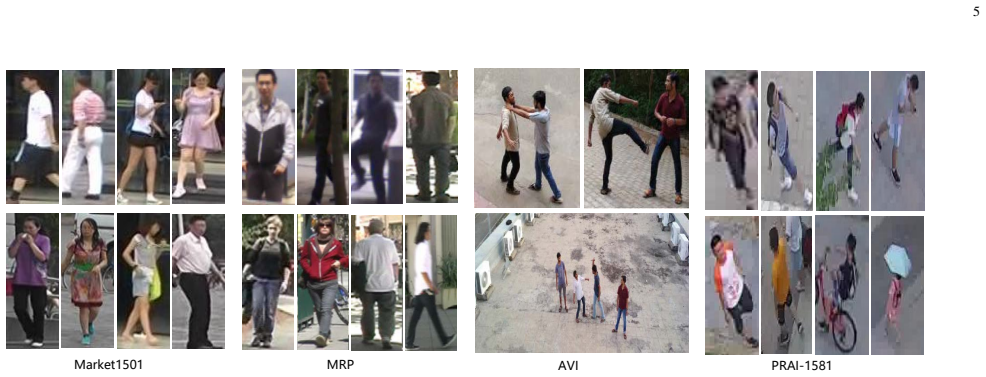
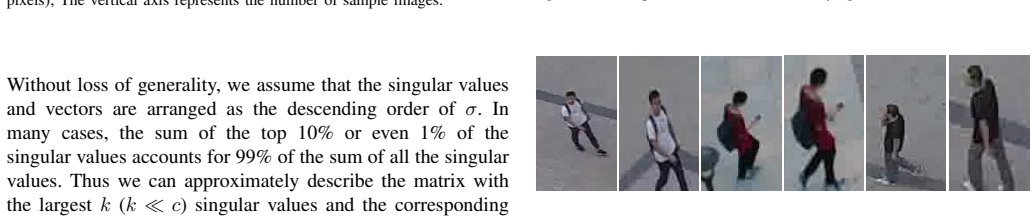
- PRAI-1581 provides a fixed train/test split for aerial person re-identification, so subsequent methods can report directly comparable mAP and rank-1 numbers in a setting where people appear small, occluded, and viewed from above.
- Subspace pooling can be added to any CNN backbone without part alignment, which matters because part-based models assume an upright person and degrade under the steep viewing angles common in drone footage.
- The reported gains on Market-1501, DukeMTMC, and CUHK03 indicate that the decorrelation effect is not limited to aerial images, making the layer a candidate plug-in for fixed-camera ReID pipelines as well.
- Because the descriptor is a $k$-dimensional orthogonal matrix rather than a long fully connected vector, it is compact and cheap to compare, which suits on-drone or large-gallery retrieval.
Reading between the lines
- The layer targets channel redundancy in global feature maps, so it should compose with part-based or multi-scale methods rather than replace them; adding it to a model like PCB or OSNET could yield further gains because the two mechanisms attack different failure modes.
- The same top-$k$ singular-vector projection is a natural fit for vehicle re-identification or drone-view object retrieval, where moving cameras and low resolution create the same viewpoint and scale variation.
- If the manual identity grouping in PRAI-1581 were re-validated by independent annotators, the benchmark could report a label-noise bound, telling later methods how large an accuracy gap is meaningful.
Signed reviews
Editorial analysis
A structured set of objections, weighed in public.
Referee Report
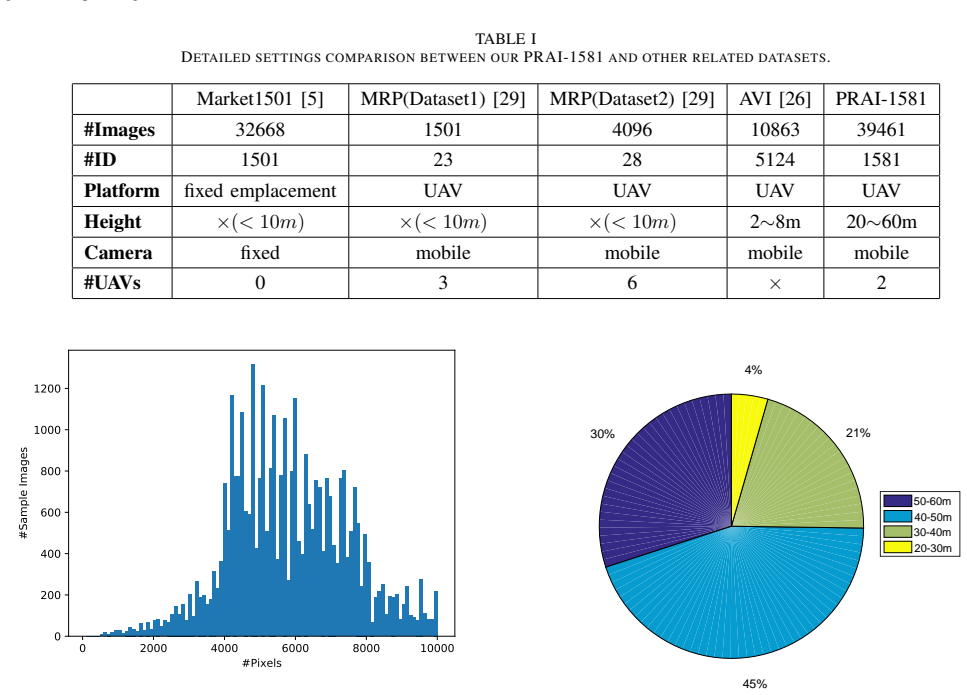
Summary. The paper introduces PRAI-1581, a person re-identification dataset captured by two consumer UAVs at altitudes of 20--60 m, containing 39,461 images of 1,581 identities. It also proposes applying a subspace pooling layer, previously developed by the authors, on top of a ResNet-50 backbone trained with identification and batch-hard triplet losses. The authors report experiments on PRAI-1581 and on Market-1501, DukeMTMC, and CUHK03, and claim in Section V-D that their SP+TL method achieves state-of-the-art performance on PRAI-1581.
Significance. If the dataset is correctly annotated, PRAI-1581 is a useful contribution: it is substantially larger than previous UAV-based person ReID datasets, is publicly released, and covers realistic altitude, resolution, occlusion, and viewpoint variability. The paper also provides a fairly broad comparison of 16 baseline and recent methods on the new benchmark, which will help the community. The method itself is not novel in its components, since subspace pooling is taken from the authors' prior work, and the reported state-of-the-art claim is contradicted by the paper's own Table II. Thus the significance rests mainly on the dataset and the benchmark numbers, not on the proposed algorithm as presented.
major comments (4)
- [Section V-D, Tables II and III] The central claim that SP+TL 'achieves state-of-the-art performance on our dataset' is contradicted by the paper's own results. Under the single-query protocol, Table II reports OSNET with 42.10 mAP / 54.40 rank-1 and MGN with 40.86 mAP / 49.64 rank-1, while Table III reports SP+TL with 39.58 mAP / 49.79 rank-1. DSR also attains a higher rank-1 (51.09). The sentence in Section V-D names only SVDNet, AlignedReID, and PCB+RPP as comparators, but the full table shows that two stronger methods are present. The stated conclusion does not follow from the reported numbers, so the paper's main technical claim must be corrected or removed.
- [Section V-E, Tables III and IV] The evaluation numbers are internally inconsistent for what appears to be the same setting. Table III reports TL+SP with multi-query mAP 44.75 and rank-1 56.49, while Table IV's 5:5 partition row reports multi-query mAP 45.23 and rank-1 54.74. In addition, the ID baseline has rank-1 42.62 in Table II but 42.46 in Table III under single-query. These discrepancies make the experimental results difficult to reproduce and need to be reconciled.
- [Section III-B] The cross-camera identity assignment is described as grouping the same person across two drone videos 'by manually searching and grouping,' with no inter-annotator agreement, no validation sample, and no quality-control procedure. Since every mAP and rank-1 number on PRAI-1581, including all baselines and the proposed method, depends on the correctness of these 1,581 identity labels, the authors should provide evidence of annotation reliability. Without such evidence, the benchmark numbers are built on an unverified ground-truth premise.
- [Section V-A and Table VI] All conclusions are based on a single fixed train/test split, and no variance or significance estimates are reported. Several claimed improvements are very small, for example +0.03 rank-1 on Market-1501 in Table VI. Because the gains are close to the likely run-to-run variation of deep ReID models, the authors should either report results over multiple splits or provide error bars; otherwise the effectiveness of the subspace pooling layer is not statistically established.
minor comments (6)
- [Section III-C] The phrase 'duo to' should be 'due to'.
- [Reference [5]] The Market-1501 reference is given as the arXiv survey 'Person re-identification: past, present and future'; please cite the original dataset paper by Zheng et al.
- [Equation (2)] The output f(A)=Uk is described as a matrix of left singular vectors; please clarify how this matrix is converted into the final feature vector used by the classification and triplet losses.
- [Figure 9] Figure 9 is first mentioned only in Section IV; add an explicit reference to it in the text describing the framework.
- [Tables I and III] The acronym 'A VI' is written inconsistently in the text and tables; please use a single consistent form, e.g., AVI.
- [Table IV] The caption of Table IV does not state which method is being evaluated; clarify that the rows correspond to the proposed TL+SP method so the reader can compare with Table III.
Circularity Check
No significant circularity; the method is an external citation, and the main claims rest on independent benchmarks rather than on fitted inputs or self-derived equations.
full rationale
The paper's central contribution is the PRAI-1581 dataset and the application of subspace pooling to aerial ReID. The subspace pooling layer (Eqs. 1–2) is explicitly attributed to the authors' prior work [23], [24], so it is a cited component rather than a newly derived result. The method's effectiveness is evaluated on three external benchmarks (Market-1501, DukeMTMC, CUHK03) in Table VI, and no parameter is fitted to the target test results; the gains over baselines are empirical measurements, not definitions. The paper's claim in Section V-D that SP+TL achieves state-of-the-art is internally contradicted by Table II, where OSNET (42.10 mAP) and MGN (40.86 mAP) outperform SP+TL (39.58 mAP), but this is a factual inconsistency about comparative performance, not a circularity in the derivation. There are self-citations, but they do not carry the argument in a way that makes the prediction equivalent to its inputs. Thus, no circular step is present.
Assumptions & free parameters
free parameters (2)
- 1x1 conv output dimension (also subspace dimension k) =
512
- triplet loss margin m =
not reported
assumptions (3)
- domain assumption Low-rank approximation of CNN feature maps retains discriminative identity information.
- domain assumption Manual cross-camera identity grouping in PRAI-1581 is correct.
- domain assumption A single random 1:1 train/test split of PRAI-1581 is a representative evaluation.
Cite this review
Pith. "Pith review of Person Re-identification in Aerial Imagery." pith.science (2026). https://pith.science/paper/4IKMCVJY
@misc{pith2026190805024,
  author       = {Pith},
  title        = {Pith review of: Person Re-identification in Aerial Imagery},
  year         = {2026},
  howpublished = {\url{https://pith.science/paper/4IKMCVJY}},
  note         = {Machine review of arXiv:1908.05024}
}
read the original abstract
Nowadays, with the rapid development of consumer Unmanned Aerial Vehicles (UAVs), visual surveillance by utilizing the UAV platform has been very attractive. Most of the research works for UAV captured visual data are mainly focused on the tasks of object detection and tracking. However, limited attention has been paid to the task of person Re-identification (ReID) which has been widely studied in ordinary surveillance cameras with fixed emplacements. In this paper, to facilitate the research of person ReID in aerial imagery, we collect a large scale airborne person ReID dataset named as Person ReID for Aerial Imagery (PRAI-1581), which consists of 39,461 images of 1581 person identities. The images of the dataset are shot by two DJI consumer UAVs flying at an altitude ranging from 20 to 60 meters above the ground, which covers most of the real UAV surveillance scenarios. In addition, we propose to utilize subspace pooling of convolution feature maps to represent the input person images. Our method can learn a discriminative and compact feature representation for ReID in aerial imagery and can be trained in an end-to-end fashion efficiently. We conduct extensive experiments on the proposed dataset and the experimental results demonstrate that re-identify persons in aerial imagery is a challenging problem, where our method performs favorably against state of the arts. Our dataset can be accessed via \url{https://github.com/stormyoung/PRAI-1581}.
Figures

Figures from the paper (7 more)



Reference graph
Works this paper leans on
-
[1]
Deepreid: Deep filter pairing neural network for person re-identification,
W. Li, R. Zhao, T. Xiao, and X. Wang, “Deepreid: Deep filter pairing neural network for person re-identification,” in Proceedings of the IEEE Conference on Computer Vision and Pattern Recognition, 2014, pp. 152– 159
work page 2014
-
[2]
Zero-shot person re-identification via cross-view consistency,
Z. Wang, R. Hu, C. Liang, Y . Yu, J. Jiang, M. Ye, J. Chen, and Q. Leng, “Zero-shot person re-identification via cross-view consistency,” IEEE Transactions on Multimedia , vol. 18, no. 2, pp. 260–272, 2015
work page 2015
-
[3]
Person reidentification via ranking aggregation of similarity pulling and dissimilarity pushing,
M. Ye, C. Liang, Y . Yu, Z. Wang, Q. Leng, C. Xiao, J. Chen, and R. Hu, “Person reidentification via ranking aggregation of similarity pulling and dissimilarity pushing,” IEEE Transactions on Multimedia , vol. 18, no. 12, pp. 2553–2566, 2016
work page 2016
-
[4]
Learning deep feature representations with domain guided dropout for person re-identification,
T. Xiao, H. Li, W. Ouyang, and X. Wang, “Learning deep feature representations with domain guided dropout for person re-identification,” in Proceedings of the IEEE Conference on Computer Vision and Pattern Recognition, 2016, pp. 1249–1258
work page 2016
-
[5]
Person re-identification: Past, present and future,
L. Zheng, Y . Yang, and A. G. Hauptmann, “Person re-identification: Past, present and future,” arXiv preprint arXiv:1610.02984 , 2016
arXiv 2016
-
[6]
In defense of the triplet loss for person re-identification,
A. Hermans, L. Beyer, and B. Leibe, “In defense of the triplet loss for person re-identification,” arXiv preprint arXiv:1703.07737 , 2017
arXiv 2017
-
[7]
Large margin learning in set-to-set similarity comparison for person reidentification,
S. Zhou, J. Wang, R. Shi, Q. Hou, Y . Gong, and N. Zheng, “Large margin learning in set-to-set similarity comparison for person reidentification,” IEEE Transactions on Multimedia , vol. 20, no. 3, pp. 593–604, 2017
work page 2017
-
[8]
Pedestrian search in surveillance videos by learning discriminative deep features,
S. Zhang, D. Cheng, Y . Gong, D. Shi, X. Qiu, Y . Xia, and Y . Zhang, “Pedestrian search in surveillance videos by learning discriminative deep features,” Neurocomputing, vol. 283, pp. 120–128, 2018
work page 2018
Show all 54 references
-
[9]
Person re-identification by deep learning multi-scale representations,
Y . Chen, X. Zhu, S. Gong et al. , “Person re-identification by deep learning multi-scale representations,” 2018
2018
-
[10]
Incremental re-identification by cross-direction and cross-ranking adaption,
Z. Wang, J. Jiang, Y . Yu, and S. Satoh, “Incremental re-identification by cross-direction and cross-ranking adaption,” IEEE Transactions on Multimedia, 2019
2019
-
[11]
Feature affinity based pseudo labeling for semi-supervised person re- identification,
G. Ding, S. Zhang, S. Khan, Z. Tang, J. Zhang, and F. Porikli, “Feature affinity based pseudo labeling for semi-supervised person re- identification,” arXiv preprint arXiv:1805.06118 , 2018
2018 arXiv
-
[12]
Person re- identification with neural architecture search,
S. Zhang, R. Cao, X. Wei, P. Wang, and Y . Zhang, “Person re- identification with neural architecture search,” in Chinese Conference on Pattern Recognition and Computer Vision (PRCV) . Springer, 2019, pp. 540–551
2019
-
[13]
Infrared-visible cross-modal person re-identification with an x modality,
D. Li, X. Wei, X. Hong, and Y . Gong, “Infrared-visible cross-modal person re-identification with an x modality,” in The Thirty-Fourth AAAI Conference on Artificial Intelligence , 2020
2020
-
[14]
Dota: A large-scale dataset for object detection in aerial images,
G.-S. Xia, X. Bai, J. Ding, Z. Zhu, S. Belongie, J. Luo, M. Datcu, M. Pelillo, and L. Zhang, “Dota: A large-scale dataset for object detection in aerial images,” in Proc. CVPR, 2018
2018
-
[15]
Vision meets drones: a challenge,
P. Zhu, L. Wen, X. Bian, H. Ling, and Q. Hu, “Vision meets drones: a challenge,” arXiv preprint arXiv:1804.07437 , 2018
2018 arXiv
-
[16]
A benchmark and simulator for uav tracking,
M. Mueller, N. Smith, and B. Ghanem, “A benchmark and simulator for uav tracking,” in European conference on computer vision . Springer, 2016, pp. 445–461
2016
-
[17]
Learning rotation-invariant convolu- tional neural networks for object detection in vhr optical remote sensing images,
G. Cheng, P. Zhou, and J. Han, “Learning rotation-invariant convolu- tional neural networks for object detection in vhr optical remote sensing images,”IEEE Transactions on Geoscience and Remote Sensing, vol. 54, no. 12, pp. 7405–7415, 2016
2016
-
[18]
Scale-transferrable object detection,
P. Zhou, B. Ni, C. Geng, J. Hu, and Y . Xu, “Scale-transferrable object detection,” in Proceedings of the IEEE Conference on Computer Vision and Pattern Recognition, 2018, pp. 528–537
2018
-
[19]
W2f: A weakly- supervised to fully-supervised framework for object detection,
Y . Zhang, Y . Bai, M. Ding, Y . Li, and B. Ghanem, “W2f: A weakly- supervised to fully-supervised framework for object detection,” in Pro- ceedings of the IEEE Conference on Computer Vision and Pattern Recognition, 2018, pp. 928–936
2018
-
[20]
Learning rich features for image manipulation detection,
P. Zhou, X. Han, V . I. Morariu, and L. S. Davis, “Learning rich features for image manipulation detection,” in Proceedings of the IEEE Conference on Computer Vision and Pattern Recognition , 2018, pp. 1053–1061
2018
-
[21]
Monocular multiview object tracking with 3d aspect parts,
Y . Xiang, C. Song, R. Mottaghi, and S. Savarese, “Monocular multiview object tracking with 3d aspect parts,” in European Conference on Computer Vision. Springer, 2014, pp. 220–235
2014
-
[22]
Svdnet for pedestrian retrieval,
Y . Sun, L. Zheng, W. Deng, and S. Wang, “Svdnet for pedestrian retrieval,” arXiv preprint, vol. 1, no. 6, 2017
2017
-
[23]
Kernelized subspace pooling for deep local descriptors,
X. Wei, Y . Zhang, Y . Gong, and N. Zheng, “Kernelized subspace pooling for deep local descriptors,” in The IEEE Conference on Computer Vision and Pattern Recognition (CVPR) , June 2018
2018
-
[24]
Grassmann pooling as compact homogeneous bilinear pooling for fine-grained visual classification,
X. Wei, Y . Zhang, Y . Gong, J. Zhang, and N. Zheng, “Grassmann pooling as compact homogeneous bilinear pooling for fine-grained visual classification,” in Proceedings of the European Conference on Computer Vision (ECCV), 2018, pp. 355–370
2018
-
[25]
Kernel methods on riemannian manifolds with gaussian rbf kernels,
S. Jayasumana, R. Hartley, M. Salzmann, H. Li, and M. Harandi, “Kernel methods on riemannian manifolds with gaussian rbf kernels,” IEEE transactions on pattern analysis and machine intelligence, vol. 37, no. 12, pp. 2464–2477, 2015
2015
-
[26]
Eye in the sky: Real-time drone surveillance system (dss) for violent individuals identification using scatternet hybrid deep learning network,
A. Singh, D. Patil, and S. Omkar, “Eye in the sky: Real-time drone surveillance system (dss) for violent individuals identification using scatternet hybrid deep learning network,” in Proceedings of the IEEE Conference on Computer Vision and Pattern Recognition Workshops , 2018,...
2018
-
[27]
Mars: A video benchmark for large-scale person re-identification,
L. Zheng, Z. Bie, Y . Sun, J. Wang, C. Su, S. Wang, and Q. Tian, “Mars: A video benchmark for large-scale person re-identification,” in European Conference on Computer Vision . Springer, 2016, pp. 868–884
2016
-
[28]
Unlabeled samples generated by gan improve the person re-identification baseline in vitro,
Z. Zheng, L. Zheng, and Y . Yang, “Unlabeled samples generated by gan improve the person re-identification baseline in vitro,” in Proceedings of the IEEE International Conference on Computer Vision , 2017, pp. 3754–3762
2017
-
[29]
Investigating open-world person re-identification using a drone,
R. Layne, T. M. Hospedales, and S. Gong, “Investigating open-world person re-identification using a drone,” in European Conference on Computer Vision. Springer, 2014, pp. 225–240
2014
-
[30]
Zero-shot person re-identification via cross-view consistency,
W. Zheng, R. Hu, L. Chao, Y . Yi, and Q. Leng, “Zero-shot person re-identification via cross-view consistency,” IEEE Transactions on Multimedia, vol. 18, no. 2, pp. 260–272, 2016
2016
-
[31]
A joint deep boltzmann machine (jdbm) model for person identification using mobile phone data,
M. Alam, M. Bennamoun, R. Togneri, and F. Sohel, “A joint deep boltzmann machine (jdbm) model for person identification using mobile phone data,” IEEE Transactions on Multimedia, vol. PP, no. 99, pp. 1–1, 2017. 10 TABLE VI RESULTS ON MARKET -1501, D UKE MTMC AND CUHK-03 DATASET...
2017
-
[32]
An improved deep learning architecture for person re-identification,
E. Ahmed, M. Jones, and T. K. Marks, “An improved deep learning architecture for person re-identification,” in Proceedings of the IEEE Conference on Computer Vision and Pattern Recognition , 2015, pp. 3908–3916
2015
-
[33]
Set- label modeling and deep metric learning on person re-identification,
H. Liu, B. Ma, L. Qin, J. Pang, C. Zhang, and Q. Huang, “Set- label modeling and deep metric learning on person re-identification,” Neurocomputing, vol. 151, pp. 1283–1292, 2015
2015
-
[34]
Deep metric learning for person re- identification,
D. Yi, Z. Lei, S. Liao, and S. Z. Li, “Deep metric learning for person re- identification,” in Pattern Recognition (ICPR), 2014 22nd International Conference on. IEEE, 2014, pp. 34–39
2014
-
[35]
Part-based feature extraction for person re- identification,
C. Liu, T. Bao, and M. Zhu, “Part-based feature extraction for person re- identification,” in Proceedings of the 2018 10th International Conference on Machine Learning and Computing . ACM, 2018, pp. 172–177
2018
-
[36]
Homocentric hy- persphere feature embedding for person re-identification,
W. Xiang, J. Huang, X. Qi, X. Hua, and L. Zhang, “Homocentric hy- persphere feature embedding for person re-identification,” arXiv preprint arXiv:1804.08866, 2018
2018 arXiv
-
[37]
Fd-gan: Pose-guided feature distilling gan for robust person re-identification,
Y . Ge, Z. Li, H. Zhao, G. Yin, S. Yi, X. Wang, and H. Li, “Fd-gan: Pose-guided feature distilling gan for robust person re-identification,” 2018
2018
-
[38]
Unsupervised person re-identification by deep learning tracklet association,
M. Li, X. Zhu, and S. Gong, “Unsupervised person re-identification by deep learning tracklet association,” arXiv preprint arXiv:1809.02874 , 2018
2018 arXiv
-
[39]
Unsupervised person re-identification by soft multilabel learning,
H. X. Yu, W. S. Zheng, A. Wu, X. Guo, and J. H. Lai, “Unsupervised person re-identification by soft multilabel learning,” 2019
2019
-
[40]
Person re-identification with deep similarity-guided graph neural network,
Y . Shen, H. Li, S. Yi, D. Chen, and X. Wang, “Person re-identification with deep similarity-guided graph neural network,” in European Con- ference on Computer Vision . Springer, 2018, pp. 508–526
2018
-
[41]
Person transfer gan to bridge domain gap for person re-identification,
L. Wei, S. Zhang, W. Gao, and Q. Tian, “Person transfer gan to bridge domain gap for person re-identification,” in Proceedings of the IEEE Conference on Computer Vision and Pattern Recognition, 2018, pp. 79– 88. 11 Fig. 11. Failure cases of the proposed method on our dataset. T...
2018
-
[42]
Harmonious attention network for person re-identification,
W. Li, X. Zhu, and S. Gong, “Harmonious attention network for person re-identification,” in CVPR, vol. 1, 2018, p. 2
2018
-
[43]
Dissecting person re-identification from the viewpoint of viewpoint,
X. Sun and L. Zheng, “Dissecting person re-identification from the viewpoint of viewpoint,” arXiv preprint arXiv:1812.02162 , 2018
2018 arXiv
-
[44]
All you need is beyond a good init: Exploring better solution for training extremely deep convolutional neural networks with orthonormality and modulation,
D. Xie, J. Xiong, and S. Pu, “All you need is beyond a good init: Exploring better solution for training extremely deep convolutional neural networks with orthonormality and modulation,” arXiv preprint arXiv:1703.01827, 2017
2017 arXiv
-
[45]
Pcanet: A simple deep learning baseline for image classification?
T.-H. Chan, K. Jia, S. Gao, J. Lu, Z. Zeng, and Y . Ma, “Pcanet: A simple deep learning baseline for image classification?” IEEE transactions on image processing, vol. 24, no. 12, pp. 5017–5032, 2015
2015
-
[46]
Beyond part models: Person retrieval with refined part pooling (and a strong convolutional baseline),
Y . Sun, L. Zheng, Y . Yang, Q. Tian, and S. Wang, “Beyond part models: Person retrieval with refined part pooling (and a strong convolutional baseline),” in Proceedings of the European Conference on Computer Vision (ECCV), 2018, pp. 480–496
2018
-
[47]
Alignedreid: Surpassing human-level perfor- mance in person re-identification,
X. Zhang, H. Luo, X. Fan, W. Xiang, Y . Sun, Q. Xiao, W. Jiang, C. Zhang, and J. Sun, “Alignedreid: Surpassing human-level perfor- mance in person re-identification,” arXiv preprint arXiv:1711.08184 , 2017
2017 arXiv
-
[48]
Multi-region bilinear con- volutional neural networks for person re-identification,
E. Ustinova, Y . Ganin, and V . Lempitsky, “Multi-region bilinear con- volutional neural networks for person re-identification,” in 2017 14th IEEE International Conference on Advanced Video and Signal Based Surveillance (AVSS). IEEE, 2017, pp. 1–6
2017
-
[49]
A discriminatively learned cnn em- bedding for person reidentification,
Z. Zheng, L. Zheng, and Y . Yang, “A discriminatively learned cnn em- bedding for person reidentification,” ACM Transactions on Multimedia Computing, Communications, and Applications (TOMM) , vol. 14, no. 1, p. 13, 2018
2018
-
[50]
Deeply-learned part-aligned representations for person re-identification,
L. Zhao, X. Li, Y . Zhuang, and J. Wang, “Deeply-learned part-aligned representations for person re-identification,” in Proceedings of the IEEE International Conference on Computer Vision , 2017, pp. 3219–3228
2017
-
[51]
Deep spatial feature reconstruc- tion for partial person re-identification: Alignment-free approach,
L. He, J. Liang, H. Li, and Z. Sun, “Deep spatial feature reconstruc- tion for partial person re-identification: Alignment-free approach,” in Proceedings of the IEEE Conference on Computer Vision and Pattern Recognition, 2018, pp. 7073–7082
2018
-
[52]
Camera style adaptation for person re-identification,
Z. Zhong, L. Zheng, Z. Zheng, S. Li, and Y . Yang, “Camera style adaptation for person re-identification,” in Proceedings of the IEEE Conference on Computer Vision and Pattern Recognition , 2018, pp. 5157–5166
2018
-
[53]
Learning discriminative features with multiple granularities for person re-identification,
G. Wang, Y . Yuan, X. Chen, J. Li, and X. Zhou, “Learning discriminative features with multiple granularities for person re-identification,” in 2018 ACM Multimedia Conference on Multimedia Conference . ACM, 2018, pp. 274–282
2018
-
[54]
Omni-scale feature learning for person re-identification,
K. Zhou, Y . Yang, A. Cavallaro, and T. Xiang, “Omni-scale feature learning for person re-identification,” arXiv preprint arXiv:1905.00953 , 2019
1905 arXiv
Reviewed August 14, 2026 · model on record in the stance chip above.
Discussion (0). Continue with ORCID to comment.