REVIEW 8 references
A Large-Scale Multi-Dimensional Empirical Study of LLMs for Conversation Summarization
T0 review · reviewed 2026-08-04 · deepseek-v4-flash
Pith's one-line read OmniCSEval evaluates 28 LLMs on 1,800 conversations across six scenarios using bidirectional fact-checking, finding that reasoning improves completeness and conciseness but not faithfulness, and that scale still matters.
The pith
A machine-rendered reading of the paper's core claim, the machinery that carries it, and where it could break.
The reading
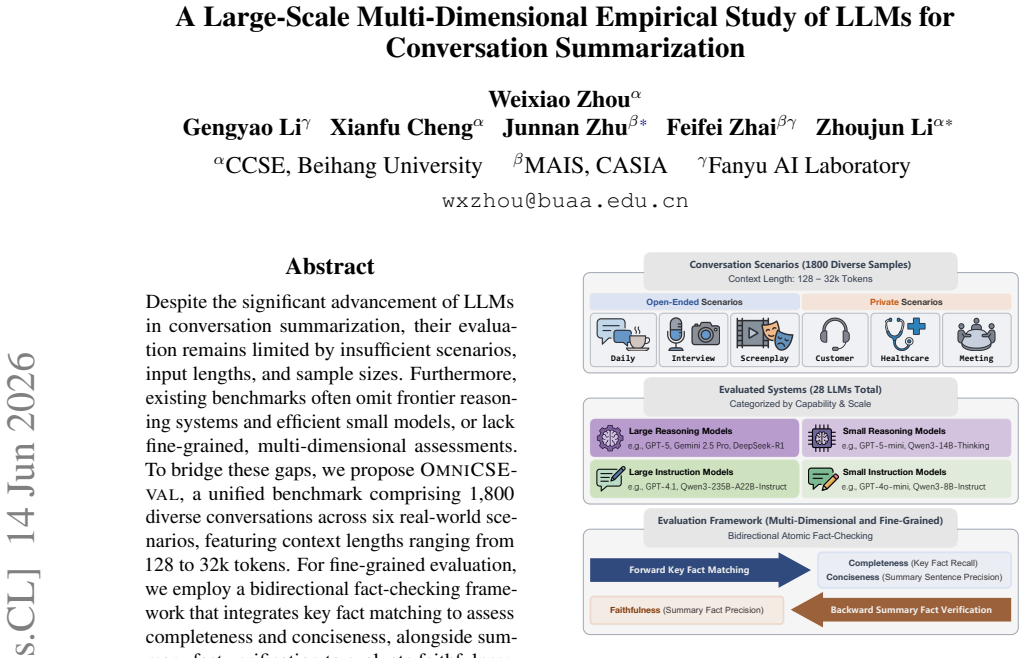
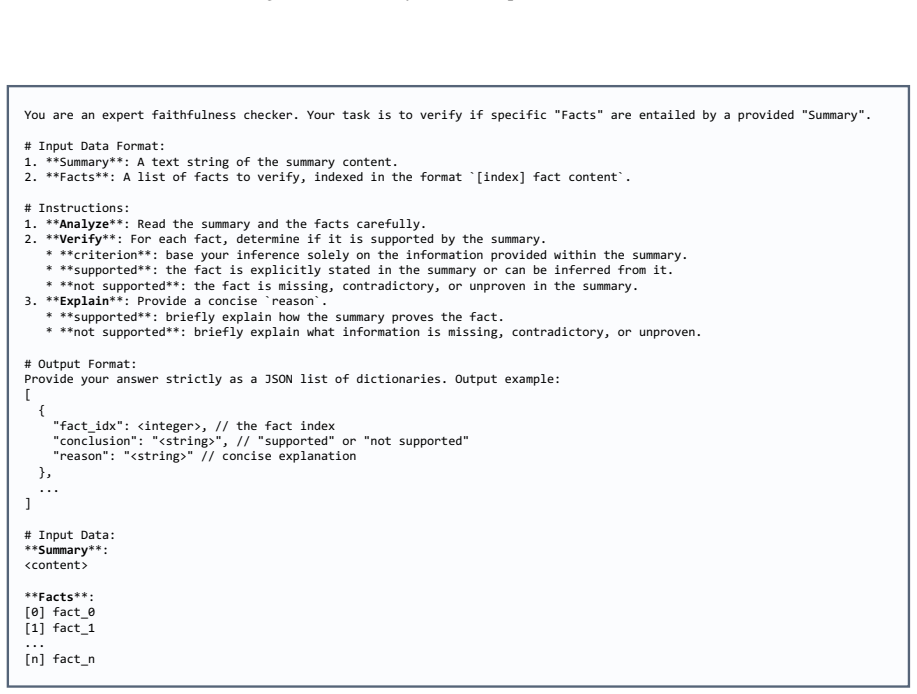
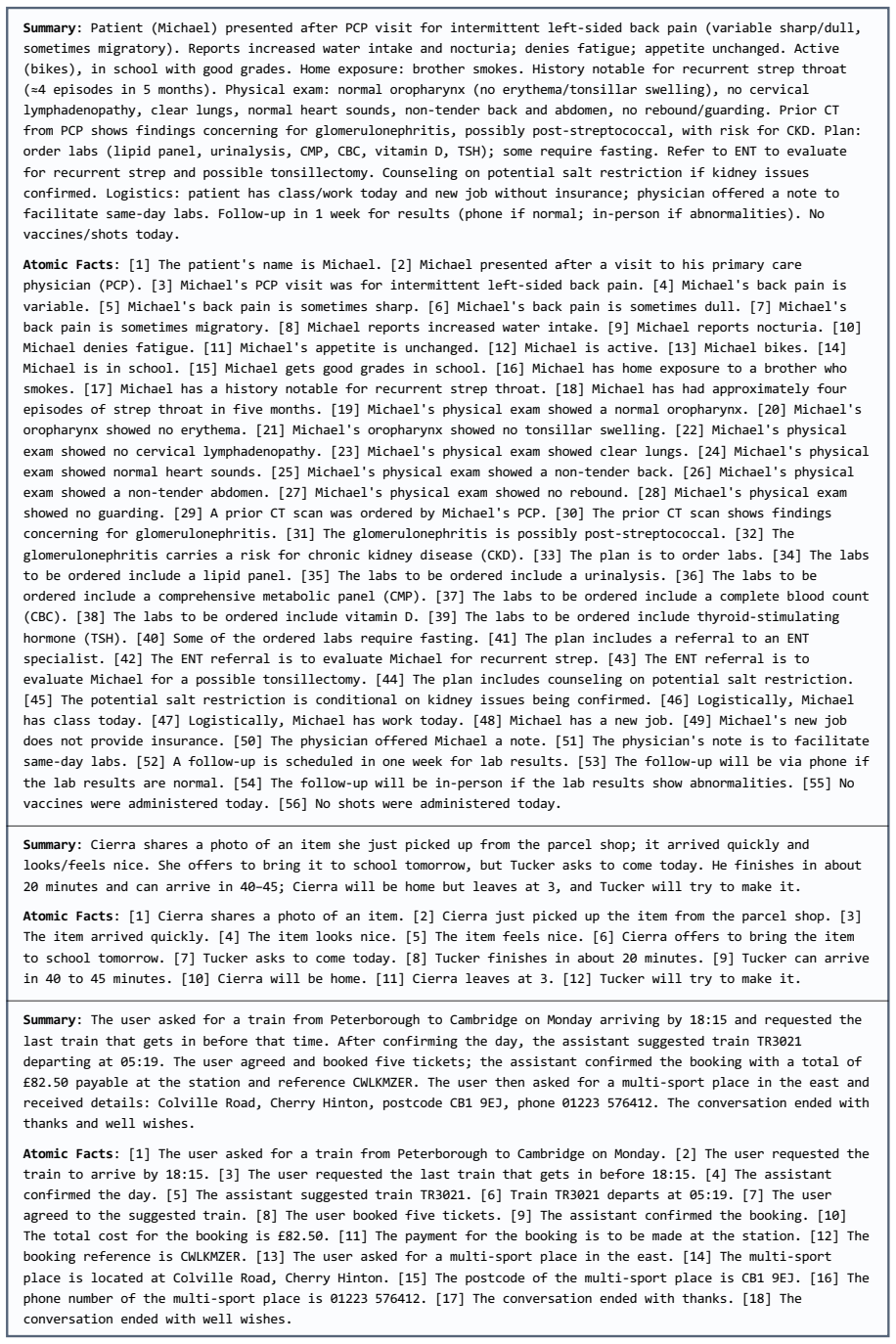
To judge those summaries, the authors used a two-direction fact-checking method. First, they had an LLM extract the most important atomic facts from each conversation. A summary scores high on completeness if it covers those facts, and high on conciseness if most of its sentences contain such facts. Second, they broke each generated summary into atomic facts and checked each fact against the original conversation to measure faithfulness, i.e., whether the summary invents anything.
The results suggest that reasoning models, which think step by step before answering, are better at picking out and condensing key information. However, they are not more faithful than ordinary instruction models; some even hallucinate more. Larger models are more stable across scenarios, and small reasoning models can match the completeness of large instruction models while producing more concise summaries. The paper also reports that thinking longer does not always improve quality, and that some reasoning models waste tokens on simple conversations.
Extended reading notes
Core claim
The central claim is that OmniCSEval provides a reliable fine-grained benchmark, and the empirical finding that explicit reasoning improves completeness and conciseness but not faithfulness, while model scale remains decisive for robustness. Quote: 'while explicit reasoning is highly effective for key content identification and noise data filtering, it paradoxically increases the risk of hallucinations' (Section 4.1). Also: 'small reasoning models effectively punch above their weight, matching the completeness and surpassing the conciseness of large instruction systems' (Section 4.1). If these findings hold, they directly support the paper's deployment guidance for choosing between reasoning, instruction, large, and small models.
Load-bearing premise
The evaluation's gold-standard key facts and faithfulness labels are produced by LLMs, with human adjudication applied only to self-rejected key facts and human meta-validation on only 120 summaries. If DeepSeek-V3.2-Instruct's match/verify judgments (BAcc 0.871) or Gemini 3 Pro's key-fact importance judgments are biased—for example, favoring summaries with certain stylistic properties—the completeness/conciseness/faithfulness rankings and the reasoning-vs-instruction conclusions could shift. This assumption enters at Section 3.3 (auto-acceptance of LLM key facts) and Section 5 (limited meta-evaluation sample).
Editorial analysis
A structured set of objections, weighed in public.
Assumptions & free parameters
free parameters (6)
- Dedup Jaccard threshold =
0.70
- IQR scale factor =
1.5
- Context length bounds =
128–32k tokens
- Context mapping highlight ratio =
25%, capped at 2,048 tokens
- Consensus filter threshold =
majority (≥2 of 3 judges)
- Scenario sampling quota =
300 per scenario
assumptions (5)
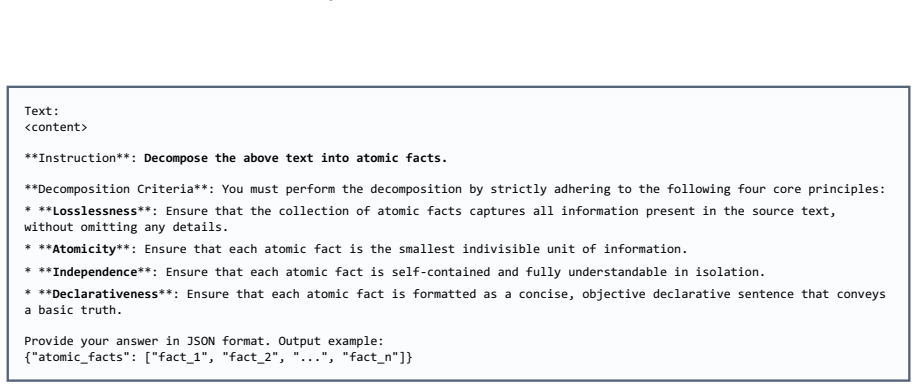
- domain assumption Atomic decomposition of summaries is lossless and atomic facts are self-contained units.
- domain assumption LLM fact-checkers validated on 120 human-annotated summaries generalize to all 50,400 summaries and all six scenarios.
- domain assumption Gemini 3 Pro's key fact extraction, with self-review and human adjudication of rejected facts, yields valid gold-standard importance judgments.
- domain assumption The 13 source datasets, after filtering and sampling, represent the six real-world scenarios well enough for cross-scenario conclusions.
- domain assumption Zero-shot instruction with temperature 0 measures intrinsic capability without prompt sensitivity.
Cite this review
Pith. "Pith review of A Large-Scale Multi-Dimensional Empirical Study of LLMs for Conversation Summarization." pith.science (2026). https://pith.science/paper/4J4QHAOC
@misc{pith2026260615974,
  author       = {Pith},
  title        = {Pith review of: A Large-Scale Multi-Dimensional Empirical Study of LLMs for Conversation Summarization},
  year         = {2026},
  howpublished = {\url{https://pith.science/paper/4J4QHAOC}},
  note         = {Machine review of arXiv:2606.15974}
}
read the original abstract
Despite the significant advancement of LLMs in conversation summarization, their evaluation remains limited by insufficient scenarios, input lengths, and sample sizes. Furthermore, existing benchmarks often omit frontier reasoning systems and efficient small models, or lack fine-grained, multi-dimensional assessments. To bridge these gaps, we propose OmniCSEval, a unified benchmark comprising 1,800 diverse conversations across six real-world scenarios, featuring context lengths ranging from 128 to 32k tokens. For fine-grained evaluation, we employ a bidirectional fact-checking framework that integrates key fact matching to assess completeness and conciseness, alongside summary fact verification to evaluate faithfulness. To ensure reliable assessment, we establish a human-LLM collaborative pipeline for key fact extraction and a multi-LLM consensus verifier for summary fact decomposition. Leveraging this framework, we evaluate 28 LLMs across four distinct categories grouped by reasoning capability and model scale. Our extensive empirical study reveals critical insights regarding the cross-scenario challenges current LLMs continue to face, the impacts of reasoning and scale, and the efficiency and adaptability of reasoning models. We also provide guidance for system selection in real-world deployments.
Figures


Figures from the paper (14 more)




Reference graph
Works this paper leans on
-
[1]
[3] Bart agrees to unlock the door for Pat
Pat has an unexpected work project to finish.[2] Pat will arrive the morning following the conversation. [3] Bart agrees to unlock the door for Pat. [4] Bart can work from home in the morning. [5] Pat is not a painter. [6] Pat is working on a stage project. [7] Pat intends to travel by train.[1] Jon Hamilton is reporting for NPR on Hurricane Gustav. [2] J...
-
[6]
InFindings of the Association for Com- putational Linguistics: EMNLP 2023, pages 6893– 6908, Singapore
Multi-stage pre-training enhanced by Chat- GPT for multi-scenario multi-domain dialogue sum- marization. InFindings of the Association for Com- putational Linguistics: EMNLP 2023, pages 6893– 6908, Singapore. Association for Computational Lin- guistics. Weixiao Zhou, Junnan Zhu, Gengyao Li, Xianfu Cheng, Xinnian Liang, Feifei Zhai, and Zhoujun Li. 2025. W...
2023
-
[7]
supported
MediaSum: A large-scale media interview dataset for dialogue summarization. InProceedings of the 2021 Conference of the North American Chap- ter of the Association for Computational Linguistics: Human Language Technologies, pages 5927–5934, Online. Association for Computational Linguistics. Rongxin Zhu, Jey Han Lau, and Jianzhong Qi. 2025. Factual dialogu...
2021
-
[2021]
InFindings of the Association for Computational Linguistics: ACL-IJCNLP 2021, pages 5062–5074, Online
DialogSum: A real-life scenario dialogue sum- marization dataset. InFindings of the Association for Computational Linguistics: ACL-IJCNLP 2021, pages 5062–5074, Online. Association for Computa- tional Linguistics. Alexander Fabbri, Chien-Sheng Wu, Wenhao Liu, and Caiming Xiong. 2022. QAFactEval: Improved QA- based factual consistency evaluation for summar...
2021
-
[2023]
InProceedings of the 61st An- nual Meeting of the Association for Computational Linguistics (Volume 1: Long Papers), pages 16409– 16423, Toronto, Canada
MeetingBank: A benchmark dataset for meet- ing summarization. InProceedings of the 61st An- nual Meeting of the Association for Computational Linguistics (Volume 1: Long Papers), pages 16409– 16423, Toronto, Canada. Association for Computa- tional Linguistics. Yeonseok Jeong, Minsoo Kim, Seung-won Hwang, and Byung-Hak Kim. 2025. Agent-as-judge for factual...
2025
-
[2024]
FENICE: Factuality evaluation of summariza- tion based on natural language inference and claim extraction. InFindings of the Association for Compu- tational Linguistics: ACL 2024, pages 14148–14161, Bangkok, Thailand. Association for Computational Linguistics. Hwanjun Song, Hang Su, Igor Shalyminov, Jason Cai, and Saab Mansour. 2024a. FineSurE: Fine-grain...
arXiv 2024
-
[2025]
Reasoning or not? a comprehensive evalua- tion of reasoning llms for dialogue summarization. Preprint, arXiv:2507.02145. Frederic Kirstein, Jan Philip Wahle, Bela Gipp, and Terry Ruas. 2025. Cads: A systematic literature review on the challenges of abstractive dialogue sum- marization.J. Artif. Int. Res., 82. Mahnaz Koupaee, Jake W. Vincent, Saab Mansour,...
arXiv 2025
-
[2026]
InFindings of the Association for Computational Linguistics: EACL 2026, pages 5887–5912, Rabat, Morocco
Distill and align decomposition for enhanced claim verification. InFindings of the Association for Computational Linguistics: EACL 2026, pages 5887–5912, Rabat, Morocco. Association for Com- putational Linguistics. Hyangsuk Min, Yuho Lee, Minjeong Ban, Jiaqi Deng, Nicole Hee-Yeon Kim, Taewon Yun, Hang Su, Jason Cai, and Hwanjun Song. 2025. Towards multi-d...
2026
Reviewed August 4, 2026 · model on record in the stance chip above.
Discussion (0). Continue with ORCID to comment.