REVIEW 4 major objections 6 minor 296 references
Mode switching in transitional millisecond pulsars is controlled by the disk's position relative to the light cylinder: outside it, the pulsar wind heats the disk and powers the bright X-ray mode; inside it, the system dims into the low mod
Reviewed by Pith at T0; open to challenge. T0 means a machine referee read the full paper against a public rubric. the ladder, T0–T4 →
T0 review · deepseek-v4-flash
2026-08-01 13:23 UTC pith:4JBSMI7Y
load-bearing objection First GRMHD + radiative-transfer study of tMSP modes; the wind-heating mechanism is plausible and the bimodality in Rm is real, but the quantitative agreements lean on fitted numbers, so treat the low-mode wind fraction as a demonstration, not a prediction. the 4 major comments →
Modes in Transitional Millisecond Pulsars: Evidence of Pulsar Wind-Induced Disk Heating from GRMHD and Radiative Transfer
The pith
A machine-rendered reading of the paper's core claim, the machinery that carries it, and where it could break.
Core claim
On the paper's own terms: by post-processing 2D general-relativistic magnetohydrodynamic simulations of a neutron star magnetosphere interacting with an accretion disk, the authors find that varying the disk density — equivalently the inflow rate — switches the system between two distinct dynamical regimes. In the 'wind' regime, the pulsar wind truncates the disk outside the light cylinder; the wind's electromagnetic energy is dissipated at the wind–disk interface, heating the surface plasma to relativistic temperatures, and thermal synchrotron emission from that interface produces the X-ray flux of the high mode. In the 'propeller' regime, the disk penetrates inside the light cylinder, wind
What carries the argument
The organizing quantity is the magnetospheric radius Rm relative to the light cylinder radius RLC — the radius at which a corotating magnetosphere would reach light speed. The paper shows that the system is bimodal: Rm sits either outside or inside RLC depending on inflow rate, and X-ray luminosity increases monotonically with Rm up to saturation beyond about 2 RLC. The physical engine is the pulsar wind–disk interface: when Rm > RLC, the wind's outgoing electromagnetic luminosity is intercepted by the disk surface, where dissipation heats the plasma to relativistic temperatures; that heated, magnetized layer then emits thermal synchrotron in X-rays (and synchrotron self-Compton at gamma ray
Load-bearing premise
The low-mode identification rests on a hand-tuned 70% propeller / 30% wind mix: the simulations show that the propeller regime dominates but do not dynamically predict the duty cycle of wind episodes, so if the real low-mode wind fraction differs substantially, the spectral match that anchors the low-mode interpretation collapses.
What would settle it
A decisive test would measure the inner disk radius during a mode switch — for example through relativistic reflection line fitting or the timing of optical/X-ray pulsations — and check whether the high mode always occurs with the disk outside the light cylinder and the low mode with it inside. A high-mode episode with the disk inside the light cylinder, or a low-mode spectrum that cannot be decomposed into a dominant propeller component plus a wind component, would falsify the central claim.
If this is right
- If inflow rate is the control parameter, the high X-ray mode should appear whenever the inner disk is parked outside the light cylinder, and its flux should saturate once Rm exceeds roughly twice the light cylinder radius.
- The low X-ray mode is not a pure propeller state: a ~30% wind-regime contribution is required to match the observed X-ray spectrum, so pulsar wind–induced disk heating operates in both modes, at lower efficiency in the low mode.
- The propeller regime's extra electromagnetic torque makes the mode-averaged spin-down rate a few percent higher than in the radio pulsar state, consistent with the small measured spin-down excesses in tMSPs.
- Jet (radio) luminosity is higher in the low mode and lower in the high mode, explaining the observed anti-correlation between radio and X-ray flux if the radio emission traces the jet.
- The density normalization that matches the high-mode X-ray flux implies a neutron-star surface magnetic field of about 8e7 G, in line with independent measurements.
Where Pith is reading between the lines
- Beyond the paper: the 70/30 propeller–wind mix is chosen after the fact rather than dynamically predicted. A natural extension is that the same model predicts stochastic spectral fluctuations within the low mode, which high-cadence X-ray monitoring could detect, and that a 3D non-axisymmetric flow could replace the fixed ratio with a partial-azimuth wind–disk interaction.
- Beyond the paper: because the simulations underestimate the gamma-ray flux by about an order of magnitude under the thermal-electron assumption, the framework would predict that non-thermal electron populations — expected from reconnection and plasmoids — raise the gamma-ray output while leaving the hard X-ray slope essentially unchanged; this gives an observational handle on particle acceleration
- Beyond the paper: the Rm/RLC criterion is argued for the confirmed tMSPs, but it suggests a broader survey test: in candidate transitional pulsars, synchronized radio/X-ray monitoring should reveal the same anti-correlation and the same modest spin-down excess if the wind-heating mechanism is universal.
Editorial analysis
A structured set of objections, weighed in public.
Referee Report
Summary. The paper presents 2D axisymmetric GRMHD simulations of a neutron-star magnetosphere interacting with an accretion torus, using a hybrid force-free treatment inside the light cylinder, and post-processes the outputs with the grmonty radiative-transfer code. Two initial torus densities are considered: a lower-density run (sim-d36) in which the disk is truncated outside the light cylinder and the pulsar wind heats the disk surface, and a higher-density run (sim-d100) in which the disk is mostly in a propeller state inside the light cylinder. The authors associate the wind regime with the high X-ray mode and reproduce the low X-ray mode by a 70% propeller + 30% wind mixture. They also report an X-ray/jet anti-correlation, a spin-down enhancement of a few percent, and a derived surface magnetic field B* ~ 8e7 G consistent with PSR J1023+0038.
Significance. This is a valuable first step: it is the first combination of tMSP GRMHD simulations with radiative-transfer post-processing, and it offers a concrete mechanism (wind-induced disk heating controlled by Rm/RLC) that connects several independent observables: the hard X-ray spectral slope, the NS surface magnetic field, the spin-down increase, and the radio/X-ray anti-correlation. The anti-correlation shown in Fig. 5 and the B-field consistency are non-trivial and give genuine support. However, two of the central quantitative agreements are fitted inputs: rho0 is chosen to match the high-mode luminosity (Sec. 3), and the 30% wind fraction is chosen to match the low-mode SED (Appendix B). The paper is therefore best read as a promising proof-of-concept, and the presentation should clearly separate fitted quantities from predictions.
major comments (4)
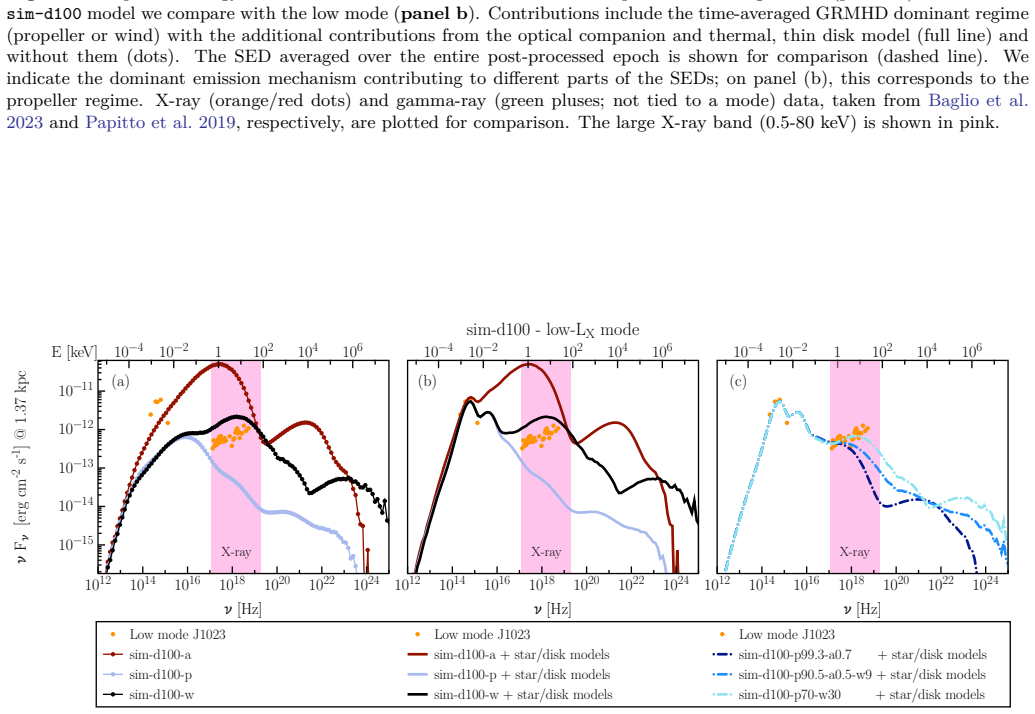
- [Sec. 4.2, Appendix B, Fig. 8(c)] The low-mode identification rests on a fitted mixing fraction. The pure propeller SED sim-d100-p undershoots the observed low-mode flux (Fig. 7b) and the pure wind SED overshoots it (Fig. 8a,b); only the ad hoc 70% propeller / 30% wind combination tracks the data (Fig. 8c). That 30% is not the duty cycle realized in the sim-d100 run, which is dominated by the propeller regime with only episodic wind epochs (Fig. 2b). It is a free parameter chosen post hoc to match the SED. Consequently the claim that wind-induced disk heating contributes to the low X-ray mode is not independently established, and the same fitted fraction is reused in Sec. 4.5 to compute the low-mode torque and spin-down enhancement. The paper acknowledges the fixed-rate issue in Sec. 5, but the abstract and conclusions present the low-mode match as evidence.
- [Sec. 3, Eq. (3), Fig. 4(a)] The high-mode luminosity agreement is by construction: rho0 is chosen so that sim-d36 yields L_X ~ 1e33 erg/s, the observed high-mode value. The independent content of the high-mode comparison is the spectral slope (alpha ~ 0.4) and the derived B* ~ 7.9e7 G versus ~9.6e7 G from timing. Because Eq. (3) maps rho0 to mu, the B-field value is correlated with the assumed luminosity normalization, though not trivially. Please state in the summary and conclusions which quantities are fitted and which are predictions, and avoid phrasing that implies the high-mode flux level is a prediction.
- [Sec. 4.1, Fig. 2] The central dynamical claim that the mass density/inflow rate controls the mode rests on only two presented initial torus densities and a simulation duration of ~0.35 s, much shorter than mode durations. The text says 'continuous changes in rho_max result in two distinct disk regimes,' but no intermediate-density run or long-time average is shown; moreover, sim-d36 does cross into the light cylinder at t ~ 15,000 rg/c, and sim-d100 has transient wind and accretor episodes. The bimodality and the direction of causality would be strengthened by showing the additional densities mentioned in the text and by stating the expected duty cycle. As written, the two-point mapping is suggestive but not established.
- [Sec. 2 and Sec. 4.2] The radiative-transfer model assumes a one-temperature thermal plasma (T_e = T_p) and discards sigma > 20 regions with density floors. The authors note the resulting discrepancies: the model cutoff is at ~1e18 Hz, whereas observations show no cutoff up to 79 keV, and the gamma-ray flux is underestimated by an order of magnitude. Because the X-ray slope and normalization are central to the mode identification, the paper should either test sensitivity to T_e/T_p and non-thermal electrons or explicitly state how these limitations affect the quantitative comparison. This is a caveat on the strength of the 'evidence' claim, not a fatal flaw.
minor comments (6)
- [Title/Abstract] The title contains a formatting artifact ('T ransitional'); there are also typos throughout, e.g. 'efficiency' as 'efficiency', 'sufficient' as 'sufficient', and 'Quantatively' in Appendix A.
- [References] The reference list contains the same entry twice: Parfrey & Tchekhovskoy (2024), ApJ, 975, 57.
- [Fig. 2 and Sec. 4.1] The legend of Fig. 2 includes sim-d36-p, but the text does not define the criterion that distinguishes propeller from wind epochs within the sim-d36 run. Please define the classification thresholds explicitly.
- [Sec. 4.2 / Appendix B] The notation sim-d100-p70-w30 may be misread as a separate simulation rather than a post-processing weighted average of two regimes. State this explicitly at first use, including the time intervals over which the propeller and wind SEDs are averaged.
- [Sec. 4.2] The gamma-ray data points are averaged over both modes, while the models are mode-specific. The comparison should be labeled as order-of-magnitude only, and the text should note this limitation where the gamma-ray deficit is discussed.
- [Sec. 3 / Sec. 4.2] Please specify the number of post-processed snapshots used in the time averages and state whether 10^4 superphotons per snapshot is sufficient for convergence of the 0.5-10 keV flux and spectral slope.
Circularity Check
Low-mode wind-heating evidence rests on a hand-tuned 70/30 propeller/wind mixture; high-mode X-ray normalization is fitted, so the two key quantitative agreements are partly by construction.
specific steps
-
fitted input called prediction
[Sec. 4.2 and Appendix B, Fig. 8(c); Conclusions, Sec. 5]
"The low mode SED data are best reproduced with 30% wind regime and 70% propeller (light green curve), i.e., without accretion columns; this is our best model for the low mode (Fig. 4). ... The question would then be to explain why this would happen at the fixed rate, found to be 70% − 30% here, needed to reproduce the observed mode stability."
The central claim that wind–induced disk heating contributes to the low X-ray mode is anchored by the sim-d100-p70-w30 spectrum. The pure propeller SED undershoots the observed low-mode flux, and the pure wind SED overshoots it, so the 30% wind fraction is chosen after the fact to make the model match the data. This weight is not predicted by the GRMHD dynamics (the sim-d100 run spends most time in the propeller regime, with only transient wind episodes), and the paper explicitly leaves unexplained why the rate should be 70/30. Thus the low-mode evidence for wind heating is a fitted mixture, not an independent prediction.
-
fitted input called prediction
[Sec. 3 and Sec. 4.3, Eq. (3)]
"in grmonty we set the gas density normalization, ρ0 = 1.2×10⁻⁹ g cm−3, so that the sim-d36 model produces an X-ray luminosity equal to that of the observed high mode, LX ∼ 1033 erg s−1. ... we aim to compare the NS dipolar magnetic moment associated with this chosen density normalization to observational constraints; this is an independent test of our model."
The high-mode X-ray luminosity is matched by construction: ρ0 is fixed to make sim-d36 produce the observed LX. The magnetic moment in Eq. (3) scales as sqrt(ρ0), so the derived B* ≈ 7.9×10^7 G is not an independent prediction but a consequence of the same fitted normalization; the comparison with the measured 9.6×10^7 G is a consistency check, not a free test. The association of the wind regime with the high mode therefore has one of its two quantitative anchors (the flux level) built into the normalization choice.
full rationale
The paper has genuine independent content: the two-density GRMHD runs produce a real bimodality in Rm relative to RLC, the simulated X-ray luminosity rises with Rm, the spectral slope in the wind regime is not fitted, the jet–X-ray anti-correlation (Fig. 5) is a simulation output, and the propeller torque enhancement (N ≈ 1.3 N0) is computed rather than tuned. However, two of the central quantitative agreements are fitted inputs. The high-mode LX is fixed by choosing ρ0, and the derived B* is then presented as an independent test even though Eq. (3) ties B* to that same ρ0. More importantly, the low-mode wind-heating contribution rests on the 70% propeller/30% wind mixture of Appendix B, a weight chosen solely to reproduce the observed low-mode SED. The paper itself flags the open question of why the 70/30 rate would be fixed. Because the claim that wind-induced disk heating contributes in both modes is weakest for the low mode, and that low-mode contribution is essentially a two-component fit to the data, the derivation is partially circular rather than fully self-contained; the independent elements prevent a higher score.
Axiom & Free-Parameter Ledger
free parameters (4)
- Density normalization rho0 =
1.2e-9 g cm^-3
- Low-mode wind fraction =
30% wind, 70% propeller
- Initial torus density values =
rho_max = rho0 and 0.36 rho0
- Shakura-Sunyaev outer disk parameters =
Mdot = 3e-4 Mdot_Edd, r_in = 1e3 rg, r_out = 1e5 rg
axioms (6)
- standard math Ideal GRMHD equations with Kerr metric and gamma=4/3 ideal gas
- ad hoc to paper Hybrid force-free treatment inside RLC via passive scalar F
- domain assumption Axisymmetry (2D) and neglect of non-axisymmetric accretion
- domain assumption Thermal electron distribution with Te = Tp everywhere
- ad hoc to paper Ignore emission from regions with sigma > 20 and adopt density floors
- domain assumption Fast-light approximation in grmonty
read the original abstract
Transitional millisecond pulsars (tMSPs) alternate between radio and X-ray pulsar states, and can represent the missing link between rotation- and accretion-powered neutron stars. Their disk state switches stochastically between the low and high X-ray modes, both of unknown physical origin and less luminous than low-mass X-ray binaries. To reveal the source of the X-ray emission, we carry out 2D axisymmetric general-relativistic magnetohydrodynamical simulations of the interaction between an accretion disk and tMSP magnetosphere. For the first time, we post-process tMSP simulations with a radiative transfer code that incorporates thermal synchrotron, absorption, and Compton scattering processes. By varying the disk density, hence the inflow rate, we explore two disk regimes: one truncated outside and another inside the light cylinder. In the former, most of the X-ray flux comes from the synchrotron emission powered by the wind heating the disk: this "wind" regime could correspond to the high X-ray mode. The latter is the propeller regime and lacks this heating process. However, the propeller episodically expels the disk, activating the wind heating: a 70%-30% mixture of such propeller and wind regimes reproduces the X-ray spectrum of the low X-ray mode. The excess electromagnetic torque in the propeller regime increases the spin-down rate, averaged over both modes, by a few percent above the disk-free radio pulsar state, in agreement with observations. Overall, the system is more luminous in X-rays when the flow is truncated outside the light cylinder and supports a contribution from wind-induced disk heating in both low and high X-ray modes.
Figures



Reference graph
Works this paper leans on
-
[1]
ApJ , author =. 2003 , pages =. doi:10.1086/374594 , language =
doi:10.1086/374594 2003
-
[2]
arXiv:2109.06947 [astro-ph] , author =
Exploring the role of binarity in the origin of the bimodal rotational velocity distribution in stellar clusters , url =. arXiv:2109.06947 [astro-ph] , author =. 2021 , note =
Pith/arXiv arXiv 2021
-
[3]
Spectroscopic constraints on the properties of dust in active galactic nuclei , volume =. ApJ , author =. 1993 , pages =. doi:10.1086/172149 , language =
doi:10.1086/172149 1993
-
[4]
Erratum:. Phys. Rev. D , author =. 2010 , pages =. doi:10.1103/PhysRevD.81.089901 , language =
-
[5]
Energy and angular momentum flow into a black hole in a binary , volume =. Phys. Rev. D , author =. 2001 , pages =. doi:10.1103/PhysRevD.64.104020 , language =
-
[6]
arXiv:2109.07511 [astro-ph] , author =
Extreme black hole spin--orbit misalignment in. arXiv:2109.07511 [astro-ph] , author =. 2021 , note =
Pith/arXiv arXiv 2021
-
[7]
arXiv:2109.07535 [astro-ph] , author =
Formation and evolution of protostellar accretion discs. arXiv:2109.07535 [astro-ph] , author =. 2021 , note =
Pith/arXiv arXiv 2021
-
[8]
Orbital. ApJL , author =. 2021 , keywords =. doi:10.3847/2041-8213/ac0621 , number =
-
[9]
Equilibrium. ApJL , author =. 2021 , keywords =. doi:10.3847/2041-8213/abdd1c , number =
-
[10]
arXiv:2109.08154 [astro-ph, physics:gr-qc] , author =
Hunting intermediate-mass black holes with. arXiv:2109.08154 [astro-ph, physics:gr-qc] , author =. 2021 , note =
Pith/arXiv arXiv 2021
-
[11]
On tidally induced shocks in accretion discs in close binary systems , volume =. MNRAS , author =. 1994 , pages =. doi:10.1093/mnras/268.1.13 , language =
-
[12]
arXiv:1807.11489 [astro-ph] , author =
Lecture notes on black hole binary astrophysics , url =. arXiv:1807.11489 [astro-ph] , author =. 2018 , note =
Pith/arXiv arXiv 2018
-
[13]
Progress of Theoretical Physics , author =
Post-. Progress of Theoretical Physics , author =. 1997 , keywords =. doi:10.1143/PTP.98.829 , language =
-
[14]
Monthly Notices of the Royal Astronomical Society , author =
Tidal disruptions by rotating black holes: relativistic hydrodynamics with. Monthly Notices of the Royal Astronomical Society , author =. 2017 , keywords =. doi:10.1093/mnras/stx1089 , language =
-
[15]
Dynamics of binary-disk interaction. 1:. ApJ , author =. 1994 , keywords =. doi:10.1086/173679 , language =
doi:10.1086/173679 1994
-
[16]
arXiv:2109.10921 [astro-ph] , author =
Are. arXiv:2109.10921 [astro-ph] , author =. 2021 , note =
Pith/arXiv arXiv 2021
-
[17]
On the. ApJ , author =. 2018 , keywords =. doi:10.3847/1538-4357/aa998e , number =
-
[18]
arXiv:2109.12745 [astro-ph] , author =
Investigating the physical properties and fragmentation of the. arXiv:2109.12745 [astro-ph] , author =. 2021 , note =
Pith/arXiv arXiv 2021
-
[19]
Monthly Notices of the Royal Astronomical Society , author =
Self-induced warping of accretion discs , volume =. Monthly Notices of the Royal Astronomical Society , author =. 1996 , pages =. doi:10.1093/mnras/281.1.357 , language =
-
[20]
Gravitational. ApJS , author =. 2021 , note =. doi:10.3847/1538-4365/abe86f , abstract =
-
[21]
arXiv:2109.15115 [astro-ph, physics:gr-qc, physics:physics] , author =
Black hole flares: ejection of accreted magnetic flux \ through. arXiv:2109.15115 [astro-ph, physics:gr-qc, physics:physics] , author =. 2021 , note =
Pith/arXiv arXiv 2021
-
[22]
arXiv:2110.00766 [astro-ph, physics:gr-qc] , author =
The interplay of spin-precession and higher harmonics in the parameter estimation of binary black holes , url =. arXiv:2110.00766 [astro-ph, physics:gr-qc] , author =. 2021 , note =
Pith/arXiv arXiv 2021
-
[23]
arXiv:2110.02081 [astro-ph] , author =
Proper motions of. arXiv:2110.02081 [astro-ph] , author =. 2021 , note =
Pith/arXiv arXiv 2021
-
[24]
arXiv:2110.02982 [astro-ph] , author =
Investigating the. arXiv:2110.02982 [astro-ph] , author =. 2021 , note =
Pith/arXiv arXiv 2021
-
[25]
arXiv:2110.03013 [astro-ph] , author =
Constraints on the preferential disruption of moderately massive stars by supermassive black holes , url =. arXiv:2110.03013 [astro-ph] , author =. 2021 , note =
Pith/arXiv arXiv 2021
-
[26]
ApJ , author =. 2012 , keywords =. doi:10.1088/0004-637X/749/2/118 , number =
-
[27]
The formation of close binary systems by dynamical interactions and orbital decay , volume =. MNRAS , author =. 2002 , pages =. doi:10.1046/j.1365-8711.2002.05775.x , language =
arXiv 2002
-
[28]
The. A&A , author =. 2001 , keywords =. doi:10.1051/0004-6361:20011346 , number =
-
[29]
On the tidal evolution of the orbits of low-mass satellites around black holes , volume =. A&A , author =. 2008 , keywords =. doi:10.1051/0004-6361:200809483 , number =
-
[30]
Tidal effects on small bodies by massive black holes , volume =. A&A , author =. 2009 , keywords =. doi:10.1051/0004-6361/200811059 , number =
-
[31]
ApJS , author =. 2012 , keywords =. doi:10.1088/0067-0049/203/2/18 , number =
-
[32]
Monthly Notices of the Royal Astronomical Society , author =
An 8 h characteristic time-scale in submillimetre light curves of. Monthly Notices of the Royal Astronomical Society , author =. 2014 , keywords =. doi:10.1093/mnras/stu1039 , language =
-
[33]
Near-infrared flares from accreting gas around the supermassive black hole at the. Nature , author =. 2003 , keywords =. doi:10.1038/nature02065 , language =
-
[34]
First simultaneous. A&A , author =. 2004 , keywords =. doi:10.1051/0004-6361:20040495 , number =
- [36]
-
[37]
The. ApJ , author =. 2019 , keywords =. doi:10.3847/1538-4357/aaf732 , number =
-
[38]
ApJ , author =. 2016 , keywords =. doi:10.3847/0004-637X/820/2/137 , number =
-
[39]
A statistical analysis of dust polarization properties in. A&A , author =. 2020 , pages =. doi:10.1051/0004-6361/202038404 , abstract =
-
[40]
The. Rev. Mod. Phys. , author =. 2010 , keywords =. doi:10.1103/RevModPhys.82.3121 , language =
-
[41]
The origins of massive black holes , issn =. Nat Rev Phys , author =. 2021 , keywords =. doi:10.1038/s42254-021-00364-9 , language =
-
[42]
arXiv:2110.10786 [astro-ph] , author =
Possible. arXiv:2110.10786 [astro-ph] , author =. 2021 , note =
Pith/arXiv arXiv 2021
-
[43]
arXiv:2110.10838 [astro-ph] , author =
Mass and effective spin distributions of binary black hole events:. arXiv:2110.10838 [astro-ph] , author =. 2021 , note =
Pith/arXiv arXiv 2021
-
[44]
Global magnetohydrodynamical models of turbulence in protoplanetary disks:. A&A , author =. 2008 , keywords =. doi:10.1051/0004-6361:20077948 , number =
-
[45]
A comparative study of disc-planet interaction , volume =. MNRAS , author =. 2006 , keywords =. doi:10.1111/j.1365-2966.2006.10488.x , language =
arXiv 2006
-
[46]
EAS Publications Series , author =
Modelling the. EAS Publications Series , author =. 2010 , keywords =. doi:10.1051/eas/1044018 , urldate =
arXiv 2010
-
[47]
EAS Publications Series , author =
On resolution requirements for selfgravitating protoplanetary discs – a comparison of grid and. EAS Publications Series , author =. 2010 , keywords =. doi:10.1051/eas/1042028 , urldate =
arXiv 2010
-
[48]
arXiv:0710.3590 [astro-ph] , author =
Protoplanetary disk fragmentation with varying radiative physics, initial conditions and numerical techniques , abstract =. arXiv:0710.3590 [astro-ph] , author =. 2007 , note =
Pith/arXiv arXiv 2007
-
[49]
JOSS , author =. 2021 , note =. doi:10.21105/joss.03336 , abstract =
-
[50]
Protostellar hydrodynamics:. ApJS , author =. 1993 , keywords =. doi:10.1086/191852 , language =
-
[51]
arXiv:2110.11374 [astro-ph] , author =
The. arXiv:2110.11374 [astro-ph] , author =. 2021 , note =
Pith/arXiv arXiv 2021
-
[52]
arXiv:2110.13838 [astro-ph] , author =
Structure of the. arXiv:2110.13838 [astro-ph] , author =. 2021 , note =
Pith/arXiv arXiv 2021
-
[53]
arXiv:2111.01317 [astro-ph] , author =
The. arXiv:2111.01317 [astro-ph] , author =. 2021 , note =
Pith/arXiv arXiv 2021
-
[54]
arXiv:2111.00692 [astro-ph] , author =
Did the. arXiv:2111.00692 [astro-ph] , author =. 2021 , note =
Pith/arXiv arXiv 2021
-
[55]
Evolution of circumbinary accretion disk around supermassive binary black hole: post-. MNRAS , author =. 2021 , note =. doi:10.1093/mnras/stab1022 , abstract =
-
[56]
Relativistic fluid disks in orbit around. ApJ , author =. 1976 , keywords =. doi:10.1086/154565 , language =
doi:10.1086/154565 1976
-
[57]
arXiv:2111.02439 [astro-ph] , author =
What really makes an accretion disc. arXiv:2111.02439 [astro-ph] , author =. 2021 , note =
Pith/arXiv arXiv 2021
-
[58]
arXiv:2111.04039 [astro-ph] , author =
A cold accretion flow onto one component of a multiple protostellar system , url =. arXiv:2111.04039 [astro-ph] , author =. 2021 , note =
Pith/arXiv arXiv 2021
-
[59]
arXiv:2111.03689 [astro-ph, physics:gr-qc, physics:physics] , author =
Magnetic reconnection and plasmoid formation in three-dimensional accretion flows around black holes , url =. arXiv:2111.03689 [astro-ph, physics:gr-qc, physics:physics] , author =. 2021 , note =
Pith/arXiv arXiv 2021
-
[60]
arXiv:2111.05801 [astro-ph] , author =
The. arXiv:2111.05801 [astro-ph] , author =. 2021 , note =
Pith/arXiv arXiv 2021
-
[61]
Accretion and. ApJ , author =. 2020 , pages =. doi:10.3847/1538-4357/abbeef , number =
-
[62]
ApJ , author =. 2013 , keywords =. doi:10.1088/0004-637X/766/1/62 , number =
-
[63]
Monthly Notices of the Royal Astronomical Society , author =
A. Monthly Notices of the Royal Astronomical Society , author =. 1999 , keywords =. doi:10.1046/j.1365-8711.1999.02244.x , language =
arXiv 1999
-
[64]
ApJS , author =. 2016 , pages =. doi:10.3847/0067-0049/225/2/22 , number =
-
[65]
arXiv:2111.08065 [astro-ph] , author =
The. arXiv:2111.08065 [astro-ph] , author =. 2021 , note =
Pith/arXiv arXiv 2021
-
[66]
arXiv:2111.09173 [astro-ph] , author =
Revisiting the. arXiv:2111.09173 [astro-ph] , author =. 2021 , note =
Pith/arXiv arXiv 2021
-
[67]
arXiv:2111.09401 [astro-ph, physics:gr-qc] , author =
All. arXiv:2111.09401 [astro-ph, physics:gr-qc] , author =. 2021 , note =
Pith/arXiv arXiv 2021
-
[68]
Probing the initial conditions of high-mass star formation:. A&A , author =. 2020 , keywords =. doi:10.1051/0004-6361/201936118 , abstract =
-
[69]
Protoplanetary. ApJL , author =. 2021 , pages =. doi:10.3847/2041-8213/ac158c , number =
-
[70]
Runaway. ApJ , author =. 2020 , keywords =. doi:10.3847/1538-4357/abbc6b , number =
-
[71]
Chemical complexity in high-mass star formation:. A&A , author =. 2019 , pages =. doi:10.1051/0004-6361/201935865 , abstract =
-
[72]
arXiv:2111.10451 [astro-ph] , author =
A. arXiv:2111.10451 [astro-ph] , author =. 2021 , note =
arXiv 2021
-
[73]
The broad emission line asymmetry in low mass ratio of supermassive binary black holes on elliptical orbits , issn =. Astron. Nachr. , author =. 2021 , note =. doi:10.1002/asna.20210073 , abstract =
-
[74]
Estimation de l'empreinte carbone d'une heure.coeur de calcul , url =
Berthoud, Francoise and Bzeznik, Bruno and Gibelin, Nicolas and Laurens, Myriam and Bonamy, Cyrille and Morel, Maxence and Schwindenhammer, Xavier , month = apr, year =. Estimation de l'empreinte carbone d'une heure.coeur de calcul , url =
-
[75]
arXiv:2111.12735 [astro-ph] , author =
Stars. arXiv:2111.12735 [astro-ph] , author =. 2021 , note =
Pith/arXiv arXiv 2021
-
[76]
arXiv:2111.12736 [astro-ph] , author =
Stars. arXiv:2111.12736 [astro-ph] , author =. 2021 , note =
Pith/arXiv arXiv 2021
- [77]
-
[78]
arXiv:2111.14854 [astro-ph] , author =
First direct dynamical detection of a dual supermassive black hole system at sub-kiloparsec separation , url =. arXiv:2111.14854 [astro-ph] , author =. 2021 , note =
Pith/arXiv arXiv 2021
-
[79]
An. ApJ , author =. 2008 , keywords =. doi:10.1086/523869 , language =
doi:10.1086/523869 2008
-
[81]
Accretion into the central cavity of a circumbinary disc , volume =. MNRAS , author =. 2013 , keywords =. doi:10.1093/mnras/stt1787 , language =
-
[82]
ApJ , author =. 2016 , keywords =. doi:10.3847/0004-637X/827/2/111 , number =
discussion (0)
Sign in with ORCID, Apple, or X to comment. Anyone can read and Pith papers without signing in.