Superconductivity in doped spin multimer systems
Pith reviewed 2026-05-22 02:47 UTC · model grok-4.3
The pith
Hole-doped systems with complex spin couplings map to the hardcore boson model and show superconductivity when binding energies are strong.
A machine-rendered reading of the paper's core claim, the machinery that carries it, and where it could break.
Core claim
In the double Kondo lattice model, which realizes doped spin multimer systems, a pairing state is maintained via crossover even for parameters away from the strong-coupling regime. Once binding energies are sufficiently generated, pair correlations develop similarly regardless of the details of local spin correlations.
What carries the argument
Mapping of hole-doped systems with complex spin couplings onto the universal hardcore boson model in the strong-binding-energy limit, which produces universal pairing behavior.
If this is right
- Pairing states persist through crossovers for parameters outside the strict strong-coupling regime.
- Pair correlations become independent of the specific local spin correlation details once binding energies are high enough.
- The mapping supplies concrete guidelines for searching superconductivity in materials with complicated spin interactions.
Where Pith is reading between the lines
- Material searches could focus first on generating strong pair binding rather than simplifying the underlying spin network.
- The same reduction may apply to other doped magnetic Hamiltonians that share the hardcore-boson structure at strong binding.
- Targeted experiments on known multimer compounds could test whether high binding energy reliably produces the predicted pairing signatures.
Load-bearing premise
Hole-doped systems with complex spin couplings can be mapped onto the universal hardcore boson model in the strong-binding-energy limit.
What would settle it
DMRG or experimental measurements that find markedly different pair correlations in two spin-coupling realizations despite equally large binding energies would falsify the universality claim.
Figures


read the original abstract
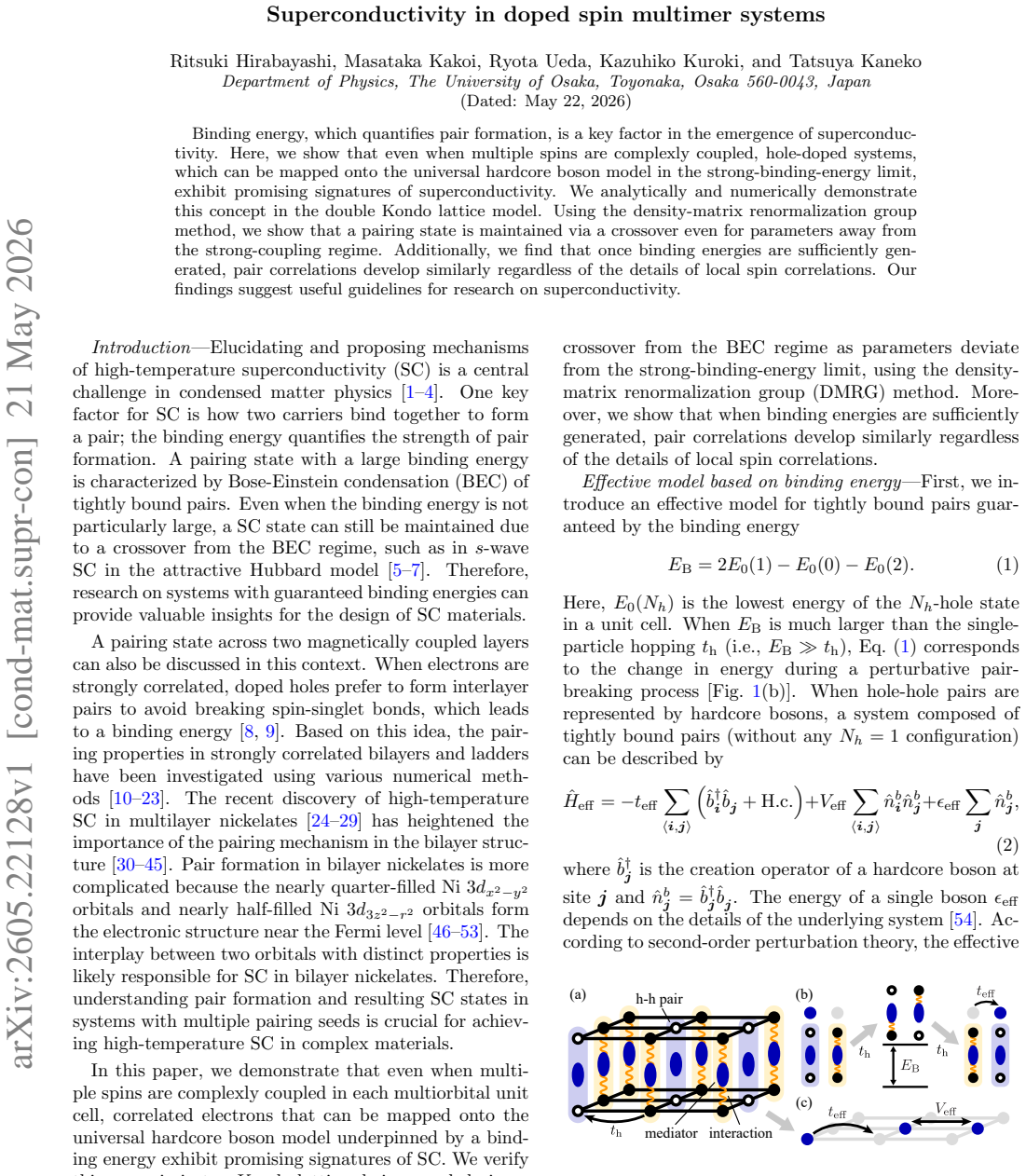
Binding energy, which quantifies pair formation, is a key factor in the emergence of superconductivity. Here, we show that even when multiple spins are complexly coupled, hole-doped systems, which can be mapped onto the universal hardcore boson model in the strong-binding-energy limit, exhibit promising signatures of superconductivity. We analytically and numerically demonstrate this concept in the double Kondo lattice model. Using the density-matrix renormalization group method, we show that a pairing state is maintained via a crossover even for parameters away from the strong-coupling regime. Additionally, we find that once binding energies are sufficiently generated, pair correlations develop similarly regardless of the details of local spin correlations. Our findings suggest useful guidelines for research on superconductivity.
Editorial analysis
A structured set of objections, weighed in public.
Referee Report
Summary. The paper claims that hole-doped spin multimer systems with complex local spin couplings can be mapped onto the universal hardcore boson model once binding energies are sufficiently large, yielding superconductivity signatures independent of microscopic spin details. This is shown analytically and via DMRG in the double Kondo lattice model, where a pairing state persists through a crossover even outside the strong-coupling regime, and pair correlations develop similarly regardless of local spin correlations.
Significance. If the mapping to the universal hardcore boson model holds with effective parameters independent of spin-multimer details, the work offers practical guidelines for superconductivity in doped systems with intricate spin couplings by emphasizing the dominant role of binding energy. The analytical mapping combined with DMRG evidence for crossover behavior is a positive feature.
major comments (1)
- [Mapping and effective model section] The central claim that the low-energy physics reduces to the standard hardcore boson Hamiltonian independent of spin-multimer details requires that effective boson hopping and nearest-neighbor repulsion become independent of the intra- versus inter-multimer exchange ratio. The manuscript does not derive these effective parameters analytically or extract them numerically as a function of spin-coupling anisotropy to confirm they flow to the same universal values (see the discussion of the double Kondo lattice mapping and DMRG results).
minor comments (1)
- [Abstract] The abstract would benefit from specifying the range of Kondo couplings and anisotropy parameters used in the DMRG simulations to allow readers to assess the crossover regime.
Simulated Author's Rebuttal
We thank the referee for the careful reading of our manuscript and the constructive feedback. We address the major comment below and outline how we will strengthen the presentation of the effective model mapping.
read point-by-point responses
-
Referee: [Mapping and effective model section] The central claim that the low-energy physics reduces to the standard hardcore boson Hamiltonian independent of spin-multimer details requires that effective boson hopping and nearest-neighbor repulsion become independent of the intra- versus inter-multimer exchange ratio. The manuscript does not derive these effective parameters analytically or extract them numerically as a function of spin-coupling anisotropy to confirm they flow to the same universal values (see the discussion of the double Kondo lattice mapping and DMRG results).
Authors: We agree that a more explicit demonstration of the independence of the effective parameters would reinforce the central claim. In the strong-binding-energy limit, the analytical mapping proceeds via a perturbative elimination of the high-energy spin excitations, yielding effective boson hopping and nearest-neighbor repulsion that are determined primarily by the pair binding energy and become insensitive to the intra- versus inter-multimer exchange ratio once the binding energy is sufficiently large compared with the spin-exchange scale. This limiting behavior is implicit in the derivation presented in the methods and results sections, but we acknowledge that the dependence on the exchange anisotropy is not shown explicitly as a function of the ratio. Our DMRG data already indicate that pair correlations converge to the same universal form independent of local spin details once the binding energy exceeds a threshold value, which is consistent with the effective parameters approaching the same values. To address this point directly, we will add a dedicated appendix that (i) derives the effective t and V analytically as functions of the exchange ratio in the strong-binding limit and (ii) extracts the same quantities numerically from the DMRG pair-correlation data via finite-size scaling, confirming their convergence to universal values. These additions will be included in the revised manuscript. revision: yes
Circularity Check
No significant circularity detected in derivation chain
full rationale
The paper analytically maps hole-doped spin-multimer systems to the universal hardcore boson model in the strong-binding-energy limit and then uses independent DMRG numerics on the double Kondo lattice to demonstrate that pair correlations develop similarly once binding energies are large, regardless of local spin details. The numerical checks on pairing states and crossovers are presented as verification rather than being fitted parameters renamed as predictions. No self-definitional steps, fitted inputs called predictions, or load-bearing self-citations appear in the abstract or described claims; the central result rests on the mapping plus external numerical evidence rather than reducing to its own inputs by construction.
Axiom & Free-Parameter Ledger
axioms (1)
- domain assumption Hole-doped spin multimer systems map to the universal hardcore boson model in the strong-binding-energy limit
Lean theorems connected to this paper
-
IndisputableMonolith/Cost/FunctionalEquation.leanwashburn_uniqueness_aczel echoes?
echoesECHOES: this paper passage has the same mathematical shape or conceptual pattern as the Recognition theorem, but is not a direct formal dependency.
once binding energies are sufficiently generated, pair correlations develop similarly regardless of the details of local spin correlations
-
IndisputableMonolith/Foundation/BranchSelection.leanbranch_selection unclear?
unclearRelation between the paper passage and the cited Recognition theorem.
hole-doped systems, which can be mapped onto the universal hardcore boson model in the strong-binding-energy limit
What do these tags mean?
- matches
- The paper's claim is directly supported by a theorem in the formal canon.
- supports
- The theorem supports part of the paper's argument, but the paper may add assumptions or extra steps.
- extends
- The paper goes beyond the formal theorem; the theorem is a base layer rather than the whole result.
- uses
- The paper appears to rely on the theorem as machinery.
- contradicts
- The paper's claim conflicts with a theorem or certificate in the canon.
- unclear
- Pith found a possible connection, but the passage is too broad, indirect, or ambiguous to say the theorem truly supports the claim.
Reference graph
Works this paper leans on
-
[1]
Interactive Mate- rials Science Cadet Program
= (1,0) represents the position of an electron. Taking only the above lowest excited state into account,t eff andV eff for the hardcore boson model are given by Veff = 2teff = 4t2 ∥ EB cos2 ϕ 2 cos2 θ−ϕ 2 .(6) In contrast to the mixDt-Jmodel,t eff andV eff depend on the Kondo couplingJ K included inθ,ϕ, andE B. The details of the derivation and more preci...
-
[2]
Dagotto, Correlated electrons in high-temperature su- perconductors, Rev
E. Dagotto, Correlated electrons in high-temperature su- perconductors, Rev. Mod. Phys.66, 763 (1994)
work page 1994
-
[3]
J. Orenstein and A. J. Millis, Advances in the physics of high-temperature superconductivity, Science288, 468 (2000)
work page 2000
-
[4]
P. A. Lee, N. Nagaosa, and X.-G. Wen, Doping a Mott in- sulator: Physics of high-temperature superconductivity, Rev. Mod. Phys.78, 17 (2006)
work page 2006
- [5]
-
[6]
P. Nozi` eres and S. Schmitt-Rink, Bose condensation in an attractive fermion gas: From weak to strong coupling superconductivity, J. Low Temp. Phys.59, 195 (1985)
work page 1985
- [7]
-
[8]
M. Randeria and E. Taylor, Crossover from Bardeen- Cooper-Schrieffer to Bose-Einstein condensation and the unitary Fermi gas, Annu. Rev. Condens. Matter Phys.5, 209 (2014)
work page 2014
-
[9]
E. Dagotto, J. Riera, and D. Scalapino, Superconductiv- ity in ladders and coupled planes, Phys. Rev. B45, 5744 (1992)
work page 1992
- [10]
-
[11]
H. Tsunetsugu, M. Troyer, and T. M. Rice, Pairing and excitation spectrum in dopedt-Jladders, Phys. Rev. B 49, 16078 (1994)
work page 1994
-
[12]
C. A. Hayward, D. Poilblanc, R. M. Noack, D. J. Scalapino, and W. Hanke, Evidence for a superfluid den- sity int-Jladders, Phys. Rev. Lett.75, 926 (1995)
work page 1995
- [14]
- [15]
- [16]
- [17]
-
[18]
J. Chen, F. Yang, and W. Li, Orbital-selective supercon- ductivity in the pressurized bilayer nickelate La 3Ni2O7: An infinite projected entangled-pair state study, Phys. Rev. B110, L041111 (2024)
work page 2024
- [19]
-
[20]
H. Schl¨ omer, U. Schollw¨ ock, F. Grusdt, and A. Bohrdt, Superconductivity in the pressurized nickelate La3Ni2O7 in the vicinity of a BEC–BCS crossover, Commun. Phys. 7, 366 (2024)
work page 2024
-
[21]
H. Schl¨ omer, H. Lange, T. Franz, T. Chalopin, P. Bo- jovi´ c, S. Wang, I. Bloch, T. A. Hilker, F. Grusdt, and A. Bohrdt, Local control and mixed dimensions: Explor- ing high-temperature superconductivity in optical lat- tices, PRX Quantum5, 040341 (2024)
work page 2024
- [22]
- [23]
- [24]
-
[25]
H. Sun, M. Huo, X. Hu, J. Li, Z. Liu, Y. Han, L. Tang, Z. Mao, P. Yang, B. Wang, J. Cheng, D.-X. Yao, G.-M. Zhang, and M. Wang, Signatures of superconductivity near 80 K in a nickelate under high pressure, Nature621, 493 (2023)
work page 2023
-
[26]
N. Wang, G. Wang, X. Shen, J. Hou, J. Luo, X. Ma, H. Yang, L. Shi, J. Dou, J. Feng, J. Yang, Y. Shi, Z. Ren, H. Ma, P. Yang, Z. Liu, Y. Liu, H. Zhang, X. Dong, Y. Wang, K. Jiang, J. Hu, S. Nagasaki, K. Kitagawa, S. Calder, J. Yan, J. Sun, B. Wang, R. Zhou, Y. Uwatoko, and J. Cheng, Bulk high-temperature superconductivity in pressurized tetragonal La 2PrNi...
work page 2024
-
[27]
H. Sakakibara, M. Ochi, H. Nagata, Y. Ueki, H. Saku- rai, R. Matsumoto, K. Terashima, K. Hirose, H. Ohta, M. Kato, Y. Takano, and K. Kuroki, Theoretical analy- sis on the possibility of superconductivity in the trilayer Ruddlesden-Popper nickelate La 4Ni3O10 under pressure and its experimental examination: Comparison with La3Ni2O7, Phys. Rev. B109, 144511 (2024)
work page 2024
-
[28]
Y. Zhu, D. Peng, E. Zhang, B. Pan, X. Chen, L. Chen, H. Ren, F. Liu, Y. Hao, N. Li, Z. Xing, F. Lan, J. Han, J. Wang, D. Jia, H. Wo, Y. Gu, Y. Gu, L. Ji, W. Wang, H. Gou, Y. Shen, T. Ying, X. Chen, W. Yang, H. Cao, C. Zheng, Q. Zeng, J.-g. Guo, and J. Zhao, Superconduc- tivity in pressurized trilayer La4Ni3O10−δ single crystals, Nature631, 531 (2024)
work page 2024
-
[29]
E. K. Ko, Y. Yu, Y. Liu, L. Bhatt, J. Li, V. Thampy, C.-T. Kuo, B. Y. Wang, Y. Lee, K. Lee, J.-S. Lee, B. H. Goodge, D. A. Muller, and H. Y. Hwang, Signa- tures of ambient pressure superconductivity in thin film La3Ni2O7, Nature638, 935 (2025)
work page 2025
-
[30]
G. Zhou, W. Lv, H. Wang, Z. Nie, Y. Chen, Y. Li, H. Huang, W.-Q. Chen, Y.-J. Sun, Q.-K. Xue, and Z. Chen, Ambient-pressure superconductivity onset above 40 K in (La,Pr) 3Ni2O7 films, Nature640, 641 (2025)
work page 2025
- [31]
-
[32]
T. A. Maier and D. J. Scalapino, Pair structure and the pairing interaction in a bilayer Hubbard model for un- conventional superconductivity, Phys. Rev. B84, 180513 (2011)
work page 2011
- [33]
-
[34]
Y. Shen, M. Qin, and G.-M. Zhang, Effective bi- layer model Hamiltonian and density-matrix renormal- ization group study for the high-T c superconductivity in La3Ni2O7 under high pressure, Chin. Phys. Lett.40, 127401 (2023)
work page 2023
-
[35]
H. Oh and Y.-H. Zhang, Type-IIt−Jmodel and shared superexchange coupling from Hund’s rule in supercon- ducting La3Ni2O7, Phys. Rev. B108, 174511 (2023)
work page 2023
- [36]
-
[37]
C. Lu, Z. Pan, F. Yang, and C. Wu, Interlayer-coupling- driven high-temperature superconductivity in La 3Ni2O7 under pressure, Phys. Rev. Lett.132, 146002 (2024)
work page 2024
- [38]
-
[39]
Z. Luo, B. Lv, M. Wang, W. W´ u, and D.-X. Yao, High- Tc superconductivity in La 3Ni2O7 based on the bilayer two-orbitalt–Jmodel, npj Quantum Mater.9, 61 (2024)
work page 2024
-
[40]
H. Yang, H. Oh, and Y.-H. Zhang, Strong pairing from a small Fermi surface beyond weak coupling: Application to La3Ni2O7, Phys. Rev. B110, 104517 (2024)
work page 2024
-
[41]
H. Oh, B. Zhou, and Y.-H. Zhang, Type-IIt−Jmodel in charge transfer regime in bilayer La 3Ni2O7 and trilayer La4Ni3O10, Phys. Rev. B111, L020504 (2025)
work page 2025
- [42]
- [43]
-
[44]
T. A. Maier, P. Doak, L.-F. Lin, Y. Zhang, A. Moreo, and E. Dagotto, Interlayer pairing in bilayer nickelates, npj Quantum Mater.11, 19 (2026)
work page 2026
-
[45]
H. Oh, H. Yang, and Y.-H. Zhang, Doping a spin-one Mott insulator: possible application to bilayer nickelate, New J. Phys.28, 021201 (2026)
work page 2026
- [46]
- [47]
-
[48]
Z. Luo, X. Hu, M. Wang, W. W´ u, and D.-X. Yao, Bilayer two-orbital model of La 3Ni2O7 under pressure, Phys. Rev. Lett.131, 126001 (2023)
work page 2023
-
[49]
Q.-G. Yang, D. Wang, and Q.-H. Wang, Possibles ±- wave superconductivity in La3Ni2O7, Phys. Rev. B108, L140505 (2023)
work page 2023
-
[50]
V. Christiansson, F. Petocchi, and P. Werner, Correlated electronic structure of La 3Ni2O7 under pressure, Phys. Rev. Lett.131, 206501 (2023)
work page 2023
-
[51]
Y. Zhang, L.-F. Lin, A. Moreo, and E. Dagotto, Elec- tronic structure, dimer physics, orbital-selective behav- ior, and magnetic tendencies in the bilayer nickelate su- perconductor La 3Ni2O7 under pressure, Phys. Rev. B 108, L180510 (2023)
work page 2023
-
[52]
F. Lechermann, J. Gondolf, S. B¨ otzel, and I. M. Eremin, Electronic correlations and superconducting instability in La 3Ni2O7 under high pressure, Phys. Rev. B108, L201121 (2023)
work page 2023
-
[53]
H. Sakakibara, N. Kitamine, M. Ochi, and K. Kuroki, Possible highT c superconductivity in La 3Ni2O7 under high pressure through manifestation of a nearly half-filled bilayer Hubbard model, Phys. Rev. Lett.132, 106002 (2024)
work page 2024
-
[54]
S. Ryee, N. Witt, and T. O. Wehling, Quenched pair breaking by interlayer correlations as a key to super- conductivity in La3Ni2O7, Phys. Rev. Lett.133, 096002 (2024)
work page 2024
-
[55]
See Supplemental Material for details. 7
- [56]
-
[57]
H. Yang, H. Oh, and Y.-H. Zhang, Strong pairing and symmetric pseudogap metal in a double Kondo lattice model: From a nickelate superconductor to a tetralayer optical lattice, Phys. Rev. B111, L241102 (2025)
work page 2025
-
[58]
The spin state|S tot, M;S f , Sc⟩can be decomposed into |Sf , M f ⟩⊗|S c, M c⟩with the Clebsch-Gordan coefficients, whereM µ is the spin magnetization in orbitalµ
-
[59]
S. R. White, Density matrix formulation for quantum renormalization groups, Phys. Rev. Lett.69, 2863 (1992)
work page 1992
-
[60]
S. R. White, Density-matrix algorithms for quantum renormalization groups, Phys. Rev. B48, 10345 (1993)
work page 1993
-
[61]
Schollw¨ ock, The density-matrix renormalization group in the age of matrix product states, Ann
U. Schollw¨ ock, The density-matrix renormalization group in the age of matrix product states, Ann. Phys.326, 96 (2011)
work page 2011
-
[63]
M. A. Cazalilla, R. Citro, T. Giamarchi, E. Orignac, and M. Rigol, One dimensional bosons: From condensed mat- ter systems to ultracold gases, Rev. Mod. Phys.83, 1405 (2011)
work page 2011
- [64]
- [66]
-
[67]
Giamarchi,Quantum Physics in One Dimension(Ox- ford University Press, Oxford, UK, 2003)
T. Giamarchi,Quantum Physics in One Dimension(Ox- ford University Press, Oxford, UK, 2003)
work page 2003
-
[68]
M. Fishman, S. R. White, and E. M. Stoudenmire, The ITensor software library for tensor network calculations, SciPost Phys. Codebases 4 (2022)
work page 2022
-
[69]
M. Fishman, S. R. White, and E. M. Stoudenmire, Code- base release 0.3 for ITensor, SciPost Phys. Codebases 4- r0.3 (2022). Supplemental Material: Superconductivity in doped spin multimer systems Ritsuki Hirabayashi, Masataka Kakoi, Ryota Ueda, Kazuhiko Kuroki, and Tatsuya Kaneko Department of Physics, The University of Osaka, Toyonaka, Osaka 560-0043, Ja...
work page 2022
-
[70]
First, we consider the (N c, Stot, M) = (2,0,0) sector
= (2,0),(0,2), and (1,1) are mutually decoupled. First, we consider the (N c, Stot, M) = (2,0,0) sector. ForU >0, the ground state is in the (n c 1, nc
-
[71]
We therefore consider the subspace spanned by{|0,0; 0,0⟩ 1,1 ,|0,0; 1,1⟩ 1,1}
= (1,1) sector. We therefore consider the subspace spanned by{|0,0; 0,0⟩ 1,1 ,|0,0; 1,1⟩ 1,1}. Hereafter, we omit the indices 2 Stot M Stot M ··· ··· M f M c M f M c ... ... χf × χc Coefficient¯ 1 × 1/2 3/2 3/2 3/2 1/2 1 1/2 1 1/2 1/2 1 -1/2 1/3 2/3 3/2 1/2 0 1/2 2/3 -1/3 -1/2 -1/2 0 -1/2 2/3 1/3 3/2 -1 1/2 1/3 -2/3 -3/2 -1 -1/2 1 1 × 1 2 221 11111 10 1/2 1...
-
[72]
= (1,0) and (0,1) are decoupled. In the basis | 1 2 , M; 0, 1 2 ⟩nc 1,nc 2 ,| 1 2 , M; 1, 1 2 ⟩nc 1,nc 2 , the Hamiltonian matrixH (N c,Stot,M) nc 1,nc 2 reads H (1, 1 2 ,M) nc 1,nc 2 = − 3J⊥ 4 0 0 J⊥ 4 − JK 2 ! −sgn(n c 1 −n c 2) 0 √ 3JK 4√ 3JK 4 0 ! .(10) Here, sgn(nc 1 −n c
-
[73]
in the second term arises when the Kondo coupling (J K) term is applied to thef-fspin singlet in | 1 2 , M; 0, 1 2 ⟩nc 1,nc 2 . The eigenenergies and the eigenstates are given by E (1, 1 2 ,M) ± =− J⊥ 4 − JK 4 ± p J2 ⊥ −J ⊥JK +J 2 K 2 ,(11) and |χ (1, 1 2 ,M) + ⟩nc 1,nc 2 =−sgn(n c 1 −n c
-
[74]
sin ϕ 2 | 1 2 , M; 0, 1 2 ⟩nc 1,nc 2 + cos ϕ 2 | 1 2 , M; 1, 1 2 ⟩nc 1,nc 2 , |χ (1, 1 2 ,M) − ⟩nc 1,nc 2 = cos ϕ 2 | 1 2 , M; 0, 1 2 ⟩nc 1,nc 2 + sgn(nc 1 −n c
-
[75]
sin ϕ 2 | 1 2 , M; 1, 1 2 ⟩nc 1,nc 2 , (12) respectively, whereϕsatisfies sinϕ= √ 3JK 2 p J2 ⊥ −J ⊥JK +J 2 K ,cosϕ= 2J⊥ −J K 2 p J2 ⊥ −J ⊥JK +J 2 K .(13) ForN c = 0, the ground state is given by theS tot = 0 state, in which the two localized spins form a spin singlet, with the ground-state energyE (0,0,0) =−3J ⊥/4. Using Eqs. (5) and (11) together withE (...
-
[76]
= (1,0) are presented. The fourth and fifth rows show the asymptotic forms of the spin gap ∆ s and the binding energyE B at half filling, respectively. JK/J⊥ ≫1−J K/J⊥ ≫1 degeneracy N c = 2,S tot = 0 1 2 |0,0; 0,0⟩+ √ 3 2 |0,0; 1,1⟩ √ 3 2 |0,0; 0,0⟩ − 1 2 |0,0; 1,1⟩1 N c = 2,S tot = 1 1√ 2 |1, M; 0,1⟩ − 1√ 2 |1, M; 1,0⟩ 1√ 2 |1, M; 0,1⟩+ 1√ 2 |1, M; 1,0⟩3...
-
[77]
= (1,0) and (0,1), thereby lifting their degeneracy, while the degeneracy with respect toMis preserved. ForS tot = 1/2, the Hamiltonian can be decomposed into two 2×2 blocks in the basis{|ψ 0 +⟩,|ψ 1 −⟩,|ψ 0 −⟩,|ψ 1 +⟩}, where|ψ Sf ± ⟩:= 1√ 2 | 1 2 , M;S f , 1 2 ⟩1,0 ± | 1 2 , M;S f , 1 2 ⟩0,1 , as H(1, 1 2 ,M) = − 3J⊥ 4 −t ⊥ − √ 3JK 4 0 0 − √ 3JK ...
-
[78]
= (2,0),(0,2), and (1,1). In theS tot = 0 sector, using the basis{|χ (2,0,0) + ⟩,|χ (2,0,0) − ⟩,|D⟩ + ,|D⟩ −}, where|D⟩ ± := (|0,0; 0,0⟩ 2,0 ± |0,0; 0,0⟩ 0,2)/ √ 2 are appended, we have H(2,0,0) = E(2,0,0) + 0 2t ⊥ sin θ 2 0 0E (2,0,0) − −2t⊥ cos θ 2 0 2t⊥ sin θ 2 −2t⊥ cos θ 2 U− 3J⊥ 4 0 0 0 0U− 3J⊥ 4 .(18) Diagonalizing the 3×3 block in Eq....
work page 2000
-
[79]
D. J. Griffiths and D. F. Schroeter,Introduction to Quantum Mechanics, 3rd ed. (Cambridge University Press, Cambridge, UK, 2018)
work page 2018
- [80]
-
[81]
T. Matsubara and H. Matsuda, A lattice model of liquid helium, I, Prog. Theor. Phys.16, 569 (1956)
work page 1956
-
[82]
M. A. Cazalilla, R. Citro, T. Giamarchi, E. Orignac, and M. Rigol, One dimensional bosons: From condensed matter systems to ultracold gases, Rev. Mod. Phys.83, 1405 (2011)
work page 2011
-
[83]
C. N. Yang and C. P. Yang, One-dimensional chain of anisotropic spin-spin interactions. I. Proof of Bethe’s hypothesis for ground state in a finite system, Phys. Rev.150, 321 (1966); One-dimensional chain of anisotropic spin-spin interactions. II. Properties of the ground-state energy per lattice site for an infinite system, Phys. Rev.150, 327 (1966); One...
work page 1966
discussion (0)
Sign in with ORCID, Apple, or X to comment. Anyone can read and Pith papers without signing in.