REVIEW 3 major objections 6 minor 88 references
Variational optical phase learning on a continuous-variable quantum compiler
T0 review · 3 major / 6 minor · reviewed 2026-08-07 · deepseek-v4-flash
Pith's one-line read This paper reports an experimental continuous-variable quantum compiler that learns the phase of an optical gate using a two-mode squeezed state, with a 5.4-fold precision gain and a 3.6-fold faster convergence.
desk verdict Real first demonstration of a CV quantum compiler, but the 'genuine quantum advantage' claim lacks an equal-energy coherent-state control and the headline precision factor rests on N=5. read the letter →
The pith
A machine-rendered reading of the paper's core claim, the machinery that carries it, and where it could break.
The reading
What carries the argument
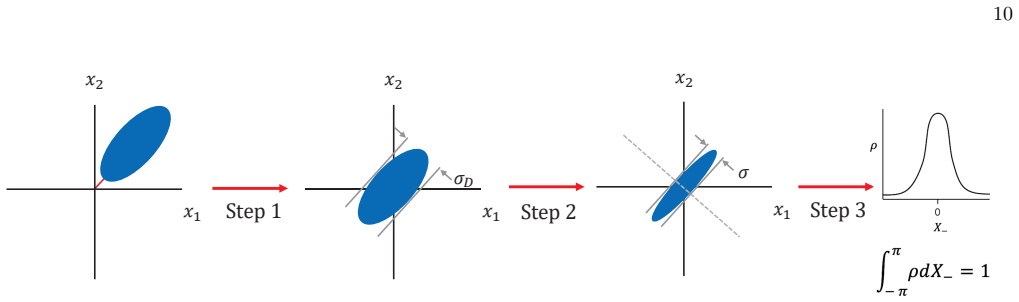
The load-bearing object is the cost function $C(r,\varepsilon,\varepsilon',N'_B,\Delta\phi) = -\rho(0,r,\varepsilon,\varepsilon',N'_B,\Delta\phi) = -\sqrt{2/(\pi(\mathrm{tr}A+2A_{1,2}))}$, obtained by projecting the Wigner function of the noisy two-mode squeezed state onto the amplitude-difference quadrature $(q_1-q_2)/\sqrt{2}$ and taking its peak value at $X_-=0$; $A$ is the $2\times 2$ matrix in Eq. (4) depending on squeezing $r$, transmission efficiencies $\varepsilon,\varepsilon'$, seed excess noise $N'_B$, and phase difference $\Delta\phi$. This cost function is evaluated from homodyne measurement statistics and minimized by gradient descent on $\phi_c$. The squeezing parameter $r$ acts as a landscape dial: it controls the curvature $f(N)$ near the minimum, which enters the quadratic expansion $C \approx -1 + f(N)\Delta\phi^2/2$ and therefore sets both the achievable phase precision and the gradient magnitude available for training.
What would settle it
Lock the apparatus at each detuning and measure the amplitude-difference squeezing directly at $\Delta\phi=0$ with an independent characterization, then check whether the observed phase standard deviation and time-to-solution follow the $f(N)$-based scalings with that independently measured $r$; separately, run the compiler with a coherent-state probe of equal total photon number, because if its precision and speed match the squeezed-resource results, the claimed quantum advantage is falsified.
Extended reading notes
Core claim
Using a two-mode squeezed state produced by four-wave mixing in a rubidium vapor cell, the authors implement a variational quantum compilation algorithm that learns the phase $\phi_0$ of a target optical phase gate. A control phase $\phi_c$ is adjusted by gradient descent to minimize a cost function defined as the negative peak value of the homodyne-measured marginal distribution of the amplitude-difference quadrature; minimizing this cost drives $\phi_c$ to $\phi_0$. The central discovery is that the squeezing parameter $r$ tunes the shape of this cost function: increasing $r$ narrows the minimum and steepens its slopes, which simultaneously raises the precision with which $\phi_0$ can be estimated and shortens the time-to-solution. Quantitatively, the measured phase standard deviation falls from 513.8 mrad at $r=0.18$ to 96 mrad at $r=0.74$ (a 5.4-fold precision gain), while convergence time falls from 470 to 130 iterations (a 3.6-fold speedup). In the ideal limit the cost function's curvature grows with $f(N)=\sqrt{N(N+1)}(2\sqrt{N(N+1)}+(2N+1))$, so the phase error scales as $\delta/N^2$ with the squeezed photon number $N$, which the paper presents as evidence for Heisenberg-like scaling and for a genuine quantum advantage.
Load-bearing premise
The whole quantitative story depends on modeling the four-wave-mixing resource as a two-mode squeezed state with one excess-noise parameter and noiseless attenuation; the fit of this model to the homodyne data supplies the $r$ values, the convergence thresholds, and the cost curves, and the paper's own Appendix D notes the model ignores distributed gain and loss in the medium, which would increase the effective input noise.
Editorial extensions
If this is right
- At higher squeezing, the same compiler yields more precise phase estimates while converging in fewer iterations, so squeezing is a tunable resource rather than a fixed noise cost.
- Because the cost curvature grows with $f(N)$, the phase error scales as $\delta/N^2$ in the ideal lossless case, approaching the Heisenberg limit set by squeezed-light interferometry.
- The adaptive strategy of starting at low squeezing and increasing it during training can avoid the barren-plateau regime at high squeezing, making the compiler trainable at precision that would otherwise be inaccessible.
- The same cost-function construction generalizes to learning other Gaussian unitary parameters from homodyne data, since Gaussian states are fully characterized by first and second quadrature moments.
- The demonstrated quantum advantage, if it holds, means continuous-variable variational compilers can outperform equal-energy classical or coherent-state counterparts on phase learning.
Reading between the lines
- Beyond the paper, a direct head-to-head test against an equal-energy coherent-state probe, rather than only the theoretical comparison in Eq. (8), would put the 'quantum correlations, not photon number' claim on firmer experimental footing.
- Beyond the paper, the proposed low-to-high squeezing schedule could be tested by comparing random initialization with the adaptive schedule at the same final squeezing, checking whether barren-plateau avoidance actually delivers the projected precision gains.
- Beyond the paper, the cost-function readout relies on one Gaussian marginal; extending it to multi-parameter Gaussian unitaries such as beam splitters would require tracking more than one marginal, and the paper's Appendix C notes that the simple moment-based cost is not universal.
- Beyond the paper, if the single-excess-noise model underestimates distributed gain and loss in the medium, the inferred $r$ values may be systematically biased, and a more detailed model would likely change the quantitative precision scaling even if the qualitative trend survives.
Editorial analysis
A structured set of objections, weighed in public.
Referee Report
Summary. This paper reports an experimental continuous-variable (CV) quantum compiler that learns a single optical phase gate via gradient descent. The resource is a two-mode squeezed state (TMSS) generated by four-wave mixing in a truncated SU(1,1) interferometer. The authors derive a cost function from the amplitude-difference marginal of the Wigner function, fit their measured cost curves to a noisy-TMSS model with two free parameters, and show that increasing the effective squeezing parameter r narrows the cost landscape, speeds convergence (3.6-fold reduction in iterations to convergence), and improves the reported phase precision (5.4-fold between r=0.18 and r=0.74). They also present a theoretical analysis of the cost landscape and claim that the observed enhancements constitute a 'genuine quantum advantage' driven by quantum correlations rather than total photon number. The paper includes detailed appendices on data processing, parameter estimation, and robustness checks.
Significance. If supported, this would be a valuable first experimental demonstration of a squeezing-based CV variational quantum compiler, with a practical cost function, direct comparison to theoretical predictions, and a tunable landscape that connects to barren-plateau avoidance in the CV setting. The theoretical cost-function derivation is explicit, and Eq. (5) provides a parameter-free prediction of the lossless precision scaling given the squeezing parameter, which is a notable strength. The experimental methods are detailed, including noise modeling, AIC-based model comparison, and robustness tests over target/control phases. However, the central quantitative claims—the 5.4-fold and 3.6-fold factors and, especially, the asserted 'genuine quantum advantage'—are not fully supported by the data as presented, so the significance of the paper currently rests on the more modest demonstration of a controllable CV compiler.
major comments (3)
- [Section IV] The claim of a 'genuine quantum advantage' over an equal-energy classical (coherent-state) resource is not supported by the data. No equal-energy coherent-state control experiment is reported, and the cost function defined in Eq. (3) is phase-insensitive for coherent states because the quadrature-noise marginal of a coherent state has constant variance independent of Δφ. The interpolating analysis in Eqs. (8)–(10) lives on the seeded-TMSS manifold and does not compare against an optimized coherent-state phase-estimation strategy with the same total photon number and measurement time. The observed 5.4-fold precision increase and 3.6-fold speedup could in principle arise from increased photon number, higher local-oscillator power, or improved signal-to-noise rather than from two-mode squeezing correlations. To substantiate the 'quantum correlations, not merely total photon number' statement, the authors should either add a resource-accounted comparison with a classical baseline using a phase-sensitive readout, or explicitly temper the claim to a demonstration of enhanced precision and speed with squeezed resources without asserting genuine quantum advantage.
- [Section III, Table I, and Appendix B] The 5.4-fold precision factor rests on N=5 runs per squeezing value with no uncertainty reported on σΔφ, and the N=15 validation run in Appendix B yields a smaller factor of 4.15 with a modified learning rate. The paper does not provide error bars, confidence intervals, or a statistical test that the precision ratio differs from what could be obtained from noisy data. Please report the uncertainty on the σΔφ estimates (e.g., bootstrap or chi-square intervals) or present the factor as a qualitative trend rather than a precise quantitative claim. In addition, the claim that the measurements are 'unbiased' is not persuasive given the relatively large phase-difference means in Table I (e.g., 90 mrad for r=0.18) and especially in Table II (485 mrad for r=0.18), where the authors attribute the offset to the learning rate; this should be discussed quantitatively.
- [Appendix D] The inferred squeezing parameters r=0.18, 0.35, and 0.74, and hence the theoretical cost curves and the quoted precision scaling, depend on a model that the authors themselves state neglects distributed gain and loss in the four-wave mixing medium and underestimates the effective input noise Nin. The fitting procedure constrains r through a relation r(Nin, ε') that is derived from this simplified model, so the reported ratios and the 'validated' scaling could shift under a different noise model. Please provide a sensitivity analysis showing how the extracted r values and the resulting precision/speed-up factors change under the alternative noisy-homodyne model (or a model that incorporates distributed loss), rather than only reporting the AIC difference.
minor comments (6)
- [Section II A and II C] The text refers to the main experimental schematic as Fig. 4(a) and Fig. 4(b), but the schematic with panels (a) and (b) appears to be Fig. 1; the later Fig. 4 is the data-processing validation diagram. Please correct the cross-references.
- [Section II A] There is a typo: 'homoydne detection' should be 'homodyne detection'.
- [Appendix D] The sentence 'expressed as, expressed as' contains a duplicated phrase.
- [Appendix E] The text 'over the thee runs' should read 'over the three runs'.
- [Appendix B] The quantity σΔσ in the paragraph describing Table II should be σΔφ.
- [Fig. 4] The figure title says 'complimentary data processing procedure'; 'complimentary' should be 'complementary'.
Circularity Check
No circularity: the precision scaling is an analytic expansion of a self-contained cost model, and the reported precision/speedup factors are measured rather than fitted.
full rationale
Walking the derivation chain, the cost function C (Eq. 3) is obtained from the Wigner marginal of a noisy TMSS in Appendix C, and the ideal precision scaling Eqs. (5)-(6) follows by Taylor expansion of that cost function. This scaling is an analytic prediction for a given squeezing parameter; it is not fitted to the measured phase statistics. The experimental squeezing parameters r are estimated from independent amplitude-difference squeezing and loss measurements subject to a two-parameter fit of the cost model, but the reported 5.4x precision factor and 3.6x time-to-solution factor are measured quantities from the QCA runs (Table I), not values extracted from the fitted cost function. The paper explicitly notes that Eq. (3) is not applicable to coherent states, so the 'genuine quantum advantage' claim in Section IV lacks an equal-energy classical control and is therefore not established; however, that is a benchmark/comparison gap, not a case of a prediction being equivalent to its input by construction. Self-citations to Ref. [26] motivate the landscape-narrowing and barren-plateau discussion, but the cost-function derivation is self-contained in Appendix C and the barren-plateau instance is also shown experimentally, so the citations are not load-bearing in a circular way. No equation in the paper reduces to another by construction, and no fitted parameter is renamed as an independent prediction. Therefore no significant circularity is identified.
Assumptions & free parameters
free parameters (3)
- Effective squeezing parameter r =
0.18, 0.35, 0.74
- Probe excess noise N'_B (input noise Nin) =
N'_B = 1.08, 1.08, 2.37 (Nin = 1.58, 1.58, 2.87)
- Probe transmissivity epsilon' =
0.69, 0.70, 0.59
assumptions (4)
- domain assumption The four-wave-mixing output is a Gaussian TMSS described by Eq C4: thermal excess noise in the probe, vacuum conjugate, noiseless attenuation channels, and no distributed gain or loss.
- domain assumption The peak of the X- marginal of the Wigner function is a faithful cost function with a unique global minimum at Delta phi = 0.
- domain assumption The weak coherent seed used for phase locking does not affect the cost function because the cost is computed from fluctuations about the mean.
- standard math Shot-noise calibration assumes a minimum-uncertainty quadrature variance of 1/2 for the vacuum.
Cite this review
Pith. "Pith review of Variational optical phase learning on a continuous-variable quantum compiler." pith.science (2026). https://pith.science/paper/4JYFTPBS
@misc{pith2026250210242,
  author       = {Pith},
  title        = {Pith review of: Variational optical phase learning on a continuous-variable quantum compiler},
  year         = {2026},
  howpublished = {\url{https://pith.science/paper/4JYFTPBS}},
  note         = {Machine review of arXiv:2502.10242}
}
read the original abstract
Quantum process learning is a fundamental primitive that draws inspiration from machine learning with the goal of better studying the dynamics of quantum systems. One approach to quantum process learning is quantum compilation, whereby an analog quantum operation is digitized by compiling it into a series of basic gates. While there has been significant focus on quantum compiling for discrete-variable systems, the continuous-variable (CV) framework has received comparatively less attention. We present an experimental implementation of a CV quantum compiler that uses two mode-squeezed light to learn a Gaussian unitary operation. We demonstrate the compiler by learning a parameterized linear phase unitary through the use of target and control phase unitaries to demonstrate a factor of 5.4 increase in the precision of the phase estimation and a 3.6-fold acceleration in the time-to-solution metric when leveraging quantum resources. Our results are enabled by the tunable control of our cost landscape via variable squeezing, thus providing a critical framework to simultaneously increase precision and reduce time-to-solution.
Figures


Figures from the paper (5 more)


Reference graph
Works this paper leans on
-
[1]
can then be used to compute the Wigner function via the Fourier transform of the characteristic function [46]. Given the correlations that are present between the amplitude difference and phase sum quadratures in a TMSS, to obtain a cost function that can be efficiently evaluated through homodyne detection, we choose to project the Wigner function onto the a...
-
[2]
The distribution of such joint quadrature with eigenvalue X− = ( x1 − x2)/ √ 2 is obtained via ρ(X−, r, ε, ε′, N ′ B, ∆ φ) := 1 4 ∫ R3 dX+dy1dy2W (x1, y1, x2, y2), (2) where y1 and y2 are the eigenvalues of the phase quadra- tures of the respective modes and X+ = (x1 + x2)/ √ 2 is the eigenvalue of the quadrature sum, ( q1 + q2)/ √ 2. Finally, to obtain a...
-
[3]
# CPU !",!#,$% HD & $' HD !
to obtain the cost function 3 a) ! "# CPU !",!#,$% HD & $' HD !" !# $% | ()**+,-. / | 01+ 23;456 7 *#287 b) | !" (0;1/2) FIG. 1. (a) Schematic of a continuous-variable (CV) quantum compiler. A parameteric amplifier is weakly seeded with a noi sy probe beam modeled as a thermal state, ρPr, with no displacement, i.e. ρPr(0; Nin) = D(0)ρPr(Nin)D†(0) where D(α...
-
[4]
Vari- ational quantum gate optimization,
K. Heya, Y. Suzuki, Y. Nakamura, and K. Fujii, “Vari- ational quantum gate optimization,” arXiv preprint arXiv:1810.12745 (2018)
arXiv 2018
-
[5]
Although in both Eqs
is defined in terms of the quadrature noise properties of the resource state and is not applicable to pure coherent states because it contains no information about ∆ φ in this case. Although in both Eqs. (
-
[6]
and ( 8) the physical source of the precision advantage (namely quadrature squeez- ing) is the same as in homodyne readout of a Mach- Zehnder interferometer, the gradient-descent based al- gorithm learns φ0 by tuning φc and calculating the cost function, not by directly estimating the φ0 phase shift. Our demonstration of this approach in Section II C show...
-
[7]
We reduce the number of fit parameters by directly mea- suring the degree of squeezing and losses after the FWM process
and Eq.( 4), were obtained using a maximum likelihood fit of C to the data. We reduce the number of fit parameters by directly mea- suring the degree of squeezing and losses after the FWM process. This leaves only two fitting parameters: the ex- cess noise for the input probe seed, N ′ B, and the probe transmissivity, ε′. Determining these parameters also al...
-
[8]
reduces to the same quadratic scaling found in Eq. ( 5), −1 + 2N 2 ∆ φ2 + o(∆ φ4), (9) yielding ∆ φ2 ∝ δ/N 2 when the cost function is within δ of the minimum, thereby recovering Heisenberg scaling of the precision, where here N = sinh 2 r. In the opposite limit of negligible squeezing r → 0, Eq. ( 8) simplifies to −1 + N 2 ∆ φ4 + o(∆ φ4), (10) where N = α...
Show all 88 references
-
[9]
demonstrates that squeezing dramat- ically steepens the cost function slope near the neigh- borhood of the minimum, allowing faster convergence to a more precise phase difference estimate. We also show that our cost function-based readout allows one to ap- proach the Heisenberg...
2000
-
[10]
Our non- universal cost function is obtained by finding the maxi- mum of ρ(X−), which is simply related to the variance of X−. For our optical phase compiling task, we use a model of the resource state ξ that, in addition to being parameterized by the target phase φ0 and the co...
-
[11]
Here 12% of the FWHM was chosen as it minimized the residuals in our fits to the theory model. We then express the cost function C = −[2π⟨∆ X 2 −⟩]− 1 2 in terms of the free parameters ǫ′, N ′ B and the constrained r(ǫ′, N ′ B), and performed a nonlinear least squares minimizat...
2000
-
[12]
An introduction to quantum machine learning,
I. S. Maria Schuld and F. Petruccione, “An introduction to quantum machine learning,” Contemporary Physics 56, 172 (2015)
2015
-
[13]
Recent advances in quantum ma- chine learning,
Y. Zhang and Q. Ni, “Recent advances in quantum ma- chine learning,” Quantum Engineering 2, e34 (2020)
2020
-
[14]
Quantum-assisted quan- tum compiling,
S. Khatri, R. LaRose, A. Poremba, L. Cincio, A. T. Sornborger, and P. J. Coles, “Quantum-assisted quan- tum compiling,” Quantum 3, 140 (2019)
2019
-
[15]
No free lunch for quantum machine learning,
K. Poland, K. Beer, and T. J. Osborne, “No free lunch for quantum machine learning,” arXiv preprint arXiv:2003.14103 (2020)
2020 arXiv
-
[16]
Reformulation of the no-free- lunch theorem for entangled datasets,
K. Sharma, M. Cerezo, Z. Holmes, L. Cincio, A. Sorn- borger, and P. J. Coles, “Reformulation of the no-free- lunch theorem for entangled datasets,” Physical Review Letters 128, 070501 (2022)
2022
-
[17]
Continuous-variable quantum neural networks,
N. Killoran, T. R. Bromley, J. M. Arrazola, M. Schuld, N. Quesada, and S. Lloyd, “Continuous-variable quantum neural networks,” Physical Review Research 1, 033063 (2019)
2019
-
[18]
Variational fast forwarding for quan- tum simulation beyond the coherence time,
C. Cirstoiu, Z. Holmes, J. Iosue, L. Cincio, P. J. Coles, and A. Sornborger, “Variational fast forwarding for quan- tum simulation beyond the coherence time,” npj Quan- tum Information 6, 1 (2020)
2020
-
[19]
Long-time simulations for fixed input states on quantum hardware,
J. Gibbs, K. Gili, Z. Holmes, B. Commeau, A. Arrasmith, L. Cincio, P. J. Coles, and A. Sornborger, “Long-time simulations for fixed input states on quantum hardware,” npj Quantum Information 8, 135 (2022)
2022
-
[20]
Dynami- cal simulation via quantum machine learning with prov- able generalization,
J. Gibbs, Z. Holmes, M. C. Caro, N. Ezzell, H.-Y. Huang, L. Cincio, A. T. Sornborger, and P. J. Coles, “Dynami- cal simulation via quantum machine learning with prov- able generalization,” arXiv preprint arXiv:2204.10269 (2022)
2022 arXiv
-
[21]
Experimental quantum learning of a spectral decompo- sition,
M. R. Geller, Z. Holmes, P. J. Coles, and A. Sornborger, “Experimental quantum learning of a spectral decompo- sition,” Physical Review Research 3, 033200 (2021)
2021
-
[22]
Quantum advantage in learning from experiments,
H.-Y. Huang, M. Broughton, J. Cotler, S. Chen, J. Li, M. Mohseni, H. Neven, R. Babbush, R. Kueng, J. Preskill, and J. R. McClean, “Quantum advantage in learning from experiments,” Science 376, 1182 (2022)
2022
-
[23]
Generalization in quantum machine learning from few training data,
M. C. Caro, H.-Y. Huang, M. Cerezo, K. Sharma, A. Sornborger, L. Cincio, and P. J. Coles, “Generalization in quantum machine learning from few training data,” Nature Communications 13, 4919 (2022)
2022
-
[24]
Out- of-distribution generalization for learning quantum dy- namics,
M. C. Caro, H.-Y. Huang, N. Ezzell, J. Gibbs, A. T. Sornborger, L. Cincio, P. J. Coles, and Z. Holmes, “Out- of-distribution generalization for learning quantum dy- namics,” Nature Communications 14, 3751 (2023)
2023
-
[25]
Learning to pre- dict arbitrary quantum processes,
H.-Y. Huang, S. Chen, and J. Preskill, “Learning to pre- dict arbitrary quantum processes,” Physical Review X Quantum 4, 040337 (2023)
2023
-
[26]
Learning Quantum Processes and Hamilto- nians via the Pauli Transfer Matrix,
M. C. Caro, “Learning Quantum Processes and Hamilto- nians via the Pauli Transfer Matrix,” ACM Transactions on Quantum Computing 5, 10.1145/3670418 (2024)
2024 doi
-
[27]
The power and limitations of learning quantum dynamics incoherently,
S. Jerbi, J. Gibbs, M. S. Rudolph, M. C. Caro, P. J. Coles, H.-Y. Huang, and Z. Holmes, “The power and limitations of learning quantum dynamics incoherently,” arXiv preprint arXiv:2303.12834 (2023)
2023 arXiv
-
[28]
Universal compilation for quantum state tomography,
V. T. Hai and L. B. Ho, “Universal compilation for quantum state tomography,” Scientific Reports 13, 3750 (2023)
2023
-
[29]
Generalization of Quantum Machine Learning Models Using Quantum Fisher Infor- mation Metric,
T. Haug and M. S. Kim, “Generalization of Quantum Machine Learning Models Using Quantum Fisher Infor- mation Metric,” Physical Review Letters 133, 050603 (2024)
2024
-
[30]
Variational spin-squeezing algorithms on programmable quantum sensors,
R. Kaubruegger, P. Silvi, C. Kokail, R. van Bijnen, A. M. Rey, J. Ye, A. M. Kaufman, and P. Zoller, “Variational spin-squeezing algorithms on programmable quantum sensors,” Physical Review Letters 123, 260505 (2019)
2019
-
[31]
Optimal and variational multiparameter quan- tum metrology and vector-field sensing,
R. Kaubruegger, A. Shankar, D. V. Vasilyev, and P. Zoller, “Optimal and variational multiparameter quan- tum metrology and vector-field sensing,” Physical Review X Quantum 4, 020333 (2023)
2023
-
[32]
Inference- based quantum sensing,
C. Huerta Alderete, M. H. Gordon, F. Sauvage, A. Sone, 16 A. T. Sornborger, P. J. Coles, and M. Cerezo, “Inference- based quantum sensing,” Physical Review Letters 129, 190501 (2022)
2022
-
[33]
Learning quantum states of continuous variable systems,
F. A. Mele, A. A. Mele, L. Bittel, J. Eisert, V. Giovan- netti, L. Lami, L. Leone, and S. F. E. Oliviero, “Learning quantum states of continuous variable systems,” arXiv preprint arXiv:2405.01431 (2024)
2024
-
[34]
Variational prepa- ration of entangled states on quantum computers,
V. T. Hai, N. T. Viet, and L. B. Ho, “Variational prepa- ration of entangled states on quantum computers,” arXiv preprint arXiv:2306.17422 (2023)
2023 arXiv
-
[35]
Learning the quantum algorithm for state overlap,
L. Cincio, Y. Suba¸ sı, A. T. Sornborger, and P. J. Coles, “Learning the quantum algorithm for state overlap,” New Journal of Physics 20, 113022 (2018)
2018
-
[36]
Uni- versal compiling and (No-)Free-Lunch Theorems for Continuous-Variable Quantum Learning,
T. J. Volkoff, Z. Holmes, and A. Sornborger, “Uni- versal compiling and (No-)Free-Lunch Theorems for Continuous-Variable Quantum Learning,” Physical Re- view X Quantum 2, 040327 (2021)
2021
-
[37]
Learning linear opti- cal circuits with coherent states,
T. Volkoff and A. T. Sornborger, “Learning linear opti- cal circuits with coherent states,” Journal of Physics A: Mathematical and Theoretical 57, 305302 (2024)
2024
-
[38]
Strategies for Variational Quantum Com- piling of a Zero-Phase Beam Splitter on the Xanadu X8 Processor,
T. J. Volkoff, “Strategies for Variational Quantum Com- piling of a Zero-Phase Beam Splitter on the Xanadu X8 Processor,” Journal of Russian Laser Research 43, 448 (2022)
2022
-
[39]
Robust quantum compi- lation and circuit optimisation via energy minimisation,
T. Jones and S. C. Benjamin, “Robust quantum compi- lation and circuit optimisation via energy minimisation,” Quantum 6, 628 (2022)
2022
-
[40]
Quantum computational advantage with a programmable photonic processor,
L. S. Madsen, F. Laudenbach, M. F. Askarani, F. Rortais, T. Vincent, J. F. F. Bulmer, F. M. Miatto, L. Neuhaus, L. G. Helt, M. J. Collins, A. E. Lita, T. Gerrits, S. W. Nam, V. D. Vaidya, M. Menotti, I. Dhand, Z. Vernon, N. Que- sada, and J. Lavoie, “Quantum computational adva...
2022
-
[41]
Quantum Machine Learning in Feature Hilbert Spaces,
M. Schuld and N. Killoran, “Quantum Machine Learning in Feature Hilbert Spaces,” Physical Review Letters 122, 040504 (2019)
2019
-
[42]
Quantum Sensing with Squeezed Light,
B. J. Lawrie, P. D. Lett, A. M. Marino, and R. C. Pooser, “Quantum Sensing with Squeezed Light,” ACS Photonics 6, 1307 (2019)
2019
-
[43]
Quantum Enhanced Probes of Magnetic Circular Dichroism,
C. Hua, C. E. Marvinney, S. Hong, M. Feldman, Y.-Y. Pai, M. Chilcote, J. Rabinowitz, R. C. Pooser, A. M. Marino, and B. J. Lawrie, “Quantum Enhanced Probes of Magnetic Circular Dichroism,” Advanced Quantum Tech- nologies, 2300126 (2023)
2023
-
[44]
Distributed quantum sens- ing in a continuous-variable entangled network,
X. Guo, C. R. Breum, J. Borregaard, S. Izumi, M. V. Larsen, T. Gehring, M. Christandl, J. S. Neergaard- Nielsen, and U. L. Andersen, “Distributed quantum sens- ing in a continuous-variable entangled network,” Nature Physics 16, 281 (2020)
2020
-
[45]
Determin- istic generation of a two-dimensional cluster state,
Mikkel V. Larsen, Xueshi Guo, Casper R. Breum, Jonas S. Neergaard-Nielsen, and Ulrik L. Andersen, “Determin- istic generation of a two-dimensional cluster state,” Sci- ence 366, 369 (2019)
2019
-
[46]
Generation of time-domain-multiplexed two- dimensional cluster state,
W. Asavanant, Y. Shiozawa, S. Yokoyama, B. Charoen- sombutamon, H. Emura, R. N. Alexander, S. Takeda, J. ichi Yoshikawa, N. C. Menicucci, H. Yonezawa, and A. Furusawa, “Generation of time-domain-multiplexed two- dimensional cluster state,” Science 366, 373 (2019)
2019
-
[47]
Encoding a qubit in an oscillator,
D. Gottesman, A. Kitaev, and J. Preskill, “Encoding a qubit in an oscillator,” Physical Review A 64, 012310 (2001)
2001
-
[48]
Quan- tum computing with rotation-symmetric bosonic codes,
A. L. Grimsmo, J. Combes, and B. Q. Baragiola, “Quan- tum computing with rotation-symmetric bosonic codes,” Physical Review X 10, 011058 (2020)
2020
-
[49]
Performance and structure of single-mode bosonic codes,
V. V. Albert, K. Noh, K. Duivenvoorden, D. J. Young, R. T. Brierley, P. Reinhold, C. Vuillot, L. Li, C. Shen, S. M. Girvin, B. M. Terhal, and L. Jiang, “Performance and structure of single-mode bosonic codes,” Physical Review A 97, 032346 (2018)
2018
-
[50]
Nonclassical Properties and Quantum Re- sources of Hierarchical Photonic Superposition States,
T. J. Volkoff, “Nonclassical Properties and Quantum Re- sources of Hierarchical Photonic Superposition States,” Journal of Experimental and Theoretical Physics 121, 770 (2015)
2015
-
[51]
Quantum Machine Learning over Infinite Dimensions,
H.-K. Lau, R. Pooser, G. Siopsis, and C. Weedbrook, “Quantum Machine Learning over Infinite Dimensions,” Physical Review Letters 118, 080501 (2017)
2017
-
[52]
Variational quantum algorithm for enhanced continuous variable optical phase sensing,
J. A. H. Nielsen, M. Kicinski, T. N. Arge, K. Vijayad- haran, J. Foldager, J. J. Meyer, J. S. Neergaard-Nielsen, T. Gehring, and U. L. Andersen, “Variational quantum algorithm for enhanced continuous variable optical phase sensing,” arXiv preprint arXiv:2312.1387 (2023)
2023
-
[53]
Continuous-variable quantum approximate optimiza- tion on a programmable photonic quantum processor,
Y. Enomoto, K. Anai, K. Udagawa, and S. Takeda, “Continuous-variable quantum approximate optimiza- tion on a programmable photonic quantum processor,” Physical Review Research 5, 043005 (2023)
2023
-
[54]
Entanglement-enabled advantage for learning a bosonic random displacement channel,
C. Oh, S. Chen, Y. Wong, S. Zhou, H.-Y. Huang, J. A. H. Nielsen, Z.-H. Liu, J. S. Neergaard-Nielsen, U. L. An- dersen, L. Jiang, and J. Preskill, “Entanglement-enabled advantage for learning a bosonic random displacement channel,” Physical Review Letters 133, 230604 (2024)
2024
-
[55]
Machine learning method for state preparation and gate synthesis on photonic quantum computers,
J. M. Arrazola, T. R. Bromley, J. Izaac, C. R. Myers, K. Br´ adler, and N. Killoran, “Machine learning method for state preparation and gate synthesis on photonic quantum computers,” Quantum Science and Technology , 024004 (2019)
2019
-
[56]
Serafini, Quantum Continuous Variables: A Primer of Theoretical Methods (CRC Press, 2017)
A. Serafini, Quantum Continuous Variables: A Primer of Theoretical Methods (CRC Press, 2017)
2017
-
[57]
Quantum-mechanical noise in an interfer- ometer,
C. M. Caves, “Quantum-mechanical noise in an interfer- ometer,” Physical Review D 23, 1693 (1981)
1981
-
[58]
Equivalence of quantum barren plateaus to cost concen- tration and narrow gorges,
A. Arrasmith, Z. Holmes, M. Cerezo, and P. J. Coles, “Equivalence of quantum barren plateaus to cost concen- tration and narrow gorges,” Quantum Science and Tech- nology 7, 045015 (2022)
2022
-
[59]
Efficient trainability of linear optical mod- ules in quantum optical neural networks,
T. J. Volkoff, “Efficient trainability of linear optical mod- ules in quantum optical neural networks,” Journal of Russian Laser Research 42, 250 (2021)
2021
-
[60]
Energy-dependent barren plateau in bosonic variational quantum circuits,
B. Zhang and Q. Zhuang, “Energy-dependent barren plateau in bosonic variational quantum circuits,” Quan- tum Science and Technology 10, 015009 (2024)
2024
-
[61]
Does provable absence of barren plateaus imply classical simulability? or, why we need to rethink variational quantum computing,
M. Cerezo, M. Larocca, D. Garc ´ ıa-Mart ´ ın, N. L. Diaz, P. Braccia, E. Fontana, M. S. Rudolph, P. Bermejo, A. Ijaz, S. Thanasilp, et al., “Does provable absence of barren plateaus imply classical simulability? or, why we need to rethink variational quantum computing,” arXiv...
2023 arXiv
-
[62]
Barren plateaus in quantum neural net- work training landscapes,
J. R. McClean, S. Boixo, V. N. Smelyanskiy, R. Babbush, and H. Neven, “Barren plateaus in quantum neural net- work training landscapes,” Nature Communications 9, 1 (2018)
2018
-
[63]
Con- necting ansatz expressibility to gradient magnitudes and barren plateaus,
Z. Holmes, K. Sharma, M. Cerezo, and P. J. Coles, “Con- necting ansatz expressibility to gradient magnitudes and barren plateaus,” Physical Review X Quantum 3, 010313 (2022)
2022
-
[64]
Cost function dependent barren plateaus in shal- low parametrized quantum circuits,
M. Cerezo, A. Sone, T. Volkoff, L. Cincio, and P. J. Coles, “Cost function dependent barren plateaus in shal- low parametrized quantum circuits,” Nature Communi- cations 12, 1 (2021). 17
2021
-
[65]
Entanglement-induced barren plateaus,
C. O. Marrero, M. Kieferov´ a, and N. Wiebe, “Entanglement-induced barren plateaus,” Physical Re- view X Quantum 2, 040316 (2021)
2021
-
[66]
Barren plateaus pre- clude learning scramblers,
Z. Holmes, A. Arrasmith, B. Yan, P. J. Coles, A. Al- brecht, and A. T. Sornborger, “Barren plateaus pre- clude learning scramblers,” Physical Review Letters 126, 190501 (2021)
2021
-
[67]
The adjoint is all you need: Characterizing barren plateaus in quantum ans¨ atze,
E. Fontana, D. Herman, S. Chakrabarti, N. Kumar, R. Yalovetzky, J. Heredge, S. Hari Sureshbabu, and M. Pistoia, “The adjoint is all you need: Characterizing barren plateaus in quantum ans¨ atze,” arXiv preprint arXiv:2309.07902 (2023)
2023 arXiv
-
[68]
A unified theory of barren plateaus for deep parametrized quantum circuits,
M. Ragone, B. N. Bakalov, F. Sauvage, A. F. Kemper, C. O. Marrero, M. Larocca, and M. Cerezo, “A unified theory of barren plateaus for deep parametrized quantum circuits,” arXiv preprint arXiv:2309.09342 (2023)
2023 arXiv
-
[69]
Strong relative intensity squeezing by four-wave mixing in rubidium vapor,
C. F. McCormick, V. Boyer, E. Arimondo, and P. D. Lett, “Strong relative intensity squeezing by four-wave mixing in rubidium vapor,” Optics Letters 32, 178 (2007)
2007
-
[70]
Strong low-frequency quantum correlations from a four-wave-mixing amplifier,
C. F. McCormick, A. M. Marino, V. Boyer, and P. D. Lett, “Strong low-frequency quantum correlations from a four-wave-mixing amplifier,” Physical Review A 78, 043816 (2008)
2008
-
[71]
Phase sensing beyond the standard quantum limit with a variation on the SU(1,1) interferometer,
B. E. Anderson, P. Gupta, B. L. Schmittberger, T. Hor- rom, C. Hermann-Avigliano, K. M. Jones, and P. D. Lett, “Phase sensing beyond the standard quantum limit with a variation on the SU(1,1) interferometer,” Optica 4, 752 (2017)
2017
-
[72]
Entangled images from four-wave mixing,
V. Boyer, A. M. Marino, R. C. Pooser, and P. D. Lett, “Entangled images from four-wave mixing,” Science 321, 544 (2008)
2008
-
[73]
A geometric-phase interferometer,
P. Hariharan and Maitreyee Roy, “A geometric-phase interferometer,” Journal of Modern Optics 39, 1811 (1992)
1992
-
[74]
Geometric phases in two-photon interference experiments,
J. Brendel, W. Dultz, and W. Martienssen, “Geometric phases in two-photon interference experiments,” Physical Review A 52, 2551 (1995)
1995
-
[75]
Nocedal and S
J. Nocedal and S. Wright, Numerical optimization (Springer Science & Business Media, 2006)
2006
-
[76]
Op- tical quantum states based on hot atomic ensembles and their applications,
K. Zhang, S. Liu, Y. Chen, X. Wang, and J. Jing, “Op- tical quantum states based on hot atomic ensembles and their applications,” Photonics Insights 1, R06 (2022)
2022
-
[77]
Goodfellow, Y
I. Goodfellow, Y. Bengio, and A. Courville, Deep Learn- ing (MIT Press, 2016)
2016
-
[78]
Rela- tive intensity squeezing by four-wave mixing with loss: an analytic model and experimental diagnostic,
M. Jasperse, L. D. Turner, and R. E. Scholten, “Rela- tive intensity squeezing by four-wave mixing with loss: an analytic model and experimental diagnostic,” Optics Express 19, 3765 (2011)
2011
-
[79]
Role of the phase-matching con- dition in nondegenerate four-wave mixing in hot vapors for the generation of squeezed states of light,
M. T. Turnbull, P. G. Petrov, C. S. Embrey, A. M. Marino, and V. Boyer, “Role of the phase-matching con- dition in nondegenerate four-wave mixing in hot vapors for the generation of squeezed states of light,” Physical Review A 88, 033845 (2013)
2013
-
[80]
Effect of imperfect homodyne visibility on multi-spatial- mode two-mode squeezing measurements,
P. Gupta, R. W. Speirs, K. M. Jones, and P. D. Lett, “Effect of imperfect homodyne visibility on multi-spatial- mode two-mode squeezing measurements,” Optics Ex- press 28, 652 (2020)
2020
-
[81]
Accuracy of quantum-state estimation utilizing Akaike’s information criterion,
K. Usami, Y. Nambu, Y. Tsuda, K. Matsumoto, and K. Nakamura, “Accuracy of quantum-state estimation utilizing Akaike’s information criterion,” Physical Review A 68, 022314 (2003)
2003
-
[82]
Quantum information cri- teria for model selection in quantum state estimation,
H. Yano and N. Yamamoto, “Quantum information cri- teria for model selection in quantum state estimation,” Journal of Physics A: Mathematical and Theoretical 56, 405301 (2023)
2023
-
[83]
Characterizing entan- glement sources,
P. Lougovski and S. J. van Enk, “Characterizing entan- glement sources,” Physical Review A 80, 052324 (2009)
2009
-
[84]
Information criteria for efficient quantum state estimation,
J. O. S. Yin and S. J. van Enk, “Information criteria for efficient quantum state estimation,” Physical Review A 83, 062110 (2011)
2011
-
[85]
En- gineering the level structure of a giant artificial atom in waveguide quantum electrodynamics,
A. M. Vadiraj, A. Ask, T. G. McConkey, I. Nsanzineza, C. W. S. Chang, A. F. Kockum, and C. M. Wilson, “En- gineering the level structure of a giant artificial atom in waveguide quantum electrodynamics,” Physical Review A 103, 023710 (2021)
2021
-
[86]
When quantum tomography goes wrong: drift of quantum sources and other errors,
S. J. van Enk and R. Blume-Kohout, “When quantum tomography goes wrong: drift of quantum sources and other errors,” New Journal of Physics 15, 025024 (2013)
2013
-
[87]
Method for identifying electromagneti- cally induced transparency in a tunable circuit quantum electrodynamics system,
Q.-C. Liu, T.-F. Li, X.-Q. Luo, H. Zhao, W. Xiong, Y.-S. Zhang, Z. Chen, J. S. Liu, W. Chen, F. Nori, J. S. Tsai, and J. Q. You, “Method for identifying electromagneti- cally induced transparency in a tunable circuit quantum electrodynamics system,” Physical Review A 93, 053838 (2016)
2016
-
[88]
K. P. Burnham and D. R. Anderson, Model Selection and Multimodel Inference: A Practical Information-Theoretic Approach, 2nd ed. (Springer Science & Business Media, New York, NY, 2002)
2002
Reviewed August 7, 2026 · model on record in the stance chip above.
Discussion (0). Continue with ORCID to comment.