Unsupervised Anomalous Trajectory Detection for Crowded Scenes
Pith reviewed 2026-05-25 10:49 UTC · model grok-4.3
The pith
Mean-shift clustering on trajectory features combined with entropy-based detection identifies anomalous paths in crowded videos without any labels.
A machine-rendered reading of the paper's core claim, the machinery that carries it, and where it could break.
Core claim
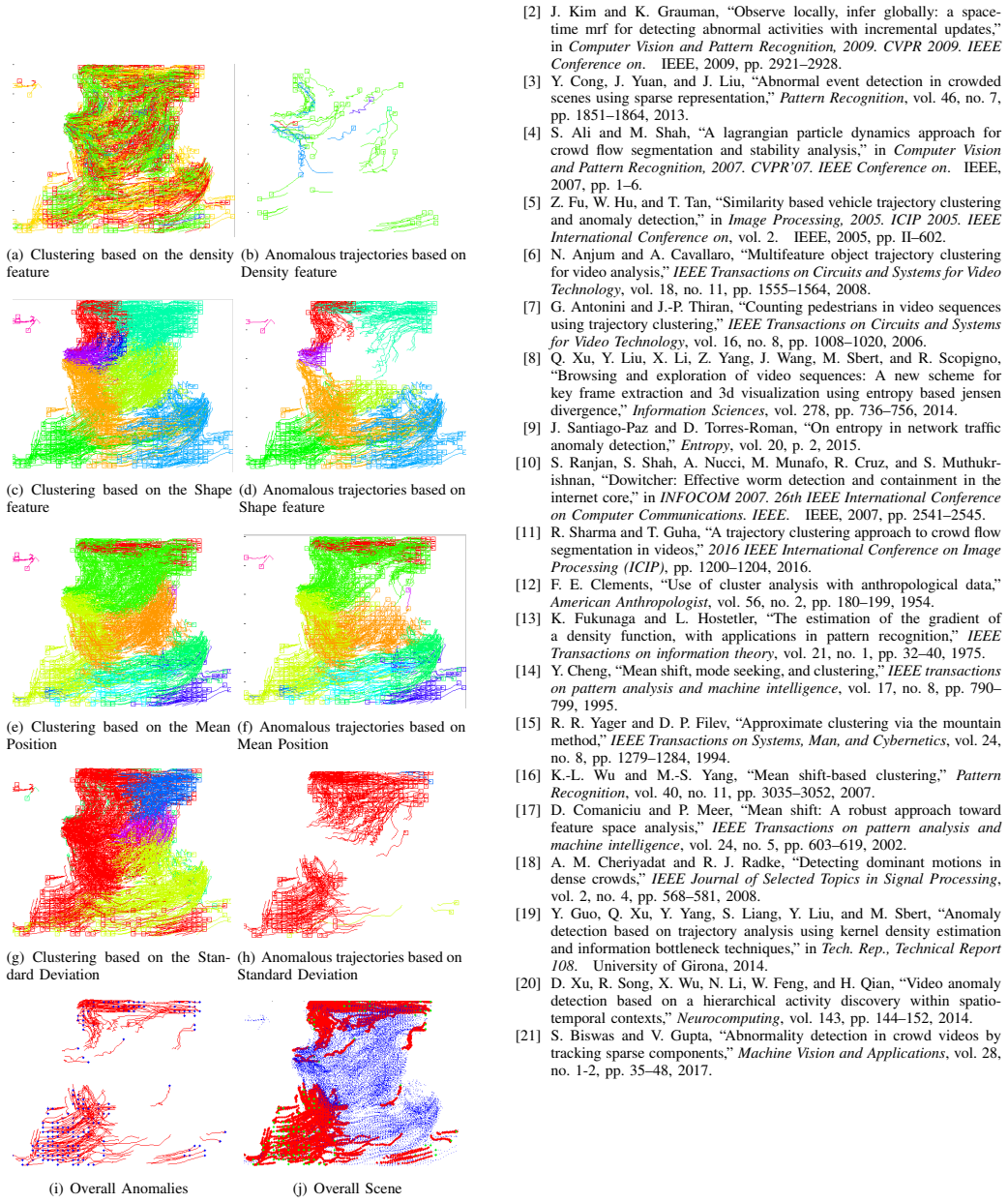
The algorithm extracts trajectories from crowded scene videos using a multi feature video object tracker, transforms them into feature spaces, performs independent mean-shift clustering on the feature matrices, identifies anomalies using a Shannon Entropy based detector, and applies a voting mechanism to select trajectories with anomalous characteristics. This process allows detection of expected anomalous trajectories in various crowd scenes with different motion patterns.
What carries the argument
Independent mean-shift clustering on trajectory feature matrices combined with Shannon entropy anomaly detection and a voting mechanism
If this is right
- The method detects anomalous trajectories in crowd videos from standard datasets representing various motion patterns.
- The unsupervised nature means no labeled data is required for training or detection.
- The voting mechanism combines information from multiple feature spaces to improve anomaly identification.
Where Pith is reading between the lines
- If the clustering reliably groups similar trajectories, the entropy measure could highlight outliers in feature distributions that correspond to unusual behaviors.
- This could be tested by applying the same pipeline to non-crowd videos such as sports or traffic to see if it generalizes beyond the paper's datasets.
Load-bearing premise
Independent mean-shift clustering on trajectory features combined with an entropy-based detector will reliably separate normal from anomalous trajectories without supervision or labeled data.
What would settle it
Running the algorithm on a crowded scene video containing known anomalous trajectories and observing whether it correctly identifies them or incorrectly labels normal trajectories as anomalous.
Figures
read the original abstract
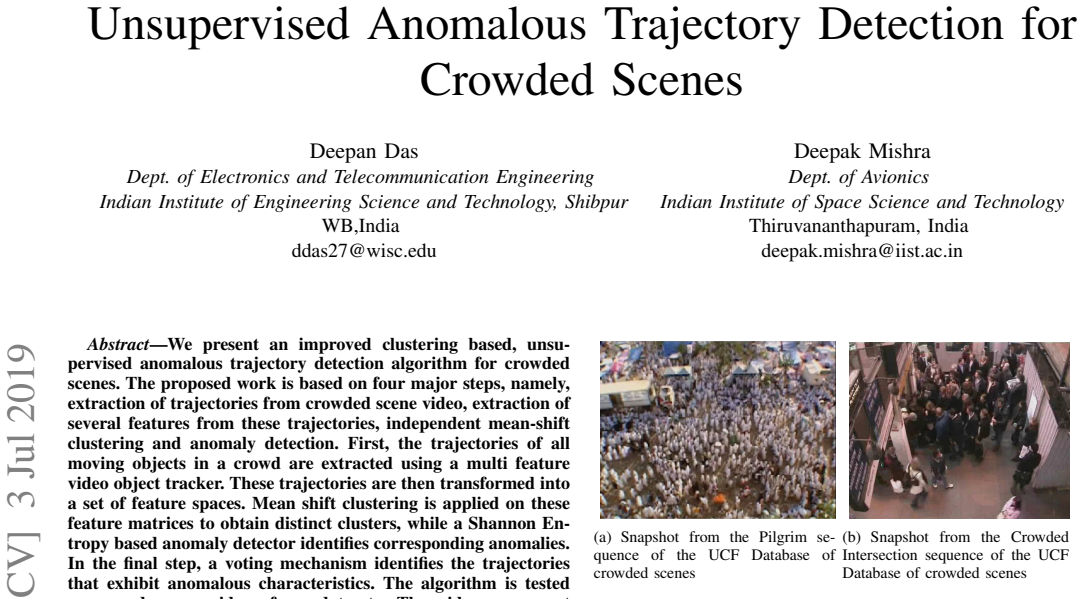
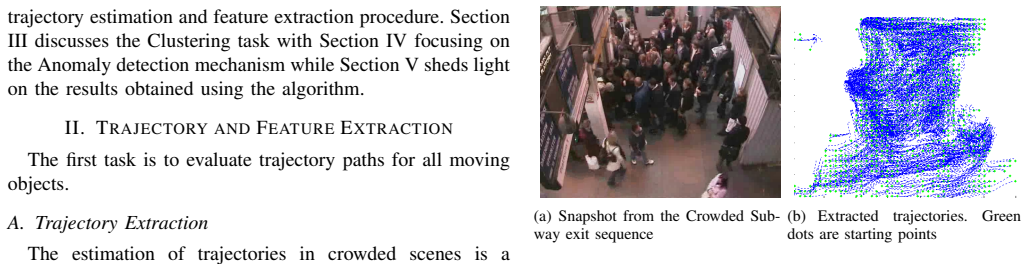
We present an improved clustering based, unsupervised anomalous trajectory detection algorithm for crowded scenes. The proposed work is based on four major steps, namely, extraction of trajectories from crowded scene video, extraction of several features from these trajectories, independent mean-shift clustering and anomaly detection. First, the trajectories of all moving objects in a crowd are extracted using a multi feature video object tracker. These trajectories are then transformed into a set of feature spaces. Mean shift clustering is applied on these feature matrices to obtain distinct clusters, while a Shannon Entropy based anomaly detector identifies corresponding anomalies. In the final step, a voting mechanism identifies the trajectories that exhibit anomalous characteristics. The algorithm is tested on crowd scene videos from datasets. The videos represent various possible crowd scenes with different motion patterns and the method performs well to detect the expected anomalous trajectories from the scene.
Editorial analysis
A structured set of objections, weighed in public.
Referee Report
Summary. The paper presents an unsupervised anomalous trajectory detection method for crowded scenes consisting of four steps: multi-feature video object tracking to extract trajectories, transformation of trajectories into multiple feature spaces, independent mean-shift clustering on the feature matrices, and Shannon entropy-based anomaly detection followed by a voting mechanism to identify anomalous trajectories. The algorithm is evaluated on crowd scene videos representing various motion patterns and is claimed to detect expected anomalies effectively.
Significance. If the pipeline can be shown to operate without supervision or data-dependent tuning while producing reliable separation of normal and anomalous trajectories, it would offer a practical contribution to video-based crowd monitoring. However, the absence of quantitative performance metrics, baseline comparisons, ablation studies, or details on hyperparameter selection in the abstract and method description makes it impossible to evaluate whether the claimed performance holds or advances the state of the art.
major comments (2)
- [Abstract / method description] Abstract and method description: the central claim that the approach is fully unsupervised and reliably separates normal from anomalous trajectories rests on mean-shift clustering and an entropy-based detector, yet no procedure is supplied for selecting the mean-shift kernel bandwidth or the entropy decision threshold. These choices are data-dependent and, if performed by inspection of the test videos, directly contradict the unsupervised guarantee.
- [Abstract] Abstract: the statement that 'the method performs well to detect the expected anomalous trajectories' is unsupported by any quantitative results, error bars, baseline comparisons, or ablation studies, so the performance claim cannot be verified and the soundness of the pipeline cannot be assessed.
Simulated Author's Rebuttal
We thank the referee for the constructive feedback on our manuscript. We address the major comments point by point below, clarifying the unsupervised aspects of the method and committing to revisions that strengthen the presentation without altering the core claims.
read point-by-point responses
-
Referee: [Abstract / method description] Abstract and method description: the central claim that the approach is fully unsupervised and reliably separates normal from anomalous trajectories rests on mean-shift clustering and an entropy-based detector, yet no procedure is supplied for selecting the mean-shift kernel bandwidth or the entropy decision threshold. These choices are data-dependent and, if performed by inspection of the test videos, directly contradict the unsupervised guarantee.
Authors: We agree that explicit procedures for parameter selection are necessary to substantiate the unsupervised claim. The mean-shift bandwidth is computed in a data-driven manner as the median of pairwise Euclidean distances within each feature matrix, a standard automatic heuristic that requires no labeled data or anomaly-specific inspection. The entropy threshold is set to the 95th percentile of the entropy values computed over all trajectories in a given scene, again derived solely from the data distribution. We will add a dedicated subsection in the revised method description detailing these procedures to eliminate any ambiguity. revision: yes
-
Referee: [Abstract] Abstract: the statement that 'the method performs well to detect the expected anomalous trajectories' is unsupported by any quantitative results, error bars, baseline comparisons, or ablation studies, so the performance claim cannot be verified and the soundness of the pipeline cannot be assessed.
Authors: The abstract is necessarily brief and focuses on the overall outcome. The full manuscript presents qualitative results across multiple crowd videos with varying motion patterns, showing that the voting mechanism correctly flags trajectories deviating from the dominant clusters. We acknowledge that quantitative support would allow better verification of the claims. In the revision we will augment the experimental section with detection accuracy figures on scenes containing known anomalies, plus comparisons against at least two published trajectory anomaly baselines. revision: yes
Circularity Check
No circularity: standard off-the-shelf clustering and entropy applied to trajectories
full rationale
The paper describes a pipeline of trajectory extraction, feature transformation, mean-shift clustering, Shannon entropy anomaly scoring, and voting. No equations, fitted parameters, or self-referential definitions are present in the abstract or method outline. Mean-shift and entropy are invoked as standard algorithms without any claim that a derived quantity is obtained by fitting to the same data it is then used to predict. The unsupervised claim rests on the absence of labels rather than on any internal derivation that reduces to its own inputs.
Axiom & Free-Parameter Ledger
axioms (2)
- domain assumption Mean-shift clustering applied independently to trajectory feature matrices produces distinct and meaningful groups of normal behavior.
- domain assumption Shannon entropy computed on trajectory features can serve as a reliable indicator of anomalous behavior.
Lean theorems connected to this paper
-
IndisputableMonolith/Cost/FunctionalEquation.leanwashburn_uniqueness_aczel unclear?
unclearRelation between the paper passage and the cited Recognition theorem.
Mean shift clustering is applied on these feature matrices to obtain distinct clusters, while a Shannon Entropy based anomaly detector identifies corresponding anomalies. In the final step, a voting mechanism identifies the trajectories that exhibit anomalous characteristics.
-
IndisputableMonolith/Foundation/RealityFromDistinction.leanreality_from_one_distinction unclear?
unclearRelation between the paper passage and the cited Recognition theorem.
The algorithm is tested on crowd scene videos from datasets... the method performs well to detect the expected anomalous trajectories from the scene.
What do these tags mean?
- matches
- The paper's claim is directly supported by a theorem in the formal canon.
- supports
- The theorem supports part of the paper's argument, but the paper may add assumptions or extra steps.
- extends
- The paper goes beyond the formal theorem; the theorem is a base layer rather than the whole result.
- uses
- The paper appears to rely on the theorem as machinery.
- contradicts
- The paper's claim conflicts with a theorem or certificate in the canon.
- unclear
- Pith found a possible connection, but the passage is too broad, indirect, or ambiguous to say the theorem truly supports the claim.
Reference graph
Works this paper leans on
-
[1]
How effective is human video surveillance performance?
N. Sulman, T. Sanocki, D. Goldgof, and R. Kasturi, “How effective is human video surveillance performance?” in Pattern Recognition, 2008. ICPR 2008. 19th International Conference on . IEEE, 2008, pp. 1–3. (a) Clustering based on the density feature (b) Anomalous trajectories based on Density feature (c) Clustering based on the Shape feature (d) Anomalous ...
work page 2008
-
[2]
J. Kim and K. Grauman, “Observe locally, infer globally: a space- time mrf for detecting abnormal activities with incremental updates,” in Computer Vision and Pattern Recognition, 2009. CVPR 2009. IEEE Conference on. IEEE, 2009, pp. 2921–2928
work page 2009
-
[3]
Abnormal event detection in crowded scenes using sparse representation,
Y . Cong, J. Yuan, and J. Liu, “Abnormal event detection in crowded scenes using sparse representation,” Pattern Recognition, vol. 46, no. 7, pp. 1851–1864, 2013
work page 2013
-
[4]
A lagrangian particle dynamics approach for crowd flow segmentation and stability analysis,
S. Ali and M. Shah, “A lagrangian particle dynamics approach for crowd flow segmentation and stability analysis,” in Computer Vision and Pattern Recognition, 2007. CVPR’07. IEEE Conference on . IEEE, 2007, pp. 1–6
work page 2007
-
[5]
Similarity based vehicle trajectory clustering and anomaly detection,
Z. Fu, W. Hu, and T. Tan, “Similarity based vehicle trajectory clustering and anomaly detection,” in Image Processing, 2005. ICIP 2005. IEEE International Conference on , vol. 2. IEEE, 2005, pp. II–602
work page 2005
-
[6]
Multifeature object trajectory clustering for video analysis,
N. Anjum and A. Cavallaro, “Multifeature object trajectory clustering for video analysis,” IEEE Transactions on Circuits and Systems for Video Technology, vol. 18, no. 11, pp. 1555–1564, 2008
work page 2008
-
[7]
Counting pedestrians in video sequences using trajectory clustering,
G. Antonini and J.-P. Thiran, “Counting pedestrians in video sequences using trajectory clustering,” IEEE Transactions on Circuits and Systems for Video Technology, vol. 16, no. 8, pp. 1008–1020, 2006
work page 2006
-
[8]
Q. Xu, Y . Liu, X. Li, Z. Yang, J. Wang, M. Sbert, and R. Scopigno, “Browsing and exploration of video sequences: A new scheme for key frame extraction and 3d visualization using entropy based jensen divergence,” Information Sciences , vol. 278, pp. 736–756, 2014
work page 2014
-
[9]
On entropy in network traffic anomaly detection,
J. Santiago-Paz and D. Torres-Roman, “On entropy in network traffic anomaly detection,” Entropy, vol. 20, p. 2, 2015
work page 2015
-
[10]
Dowitcher: Effective worm detection and containment in the internet core,
S. Ranjan, S. Shah, A. Nucci, M. Munafo, R. Cruz, and S. Muthukr- ishnan, “Dowitcher: Effective worm detection and containment in the internet core,” in INFOCOM 2007. 26th IEEE International Conference on Computer Communications. IEEE . IEEE, 2007, pp. 2541–2545
work page 2007
-
[11]
A trajectory clustering approach to crowd flow segmentation in videos,
R. Sharma and T. Guha, “A trajectory clustering approach to crowd flow segmentation in videos,” 2016 IEEE International Conference on Image Processing (ICIP), pp. 1200–1204, 2016
work page 2016
-
[12]
Use of cluster analysis with anthropological data,
F. E. Clements, “Use of cluster analysis with anthropological data,” American Anthropologist, vol. 56, no. 2, pp. 180–199, 1954
work page 1954
-
[13]
The estimation of the gradient of a density function, with applications in pattern recognition,
K. Fukunaga and L. Hostetler, “The estimation of the gradient of a density function, with applications in pattern recognition,” IEEE Transactions on information theory , vol. 21, no. 1, pp. 32–40, 1975
work page 1975
-
[14]
Mean shift, mode seeking, and clustering,
Y . Cheng, “Mean shift, mode seeking, and clustering,”IEEE transactions on pattern analysis and machine intelligence , vol. 17, no. 8, pp. 790– 799, 1995
work page 1995
-
[15]
Approximate clustering via the mountain method,
R. R. Yager and D. P. Filev, “Approximate clustering via the mountain method,” IEEE Transactions on Systems, Man, and Cybernetics , vol. 24, no. 8, pp. 1279–1284, 1994
work page 1994
-
[16]
K.-L. Wu and M.-S. Yang, “Mean shift-based clustering,” Pattern Recognition, vol. 40, no. 11, pp. 3035–3052, 2007
work page 2007
-
[17]
Mean shift: A robust approach toward feature space analysis,
D. Comaniciu and P. Meer, “Mean shift: A robust approach toward feature space analysis,” IEEE Transactions on pattern analysis and machine intelligence, vol. 24, no. 5, pp. 603–619, 2002
work page 2002
-
[18]
Detecting dominant motions in dense crowds,
A. M. Cheriyadat and R. J. Radke, “Detecting dominant motions in dense crowds,” IEEE Journal of Selected Topics in Signal Processing , vol. 2, no. 4, pp. 568–581, 2008
work page 2008
-
[19]
Y . Guo, Q. Xu, Y . Yang, S. Liang, Y . Liu, and M. Sbert, “Anomaly detection based on trajectory analysis using kernel density estimation and information bottleneck techniques,” in Tech. Rep., Technical Report
-
[20]
University of Girona, 2014
work page 2014
-
[21]
Video anomaly detection based on a hierarchical activity discovery within spatio- temporal contexts,
D. Xu, R. Song, X. Wu, N. Li, W. Feng, and H. Qian, “Video anomaly detection based on a hierarchical activity discovery within spatio- temporal contexts,” Neurocomputing, vol. 143, pp. 144–152, 2014
work page 2014
-
[22]
Abnormality detection in crowd videos by tracking sparse components,
S. Biswas and V . Gupta, “Abnormality detection in crowd videos by tracking sparse components,” Machine Vision and Applications , vol. 28, no. 1-2, pp. 35–48, 2017
work page 2017
discussion (0)
Sign in with ORCID, Apple, or X to comment. Anyone can read and Pith papers without signing in.