REVIEW 4 major objections 6 minor 29 references
Interpretable GOHR Agents via Sparse Autoencoders
T0 review · 4 major / 6 minor · reviewed 2026-07-31 · grok-4.5
Pith's one-line read Sparse autoencoders recover shape, bucket, and probe-and-switch strategies inside a frozen two-rule GOHR agent.
desk verdict Clean two-rule SAE case study with honest scope; the quantitative backbone is partly baked in by the action head and OR-recall, so the real interest is the strategy dimensions and the testbed framing. read the letter →
The pith
A machine-rendered reading of the paper's core claim, the machinery that carries it, and where it could break.
The reading
What carries the argument
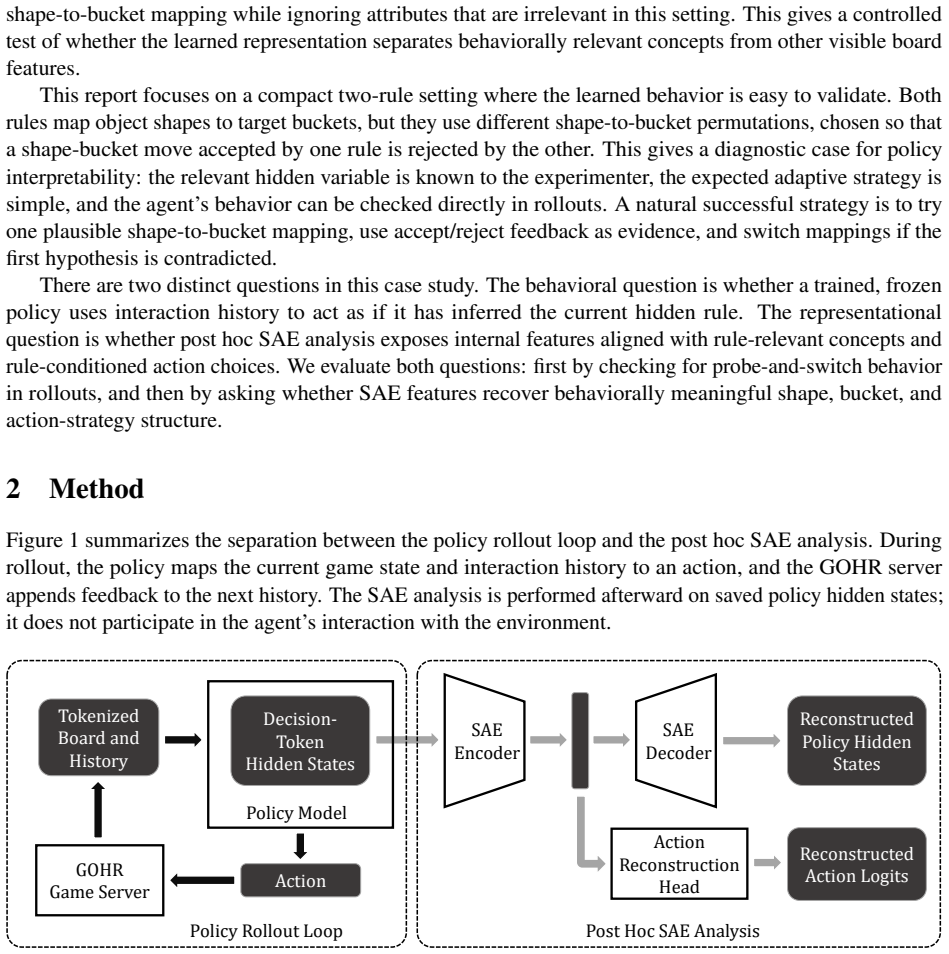
Post hoc sparse autoencoders on decision-token hidden states, trained with reconstruction, sparsity, and an auxiliary action-logit reconstruction head; concepts are scored by per-dimension precision and feature-set recall of the OR-combined selective dimensions.
What would settle it
Retrain or ablate the SAE without the action-reconstruction term and recompute the recall-vs-precision curves and top-dimension behavior profiles: if shape/bucket coverage and probe-and-switch dimensions collapse, the reported concept recovery is largely an artifact of that auxiliary objective and the OR metric.
Extended reading notes
Core claim
In a compact two-rule GOHR setting, sparse autoencoders trained on a frozen tokenized Transformer’s decision-token embeddings recover both aggregate task concepts (selected shape and bucket) with high feature-set recall at high per-dimension precision, and individual dimensions whose activations match interpretable rule-conditioned strategies such as probing one hypothesis and switching after negative feedback.
Load-bearing premise
The claim depends on treating high OR-combined feature-group recall, under an SAE objective that also pushes the code to reconstruct actions, as genuine recovery of internal concepts rather than redundant behavior-aligned dimensions.
Editorial extensions
If this is right
- Small rule-learning environments with known latent structure can serve as testbeds for SAE interpretability before larger agents or richer rule mixtures.
- Probe-and-switch behavior in frozen rollouts can be linked to specific SAE dimensions rather than only to external action traces.
- Concept-level feature-set recall can be checked against simple labels such as chosen shape and bucket even when the policy never receives a rule label.
- Alignment-oriented concept exposure can begin with sequential decision agents whose hidden variables are experimenter-known and behaviorally verifiable.
Reading between the lines
- If the same SAE readout works when more than two permutations or attribute-irrelevant distractors are added, GOHR becomes a scalable ladder for testing whether dictionary learning tracks latent rule inference rather than surface board tokens.
- Comparing SAEs with and without the action head would separate ‘features that explain actions’ from ‘features that merely reconstruct hidden states.’
- The qualitative episode heat maps suggest a practical audit loop: flag decisions where strategy-linked dimensions fire without matching accept/reject history.
Editorial analysis
A structured set of objections, weighed in public.
Referee Report
Summary. This technical report trains a small tokenized autoregressive Transformer (6 layers, d=256) via SFT warm start plus A2C on a two-rule instance of the Game of Hidden Rules, where both hidden rules are shape-to-bucket permutations (Table 1) chosen so that every shape maps to a different bucket across rules. The frozen policy is shown to exhibit a probe-and-switch strategy in rollouts (Fig. 3). The authors then train sparse autoencoders with an auxiliary action-reconstruction head (Eq. for L_SAE, α=0.1) on saved decision-token embeddings and report two results: (a) aggregate recovery of shape and bucket concepts, measured by recall of OR-combined feature groups D_c(τ) as a function of per-dimension precision threshold τ (Fig. 2, Table 4), and (b) individual SAE dimensions with interpretable rule-conditioned semantics, e.g., a dimension selective for circle→bucket-1 probe moves that succeed ~half the time (Fig. 4). The paper is explicit about scope (§3.6): two closely related rules, qualitative rollout evidence, and a feature-group metric that can hide redundancy.
Significance. If the results hold under appropriate controls, the paper provides a clean, fully checkable case study of SAE interpretability in a sequential decision-making agent: the latent variable (rule identity) is known to the experimenter, the expected strategy is simple, and recovered features can be cross-validated against rollout behavior. The three-view methodology (rollouts, concept-level recall curves, per-dimension profiles) is a reasonable template, and the two-rule probe-and-switch diagnostic is well designed for falsifiability — the pre-feedback unidentifiability argument is correctly stated. The report is commendably honest about its limitations (§3.6) and does not overclaim beyond the two-rule setting. However, the quantitative backbone (Table 4) currently lacks the baselines and controls needed to distinguish "SAE recovers concepts" from "concepts are linearly decodable from action-predictive codes," and the per-dimension findings rest on two hand-picked dimensions from a single run. As written, this is a useful but preliminary case study rather than a validated method demonstration.
major comments (4)
- [§2.3, §3.3, Table 4] Circularity risk in the aggregate-recovery claim. The SAE objective includes α‖G_η(z)−ℓ‖² with α=0.1, training z to linearly predict the policy's action logits. The evaluated concepts are components of that very action: the bucket decision is read out at ⟨bucket_cls⟩ (the policy factorization in §2.2 makes k_t an explicit output), and the chosen shape is determined by the chosen coordinates, also policy outputs. Table 4's bucket row — nAUC = 1.000, Recall@0.8 = 1.000 — is therefore close to a restatement of the auxiliary objective rather than an emergent finding, and the perfect score is more consistent with reconstruction-by-construction than with selective recovery. The load-bearing control is an ablation at α=0 (and ideally a sweep over α): does bucket-concept recall survive when the SAE is trained on reconstruction + sparsity alone? Without it, tier (a) of the central claim is not es
- [§2.3, Table 4, Fig. 2] The OR-combined recall metric is not controlled for feature-group size, and the reported numbers show the signature the paper itself warns about in §3.6. Recall(c,τ) = P(∃j∈D_c(τ): z_j>0 | c=1) increases mechanically with |D_c(τ)|, yet Table 4 reports only the number of concept groups (n=4/8), never the number of selected dimensions per concept at each τ. The bucket group at τ=0.8 has recall 1.000 but group precision 0.513 — nearly half the decisions where some bucket-selective feature fires do not involve that bucket — which is exactly the recall-by-redundancy pattern. There is also concrete evidence of group overlap: in Fig. 3(a), t=0, the Triangle and Bucket 2 cells both read 3.92, implying the same dimension attains the max in two different 'concept-specific' groups; the same pattern repeats (1.92 at t=1 across Triangle/Bucket 3; 4.56 at t=0 in panel (b) across Star/Bucket 3). Please
- [§3.3, Fig. 2 caption] Possible selection leakage in the precision/recall estimates. The caption states the curves are computed over 10,000 held-out activation samples, but it is not stated whether Prec(j,c) — used to select D_c(τ) — is estimated on a split disjoint from the samples on which Recall(c,τ) is evaluated. If the same 10,000 samples are used for both selection and evaluation, the recall curves are optimistically biased by selection, and the bias grows with the dictionary size. This is a cheap fix (split the held-out set) but it is load-bearing for every number in Table 4.
- [§3.5, Fig. 4; §3.2] Statistical robustness is insufficient for both tiers of the claim. The SAE analysis appears to be a single run ('the run analyzed here', §2.3) on a single trained policy, with no seeds, no error bars on Fig. 2, and no statement of dictionary width or sparsity level (dimension index 9697 implies a wide dictionary, which matters for interpreting per-dimension selectivity as a multiple-comparison problem: with ~10⁴ dimensions, some will look clean by chance, especially when profiles are summarized by the 64 highest-activation examples). At minimum: report dictionary size, β, activation frequency statistics, and the selection procedure that surfaced dims 9697 and 8720; ideally repeat policy training and SAE fitting over a few seeds and report variance of nAUC. Similarly, the behavioral claim of probe-and-switch rests on two displayed episodes (Fig. 3); a quantitative rollout statistic (e.g.
minor comments (6)
- [§2.3] The choices α=0.1 and β (unreported) are never justified or ablated; the sparsity penalty value and resulting average L0 should be stated in Table 2 or a companion table.
- [§3.1, Table 3] SFT exact accuracy of 0.436 and bucket accuracy of 0.576 are quite low; a sentence clarifying that this is expected given multiple valid targets (and that A2C is where rule inference is learned) would help readers not misread the warm start as the learned policy's quality.
- [§2.3] Notation: E_ϕ, D_ψ, G_η are introduced but the architectures (hidden width of z, whether G is linear as stated 'linear action-reconstruction head') are not specified; 'linear' is asserted in text but G_η suggests parameters — please reconcile.
- [Fig. 2] The caption's explanation for asymmetric shape curves (policy may prefer clearing one shape first) is plausible but unchecked; a one-line statistic on per-shape decision frequencies would substantiate it.
- [References] The SAE literature cited is minimal ([1] only); recent work on SAE evaluation methodology and on the difficulty of distinguishing interpretable-from-decodable features (e.g., downstream SAE critiques and baseline comparisons in LM interpretability) should be cited and engaged, since it bears directly on the baseline concerns above.
- [Abstract/Conclusion] The phrase 'recover this structure' is stronger than what the OR-recall metric establishes; 'are predictive of' or 'align with' would better match the evidence as currently controlled.
Circularity Check
Partial circular pressure: SAE is trained to reconstruct action logits, then scored on recovering action components (chosen shape/bucket); strategy-dimension claims are more independent.
-
fitted input called prediction
[§2.3 SAE objective; §3.3 Table 4 / Fig. 2 evaluation]
"The auxiliary head predicts the agent’s policy logits from the same sparse code... LSAE = ∥Dψ(Eϕ(ht))−ht∥²₂ + β∥zt∥₁ + α∥Gη(zt)−ℓt∥²₂, with α=0.1 in the analyzed run. ... When held-out decisions are labeled by simple concepts such as the chosen shape or bucket, SAE dimensions that are highly selective for a concept cover most decisions where that concept is present. ... Bucket concepts nAUC 1.000 Recall @ 0.8 1.000 Group precision @ 0.8 0.513"
z is explicitly fitted to reconstruct action logits ℓ (bucket choice is part of the autoregressive action). The headline recovery metrics then ask whether sparse dimensions are selective for chosen bucket/shape—i.e., action components the auxiliary term already pushes z to encode. Perfect bucket recall with mediocre OR-group precision is the signature of recall-by-redundancy under that supervision, not an independent emergence test. A linear probe or α=0 ablation would separate fit from discovery; neither is reported.
-
other
[§3.6 Scope; §3.3 feature-group metric definition]
"the feature-group metric can hide redundancy because multiple dimensions are combined with a logical OR. ... Recall(c, τ)=P(∃j∈Dc(τ): zj>0|c=1). ... Group precision is P(concept|any selected dimension active), where selected dimensions are combined with a logical OR."
Aggregate ‘recovery’ is defined as existence of any selected dimension firing on concept-positive decisions. With an unrestricted OR over all dimensions meeting a precision threshold, recall can approach 1 whenever the dictionary is wide and somewhat behaviorally aligned—even if no single monosemantic feature covers the concept. The paper notes this limitation but still treats nAUC/recall as the main quantitative evidence of concept recovery, so the reported success partially reflects the metric’s permissiveness rather than a tight constructive discovery.
full rationale
This is an empirical interpretability case study, not a first-principles derivation, so classical self-definitional or uniqueness-import circularity is absent. The main load-bearing quantitative claim—that SAE dimensions recover shape and bucket concepts with high feature-set recall (Fig. 2, Table 4)—is partially pressured by construction: the SAE objective includes an auxiliary head that fits z to the policy’s action logits (α=0.1), and the evaluated concepts are precisely components of those actions (selected shape via coordinates; selected bucket). Bucket nAUC/recall = 1.0 with group precision only 0.513 is consistent with OR-combined recall saturation under a behaviorally supervised dictionary, a failure mode the paper itself flags in §3.6. This is not full circularity: selectivity/precision of individual dimensions is not algebraically forced, shape is not a direct logit channel, and the probe-and-switch dimension examples (Fig. 4) plus frozen-policy rollout behavior are independent of the auxiliary head. No load-bearing self-citation uniqueness chain. Score 4 reflects partial ‘optimize-in then recover’ pressure on the aggregate concept metrics only.
Assumptions & free parameters
free parameters (4)
- SAE auxiliary action-reconstruction weight α =
0.1
- SAE sparsity penalty β =
unreported
- Precision threshold τ for feature groups =
0.8 / 0.75 (reporting choices)
- Policy and SAE architectural sizes =
d_model=256; SAE width unreported
assumptions (4)
- domain assumption Standard Transformer sequence modeling and A2C policy optimization are adequate to learn feedback-driven rule inference without an explicit rule classifier.
- domain assumption Human-defined binary labels (selected shape, selected bucket, accept/reject, rule-conditioned patterns) are the right external concepts for scoring SAE dimensions.
- ad hoc to paper The two complementary shape-to-bucket permutations in Table 1 create a clean probe-and-switch diagnostic in which a first informative move disambiguates the rule.
- domain assumption Dictionary-learning SAEs with nonnegative sparse codes yield monosemantic features useful for interpretability.
invented entities (1)
-
Concept-selective SAE feature groups D_c(τ) with OR-combined recall
Cite this review
Pith. "Pith review of Interpretable GOHR Agents via Sparse Autoencoders." pith.science (2026). https://pith.science/paper/4KYGWJFF
@misc{pith2026260725132,
  author       = {Pith},
  title        = {Pith review of: Interpretable GOHR Agents via Sparse Autoencoders},
  year         = {2026},
  howpublished = {\url{https://pith.science/paper/4KYGWJFF}},
  note         = {Machine review of arXiv:2607.25132}
}
read the original abstract
A central challenge in interpreting learned decision-making systems is to determine whether their internal representations contain concepts that help explain their behavior. We report interpretability experiments for a tokenized autoregressive Transformer agent in the Game of Hidden Rules (GOHR). We focus on a compact two-rule task in which both hidden rules map object shapes to target buckets, but with different permutations. The policy is trained on episodes sampled from these two hidden rules and then evaluated with fixed weights. It is never given a rule label and does not use an explicit rule classifier; any rule information must be inferred implicitly from interaction history. In this setting, the correct rule is not identifiable before the agent tries an informative move and observes accept/reject feedback. Sparse autoencoders (SAEs) trained on the agent's decision-token embeddings recover this structure. When held-out decisions are labeled by simple concepts such as the chosen shape or bucket, SAE dimensions that are highly selective for a concept cover most decisions where that concept is present. Individual SAE dimensions also correspond to interpretable strategies such as probing one rule hypothesis and switching after negative feedback.
Figures


Figures from the paper (1 more)

Reference graph
Works this paper leans on
-
[1]
Distill , year =
Olah, Chris and Satyanarayan, Arvind and Johnson, Ian and Carter, Shan and Schubert, Ludwig and Ye, Katherine and Mordvintsev, Alexander , title =. Distill , year =
-
[2]
1972 , publisher=
The Theory of Parsing, Translation, and Compiling: Compiling , author=. 1972 , publisher=
1972
-
[3]
Publications Manual , year = "1983", publisher =
1983
-
[4]
Ashok K. Chandra and Dexter C. Kozen and Larry J. Stockmeyer , year = "1981", title =. doi:10.1145/322234.322243
arXiv 1981
-
[5]
Scalable training of
Andrew, Galen and Gao, Jianfeng , booktitle=. Scalable training of
-
[6]
Dan Gusfield , title =. 1997
1997
-
[7]
Tetreault , title =
Mohammad Sadegh Rasooli and Joel R. Tetreault , title =. Computing Research Repository , volume =. 2015 , url =
2015
-
[8]
A Framework for Learning Predictive Structures from Multiple Tasks and Unlabeled Data , Volume =
Ando, Rie Kubota and Zhang, Tong , Issn =. A Framework for Learning Predictive Structures from Multiple Tasks and Unlabeled Data , Volume =. Journal of Machine Learning Research , Month = dec, Numpages =
Show all 29 references
-
[9]
and Lupyan, Gary and Zhu, Xiaojin , year =
Bier, Vicki and Kantor, Paul B. and Lupyan, Gary and Zhu, Xiaojin , year =. Can
-
[10]
arXiv preprint arXiv:2207.10218 , year=
The game of hidden rules: A new kind of benchmark challenge for machine learning , author=. arXiv preprint arXiv:2207.10218 , year=
-
[11]
and Lupyan, Gary and Zhu, Xiaojin , year =
Bier, Vicki M. and Lupyan, Gary and Zhu, Xiaojin , year =
-
[12]
IEEE Access , volume=
Comparing reinforcement learning and human learning with the game of hidden rules , author=. IEEE Access , volume=. 2024 , publisher=
2024
-
[13]
Game of Hidden Rules , author =
-
[14]
Rule Game Server , author =
Rule. Rule Game Server , author =
-
[15]
Menkov, Vladimir , year =. Rule
-
[16]
Setting up the
Menkov, Vladimir , year =. Setting up the
-
[17]
Menkov, Vladimir , year =. Captive
-
[18]
Psychological review , author =
What one intelligence test measures: a theoretical account of the processing in the. Psychological review , author =. 1990 , note =
1990
-
[19]
Chollet, François , month = nov, year =. On the
-
[20]
Large language models are not strong abstract reasoners , journal =
Gendron, Gaël and Bao, Qiming and Witbrock, Michael and Dobbie, Gillian , year =. Large language models are not strong abstract reasoners , journal =
- [21]
-
[22]
, year =
Opiełka, Gustaw and Rosenbusch, Hannes and Vijverberg, Veerle and Stevenson, Claire E. , year =. Do
-
[23]
Electrical
Thomson, William , year =. Electrical. Popular
-
[24]
International conference on machine learning , pages=
Asynchronous methods for deep reinforcement learning , author=. International conference on machine learning , pages=. 2016 , organization=
2016
-
[25]
arXiv preprint arXiv:2303.08774 , year=
Gpt-4 technical report , author=. arXiv preprint arXiv:2303.08774 , year=
-
[26]
arXiv preprint arXiv:2507.06261 , year=
Gemini 2.5: Pushing the frontier with advanced reasoning, multimodality, long context, and next generation agentic capabilities , author=. arXiv preprint arXiv:2507.06261 , year=
-
[27]
arXiv preprint arXiv:2407.21783 , year=
The llama 3 herd of models , author=. arXiv preprint arXiv:2407.21783 , year=
-
[28]
arXiv preprint arXiv:2509.06213 , year=
Toward a Metrology for Artificial Intelligence: Hidden-Rule Environments and Reinforcement Learning , author=. arXiv preprint arXiv:2509.06213 , year=
-
[29]
arXiv preprint arXiv:2309.08600 , year=
Sparse Autoencoders Find Highly Interpretable Features in Language Models , author=. arXiv preprint arXiv:2309.08600 , year=
Reviewed July 31, 2026 · model on record in the stance chip above.
Discussion (0). Continue with ORCID to comment.