REVIEW 3 major objections 5 minor 49 references
Magnetic phase transitions of insulating spin-orbit coupled Bose atoms in one-dimensional optical lattices
T0 review · 3 major / 5 minor · reviewed 2026-08-14 · deepseek-v4-flash
Pith's one-line read The ground state of a spin-orbit-coupled bosonic Mott insulator in a one-dimensional optical lattice is governed by an anisotropic XXZ chain with DM interaction and transverse field, whose phase diagram contains four magnetic phases…
desk verdict The one genuinely new claim, a gapless but long-range-ordered xy-SP spiral phase, is supported only by a visual plateau at a single system size; the model derivation is solid, but that phase needs a finite-size scaling test before it is bankable. read the letter →
The pith
A machine-rendered reading of the paper's core claim, the machinery that carries it, and where it could break.
The reading
What carries the argument
The central object is the effective spin-1/2 Hamiltonian of Eq. (3): an anisotropic XXZ Heisenberg chain with a Dzyaloshinskii-Moriya term proportional to sinφ and a transverse field Ω′, obtained by treating the tunneling term as a perturbation to the on-site interactions to second order. The argument is carried by three tools: a unitary rotation that removes the DM term when Ω′=0 and reduces the problem to the exactly solvable ferromagnetic XXZ chain solved by Bethe ansatz; a variational matrix-product-state (MPS) search that yields ground and low-lying excited states for chains up to 295 sites; and order parameters Mα, Nα, and Cα — magnetization, staggered magnetization, and spiral order — that diagnose the four phases from the correlation functions and structure factors.
What would settle it
Run a density-matrix renormalization group calculation directly on the two-component Bose-Hubbard Hamiltonian of Eqs. (1)-(2) at half filling for parameters such as φ=π/2, λ=0.75, Ω′=0.5 $t^{2}$/U, and compare the spin correlations and energy gap with the predictions of Eq. (3); if the long-range spiral correlations decay or the gap opens, the second-order truncation is not the right low-energy description.
Extended reading notes
Core claim
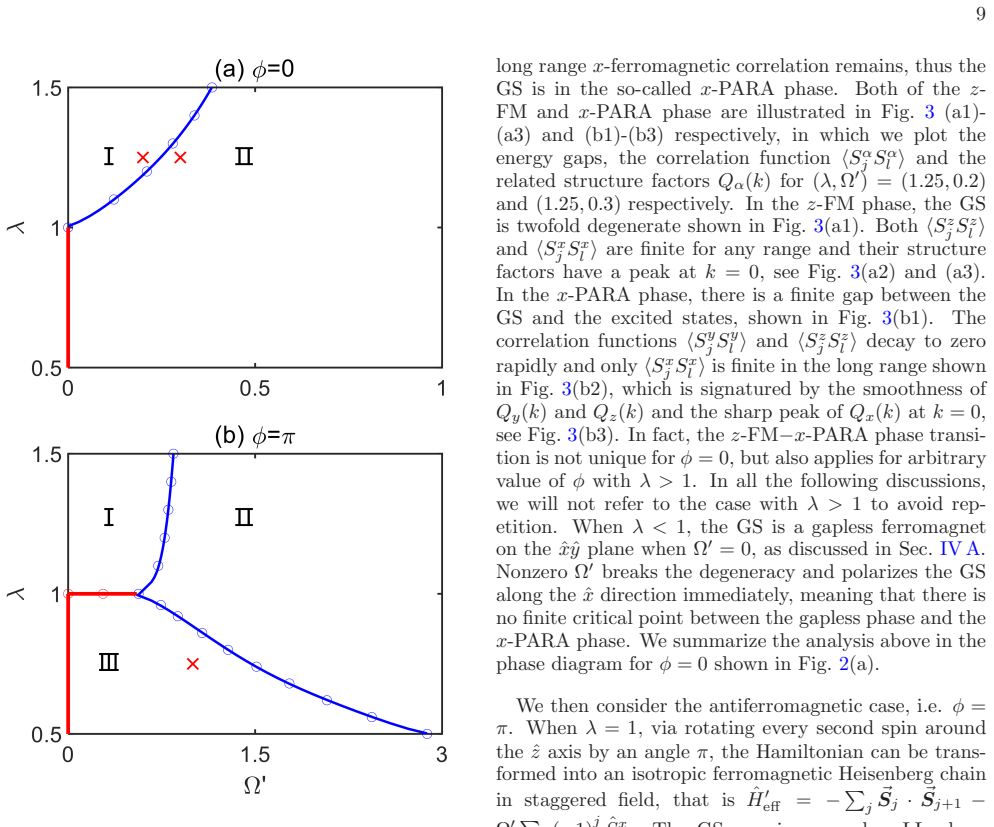
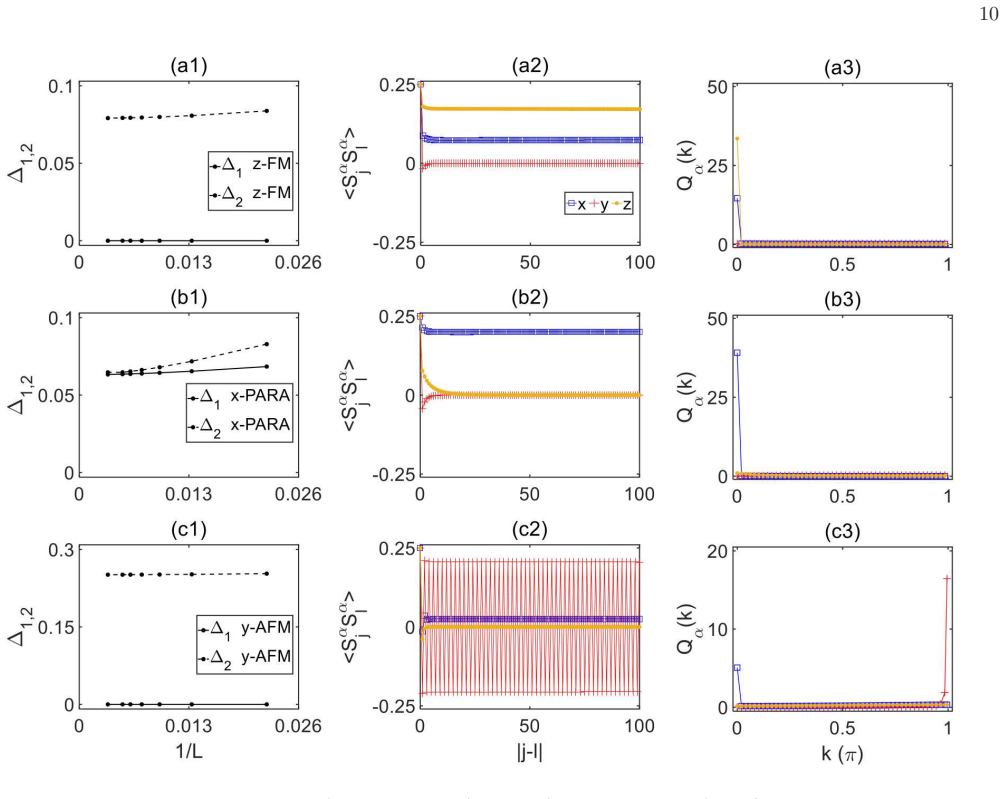
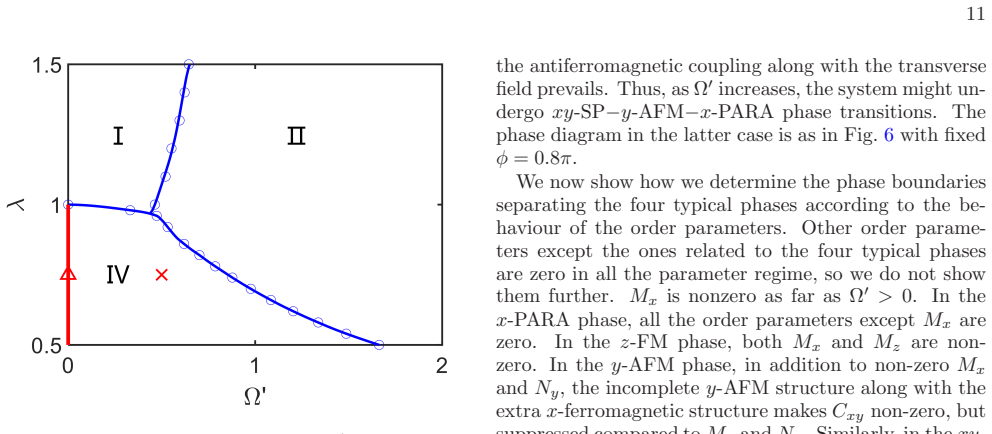
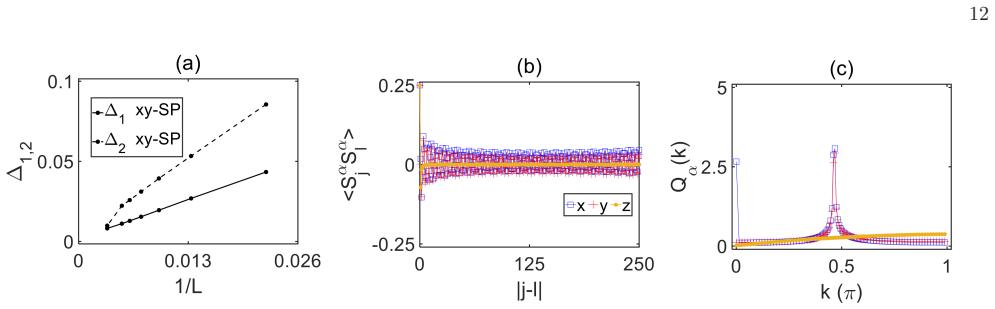
The central claim is that the effective XXZ chain with DM interaction and transverse field, derived from a second-order strong-coupling expansion of the spin-orbit-coupled Bose-Hubbard model, hosts four magnetic phases whose order is set by the interplay of the anisotropy ratio λ, the flux φ, and the transverse field Ω′. Fixing φ = π/2, where the planar Heisenberg couplings vanish, the ground state is a gapless xy-SP spiral phase for small transverse field; the correlations ⟨Sx_j Sx_l⟩ and ⟨Sy_j Sy_l⟩ oscillate without decaying, and the structure factor Qx(k) develops a peak at k=0 in addition to the shared spiral peak. When the transverse field becomes strong, the system enters a gapped x-PARA phase. The paper further shows that for generic φ, as Ω′ increases the system can pass through a sequence xy-SP → y-AFM → x-PARA, and that the z-FM to x-PARA transition is first-order, while the xy-SP to y-AFM transition is continuous.
Load-bearing premise
The effective spin model is derived by truncating the strong-coupling expansion at second order in the tunneling, so the existence and location of the spiral phase depend on the neglected higher-order virtual processes being truly irrelevant at the interaction strengths considered.
Editorial extensions
If this is right
- The bosonic-ladder geometry already realized in the laboratory can, in the Mott regime, directly realize the xy-SP spiral phase and the transitions among the four magnetic phases by tuning the Raman flux and the interspin-to-intraspin interaction ratio λ.
- When the transverse field is off, the model reduces to a solvable XXZ chain; the paper thereby recovers the known z-FM and Luttinger-liquid phases and classifies the gapless phase into ferromagnet, antiferromagnet, or spiral depending on the flux φ.
- The xy-SP phase is distinguished from a Luttinger liquid: the gap closes but the spin correlations remain long-ranged, so the transverse field converts an algebraic-decay regime into a non-decaying one without opening a gap.
- The order-parameter analysis yields a complete phase diagram in the (φ, λ, Ω′) parameter space, with first-order transitions separating z-FM and x-PARA, and a continuous transition separating xy-SP and y-AFM.
Reading between the lines
- At finite t/U, higher-order tunneling processes such as three-site hopping and density-assisted tunneling will renormalize J, Jz, and the transverse field; a quantitative test would be a DMRG simulation of the full Bose-Hubbard model to see whether the xy-SP long-range correlations survive away from the perturbative limit.
- Because the fermionic counterpart of this model lacks the anisotropy term, the xy-SP phase may be specific to bosons and could serve as a distinguishing signature between bosonic and fermionic synthetic ladders.
- The methods here extend naturally to the three-leg Raman-coupled ladder, where the effective model becomes a spin-1 chain; the MPS machinery described in the paper is directly applicable to searching for spiral order in that higher-spin setting.
Signed reviews
Editorial analysis
A structured set of objections, weighed in public.
Referee Report
Summary. The paper considers a two-component Bose-Hubbard model with spin-orbit coupling in a one-dimensional optical lattice, derives an effective XXZ spin-1/2 chain with Dzyaloshinskii-Moriya interaction and a transverse field by second-order perturbation theory, and studies the ground-state phase diagram using matrix product state (MPS) calculations. Four phases are reported: a gapped z-ferromagnetic phase, a gapped x-polarized phase, a gapped y-antiferromagnetic phase, and a gapless xy-spiral phase claimed to have long-range correlations. The zero-field limit is checked against Bethe ansatz results, and the φ=π limit is benchmarked against known mean-field results. The central novelty is the xy-spiral phase, which the authors distinguish from the ordinary Luttinger-liquid spiral phase found in previous studies of related models.
Significance. If the main claims hold, the paper would provide a useful extension of spin-orbit-coupled boson physics, showing that a transverse field can produce a long-range ordered spiral phase that remains gapless in one dimension. The strengths of the manuscript include a transparent strong-coupling derivation of the effective model, explicit benchmarks against exact and mean-field results in limiting cases, and a self-contained presentation of the MPS methodology. The central claims do not rely on fitted parameters. However, the distinguishing xy-spiral phase is supported only by visual inspection of correlation functions at a single system size, which is insufficient to establish true long-range order in a gapless one-dimensional system.
major comments (3)
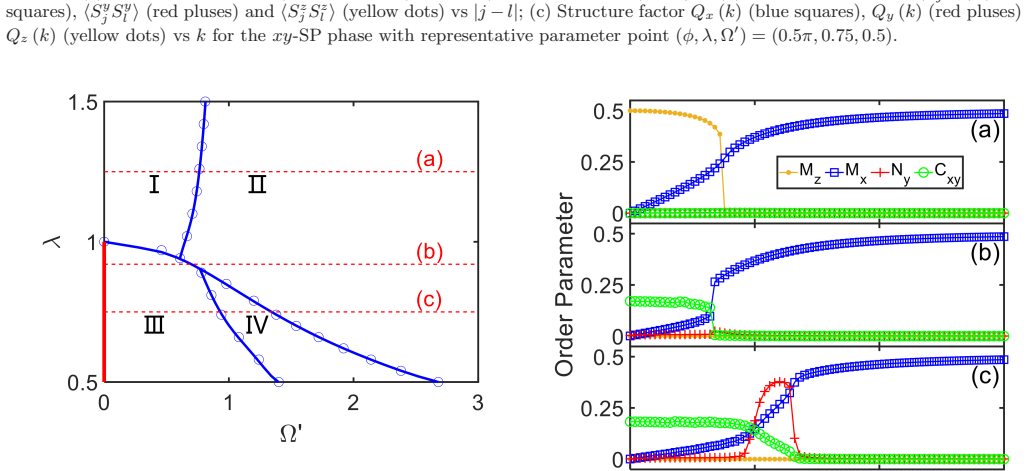
- [§IV.C, Fig. 5] The identification of the xy-SP phase as a long-range ordered phase rests on the correlation functions ⟨Sx_j Sx_l⟩ and ⟨Sy_j Sy_l⟩ plotted for a single parameter point at L=295 and χ=24, with the statement that they show 'no decaying behaviour'. No quantitative fit to a constant plateau versus an algebraic decay is provided, no finite-size extrapolation of the correlation functions or of the order parameters Cxy, Mx, and Ny is shown, and no comparison with the known algebraic decay of the Ω'=0 spiral phase is made at the same system size. Because this phase is the central novelty over Refs. [26–28], and because a gapless phase with true long-range order is unusual in one dimension, the authors must provide scaling data at several L values, fits to A + B/|j-l|^η versus C/|j-l|^η', and a demonstration that any plateau height extrapolates to a nonzero value in the thermodynamic limit.
- [§II, Eq. (3)] The effective spin model is derived to second order in the tunneling H_t relative to the interaction H_U, but the manuscript does not estimate the magnitude of higher-order virtual processes such as three-site hopping or density-assisted tunneling. Since the paper's title and abstract claim to describe the Bose-atom system, the mapping should be controlled: the authors should either estimate the fourth-order corrections at the values of t/U and Ω/U of interest, or explicitly state that the numerical results apply to the spin model Eq. (3) itself and should not be interpreted as quantitative predictions for the original Hubbard model without a separate analysis of the truncation.
- [§IV.D and Figs. 2, 4, 6, 7] The phase boundaries are determined by criteria that are not precisely specified. For example, the text says a first-order transition is identified by a 'sudden drop' of Mz and a continuous transition by the behavior of Ny and Cxy, but no threshold, crossing condition, or convergence estimator is given. The blue solid lines in the phase diagrams are called 'fittings', yet the fitting function and the data points used for the fits are not stated. This prevents reproduction of the quantitative phase diagrams and of the reported critical values such as Ω'_c=0.76, 0.68, 0.92, and 1.36 in Fig. 7. The authors should state the exact numerical criterion used for each boundary type and provide the fitting form and the corresponding data set.
minor comments (5)
- [§II, after Eq. (3)] The word 'pseuudospin' should be 'pseudospin'.
- [Figures 4 and 6 captions] The phase labelled 'x-PARA' in the text and in Fig. 2 is called 'x-FM' in the captions of Figs. 4 and 6; please use consistent terminology.
- [§III.E and Fig. 5 caption] There are several typos: 'constrainets' should be 'constraints' in §III.E, and 'soli-dotted' should be 'solid-dotted' in the caption of Fig. 5.
- [§IV, MPS parameters] The system size and bond dimension for the phase diagrams in Figs. 2, 4, and 6 and for the order parameters in Fig. 7 are not stated; the text says L=195 is used 'unless otherwise specified', but this should be made explicit for each figure.
- [§IV, convergence statement] The statement that results 'already converge as χ approaches 16' is not quantified; please report the change in energy or observables between χ=16 and the maximum χ=24, or give the discarded weight, to support the convergence claim.
Circularity Check
No significant circularity: the effective spin model is derived from the microscopic Hubbard Hamiltonian and the phase diagram is obtained by direct MPS simulation, not by fitting or renaming the inputs.
full rationale
The central derivation is self-contained. The effective Hamiltonian Eq. (3) is obtained from Eqs. (1)-(2) by treating H_t as a perturbation to H_U and keeping second-order virtual processes; the couplings J, Jz, and the transverse field are explicit functions of t, U, lambda, phi, and Omega, and are not adjusted to reproduce the target phases. The phase identification uses MPS-computed gaps, correlations, structure factors, and order parameters Mx, Mz, Ny, and Cxy; these observables are outputs of the calculation, not inputs. The Omega'=0 case is benchmarked against the Bethe-ansatz solution of the equivalent XXZ chain, and the phi=pi case is compared with known mean-field results, providing independent checks. The self-citations (e.g., Refs. [3], [7], [9], and [10]) are background or experimental references and are not load-bearing for the derivation. Concerns about the single-size identification of the xy-SP phase and the truncation order of the strong-coupling expansion are correctness risks, not circularity: neither makes the result equal to its inputs by construction.
Assumptions & free parameters
assumptions (4)
- domain assumption The second-order perturbation expansion in the tunneling Hamiltonian is sufficient to describe the Mott-insulator spin physics; higher-order terms are negligible.
- domain assumption MPS bond dimensions of 16 to 24 and system sizes up to L=295 give converged ground state energies, gaps, and correlations.
- standard math The Omega'=0 model is unitarily equivalent to the standard ferromagnetic XXZ chain whose ground state is known from Bethe ansatz.
- domain assumption The phase structure for all phi follows from the symmetry Gamma H(phi) Gamma^dag = H(-phi) with phi restricted to [0, pi].
Cite this review
Pith. "Pith review of Magnetic phase transitions of insulating spin-orbit coupled Bose atoms in one-dimensional optical lattices." pith.science (2026). https://pith.science/paper/4KZDY4MO
@misc{pith2026190803300,
  author       = {Pith},
  title        = {Pith review of: Magnetic phase transitions of insulating spin-orbit coupled Bose atoms in one-dimensional optical lattices},
  year         = {2026},
  howpublished = {\url{https://pith.science/paper/4KZDY4MO}},
  note         = {Machine review of arXiv:1908.03300}
}
read the original abstract
We consider the insulating spin-orbit coupled Bose atoms confined within one-dimensional optical lattices and explore their ground-state magnetic phase transitions. Under strong interactions, the charge degrees of atoms are frozen and the system can be described by an anisotropic XXZ Heisenberg chain with Dzyaloshinskii-Moriya interaction and transverse field. We apply the matrix product state method to obtain low-energy states and analyze the lowest energy gaps and the ground-state magnetization and correlations. We find when the transverse field is absent, the ground state is a gapped ferromagnetic phase with long-range correlation in the z direction if the interspin s-wave interacting strength is stronger than that of the intraspin one, otherwise it is a gapless Luttinger liquid (LL) phase with algebraic decaying correlation. When the transverse field is turned on, the gapless LL phase is broken, there emerges a long-range correlated phase with ferromagnetic, antiferromagnetic or spiral order, which depends on the DM interaction strength. We believe our study provides a complete understanding of the interplay between SOC and quantum magnetism of spinor atoms in optical lattices.
Figures

Figures from the paper (3 more)
Reference graph
Works this paper leans on
-
[1]
A. B. Kuklov, and B. V. Svistunov, Counterflow Super- fluidity of Two-Species Ultracold Atoms in a Commensu- rate Optical Lattice, Phys. Rev. Lett. 90, 100401 (2003)
work page 2003
-
[2]
L.-M. Duan, E. Demler, and M. D. Lukin, Controlling Spin Exchange Interactions of Ultracold Atoms in Opti- cal Lattices, Phys. Rev. Lett. 91, 090402 (2003)
2003
-
[3]
Besides, we scale the energy by 4t2 U and define Ω ′ = Ω/ 4t2 U
satisfies ˆΓ ˆHeff (φ,λ, Ω) ˆΓ † = ˆHeff (−φ,λ, Ω) with ˆΓ = ∏ j 2 ˆSx j , in the theoretical perspective. Besides, we scale the energy by 4t2 U and define Ω ′ = Ω/ 4t2 U . III. MATRIX PRODUCT STATE METHOD FOR SEARCHING THE LOW-ENERGY STATES The general Hamiltonian Eq. ( 3) for arbitrary φ,λ and Ω are not exactly solvable. In this section, we apply the MPS al...
-
[4]
V. Galitski, and I. B. Spielman, Spin–orbit coupling in quantum gases, Nature 494, 49 (2013)
work page 2013
-
[5]
Zhai, Degenerate quantum gases with spin–orbit cou- pling: a review, Rep
H. Zhai, Degenerate quantum gases with spin–orbit cou- pling: a review, Rep. Prog. Phys. 78, 026001 (2015)
work page 2015
-
[6]
75, along which we plot the order parameters in Fig
92 and 0 . 75, along which we plot the order parameters in Fig. 7. relation function. Thus, our study provides a complete understanding of the SOC effect on the strongly interact- ing atoms in optical lattice system. Interesting extensions of our present study include the magnetic phase transition of the strongly interacting artificial bosonic three-leg lad...
-
[7]
7(a), there is a first-order phase transition between the z-FM and the x-PARA phase as Ω ′ increases
In Fig. 7(a), there is a first-order phase transition between the z-FM and the x-PARA phase as Ω ′ increases. The transition point at Ω ′ = 0.76 can be determined by the sudden drop of Mz to 0. In Fig. 7(b), with increasing Ω ′, there is also a first- order phase transition at Ω ′ = 0.68, separating the xy-SP and x-PARA phase. In Fig. 7(c), as Ω ′ increases...
- [8]
Show all 49 references
-
[9]
Lee, Bose-Einstein Condensation of Particle-Hole Pairs in Ultracold Fermionic Atoms Trapped within Op- tical Lattices, Phys
C. Lee, Bose-Einstein Condensation of Particle-Hole Pairs in Ultracold Fermionic Atoms Trapped within Op- tical Lattices, Phys. Rev. Lett. 93, 120406 (2004)
2004
-
[10]
B. Song, L. Zhang, C. He, T. F. J. Poon, E. Ha- jiyev, S. Zhang, X.-J. Liu, and G.-B. Jo, Observation of symmetry-protected topological band with ultracold fermions, Sci. Adv. 4, eaao4748 (2018)
2018
-
[11]
( 12) gives the left- or right-canonical MPS
or Eq. ( 12) gives the left- or right-canonical MPS. The MPSs obtained in theses ways are exact, but not productive for computation, for the reason that the di- mension of the matrices grows up exponentially, as can be seen from the recursion constructing the canonical MPS. On...
-
[12]
Zhang, and G.-B
S. Zhang, and G.-B. Jo, Recent advances in spin-orbit coupled quantum gases, J. Phys. Chem. Solids 128, 75 (2018)
2018
-
[13]
Zhang, and X
L. Zhang, and X. J. Liu, Spin-orbit Coupling and Topo- logical Phases for Ultracold Atoms, Chap. 1, p. 1 (2018)
2018
-
[14]
Mancini, G
M. Mancini, G. Pagano, G. Cappellini, L. Livi, M. Rider, J. Catani, C. Sias, P. Zoller, M. Inguscio, M. Dalmonte, and L. Fallani, Observation of chiral edge states with neutral fermions in synthetic Hall ribbons, Science 349, 1510 (2015)
2015
-
[15]
with respect to M σk[k]∗ ak−1,ak , we obtain ∑ σ′ k ∑ a′ k−1,a′ k ∑ bk−1,bk Lbk−1[k−1] ak−1,a′ k−1 W σk,σ′ k[k] bk−1,bk Rbk[k+1] ak,a′ k M σ′ k[k] a′ k−1,a′ k −EM σk[k] ak−1,ak = 0. (18) 6 It is an eigenvalue problem ˆH [k]⏐ ⏐v[k]⟩ −E ⏐ ⏐v[k]⟩ = 0 if we view M [k] as a vector ...
-
[16]
Z. Wu, L. Zhang, W. Sun, X.-T. Xu, B.-Z. Wang, S.-C. Ji, Y. Deng, S. Chen, X.-J. Liu, and J.-W. Pan, Realization of two-dimensional spin-orbit coupling for Bose-Einstein condensates, Science 354, 83 (2016)
2016
-
[17]
( 23) respectively
and Eq. ( 23) respectively. (iii) Right sweep. Construct the effective Hamiltonian by Eq. ( 19) and the projector by Eq. ( 22) and Eq. ( 24). Solve the projected effective Hamiltonian for the mini- mum energy En and state vector ⏐ ⏐v[k]⟩ . Update M [k] by reshaping M σk[k] ak−1,...
-
[18]
H¨ ugel, and B
D. H¨ ugel, and B. Paredes, Chiral ladders and the edges of quantum Hall insulators, Phys. Rev. A 89, 023619 (2014)
2014
-
[19]
A. Celi, P. Massignan, J. Ruseckas, N. Goldman, I. B. Spielman, G. Juzeli unas, and M. Lewenstein, Syn- thetic Gauge Fields in Synthetic Dimensions, Phys. Rev. Lett. 112, 043001 (2014)
2014
-
[20]
B. K. Stuhl, H.-I. Lu, L. M. Aycock, D. Genkina, and I. B. Spielman, Visualizing edge states with an atomic Bose gas in the quantum Hall regime, Science 349, 1514 (2015)
2015
-
[21]
Atala, M
M. Atala, M. Aidelsburger, M. Lohse, J. T. Barreiro, B. Paredes, and I. Bloch, Observation of chiral currents with ultracold atoms in bosonic ladders, Nat. Phys. 10, 588 (2014)
2014
-
[22]
M. L. Wall, A. P. Koller, S. Li, X. Zhang, N. R. Cooper, J. Ye, and A. M. Rey, Synthetic Spin-Orbit Coupling in an Optical Lattice Clock, Phys. Rev. Lett. 116, 035301 (2016)
2016
-
[23]
L. F. Livi, G. Cappellini, M. Diem, L. Franchi, C. Clivat i, M. Frittelli, F. Levi, D. Calonico, J. Catani, M. Ingus- cio, and L. Fallani, Synthetic Dimensions and Spin-Orbit Coupling with an Optical Clock Transition, Phys. Rev. Lett. 117, 220401 (2016)
2016
-
[24]
Kolkowitz, S
S. Kolkowitz, S. L. Bromley, T. Bothwell, M. L. Wall, G. E. Marti, A. P. Koller, X. Zhang, A. M. Rey, and J. Ye, Spin-orbit-coupled fermions in an optical lattice clock, Nature 542, 66 (2017)
2017
-
[25]
Dzyaloshinsky, A thermodynamic theory of weak fer- romagnetism of antiferromagnetics, J.Phys.Chem.Solids 4, 241 (1958)
I. Dzyaloshinsky, A thermodynamic theory of weak fer- romagnetism of antiferromagnetics, J.Phys.Chem.Solids 4, 241 (1958)
1958
-
[26]
Moriya, Anisotropic Superexchange Interaction and Weak Ferromagnetism, Phys.Rev
T. Moriya, Anisotropic Superexchange Interaction and Weak Ferromagnetism, Phys.Rev. 120, 91 (1960)
1960
-
[27]
Z. Cai, X. Zhou, and C. Wu, Magnetic phases of bosons with synthetic spin-orbit coupling in optical lattices, Phys. Rev. A 85, 061605 (2012)
2012
-
[28]
W. S. Cole, S. Zhang, A. Paramekanti, and N. Trivedi, Bose-Hubbard Models with Synthetic Spin-Orbit Cou- pling: Mott Insulators, Spin Textures, and Superfluidity, Phys. Rev. Lett. 109, 085302 (2012)
2012
-
[29]
Radi´ c, A
J. Radi´ c, A. D. Ciolo, K. Sun, and V. Galitski, Exotic Quantum Spin Models in Spin-Orbit-Coupled Mott In- sulators, Phys. Rev. Lett. 109, 085303(2012)
2012
-
[30]
M. Gong, Y. Qian, M. Yan, V. W. Scarola, and C. Zhang, Dzyaloshinskii-Moriya Interaction and Spiral Order in Spin-orbit Coupled Optical Lattices, Sci. Rep. 5, 10050 (2015)
2015
-
[31]
Wang, S.-P
J.-G. Wang, S.-P. Feng, and S.-J. Yang, Variational stu dy of phase diagrams of spin-orbit coupled bosons, New J. Phys. 18, 103053 (2016)
2016
-
[32]
J. Zhao, S. Hu, J. Chang, F. Zheng, P. Zhang, and X. Wang, Evolution of magnetic structure driven by synthetic spin-orbit coupling in a two-component Bose- Hubbard model, Phys. Rev. B 90, 085117 (2014)
2014
-
[33]
Piraud, Z
M. Piraud, Z. Cai, I. P. McCulloch, and U. Schollw¨ ock, Quantum magnetism of bosons with synthetic gauge fields in one-dimensional optical lattices: A density- matrix renormalization-group study, Phys. Rev. A 89, 063618 (2014)
2014
-
[34]
Z. Xu, W. S. Cole, and S. Zhang, Mott-superfluid tran- sition for spin-orbit-coupled bosons in one-dimensional optical lattices, Phys. Rev. A 89, 051604 (2014)
2014
-
[35]
Peotta, L
S. Peotta, L. Mazza, E. Vicari, M. Polini, R. Fazio, and D. Rossini, The XYZ chain with Dzyaloshinsky-Moriya interactions: from spin-orbit-coupled lattice bosons to i n- teracting Kitaev chains, J. Stat. Mech. (2014), P09005
2014
-
[36]
J. Zhao, S. Hu, J. Chang, P. Zhang, and X. Q. Wang, Fer- romagnetism in a two-component Bose-Hubbard model with synthetic spin-orbit coupling, Phys. Rev. A 89, 043611 (2014). 14
2014
-
[37]
G. Sun, J. Jaramillo, L. Santos, and T. Vekua, Spin- orbit coupled fermions in ladderlike optical lattices at half filling, Phys. Rev. B 88, 165101 (2013)
2013
-
[38]
Verstraete, V
F. Verstraete, V. Murg, and J. I. Cirac, Matrix prod- uct states, projected entangled pair states, and varia- tional renormalization group methods for quantum spin systems, Adv. Phys. 57, 143 (2008)
2008
-
[39]
Schollw¨ ock, The density-matrix renormalization group in the age of matrix product states, Ann
U. Schollw¨ ock, The density-matrix renormalization group in the age of matrix product states, Ann. Phys. 326, 96 (2011)
2011
-
[40]
M. L. Wall, and L. D. Carr, Out-of-equilibrium dynamics with matrix product states, New J. Phys. 14, 125015 (2012)
2012
-
[41]
Brion, L
E. Brion, L. H. Pedersen, and K. Mølmer, Adiabatic elim- ination in a lambda system, J. Phy. A: Math. Theor. 40, 1033 (2007)
2007
-
[42]
Takahashi, Thermodynamics of One-Dimensional Solvable Models, Cambridge, UK: Cambridge University Press, 2005 (2005)
M. Takahashi, Thermodynamics of One-Dimensional Solvable Models, Cambridge, UK: Cambridge University Press, 2005 (2005)
2005
-
[43]
F. C. Alcaraz, and A. L. Malvezzi, Critical and off-criti cal properties of the XXZ chain in external homogeneous and staggered magnetic fields, J. Phys. A: Math. Gen. 28, 1521 (1995)
1995
-
[44]
D. V. Dmitriev, V. Ya. Krivnov, A. A. Ovchinnikov, and A. Langari, One-dimensional anisotropic Heisenberg model in the transverse magnetic field, J. Exp. Theor. Phys. 95, 538 (2002)
2002
-
[45]
D. V. Dmitriev, V. Ya. Krivnov, and A. A. Ovchinnikov, Gap generation in the XXZ model in a transverse mag- netic field, Phys. Rev. B 65, 172409 (2002)
2002
-
[46]
Cappellini, M
G. Cappellini, M. Mancini, G. Pagano, P. Lombardi, L. Livi, M. S. de Cumis, P. Cancio, M. Pizzocaro, D. Calonico, F. Levi, C. Sias, J. Catani, M. Inguscio, and L. Fallani, Direct Observation of Coherent Interorbital Spin-Exchange Dynamics, Phys. Rev. Lett. 113, 120402 (2014)
2014
-
[47]
Scazza, C
F. Scazza, C. Hofrichter, M. H¨ ofer, P. C. De Groot, I. Bloch, and S. F¨ olling, Observation of two-orbital spin- exchange interactions with ultracold SU(N)-symmetric fermions, Nat. Phys. 10, 779 (2014)
2014
-
[48]
Zhang, M
X. Zhang, M. Bishof, S. L. Bromley, C. V. Kraus, M. S. Safronova, P. Zoller, A. M. Rey, and J. Ye, Spec- troscopic observation of SU(N)-symmetric interactions in Sr orbital magnetism, Science 345, 1467 (2014)
2014
-
[49]
Zhou, J.-S
X. Zhou, J.-S. Pan, W. Yi, G. Chen, and S. Jia, Interaction-induced exotic vortex states in an optical lat - tice clock with spin-orbit coupling, Phys. Rev. A 96, 023627 (2017)
2017
Reviewed August 14, 2026 · model on record in the stance chip above.
Discussion (0). Continue with ORCID to comment.