REVIEW 1 major objections 6 minor 53 references
One formula interface and sparse-precision sampler unifies spatial, temporal, and space-time mixed models for ecological small-area estimation.
Reviewed by Pith at T0; open to challenge. T0 means a machine referee read the full paper against a public rubric. the ladder, T0–T4 →
stLMM unifies Bayesian spatial, temporal, and space-time linear mixed models in one R package with a shared sparse-precision engine for ecological small-area estimation.
T0 review reviewed 2026-07-12 challenge →
load-bearing objection Solid package paper: one formula grammar and collapsed sparse-precision engine for SAE-oriented Bayesian LMMs; engineering contribution, not a new model class. the 1 major comments →
stLMM: Bayesian Spatial and Space-Time Linear Mixed Models for Small-Area Ecological Estimation
The pith
A machine-rendered reading of the paper's core claim, the machinery that carries it, and where it could break.
The reading
Core claim
stLMM supplies a common formula interface and shared sparse-precision MCMC engine that implements iid, AR, GP/NNGP, CAR/DAGAR, separable areal space-time, and structured varying-coefficient terms; collapses the structured latents during fitting; recovers them for fitted values, diagnostics, and prediction; and thereby supports one posterior-draw workflow for both direct-estimate and unit-level ecological small-area estimation, including missing-response prediction targets.
What carries the argument
The sparse matrix M = Q_w + A^T W A: prior process precision plus likelihood information mapped through the observation-to-process design. Structured latents are integrated out of the MCMC state via sparse Cholesky factorizations of M and recovered post-hoc, so one computational engine serves all supported process terms.
Load-bearing premise
That collapsing the structured latents out of the sampler and recovering them afterward still gives correct joint posterior inference for every supported process type and for the binomial and negative-binomial cases.
What would settle it
Run the package's own parameter-recovery simulations or the documented lme4/NIMBLE comparisons on a known CAR/DAGAR or NNGP model; systematic bias in recovered process parameters or credible-interval coverage would falsify the claim that the collapsed sparse-precision engine is correctly implementing the joint posterior.
Editorial analysis
A structured set of objections, weighed in public.
Referee Report
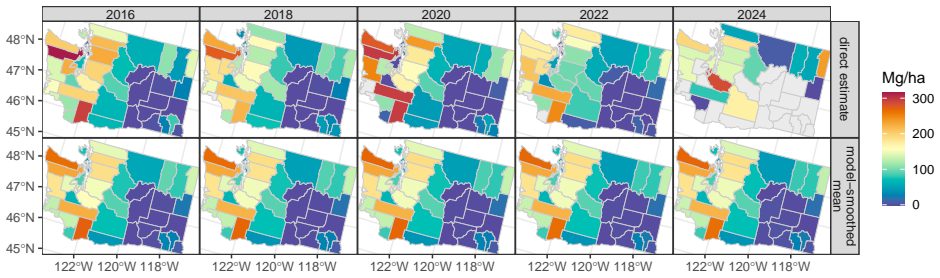
Summary. The manuscript presents stLMM, an R package for Bayesian linear mixed models with a shared formula interface covering iid grouped effects, AR temporal effects, GP/NNGP point-referenced effects, CAR/DAGAR areal effects, separable areal space-time effects, and structured varying coefficients. The central engineering claim is a common sparse-precision computational engine (Eqs. 1–6) that collapses structured latent processes during MCMC, recovers them for fitted values and prediction, and supports one posterior-draw workflow for ecological small-area estimation, including direct-estimate residual-variance models, unit-level models, and missing-response prediction targets. A Washington county-year biomass example using FIA data and tree canopy cover illustrates the interface for a scaled-variance CAR-time model with a spatially varying coefficient.
Significance. If the package behaves as described, it fills a practical niche: analysts can compare point-referenced, areal, temporal, and space-time SAE models under one formula grammar and one posterior aggregation workflow without rewriting model-specific code. The design strengths are concrete and creditworthy—public source under GPL-3, a documented recover/predict workflow, CHOLMOD-backed sparse precision assembly, support for Pólya-Gamma binomial/negative-binomial cases, and a reproducible FIA application series with diagnostics and related model variants. The contribution is primarily software and interface unification rather than new theory; that is appropriate for a package paper and is useful for ecological monitoring and national forest inventory SAE.
major comments (1)
- Section 6 states that simulation-based parameter-recovery checks and validation comparisons with lme4 and NIMBLE for iid and CAR/DAGAR models live on the package website rather than in the manuscript. For the central claim that the collapsed sparse-precision sampler (Section 2, M = Q_w + A^T W A, structured w integrated out then recovered) yields correct joint posterior inference across the advertised term set—including NNGP, CAR-time/DAGAR-time, structured varying coefficients, and Pólya-Gamma cases—the manuscript should include at least a compact table or short appendix summarizing recovery metrics and agreement with the reference implementations. Without that, readers cannot assess the weakest assumption of the paper from the text alone.
minor comments (6)
- Section 2, Eq. (1): A is described as mapping observations to latent process nodes and applying covariate scaling for varying-coefficient terms, but the construction of A for interactions such as x:car() is not shown algebraically. A short explicit block for a varying-coefficient term would clarify the design.
- Section 5, Eq. (8): the shrinkage weight ω_i = n_i/(n_i + c) with c = 10 is clear in the example, but the manuscript should note whether c is treated as fixed or estimable and how sensitive posterior county-year means are to that choice.
- Figure 1 caption and map panels: grey counties are explained as lacking model-ready direct estimates; stating whether those cells still receive full posterior predictive draws from the CAR-time support would help readers interpret the smoothed maps.
- Section 4 software context is thorough; a one-sentence contrast of prediction-on-missing-response-rows versus typical newdata-only workflows in spNNGP/sdmTMB would sharpen the niche claim.
- Section 7: CRAN status is noted as pending; once accepted, update the permanent archive citation and version pin so the paper remains a stable software reference.
- Minor typography: “fixed-sizenegativebinomial” and similar concatenated words in Section 2 should be spaced; “stLMM()” call formatting in Section 5 is otherwise clear.
Circularity Check
No significant circularity: software-interface paper implements known model classes under a shared sparse-precision engine without claiming first-principles derivations or forced predictions.
full rationale
stLMM is a package paper whose central claim is engineering and interface unification (common formula grammar; sparse M = Q_w + A^T W A; collapsed MCMC with post-hoc recover/predict), not a derivation of new scientific constants or uniqueness theorems. Section 2 states the standard latent mixed model (Eqs. 1–6) and the computational organization around sparse precision; these are definitions of the implementation, not predictions that reduce to fitted inputs. The Washington biomass example (Section 5, Eqs. 7–8) is a demonstration of the formula syntax on FIA data, not a claim that model-smoothed means are independent discoveries forced by construction. Self-citations (NNGP, spBayes, DAGAR) point to prior published theory and independent implementations; they are not load-bearing uniqueness imports that forbid alternatives or smuggle an ansatz that then becomes the paper’s result. Validation against lme4/NIMBLE and simulation recovery checks are described as external checks, not as re-presentations of fitted parameters. No step equates a claimed prediction to its own fitting target by construction. Score 0 is therefore the correct, proportionate finding.
Axiom & Free-Parameter Ledger
free parameters (2)
- residual shrinkage constant c (example) =
10
- user-specified process hyperparameters and priors
axioms (5)
- domain assumption Gaussian linear mixed model observation equation y = Xβ + Zα + A w + ε with diagonal observation precision W (Eq. 1–3).
- domain assumption Structured latent processes admit sparse precision representations (neighbor sets, adjacency, temporal order, DAG orderings) that can be assembled into block-diagonal Q_w and the sparse matrix M = Q_w + A^T W A.
- standard math Pólya-Gamma data augmentation yields a conditionally Gaussian working likelihood for binomial and fixed-size negative binomial responses.
- domain assumption CHOLMOD sparse Cholesky factorizations and BLAS/LAPACK dense kernels correctly implement the required solves and products.
- ad hoc to paper Collapsing structured latents during MCMC and recovering them afterward yields draws from the correct joint posterior for the supported models.
Cite this review
Pith. "Pith review of stLMM: Bayesian Spatial and Space-Time Linear Mixed Models for Small-Area Ecological Estimation." pith.science (2026). https://pith.science/paper/4L3ZY4KG
@misc{pith2026260702836,
  author       = {Pith},
  title        = {Pith review of: stLMM: Bayesian Spatial and Space-Time Linear Mixed Models for Small-Area Ecological Estimation},
  year         = {2026},
  howpublished = {\url{https://pith.science/paper/4L3ZY4KG}},
  note         = {Machine review of arXiv:2607.02836}
}
read the original abstract
stLMM is an R package for Bayesian linear mixed models with spatial, temporal, and space-time latent effects. It provides a common formula interface for independent and identically distributed (iid) grouped effects, autoregressive (AR) temporal effects, Gaussian process (GP) and nearest-neighbor Gaussian process (NNGP) point-referenced effects, conditional autoregressive (CAR) and directed acyclic graph autoregressive (DAGAR) areal effects, separable areal space-time effects, and structured varying coefficients. The package is designed for ecological small-area estimation workflows in which analysts must move between direct-estimate and unit-level models, combine sampling variances or residual-variance models with spatial and temporal borrowing, and retain missing response rows as prediction targets. A shared sparse-precision implementation underlies the model terms. Structured latent effects are collapsed during fitting, then recovered or retained for fitted values, diagnostics, prediction, and posterior summaries. This gives users one posterior-draw workflow for propagating uncertainty from model fitting through prediction and aggregation. The package is demonstrated with a Washington county biomass example from the package article series, using Forest Inventory and Analysis (FIA) data and tree canopy cover to estimate county-year biomass means. The full article series provides reproducible source code, data, diagnostics, and related model variants.
Figures


Reference graph
Works this paper leans on
-
[1]
and Gelfand, Alan E
Datta, Abhirup and Banerjee, Sudipto and Finley, Andrew O. and Gelfand, Alan E. , title =. Journal of the American Statistical Association , year =
-
[2]
and Datta, Abhirup and Cook, Bruce D
Finley, Andrew O. and Datta, Abhirup and Cook, Bruce D. and Morton, Douglas C. and Andersen, Hans-Erik and Banerjee, Sudipto , title =. Journal of Computational and Graphical Statistics , year =
-
[3]
Journal of Agricultural, Biological and Environmental Statistics , year =
Katzfuss, Matthias and Guinness, Joseph and Gong, Wenlong and Zilber, Daniel , title =. Journal of Agricultural, Biological and Environmental Statistics , year =
-
[4]
and Gao, Leiwen , title =
Datta, Abhirup and Banerjee, Sudipto and Hodges, James S. and Gao, Leiwen , title =. Bayesian Analysis , year =
-
[5]
and Scott, James G
Polson, Nicholas G. and Scott, James G. and Windle, Jesse , title =. Journal of the American Statistical Association , year =
-
[6]
Windle, Jesse and Carvalho, Carlos M. and Scott, James G. and Sun, Liang , title =. arXiv preprint arXiv:1308.0774 , year =
-
[7]
Windle, Jesse and Polson, Nicholas G. and Scott, James G. , title =. arXiv preprint arXiv:1405.0506 , year =
-
[8]
and Smith, Aaron and Pillai, Natesh and Dunson, David B
Johndrow, James E. and Smith, Aaron and Pillai, Natesh and Dunson, David B. , title =. Journal of the American Statistical Association , year =
-
[9]
Ultimate
Zens, Gregor and Fr. Ultimate. Journal of the American Statistical Association , year =
-
[10]
Proceedings of the 29th International Conference on Machine Learning , year =
Zhou, Mingyuan and Li, Lingbo and Dunson, David and Carin, Lawrence , title =. Proceedings of the 29th International Conference on Machine Learning , year =
-
[11]
IEEE Transactions on Pattern Analysis and Machine Intelligence , year =
Zhou, Mingyuan and Carin, Lawrence , title =. IEEE Transactions on Pattern Analysis and Machine Intelligence , year =
-
[12]
and Andersen, Hans-Erik and Babcock, Chad and Cook, Bruce D
Finley, Andrew O. and Andersen, Hans-Erik and Babcock, Chad and Cook, Bruce D. and Morton, Douglas C. and Banerjee, Sudipto , title =. Journal of Agricultural, Biological and Environmental Statistics , year =
-
[13]
and Herriot, Roger A
Fay, Robert E. and Herriot, Roger A. , title =. Journal of the American Statistical Association , year =
-
[14]
and Lei, Xingye and Breslow, Norman , title =
Leroux, Brian G. and Lei, Xingye and Breslow, Norman , title =. Statistical Models in Epidemiology, the Environment, and Clinical Trials , editor =
-
[15]
and Finley, Andrew O
Shannon, Elliot S. and Finley, Andrew O. and May, Paul B. and Domke, Grant M. and Andersen, Hans-Erik and. Leveraging National Forest Inventory Data to Estimate Forest Carbon Density Status and Trends for Small Areas , journal =. 2025 , volume =
2025
-
[16]
Journal of the American Statistical Association , year =
Gneiting, Tilmann , title =. Journal of the American Statistical Association , year =
-
[17]
A Tutorial on Adaptive
Andrieu, Christophe and Thoms, Johannes , journal =. A Tutorial on Adaptive. 2008 , publisher =
2008
-
[18]
and Rosenthal, Jeffrey S
Roberts, Gareth O. and Rosenthal, Jeffrey S. , title =. Journal of Applied Probability , volume =. 2007 , doi =
2007
-
[19]
Gareth O. Roberts and Jeffrey S. Rosenthal , title =. Journal of Computational and Graphical Statistics , volume =. 2009 , publisher =. doi:10.1198/jcgs.2009.06134 , url =
-
[20]
Frontiers in Forests and Global Change , VOLUME=
Prisley, Steve and Bradley, Jeff and Clutter, Mike and Friedman, Suzy and Kempka, Dick and Rakestraw, Jim and Sonne Hall, Edie , TITLE=. Frontiers in Forests and Global Change , VOLUME=. 2021 , URL=. doi:10.3389/ffgc.2021.746439 , ISSN=
-
[21]
Knott, Jonathan A. and Liknes, Greg C. and Giebink, Courtney L. and Oh, Sungchan and Domke, Grant M. and McRoberts, Ronald E. and Quirino, Valquiria F. and Walters, Brian F. , title =. Methods in Ecology and Evolution , volume =. doi:https://doi.org/10.1111/2041-210X.14084 , url =. https://besjournals.onlinelibrary.wiley.com/doi/pdf/10.1111/2041-210X.1408...
-
[22]
2015 , publisher=
Small area estimation , author=. 2015 , publisher=
2015
-
[23]
and Harter, Rachel M
Battese, George E. and Harter, Rachel M. and Fuller, Wayne A. , title =. Journal of the American Statistical Association , year =
-
[24]
Dumelle, Michael and Higham, Matt and Ver Hoef, Jay M. and Olsen, Anthony R. and Madsen, Lisa , title =. Methods in Ecology and Evolution , volume =. doi:https://doi.org/10.1111/2041-210X.13919 , url =. https://besjournals.onlinelibrary.wiley.com/doi/pdf/10.1111/2041-210X.13919 , year =
-
[25]
2014 , publisher=
Hierarchical Modeling and Analysis for Spatial Data, Second Edition , author=. 2014 , publisher=
2014
-
[26]
White, Grayson W. and Finley, Andrew O. and Yamamoto, Josh K. and Green, Jennifer L. and Frescino, Tracey S. and MacFarlane, David W. and Andersen, Hans-Erik and Domke, Grant M. , title =. Canadian Journal of Forest Research , year =. doi:10.1139/cjfr-2025-0175 , url =
-
[27]
Shannon, Elliot S. and Finley, Andrew O. and May, Paul B. and Domke, Grant M. and Andersen, Hans-Erik and. Leveraging National Forest Inventory Data to Estimate Forest Carbon Density Status and Trends for Small Areas , journal =. 2025 , volume =. doi:10.1016/j.foreco.2025.122999 , url =
-
[28]
Shannon, Elliot S. and Finley, Andrew O. and Domke, Grant M. and May, Paul B. and Andersen, Hans-Erik and. Toward Spatio-Temporal Models to Support National-Scale Forest Carbon Monitoring and Reporting , journal =. 2025 , volume =. doi:10.1088/1748-9326/ad9e07 , url =
-
[29]
and Hamm, Nicholas A
Datta, Abhirup and Banerjee, Sudipto and Finley, Andrew O. and Hamm, Nicholas A. S. and Schaap, Martijn , title =. The Annals of Applied Statistics , year =
-
[30]
Annals of the Institute of Statistical Mathematics , year =
Besag, Julian and York, Jeremy and Mollie, Annie , title =. Annals of the Institute of Statistical Mathematics , year =
-
[31]
Journal of the Royal Statistical Society: Series B , year =
Rue, Havard and Martino, Sara and Chopin, Nicolas , title =. Journal of the Royal Statistical Society: Series B , year =
-
[32]
Journal of the Royal Statistical Society: Series B , year =
Lindgren, Finn and Rue, Havard and Lindstrom, Johan , title =. Journal of the Royal Statistical Society: Series B , year =
-
[33]
and Lee, Daniel and Goodrich, Ben and Betancourt, Michael and Brubaker, Marcus A
Carpenter, Bob and Gelman, Andrew and Hoffman, Matthew D. and Lee, Daniel and Goodrich, Ben and Betancourt, Michael and Brubaker, Marcus A. and Guo, Jiqiang and Li, Peter and Riddell, Allen , title =. Journal of Statistical Software , year =
-
[34]
and Anderson-Bergman, Clifford and Temple Lang, Duncan and Bodik, Rastislav , title =
de Valpine, Perry and Turek, Daniel and Paciorek, Christopher J. and Anderson-Bergman, Clifford and Temple Lang, Duncan and Bodik, Rastislav , title =. Journal of Computational and Graphical Statistics , year =
-
[35]
and Banerjee, Sudipto and Gelfand, Alan E
Finley, Andrew O. and Banerjee, Sudipto and Gelfand, Alan E. , title =. Journal of Statistical Software , year =
-
[36]
and Datta, Abhirup and Banerjee, Sudipto , title =
Finley, Andrew O. and Datta, Abhirup and Banerjee, Sudipto , title =. Journal of Statistical Software , year =
-
[37]
and Ward, Eric J
Anderson, Sean C. and Ward, Eric J. and English, Philina A. and Barnett, Lewis A. K. and Thorson, James T. , title =. Journal of Statistical Software , year =
-
[38]
and Finley, Andrew O
Doser, Jeffrey W. and Finley, Andrew O. and K. Methods in Ecology and Evolution , year =
-
[39]
Journal of Open Source Software , year =
Donegan, Connor , title =. Journal of Open Source Software , year =
-
[40]
2023 , note =
Vieilledent, Ghislain , title =. 2023 , note =
2023
-
[41]
Joint Species Distribution Modelling with the
Tikhonov, Gleb and Opedal,. Joint Species Distribution Modelling with the. Methods in Ecology and Evolution , year =
-
[42]
Journal of Statistical Software , year =
Zammit-Mangion, Andrew and Cressie, Noel , title =. Journal of Statistical Software , year =
-
[43]
WIREs Computational Statistics , year =
Bakka, Haakon and Rue, Havard and Fuglstad, Geir-Arne and Riebler, Andrea and Bolin, David and Illian, Janine and Krainski, Elias and Simpson, Daniel and Lindgren, Finn , title =. WIREs Computational Statistics , year =
-
[44]
Journal of Statistical Software , year =
Pebesma, Edzer , title =. Journal of Statistical Software , year =
-
[45]
Journal of Statistical Software , year =
Lee, Duncan , title =. Journal of Statistical Software , year =
-
[46]
and Skaug, Hans and Bell, Bradley M
Kristensen, Kasper and Nielsen, Anders and Berg, Casper W. and Skaug, Hans and Bell, Bradley M. , title =. Journal of Statistical Software , year =
-
[47]
, title =
Lindgren, Finn and Seaton, Andy and Ho, Suen Man and Bachl, Fabian E. , title =. 2026 , note =
2026
-
[48]
2025 , note =
Wickham, Hadley and Hesselberth, Jay and Salmon, Ma. 2025 , note =
2025
-
[49]
Fitting Linear Mixed-Effects Models Using
Bates, Douglas and M. Fitting Linear Mixed-Effects Models Using. Journal of Statistical Software , year =
-
[50]
and Hager, William W
Chen, Yanqing and Davis, Timothy A. and Hager, William W. and Rajamanickam, Sivasankaran , title =. ACM Transactions on Mathematical Software , year =
-
[51]
2025 , note =
Bates, Douglas and Maechler, Martin and Jagan, Mikael , title =. 2025 , note =
2025
-
[52]
Blackford, L. Susan and Demmel, James and Dongarra, Jack and Duff, Iain and Hammarling, Sven and Henry, Greg and Heroux, Michael and Kaufman, Linda and Lumsdaine, Andrew and Petitet, Antoine and Pozo, Roldan and Remington, Karin and Whaley, R. Clint , title =. ACM Transactions on Mathematical Software , year =
-
[53]
Susan and Demmel, James and Dongarra, Jack and Du Croz, Jeremy and Greenbaum, Anne and Hammarling, Sven and McKenney, Alan and Sorensen, Danny , title =
Anderson, Edward and Bai, Zhaojun and Bischof, Christian and Blackford, L. Susan and Demmel, James and Dongarra, Jack and Du Croz, Jeremy and Greenbaum, Anne and Hammarling, Sven and McKenney, Alan and Sorensen, Danny , title =
This paper was first reviewed by grok-4.5 on July 12, 2026.
discussion (0)
Sign in with ORCID, Apple, or X to comment. Anyone can read and Pith papers without signing in.