Finite-Resolution Information from Collision Statistics
Pith reviewed 2026-06-28 16:29 UTC · model grok-4.3
The pith
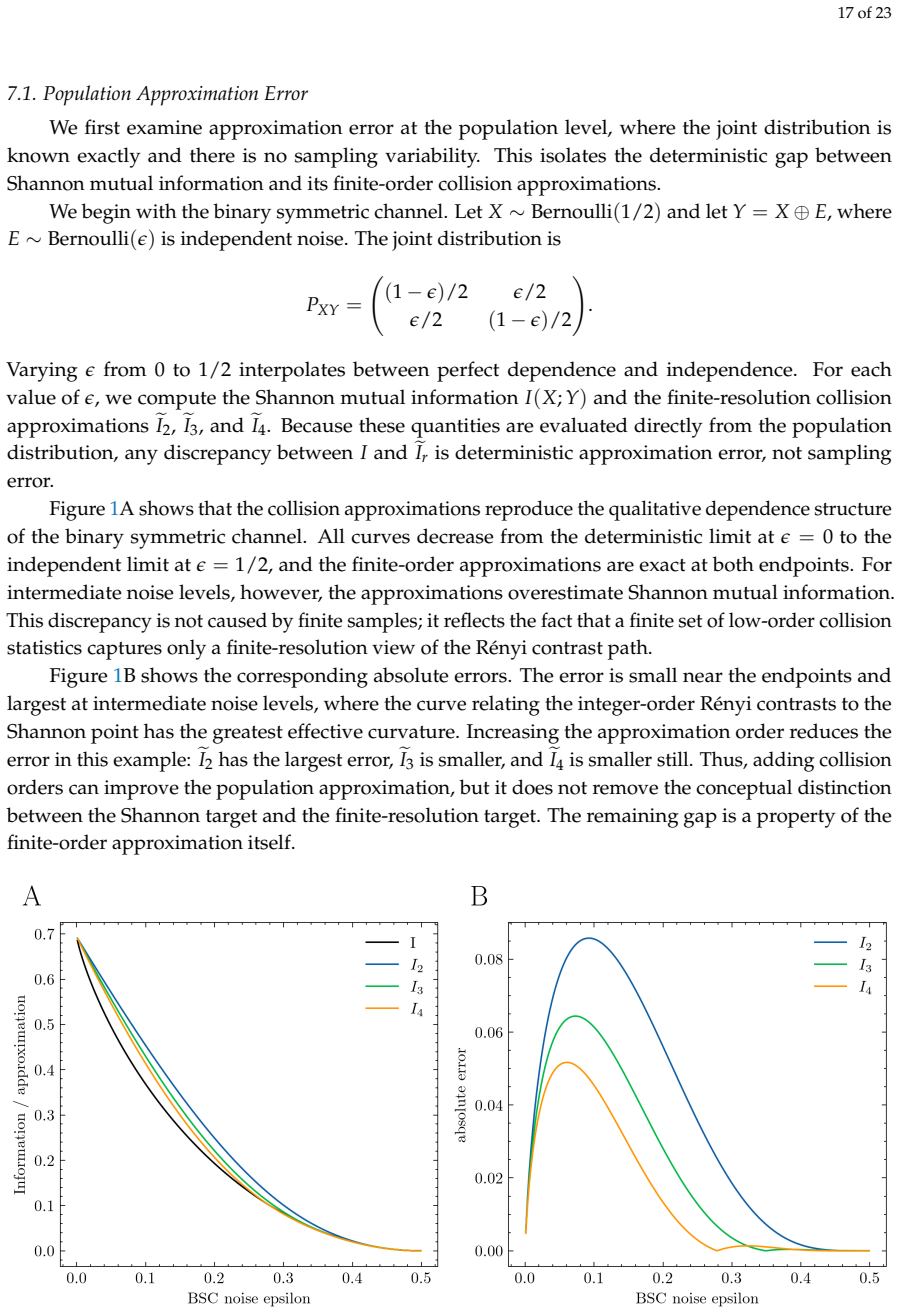
Low-order collision statistics approximate Shannon entropy with error controlled by the Rényi entropy path near order 1.
A machine-rendered reading of the paper's core claim, the machinery that carries it, and where it could break.
Core claim
Collision statistics provide a finite-resolution view of information by measuring how often a fixed number of independent samples fall on the same state. These directly countable quantities form the basis of integer-order Rényi entropies. Low-order Rényi entropies approximate Shannon entropy and mutual information, with interpolation-error bounds showing that approximation error is controlled by the shape of the Rényi entropy path near the Shannon point. Deterministic error is separated from finite-sample estimation error: for fixed collision order, increasing sample size improves estimation of the finite-resolution target but does not eliminate its deterministic difference from Shannon entr
What carries the argument
The Rényi entropy path as a function of order, with interpolation-error bounds near the Shannon point (order 1) that quantify the deterministic approximation error from finite collision moments.
If this is right
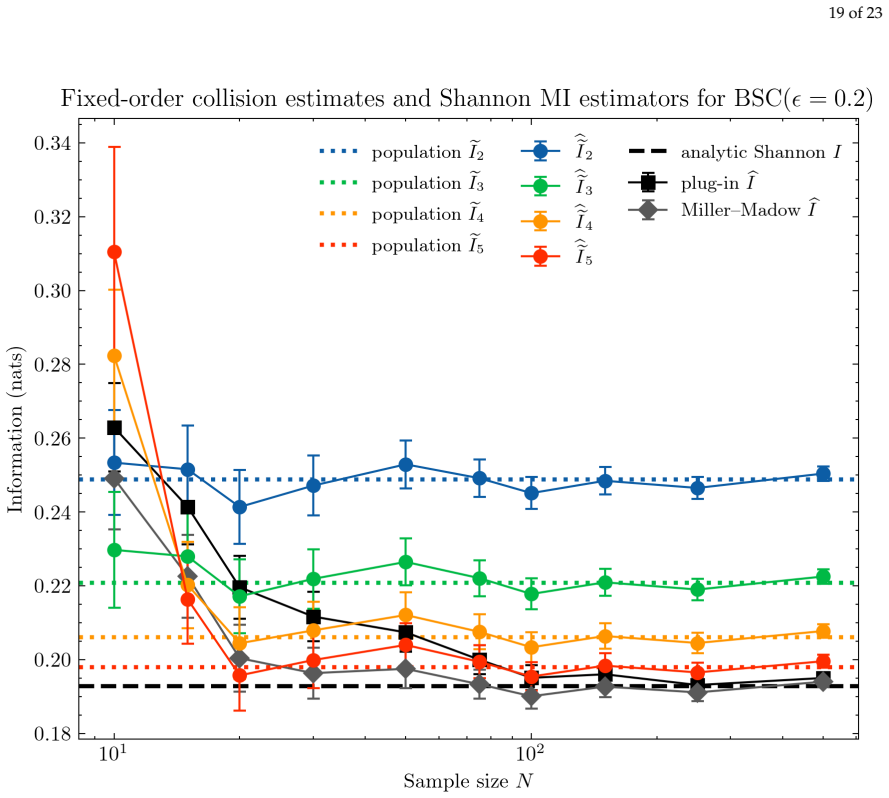
- For any fixed collision order, larger samples reduce statistical estimation error around the finite-resolution target while leaving its deterministic offset from Shannon entropy unchanged.
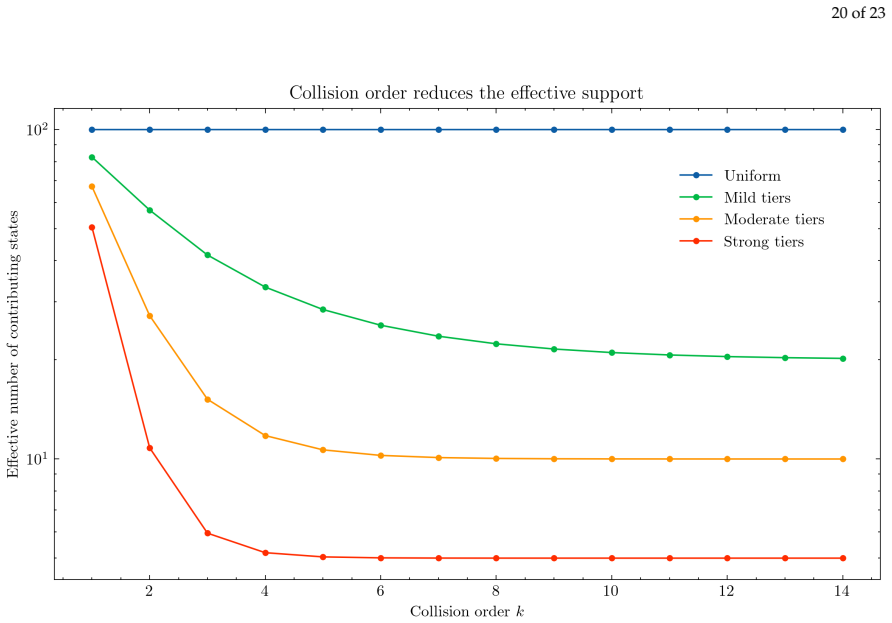
- Raising the collision order shrinks the deterministic approximation gap to Shannon entropy but increases sensitivity to high-probability events.
- Shannon entropy and mutual information cannot be recovered exactly from any finite set of collision moments in general.
- The approximation-estimation tradeoff can be tuned by choosing collision order, with numerical comparisons to plug-in and Miller-Madow estimators illustrating the resulting behavior.
Where Pith is reading between the lines
- Collision-based approximations may remain useful in streaming or memory-constrained settings where full histogram construction is infeasible, provided the target resolution matches the application.
- The separation of deterministic and statistical errors suggests that standard bias-correction techniques cannot eliminate the gap shown by the interpolation bounds.
- Choosing collision order according to whether rare or common events dominate the quantity of interest offers a practical design lever not available in direct Shannon estimators.
Load-bearing premise
The shape of the Rényi entropy path near order 1 controls the interpolation error in the derived approximation bounds.
What would settle it
A probability distribution in which Shannon entropy equals a fixed function of only finitely many collision probabilities would falsify the claim that finite collision moments do not generally identify Shannon entropy.
Figures
read the original abstract
Collision statistics provide a finite-resolution view of information by measuring how often a fixed number of independent samples fall on the same state. These directly countable quantities form the basis of integer-order R\'enyi entropies. Here, we use low-order R\'enyi entropies to approximate Shannon entropy and mutual information, while characterizing what is necessarily lost when only finitely many collision moments are used. We derive interpolation-error bounds showing that approximation error is controlled by the shape of the R\'enyi entropy path near the Shannon point. We also separate this deterministic error from finite-sample estimation error: for fixed collision order, increasing sample size improves estimation of the finite-resolution target but does not eliminate its deterministic difference from Shannon entropy or mutual information. Finally, we show that finite collision moments do not generally identify Shannon entropy, and that increasing collision order shifts sensitivity toward high-probability events. Numerical experiments illustrate the approximation--estimation tradeoff and compare collision-based approximations with plug-in and Miller--Madow estimators. The framework links collision counts, R\'enyi entropy, Shannon limits, and mutual information through a finite-resolution view of information, clarifying when low-order coincidence structure is informative and when irreducible information is lost.
Editorial analysis
A structured set of objections, weighed in public.
Referee Report
Summary. The manuscript presents a framework viewing information through finite-resolution collision statistics corresponding to integer-order Rényi entropies. It derives interpolation-error bounds for approximating Shannon entropy and mutual information from low-order Rényi entropies, with error controlled by the shape of the Rényi entropy path near order 1. The work separates deterministic approximation error from finite-sample estimation error, shows that finite collision moments do not generally identify Shannon entropy, and demonstrates that increasing collision order shifts sensitivity toward high-probability events. Numerical experiments compare collision-based approximations against plug-in and Miller-Madow estimators.
Significance. If the interpolation bounds hold, the paper provides a useful clarification of the approximation-estimation tradeoff in collision-based entropy estimation and a clean separation between deterministic loss and statistical error. The extension to mutual information and the observation on sensitivity to high-probability events are constructive. The numerical comparisons supply practical evidence of the tradeoff. The overall contribution is modest but well-scoped for the information-theory literature; its impact depends on confirming that the regularity conditions invoked for the Rényi path apply to general discrete distributions.
major comments (1)
- [Abstract / interpolation-error bounds derivation] Abstract and derivation of interpolation-error bounds: the claim that approximation error is controlled by the shape of the Rényi entropy path near the Shannon point (order 1) requires regularity conditions (differentiability, continuity, or monotonicity properties) on the Rényi function for arbitrary discrete distributions on finite alphabets. These conditions are not established, yet they are load-bearing for both the deterministic-vs-estimation error separation and the conclusion that finite collision moments do not identify Shannon entropy.
minor comments (1)
- [Abstract] The abstract refers to 'finite collision moments' without an explicit early statement that these are exactly the integer-order Rényi entropies; a single clarifying sentence would improve readability.
Simulated Author's Rebuttal
We thank the referee for their careful reading and for identifying the need to establish regularity conditions on the Rényi entropy path. We address the major comment below.
read point-by-point responses
-
Referee: Abstract and derivation of interpolation-error bounds: the claim that approximation error is controlled by the shape of the Rényi entropy path near the Shannon point (order 1) requires regularity conditions (differentiability, continuity, or monotonicity properties) on the Rényi function for arbitrary discrete distributions on finite alphabets. These conditions are not established, yet they are load-bearing for both the deterministic-vs-estimation error separation and the conclusion that finite collision moments do not identify Shannon entropy.
Authors: We agree that the interpolation bounds rely on regularity of the Rényi function near order 1. However, for any discrete distribution on a finite alphabet these conditions hold automatically. The map α ↦ ∑ p_i^α is a finite sum of exponential functions exp(α log p_i) and is therefore C^∞ on (0, ∞). The Rényi entropy H_α is thus C^∞ on (0,∞) excluding α=1, and the limit lim_{α→1} H_α equals the Shannon entropy by standard properties of the logarithm and the fact that the derivative at α=1 recovers the entropy. Continuity at α=1 follows similarly. We will add a brief lemma (or appendix) to the revised manuscript that states and proves these facts for finite alphabets. With this addition, the interpolation-error bounds are justified, the deterministic approximation error is cleanly separated from the estimation error, and the conclusion that finite-order collisions do not identify Shannon entropy remains valid because matching values at finitely many points α=2,3,… does not determine the value at α=1. revision: yes
Circularity Check
No circularity: derivations from Rényi definitions and collision moments are self-contained
full rationale
The paper's core claims—interpolation-error bounds controlled by Rényi path shape near order 1, separation of deterministic vs. estimation error, and non-identification of Shannon entropy by finite collision moments—follow directly from the definitions of integer-order Rényi entropies and standard interpolation theory applied to the entropy function. No step reduces a claimed prediction to a fitted input by construction, invokes a self-citation as the sole justification for a uniqueness or regularity property, or renames an empirical pattern. The regularity conditions on the Rényi path are invoked as mathematical assumptions whose consequences are derived, not smuggled in via prior self-work. The framework remains externally falsifiable via direct computation on discrete distributions.
Axiom & Free-Parameter Ledger
Reference graph
Works this paper leans on
-
[1]
Note on the Bias of Information Estimates.Information Theory in Psychology: Problems and Methods1955, pp
Miller, G.A. Note on the Bias of Information Estimates.Information Theory in Psychology: Problems and Methods1955, pp. 95–100
-
[2]
Estimation of Entropy and Mutual Information.Neural Computation2003,15, 1191–1253
Paninski, L. Estimation of Entropy and Mutual Information.Neural Computation2003,15, 1191–1253
-
[3]
Estimating Entropy on m Bins Given Fewer than m Samples.IEEE Transactions on Information Theory2004,50, 2200–2203
Paninski, L. Estimating Entropy on m Bins Given Fewer than m Samples.IEEE Transactions on Information Theory2004,50, 2200–2203
-
[4]
Finite Sample Corrections to Entropy and Dimension Estimates.Physics Letters A1988, 128, 369–373
Grassberger, P . Finite Sample Corrections to Entropy and Dimension Estimates.Physics Letters A1988, 128, 369–373
-
[5]
Entropy and Inference, Revisited.Advances in Neural Information Processing Systems2002,14, 471–478
Nemenman, I.; Shafee, F.; Bialek, W. Entropy and Inference, Revisited.Advances in Neural Information Processing Systems2002,14, 471–478
-
[6]
Estimating the Unseen: An n/ logn -Sample Estimator for Entropy and Support Size, Shown Optimal via New CLTs
Valiant, G.; Valiant, P . Estimating the Unseen: An n/ logn -Sample Estimator for Entropy and Support Size, Shown Optimal via New CLTs. In Proceedings of the Proceedings of the Forty-Third Annual ACM Symposium on Theory of Computing, 2011, pp. 685–694
2011
-
[7]
Minimax Estimation of Functionals of Discrete Distributions.IEEE Transactions on Information Theory2015,61, 2835–2885
Jiao, J.; Venkat, K.; Han, Y.; Weissman, T. Minimax Estimation of Functionals of Discrete Distributions.IEEE Transactions on Information Theory2015,61, 2835–2885
-
[8]
Minimax Rates of Entropy Estimation on Large Alphabets via Best Polynomial Approxima- tion.IEEE Transactions on Information Theory2016,62, 3702–3720
Wu, Y.; Yang, P . Minimax Rates of Entropy Estimation on Large Alphabets via Best Polynomial Approxima- tion.IEEE Transactions on Information Theory2016,62, 3702–3720
-
[9]
A Class of Statistics with Asymptotically Normal Distribution.The Annals of Mathematical Statistics1948,19, 293–325
Hoeffding, W. A Class of Statistics with Asymptotically Normal Distribution.The Annals of Mathematical Statistics1948,19, 293–325
-
[10]
Serfling, R.J.Approximation Theorems of Mathematical Statistics; Wiley, 1980
1980
-
[11]
On Measures of Entropy and Information.Proceedings of the Fourth Berkeley Symposium on Mathematical Statistics and Probability1961,1, 547–561
Rényi, A. On Measures of Entropy and Information.Proceedings of the Fourth Berkeley Symposium on Mathematical Statistics and Probability1961,1, 547–561
-
[12]
Towards more efficient Renyi entropy estimation.Entropy2023,25, 185
Skorski, M. Towards more efficient Renyi entropy estimation.Entropy2023,25, 185
-
[13]
Measurement of Diversity.Nature1949,163, 688
Simpson, E.H. Measurement of Diversity.Nature1949,163, 688
-
[14]
Diversity and Evenness: A Unifying Notation and Its Consequences.Ecology1973,54, 427–432
Hill, M.O. Diversity and Evenness: A Unifying Notation and Its Consequences.Ecology1973,54, 427–432
-
[15]
23 of 23
Cover, T.M.; Thomas, J.A.Elements of Information Theory, 2 ed.; Wiley, 2006. 23 of 23
2006
-
[16]
The entropy universe.Entropy2021,23, 222
Ribeiro, M.; Henriques, T.; Castro, L.; Souto, A.; Antunes, L.; Costa-Santos, C.; Teixeira, A. The entropy universe.Entropy2021,23, 222
-
[17]
Information Radius.Zeitschrift für Wahrscheinlichkeitstheorie und Verwandte Gebiete1969,14, 149–160
Sibson, R. Information Radius.Zeitschrift für Wahrscheinlichkeitstheorie und Verwandte Gebiete1969,14, 149–160
-
[18]
Information Measures and Capacity of Order α for Discrete Memoryless Channels.Topics in Information Theory1977, pp
Arimoto, S. Information Measures and Capacity of Order α for Discrete Memoryless Channels.Topics in Information Theory1977, pp. 41–52
-
[19]
Rényi Divergence and Kullback–Leibler Divergence.IEEE Transactions on Information Theory2014,60, 3797–3820
van Erven, T.; Harremoës, P . Rényi Divergence and Kullback–Leibler Divergence.IEEE Transactions on Information Theory2014,60, 3797–3820
-
[20]
Bayesian Entropy Estimation for Countable Discrete Distributions.Journal of Machine Learning Research2014,15, 2833–2868
Archer, E.; Park, I.M.; Pillow, J.W. Bayesian Entropy Estimation for Countable Discrete Distributions.Journal of Machine Learning Research2014,15, 2833–2868
-
[21]
Macdonald, I.G.Symmetric Functions and Hall Polynomials, 2 ed.; Oxford University Press, 1995
1995
-
[22]
Comparing clusterings—an information based distance.Journal of Multivariate Analysis2007, 98, 873–895
Meil˘ a, M. Comparing clusterings—an information based distance.Journal of Multivariate Analysis2007, 98, 873–895
-
[23]
Information Theoretic Measures for Clusterings Comparison: Variants, Properties, Normalization and Correction for Chance.Journal of Machine Learning Research2010,11, 2837– 2854
Vinh, N.X.; Epps, J.; Bailey, J. Information Theoretic Measures for Clusterings Comparison: Variants, Properties, Normalization and Correction for Chance.Journal of Machine Learning Research2010,11, 2837– 2854
-
[24]
The Impact of Random Models on Clustering Similarity.Journal of Machine Learning Research2017,18, 1–28
Gates, A.J.; Ahn, Y.Y. The Impact of Random Models on Clustering Similarity.Journal of Machine Learning Research2017,18, 1–28
-
[25]
Objective criteria for the evaluation of clustering methods
Rand, W.M. Objective Criteria for the Evaluation of Clustering Methods.Journal of the American Statistical Association1971,66, 846–850. https://doi.org/10.1080/01621459.1971.10482356
-
[26]
Comparing Partitions.Journal of Classification1985,2, 193–218
Hubert, L.; Arabie, P . Comparing Partitions.Journal of Classification1985,2, 193–218. https://doi.org/10.100 7/BF01908075
-
[27]
Gates, A.J. Unifying Information-Theoretic and Pair-Counting Clustering Similarity.arXiv preprint arXiv:2511.030002025
-
[28]
Element-centric clustering comparison unifies overlaps and hierarchy.Scientific reports2019,9, 8574
Gates, A.J.; Wood, I.B.; Hetrick, W.P .; Ahn, Y.Y. Element-centric clustering comparison unifies overlaps and hierarchy.Scientific reports2019,9, 8574
discussion (0)
Sign in with ORCID, Apple, or X to comment. Anyone can read and Pith papers without signing in.