REVIEW 4 major objections 6 minor 37 references
Effective and Efficient Representation Learning for Flight Trajectories
T0 review · 4 major / 6 minor · reviewed 2026-08-11 · deepseek-v4-flash
Pith's one-line read Flight2Vec claims that a single pretrained flight-trajectory representation, built with behavior-adaptive patching and motion-trend learning, outperforms task-specific baselines on trajectory prediction, flight recognition, and anomaly…
desk verdict Plausible flight-specific TRL recipe with public code, but the empirical case for 'significant' is undercut by near-ties, no variance, and a timestamp-based split that leaks flight identity. read the letter →
The pith
A machine-rendered reading of the paper's core claim, the machinery that carries it, and where it could break.
The reading
What carries the argument
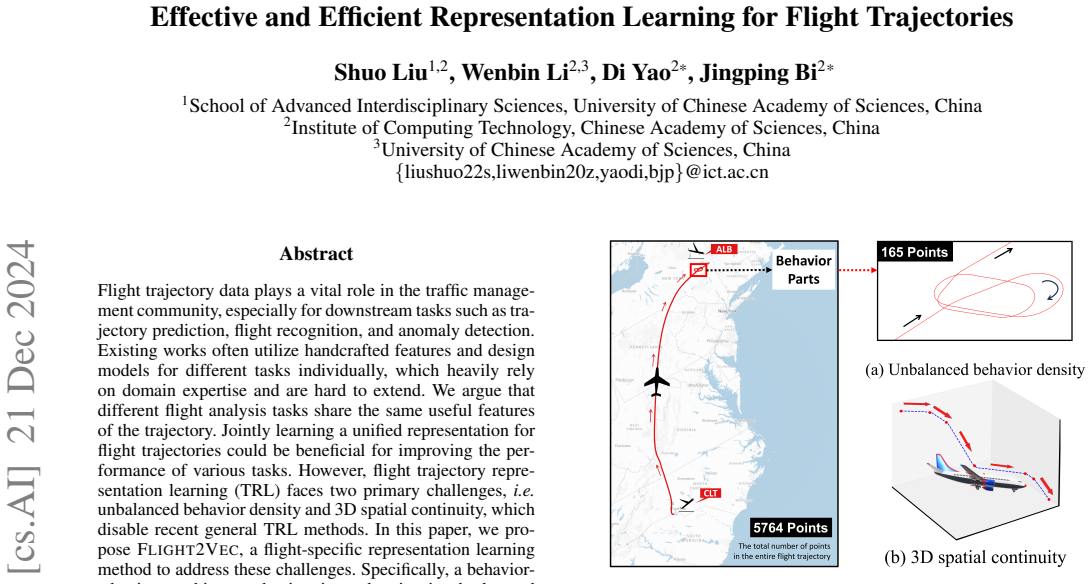
The load-bearing object is the behavior-adaptive patching Transformer trained with a two-part self-supervised loss. Behavior-adaptive patching selects 'active points' (points whose angle change exceeds a threshold), clusters neighboring active points into patches of size $S$, and downsamples non-behavior segments; this is what injects behavior-density awareness into the representation. The motion-trend objective turns 3D spatial continuity into a classification problem: for each point, the displacement to the next point is encoded as signs in three dimensions, yielding 26 classes ($3\times3\times3$ minus the all-zero case), and a cross-entropy term predicts that class for masked patches. Combined with masked MSE reconstruction, the model is pushed to remember both exact coordinates and forward motion.
What would settle it
Swap the behavior-adaptive patches for fixed-interval random patches under the same masking and the same MSE plus 26-class direction loss: if downstream scores stay flat, the reported gains do not come from behavior-density patching, and an arithmetic check of the released code will independently reveal whether the published step-size formula can produce the stated patch counts.
Extended reading notes
Core claim
The central claim, stated on the paper's own terms, is that flight-specific representation learning can be made both effective and efficient by explicitly modeling where in a trajectory the behavior is and which way the aircraft is moving. Concretely, the paper identifies 'active points' by angle change, clusters neighboring active points into behavior patches, and downsamples the remaining straight-line segments; a decoder-only Transformer then learns patch embeddings under a masking scheme that masks behavior patches and their neighbors more aggressively than ordinary segments. The optimization combines an MSE reconstruction loss with a motion-trend loss that classifies each reconstructed point's direction into one of 26 direction categories, the signs of the longitude, latitude, and altitude increments. The paper reports that this combination outperforms PatchTST, FlightBERT++, LSTM+Attention, DDM, DMDN, SPIRAL, and ATSCC on its chosen tasks, and that both proposed components contribute in an ablation on trajectory prediction.
Load-bearing premise
The load-bearing premise is that the published uniform-sampling step size for non-behavior segments actually produces enough points to build the promised non-behavior patches; as written it produces far fewer points than the patches need, so an unstated corrected sampling rule carries the construction.
Editorial extensions
If this is right
- If the central claim holds, air-traffic applications can share one pretrained flight representation instead of rebuilding task-specific feature pipelines for each new task.
- The behavior-based patching means informative trajectory segments can be located automatically from local angle change, without hand-labeled behavior segments.
- Because inference is a single Transformer pass over patches, new downstream tasks can be built by attaching a lightweight head, at inference costs the paper reports as lower than several baselines.
- The reported ablation suggests that both the adaptive patching and the direction loss contribute, and that removing either component increases prediction error.
Reading between the lines
- The behavior-density idea is plausibly transferable to other movement data with sparse informative events, such as maritime routes or animal tracking, but the paper only tests flight trajectories.
- The paper's anomaly detection uses synthetically generated anomalies rather than real operational events, so a natural-anomaly benchmark would be a stricter test of the representation's usefulness.
- If the released code follows the published step-size formula literally, the counts of non-behavior patches cannot match the stated sequence length; a corrected stride or overlapping-patch rule appears to be an unstated assumption.
Editorial analysis
A structured set of objections, weighed in public.
Referee Report
Summary. The paper proposes Flight2Vec, a self-supervised representation learning framework for flight trajectories. The method combines a behavior-adaptive patching mechanism, which identifies and amplifies behavior-dense trajectory segments, with a motion trend learning objective that predicts a 26-class moving-direction label alongside standard MSE patch reconstruction. The authors evaluate the learned representations on three downstream tasks (flight trajectory prediction, flight recognition, anomaly detection) using the SCAT and ATFMTraj datasets, and they report an ablation study and a computational cost comparison. The central claim is that Flight2Vec significantly improves downstream task performance over task-specific baselines.
Significance. If the empirical claims are substantiated, Flight2Vec would be a useful general-purpose flight trajectory encoder, and the two proposed components (behavior-adaptive patching and motion-trend loss) are natural and plausible building blocks for flight-specific representation learning. The authors should be credited for making the code and data publicly available, for including an ablation that isolates each component, and for reporting efficiency metrics. However, the central claim of 'significantly improves' is currently not supported by the reported evidence: the recognition results in Table 3 are essentially tied with the ATSCC baseline, the vanilla model in Table 1 underperforms FlightBERT++ on short-horizon MDE, and no variance or statistical significance is reported anywhere. The paper is therefore at a stage where the ideas are promising but the evidence needs strengthening.
major comments (4)
- [Methodology, Behavior-Based Patching] The sampling formula for non-behavioral patches is dimensionally inconsistent as written. The text says 'we perform uniform sampling with a step size of n−S·g / N−g to generate additional patches.' If this is a sampling interval over the raw points, then the number of sampled points is approximately (n − S·g) / step = N − g, but constructing N − g patches of size S requires S(N − g) points, not N − g. If instead the formula denotes a stride between patch centers, the paper should say so explicitly and state how the S points within each patch are selected. As published, the algorithm cannot produce the stated patch sequence, and this is a load-bearing description because the patching mechanism is a core contribution. Please correct the formula or clarify the intended reading, and ensure the accompanying text matches the public code.
- [Hyperparameters setting] Several hyperparameters that control the two main contributions are not reported: the angle-change threshold s, the index-distance threshold for clustering active points, the masking probabilities ρ_b and ρ_n, and the loss weight λ. The experimental section only states that 'the binomial masking probability is set at 0.4,' which does not disambiguate the behavior-patch masking from the non-behavior masking. Without these values, the method cannot be reproduced exactly and the sensitivity analysis in Figure 5 covers only patch size and embedding dimension, not these key parameters. Please report the full hyperparameter set in the experimental settings or appendix.
- [Results of Flight Recognition and Table 3] The claim that Flight2Vec 'significantly improves performance' is not backed by statistical evidence. No standard deviations, number of runs, or significance tests are reported for any table. In Table 3, the ACC differences between Flight2Vec and ATSCC are between 0.0001 and 0.0004, PRE differences range from −0.0003 to +0.0001, and only the RKSla REC cell differs by 0.0032; these are essentially ties. In Table 1, vanilla Flight2Vec has a higher horizon-1 MDE than FlightBERT++ (0.34 vs. 0.32) and is worse on several horizon-3 Lon/Lat metrics. The abstract and conclusion use 'significantly' without empirical support. Please either add error bars and a significance test (e.g., paired tests across seeds) or soften the claim to 'improves' on specific metrics.
- [Appendix, Experimental Protocol] The data split is ambiguous and potentially leaky. The appendix says 'the first 50% of timestamps is denoted as the training set, while the latter 50% is denoted as the test set.' This could mean a temporal split in which the same flight IDs appear in both training and test sets, so a test trajectory's prefix may have been used during training or pretraining. If the split is by timestamp and not by flight ID, the trajectory prediction results may be inflated because the model has seen part of each test flight. Please clarify whether train and test sets are disjoint by flight ID, and state whether the pretraining phase sees any data from the test timestamp range. If the split is by trajectory, please describe the assignment procedure precisely.
minor comments (6)
- [Overview and Methodology] The architecture is described inconsistently: the Introduction calls it a 'decoder-only Transformer,' while the Overview and Methodology say 'patch Transformer encoder.' Please align the terminology.
- [Hyperparameters setting] The sentence 'the binomial masking probability is set at 0.4' conflicts with the use of two separate probabilities ρ_b and ρ_n. Clarify which probability is 0.4 and whether ρ_b > ρ_n.
- [Equation for Motion Trend Learning] The notation in the direction loss L_MD is unclear: the conditional y_mask_1:i−1 and the unconditional x are not defined before use. Please define all symbols and state whether the direction prediction is conditioned on the reconstructed sequence.
- [Complexity Analysis] The phrase 'the number of patches is much less the length of trajectory' should read 'much less than the length.' Also, 'D × P linear layer' in the optimization section uses undefined D and P.
- [Experimental Settings / Results] In Table 1, the column header 'Hor.' is not expanded; elsewhere 'MDE' is used but not defined in the caption. Also, the appendix says 'three kinds of systematic anomaly types' but lists four types (SMA, HD, VD, Go-Around); please correct the count.
- [Related Work] There are minor language issues, e.g., 'utilizes a similar approach similar to PatchTST,' 'an Multi-layer Perceptron,' and 'revealing the importance' (should be 'reveals'). These do not affect the technical content but should be fixed in a revision.
Circularity Check
No circularity found: the representation is trained with self-supervised objectives and judged on external downstream benchmarks, so the claimed improvements are not forced by construction.
full rationale
The derivation chain in Flight2Vec is self-contained. The behavior-adaptive patching selects behavior patches by an angle-change threshold and down-samples non-behavior segments; the patch Transformer encoder and masked reconstruction follow PatchTST (an external base architecture). The motion-trend loss is a 26-class classification of direction signs computed from consecutive coordinate differences; it is an auxiliary self-supervised training signal, not a fitted prediction of an external benchmark quantity, so its labels being derived from the same coordinates do not pre-ordain the downstream results. Downstream evaluation is against published baselines on the public SCAT and ATFMTraj datasets, with ablations (w/o PD, w/o MD) on the same protocol; this is standard empirical practice rather than a definitional equivalence. The self-citations in the related work (Yao et al. 2017-2022; Jing et al. 2022) are background material and are not load-bearing for the central claim; no uniqueness theorem is imported from the authors' own prior work, and no ansatz is smuggled in via self-citation. The paper does note a real limitation, admitting that FlightBERT++ is better on some short-horizon FTP metrics while elsewhere claiming victory on all horizons; this is an evidential inconsistency, not circularity. Likewise, the lack of variance or significance testing and the near-tie with ATSCC in Table 3 concern statistical support, not circular derivation. No equation in the paper reduces a claimed prediction to a fitted input by construction, and the code and data are publicly available for independent checks. Consequently, no circular step can be exhibited, and the circularity score is 0.
Assumptions & free parameters
free parameters (5)
- behavior angle threshold s =
not reported
- active-point cluster distance threshold =
not reported
- non-behavioral sampling step size =
(n - S*g)/(N - g)
- mask probabilities rho_b, rho_n =
not reported (binomial masking p=0.4 stated)
- loss weight lambda =
not reported
assumptions (3)
- domain assumption Angle change computed on consecutive trajectory points is a reliable indicator of informative flight behavior.
- domain assumption A 26-class classification of sign-changes between consecutive points captures the relevant 3D motion trend.
- standard math The Transformer with patches can represent a trajectory with enough fidelity for downstream tasks.
Cite this review
Pith. "Pith review of Effective and Efficient Representation Learning for Flight Trajectories." pith.science (2026). https://pith.science/paper/4LGOFKAY
@misc{pith2026241216581,
  author       = {Pith},
  title        = {Pith review of: Effective and Efficient Representation Learning for Flight Trajectories},
  year         = {2026},
  howpublished = {\url{https://pith.science/paper/4LGOFKAY}},
  note         = {Machine review of arXiv:2412.16581}
}
read the original abstract
Flight trajectory data plays a vital role in the traffic management community, especially for downstream tasks such as trajectory prediction, flight recognition, and anomaly detection. Existing works often utilize handcrafted features and design models for different tasks individually, which heavily rely on domain expertise and are hard to extend. We argue that different flight analysis tasks share the same useful features of the trajectory. Jointly learning a unified representation for flight trajectories could be beneficial for improving the performance of various tasks. However, flight trajectory representation learning (TRL) faces two primary challenges, \ie unbalanced behavior density and 3D spatial continuity, which disable recent general TRL methods. In this paper, we propose Flight2Vec , a flight-specific representation learning method to address these challenges. Specifically, a behavior-adaptive patching mechanism is used to inspire the learned representation to pay more attention to behavior-dense segments. Moreover, we introduce a motion trend learning technique that guides the model to memorize not only the precise locations, but also the motion trend to generate better representations. Extensive experimental results demonstrate that Flight2Vec significantly improves performance in downstream tasks such as flight trajectory prediction, flight recognition, and anomaly detection.
Figures


Figures from the paper (1 more)

Reference graph
Works this paper leans on
-
[1]
, " * write output.state after.block = add.period write newline
ENTRY address archivePrefix author booktitle chapter edition editor eid eprint howpublished institution isbn journal key month note number organization pages publisher school series title type volume year label extra.label sort.label short.list INTEGERS output.state before.all mid.sentence after.sentence after.block FUNCTION init.state.consts #0 'before.a...
-
[2]
write newline
" write newline "" before.all 'output.state := FUNCTION n.dashify 't := "" t empty not t #1 #1 substring "-" = t #1 #2 substring "--" = not "--" * t #2 global.max substring 't := t #1 #1 substring "-" = "-" * t #2 global.max substring 't := while if t #1 #1 substring * t #2 global.max substring 't := if while FUNCTION word.in bbl.in capitalize " " * FUNCT...
-
[3]
Chen, P.; Zhang, Y.; Cheng, Y.; Shu, Y.; Wang, Y.; Wen, Q.; Yang, B.; and Guo, C. 2024. Multi-scale transformers with adaptive pathways for time series forecasting. In International Conference on Learning Representations
work page 2024
-
[4]
Chen, Y.; Li, X.; Cong, G.; Bao, Z.; Long, C.; Liu, Y.; Chandran, A. K.; and Ellison, R. 2021. Robust road network representation learning: When traffic patterns meet traveling semantics. In Proceedings of the 30th ACM International Conference on Information & Knowledge Management, 211--220
work page 2021
-
[5]
Fang, W.; Wang, Y.; Yan, W.; and Lin, C. 2021. Symbolic flight action recognition based on neural networks. Syst. Eng. Electron, 13: 963--969
work page 2021
-
[6]
Fern \'a ndez, A.; Mart nez, D.; Hern \'a ndez, P.; Crist \'o bal, S.; Schwaiger, F.; Nunez, J. M.; and Ruiz, J. M. 2019. Flight data monitoring (FDM) unknown hazards detection during approach phase using clustering techniques and AutoEncoders. Proceedings of the Ninth SESAR Innovation Days, Athens, Greece, 2--5
work page 2019
-
[7]
Fu, T.-Y.; and Lee, W.-C. 2020. Trembr: Exploring road networks for trajectory representation learning. ACM Transactions on Intelligent Systems and Technology (TIST), 11(1): 1--25
2020
-
[8]
Q.; Wu, Y.; Zhang, J.; Law, R.; and Lin, Y
Guo, D.; Wu, E. Q.; Wu, Y.; Zhang, J.; Law, R.; and Lin, Y. 2022 a . FlightBERT: binary encoding representation for flight trajectory prediction. IEEE Transactions on Intelligent Transportation Systems, 24(2): 1828--1842
work page 2022
Show all 37 references
-
[9]
Guo, D.; Zhang, Z.; Yan, Z.; Zhang, J.; and Lin, Y. 2024. FlightBERT++: A Non-autoregressive Multi-Horizon Flight Trajectory Prediction Framework. In Proceedings of the AAAI Conference on Artificial Intelligence, volume 38, 127--134
2024
-
[10]
Guo, Z.; Yin, C.; Zeng, W.; Tan, X.; and Bao, J. 2022 b . Data-driven method for detecting flight trajectory deviation anomaly. Journal of Aerospace Information Systems, 19(12): 799--810
2022
-
[11]
Huang, Q.; Shen, L.; Zhang, R.; Cheng, J.; Ding, S.; Zhou, Z.; and Wang, Y. 2024. Hdmixer: Hierarchical dependency with extendable patch for multivariate time series forecasting. In Proceedings of the AAAI Conference on Artificial Intelligence, volume 38, 12608--12616
2024
-
[12]
Jiang, J.; Pan, D.; Ren, H.; Jiang, X.; Li, C.; and Wang, J. 2023. Self-supervised trajectory representation learning with temporal regularities and travel semantics. In 2023 IEEE 39th international conference on data engineering (ICDE), 843--855. IEEE
2023
-
[13]
Jing, Q.; Liu, S.; Fan, X.; Li, J.; Yao, D.; Wang, B.; and Bi, J. 2022. Can Adversarial Training benefit Trajectory Representation? An Investigation on Robustness for Trajectory Similarity Computation. In Proceedings of the 31st ACM International Conference on Information & Kn...
2022
-
[14]
Lei, Q.; Yi, J.; Vaculin, R.; Wu, L.; and Dhillon, I. S. 2019. Similarity preserving representation learning for time series clustering. In Proceedings of the 28th International Joint Conference on Artificial Intelligence, 2845--2851
2019
-
[15]
S.; and Wei, W
Li, X.; Zhao, K.; Cong, G.; Jensen, C. S.; and Wei, W. 2018. Deep representation learning for trajectory similarity computation. In 2018 IEEE 34th international conference on data engineering (ICDE), 617--628. IEEE
2018
-
[16]
Li, Z.; Li, S.; and Yan, X. 2024. Time series as images: Vision transformer for irregularly sampled time series. Advances in Neural Information Processing Systems, 36
2024
-
[17]
Lijing, C.; Weili, Z.; and Zhao, Y. 2021. An Aircraft Trajectory Anomaly Detection Method Based on Deep Mixture Density Network. Transactions of Nanjing University of Aeronautics & Astronautics, 38(5)
2021
-
[18]
Liu, Y.; and Hansen, M. 2018. Predicting aircraft trajectories: A deep generative convolutional recurrent neural networks approach. arXiv preprint arXiv:1812.11670
2018 arXiv
-
[19]
Memarzadeh, M.; Matthews, B.; and Templin, T. 2022. Multiclass Anomaly Detection in Flight Data Using Semi-Supervised Explainable Deep Learning Model. Journal of Aerospace Information Systems, 19(2): 83--97
2022
-
[20]
L.; and Weckler, D
Memarzadeh, M.; Matthews, B. L.; and Weckler, D. I. 2023. Anomaly Detection in Flight Operational Data Using Deep Learning. In System-Wide Safety Technical Challenge 1 Close Out Event
2023
-
[21]
H.; Sinthong, P.; and Kalagnanam, J
Nie, Y.; Nguyen, N. H.; Sinthong, P.; and Kalagnanam, J. 2022. A time series is worth 64 words: Long-term forecasting with transformers. arXiv preprint arXiv:2211.14730
2022 arXiv
-
[22]
Nilsson, J.; and Unger, J. 2023. Swedish civil air traffic control dataset. Data in brief, 48: 109240
2023
-
[23]
Olive, X.; and Basora, L. 2020. Detection and identification of significant events in historical aircraft trajectory data. Transportation Research Part C: Emerging Technologies, 119: 102737
2020
-
[24]
J.; and Choi, H.-L
Phisannupawong, T.; Damanik, J. J.; and Choi, H.-L. 2024 a . Aircraft Trajectory Segmentation-based Contrastive Coding: A Framework for Self-supervised Trajectory Representation. arXiv:2407.20028
2024 arXiv
-
[25]
J.; and Choi, H.-L
Phisannupawong, T.; Damanik, J. J.; and Choi, H.-L. 2024 b . ATFMTraj: Aircraft Trajectory Classification Data for Air Traffic Management. Https://huggingface.co/datasets/petchthwr/ATFMTraj
2024
-
[26]
Qian, T.; Li, J.; Chen, Y.; Cong, G.; Sun, T.; Wang, F.; and Xu, Y. 2024. Context-Enhanced Multi-View Trajectory Representation Learning: Bridging the Gap through Self-Supervised Models. arXiv preprint arXiv:2410.13196
2024 arXiv
-
[27]
Qin, K.; Wang, Q.; Lu, B.; Sun, H.; and Shu, P. 2022. Flight anomaly detection via a deep hybrid model. Aerospace, 9(6): 329
2022
-
[28]
Y.; and Zhou, J
Wang, S.; Wu, H.; Shi, X.; Hu, T.; Luo, H.; Ma, L.; Zhang, J. Y.; and Zhou, J. 2024. Timemixer: Decomposable multiscale mixing for time series forecasting. arXiv preprint arXiv:2405.14616
2024 arXiv
-
[29]
Wu, X.; Yang, H.; Chen, H.; Hu, Q.; and Hu, H. 2022. Long-term 4D trajectory prediction using generative adversarial networks. Transportation Research Part C: Emerging Technologies, 136: 103554
2022
-
[30]
Yang, P.; Wang, H.; Zhang, Y.; Qin, L.; Zhang, W.; and Lin, X. 2021. T3s: Effective representation learning for trajectory similarity computation. In 2021 IEEE 37th International Conference on Data Engineering (ICDE), 2183--2188. IEEE
2021
-
[31]
Yang, Y.; Zhang, C.; Zhou, T.; Wen, Q.; and Sun, L. 2023. Dcdetector: Dual attention contrastive representation learning for time series anomaly detection. In Proceedings of the 29th ACM SIGKDD Conference on Knowledge Discovery and Data Mining, 3033--3045
2023
-
[32]
Yao, D.; Cong, G.; Zhang, C.; and Bi, J. 2019. Computing trajectory similarity in linear time: A generic seed-guided neural metric learning approach. In 2019 IEEE 35th international conference on data engineering (ICDE), 1358--1369. IEEE
2019
-
[33]
Yao, D.; Hu, H.; Du, L.; Cong, G.; Han, S.; and Bi, J. 2022. TrajGAT: A graph-based long-term dependency modeling approach for trajectory similarity computation. In Proceedings of the 28th ACM SIGKDD conference on knowledge discovery and data mining, 2275--2285
2022
-
[34]
Yao, D.; Zhang, C.; Zhu, Z.; Hu, Q.; Wang, Z.; Huang, J.; and Bi, J. 2018. Learning deep representation for trajectory clustering. Expert Systems, 35(2): e12252
2018
-
[35]
Yao, D.; Zhang, C.; Zhu, Z.; Huang, J.; and Bi, J. 2017. Trajectory clustering via deep representation learning. In 2017 international joint conference on neural networks (IJCNN), 3880--3887. IEEE
2017
-
[36]
Zhang, X.; Yin, Z.; Liu, F.; and Huang, Q. 2016. Data mining method for aircraft maneuvering division. J. Northwest. Polytech. Univ, 34: 33--40
2016
-
[37]
Zhang, Z.; Guo, D.; Zhou, S.; Zhang, J.; and Lin, Y. 2023. Flight trajectory prediction enabled by time-frequency wavelet transform. Nature Communications, 14(1): 5258
2023
Reviewed August 11, 2026 · model on record in the stance chip above.
Discussion (0). Continue with ORCID to comment.