REVIEW 2 major objections 4 minor 1 cited by
Symmetry-protected pure-momentum dark-sector coupling cannot suppress structure growth enough to fix the S8 tension.
Reviewed by Pith at T0; open to challenge. T0 means a machine referee read the full paper against a public rubric. the ladder, T0–T4 →
T0 review · grok-4.5
2026-07-15 12:58 UTC pith:4LINOM2I
load-bearing objection Useful controlled negative benchmark for pure-momentum IDE: σ8 saturates ~3.6% below ΛCDM, short of S8, but the 'symmetry-protected' claim rests on hand-set portals and simplified drag matching. the 2 major comments →
Symmetry-Protected Momentum Exchange between Dark Matter and Dark Energy
The pith
A machine-rendered reading of the paper's core claim, the machinery that carries it, and where it could break.
Core claim
Even with sizeable momentum exchange allowed by a dimension-6 derivative portal, the Z4-IDSM model implemented in CLASS suppresses σ8 from a ΛCDM baseline of 0.825 to a floor of approximately 0.795 once Γ/H ≳ 10. That ~3.6 percent reduction saturates short of the level needed to resolve the S8 tension, showing that symmetry-protected, momentum-exchange-only dark-sector interactions possess an intrinsic limit on structure suppression.
What carries the argument
The pNGB protection condition: all hard singlet–doublet portal operators are set to zero so that the angular mode of the complex singlet remains a radiatively stable pseudo-Nambu-Goldstone boson; the only surviving dark-sector coupling is then a dimension-6 derivative operator that produces pure momentum exchange (a density-weighted drag rate Γ) at the level of cosmological perturbations.
Load-bearing premise
The hard portal couplings between the singlet and the inert doublet are set to zero by hand even though the symmetries allow them; if those operators are present they would spoil both the ultralight dark-energy mass and the pure-momentum-exchange dynamics.
What would settle it
A direct CLASS (or equivalent Boltzmann) run of the same model with a non-zero hard portal coupling λ_S2 (or λ_S12) large enough to generate an unsuppressed φ mass or background energy transfer would destroy the claimed radiative stability and the pure-momentum saturation of σ8, falsifying the central limit.
Editorial analysis
A structured set of objections, weighed in public.
Referee Report
Summary. The paper constructs a particle-physics realization of pure-momentum-exchange interacting dark energy (IDE). An inert scalar doublet stabilized by Z4 supplies WIMP dark matter, while a complex singlet with softly broken U(1)_S yields a radiatively stable pNGB dark-energy field. Hard singlet–doublet portal operators are set to zero by a “pNGB protection condition” so that the leading interaction is a dimension-6 derivative operator; energy transfer therefore vanishes at the background level while momentum exchange appears in the Euler equations. After fixing m_DM ≈ 548 GeV with micrOMEGAs to match the Planck relic density and verifying one-loop RGE isolation of the soft-breaking parameter, the model is implemented in CLASS. The clustering amplitude σ8 is found to fall from a ΛCDM baseline of 0.825 to at most ≈0.795 (≈3.6 %) once Γ/H ≳ 10, saturating short of the 5–10 % reduction needed for the S8 tension. The authors present this ceiling as an intrinsic limitation of symmetry-protected, momentum-exchange-only dark-sector interactions.
Significance. If the saturation result holds under a more complete EFT matching, the work supplies a clean, radiatively controlled benchmark that cleanly separates pure-momentum IDE from energy-transfer models. The combination of micrOMEGAs relic-density scans, explicit one-loop RGE isolation of μ_S^{2} and μ_sb^{2}, a tree-level pNGB mass derivation, and a self-consistent CLASS implementation of the modified Euler equations is a genuine technical contribution. The paper therefore offers a useful reference point for future model-building that either accepts the limited structure suppression or deliberately relaxes the protective symmetries.
major comments (2)
- [§III, Eq. (20); Results §IV, Fig. 3] §III (Phenomenological Treatment) and Eq. (20): the microscopic matching from the dimension-6 operator is stated only schematically (“suggests Γ ∝ (c6 vs^{2}/Λ^{2} m_DM) ρ_DM H, with proportionality constants of order unity”). The numerical ceiling σ8 ≈ 0.795 is obtained by inserting a constant ξ_eff into the Euler equations (17)–(18). Without a controlled derivation of the coefficient, possible velocity-dependent corrections, or a cross-check against an independent Boltzmann/fluid solver, it is not established that the true EFT dynamics necessarily reach the Γ/H ≳ 10 regime in which saturation occurs. The central claim of an “intrinsic limit” therefore rests on an unvalidated simplification.
- [Theoretical Framework, after Eqs. (8)–(9)] Theoretical Framework after Eqs. (8)–(9): the pNGB protection condition sets all hard portal couplings (λ_S1, λ_S2, λ_S12, λ_S21, λ_S4) identically to zero even though Z4 × U(1)_S permits them. The paper correctly notes that this is a phenomenological boundary condition, not a symmetry selection rule. Because both the radiative-stability argument and the pure-momentum-exchange dynamics fail if those operators are present at any level that generates an unsuppressed ϕ mass or background energy transfer, the construction’s claim to be “symmetry-protected” is weaker than the abstract and introduction suggest. A quantitative estimate of the residual portal size still compatible with m_ϕ ∼ H0 would strengthen the result.
minor comments (4)
- [Fig. 3] Fig. 3 caption and surrounding text: the green/red shading for “perturbative/non-perturbative” c6 is not quantitatively defined; a concrete bound (e.g., |c6| ≤ 4π) should be stated.
- [§III] Notation for the drag rate switches between Γ(a), ξ, and ξ_eff without a single defining equation that relates all three; a short glossary or unified definition would help.
- [Appendix C / Eq. (4)] Appendix C derives m_ϕ^{2} = −2μ_sb^{2} while the main text (Eq. 4) writes m_ϕ^{2} = 2|μ_sb^{2}|; the sign convention for μ_sb^{2} should be stated once and used consistently.
- [References] Several references (e.g., [40], [41]) appear only in the bibliography; a brief mention of how they relate to the present construction would improve context.
Circularity Check
No significant circularity; σ8 saturation is a numerical output of independent CLASS integration of modified Euler equations, not forced by definition or self-fit.
full rationale
The load-bearing claim (saturation of σ8 at ≈0.795 for Γ/H≳10, insufficient for S8) is obtained by inserting a free phenomenological drag rate Γ(a)=ξ_eff H(a) (or the density-weighted form of Eq. 20) into the CDM and DE Euler equations (17–18), then integrating the linear system in CLASS against an unaltered ΛCDM background. m_DM=548 GeV is fixed by matching the Planck relic density via micrOMEGAs (ordinary parameter choice), and ξ_eff is scanned; neither redefines σ8. The pNGB protection condition (setting hard portals λ_S1=λ_S2=…=0) is an explicit phenomenological boundary condition, not a circular redefinition of the dynamics. No self-citations appear, no uniqueness theorems are imported from the author, and no ansatz is smuggled via prior work of the same author. The saturation itself follows from the physical equilibration of velocities once Γ≳H and is therefore an independent numerical result, not an input by construction. The paper is self-contained against external benchmarks.
Axiom & Free-Parameter Ledger
free parameters (7)
- ξ_eff (effective DM–DE drag coupling) =
scanned; stable for ξ ≲ O(10)
- m_DM (inert neutral scalar mass) =
548 GeV
- δ (inert-doublet mass splitting) =
~1 GeV (representative)
- λ_L = λ3+λ4+λ5 (Higgs–inert portal) =
|λ_L| ≲ 0.1
- c6 / Λ² (dim-6 Wilson coefficient and cutoff) =
c6 ~ O(1)–4π; Λ ~ 10^8 GeV scale discussed
- μ_sb² (soft U(1)_S breaking) =
~ H0² scale (~10^{-84} GeV² in Table I)
- λ_S, vs (singlet self-coupling and VEV) =
λ_S=0.5 (example); vs free high scale
axioms (6)
- ad hoc to paper All hard singlet–doublet portal couplings are set identically to zero (pNGB protection condition) even though Z4×U(1)_S allows them.
- domain assumption Soft breaking of U(1)_S is realized solely by a dimension-two μ_sb² S² term; this is the unique explicit breaking in the singlet sector.
- domain assumption Leading DM–DE interaction after integrating out the radial mode is the dim-6 operator (c6/Λ²)(∂_μ|S|²)(∂_μ|H2|²), inducing pure momentum exchange with no background energy transfer.
- domain assumption Background continuity equations remain uncoupled; only Euler equations acquire equal-and-opposite drag terms weighted by R_fld.
- standard math Linear cosmological perturbation theory in Newtonian gauge plus CLASS NDF15 integration adequately captures the growth and σ8 for Γ up to ~10 H.
- domain assumption Inert doublet is stabilized by residual Z2 ⊂ Z4 after soft breaking, guaranteeing DM stability.
invented entities (2)
-
Z4-IDSM dark sector (inert doublet + complex singlet with stated Z4×U(1)_S charges and soft μ_sb²)
no independent evidence
-
Dimension-6 pure-momentum DM–DE portal operator Lint = (c6/Λ²)(∂_μ|S|²)(∂_μ|H2|²) as the leading coupling after portal removal
no independent evidence
read the original abstract
We present a particle physics motivated realization of interacting dark energy in which a radiatively stable dark energy sector couples to weakly interacting massive particle dark matter through pure momentum exchange. The dark energy field arises as a pseudo-Nambu-Goldstone Boson from a complex scalar singlet charged under a softly broken global $U(1)_S$, while dark matter is identified with an inert scalar doublet stabilized by a discrete $Z_4$ symmetry. This symmetry structure allows renormalizable dark matter-dark energy portal operators; however, requiring the dark energy field to emerge as a radiatively stable pseudo-Nambu-Goldstone Boson necessitates their absence, leaving derivative interactions as the leading coupling. As a result, energy transfer between the dark sectors is absent at the background level, while momentum exchange modifies the evolution of cosmological perturbations. We implement the resulting interacting dark energy model self-consistently in the Boltzmann code CLASS and study its impact on the growth of structure. We find that, despite sizeable momentum exchange, the suppression of the clustering amplitude $\sigma_8$ saturates above the level required to fully resolve current low-redshift tensions. Our results demonstrate that symmetry-protected, momentum-exchange-only dark sector interactions possess an intrinsic limit on structure suppression, providing a theoretically controlled benchmark for interacting dark energy scenarios.
Figures


Forward citations
Cited by 1 Pith paper
-
The Impossible Triangle: A No-Go for Symmetry-Protected Scalar Portals in Interacting Dark Energy
Symmetry-protected scalar and Yukawa DM–DE portals cannot simultaneously satisfy technical naturalness and resolve the S8 tension; the derivative portal saturates too early.
Reference graph
Works this paper leans on
-
[1]
We parameterize the mass degeneracy throughδ=m A0 2 −m H 0 2
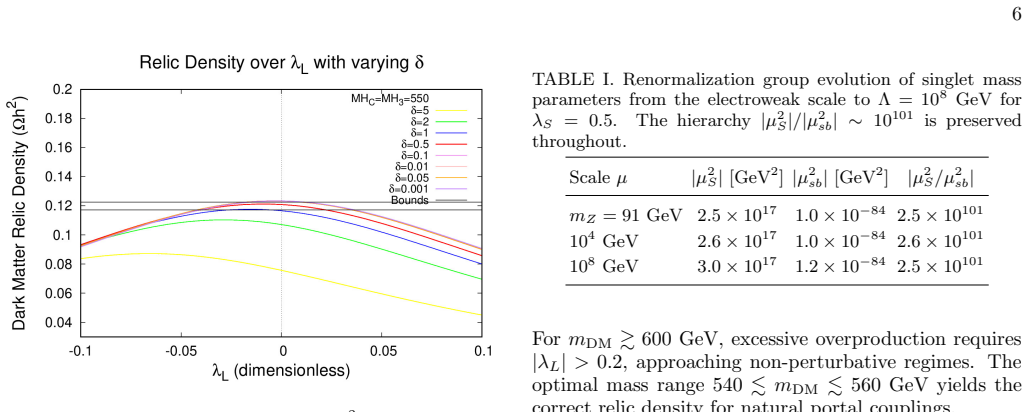
and CP-odd (A 0 2) components are constrained by the requirement of obtaining the observed dark matter relic density, ΩDMh2 = 0.1199±0.0027 [1]. We parameterize the mass degeneracy throughδ=m A0 2 −m H 0 2 . In our model the CP-even candidate is the dark matter candidate and therefore is less massive than its CP-odd counterpart, so δ≥0. 6 FIG. 1. Dark mat...
-
[2]
Two-Loop Contributions For completeness, we note that the evolution of the singlet mass parameters including two-loop effects takes the form: dµ2 S dt = 1 16π2 4λSµ2 S − 10λ2 Sµ2 S 16π2 ,(A1) dµ2 sb dt = 1 16π2 2λSµ2 sb − 6λ2 Sµ2 sb 16π2 ,(A2) where the two-loop terms are suppressed by an additional factor of 16π2 and do not affect the qualitative conclus...
-
[3]
Observation on Radiative Stability As evidenced by the derivedβ-functions, the evolution ofµ 2 S andµ 2 sb is entirely self-contained within the singlet sector. The absence of terms involving the SM Higgs mass (µ 2 1), electroweak gauge couplings (g i), or the top Yukawa coupling (Y u) confirms that the dark energy scale is technically natural. In this co...
-
[4]
In quantum field theory, the sensitivity of the vacuum to radiative corrections is governed by the dimensionality of the operators
T echnical Naturalness and Dimensional Analysis The stability of the dark energy scaleµ 2 sb ≪v 2 is guaranteed by the “soft” nature of the breaking term. In quantum field theory, the sensitivity of the vacuum to radiative corrections is governed by the dimensionality of the operators. The termV soft = µ2 sb 2 (S2 +S †2) is a mass-dimension 2 operator. It...
-
[5]
Field Expansion |S|2 =SS † = 1 2(vs+ρ+iϕ)(vs+ρ−iϕ) = 1 2 (vs +ρ) 2 +ϕ 2 . (C3) Expanding this gives: |S|2 = 1 2 v2 s +v sρ+ 1 2 ρ2 + 1 2 ϕ2.(C4) We square the result from the previous step, keeping only terms up to quadratic order in the fields (as cubic and quartic terms do not contribute to tree-level masses): |S|4 = 1 2 v2 s +v sρ+ 1 2 ρ2 + 1 2 ϕ2 2 ≈ ...
-
[6]
The Potential at Quadratic Order Substituting these expansions back intoV S, we isolate the constant (vacuum), linear (tadpole), and quadratic (mass) pieces: VS ⊃ρ vsµ2 S + λS 2 v3 s +v sµ2 sb + 1 2 ρ2 µ2 S + 3 2 λSv2 s +µ 2 sb + 1 2 ϕ2 µ2 S + 1 2 λSv2 s −µ 2 sb .(C7)
-
[7]
V acuum Extremization and T adpole Cancellation For the vacuum to be stable, the linear term inρ(the tadpole) must vanish: ∂V ∂ρ = 0 =⇒v s µ2 S +µ 2 sb + λS 2 v2 s = 0.(C8) Assumingv s ̸= 0, we obtain the critical tadpole relation: µ2 S + λS 2 v2 s =−µ 2 sb.(C9)
-
[8]
Final Mass Eigenvalues We now substitute the tadpole relation (C9) into the quadratic coefficients to find the physical masses squared m2 =∂ 2V /∂φ2. 10 Radial modeρ: m2 ρ =µ 2 S +µ 2 sb + 3 2 λSv2 s = − λS 2 v2 s −µ 2 sb +µ 2 sb + 3 2 λSv2 s =λ Sv2 s .(C10) pNGB modeϕ: m2 ϕ =µ 2 S −µ 2 sb + 1 2 λSv2 s = − λS 2 v2 s −µ 2 sb −µ 2 sb + 1 2 λSv2 s =−2µ 2 sb....
-
[9]
Planck 2018 results. VI. Cosmological parameters,
N. Aghanimet al.(Planck Collaboration), “Planck 2018 results. VI. Cosmological parameters,” Astron. Astrophys.641, A6 (2020)
2018
-
[10]
A Comprehensive Measurement of the Local Value of the Hubble Constant,
A. G. Riesset al., “A Comprehensive Measurement of the Local Value of the Hubble Constant,” Astrophys. J. Lett.934, L7 (2022)
2022
-
[11]
DESI 2024 Results: Cosmological Constraints from the First Year of Data,
DESI Collaboration, “DESI 2024 Results: Cosmological Constraints from the First Year of Data,” arXiv:2404.03002
Pith/arXiv arXiv 2024
-
[12]
Coupled quintessence,
L. Amendola, “Coupled quintessence,” Phys. Rev. D62, 043511 (2000)
2000
-
[13]
The Cosmon model for an asymptotically vanishing time dependent cosmological constant,
C. Wetterich, “The Cosmon model for an asymptotically vanishing time dependent cosmological constant,” Astron. Astrophys.301, 321 (1995)
1995
-
[14]
Instability in interacting dark energy and dark matter fluids,
J. Valiviita, E. Majerotto and R. Maartens, “Instability in interacting dark energy and dark matter fluids,” JCAP 07, 020 (2008)
2008
-
[15]
The imprint of the interaction between dark sectors in large scale cosmic microwave background anisotropies,
J.-H. He, B. Wang and P. Zhang, “The imprint of the interaction between dark sectors in large scale cosmic microwave background anisotropies,” Phys. Rev. D80, 063530 (2009)
2009
-
[16]
Scattering of dark matter and dark energy,
F. Simpson, “Scattering of dark matter and dark energy,” Phys. Rev. D82, 083505 (2010)
2010
-
[17]
Models of dark matter coupled to dark energy,
A. Pourtsidou, C. Skordis and E. J. Copeland, “Models of dark matter coupled to dark energy,” Phys. Rev. D 88, 083505 (2013)
2013
-
[18]
Parametrized post-Friedmann framework for interacting dark energy,
C. Skordis, A. Pourtsidou and E. J. Copeland, “Parametrized post-Friedmann framework for interacting dark energy,” Phys. Rev. D91, 083537 (2015)
2015
-
[19]
Quintessence and the rest of the world,
S. M. Carroll, “Quintessence and the rest of the world,” Phys. Rev. Lett.81, 3067 (1998)
1998
-
[20]
Vacuum Energy Sequestering and Gravitational Radiative Stability,
N. Kaloper and A. Padilla, “Vacuum Energy Sequestering and Gravitational Radiative Stability,” Phys. Rev. Lett.114, 101302 (2015)
2015
-
[21]
Cosmology with ultralight pseudo Nambu-Goldstone bosons,
J. A. Frieman, C. T. Hill, A. Stebbins and I. Waga, “Cosmology with ultralight pseudo Nambu-Goldstone bosons,” Phys. Rev. Lett.75, 2077 (1995)
2077
-
[22]
String or M theory axion as a quintessence,
K. Choi, “String or M theory axion as a quintessence,” Phys. Rev. D62, 043509 (2000)
2000
-
[23]
Pattern of symmetry breaking with two Higgs doublets,
N. G. Deshpande and E. Ma, “Pattern of symmetry breaking with two Higgs doublets,” Phys. Rev. D18, 2574 (1978)
1978
-
[24]
Improved naturalness with a heavy Higgs: An Alternative road to LHC physics,
R. Barbieri, L. J. Hall and V. S. Rychkov, “Improved naturalness with a heavy Higgs: An Alternative road to LHC physics,” Phys. Rev. D74, 015007 (2006)
2006
-
[25]
Significant gamma lines from inert Higgs dark matter,
M. Gustafsson, E. Lundstrom, L. Bergstrom and J. Edsjo, “Significant gamma lines from inert Higgs dark matter,” Phys. Rev. Lett.99, 041301 (2007)
2007
-
[26]
The case of inert doublet and singlet scalars,
G. B´ elanger, A. Mjallal and A. Pukhov, “The case of inert doublet and singlet scalars,” Phys. Rev. D105, 035018 (2022)
2022
-
[27]
Multi-component dark matter with a magnetic dipole and a Z 4 symmetry,
G. B´ elanger, K. Kannike, A. Pukhov and M. Raidal, “Multi-component dark matter with a magnetic dipole and a Z 4 symmetry,” JCAP01, 027 (2012)
2012
-
[28]
Small Neutrino Masses from a Decoupled Singlet Scalar Field,
J. Kim, S.-S. Kim, H. M. Lee and R. Padhan, “Small Neutrino Masses from a Decoupled Singlet Scalar Field,” arXiv:2407.13595 [hep-ph] (2024)
Pith/arXiv arXiv 2024
-
[29]
Naturalness, chiral symmetry, and spontaneous chiral symmetry breaking,
G. ’t Hooft, “Naturalness, chiral symmetry, and spontaneous chiral symmetry breaking,” inRecent Developments in Gauge Theories, NATO Adv. Study Inst. Ser. B Phys.59, 135 (1980)
1980
-
[30]
Naturally Speaking: The Naturalness Criterion and Physics at the LHC,
G. F. Giudice, “Naturally Speaking: The Naturalness Criterion and Physics at the LHC,” arXiv:0801.2562 [hep-ph] (2008)
Pith/arXiv arXiv 2008
-
[31]
Snowmass 2021 White Paper: Naturalness,
M. D. Schwartzet al., “Snowmass 2021 White Paper: Naturalness,” arXiv:2205.05708 [hep-ph] (2022)
Pith/arXiv arXiv 2021
-
[32]
Cosmology with a Time-Variable Cosmological Constant,
P. J. E. Peebles and B. Ratra, “Cosmology with a Time-Variable Cosmological Constant,” Astrophys. J. 325, L17 (1988)
1988
-
[33]
Radiative Corrections as the Origin of Spontaneous Symmetry Breaking,
S. R. Coleman and E. J. Weinberg, “Radiative Corrections as the Origin of Spontaneous Symmetry Breaking,” Phys. Rev. D7, 1888 (1973)
1973
-
[34]
The Cosmological Constant Problem,
S. Weinberg, “The Cosmological Constant Problem,” Rev. Mod. Phys.61, 1 (1989)
1989
-
[35]
Phenomenological Lagrangians,
S. Weinberg, “Phenomenological Lagrangians,” Physica A96, 327 (1979)
1979
-
[36]
Momentum transfer models of interacting dark energy,
J. Linton, R. Crittenden and A. Pourtsidou, “Momentum transfer models of interacting dark energy,” JCAP08, 075 (2022)
2022
-
[37]
G. B´ elanger, F. Boudjema, A. Pukhov, A. Semenov, micrOMEGAs: A tool for dark matter studies, Comput. Phys. Commun.182, 842 (2011).https://arxiv.org/ abs/1005.4133
Pith/arXiv arXiv 2011
-
[38]
B´ elanger et al., micrOMEGAs5.0: Freeze-in, Comput
G. B´ elanger et al., micrOMEGAs5.0: Freeze-in, Comput. Phys. Commun.231, 173 (2018).https://arxiv.org/ abs/1801.03509
Pith/arXiv arXiv 2018
-
[39]
The Cosmic Linear Anisotropy Solving System (CLASS) I: Overview,
J. Lesgourgues and T. Tram, “The Cosmic Linear Anisotropy Solving System (CLASS) I: Overview,” (2011).https://arxiv.org/abs/1104.2932
Pith/arXiv arXiv 2011
-
[40]
The Cosmic Linear Anisotropy Solving System (CLASS) II: Approximation schemes,
D. Blas, J. Lesgourgues and T. Tram, “The Cosmic Linear Anisotropy Solving System (CLASS) II: Approximation schemes,” JCAP07, 034 (2011) [arXiv:1104.2933 [astro-ph.CO]]
Pith/arXiv arXiv 2011
-
[41]
A Parameterized Post-Friedmann Framework for Modified Gravity,
W. Hu and I. Sawicki, “A Parameterized Post-Friedmann Framework for Modified Gravity,” Phys. Rev. D76, 104043 (2007) [arXiv:0708.1190 [astro-ph]]
Pith/arXiv arXiv 2007
-
[42]
Crossing the Phantom Divide with Parameterized Post-Friedmann Dark Energy,
W. Fang, W. Hu and A. Lewis, “Crossing the Phantom Divide with Parameterized Post-Friedmann Dark Energy,” Phys. Rev. D78, 087303 (2008) [arXiv:0808.3125 [astro-ph]]
Pith/arXiv arXiv 2008
-
[43]
Cosmological Perturbation Theory,
H. Kodama and M. Sasaki, “Cosmological Perturbation Theory,” Prog. Theor. Phys. Suppl.78, 1 (1984). 11
1984
-
[44]
Cosmological Perturbation Theory in the Synchronous and Conformal Newtonian Gauges,
C.-P. Ma and E. Bertschinger, “Cosmological Perturbation Theory in the Synchronous and Conformal Newtonian Gauges,” Astrophys. J.455, 7 (1995) [arXiv:astro-ph/9506072]
Pith/arXiv arXiv 1995
-
[45]
G. Benevento, M. Ballardini, M. Braglia and F. Finelli, “Matter power spectrum in a CLASS of alternative dark energy models: comparative analysis of the baryon acoustic oscillation measurements,” JCAP04, 041 (2020) [arXiv:1911.06064 [astro-ph.CO]]
Pith/arXiv arXiv 2020
-
[46]
The inert doublet model: An archetype for dark matter,
L. Lopez Honorez, E. Nezri, J. F. Oliver and M. H. G. Tytgat, “The inert doublet model: An archetype for dark matter,”JCAP0702, 028 (2007)
2007
-
[47]
King, Stefano Moretti, and Dorota Sokolowska,Observable heavy Higgs dark matter, Journal of High Energy Physics, 2015(11):3, 2015
Venus Keus, Stephen F. King, Stefano Moretti, and Dorota Sokolowska,Observable heavy Higgs dark matter, Journal of High Energy Physics, 2015(11):3, 2015
2015
-
[48]
N= 2 PNGB Quintessence Dark Energy,
J. Lee, S. Lee and J. Kim, “N= 2 PNGB Quintessence Dark Energy,” J. Korean Phys. Soc.79, 336 (2021) [arXiv:2002.01756 [astro-ph.CO]]
Pith/arXiv arXiv 2021
-
[49]
Forecasts for interacting dark energy with time-dependent momentum exchange,
N. Cruickshank, R. Crittenden and A. Pourtsidou, “Forecasts for interacting dark energy with time-dependent momentum exchange,” arXiv:2504.03555 [astro-ph.CO] (2025)
arXiv 2025
discussion (0)
Sign in with ORCID, Apple, or X to comment. Anyone can read and Pith papers without signing in.