REVIEW 3 major objections 4 minor 52 references
SPAE: Spectrally Guided Autoencoder for Pretrained Visual Latents
T0 review · 3 major / 4 minor · reviewed 2026-08-06 · deepseek-v4-flash
Pith's one-line read SPAE compresses vision-foundation latents into a 64-channel bottleneck and masks trailing channels, achieving ImageNet guided gFID 1.12 and reconstruction PSNR 30.28 while keeping linear-probe accuracy within about a point.
desk verdict A useful spectral diagnosis and a plausible bottleneck design, but the central claim that channel masking drives the generation gain is only shown at 10 epochs, and the 800-epoch gain over RAE is within noise. read the letter →
The pith
A machine-rendered reading of the paper's core claim, the machinery that carries it, and where it could break.
The reading
What carries the argument
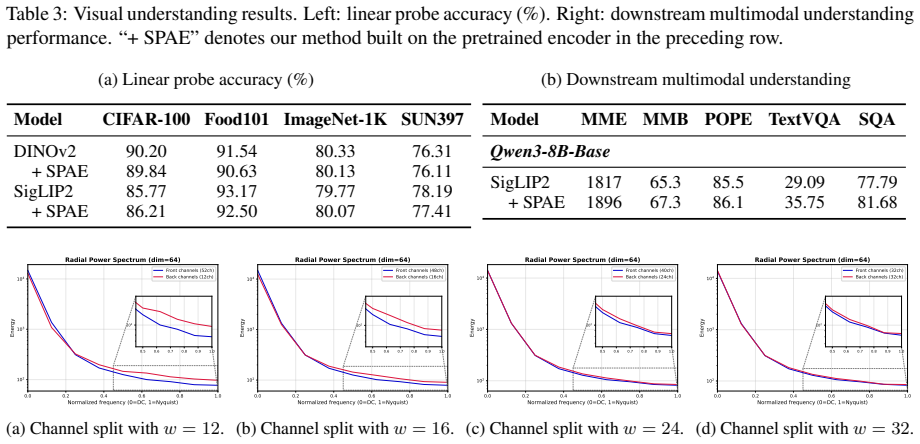
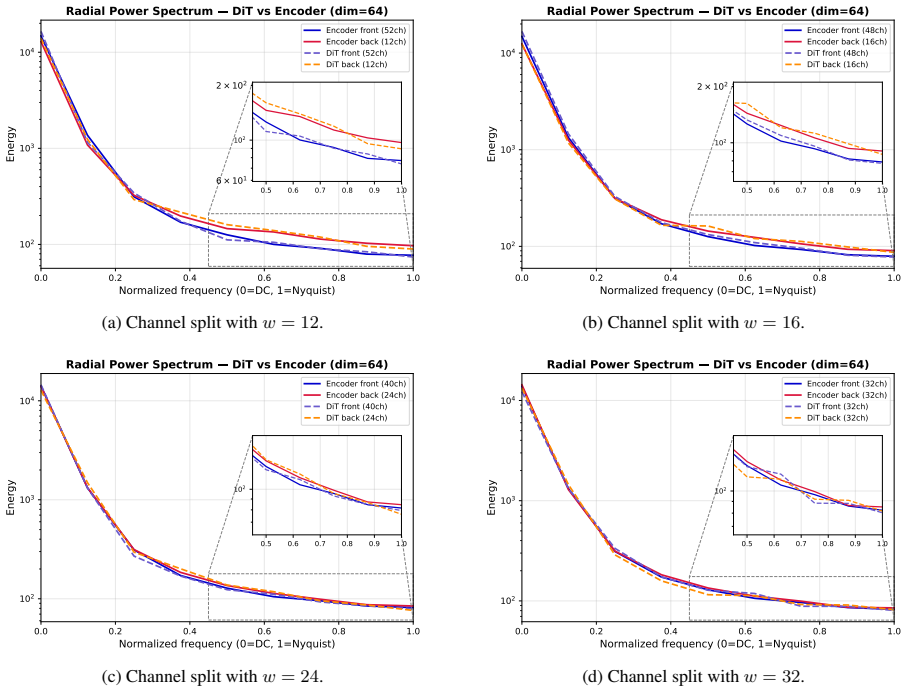
The design is a three-stage autoencoder: a frozen vision-foundation encoder; a one-layer transformer compressor that maps the high-dimensional native latent to 64 channels; a six-layer lifting module that returns to the decoder space; and a ViT-XL image decoder. Two training mechanisms do the work: compact-bottleneck compression, which removes the high-frequency components DiT fails to model, and channel-wise suffix masking, which randomly zeros the last $w \in \{0,12,16,24,32\}$ channels (probabilities 0.6, 0.15, 0.1, 0.1, 0.05) so that the remaining prefix must carry the semantic content. An alignment loss keeps the finetuned encoder from drifting away from the frozen pretrained copy.
What would settle it
Run the channel-masked versus unmasked SPAE comparison at the full 800-epoch schedule: if guided gFID is not substantially below the unmasked variant's value, the mechanism's headline evidence (a 10-epoch ablation: 5.00 vs 8.30) is a short-training effect, not a converged property.
Extended reading notes
Core claim
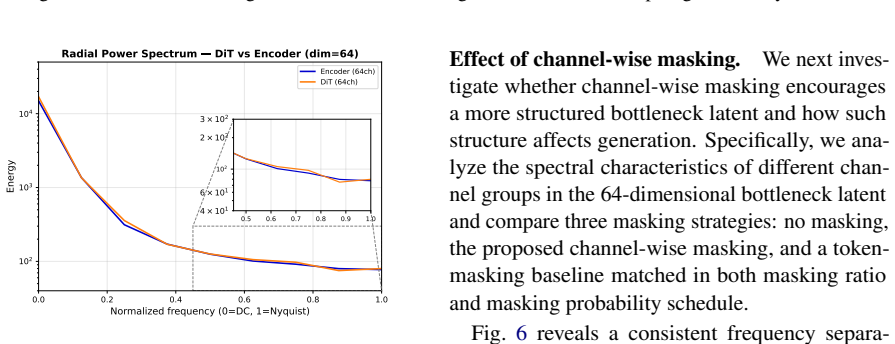
The central discovery is that RAE-style high-dimensional vision-foundation latents are hard to model because DiT-generated latents lose spectral power at high spatial frequencies relative to encoder latents, and because semantic and fine-detail content are mixed across all channels. SPAE shows that a 64-dimensional bottleneck plus training with channel-wise suffix masking reorganizes the latent so early channels carry low-frequency semantic signal and late channels carry detail; the spectra of generated and encoder latents then align across the whole frequency range. The same latent supports reconstruction (PSNR 30.28 with DINOv2 on ImageNet-1K), class-conditional generation (gFID 1.12 with
Load-bearing premise
The load-bearing premise is that the high-frequency spectral mismatch and channel-wise semantic–detail entanglement are the actual causes of poor generation, so that bottleneck compression and suffix masking help through those mechanisms rather than only through reduced dimensionality or added regularization.
Editorial extensions
If this is right
- A semantic VFM latent can be made generative by reorganizing it, not by discarding it: 64 channels sustain both diffusion training and reconstruction in one space.
- Channel-wise suffix masking, not token masking or no masking, produces the large short-horizon generation gain (gFID 8.30 -> 5.00 at 10 epochs and, after full training, 1.12 guided), so channel ordering is a controllable design axis for latent spaces.
- Wider bottlenecks trade generation for reconstruction: PSNR rises monotonically from 27.31 (32 channels) to 31.35 (128 channels) while gFID worsens, so dimensionality is a knob for the understanding-generation balance.
- Because linear probes and multimodal benchmarks stay near or above frozen-encoder levels, the adapted latent is reusable for understanding tasks, not just generation.
Reading between the lines
- If the spectral-coupling diagnosis is right, the same suffix-masking reorganization should transfer to other frozen encoders and generative backbones with no change in recipe; a cheap test would be swapping in a CLIP-style encoder and checking whether the front/back spectral split reappears.
- The masking benefit is demonstrated at 10 epochs; the full-training gFID gap over RAE is only 0.04 (1.12 vs 1.13), so the mechanism's contribution at convergence is not yet isolated from longer training.
- An ablation that suppresses high-frequency content while holding dimensionality fixed would separate the 'spectral suppression' story from the 'lower-dimensional target' story; the current experiments do not isolate these.
- Fixed-resolution training (224/256) may cap how much detail the back channels can encode, which would explain the smaller TextVQA gains; adaptive masking schedules or higher resolution are natural follow-ups.
Editorial analysis
A structured set of objections, weighed in public.
Referee Report
Summary. The paper proposes SPAE, a method for adapting high-dimensional visual foundation model latents (e.g., DINOv2, SigLIP2) for generative modeling. It identifies two obstacles: a spectral mismatch between encoder latents and DiT-generated latents, and channel-wise entanglement of semantic and high-frequency information. SPAE addresses these with a compact bottleneck (default 64 channels) and a channel-wise suffix masking strategy, using a three-stage training procedure. Experiments on ImageNet-256 report strong reconstruction (PSNR 30.28, rFID 0.13 for SPAE(DINOv2)), competitive class-conditional generation (gFID 1.47 unguided, 1.12 guided), and preserved linear-probe and multimodal understanding performance relative to the frozen encoders. The paper also includes spectral analyses and ablations of bottleneck dimension and masking strategy.
Significance. If the claims are substantiated, SPAE would be a practically useful and well-motivated recipe for turning semantic VFM latents into generative latents while retaining understanding capability, an important goal for unified vision models. The analysis is clearly presented and the evaluation is broad, covering reconstruction, generation, linear probing, and downstream multimodal understanding. The inclusion of a token-masking baseline is a good control. However, the central causal narrative — that spectral mismatch and channel entanglement are the operative obstacles and that the proposed components act on them — is supported mainly by correlational evidence and short-horizon ablations. The reported generation gains over the closest baseline at the headline training budget are very small and reported without variance, so the empirical balance claim is not yet fully demonstrated. These issues are addressable with additional controlled experiments and reporting.
major comments (3)
- [§A.2, Table 2] The paper states that each experiment is repeated with three seeds and the best result is reported, but no variance or per-seed values are given. The headline generation gains over RAE are gFID 1.47 vs 1.51 (unguided) and 1.12 vs 1.13 (guided) at 800 epochs. These differences are small enough to be within seed-to-seed variation for this type of training. Please report mean±std or all individual runs, and state whether the differences are consistent across seeds. As written, the central 'better generation' claim is not distinguishable from run-to-run noise.
- [§3.3 vs §A.1, Table 5] There is a direct contradiction about Stage II training. Section 3.3 says 'We jointly optimize Ec and Eu' and that the objective remains the same as Stage I (which includes adversarial loss). Appendix A.1 says 'In Stage 2, we introduce a 64-dimensional bottleneck and train only the compressor, while keeping both the encoder and decoder fixed,' and Table 5 lists the Stage 2 trainable module as 'compressor' with loss 'ℓ1 + LPIPS' (no GAN). This is a load-bearing reproducibility detail. Please correct the inconsistency and describe which protocol was actually used, including which modules are trainable and which losses are applied.
- [§4.5, Table 4b] The masking ablation that shows a large generation improvement (gFID 8.30→5.00, IS 97.5→151.2) is explicitly reported at 10 epochs only. The headline results in Table 2 are at 800 epochs, where SPAE vs RAE differ by 0.04/0.01 gFID, and no masked-vs-unmasked SPAE comparison is provided at 800 epochs. Consequently, the claimed causal role of channel-wise masking in improving generation is not established at the training budget used for the main evaluation. Please add an 800-epoch no-masking control, or an experiment that suppresses high-frequency components while holding the bottleneck dimension fixed, to separate the spectral-decoupling mechanism from regularization or effective-capacity effects.
minor comments (4)
- [§A.1] Typo: 'mudules' should be 'modules'. Also, 'DiTwDDTHead' appears to be a typographical or formatting error for the DiT-with-DDT-head architecture; please define it clearly.
- [§4.1 and §A.1] Section 4.1 says training is at 256×256 resolution, but Appendix A.1 says the input resolution is matched to the encoder backbone (224×224 for DINOv2-Base, 256×256 for SigLIP2-Base). Clarify which resolution is used for autoencoder training and which for DiT training.
- [Table 2] In the guided-generation columns, the Recall value for SPAE (0.70) appears concatenated with the preceding Precision value (0.75) in the table text. Please fix the formatting.
- [References] There are duplicated Russakovsky et al. entries (2015a/2015b) with inconsistent author list formatting, and several references use 'and 1 others' instead of full author lists. Please clean up the bibliography.
Circularity Check
No significant circularity; the derivation chain is empirical and self-contained.
full rationale
SPAE does not derive its predictions from its inputs by construction. The spectral analyses in Sec. 3.1 are empirical observations of RAE/VAE latents; the bottleneck compression and suffix-channel masking are architectural interventions trained with reconstruction and alignment losses, not fitted to match the measured spectra. The claim that high-frequency mismatch is reduced in the bottleneck is supported by independent spectral measurements (Fig. 5) on latents from a separately trained DiT, and the channel-separation effect (Fig. 6) is an emergent property learned under masking, not an equality enforced by the loss. The alignment loss Lalign anchors E_rep to the frozen pretrained encoder, which explains the preserved linear-probe accuracy, but linear-probe accuracy is reported as an evaluation, not as a prediction from a fit. No load-bearing step relies on a self-citation: RAE/DiTDH (Zheng et al. 2026) is external prior work with no shared authors. The 10-epoch masking ablation vs. the small 800-epoch gFID gap over RAE is an evidential/robustness concern (short-horizon effect, possible noise), not a circularity, because the method's causal claims are not derived from those numbers by definition. The paper makes no uniqueness claim and no parameter is fitted and then renamed as a prediction. Under the hard rules requiring an explicit equation-level reduction or fitted-input-as-prediction, no circular step is present.
Assumptions & free parameters
free parameters (4)
- bottleneck dimension C_b =
64
- channel masking candidate set and probabilities =
w in {0,12,16,24,32} with probs {0.6,0.15,0.1,0.1,0.05}
- loss weights lambda_perc, lambda_adv, lambda_align =
not stated
- compressor/lifting transformer depth =
1 block / 6 blocks
assumptions (4)
- domain assumption Radial power spectrum alignment is a valid proxy for generative modelability
- domain assumption Contiguous suffix masking induces an ordered channel structure (low-freq semantic first, high-freq detail last)
- domain assumption A 64-channel bottleneck plus a 6-block lifting module can recover the information needed for high-fidelity reconstruction
- domain assumption The pretrained VFM latents are semantically meaningful and should be preserved
Cite this review
Pith. "Pith review of SPAE: Spectrally Guided Autoencoder for Pretrained Visual Latents." pith.science (2026). https://pith.science/paper/4LN6LYYX
@misc{pith2026260801306,
  author       = {Pith},
  title        = {Pith review of: SPAE: Spectrally Guided Autoencoder for Pretrained Visual Latents},
  year         = {2026},
  howpublished = {\url{https://pith.science/paper/4LN6LYYX}},
  note         = {Machine review of arXiv:2608.01306}
}
read the original abstract
Latents from vision foundation models (VFMs) are semantically rich and well suited for visual understanding. Recent representation autoencoder methods such as RAE have shown that they can provide promising latent spaces for image generation. However, VFM latents remain difficult to model directly: DiT-generated latents exhibit spectral mismatch with encoder latents, especially in high-frequency components. Our channel-wise spectral analysis further reveals that these high-frequency components are diffusely distributed across latent channels and entangled with semantic information, making the latent space difficult for DiT to model. To address these challenges, we propose SPAE, latent adaptation framework for generation. Specifically, SPAE employs a compact bottleneck to distill stable semantic information while suppressing high-frequency components, thereby improving the alignment between DiT-generated latents and encoder latents. In addition, we apply a channel-wise masking strategy to promote the decoupling of semantic information and high-frequency details across bottleneck channels. Experiments show that SPAE achieves a favorable balance among visual understanding, generation quality, and reconstruction fidelity.
Figures


Figures from the paper (4 more)

Reference graph
Works this paper leans on
-
[1]
Aho and Jeffrey D
Alfred V. Aho and Jeffrey D. Ullman , title =. 1972
1972
-
[2]
Publications Manual , year = "1983", publisher =
1983
-
[3]
Ashok K. Chandra and Dexter C. Kozen and Larry J. Stockmeyer , year = "1981", title =. doi:10.1145/322234.322243
arXiv 1981
-
[4]
Scalable training of
Andrew, Galen and Gao, Jianfeng , booktitle=. Scalable training of
-
[5]
Dan Gusfield , title =. 1997
1997
-
[6]
Tetreault , title =
Mohammad Sadegh Rasooli and Joel R. Tetreault , title =. Computing Research Repository , volume =. 2015 , url =
2015
-
[7]
A Framework for Learning Predictive Structures from Multiple Tasks and Unlabeled Data , Volume =
Ando, Rie Kubota and Zhang, Tong , Issn =. A Framework for Learning Predictive Structures from Multiple Tasks and Unlabeled Data , Volume =. Journal of Machine Learning Research , Month = dec, Numpages =
-
[8]
The Fourteenth International Conference on Learning Representations , year=
Diffusion Transformers with Representation Autoencoders , author=. The Fourteenth International Conference on Learning Representations , year=
Show all 52 references
-
[9]
arXiv preprint arXiv:2510.15301 , year=
Latent diffusion model without variational autoencoder , author=. arXiv preprint arXiv:2510.15301 , year=
-
[10]
arXiv preprint arXiv:2304.07193 , year=
Dinov2: Learning robust visual features without supervision , author=. arXiv preprint arXiv:2304.07193 , year=
-
[11]
arXiv preprint arXiv:2502.14786 , year=
Siglip 2: Multilingual vision-language encoders with improved semantic understanding, localization, and dense features , author=. arXiv preprint arXiv:2502.14786 , year=
-
[12]
Proceedings of the IEEE/CVF international conference on computer vision , pages=
Scalable diffusion models with transformers , author=. Proceedings of the IEEE/CVF international conference on computer vision , pages=
-
[13]
arXiv preprint arXiv:2504.05741 , year=
Ddt: Decoupled diffusion transformer , author=. arXiv preprint arXiv:2504.05741 , year=
-
[14]
Proceedings of the IEEE/CVF International Conference on Computer Vision , pages=
Dc-ae 1.5: Accelerating diffusion model convergence with structured latent space , author=. Proceedings of the IEEE/CVF International Conference on Computer Vision , pages=
-
[15]
arXiv preprint arXiv:2512.07829 , year=
One Layer Is Enough: Adapting Pretrained Visual Encoders for Image Generation , author=. arXiv preprint arXiv:2512.07829 , year=
-
[16]
arXiv preprint arXiv:2603.19206 , year=
Rpiae: A representation-pivoted autoencoder enhancing both image generation and editing , author=. arXiv preprint arXiv:2603.19206 , year=
-
[17]
arXiv preprint arXiv:2512.17909 , year=
Both Semantics and Reconstruction Matter: Making Representation Encoders Ready for Text-to-Image Generation and Editing , author=. arXiv preprint arXiv:2512.17909 , year=
-
[18]
arXiv preprint arXiv:2602.08620 , year=
Improving reconstruction of representation autoencoder , author=. arXiv preprint arXiv:2602.08620 , year=
-
[19]
arXiv preprint arXiv:2502.14831 , year=
Improving the diffusability of autoencoders , author=. arXiv preprint arXiv:2502.14831 , year=
-
[20]
arXiv preprint arXiv:2502.09509 , year=
Eq-vae: Equivariance regularized latent space for improved generative image modeling , author=. arXiv preprint arXiv:2502.09509 , year=
-
[21]
arXiv preprint arXiv:2512.19693 , year=
The Prism Hypothesis: Harmonizing Semantic and Pixel Representations via Unified Autoencoding , author=. arXiv preprint arXiv:2512.19693 , year=
-
[22]
2009 IEEE conference on computer vision and pattern recognition , pages=
Imagenet: A large-scale hierarchical image database , author=. 2009 IEEE conference on computer vision and pattern recognition , pages=. 2009 , organization=
2009
-
[23]
European conference on computer vision , pages=
Microsoft coco: Common objects in context , author=. European conference on computer vision , pages=. 2014 , organization=
2014
-
[24]
Proceedings of the IEEE conference on computer vision and pattern recognition , pages=
The unreasonable effectiveness of deep features as a perceptual metric , author=. Proceedings of the IEEE conference on computer vision and pattern recognition , pages=
-
[25]
Advances in neural information processing systems , volume=
Gans trained by a two time-scale update rule converge to a local nash equilibrium , author=. Advances in neural information processing systems , volume=
-
[26]
Advances in neural information processing systems , volume=
Improved techniques for training gans , author=. Advances in neural information processing systems , volume=
-
[27]
Proceedings of the IEEE/CVF conference on computer vision and pattern recognition , pages=
High-resolution image synthesis with latent diffusion models , author=. Proceedings of the IEEE/CVF conference on computer vision and pattern recognition , pages=
-
[28]
generation: Taming optimization dilemma in latent diffusion models , author=
Reconstruction vs. generation: Taming optimization dilemma in latent diffusion models , author=. Proceedings of the Computer Vision and Pattern Recognition Conference , pages=
-
[29]
arXiv preprint arXiv:2510.10575 , year=
Uniflow: A unified pixel flow tokenizer for visual understanding and generation , author=. arXiv preprint arXiv:2510.10575 , year=
-
[30]
Advances in neural information processing systems , volume=
Diffusion models beat gans on image synthesis , author=. Advances in neural information processing systems , volume=
-
[31]
arXiv preprint arXiv:2504.07963 , year=
PixelFlow: Pixel-Space Generative Models with Flow , author=. arXiv preprint arXiv:2504.07963 , year=
-
[32]
arXiv preprint arXiv:2212.11972 , year=
Scalable adaptive computation for iterative generation , author=. arXiv preprint arXiv:2212.11972 , year=
-
[33]
Transactions on Machine Learning Research (TMLR) , year=
Fast Training of Diffusion Models with Masked Transformers , author=. Transactions on Machine Learning Research (TMLR) , year=
-
[34]
2022 , journal=
Scalable Diffusion Models with Transformers , author=. 2022 , journal=
2022
-
[35]
European Conference on Computer Vision , pages=
Sit: Exploring flow and diffusion-based generative models with scalable interpolant transformers , author=. European Conference on Computer Vision , pages=. 2024 , organization=
2024
-
[36]
Advances in Neural Information Processing Systems , volume=
Fasterdit: Towards faster diffusion transformers training without architecture modification , author=. Advances in Neural Information Processing Systems , volume=
-
[37]
2025 , booktitle=
Representation Alignment for Generation: Training Diffusion Transformers Is Easier Than You Think , author=. 2025 , booktitle=
2025
-
[38]
2009 , publisher=
Learning multiple layers of features from tiny images , author=. 2009 , publisher=
2009
-
[39]
European Conference on Computer Vision , year =
Food-101 -- Mining Discriminative Components with Random Forests , author =. European Conference on Computer Vision , year =
-
[40]
Berg and Li Fei-Fei , Title =
Olga Russakovsky and Jia Deng and Hao Su and Jonathan Krause and Sanjeev Satheesh and Sean Ma and Zhiheng Huang and Andrej Karpathy and Aditya Khosla and Michael Bernstein and Alexander C. Berg and Li Fei-Fei , Title =. 2015 , journal =. doi:10.1007/s11263-015-0816-y , volume=
2015 doi
-
[41]
2010 IEEE Computer Society Conference on Computer Vision and Pattern Recognition , volume =
SUN database: Large-scale scene recognition from abbey to zoo , author =. 2010 IEEE Computer Society Conference on Computer Vision and Pattern Recognition , volume =. doi:10.1109/CVPR.2010.5539970 , keywords =
2010
-
[42]
2025 , eprint=
Qwen3 Technical Report , author=. 2025 , eprint=
2025
-
[43]
Advances in Neural Information Processing Systems , volume=
Mme: A comprehensive evaluation benchmark for multimodal large language models , author=. Advances in Neural Information Processing Systems , volume=
-
[44]
European conference on computer vision , pages=
Mmbench: Is your multi-modal model an all-around player? , author=. European conference on computer vision , pages=. 2024 , organization=
2024
-
[45]
Proceedings of the 2023 conference on empirical methods in natural language processing , pages=
Evaluating object hallucination in large vision-language models , author=. Proceedings of the 2023 conference on empirical methods in natural language processing , pages=
2023
-
[46]
Proceedings of the IEEE Conference on Computer Vision and Pattern Recognition , pages=
Towards VQA Models That Can Read , author=. Proceedings of the IEEE Conference on Computer Vision and Pattern Recognition , pages=
-
[47]
The 36th Conference on Neural Information Processing Systems (NeurIPS) , year=
Learn to Explain: Multimodal Reasoning via Thought Chains for Science Question Answering , author=. The 36th Conference on Neural Information Processing Systems (NeurIPS) , year=
-
[48]
Proceedings of the IEEE/CVF Conference on Computer Vision and Pattern Recognition , pages=
Fourier image transformer , author=. Proceedings of the IEEE/CVF Conference on Computer Vision and Pattern Recognition , pages=
-
[49]
International journal of computer vision , volume=
Imagenet large scale visual recognition challenge , author=. International journal of computer vision , volume=. 2015 , publisher=
2015
-
[50]
arXiv preprint arXiv:1610.01644 , year=
Understanding intermediate layers using linear classifier probes , author=. arXiv preprint arXiv:1610.01644 , year=
-
[51]
arXiv preprint arXiv:2603.03276 , year=
Beyond language modeling: An exploration of multimodal pretraining , author=. arXiv preprint arXiv:2603.03276 , year=
-
[52]
arXiv preprint arXiv:2603.15228 , year=
HYDRA: Unifying Multi-modal Generation and Understanding via Representation-Harmonized Tokenization , author=. arXiv preprint arXiv:2603.15228 , year=
Reviewed August 6, 2026 · model on record in the stance chip above.
Discussion (0). Sign in to comment.