REVIEW 2 major objections 5 minor 83 references
Research Opportunities in Sociotechnical Interventions for Health Disparity Reduction
T0 review · 2 major / 5 minor · reviewed 2026-08-14 · deepseek-v4-flash
Pith's one-line read Health technology research should aim at the social and structural causes of health disparities rather than individual behavior change alone, the report argues.
desk verdict A solid agenda-setting workshop report with one genuine soft spot: the upstream-over-downstream priority is built on a single 2013 non-digital umbrella review, so treat it as a hypothesis, not a settled conclusion. read the letter →
The pith
A machine-rendered reading of the paper's core claim, the machinery that carries it, and where it could break.
The reading
What carries the argument
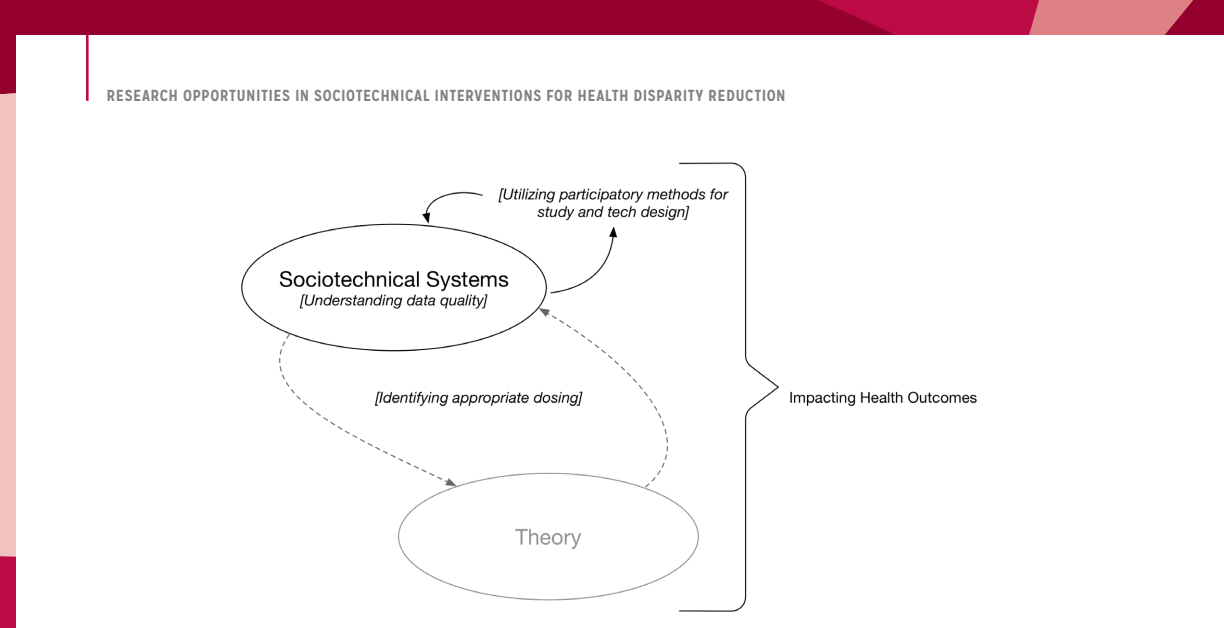
The framework that carries the argument is an extended social-determinants model of health disparities, which locates the ultimate causes of disparities in macro-level sociopolitical and economic forces and names four mechanisms—stratification, differential exposure, differential vulnerability, and differential consequences—through which those forces produce unequal health. Interventions that target these mechanisms, moving from immediate individual behavior toward the structural left side of the model, count as "upstream." The report pairs this model with a typology of six technology capabilities (social coordination, communication mediation, resource distribution, decision framing, education, and information access) and with a "sociotechnical black box" checklist—participatory design, data quality, dosing, and theory mapping—that researchers should use to open up how interventions work.
What would settle it
A meta-analysis of digital health behavior-change interventions that reports effect sizes separately for marginalized and advantaged participants could settle the key premise. If such an analysis found marginalized groups benefiting as much as or more than advantaged groups from downstream interventions, the report's case for shifting resources toward upstream interventions would be directly undercut.
Extended reading notes
Core claim
The report's central claim is that the way sociotechnical health systems are currently designed and evaluated reproduces health disparities. It contends that downstream interventions—those that focus on individual patient effort, behavior, and choice—are less effective for marginalized populations, and that the field must develop upstream and multi-level interventions that act on social stratification, differential exposures, vulnerability, and consequences. It also claims that every stage of the intervention cycle, from recruitment to retention to evaluation, currently favors advantaged groups, so equity must be built into methods, not added after the fact. The report consolidates its proposals into a table mapping research challenges to opportunities.
Load-bearing premise
The agenda's priority on upstream interventions—those that change social and structural conditions rather than individual behavior—rests on the generalization, drawn from equity-focused systematic reviews, that downstream individual-behavior interventions work less well for marginalized groups; the report treats this as settled rather than testing it for sociotechnical systems.
Editorial extensions
If this is right
- Interventions would be designed and funded for communities and networks, not just individuals, with multi-level studies that measure outcomes at community and population scales as well as individual scales.
- Evaluation would routinely include planned heterogeneity-of-treatment-effect analyses, equity-relevant outcome measures, and qualitative study of unintended consequences, making "for whom did this work?" a required question.
- Researchers would document recruitment methods, demographics, dropout, engagement, and data provenance, turning under-reporting from a norm into a reported practice.
- Funding would support pilot studies, iterative design, and small-N methods for marginalized populations, rather than treating only large randomized trials as acceptable evidence.
- Shared national infrastructure would be built to reuse algorithms, data, and recruitment/retention strategies, with annual themes that converge on standard equity metrics.
Reading between the lines
- The report's own framing implies that a design which maximizes aggregate engagement could still be inequitable: if the marginal health benefit of each unit of "dose" is larger for advantaged users, then usage-maximizing features will widen disparities even when access is equal.
- A concrete test of the upstream premise would be a study that logs intervention use and health outcomes by socioeconomic status and builds dose-response curves: if disadvantaged users need more use to get the same benefit, the priority should shift to lowering the required dose, not raising uptake.
- The six technology capabilities could be repurposed as an audit checklist for existing consumer health platforms, allowing retrospective equity assessments of products already in wide use—an application the report calls for but does not perform.
- The consortium proposal implies that shared equity metrics could be validated through cross-study meta-analysis; the absence of such metrics today is itself a measurable obstacle to knowing which interventions reduce disparities.
Signed reviews
Editorial analysis
A structured set of objections, weighed in public.
Referee Report
Summary. This paper is the report of a two-day workshop sponsored by the Computing Community Consortium and held in conjunction with the Society for Behavioral Medicine's 2018 Annual Meeting. The workshop convened researchers from computing, health informatics, behavioral medicine, and health disparities research to develop an integrative research agenda for sociotechnical interventions to reduce health disparities among marginalized groups. The report organizes the agenda into five thematic areas: equity-centered intervention strategies and implementation approaches, with emphasis on upstream and multi-level interventions and on equity-centered recruitment, uptake, engagement, and retention; opening the 'sociotechnical black boxes' of participatory design, data quality, and dosing; using sociotechnical systems to inform behavioral theory; multidimensional evaluation, including equity impacts, unintended consequences, and research ethics; and interdisciplinary bridges, including a proposed consortium or national centers. Section 7 states the central claim: the report highlights cross-disciplinary research challenges and opportunities, which are summarized in a challenge/opportunity table. The agenda is grounded in the workshop discussions, in cited empirical literature, and in the attendees' consensus as reported by the authors.
Significance. The paper is a valuable agenda-setting document. If its priorities are sound, it can shape funding decisions and collaboration patterns across four fields that rarely coordinate. Strengths worth naming: the report generates a large set of concrete, actionable open questions; it makes equity impacts and unintended consequences central to the evaluation agenda (Box 2, Section 5.2); it is candid about field-level reporting gaps such as the pervasive non-reporting of participant demographics (Section 2.2) and dropout characteristics (Section 2.3); and it discloses its provenance fully, including the planning committee, attendee list, and NSF funding. Because this is a consensus report rather than a derivation, its value turns on the empirical premises underlying its priority ordering. On reading the full text, I find that the main correctness-risk concern raised in review — the untested transfer of the downstream-versus-upstream effectiveness gradient from non-digital interventions [19] to sociotechnical interventions — lands; it is treated as a major comment below.
major comments (2)
- [§2.1, §7 (opportunity table)] The agenda's priority ordering rests on the claim in §2.1 that 'equity-focused systematic reviews have shown that downstream health behavior interventions tend to be less effective for marginalized populations than those that operate further upstream [19].' This is supported by a single citation, Lorenc et al. [19], a 2013 umbrella review whose evidence base is predominantly non-digital behavioral and structural interventions. The report immediately generalizes from this to 'a greater focus on upstream interventions in computing' and encodes the result as a challenge/opportunity row in the Section 7 table. No evidence is offered that the effectiveness gradient in [19] transfers to sociotechnical interventions, and mechanisms identified elsewhere in the report could cut the other way: differential uptake and engagement of digital tools (Sections 2.2–2.3) and differential benefits of 'universal' interventions (Section 5.2) could make an individually oriented sociotechnical intervention equity-improving in some contexts, or make an upstream-oriented digital system reproduce the gradient the report worries about. Because the Section 7 priority ordering would lose force if this premise fails for sociotechnical interventions, I treat the issue as load-bearing. The fix is within scope: either broaden the evidentiary base beyond [19], or explicitly reframe the upstream priority as a research hypothesis and add to the §2.1 open questions the question of whether the downstream/upstream gradient replicates for digital and sociotechnical interventions, assessed through the equity-focused individual-patient-data meta-analyses proposed in §5.2. The manuscript is candid about other evidence gaps (Sections 2.2, 2.3), so the absence of any caveat on this point is conspicuous.
- [§2.1 and Figure 1] The term 'upstream' is defined only directionally: interventions 'that move from the right to the left' in Figure 1 count as further upstream. Because Figure 1 depicts a causal chain of four mechanisms rather than an ordered scale with a threshold, the report gives no decision rule for classifying a particular intervention as downstream versus upstream. As stated, therefore, the agenda's priority ordering is not testable: two researchers could reasonably disagree about whether an intervention targeting mechanism (3), differences in vulnerability, or an individual-level intervention with meso-level spillovers, is upstream. I recommend an operational definition — for example, classifying interventions by which of the four mechanisms in Figure 1 they primarily target, with an explicit rule for multi-level interventions — or, alternatively, an explicit statement that developing such a classification is itself an open methodological question on the agenda.
minor comments (5)
- [Figure 1 (§2.1)] The Figure 1 caption attributes the extended WHO model to reference [77], but reference [77] is E. Pain, 'A New Funding Model for Scientists' (Science, 2015), a careers article about research funding; the WHO social-determinants framework referenced in the text is [24] (Solar and Irwin 2017). The caption citation should be corrected.
- [§2.2, Box 1, §3.2, §3.3] There are several typographical and grammatical errors, including 'sociotechical interventions' in §2.2, 'prevalance' in Box 1, 'in a researchers' possession' in §3.2, and 'for to administer a dose' in §3.3. A careful proofreading pass is needed.
- [Sections 2–5] The report repeatedly attributes conclusions to 'workshop participants' without indicating how consensus was established or whether dissenting views existed; a brief methodological note in Section 1 describing how the open questions and challenges were aggregated (e.g., plenary summaries, small-group reports, post-workshop author curation) would increase the transparency of the agenda-setting process.
- [General formatting] Web resources are cited inconsistently: some appear as footnotes (e.g., the rural engagement center in §3.1 and the FCC-NCI Broadband Cancer Collaboration in §3.3) while other online sources appear in the numbered reference list; consolidating these citation formats would improve readability.
- [§4.1] The observation that workshop participants 'could only identify two health behavior theories or models that were developed specifically with marginalized populations' is presented without the search or selection methodology that would let readers assess it; adding a citation to a systematic search, or softening the claim to 'participants were unable to identify more than two,' would be appropriate.
Circularity Check
No circularity: the report is a consensus agenda statement, not a derivation; its load-bearing empirical premise about downstream interventions is cited to an independent systematic review, and author self-citations are supporting evidence rather than definitions.
full rationale
This paper is a workshop report that assembles a research agenda from expert discussion and literature; it does not claim to derive predictions from first principles, and there is no fitted parameter or equation whose output is fed back as an input. The central agenda statement in Section 7—that the listed challenges cut across disciplines and funding agencies—is a consensus recommendation, not a derived result. The one load-bearing empirical premise, in Section 2.1, is that 'equity-focused systematic reviews have shown that downstream health behavior interventions tend to be less effective for marginalized populations than those that operate further upstream [19]'; this rests on Lorenc et al. 2013, an independent umbrella review, not on the authors' own prior work or on data fitted in this report. The paper's self-citations (e.g., [18], [51] on unintended consequences of informatics interventions; [16], [17] on health IT research challenges) are external published evidence used to support specific claims, and none of them functions as a definition, a uniqueness theorem, or a prohibition of alternatives. There is no step in which an output quantity is defined in terms of the target conclusion, no fitted parameter is relabeled as a prediction, and no ansatz is smuggled in by self-citation. The report is therefore self-contained as a consensus document, and the noted dependence on a single review for the upstream/downstream priority ordering is a scientific-evidence concern, not a circularity concern.
Assumptions & free parameters
assumptions (4)
- domain assumption Downstream health behavior interventions are less effective for marginalized populations than upstream interventions.
- domain assumption Marginalized groups are understudied because of recruitment, retention, and trust issues, and these issues are addressable through community-based participatory research.
- domain assumption Current sociobehavioral theories are dated and not representative of marginalized populations, limiting predictive power.
- domain assumption Sociotechnical interventions can generate unintended consequences that exacerbate disparities, so proactive equity evaluation is necessary.
Cite this review
Pith. "Pith review of Research Opportunities in Sociotechnical Interventions for Health Disparity Reduction." pith.science (2026). https://pith.science/paper/4LPEBQRH
@misc{pith2026190801035,
  author       = {Pith},
  title        = {Pith review of: Research Opportunities in Sociotechnical Interventions for Health Disparity Reduction},
  year         = {2026},
  howpublished = {\url{https://pith.science/paper/4LPEBQRH}},
  note         = {Machine review of arXiv:1908.01035}
}
read the original abstract
The implicit and explicit biases built into our computing systems are becoming increasingly clear -- they impact everything from targeting of advertisements to how we are identified as people. These biases disproportionately affect marginalized groups -- people who are excluded from mainstream social, economic, cultural, or political life -- more acutely. While these biases can affect all aspects of our lives, from leisure to criminal justice to personal finances, they are all the more critical in the context of health and healthcare due to their significant personal and societal implications. In this interdisciplinary workshop, we explored how to design and build health systems for diverse populations through the following disciplinary lenses. The Computing Community Consortium (CCC) sponsored a two-day workshop titled Sociotechnical Interventions for Health Disparity Reduction in collaboration with the leadership of the Society for Behavioral Medicine's (SBM) 39th Annual Meeting on Monday, April 9 and Tuesday, April 10, 2018 in New Orleans, Louisiana. The workshop's goal was to bring together leading researchers in computing, health informatics, behavioral medicine, and health disparities to develop an integrative research agenda focused on sociotechnical interventions to reduce health disparities and improve the health of marginalized populations.
Figures

Reference graph
Works this paper leans on
-
[19]
Lehne G, Bolte G. Impact of universal interventions on social inequalities in physical activity among older adults: an equity-focused systematic review. Int J Behav Nutr Phys Act. 2017;14: 20
work page 2017
-
[1]
When Discrimination Is Baked Into Algorithms
Kirchner L. When Discrimination Is Baked Into Algorithms. In: The Atlantic [Internet]. 6 Sep 2015 [cited 28 Jul 2018]. Available: https://www.theatlantic.com/business/ archive/2015/09/discrimination-algorithms-disparate- impact/403969/
work page 2015
-
[2]
How Big Data Could Discriminate
Pearson J. How Big Data Could Discriminate. In: Motherboard [Internet]. 16 Sep 2014 [cited 28 Jul 2018]. Available: https://motherboard.vice.com/en_us/article/d73x7v/ why-the-federal-trade-commission-thinks-big-data-could- be-discriminatory
work page 2014
-
[3]
black box
Sociotechnical Black Boxes When we develop interventions and applications that change people’s behaviors or outcomes — especially health related upstream or downstream interventions — it is not always clear what part of the intervention, technology, design, community engagement, sociotechnical theory, or person’s current mindset enabled that change. Likew...
-
[4]
hypotheses
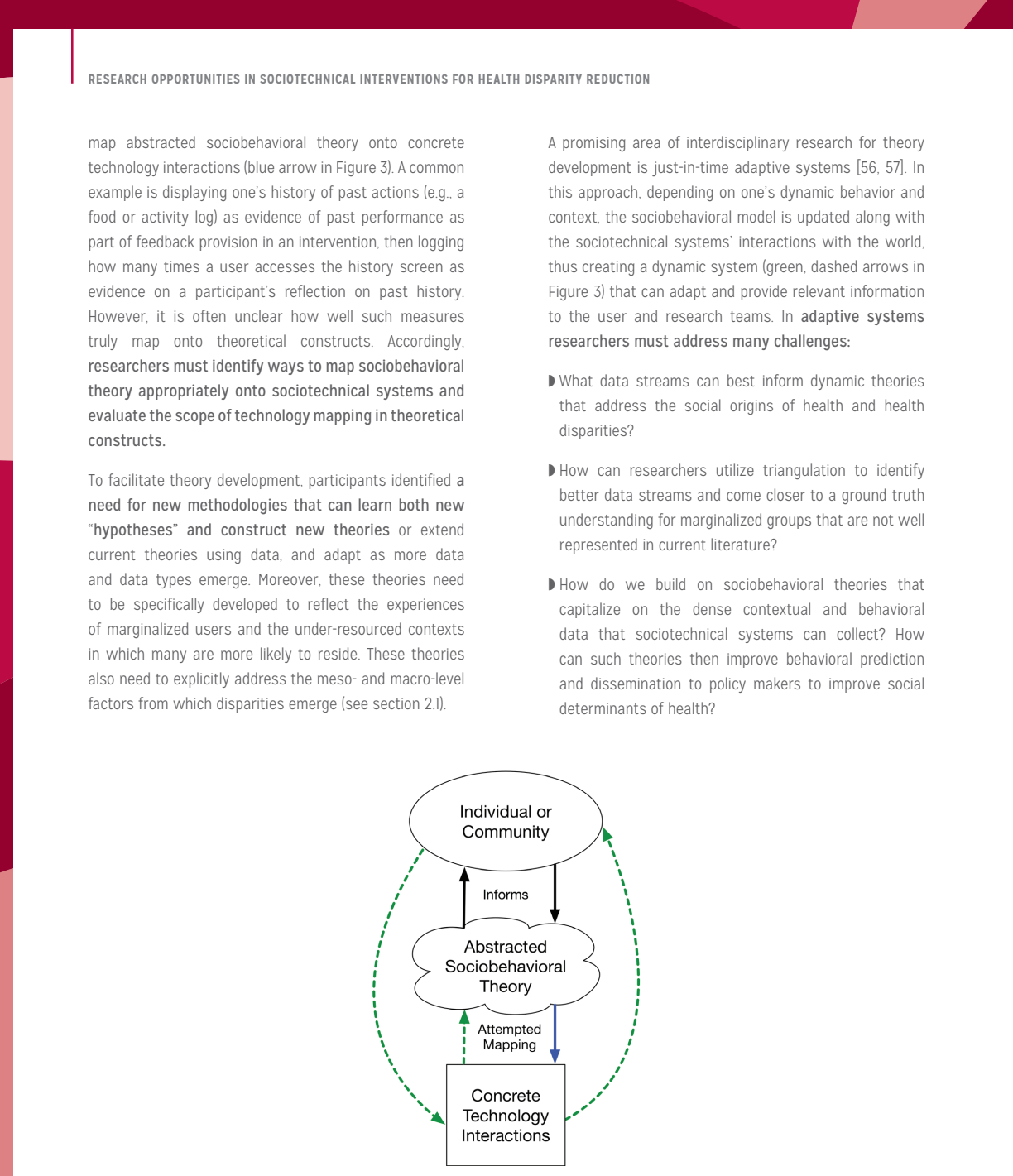
Sociotechnical Systems to Inform Theory One of the biggest challenges of developing sociotechnical health interventions is that although there are many sociobehavioral theories available [53], they are often dated because they do not account for new types of sociotechnical systems [10, 50] and are not necessarily representative of marginalized populations...
-
[5]
real world
Multidimensional Evaluation to Reduce Health Disparities at the Population Level The multidisciplinary workshop provided participants with ample time to share experiences designing, implementing, and evaluating studies at various levels of granularity — from individuals to families to communities and, finally, to the population level. Workshop participant...
-
[6]
Interdisciplinary Bridges Many diverse populations are affected by health disparities; thus different, adaptable sociotechnical intervention approaches are necessary to help address the needs of individuals, communities, and populations. Currently, researchers are largely developing separate approaches from scratch and in relative isolation or small inter...
-
[7]
The Future of Sociotechnical Systems to Address Health Disparities Studies funded by the National Institutes of Health have been formally investigating how to address health disparities for almost three decades [76]. However, health disparities persist — suggesting the need for fresh approaches. To that end, in this workshop report, we highlight computing...
Show all 83 references
-
[8]
Facial Recognition Is Accurate, if You’re a White Guy
Lohr S. Facial Recognition Is Accurate, if You’re a White Guy. The New York Times. 9 Feb 2018: B1
2018
-
[9]
Marginalized populations
Cook KE. Marginalized populations. In: Given LM, editor. The SAGE Encyclopedia of Qualitative Research Methods. SAGE Publications; 2008. p. 296
2008
-
[10]
Does Technology Have Race? Proceedings of the 2016 CHI Conference Extended Abstracts on Human Factors in Computing Systems - CHI EA ’16
Hankerson D, Marshall AR, Booker J, El Mimouni H, Walker I, Rode JA. Does Technology Have Race? Proceedings of the 2016 CHI Conference Extended Abstracts on Human Factors in Computing Systems - CHI EA ’16. New York, New York, USA: ACM Press; 2016. pp. 473–486
2016
-
[11]
Battling algorithmic bias: how do we ensure algorithms treat us fairly? Commun ACM
Kirkpatrick K. Battling algorithmic bias: how do we ensure algorithms treat us fairly? Commun ACM. 2016;59: 16–17
2016
-
[12]
Discrimination in Online Ad Delivery
Sweeney L. Discrimination in Online Ad Delivery. Queueing Syst. 2013;11: 10
2013
-
[13]
Local Standards for Anonymization Practices in Health, Wellness, Accessibility, and Aging Research at CHI
Abbott J, MacLeod H, Nurain N, Essombe Ekobe G, Patil S. Local Standards for Anonymization Practices in Health, Wellness, Accessibility, and Aging Research at CHI. Proceedings of the 2019 CHI Conference on Human Factors in Computing Systems (CHI ’19). New York: ACM; 2019. doi:...
2019
-
[14]
Designing and Evaluating mHealth Interventions for Vulnerable Populations: A Systematic Review
Stowell E, Lyson MC, Saksono H, Wurth RC, Jimison H, Pavel M, et al. Designing and Evaluating mHealth Interventions for Vulnerable Populations: A Systematic Review. Proceedings of the 2018 CHI Conference on Human Factors in Computing Systems. ACM; 2018. p. 15
2018
-
[15]
Mind the theoretical gap: interpreting, using, and developing behavioral theory in HCI research
Hekler EB, Klasnja P , Froehlich JE, Buman MP . Mind the theoretical gap: interpreting, using, and developing behavioral theory in HCI research. Proceedings of the SIGCHI Conference on Human Factors in Computing Systems. ACM
-
[16]
Present and Future Trends in Consumer Health Informatics and Patient- Generated Health Data
Lai AM, Hsueh P-YS, Choi YK, Austin RR. Present and Future Trends in Consumer Health Informatics and Patient- Generated Health Data. Yearb Med Inform. 2017;26: 152–159
2017
-
[17]
Consumer Health Informatics Adoption among Underserved Populations: Thinking beyond the Digital Divide
Huh J, Koola J, Contreras A, Castillo AK, Ruiz M, Tedone KG, et al. Consumer Health Informatics Adoption among Underserved Populations: Thinking beyond the Digital Divide. Yearb Med Inform. 2018;27: 146–155
2018
-
[18]
The impact of social disadvantage in moderate- to-severe chronic kidney disease: an equity-focused systematic review
Morton RL, Schlackow I, Mihaylova B, Staplin ND, Gray A, Cass A. The impact of social disadvantage in moderate- to-severe chronic kidney disease: an equity-focused systematic review. Nephrol Dial Transplant. 2016;31: 46–56
2016
-
[20]
Extending the PRISMA statement to equity-focused systematic reviews (PRISMA-E 2012): explanation and elaboration
Welch V, the PRISMA-Equity Bellagio group, Petticrew M, Petkovic J, Moher D, Waters E, et al. Extending the PRISMA statement to equity-focused systematic reviews (PRISMA-E 2012): explanation and elaboration. Int J Equity Health. 2015;14. doi:10.1186/s12939-015-0219-2
2012 doi
-
[21]
Research Opportunities and Visions for Smart RESEARCH OPPORTUNITIES IN SOCIOTECHNICAL INTERVENTIONS FOR HEALTH DISPARITY REDUCTION 22 and Pervasive Health [Internet]
Mynatt E, Hager GD, Kumar S, Lin M, Patel S, Stankovic J, et al. Research Opportunities and Visions for Smart RESEARCH OPPORTUNITIES IN SOCIOTECHNICAL INTERVENTIONS FOR HEALTH DISPARITY REDUCTION 22 and Pervasive Health [Internet]. Computing Community Consortium; 2017 Jun. Ava...
2017
-
[22]
Information Technology Research Challenges for Healthcare: From Discovery to Delivery
Graham S, Estrin D, Horvitz E, Kohane I, Mynatt E, Sim I. Information Technology Research Challenges for Healthcare: From Discovery to Delivery. Workshop Report on Discovery and Innovation in Health IT Workshop sponsored by the National Science Foundation, the Office of the Na...
2009
-
[23]
Good Intentions Are Not Enough: Health Informatics Interventions That Worsen Inequality [Internet]
Veinot TC, Ancker JS, Lyles C, Parker AG, Siek KA. Good Intentions Are Not Enough: Health Informatics Interventions That Worsen Inequality [Internet]. Workshop on Interactive Systems in Health Care (WISH) 2017; 2017 Nov 4; Washington, DC. Available: http://wish.gatech.edu/wp-c...
2017
-
[24]
What types of interventions generate inequalities? Evidence from systematic reviews
Lorenc T, Petticrew M, Welch V, Tugwell P . What types of interventions generate inequalities? Evidence from systematic reviews. J Epidemiol Community Health. 2013;67: 190–193
2013
-
[25]
Sexual Orientation Disparities in Preventable Disease: A Fundamental Cause Perspective
Bränström R, Hatzenbuehler ML, Pachankis JE, Link BG. Sexual Orientation Disparities in Preventable Disease: A Fundamental Cause Perspective. Am J Public Health. 2016;106: 1109–1115
2016
-
[26]
Stigma as a fundamental cause of population health inequalities
Hatzenbuehler ML, Phelan JC, Link BG. Stigma as a fundamental cause of population health inequalities. Am J Public Health. 2013;103: 813–821
2013
-
[27]
Racial residential segregation: a fundamental cause of racial disparities in health
Williams DR, Collins C. Racial residential segregation: a fundamental cause of racial disparities in health. Public Health Rep. 2001;116: 404–416
2001
-
[28]
Is Racism a Fundamental Cause of Inequalities in Health? Annu Rev Sociol
Phelan JC, Link BG. Is Racism a Fundamental Cause of Inequalities in Health? Annu Rev Sociol. 2015;41: 311–330
2015
-
[29]
A conceptual framework for action on the social determinants of health
Solar O, Irwin A. A conceptual framework for action on the social determinants of health. Social Determinants of Health Discussion Paper 2 (Policy and Practice) [Internet]. World Health Organization; 2017 Aug. Report No.: Paper 2. Available: http://www.who.int/social_determina...
2017
-
[30]
Consumer health informatics: results of a systematic evidence review and evidence based recommendations
Gibbons MC, Wilson RF, Samal L, Lehmann CU, Dickersin K, Lehmann HP , et al. Consumer health informatics: results of a systematic evidence review and evidence based recommendations. Transl Behav Med. 2011;1: 72–82
2011
-
[31]
The Tuskegee Syphilis Study, 1932 to 1972: implications for HIV education and AIDS risk education programs in the black community
Thomas SB, Quinn SC. The Tuskegee Syphilis Study, 1932 to 1972: implications for HIV education and AIDS risk education programs in the black community. Am J Public Health. 1991;81: 1498–1505
1932
-
[32]
Prior experiences of racial discrimination and racial differences in health care system distrust
Armstrong K, Putt M, Halbert CH, Grande D, Schwartz JS, Liao K, et al. Prior experiences of racial discrimination and racial differences in health care system distrust. Med Care. 2013;51: 144–150
2013
-
[33]
Barriers and drivers of health information technology use for the elderly, chronically ill, and underserved
Jimison H, Gorman P , Woods S, Nygren P , Walker M, Norris S, et al. Barriers and drivers of health information technology use for the elderly, chronically ill, and underserved. Evid Rep Technol Assess . 2008; 1–1422
2008
-
[34]
The role of trust belief and its antecedents in a community-driven knowledge environment
Kim B, Han I. The role of trust belief and its antecedents in a community-driven knowledge environment. J Am Soc Inf Sci Technol. 2009;60: 1012–1026
2009
-
[35]
A question of trust: user-centered design requirements for an informatics intervention to promote the sexual health of African-American youth
Veinot TC, Campbell TR, Kruger DJ, Grodzinski A. A question of trust: user-centered design requirements for an informatics intervention to promote the sexual health of African-American youth. J Am Med Inform Assoc. 2013;20: 758–765
2013
-
[36]
Integrating community-based participatory research and informatics approaches to improve the engagement and health of underserved populations
Unertl KM, Schaefbauer CL, Campbell TR, Senteio C, Siek KA, Bakken S, et al. Integrating community-based participatory research and informatics approaches to improve the engagement and health of underserved populations. J Am Med Inform Assoc. 2016;23: 60–73
2016
-
[37]
Examining participant engagement in an information technology-based physical activity and nutrition intervention for men: the manup randomized controlled trial
Short CE, Vandelanotte C, Dixon MW, Rosenkranz R, Caperchione C, Hooker C, et al. Examining participant engagement in an information technology-based physical activity and nutrition intervention for men: the manup randomized controlled trial. JMIR Res Protoc. 2014;3: e2. 23
2014
-
[38]
Alfonsson S, Olsson E, Hursti T. Motivation and Treatment Credibility Predicts Dropout, Treatment Adherence, and Clinical Outcomes in an Internet-Based Cognitive Behavioral Relaxation Program: A Randomized Controlled Trial. J Med Internet Res. 2016;18: e52
2016
-
[39]
The Role of Engagement in a Tailored Web- Based Smoking Cessation Program: Randomized Controlled Trial
Strecher V, McClure J, Alexander G, Chakraborty B, Nair V, Konkel J, et al. The Role of Engagement in a Tailored Web- Based Smoking Cessation Program: Randomized Controlled Trial. J Med Internet Res. 2008;10: e36
2008
-
[40]
Utilization of a Web-based vs integrated phone/Web cessation program among 140,000 tobacco users: an evaluation across 10 free state quitlines
Nash CM, Vickerman KA, Kellogg ES, Zbikowski SM. Utilization of a Web-based vs integrated phone/Web cessation program among 140,000 tobacco users: an evaluation across 10 free state quitlines. J Med Internet Res. 2015;17: e36
2015
-
[41]
My Child’s Asthma
Meischke H, Lozano P , Zhou C, Garrison MM, Christakis D. Engagement in “My Child’s Asthma”, an interactive web- based pediatric asthma management intervention. Int J Med Inform. 2011;80: 765–774
2011
-
[42]
Attrition Revisited: Adherence and Retention in a Web-Based Alcohol Trial
Murray E, White IR, Varagunam M, Godfrey C, Khadjesari Z, McCambridge J. Attrition Revisited: Adherence and Retention in a Web-Based Alcohol Trial. J Med Internet Res. 2013;15: e162
2013
-
[43]
Initial and Sustained Participation in an Internet-delivered Long-term Worksite Health Promotion Program on Physical Activity and Nutrition
Robroek SJW, Lindeboom DEM, Burdorf A. Initial and Sustained Participation in an Internet-delivered Long-term Worksite Health Promotion Program on Physical Activity and Nutrition. J Med Internet Res. 2012;14: e43
2012
-
[44]
Investigating Predictors of Visiting, Using, and Revisiting an Online Health-Communication Program: A Longitudinal Study
Van ’t Riet J, Crutzen R, De Vries H. Investigating Predictors of Visiting, Using, and Revisiting an Online Health-Communication Program: A Longitudinal Study. J Med Internet Res. 2010;12: e37
2010
-
[45]
Risk factors for not completing health interventions and the potential impact on health inequalities between educational groups - a mixed method study from Denmark
Kure-Biegel N, Schnohr CW, Hindhede AL, Diderichsen F. Risk factors for not completing health interventions and the potential impact on health inequalities between educational groups - a mixed method study from Denmark. Int J Equity Health. 2016;15: 54
2016
-
[46]
Urban-Dwelling Community Members’ Views on Biomedical Research Engagement
Cortés YI, Arcia A, Kearney J, Luchsinger J, Lucero RJ. Urban-Dwelling Community Members’ Views on Biomedical Research Engagement. Qual Health Res. 2017;27: 130–137
2017
-
[47]
A Guide to Using Asynchronous Remote Communities (ARC) for Researching Distributed Populations
MacLeod H, Jelen B, Prabhakar A, Oehlberg L, Siek K, Connelly K. A Guide to Using Asynchronous Remote Communities (ARC) for Researching Distributed Populations. EAI Endorsed Transactions on Pervasive Health and Technology. 2017;3: 152898
2017
-
[48]
The relationship of action research to human-computer interaction
Hayes GR. The relationship of action research to human-computer interaction. ACM Trans Comput-Hum Interact. 2011;18: 1–20
2011
-
[49]
Routledge International Handbook of Participatory Design
Simonsen J, Robertson T. Routledge International Handbook of Participatory Design. Routledge; 2012
2012
-
[50]
Workforce Diversity: A Key to Improve Productivity
Saxena A. Workforce Diversity: A Key to Improve Productivity. Procedia Economics and Finance. 2014;11: 76– 85
2014
-
[51]
How to evaluate technologies for health behavior change in HCI research
Klasnja P , Consolvo S, Pratt W. How to evaluate technologies for health behavior change in HCI research. Proceedings of the 2011 annual conference on Human factors in computing systems - CHI ’11. New York, New York, USA: ACM Press; 2011. p. 3063
2011
-
[52]
How we design feasibility studies
Bowen DJ, Kreuter M, Spring B, Cofta-Woerpel L, Linnan L, Weiner D, et al. How we design feasibility studies. Am J Prev Med. 2009;36: 452–457
2009
-
[53]
Toward Usable Evidence: Optimizing Knowledge Accumulation in HCI Research on Health Behavior Change
Klasnja P , Hekler EB, Korinek EV, Harlow J, Mishra SR. Toward Usable Evidence: Optimizing Knowledge Accumulation in HCI Research on Health Behavior Change. Proceedings of the 2017 CHI Conference on Human Factors in Computing Systems - CHI ’17. New York, New York, USA: ACM Pre...
2017
-
[54]
Accelerating Digital Mental Health Research From Early Design and Creation to Successful Implementation and Sustainment
Mohr DC, Lyon AR, Lattie EG, Reddy M, Schueller SM. Accelerating Digital Mental Health Research From Early Design and Creation to Successful Implementation and Sustainment. J Med Internet Res. 2017;19: e153
2017
-
[55]
Agile science: creating useful products for behavior change in the real world
Hekler EB, Klasnja P , Riley WT, Buman MP , Huberty J, Rivera DE, et al. Agile science: creating useful products for behavior change in the real world. Transl Behav Med. 2016;6: 317–328
2016
-
[56]
Good intentions are not enough: how informatics interventions can worsen inequality
Veinot TC, Mitchell H, Ancker JS. Good intentions are not enough: how informatics interventions can worsen inequality. J Am Med Inform Assoc. 2018; doi:10.1093/jamia/ ocy052
2018 doi
-
[57]
Hardy J, Veinot TC, Yan X, Berrocal VJ, Clarke P , Goodspeed R, et al. User acceptance of location-tracking technologies RESEARCH OPPORTUNITIES IN SOCIOTECHNICAL INTERVENTIONS FOR HEALTH DISPARITY REDUCTION 24 in health research: Implications for study design and data quality....
2018
-
[58]
Theories of behaviour and behaviour change across the social and behavioural sciences: a scoping review
Davis R, Campbell R, Hildon Z, Hobbs L, Michie S. Theories of behaviour and behaviour change across the social and behavioural sciences: a scoping review. Health Psychol Rev. Taylor & Francis; 2015;9: 323
2015
-
[59]
Socioeconomic status, resources, psychological experiences, and emotional responses: a test of the reserve capacity model
Gallo LC, Bogart LM, Vranceanu A-M, Matthews KA. Socioeconomic status, resources, psychological experiences, and emotional responses: a test of the reserve capacity model. J Pers Soc Psychol. 2005;88: 386–399
2005
-
[60]
positive deviants
Wishik SM, Vynckt S. The use of nutritional “positive deviants” to identify approaches for modification of dietary practices. Am J Public Health. 1976;66: 38–42
1976
-
[61]
Dynamic Models of Behavior for Just-in-Time Adaptive Interventions
Spruijt-Metz D, Nilsen W. Dynamic Models of Behavior for Just-in-Time Adaptive Interventions. IEEE Pervasive Comput. 2014;13: 13–17
2014
-
[62]
Just-in-time technology to encourage incremental, dietary behavior change
Intille SS, Kukla C, Farzanfar R, Bakr W. Just-in-time technology to encourage incremental, dietary behavior change. AMIA Annu Symp Proc. 2003; 874
2003
-
[63]
Targeting or Tailoring? Maximizing Resources to Create Effective Health Communications
Schmid KL, Rivers SE, Latimer AE, Salovey P . Targeting or Tailoring? Maximizing Resources to Create Effective Health Communications. Mark Health Serv. NIH Public Access; 2008;28: 32
2008
-
[64]
Facial-Recognition Software Might Have a Racial Bias Problem
Clare Garvie JF. Facial-Recognition Software Might Have a Racial Bias Problem. In: The Atlantic [Internet]. 7 Apr 2016 [cited 4 Jul 2018]. Available: https://www.theatlantic.com/ technology/archive/2016/04/the-underlying-bias-of-facial- recognition-systems/476991/
2016
-
[65]
Framework for design and evaluation of complex interventions to improve health
Campbell M. Framework for design and evaluation of complex interventions to improve health. BMJ. 2000;321: 694–696
2000
-
[66]
The multiphase optimization strategy (MOST) and the sequential multiple assignment randomized trial (SMART): new methods for more potent eHealth interventions
Collins LM, Murphy SA, Strecher V. The multiphase optimization strategy (MOST) and the sequential multiple assignment randomized trial (SMART): new methods for more potent eHealth interventions. Am J Prev Med. 2007;32: S112–8
2007
-
[67]
Unintended Users, Uses, and Consequences of Mobile Weight Loss Apps: Using Eating Disorders as a Case Study
Eikey EV. Unintended Users, Uses, and Consequences of Mobile Weight Loss Apps: Using Eating Disorders as a Case Study. In: Sezgin E, Yildirim S, Özkan-Yildirim S, Sumuer E, editors. Current and Emerging mHealth Technologies: Adoption, Implementation, and Use. Cham: Springer In...
2018
-
[68]
Returning Individual Research Results to Participants: Guidance for a New Research Paradigm : Health and Medicine Division
National Academies of Sciences, Engineering, and Medicine. Returning Individual Research Results to Participants: Guidance for a New Research Paradigm : Health and Medicine Division. Washington, DC: The National Academies Press; 2018
2018
-
[69]
[cited 3 Aug 2018]
App Evaluation Model [Internet]. [cited 3 Aug 2018]. Available: https://www.psychiatry.org/psychiatrists/practice/ mental-health-apps/app-evaluation-model
2018
-
[70]
Schick RS, Kelsey TW, Marston J, Samson K, Humphris GW. MapMySmoke: feasibility of a new quit cigarette smoking mobile phone application using integrated geo- positioning technology, and motivational messaging within a primary care setting. Pilot and Feasibility Studies. BioMe...
2017
-
[71]
A Context-Sensing Mobile Phone App (Q Sense) for Smoking Cessation: A Mixed-Methods Study
Naughton F, Hopewell S, Lathia N, Schalbroeck R, Brown C, Mascolo C, et al. A Context-Sensing Mobile Phone App (Q Sense) for Smoking Cessation: A Mixed-Methods Study. JMIR Mhealth Uhealth. 2016;4: e106
2016
-
[72]
A Stress-Free Life: Just-in- Time Interventions for Stress via Real-Time Forecasting and Intervention Adaptation
Jaimes L, Llofriu M, Raij A. A Stress-Free Life: Just-in- Time Interventions for Stress via Real-Time Forecasting and Intervention Adaptation. Proceedings of the 9th International Conference on Body Area Networks. 2014. doi:10.4108/icst.bodynets.2014.258237
2014
-
[73]
Mobile Phone Sensor Correlates of Depressive Symptom Severity in Daily-Life Behavior: An Exploratory Study
Saeb S, Zhang M, Karr CJ, Schueller SM, Corden ME, Kording KP , et al. Mobile Phone Sensor Correlates of Depressive Symptom Severity in Daily-Life Behavior: An Exploratory Study. J Med Internet Res. 2015;17: e175
2015
-
[74]
Predicting Negative Emotions Based on Mobile Phone Usage Patterns: An Exploratory Study
Hung GC-L, Yang P-C, Chang C-C, Chiang J-H, Chen Y-Y. Predicting Negative Emotions Based on Mobile Phone Usage Patterns: An Exploratory Study. JMIR Res Protoc. 2016;5: e160
2016
-
[75]
Developing Electronic Health Record (EHR) Strategies Related to Health Center Patients’ Social Determinants of Health
Gold R, Cottrell E, Bunce A, Middendorf M, Hollombe C, Cowburn S, et al. Developing Electronic Health Record (EHR) Strategies Related to Health Center Patients’ Social Determinants of Health. J Am Board Fam Med. 2017;30: 428– 447. 25
2017
-
[76]
Integrating Data On Social Determinants Of Health Into Electronic Health Records
Cantor MN, Thorpe L. Integrating Data On Social Determinants Of Health Into Electronic Health Records. Health Aff . 2018;37: 585–590
2018
-
[77]
Accuracy of Cardiovascular Risk Prediction Varies by Neighborhood Socioeconomic Position: A Retrospective Cohort Study
Dalton JE, Perzynski AT, Zidar DA, Rothberg MB, Coulton CJ, Milinovich AT, et al. Accuracy of Cardiovascular Risk Prediction Varies by Neighborhood Socioeconomic Position: A Retrospective Cohort Study. Ann Intern Med. 2017;167: 456– 464
2017
-
[78]
Association of Social Determinants With Children’s Hospitals’ Preventable Readmissions Performance
Sills MR, Hall M, Colvin JD, Macy ML, Cutler GJ, Bettenhausen JL, et al. Association of Social Determinants With Children’s Hospitals’ Preventable Readmissions Performance. JAMA Pediatr. 2016;170: 350–358
2016
-
[79]
Participant
Fiesler C, Proferes N. “Participant” Perceptions of Twitter Research Ethics. Social Media+ Society. journals. sagepub.com; 2018;4: 1–14
2018
-
[80]
Engaging patient in health and health care processes: the role of patient platforms [Internet]
Lai C. Engaging patient in health and health care processes: the role of patient platforms [Internet]. tspace. library.utoronto.ca. 2018. Available: https://tspace.library. utoronto.ca/handle/1807/92035
2018
-
[81]
Science Visioning in Minority Health and Health Disparities
Pérez-Stable EJ, Collins FS. Science Visioning in Minority Health and Health Disparities. Am J Public Health. 2019;109: S5
2019
-
[82]
A New Funding Model for Scientists
Pain E. A New Funding Model for Scientists. Science. 14 Jan 2015. doi:10.1126/science.caredit.a1400012
2015 doi
-
[83]
Assessing scientists for hiring, promotion, and tenure
Moher D, Naudet F, Cristea IA, Miedema F, Ioannidis JPA, Goodman SN. Assessing scientists for hiring, promotion, and tenure. PLoS Biol. Public Library of Science; 2018;16: e2004089. RESEARCH OPPORTUNITIES IN SOCIOTECHNICAL INTERVENTIONS FOR HEALTH DISPARITY REDUCTION 26 First ...
2018
Reviewed August 14, 2026 · model on record in the stance chip above.
Discussion (0). Continue with ORCID to comment.