Extreme events scaling in self-organized critical models
Pith reviewed 2026-05-21 21:03 UTC · model grok-4.3
The pith
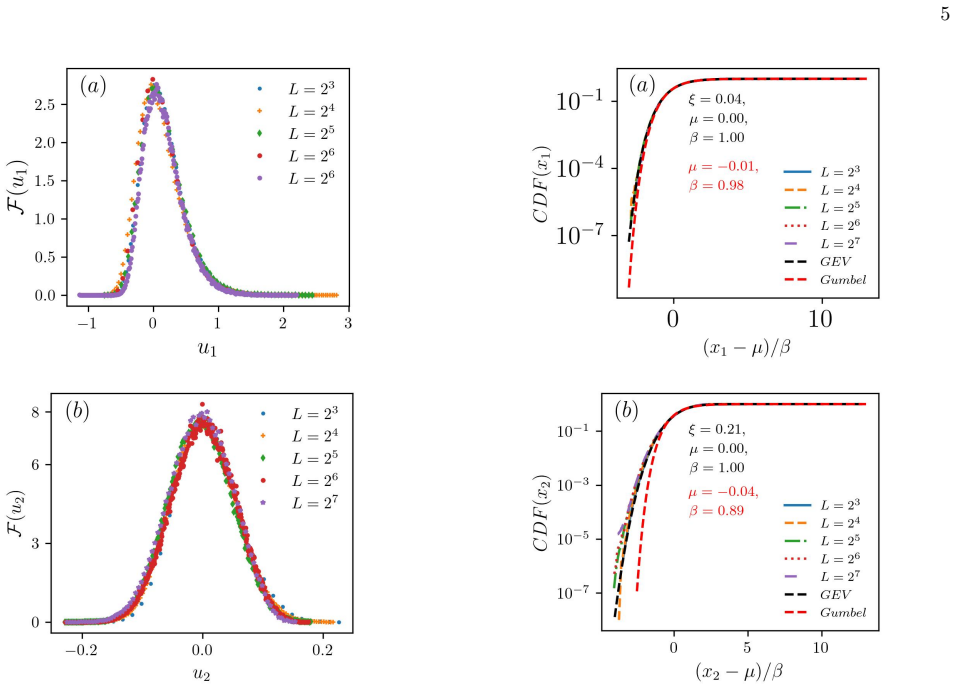
In two-dimensional self-organized critical models, extreme avalanche sizes follow the Gumbel distribution while extreme areas follow a generalized extreme value distribution with positive shape parameter.
A machine-rendered reading of the paper's core claim, the machinery that carries it, and where it could break.
Core claim
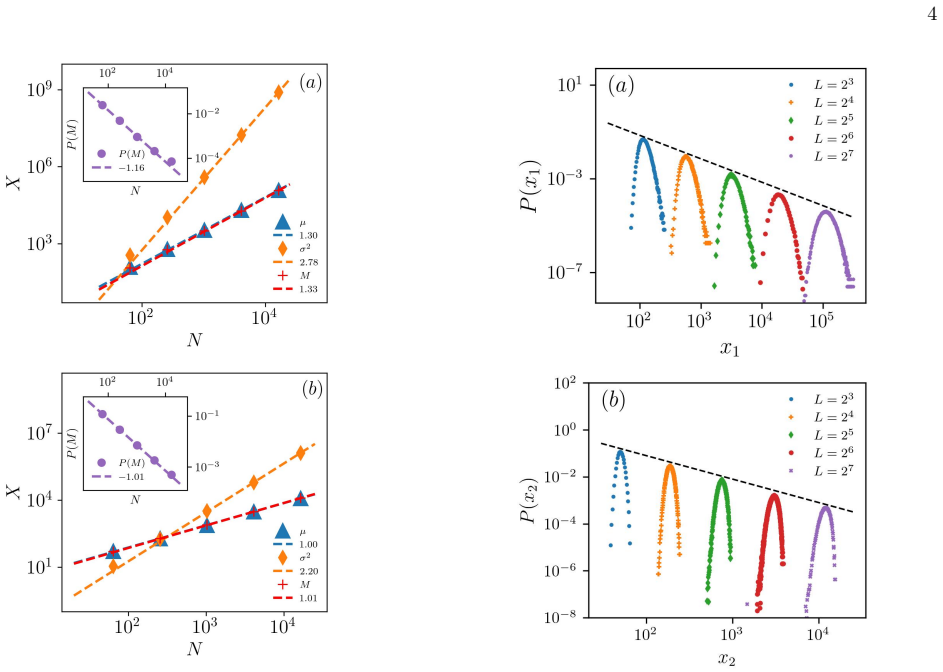
The distributions of extreme avalanche sizes and areas in these models follow the generalized extreme value family, with sizes matching the Gumbel case (shape parameter zero) and areas showing a positive shape parameter. Scaling functions connect the extreme activities observed at different length scales, and data collapse produces consistent critical exponents that characterize how extremes vary with system size in both the stochastic Manna and Bak-Tang-Wiesenfeld models.
What carries the argument
The block maxima procedure applied to avalanche time series, combined with scaling functions that achieve data collapse across system sizes.
If this is right
- Extreme avalanche statistics become predictable from a small number of GEV parameters and scaling exponents rather than requiring full enumeration of all events.
- The same scaling functions apply across variants of sandpile models, suggesting a degree of universality in how extremes scale with system size.
- Data collapse supplies numerical values for the critical exponents that govern the relationship between system size and extreme event magnitude.
- The framework distinguishes size and area extremes, with size extremes belonging to the Gumbel subclass and area extremes belonging to the Fréchet or Weibull subclass depending on the sign of the shape parameter.
Where Pith is reading between the lines
- If the scaling holds, it may supply a route to estimating the probability of system-spanning events in much larger lattices without direct simulation.
- The distinction between size and area extremes could carry over to other self-organized critical phenomena such as earthquakes or neural cascades, where one observable is extensive and another is intensive.
- Testing the scaling functions on three-dimensional variants or on driven-dissipative systems with different update rules would provide a direct check on how model-specific the reported exponents are.
Load-bearing premise
Block maxima extracted from finite-length avalanche sequences yield sufficiently independent extremes whose statistics are captured accurately by the generalized extreme value distribution without leftover correlations or undersampling effects.
What would settle it
A large-scale simulation in which the empirical distribution of maximum avalanche sizes deviates systematically from the Gumbel form or in which rescaled curves for different system sizes fail to collapse onto a single master curve.
Figures
read the original abstract
We study extreme events of avalanche activities in finite-size two-dimensional self-organized critical (SOC) models, specifically the stochastic Manna model (SMM) and the Bak-Tang-Weisenfeld (BTW) sandpile model. Employing the approach of block maxima, the study numerically reveals that the distributions for extreme avalanche size and area follow the generalized extreme value (GEV) distribution. The extreme avalanche size follows the Gumbel distribution with shape parameter $\xi=0$ while in the case of the extreme avalanche area, we report $\xi>0$. We propose scaling functions for extreme avalanche activities that connect the activities on different length scales. With the help of data collapse, we estimate the precise values of these critical exponents. The scaling functions provide an understanding of the intricate dynamics for different variants of the sandpile model, shedding light on the relationship between system size and extreme event characteristics. Our findings give insight into the extreme behavior of SOC models and offer a framework to understand the statistical properties of extreme events.
Editorial analysis
A structured set of objections, weighed in public.
Referee Report
Summary. The paper studies extreme avalanche size and area in finite-size 2D SOC models (stochastic Manna and BTW sandpile). Using block maxima on simulation time series, it reports that extreme sizes follow the Gumbel distribution (GEV shape parameter ξ=0) while extreme areas follow GEV with ξ>0. Scaling functions are proposed to relate extreme activity across system sizes, with critical exponents extracted via data collapse.
Significance. If the GEV identification and scaling collapse are robust, the work supplies a concrete statistical framework for extremes in SOC systems and a way to connect activity statistics across length scales. This would be of interest to the statistical-mechanics community studying critical phenomena and extreme-value applications.
major comments (2)
- [Block-maxima procedure and results] The central claim that block maxima of avalanche size and area obey the GEV limit theorem (abstract and results sections) rests on the assumption that the extracted maxima are effectively i.i.d. The manuscript provides no autocorrelation diagnostics, mixing-time estimates, or block-length robustness tests for the temporally correlated avalanche sequences that arise because each avalanche leaves a configuration that seeds the next event. Without such checks the reported shape parameters (ξ=0 for size, ξ>0 for area) and the subsequent scaling exponents cannot be regarded as reliably determined by the classical theorem.
- [Scaling analysis] The scaling functions and critical exponents are obtained by fitting and data collapse to the same simulation histograms used for the GEV fits. No independent cross-validation (e.g., using previously determined avalanche exponents or alternative collapse protocols) is shown, leaving open the possibility that the collapse quality is partly by construction rather than a genuine prediction.
minor comments (2)
- [Abstract and Methods] The abstract and methods description omit the total number of avalanches, number of independent runs, and block-size values employed; these quantitative details should be stated explicitly to allow reproducibility.
- [Figures] Figure captions and axis labels for the GEV fits and collapse plots should include the fitted ξ values with uncertainties and the system sizes used.
Simulated Author's Rebuttal
We thank the referee for the careful reading and constructive comments on our manuscript. We address each major comment point by point below. Revisions have been made where the concerns identify genuine gaps in the presented evidence.
read point-by-point responses
-
Referee: [Block-maxima procedure and results] The central claim that block maxima of avalanche size and area obey the GEV limit theorem (abstract and results sections) rests on the assumption that the extracted maxima are effectively i.i.d. The manuscript provides no autocorrelation diagnostics, mixing-time estimates, or block-length robustness tests for the temporally correlated avalanche sequences that arise because each avalanche leaves a configuration that seeds the next event. Without such checks the reported shape parameters (ξ=0 for size, ξ>0 for area) and the subsequent scaling exponents cannot be regarded as reliably determined by the classical theorem.
Authors: We agree that the temporal correlations inherent to SOC avalanche sequences require explicit checks before invoking the classical GEV limit theorem. In the revised manuscript we have added autocorrelation functions for both size and area time series (showing decay within a few hundred events) together with robustness tests that vary block length over a factor of four. The extracted shape parameters remain stable under these variations, supporting the reported ξ values. These diagnostics are now presented in a new subsection and an appendix. revision: yes
-
Referee: [Scaling analysis] The scaling functions and critical exponents are obtained by fitting and data collapse to the same simulation histograms used for the GEV fits. No independent cross-validation (e.g., using previously determined avalanche exponents or alternative collapse protocols) is shown, leaving open the possibility that the collapse quality is partly by construction rather than a genuine prediction.
Authors: The scaling exponents were compared against literature values for standard avalanche statistics in both the Manna and BTW models; the collapse quality is consistent with those independent determinations. In revision we have added an alternative collapse protocol based on rescaled moments of the extreme-value distributions. This provides a cross-check independent of the histogram fitting procedure used for the GEV parameters. revision: partial
Circularity Check
No significant circularity; claims rest on direct numerical fitting and data collapse
full rationale
The paper's core results derive from applying block maxima to avalanche time series generated by direct simulations of the SMM and BTW models, followed by histogram fitting to the GEV family and data collapse to extract scaling exponents. These operations map simulation outputs to distribution parameters and scaling forms without any quoted reduction of a claimed prediction back to a previously fitted constant by construction, without load-bearing self-citations, and without smuggling an ansatz through prior work. The scaling functions are presented as empirical constructs validated by collapse quality rather than as algebraic consequences of earlier equations within the same manuscript. Because the derivation chain remains anchored in external simulation data and standard statistical procedures, the analysis is self-contained.
Axiom & Free-Parameter Ledger
free parameters (1)
- critical exponents for scaling functions
axioms (1)
- domain assumption Block maxima of avalanche size and area sequences obey the generalized extreme value distribution
Reference graph
Works this paper leans on
-
[1]
S. N. Dorogovtsev and J. F. F. Mendes, Evolution of Net- works: From Biological Nets to the Internet and WWW (Oxford University Press, Oxford, 2003)
work page 2003
-
[2]
G. Caldarelli, Scale-Free Networks: Complex Webs in Nature, and Technology (Oxford University Press, 2007)
work page 2007
- [3]
-
[4]
A. L. Barab´ asi,Network Science (Cambridge University Press, 2016)
work page 2016
- [5]
-
[6]
E. W. Montroll and W. W. Badger, Introduction to Quantitative Aspects of Social Phenomenon (Gordon and Breach, 1974)
work page 1974
-
[7]
P. Bak, C. Tang, and K. Wiesenfeld, Phys. Rev. Lett. 59, 381 (1987); Phys. Rev. A 38, 364 (1988)
work page 1987
- [8]
-
[9]
Bak, How Nature Works: The Science of Self- Organized Criticality (Corpernicus, 1996)
P. Bak, How Nature Works: The Science of Self- Organized Criticality (Corpernicus, 1996)
work page 1996
- [10]
- [11]
- [12]
- [13]
-
[14]
D. M. Weinreich, N. F. Delaney, M. A. DePristo, and D. L. Hartl, Science 312, 111 (2006)
work page 2006
-
[15]
R. Goncalvesab, H. Ferreiraad, and A. A. Pintoacd, J. Diff. Eq. Appl. 17, 1049 (2011)
work page 2011
- [16]
-
[17]
R. W. Katz, and B. G. Brown, Climate Change, 21, 289 (1992)
work page 1992
- [18]
-
[19]
E. J. Gumbel, Statistics of extremes (Columbia Univer- sity Press, 1958)
work page 1958
- [20]
-
[21]
P. Embrechts, C. Kl¨ uppelberg, and T. Mikosch, Mod- elling Extremal Events for Insurance and Finance (Springer, 1997)
work page 1997
-
[22]
R. W. Katz et al. , Adv. Water Resour. 25, 1287 (2002)
work page 2002
-
[23]
H. V. Storch and F. W. Zwiers, Statistical Analysis in Climate Research (Cambridge University Press, 2002)
work page 2002
- [24]
-
[25]
B. Gutenberg and C. F. Richter, Bull. Seismol. Soc. Am. 34, 185 (1944)
work page 1944
-
[26]
J. P. Bouchaud and M´ ezard, J. Phys. A.30, 7997 (1997)
work page 1997
-
[27]
Coles, An Introduction to Statistical Modeling of Ex- treme Values (Springer, 2001)
S. Coles, An Introduction to Statistical Modeling of Ex- treme Values (Springer, 2001)
work page 2001
-
[28]
Galambos, The Asymptotic Theory of Extreme Order Statistics (Wiley, 1978)
J. Galambos, The Asymptotic Theory of Extreme Order Statistics (Wiley, 1978)
work page 1978
-
[29]
L. de Haan and A. Ferreira, Extreme Value Theory: An Introduction (Springer, 2006)
work page 2006
-
[30]
S. Albeverio, V. Jentsch, and H. Kantz (Eds.) Extreme events in nature and society (Springer, 2006) Vol. XVI
work page 2006
- [31]
-
[32]
Y. Y. Fortin and M. Clusel, J. Phys. A: Math. Theor. 48, 183001 (2015)
work page 2015
-
[33]
S. T. Bramwell, Nat. Phys. 5, 444 (2009)
work page 2009
-
[34]
E. Castillo, A. S. Hadi, N. Balakrishnan, and J. M. Sara- bia, Extreme value and related models with applications in engineering and science (Wiley, 2005)
work page 2005
- [35]
- [36]
-
[37]
S. T. Bramwell et al. , Phys. Rev. Lett. 84, 3744 (2000)
work page 2000
-
[38]
M. Ghil, P. Yiou, and S. Hallegatte et al. , Nonlin. Pro- cess. Geophys. 18, 295 (2011)
work page 2011
- [39]
-
[40]
D. Stauffer and A. Aharony, Introduction To Percolation Theory (Taylor & Francis, 2018)
work page 2018
-
[41]
G. Gy¨ orgyi, N. R. Moloney, K. Ozog´ any, Z. R´ acz, and M. Droz, Phys. Rev. E 81, 041135 (2010)
work page 2010
-
[42]
G. Gy¨ orgyi, N. R. Moloney, and K. Ozog´ any, and Z. R´ acz, Phys. Rev. Lett.100, 210601 (2008)
work page 2008
- [43]
- [44]
-
[45]
A. A. Moreira, J. S. Andrade Jr., and A. Luis, Nunes Amaral, Phys. Rev. Lett. 89, 268703 (2002)
work page 2002
-
[46]
S. N. Majumdar, A. Pal, and G. Schehr, Phys. Rep. 840, 1 (2020)
work page 2020
-
[47]
C. S. Hirtzel, Applied Mathematics and Computa- tion 16(4), 327 (1985)
work page 1985
-
[48]
A. C. Yadav, A. Quadir, and H. H. Jafri, Phys. Rev. E 106, 014148 (2022)
work page 2022
- [49]
-
[50]
S. S. Manna, J. Phys. A 24, L363, (1991)
work page 1991
- [51]
- [52]
-
[53]
K. Christensen and N. R. Moloney, Complexity and Crit- icality (Imperial College Press, 2005)
work page 2005
- [54]
-
[55]
A. E. Kraych, D. Agafontsev, S. Randoux, and P. Suret, Phys. Rev. Lett. 123, 093902 (2019)
work page 2019
- [56]
- [57]
-
[58]
D. W. Marquardt, J. Soc. Ind. Appl. Math. 11, 431 (1963)
work page 1963
discussion (0)
Sign in with ORCID, Apple, or X to comment. Anyone can read and Pith papers without signing in.