Boundary-conformal integration for the invariant-imbedding T-matrix method: high-order convergence for faceted particles
Pith reviewed 2026-06-26 13:58 UTC · model grok-4.3
The pith
A boundary-conformal integration scheme removes geometric non-smoothness and restores spectral plus fourth-order convergence in the invariant-imbedding T-matrix method for faceted particles.
A machine-rendered reading of the paper's core claim, the machinery that carries it, and where it could break.
Core claim
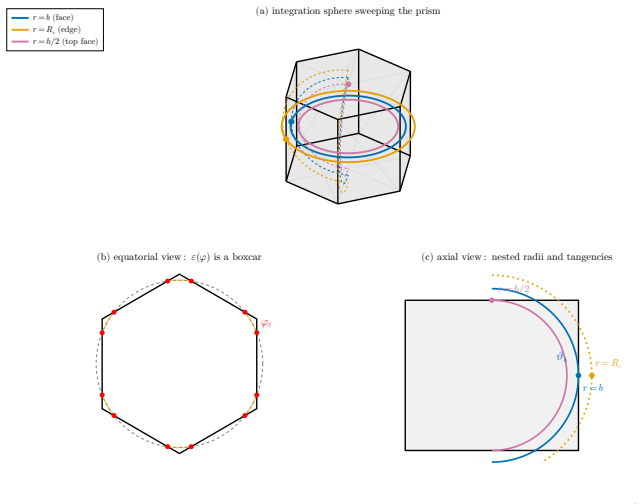
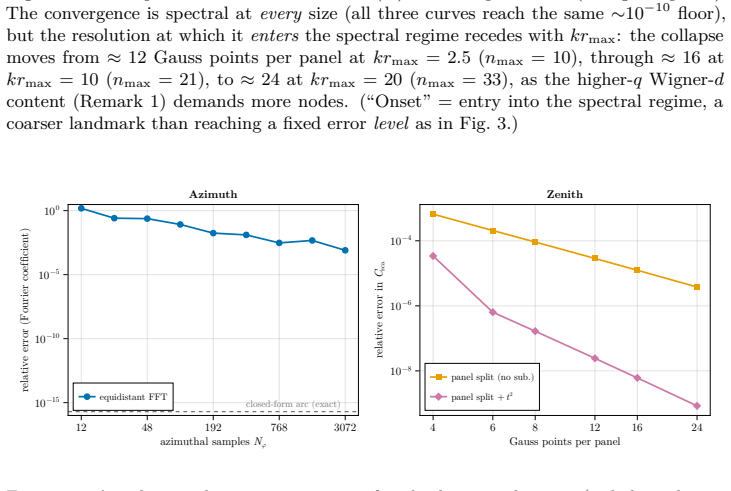
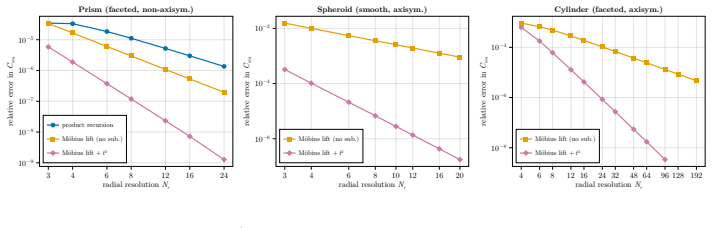
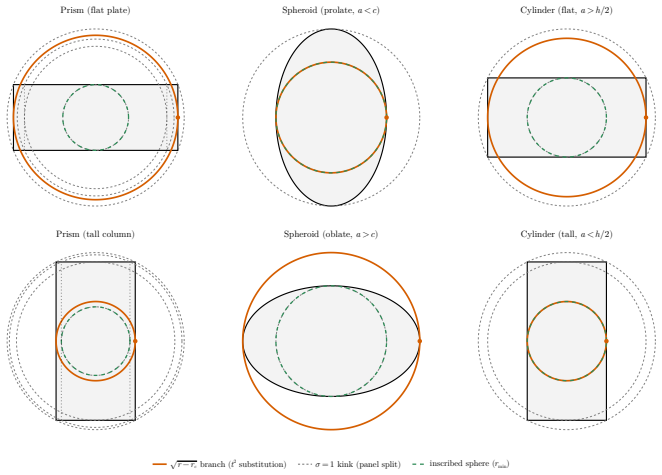
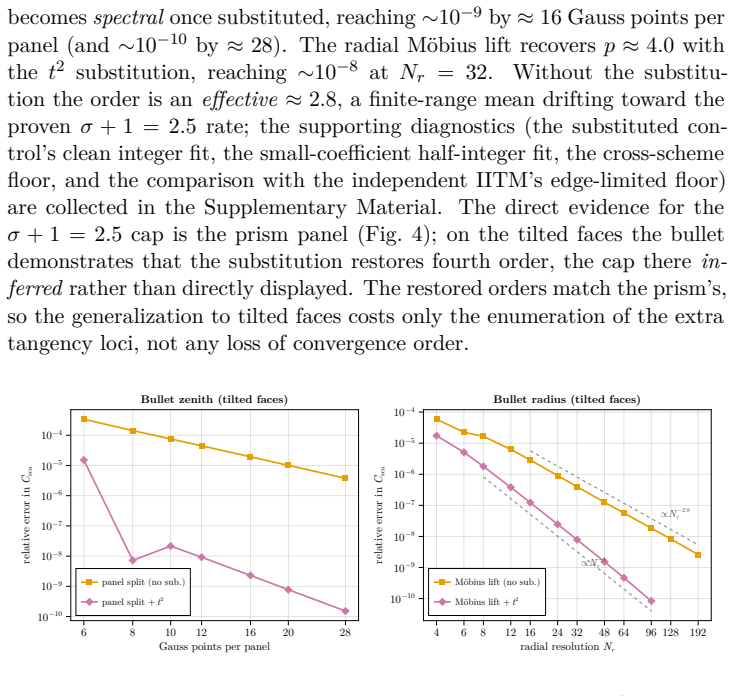
The non-smoothness of the dielectric-contrast integral has a single geometric origin in the tangencies of the integration sphere to the faces and edges of the particle. These tangencies generate jumps, kinks, and half-integer branches in all three coordinate directions. A boundary-conformal scheme eliminates them through closed-form azimuthal coefficients, panel splitting at the known tangency loci, and the substitution x maps to x_c plus t squared that absorbs the half-integer branches. For the hexagonal prism the azimuthal integration becomes exact, the zenithal direction recovers spectral convergence, and the radial direction recovers fourth-order convergence; the same scheme extends dire
What carries the argument
Boundary-conformal integration scheme that employs closed-form azimuthal coefficients, panel splitting at analytically known tangency loci, and square-root substitution x maps to x_c plus t squared.
If this is right
- Azimuthal integration becomes exact for a hexagonal prism.
- Zenithal integration recovers spectral convergence.
- Radial integration recovers fourth-order convergence.
- The scheme extends to any convex polyhedron because it uses only contact geometry.
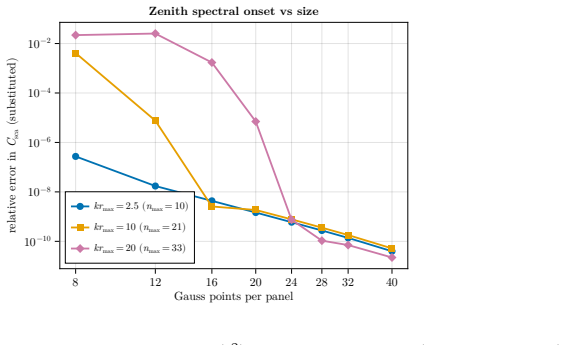
- Convergence orders are fixed by local contact geometry and remain independent of size up to kr_max equals 20.
Where Pith is reading between the lines
- The same tangency-based splitting and substitution could be inserted into other volume-integral scattering codes that integrate over faceted domains.
- Because the required resolution grows with particle size while the order stays fixed, the method supplies a clear scaling rule for atmospheric ice-crystal calculations at visible and infrared wavelengths.
- The analytic location of tangency loci suggests that the scheme can be combined with adaptive quadrature that automatically refines only near edges and vertices.
Load-bearing premise
The non-smoothness originates solely from the tangencies of the integration sphere to the particle faces and edges.
What would settle it
A numerical test on a hexagonal prism that applies the full scheme yet fails to reach spectral convergence in the zenithal direction or fourth-order convergence in the radial direction.
Figures
read the original abstract
The invariant-imbedding T-matrix method (IITM) is a standard tool for light scattering by large, sharply faceted, non-axisymmetric particles (atmospheric ice crystals and mineral dust) where the surface-based extended boundary condition method loses accuracy. Its accuracy is limited by "staircasing": the dielectric contrast of a faceted particle is integrated across boundaries that cut the quadrature grid, so standard quadrature converges at low algebraic order. We show that this non-smoothness has a single geometric origin, the tangencies of the integration sphere to the faces and edges of the particle, which produce jumps, kinks, and half-integer branches according to the tangency type, in all three integration directions. A boundary-conformal scheme removes them using closed-form azimuthal coefficients, panel splitting at the analytically known tangency loci, and a square-root substitution $x \mapsto x_c + t^2$ that absorbs the half-integer branches. For a hexagonal prism the azimuthal integration becomes exact and the zenithal and radial directions recover spectral and fourth-order convergence; because the construction depends only on the contact geometry, it extends to any convex polyhedron, demonstrated on the solid hexagonal bullet (a faceted ice habit with tilted faces). The zenithal crossing is a square-root branch rather than a kink, so the established interval-splitting alone gives only $\mathcal{O}(N^{-3})$, while the radial step removes the half-integer edge branch that caps the Riccati recurrence on faceted particles. The convergence orders are fixed by the local contact geometry and verified size-independent up to $k\,r_{\max} = 20$; what grows with size is the resolution needed to reach each asymptotic regime, not the order.
Editorial analysis
A structured set of objections, weighed in public.
Referee Report
Summary. The paper claims that non-smoothness in the invariant-imbedding T-matrix method for faceted particles originates solely from tangencies of the integration sphere with faces and edges, producing jumps, kinks, and half-integer branches. A boundary-conformal scheme removes these via closed-form azimuthal coefficients, analytic panel splitting at known tangency loci, and the substitution x ↦ x_c + t². For a hexagonal prism this yields exact azimuthal integration, spectral zenithal convergence, and fourth-order radial convergence; the construction extends to any convex polyhedron and is demonstrated on the solid hexagonal bullet, with orders verified size-independent up to kr_max=20.
Significance. If the geometric analysis and quadrature recoveries hold, the work provides a parameter-free route to high-order convergence for scattering by sharply faceted non-axisymmetric particles, directly relevant to atmospheric ice crystals and mineral dust. The size-independent orders and explicit extension to general convex polyhedra are concrete strengths that would improve both accuracy and computational cost relative to staircased quadrature.
minor comments (3)
- [Abstract] Abstract and §1: the statement that 'the zenithal crossing is a square-root branch rather than a kink' is load-bearing for the O(N^{-3}) claim under interval-splitting alone; a short explicit contrast (perhaps via the local expansion of the integrand) would strengthen the exposition.
- Figure captions and §4: the radial and zenithal convergence plots would benefit from explicit annotation of the asymptotic slopes (e.g., 'slope 4' and 'spectral') to make the order recovery immediately visible without consulting the text.
- Notation: the definition of the tangency loci (used for panel splitting) appears in the geometric analysis; a compact table listing the three tangency types, their singularity class, and the corresponding remedy would improve readability for readers outside the immediate subfield.
Simulated Author's Rebuttal
We thank the referee for the positive summary of our work, the recognition of its relevance to scattering by faceted particles, and the recommendation for minor revision. No specific major comments were provided in the report.
Circularity Check
No significant circularity
full rationale
The paper derives its boundary-conformal quadrature scheme directly from explicit geometric analysis of sphere-particle tangency loci (producing jumps, kinks, and square-root branches) together with standard substitutions (closed-form azimuthal integrals, analytic panel splits, and the x ↦ x_c + t² change of variable). These steps are constructed from the contact geometry itself and do not rely on any fitted parameter, self-referential definition, or load-bearing self-citation chain; the claimed spectral/4th-order recovery for the hexagonal prism and bullet is presented as a consequence of removing those specific singularities, with orders verified numerically rather than forced by construction. No step reduces the central result to an input by definition.
Axiom & Free-Parameter Ledger
axioms (1)
- domain assumption The non-smoothness has a single geometric origin, the tangencies of the integration sphere to the faces and edges of the particle, which produce jumps, kinks, and half-integer branches according to the tangency type, in all three integration directions.
Reference graph
Works this paper leans on
-
[1]
P. C. Waterman, Symmetry, unitarity, and geometry in electromagnetic scattering, Physical Review D 3 (1971) 825–839. doi: 10.1103/PhysRe vD.3.825
-
[2]
M. I. Mishchenko, L. D. Travis, A. A. Lacis, Scattering, Absorption, and Emission of Light by Small Particles, Cambridge University Press, Cambridge, 2002
2002
- [3]
-
[4]
B. R. Johnson, Invariant imbedding T matrix approach to electromag- netic scattering, Applied Optics 27 (1988) 4861–4873. doi: 10.1364/AO .27.004861
work page doi:10.1364/ao 1988
-
[5]
L. Bi, P. Yang, G. W. Kattawar, M. I. Mishchenko, Efficient implemen- tation of the invariant imbedding T-matrix method and the separation of variables method applied to large nonspherical inhomogeneous parti- cles, Journal of Quantitative Spectroscopy and Radiative Transfer 116 (2013) 169–183. doi: 10.1016/j.jqsrt.2012.11.014
-
[6]
L. Bi, P. Yang, Accurate simulation of the optical properties of at- mospheric ice crystals with the invariant imbedding T-matrix method, Journal of Quantitative Spectroscopy and Radiative Transfer 138 (2014) 17–35. doi: 10.1016/j.jqsrt.2014.01.013
-
[7]
B. Sun, L. Bi, P. Yang, M. Kahnert, G. W. Kattawar, Invariant Imbed- ding T-matrix Method for Light Scattering by Nonspherical and Inho- mogeneous Particles, Elsevier, Amsterdam, 2020. doi: 10.1016/C201 8-0-02999-0
-
[8]
P. Yang, L. Bi, B. A. Baum, K.-N. Liou, G. W. Kattawar, M. I. Mishchenko, B. Cole, Spectrally consistent scattering, absorption, and polarization properties of atmospheric ice crystals at wavelengths from 0.2 to 100 µm, Journal of the Atmospheric Sciences 70 (2013) 330–347. doi:10.1175/JAS-D-12-039.1
-
[9]
Y. Xiong, Z. Wu, TransitionMatrices.jl: a high-efficiency open-source Julia framework for electromagnetic scattering and polarimetric remote 29 sensing of nonspherical atmospheric particles, 2025. SSRN preprint, ht tps://doi.org/10.2139/ssrn.5335549 ; code: https://github.com /JuliaRemoteSensing/TransitionMatrices.jl
-
[10]
S. Zhai, R. L. Panetta, P. Yang, Improvements in the computational efficiency and convergence of the invariant imbedding T-matrix method for spheroids and hexagonal prisms, Optics Express 27 (2019) A1441– A1457. doi: 10.1364/OE.27.0A1441
-
[11]
A. Doicu, T. Wriedt, N. Khebbache, An overview of the methods for deriving recurrence relations for T-matrix calculation, Journal of Quantitative Spectroscopy and Radiative Transfer 224 (2019) 289–302. doi:10.1016/j.jqsrt.2018.11.029
-
[12]
S. Hu, L. Liu, Q. Zeng, T. Gao, F. Zhang, An investigation of the symmetrical properties in the invariant imbedding T-matrix method for the nonspherical particles with symmetrical geometry, Journal of Quantitative Spectroscopy and Radiative Transfer 259 (2021) 107401. doi:10.1016/j.jqsrt.2020.107401
-
[13]
J. Zhao, S. Hu, X. Liu, S. Li, The computational optimization of the invariant imbedding T matrix method for the particles with N-fold symmetry, Remote Sensing 14 (2022) 4061. doi: 10.3390/rs14164061
-
[14]
S. Hu, S. Li, Q. Zeng, L. Liu, Dimension-variable invariant imbedding (DVIIM) T-matrix computational method for the light scattering simu- lation of atmospheric nonspherical particles, Optics Express 31 (2023) 10052–10069. doi: 10.1364/OE.472809
-
[15]
B. Sun, C. Gao, L. Bi, R. Spurr, Analytical Jacobians of single scatter- ing optical properties using the invariant imbedding T-matrix method, Optics Express 29 (2021) 9635–9669. doi: 10.1364/OE.421886
-
[16]
B. Sun, C. Gao, D. Liang, Z. Liu, J. Liu, Capability and convergence of linearized invariant-imbedding T-matrix and physical-geometric optics methods for light scattering, Optics Express 30 (2022) 37769–37785. doi:10.1364/OE.473075
-
[17]
S. Hu, L. Liu, T. Gao, Q. Zeng, An analysis of the factors influencing the modeling accuracy of the invariant imbedding T-matrix method and the optimal design of the parameter settings for particles with different geometrical and optical properties, Journal of Quantitative 30 Spectroscopy and Radiative Transfer 256 (2020) 107306. doi: 10.1016/ j.jqsrt.2020.107306
arXiv 2020
-
[18]
Y. Zhang, J. Ding, P. Yang, R. L. Panetta, Vector spherical wave func- tion truncation in the invariant imbedding T-matrix method, Optics Express 30 (2022) 30020–30037. doi: 10.1364/OE.459648
-
[19]
Z. Wang, L. Bi, S. Kong, Flexible implementation of the particle shape and internal inhomogeneity in the invariant imbedding T-matrix method, Optics Express 31 (2023) 29427–29444. doi: 10.1364/OE.498 190
-
[20]
M. I. Mishchenko, Comprehensive thematic T-matrix reference database: a 2017–2019 update, Journal of Quantitative Spectroscopy and Radiative Transfer 242 (2020) 106692. doi: 10.1016/j.jqsrt.2019 .106692
-
[21]
M. G. Duffy, Quadrature over a pyramid or cube of integrands with a singularity at a vertex, SIAM Journal on Numerical Analysis 19 (1982) 1260–1262. doi: 10.1137/0719090
-
[22]
J. C. F. Telles, A self-adaptive co-ordinate transformation for efficient numerical evaluation of general boundary element integrals, Interna- tional Journal for Numerical Methods in Engineering 24 (1987) 959–973. doi:10.1002/nme.1620240509
-
[23]
P. J. Davis, P. Rabinowitz, Methods of Numerical Integration, 2nd ed., Academic Press, Orlando, 1984
1984
-
[24]
L. N. Trefethen, Approximation Theory and Approximation Practice, SIAM, Philadelphia, 2013
2013
-
[25]
L. Dieci, T. Eirola, Preserving monotonicity in the numerical solution of Riccati differential equations, Numerische Mathematik 74 (1996) 35–47. doi: 10.1007/s002110050206
-
[26]
J. Schiff, S. Shnider, A natural approach to the numerical integration of Riccati differential equations, SIAM Journal on Numerical Analysis 36 (1999) 1392–1413. doi: 10.1137/S0036142996307946
-
[27]
E. Hairer, C. Lubich, G. Wanner, Geometric Numerical Integration: Structure-Preserving Algorithms for Ordinary Differential Equations, volume 31 of Springer Series in Computational Mathematics , 2nd ed., Springer, Berlin, 2006. doi: 10.1007/3-540-30666-8 . 31
-
[28]
S. G. Warren, R. E. Brandt, Optical constants of ice from the ultraviolet to the microwave: A revised compilation, Journal of Geophysical Re- search: Atmospheres 113 (2008) D14220. doi: 10.1029/2007JD009744
-
[29]
C. G. Schmitt, A. J. Heymsfield, On the occurrence of hollow bullet rosette- and column-shaped ice crystals in midlatitude cirrus, Journal of the Atmospheric Sciences 64 (2007) 4515–4520. doi: 10.1175/2007JA S2317.1
-
[30]
F. M. Kahnert, J. J. Stamnes, K. Stamnes, Application of the extended boundary condition method to particles with sharp edges: a comparison of two surface integration approaches, Applied Optics 40 (2001) 3101–
2001
-
[31]
doi: 10.1364/AO.40.003101
-
[32]
Calogero, Variable Phase Approach to Potential Scattering, vol- ume 35 of Mathematics in Science and Engineering , Academic Press, New York, 1967
F. Calogero, Variable Phase Approach to Potential Scattering, vol- ume 35 of Mathematics in Science and Engineering , Academic Press, New York, 1967
1967
-
[33]
Smooth sets of fields: A pedagogical introduction
E. Hairer, S. P. Nørsett, G. Wanner, Solving Ordinary Differential Equa- tions I: Nonstiff Problems, volume 8 of Springer Series in Computa- tional Mathematics , 2nd ed., Springer, Berlin, 1993. doi: 10.1007/97 8-3-540-78862-1 . 32
work page doi:10.1007/97 1993
discussion (0)
Sign in with ORCID, Apple, or X to comment. Anyone can read and Pith papers without signing in.