REVIEW 3 major objections 5 minor 73 references
Three-body potential energy surface for parahydrogen
T0 review · 3 major / 5 minor · reviewed 2026-08-07 · deepseek-v4-flash
Pith's one-line read The paper constructs a 3D ab initio three-body potential surface for parahydrogen, showing short-range attraction where the standard triple-dipole form predicts repulsion; equilateral triangles dominate the solid's three-body energy.
desk verdict Useful first 3D isotropic three-body PES for para-H2, with a physically interesting hcp finding, but the accuracy claim overreaches in the MATM extrapolation region. read the letter →
The pith
A machine-rendered reading of the paper's core claim, the machinery that carries it, and where it could break.
The reading
What carries the argument
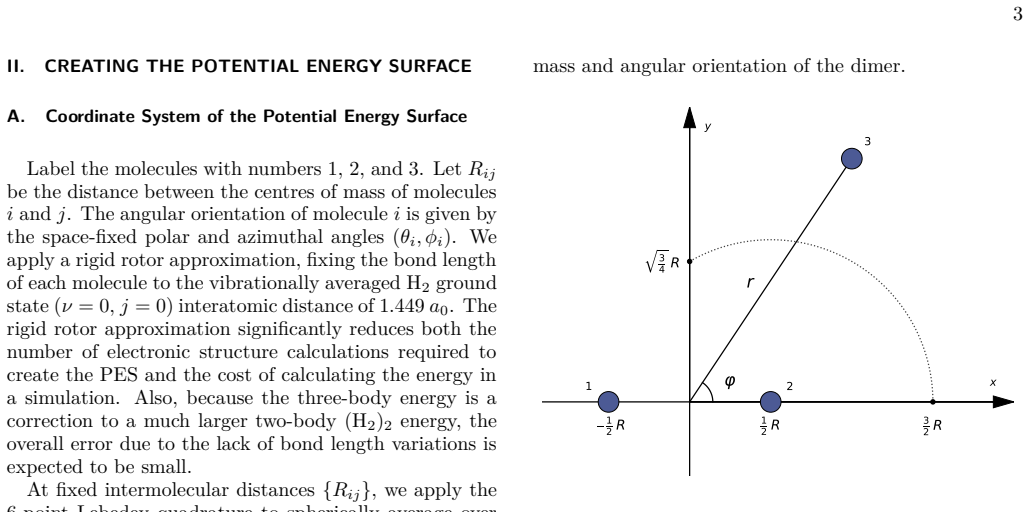
The machinery has two parts. The first is a coordinate system: the rescaled Jacobi coordinates $(R, s, \varphi)$, where $R$ is the shortest pair distance, $s = r/r_{\mathrm{min}}$ measures how far the third molecule sits from the dimer's centre relative to the closest allowed approach, and $\varphi$ is the orientation of the third molecule relative to the dimer axis; the values $s = 1$ and $\varphi = 0, \tan^{-1}(1/2), \pi/2$ cover the collinear, right-angled, and equilateral limiting triangles, and every triangle has a unique representation. These coordinates convert the trimer problem into a regular 3D grid of input data. The second is the patching scheme that turns the grid into a global surface: RKHS interpolation, which is smooth and reproduces the input CCSD(T) energies exactly; the ATM potential $V_3 = C_9[1 + 3\cos\alpha_1\cos\alpha_2\cos\alpha_3]/(R_{12}^3 R_{13}^3 R_{23}^3)$ with $C_9 = 34336.220\ \mathrm{cm}^{-1}\,\mathrm{\AA}^9$, spliced in for large $R$ by a Gaussian-tapered correction whose decay rate $\lambda$ is chosen between 2 and 5; the modified ATM form $V_{\mathrm{MATM}} = (C_9/64 R^9)[a(R,\varphi) + b(R,\varphi) f(s,\varphi)]/[T(s,\varphi)]^{3/2}$ for the two-close-one-far geometry, with coefficients $a$ and $b$ fitted at $s = 3.55$ and 3.85 and filtered back to unity for $R > 3.2$ Å; and an exponential extrapolation below $R = 2.2$ Å with a linear fallback where the exponential would blow up. The coefficient $b$ grows as large as 8.64 for small equilateral triangles, which is the quantitative signature of the short-range physics that the plain ATM form misses.
What would settle it
Run fresh CCSD(T) calculations with the larger AVQZ basis plus midbond functions at triangle geometries inside the transition bands — for example $R$ between roughly 3.6 and 5.35 Å at several $(s,\varphi)$ choices, and $s$ between 3.85 and 5.0 with $R$ between 2.2 and 3.2 Å — and compare them with the PES at those same points; the paper's own basis-set tests put AVTZ-to-AVQZ agreement at the 1–3% level, so any transition-region discrepancy larger than that would show the empirical splicing is not shape-robust. On the application side, a path-integral Monte Carlo simulation of solid parahydrogen with the FSH potential plus this PES that still overshoots the experimental pressure near $\rho = 0.02$–$0.04$ Å$^{-3}$ would falsify the expectation that the combination outperforms the standard effective pair potentials.
Extended reading notes
Core claim
The authors claim that the isotropic three-body interaction energy of three para-H2 molecules is quantitatively captured, over the stated domain of triangles with side lengths above 2.2 Å, by a 3D surface built from CCSD(T) energies, and that this energy behaves qualitatively differently from the ATM triple-dipole potential: for most triangle geometries relevant to solid parahydrogen, including the equilateral configuration, the three-body contribution at short separations is attractive — about $-578\ \mathrm{cm}^{-1}$ at the AVTZ level for an equilateral triangle of side 2.2 Å — where the ATM potential predicts strong net repulsion. The ATM form is recovered only at large separations, and in the compressed hexagonal-close-packed lattice the equilateral triangle (24 of the 66 nearest-neighbour triangles around a reference molecule) contributes the majority of the three-body energy per particle, with the remaining 42 triangles partially cancelling. For the two-close-one-far geometry the energy instead follows a modified ATM form whose $b$ coefficient reaches 8.64 at the small-equilateral limit. In a frozen-lattice equation of state, adding the surface to the FSH pair potential brings the high-density pressure below the Silvera-Goldman curves, which the authors read as evidence that the combination will outperform widely used effective pair potentials for condensed parahydrogen.
Load-bearing premise
The load-bearing premise is that the hand-chosen junction parameters — the distances where the computed energies are judged to begin and complete their merge into the standard long-range three-body decay law, the speed of that merge, and the fitted shape-dependent coefficients for the two-close-one-far geometry — are valid for every triangle shape, and not just for the curves the authors inspected by eye.
Editorial extensions
If this is right
- Adding this PES to the first-principles FSH pair potential lowers the frozen hexagonal-close-packed lattice equation of state and pressure at high densities below the Silvera-Goldman curves, correcting the pressure overestimate that pure FSH produces.
- Because equilateral and near-equilateral triangles contribute the dominant share of the three-body energy per particle, condensed-phase simulations can approximate the three-body correction with a surface restricted to a narrow range of $s$ and $\varphi$ near the equilateral values.
- At large separations the surface converges exactly to the ATM triple-dipole potential, which the unadjusted AVTZ CCSD(T) energies do not; this gives the PES reliable long-range behaviour for calculations of virial-type quantities.
- The six-point Lebedev spherical average is accurate enough (about 0.2% for equilateral and 2% for collinear configurations below 2.95 Å), so evaluating the surface in simulations stays cheap and a tenfold larger angular grid is not worth the cost.
Reading between the lines
- The decisive test of the application claim is a path-integral Monte Carlo simulation with FSH plus this PES, which the authors state is in progress; if the frozen-lattice trend survives zero-point motion, the equilibrium density and the pressure curve of solid parahydrogen near $\rho = 0.02$–$0.04$ Å$^{-3}$ should move toward experiment.
- Because the PES is pinned to the exact ATM limit at long range, it is a stronger candidate than the earlier neural-network surface for recomputing the third virial coefficient of parahydrogen, a quantity that previously needed ad hoc long-range modifications.
- A sensitivity scan of the hand-chosen junction parameters ($R_A$, $R_C$, $\lambda$, and the MATM fit points $s_0$, $s_1$) would reveal which part of the predicted high-density pressure drop is robust and which depends on those choices.
Editorial analysis
A structured set of objections, weighed in public.
Referee Report
Summary. The paper constructs a three-dimensional isotropic three-body potential energy surface for (para-H2)3. CCSD(T) interaction energies with an AVTZ basis plus a (3s3p2d) midbond function are spherically averaged over 27 angular orientations and interpolated with the RKHS method in scaled Jacobi coordinates (R,s,phi). Outside the ab initio grid, the surface is switched to the ATM potential at large R (Eqs. 9-10) and to a modified ATM form at large s for R<3.2 A (Eqs. 11-16), with exponential/linear extrapolation below R=2.2 A. The surface is then used to evaluate three-body contributions in a frozen hcp lattice and to estimate an equation of state when combined with the FSH pair potential. The authors claim the PES is accurate for all triangles with side lengths greater than 2.2 A and provides suitable extrapolations for smaller triangles.
Significance. The presented surface is a useful step toward a quantitative three-body correction for para-H2 simulations. Its strengths include standard counterpoise-corrected CCSD(T) methodology, documented basis-set convergence (AVDZ/AVTZ/AVQZ), a comparison of 6-point and 14-point Lebedev quadrature, an explicit check of RKHS mesh-spacing sensitivity, and an independent AVTZ test set for the equilateral geometry in Fig. 8. The hcp-lattice analysis is a concrete application and produces a testable prediction: the equilateral triangle configuration dominates the three-body energy, and the ATM potential is inadequate at high density. However, the broad accuracy claim for all side lengths greater than 2.2 A is not currently supported by validation data in the empirical transition regions.
major comments (3)
- [Sec. IIC2, Eqs. (15)-(16)] The large-s MATM extrapolation for R<3.2 A is fitted using only s0=3.55 and s1=3.85, and no ab initio energies are reported for s>3.85. For phi=pi/2 the denominator f(s1)-f(s0) is only about 0.023, so the fitted coefficients a and b are extremely sensitive to the small differences between U3(s0) and U3(s1); the sensitivity is not analyzed and no uncertainty is propagated. This region controls the PES for configurations such as R about 2.2 A with s between 3.55 and 3.85, which lie inside the claimed accurate domain. Independent CCSD(T) energies at larger s, or a restricted accuracy claim, are needed before the central claim is established.
- [Sec. IIC1, Eqs. (9)-(10)] The transition to the ATM potential is imposed rather than demonstrated. The authors choose RA(s,phi) and RC(s,phi) by visual inspection of rescaled plots and set lambda(s,phi) between 2 and 5; Eq. (9) then forces V3(R)=VATM(R) for R>=RA. Consequently, the statement that the PES converges to ATM at large R is true by construction and cannot serve as validation. The only comparison with independent data in this transition region is the equilateral-triangle case in Fig. 8, and no systematic check covers the full (s,phi) range that the abstract's accuracy claim encompasses.
- [Sec. III, central claim] The accuracy of the final PES is assessed piecewise (basis set, quadrature, mesh spacing), but no composite error estimate is provided for the final surface, and the empirical adjustments of Eqs. (9)-(16) are not included in any error budget. In particular, the 6-point Lebedev quadrature error is about 2% for collinear configurations at R=2.2 A (Sec. IIIB), yet this uncertainty is not propagated into the final PES. Given the abstract's claim of accurate energies for all triangles with side lengths greater than 2.2 A, the manuscript should either quantify the total uncertainty over that domain or qualify the claim.
minor comments (5)
- [Sec. IIC2, Eq. (17)] Equation (17) uses the same symbol omega for both the first and second weight functions; the second factor should be the complementary weight function omega-bar defined by Eq. (B2).
- [Fig. 5] The region labels 'Exponential*' and 'MATM+Exponential*' are not explained; the asterisk should be defined in the caption or text.
- [Data Availability] The statement that data are 'available from the corresponding author upon reasonable request' is weak for a potential energy surface paper; depositing the RKHS input data and construction code would materially improve reproducibility.
- [Abstract] The abstract describes the accompanying pair potential as 'first principles' but the present three-body PES relies on empirical adjustments (Secs. IIC1 and IIC2); the wording should clarify which components are ab initio and which are phenomenological.
- [Secs. IIA and IIIC] There are minor typographical errors such as 'analagous' (Sec. IIA) and 'reprodued' (Sec. IIIC); these should be corrected in the final version.
Circularity Check
No significant circularity: the ATM/MATM limits are explicit empirical adjustments, and the hcp-lattice application uses s=1 configurations inside the RKHS-interpolated region.
full rationale
The alleged reductions are not circular because the paper is transparent about what is interpolation, what is enforced boundary behaviour, and what is extrapolation. The RKHS step reproduces the CCSD(T) input mesh exactly, so this is interpolation, not a prediction. Equation (9) sets V3 equal to VATM for R≥RA and tapers through a Gaussian factor for RC≤R<RA; the authors explicitly describe this as ensuring a smooth transition, so the ATM asymptote is an empirically imposed boundary condition, not a result derived from the ab initio data. Likewise, the MATM coefficients in Eqs. (12), (15), and (16) are fitted to the ab initio U3 values at selected s, and Eq. (13) then defines the s>s′ region as a+bf(s); the paper calls this a fit and an extrapolation, so energies there are not presented as independent predictions. The hcp-lattice application is not riding on those fitted asymptotes: because every nearest-neighbour triangle has R12=R23=R, the rescaled coordinate is s=1, which places all 66 triangles in the RKHS-interpolated region where the surface reproduces the input CCSD(T) energies. The FSH potential and the Ref. [56] PIMC curve are external comparison inputs; the self-citations are not load-bearing. The MATM extrapolation's lack of independent validation for s>3.85 is a correctness and robustness concern, not a circularity.
Assumptions & free parameters
free parameters (6)
- RA(s,phi) =
5.35 Å for equilateral; chosen per (s,phi)
- RC(s,phi) =
3.6 Å for equilateral; chosen per (s,phi)
- lambda(s,phi) =
2 to 5
- s' (or s0,s1) =
3.55 and 3.85
- a(R,phi), b(R,phi) =
functions, e.g., a=1.06, b=8.64 at (2.2 Å, pi/2)
- phi_cf =
1e-5
assumptions (6)
- domain assumption CCSD(T) level of theory gives accurate three-body interaction energies for (H2)3
- domain assumption AVTZ basis set with midbond functions is sufficiently converged
- domain assumption 6-point Lebedev quadrature captures the isotropic component
- domain assumption Rigid rotor approximation with bond length 1.449 a0
- standard math ATM potential is the correct long-range asymptotic form
- standard math RKHS interpolation is smooth and exact at data points
Cite this review
Pith. "Pith review of Three-body potential energy surface for parahydrogen." pith.science (2026). https://pith.science/paper/4MFEODYK
@misc{pith2026250603338,
  author       = {Pith},
  title        = {Pith review of: Three-body potential energy surface for parahydrogen},
  year         = {2026},
  howpublished = {\url{https://pith.science/paper/4MFEODYK}},
  note         = {Machine review of arXiv:2506.03338}
}
abstract
We present a 3D isotropic ab initio three-body (para-H$_2$)$_3$ interaction potential energy surface (PES). The electronic structure calculations are carried out at the correlated coupled-cluster theory level, with single, double, and perturbative triple excitations. The calculations use an augmented correlation-consistent triple zeta basis set and a supplementary midbond function. We construct the PES using the Reproducing-Kernel Hilbert Space toolkit [J. Chem. Inf. Model. 57, 1923 (2017)] with phenomenological and empirical adjustments to account for short-range and long-range behaviour. The (para-H$_2$)$_3$ interaction energies deviate drastically from the Axilrod-Teller-Muto (ATM) potential at short intermolecular separations. We find that the configuration of three para-H$_2$ molecules at the corners of an equilateral triangle is responsible for the majority of the (para-H$_2$)$_3$ interaction energy contribution in a hexagonal-close-packed lattice. In cases where two para-H$_2$ molecules are close to one another while the third is far away, the (para-H$_2$)$_3$ interaction PES takes the form of a modified version of the ATM potential. We expect the combination of this PES together with a first principles para-H$_2$--para-H$_2$ Adiabatic Hindered Rotor potential to outperform a widely-used effective pair potential for condensed many-body systems of para-H$_2$.
Figures


Figures from the paper (7 more)


Reference graph
Works this paper leans on
-
[1]
author author S. Grebenev , author B. G. \ Sartakov , author J. P. \ Toennies , \ and\ author A. F. \ Vilesov ,\ title title Evidence for superfluidity in para-hydrogen clusters inside helium-4 droplets at 0.15 K elvin , \ @noop journal journal Science \ volume 289 ,\ pages 1532 ( year 2000 ) NoStop
work page 2000
-
[2]
author author S. Grebenev , author E. Lugovoi , author B. G. \ Sartakov , author J. P. \ Toennies , \ and\ author A. F. \ Vilesov ,\ title title Spectroscopy of O C S -hydrogen clusters in H e droplets , \ @noop journal journal Faraday Disc. \ volume 118 ,\ pages 19 ( year 2001 a ) NoStop
work page 2001
-
[3]
author author S. Grebenev , author B. G. \ Sartakov , author J. P. \ Toennies , \ and\ author A. F. \ Vilesov ,\ title title The structure of the O C S - H _2 van der W aals complex embedded inside ^4 H e/ ^3 H e droplets , \ @noop journal journal J.\ Chem.\ Phys. \ volume 114 ,\ pages 617 ( year 2001 b ) NoStop
work page 2001
-
[4]
author author S. Grebenev , author B. G. \ Sartakov , author J. P. \ Toennies , \ and\ author A. F. \ Vilesov ,\ title title Effect of the symmetry of H _2 molecules on their rotations around an O C S molecule in superfluid ^4 H e droplets , \ @noop journal journal Phys.\ Rev.\ Lett. \ volume 89 ,\ pages 225301 ( year 2002 ) NoStop
work page 2002
-
[5]
author author S. Grebenev , author B. G. \ Sartakov , author J. P. \ Toennies , \ and\ author A. F. \ Vilesov ,\ title title High-resolution infrared spectra of the O C S - H _2 , - H D , and - D _2 can der W aals complexes in liquid helium droplets , \ @noop journal journal J.\ Chem.\ Phys. \ volume 118 ,\ pages 8656 ( year 2003 ) NoStop
work page 2003
-
[6]
author author P. Sindzingre , author D. M. \ Ceperley , \ and\ author M. L. \ Klein ,\ title title Superfluidity in clusters of p- H _2 molecules , \ @noop journal journal Phys.\ Rev.\ Lett. \ volume 67 ,\ pages 1871 ( year 1991 ) NoStop
work page 1991
-
[7]
author author Y. Kwon \ and\ author K. B. \ Whaley ,\ title title Nanoscale molecular superfluidity of hydrogen , \ @noop journal journal Phys.\ Rev.\ Lett. \ volume 89 ,\ pages 273401 ( year 2002 ) NoStop
work page 2002
-
[8]
author author F. Paesani , author R. E. \ Zillich , author Y. Kwon , \ and\ author K. B. \ Whaley ,\ title title O C S in para-hydrogen clusters: R otational dynamics and superfluidity , \ @noop journal journal J.\ Chem.\ Phys. \ volume 122 ,\ pages 181106 ( year 2005 ) NoStop
work page 2005
Show all 73 references
-
[9]
Li , author R
author author H. Li , author R. J. \ Le Roy , author P.-N. \ Roy , \ and\ author A. R. W. \ McKellar ,\ title title Molecular superfluid: N onclassical rotations in doped para-hydrogen clusters , \ @noop journal journal Phys.\ Rev.\ Lett. \ volume 105 ,\ pages 133401 ( year 20...
2010
-
[10]
Zeng , author H
author author T. Zeng , author H. Li , \ and\ author P.-N. \ Roy ,\ title title Simulating asymmetric top impurities in superfluid clusters: A para-water dopant in para-hydrogen , \ @noop journal journal J.\ Phys.\ Chem.\ Lett. \ volume 4 ,\ pages 18 ( year 2013 ) NoStop
2013
-
[11]
Boninsegni ,\ title title Superfluid response of parahydrogen clusters in superfluid ^4 H e , \ @noop journal journal J.\ Low Temp.\ Phys
author author M. Boninsegni ,\ title title Superfluid response of parahydrogen clusters in superfluid ^4 H e , \ @noop journal journal J.\ Low Temp.\ Phys. \ volume 201 ,\ pages 193 ( year 2020 ) NoStop
2020
-
[12]
author author H. P. \ Gush , author W. F. J. \ Hare , author E. J. \ Allin , \ and\ author H. L. \ Welsh ,\ title title The infrared fundamental band of liquid and solid hydrogen , \ @noop journal journal Can.\ J.\ Phys. \ volume 38 ,\ pages 176 ( year 1960 ) NoStop
1960
-
[13]
author author L. H. \ Nosanow ,\ title title Theory of quantum crystals , \ @noop journal journal Phys.\ Rev. \ volume 146 ,\ pages 120 ( year 1966 ) NoStop
1966
-
[14]
Bostanjoglo \ and\ author R
author author O. Bostanjoglo \ and\ author R. Kleinschmidt ,\ title title Crystal structure of hydrogen isotopes , \ @noop journal journal J.\ Chem.\ Phys. \ volume 46 ,\ pages 2004 ( year 1967 ) NoStop
2004
-
[15]
author author J. van Kranendonk ,\ 10.1007/978-1-4684-4301-1 title Solid hydrogen: T heory of the properties of solid H _2 , H D , and D _2 \ ( publisher Springer ,\ address Boston, MA ,\ year 1983 ) NoStop
1983 doi
-
[16]
Fernandez-Alonso , author C
author author F. Fernandez-Alonso , author C. Cabrillo , author R. Fern\' a ndez-Perea , author F. J. \ Bermejo , author M. A. \ Gonz\' a lez , author C. Mondelli , \ and\ author E. Farhi ,\ title title Solid para-hydrogen as the paradigmatic quantum crystal: T hree observable...
2012
-
[17]
Dusseault \ and\ author M
author author M. Dusseault \ and\ author M. Boninsegni ,\ title title Atomic displacements in quantum crystals , \ @noop journal journal Phys.\ Rev.\ B \ volume 95 ,\ pages 104518 ( year 2017 ) NoStop
2017
-
[18]
author author I. F. \ Silvera ,\ title title The solid molecular hydrogens in the condensed phase: F undamentals and static properties , \ @noop journal journal Rev.\ Mod.\ Phys. \ volume 52 ,\ pages 393 ( year 1980 ) NoStop
1980
-
[19]
author author E. L. \ Wehry \ and\ author G. Mamantov ,\ title title Matrix isolation spectroscopy , \ @noop journal journal Anal.\ Chem. \ volume 51 ,\ pages 643--656 ( year 1979 ) NoStop
1979
-
[20]
author author A. J. \ Barnes ,\ title Matrix isolation spectroscopy: Technique and applications , \ \ ( publisher Springer-Verlag ,\ address Berlin, Heidelberg ,\ year 1994 )\ p.\ pages 351 NoStop
1994
-
[21]
author author V. E. \ Bondybey , author A. M. \ Smith , \ and\ author J. Agreiter ,\ title title New developments in matrix isolation spectroscopy , \ @noop journal journal Chem.\ Rev. \ volume 96 ,\ pages 2113--2134 ( year 1996 ) NoStop
1996
-
[22]
Momose \ and\ author T
author author T. Momose \ and\ author T. Shida ,\ title title Matrix-isolation spectroscopy using solid parahydrogen as the matrix: A pplication to high-resolution spectroscopy, photochemistry, and cryochemistry , \ @noop journal journal Bull.\ Chem.\ Soc.\ Jpn. \ volume 71 ,\...
1998
-
[23]
Momose , author M
author author T. Momose , author M. Fushitani , \ and\ author H. Hoshina ,\ title title Chemical reactions in quantum crystals , \ @noop journal journal Int.\ Rev.\ Phys.\ Chem. \ volume 24 ,\ pages 533--552 ( year 2005 ) NoStop
2005
-
[24]
Yoshioka , author P
author author K. Yoshioka , author P. L. \ Raston , \ and\ author D. T. \ Anderson ,\ title title Infrared spectroscopy of chemically doped solid parahydrogen , \ @noop journal journal Int.\ Rev.\ Phys.\ Chem. \ volume 25 ,\ pages 469--496 ( year 2006 ) NoStop
2006
-
[25]
Bahou , author C.-W
author author M. Bahou , author C.-W. \ Huang , author Y.-L. \ Huang , author J. Glatthaar , \ and\ author Y.-P. \ Lee ,\ title title Advances in use of p- H _2 as a novel host for matrix I R spectroscopy , \ @noop journal journal J.\ Chin.\ Chem.\ Soc. \ volume 57 ,\ pages 77...
2010
-
[26]
author author M. E. \ Fajardo , author S. Tam , \ and\ author M. E. \ Derose ,\ title title Matrix isolation spectroscopy of H _2 O , D _2 O , and H D O in solid parahydrogen , \ @noop journal journal J.\ Mol.\ Spectrosc. \ volume 695-696 ,\ pages 111--127 ( year 2004 ) NoStop
2004
-
[27]
author author M. E. \ Fajardo \ and\ author C. M. \ Lindsay ,\ title title Crystal field splitting of rovibrational transitions of water monomers isolated in solid parahydrogen , \ @noop journal journal J.\ Chem.\ Phys. \ volume 128 ,\ pages 014505 ( year 2008 ) NoStop
2008
-
[28]
Miki \ and\ author T
author author M. Miki \ and\ author T. Momose ,\ title title Rovibrational transitions and nuclear spin conversion of methane in parahydrogen crystals , \ @noop journal journal Low.\ Temp.\ Phys. \ volume 26 ,\ pages 661--668 ( year 2000 ) NoStop
2000
-
[29]
Miyamoto , author M
author author Y. Miyamoto , author M. Fushitani , author D. Ando , \ and\ author T. Momose ,\ title title Nuclear spin conversion of methane in solid parahydrogen , \ @noop journal journal J.\ Chem.\ Phys. \ volume 128 ,\ pages 114502 ( year 2008 ) NoStop
2008
-
[30]
author author M. E. \ Fajardo , author C. M. \ Lindsay , \ and\ author T. Momose ,\ title title Crystal field theory analysis of rovibrational spectra of carbon monoxide isolated in solid parahydrogen , \ @noop journal journal J.\ Chem.\ Phys. \ volume 130 ,\ pages 244508 ( ye...
2009
-
[31]
author author J. M. \ Farrer \ and\ author Y. T. \ Lee ,\ title title Intermolecular potentials from crossed beam differential elastic scattering measurements. V I I para- H _2 + para- H _2 , \ @noop journal journal J.\ Chem.\ Phys. \ volume 57 ,\ pages 5492 ( year 1972 ) NoStop
1972
-
[32]
Buck , author F
author author U. Buck , author F. Huisken , author A. Kohlhase , author D. Otten , \ and\ author J. Schaefer ,\ title title State resolved rotational excitation in D _2 + H _2 collisions , \ @noop journal journal J.\ Chem.\ Phys. \ volume 78 ,\ pages 4439 ( year 1978 ) NoStop
1978
-
[33]
author author E. A. \ Mason \ and\ author W. E. \ Rice ,\ title title The intermolecular potentials of helium and hydrogen , \ @noop journal journal J.\ Chem.\ Phys. \ volume 22 ,\ pages 522 ( year 1954 ) NoStop
1954
-
[34]
author author J. O. \ Hirschfelder , author R. B. \ Bird , \ and\ author E. L. \ Spotz ,\ title title The transport properties for non-polar gases , \ @noop journal journal J.\ Chem.\ Phys. \ volume 16 ,\ pages 968 ( year 1948 ) NoStop
1948
-
[35]
author author I. F. \ Silvera \ and\ author V. V. \ Goldman ,\ title title The isotropic intermolecular potential for H _2 and D _2 in the solid and gas phases , \ @noop journal journal J.\ Chem.\ Phys. \ volume 69 ,\ pages 4209 ( year 1978 ) NoStop
1978
-
[36]
author author M. J. \ Norman , author R. O. \ Watts , \ and\ author U. Buck ,\ title title A spherical potential for hydrogen from solid state and scattering data , \ @noop journal journal J.\ Chem.\ Phys. \ volume 81 ,\ pages 3500 ( year 1984 ) NoStop
1984
-
[37]
Diep \ and\ author J
author author P. Diep \ and\ author J. K. \ Johnson ,\ title title An accurate H _2 -- H _2 interaction potential from first principles , \ @noop journal journal J.\ Chem.\ Phys. \ volume 112 ,\ pages 4465 ( year 2000 ) NoStop
2000
-
[38]
Patkowski , author W
author author K. Patkowski , author W. Cencek , author P. Jankowski , author K. Szalewicz , author J. B. \ Mehl , author G. Garberoglio , \ and\ author A. H. \ Harvey ,\ title title Potential energy surface for interactions between two hydrogen molecules , \ @noop journal jour...
2008
-
[39]
author author R. J. \ Hinde ,\ title title A six-dimensional H _2 -- H _2 potential energy surface for bound state spectroscopy , \ @noop journal journal J.\ Chem.\ Phys. \ volume 128 ,\ pages 154308 ( year 2008 a ) NoStop
2008
-
[40]
Faruk , author M
author author N. Faruk , author M. Schmidt , author H. Li , author R. J. \ Le Roy , \ and\ author P.-N. \ Roy ,\ title title First-principles prediction of the R aman shifts in parahydrogen clusters , \ @noop journal journal J.\ Chem.\ Phys. \ volume 141 ,\ pages 014310 ( year...
2014
-
[41]
author author M. M. \ Szcz e \' s niak \ and\ author G. Cha asi\' n ski ,\ title title Ab initio calculations of nonadditive effects , \ @noop journal journal J.\ Mol.\ Struct.\ (Theochem) \ volume 261 ,\ pages 37--54 ( year 1992 ) NoStop
1992
-
[42]
author author M. J. \ Elrod \ and\ author R. J. \ Saykally ,\ title title Many-body effects in intermolecular forces , \ @noop journal journal Chem.\ Rev. \ volume 94 ,\ pages 1975 ( year 1994 ) NoStop
1975
-
[43]
author author B. M. \ Axilrod \ and\ author E. Teller ,\ title title Interaction of the van der W aals type between three atoms , \ @noop journal journal J.\ Chem.\ Phys. \ volume 11 ,\ pages 299 ( year 1943 ) NoStop
1943
-
[44]
Muto ,\ @noop journal journal J.\ Phys.\ Math.\ Soc.\ Jpn
author author Y. Muto ,\ @noop journal journal J.\ Phys.\ Math.\ Soc.\ Jpn. \ volume 17 ,\ pages 629 ( year 1943 ) NoStop
1943
-
[45]
Wind \ and\ author I
author author P. Wind \ and\ author I. R eggen ,\ title title Ab initio calculation of three-body interaction in the (h _2 ) _3 trimer , \ @noop journal journal Chem.\ Phys. \ volume 211 ,\ pages 179--189 ( year 1996 ) NoStop
1996
-
[46]
author author R. J. \ Hinde ,\ title title Three-body interactions in solid parahydrogen , \ @noop journal journal Chem.\ Phys.\ Lett. \ volume 460 ,\ pages 141--145 ( year 2008 b ) NoStop
2008
-
[47]
author author T. I. \ Sachse , author K. T. \ Tang , \ and\ author J. P. \ Toennies ,\ title title A simple damping function for the three-atom dispersion energy , \ @noop journal journal Chem.\ Phys.\ Lett. \ volume 317 ,\ pages 346--350 ( year 2000 ) NoStop
2000
-
[48]
author author O. A. \ von Lilienfeld \ and\ author A. Tkatchenko ,\ title title Two- and three-body interatomic dispersion energy contributions to binding in molecules and solids , \ @noop journal journal J.\ Chem.\ Phys. \ volume 132 ,\ pages 234109 ( year 2010 ) NoStop
2010
-
[49]
Huang \ and\ author G
author author Y. Huang \ and\ author G. J. O. \ Beran ,\ title title Reliable prediction of three-body intermolecular interactions using dispersion-corrected second-order M \" o ller- P lesset perturbation theory , \ @noop journal journal J.\ Chem.\ Phys. \ volume 143 ,\ pages...
2015
-
[50]
Moraldi ,\ title title Effective pair potential for solid molecular hydrogen at high pressures , \ @noop journal journal J.\ Low Temp.\ Phys
author author M. Moraldi ,\ title title Effective pair potential for solid molecular hydrogen at high pressures , \ @noop journal journal J.\ Low Temp.\ Phys. \ volume 168 ,\ pages 275--284 ( year 2012 ) NoStop
2012
-
[51]
Omiyinka \ and\ author M
author author T. Omiyinka \ and\ author M. Boninsegni ,\ title title Pair potentials and equation of state of solid para-hydrogen to megabar pressure , \ @noop journal journal Phys.\ Rev.\ B \ volume 88 ,\ pages 024112 ( year 2013 ) NoStop
2013
-
[52]
Manzhos , author K
author author S. Manzhos , author K. Nakai , \ and\ author K. Yamashita ,\ title title Three-body interactions in clusters C O --(p H _2 ) _n , \ @noop journal journal Chem.\ Phys.\ Lett. \ volume 493 ,\ pages 229--233 ( year 2010 ) NoStop
2010
-
[53]
Garberoglio ,\ title title On the contribution of non-additive three-body interactions to the third virial coefficient of para-hydrogen , \ @noop journal journal Chem.\ Phys.\ Lett
author author G. Garberoglio ,\ title title On the contribution of non-additive three-body interactions to the third virial coefficient of para-hydrogen , \ @noop journal journal Chem.\ Phys.\ Lett. \ volume 557 ,\ pages 26 ( year 2012 ) NoStop
2012
-
[54]
Li , author P.-N
author author H. Li , author P.-N. \ Roy , \ and\ author R. J. L. \ Roy ,\ title title An ``adiabatic-hindered-rotor'' treatment allows para- H _2 to be treated as if it were spherical , \ @noop journal journal J.\ Chem.\ Phys. \ volume 133 ,\ pages 104305 ( year 2010 ) NoStop
2010
-
[55]
Schmidt , author J
author author M. Schmidt , author J. M. \ Fern\' a ndez , author N. Faruk , author M. Nooijen , author R. J. L. \ Roy , author J. H. \ Morilla , author G. Tejeda , author S. Montero , \ and\ author P.-N. \ Roy ,\ title title Raman vibrational shifts of small clusters of hydrog...
2015
-
[56]
Ibrahim , author L
author author A. Ibrahim , author L. Wang , author T. Halverson , author R. J. L. \ Roy , \ and\ author P.-N. \ Roy ,\ title title Equation of state and first principles prediction of the vibrational matrix shift of solid parahydrogen , \ @noop journal journal J.\ Chem.\ Phys....
2019
-
[57]
author author W. B. J. M. \ Janssen \ and\ author A. van der Avoird ,\ title title Dynamics and phase transitions in solid ortho and para hydrogen and deuterium from an ab initio potential , \ @noop journal journal Phys.\ Rev.\ B \ volume 42 ,\ pages 838--848 ( year 1990 ) NoStop
1990
-
[58]
\ Tao \ and\ author Y.-K
author author F.-M. \ Tao \ and\ author Y.-K. \ Pan ,\ title title M ller- P lesset perturbation investigation of the H e _2 potential and the role of midbond basis functions , \ @noop journal journal J.\ Chem.\ Phys. \ volume 97 ,\ pages 4989 ( year 1992 ) NoStop
1992
-
[59]
author author O. T. \ Unke \ and\ author M. Meuwly ,\ title title Toolkit for the construction of reproducing kernel-based representations of data: A pplication to multidimensional potential energy surfaces , \ @noop journal journal J.\ Chem.\ Inf.\ Model. \ volume 57 ,\ pages...
1923
-
[60]
\ Ho \ and\ author H
author author T.-S. \ Ho \ and\ author H. Rabitz ,\ title title A general method for constructing multidimensional molecular potential energy surfaces from ab initio calculations , \ @noop journal journal J.\ Chem.\ Phys. \ volume 104 ,\ pages 2584 ( year 1996 ) NoStop
1996
-
[61]
\ Ho \ and\ author H
author author T.-S. \ Ho \ and\ author H. Rabitz ,\ title title Reproducing kernel H ilbert space interpolation methods as a paradigm of high dimensional model representations: A pplication to multidimensional potential energy surface construction , \ @noop journal journal J.\...
2003
-
[62]
\ Ho , author T
author author T.-S. \ Ho , author T. Hollebeek , \ and\ author H. Rabitz ,\ title title A global H _2 O potential energy surface for the reaction O ( ^ 1 D ) + H _2 O H + H , \ @noop journal journal J.\ Chem.\ Phys. \ volume 105 ,\ pages 10472 ( year 1996 ) NoStop
1996
-
[63]
\ Ho , author T
author author T.-S. \ Ho , author T. Hollebeek , author H. Rabitz , author S. D. \ Chao , author R. T. \ Skodje , author A. S. \ Zyubin , \ and\ author A. M. \ Mebel ,\ title title A globally smooth ab initio potential surface of the 1 A ' state for the reaction s( ^ 1 d ) + H...
2002
-
[64]
author author J. C. \ Castro-Palacio , author T. Nagy , author R. J. \ Bemish , \ and\ author M. Meuwly ,\ title title Computational study of collisions between O ( ^ 3 P ) and NO ( ^ 2 ) at temperatures relevant to the hypersonic flight regime , \ @noop journal journal J.\ Ch...
2014
-
[65]
author author O. T. \ Unke , author J. C. \ Castro-Palacio , author R. J. \ Bemish , \ and\ author M. Meuwly ,\ title title Collision-induced rotational excitation in N _ 2 ^ + (^ 2 _ g ^ + , = 0 ) -- A r: C omparison of computations and experiment , \ @noop journal journal J....
2016
-
[66]
author author V. I. \ Lebedev ,\ title title Quadratures on a sphere , \ @noop journal journal Zh.\ Vychisl.\ Mat.\ Mat.\ Fiz. \ volume 16 ,\ pages 293--306 ( year 1976 ) NoStop
1976
-
[67]
\ Wang \ and\ author T
author author X.-G. \ Wang \ and\ author T. C. \ Jr. ,\ title title Using L ebedev grids, sine spherical harmonics, and monomer contracted basis functions to calculate being energy levels of H F trimer , \ @noop journal journal J. Theor.\ Comp.\ Chem. \ volume 2 ,\ pages 599--...
2003
-
[68]
Rolik , author L
author author Z. Rolik , author L. Szegedy , author I. Ladj\' a nszki , author B. Lad\' o czki , \ and\ author M. K\' a llay ,\ title title An efficient linear-scaling C C S D ( T ) method based on local natural orbitals , \ @noop journal journal J.\ Chem.\ Phys. \ volume 139 ...
2013
-
[69]
Raghavachari , author G
author author K. Raghavachari , author G. W. \ Trucks , author J. A. \ Pople , \ and\ author M. Head-Gordon ,\ title title A fifth-order perturbation comparison of electron correlation theories , \ @noop journal journal Chem.\ Phys.\ Lett. \ volume 157 ,\ pages 479--483 ( year...
1989
-
[70]
author author S. F. \ Boys \ and\ author F. Bernardi ,\ title title The calculation of small molecular interactions by the differences of separate total energies. S ome procedures with reduced errors , \ @noop journal journal Mol.\ Phys. \ volume 19 ,\ pages 553 ( year 1970 ) NoStop
1970
-
[71]
author author R. J. \ Hinde ,\ title title Vibrational dependence of the H _2 -- H _2 C _6 dispersion coefficients , \ @noop journal journal J.\ Chem.\ Phys. \ volume 122 ,\ pages 144304 ( year 2005 ) NoStop
2005
-
[72]
Lekien \ and\ author J
author author F. Lekien \ and\ author J. Marsden ,\ title title Tricubic interpolation in three dimensions , \ @noop journal journal Int.\ J.\ Numer.\ Methods\ Eng. \ volume 63 ,\ pages 455--471 ( year 2005 ) NoStop
2005
-
[73]
Operetto \ and\ author F
author author F. Operetto \ and\ author F. Pederiva ,\ title title Diffusion M onte C arlo study of the equation of state of solid para- H _2 , \ @noop journal journal Phys.\ Rev.\ B \ volume 73 ,\ pages 184124 ( year 2006 ) NoStop
2006
Reviewed August 7, 2026 · model on record in the stance chip above.
Discussion (0). Sign in to comment.