REVIEW 5 major objections 6 minor 1 cited by
Central Path Proximal Policy Optimization
T0 review · 5 major / 6 minor · reviewed 2026-08-07 · deepseek-v4-flash
Pith's one-line read C3PO modifies the PPO loss with a ReLU penalty term so that policy iterates stay near the central path of a constrained Markov decision process, yielding higher reward with tighter constraint satisfaction than prior on-policy CMDP methods.
desk verdict C3PO is a plausible PPO-style constrained RL variant, but the central-path story is not proven and the experiments are mixed; still worth a review. read the letter →
The pith
A machine-rendered reading of the paper's core claim, the machinery that carries it, and where it could break.
The reading
What carries the argument
The central object is the C3PO loss, Eq. 12, $L_{\mathrm{C3PO}}(\theta) = \mathrm{ReLU}(\alpha_{\mathrm{clipped}}(\theta) - \min\{b, w \cdot b\})$, added to the PPO loss with penalty coefficient $\kappa$. Here $b = d - C(\pi_k)$ is the current cost budget and the factor $w \in (0,1)$ moves the penalty threshold inside the feasible region, so the penalty recedes as the policy approaches the constraint, mimicking the barrier divergence of C-TRPO while remaining defined everywhere. The exactness theorems show that, under convexity and sufficiently large $\kappa$, the penalized problem has the same solution set as the barrier-constrained update, and the linear penalty is equivalent to the barrier constraint for a unique $w$ set by $\delta_B$. This is what lets a minibatch PPO-style update follow a trajectory close to the central path, the regularization path a barrier method traces toward the constrained optimum, rather than oscillating at the constraint boundary.
What would settle it
Run C3PO on a small tabular CMDP where the constrained optimum and its dual variable are computable, set the penalty strength below the dual variable, and check whether C3PO converges to a different feasible policy than the constrained optimum; also measure the distance of C3PO's iterates to the exact central path and see whether it decreases over training.
Extended reading notes
Core claim
On the paper's own terms, C3PO is a proximal, first-order version of C-TRPO whose update is defined by Eq. 12, $L_{\mathrm{C3PO}}(\theta) = \mathrm{ReLU}(\alpha_{\mathrm{clipped}}(\theta) - \min\{b, w \cdot b\})$, added to the PPO loss. For $b > 0$, the ReLU penalty activates only when the policy's cost advantage exceeds $w \cdot b$ with $0 < w < 1$, so the penalty location recedes as the iterate approaches the constraint $d$. The paper proves (Theorem 3.1 and Proposition 3.2) that in the convex occupancy-polytope setting the penalized problems have the same solution set as the barrier-constrained update for sufficiently large $\kappa$, and that the linear ReLU constraint is equivalent to the barrier constraint for a unique $w$ determined by $\delta_B$. The central claim is that this loss produces policy iterates that stay close to the central path of the constrained optimization problem, and the experiments report improved performance with tighter constraint enforcement compared with existing on-policy methods.
Load-bearing premise
The argument assumes that a mathematical equivalence proven for convex problems still holds when policies are represented by neural networks, and that the two fixed tuning constants used in the experiments happen to be in the 'large enough' regime on every task.
Editorial extensions
If this is right
- C3PO gives PPO-scale scalability to safe convergence without a separate recovery mechanism for infeasible iterates.
- One fixed set of hyperparameters ($\kappa = 30.0$, $w = 0.05$) transfers across the eight benchmark tasks, suggesting central-path updates need less per-task tuning than trust-region methods.
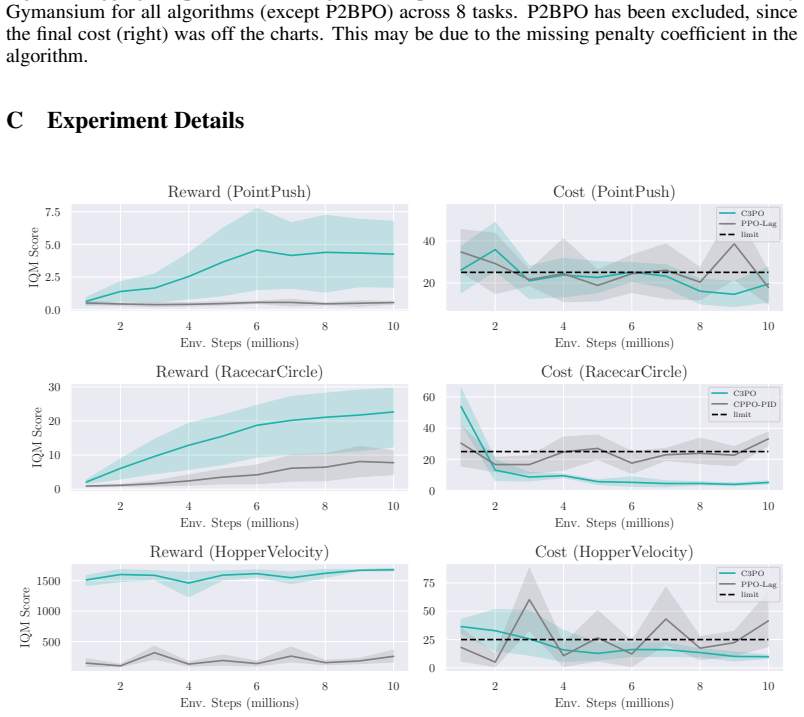
- C3PO outperforms PPO-style penalty methods such as P3O and P2BPO in aggregate reward and cost, and performs consistently against trust-region methods CPO and C-TRPO.
- Central-path guidance, rather than the specific trust-region update, can be the active ingredient in constrained policy optimization.
- Because the ReLU penalty is defined everywhere, C3PO can be added to an existing PPO implementation as a single extra loss term.
Reading between the lines
- A natural extension the paper leaves implicit: if central-path guidance is the active ingredient, the same receding ReLU threshold could be applied to offline RL or RLHF-style finetuning, where constraints matter at convergence rather than during sampling.
- A testable extension is to run C3PO on a small tabular CMDP with a known central path and measure the distance of iterates to that path as training progresses, checking whether smaller $w$ tracks it more closely.
- The paper's own conclusion flags that results are limited to small-scale, single-constraint tasks; multi-constraint and high-dimensional settings are the obvious next test of the design principle.
- The fixed $\kappa$ could be replaced by an online estimate of the dual variable, turning the hand-set penalty strength into an adaptive schedule that keeps the exactness condition $\kappa \geq |\lambda|$ satisfied.
Editorial analysis
A structured set of objections, weighed in public.
Referee Report
Summary. The paper proposes C3PO, a modification of PPO for constrained RL that adds a ReLU penalty term, LC3PO(θ) = ReLU(α_clipped(θ) − min{b, w·b}), to the PPO loss. The authors claim that this simple augmentation produces policy iterates that stay close to the central path of the constrained optimization problem, thereby improving reward while enforcing cost constraints more tightly than existing on-policy penalty and Lagrangian methods. The theory consists of an exactness result for a convex surrogate problem (Theorem 3.1, Appendix B.1) and a positive-exactness equivalence between the barrier and linear penalty formulations (Proposition 3.2, Appendix B.2). Experiments on eight Safety Gymnasium tasks compare C3PO to CPO, C-TRPO, PPO-Lag, CPPO-PID, P2BPO, and P3O, reporting aggregated IQM scores and per-task cost/reward values in Table 1.
Significance. If the central-path mechanism were established, the paper would be a meaningful contribution: it offers a simple, scalable, PPO-compatible loss for constrained RL, backed by a publicly available codebase, and the empirical comparison uses a principled aggregation (IQM) over multiple seeds. The paper is clearly written and the idea of a receding, exact penalty is interesting. However, the theoretical linkage between the convex surrogate results and the actual clipped, minibatch loss is not made, the hyperparameters w and κ are not connected to the exactness conditions, and the experimental results show constraint violations on two of eight tasks. The central claim as stated is therefore not supported by the current evidence, and the significance of the work rests on whether the theoretical gaps can be closed or the claims suitably weakened.
major comments (5)
- [Section 3, Eq. (12) and Algorithm 1] The theoretical justification does not cover the loss that is actually optimized. Theorem 3.1 and Proposition 3.2 establish agreement of solution sets for the surrogate problems (8), (9), and (10), which are formulated with a hard KL constraint and the full advantage A_c. Algorithm 1 replaces the hard KL constraint with PPO clipping, replaces A_c with the clipped-ratio estimator α_clipped of Eq. (11), uses minibatch GAE estimates, and performs stochastic gradient descent. Solution-set equality is a statement about argmax sets, not about the trajectory of iterative stochastic optimization. Since the central-path claim is a trajectory property (Eq. (25), Appendix A.3), the proof chain does not support the paper's stated conclusion that C3PO 'produces policy iterates, that stay close to the central path.'
- [Theorem 3.1 and Appendix B.1] There is a mismatch between the exactness condition in the main text and the proof. Theorem 3.1 states that solution sets agree for κ ≥ |λ|, but the proof of Theorem B.1 shows the result only for κ > λ*; with equality the strict inequality in the penultimate display becomes equality, and infeasible maximizers of the Lagrangian can also maximize the penalized problem. The absolute value is also unexplained, since λ for an inequality constraint in a maximization problem is nonnegative. This is a technical error in a load-bearing statement, since the paper relies on exactness to argue that the penalized loss has the same solution set as the constrained update.
- [Appendix B.2, Proposition 3.2, and Section 4] The connection between w and the central-path parameter δ_B is never operationalized. Proposition 3.2 only establishes existence of some w and δ_B such that the feasible sets agree; the proof shows w = W(−exp(−δ_B−1)) + 1 for a particular AB. In the experiments w = 0.05 is fixed by hand and no δ_B is reported. Moreover, the equivalence is restricted to 0 ≤ A_c < b, and the exactness of the penalty requires κ to be at least the dual multiplier of Eq. (8), which is never estimated or bounded. Without verification that the chosen (κ, w) lie in the required regime, the solution-set equality underlying the central-path argument is not guaranteed for any task or iteration.
- [Table 1 and Figure 3] The empirical claim of 'tighter constraint enforcement' is not supported by the data. In Table 1, C3PO's final costs on CarButton (53.4 ± 22.3) and PointGoal (37.9 ± 1.7) are both well above the threshold of 25.0, meaning C3PO is not admissible on those tasks by the paper's own criterion. The aggregated IQM plot in Figure 3 obscures these per-task violations. The conclusion that C3PO 'adheres more strictly to the specified constraints' is therefore overstated, and the reward comparison in the aggregated figure may be biased by excluding infeasible runs from the admissible set.
- [Algorithm 1 and Section 4] The penalty schedule κ_k is not specified. Algorithm 1 requires a scheduled penalty κ_k, and the text says a linear schedule is used, but the initial value, final value, and step schedule are not given. Section 4 reports only the fixed values κ = 30.0 and w = 0.05, which is ambiguous about whether κ is constant or scheduled. This lack of specification hinders reproducibility and is relevant because the exactness argument depends on κ being sufficiently large at each iteration.
minor comments (6)
- [Theorem 3.1 vs. Appendix B.1] The inequality condition in Theorem 3.1 should be κ > |λ| (or, if κ ≥ is intended, the proof in Theorem B.1 must be extended), and the absolute value should be justified or removed.
- [Appendix B.2, Eqs. (38)–(41)] The proof of Proposition 3.2 switches from non-strict inequalities (≤) in the problem statements (8)–(10) to strict inequalities (<) in the intermediate sets (38)–(41); the equivalence of solution sets for the two conventions should be clarified.
- [Eq. (7) and Appendix A.2] The barrier divergence DB is defined with b = d − C(πk), but Appendix A.2 uses a more general ϕ; ensure the notation for the budget b and the barrier φ is consistent throughout.
- [Algorithm 1 caption] The phrase 'deviation from PPO in green' is not visible in the text; either render the color in the algorithm or remove that note.
- [Figure 5 caption] The caption says 'except P2BPO' twice; it should be stated once why P2BPO is excluded.
- [Section 4 and Table 1] The table reports means and standard deviations over 5 seeds; state whether the bolded entries reflect statistically significant differences or merely the highest mean among admissible algorithms.
Circularity Check
C3PO's central-path claim is inherited from the authors' C-TRPO work via the assertion that C3PO is a proximal version of it; the paper's own exactness result covers only solution-set equality of idealized surrogates, not the implemented clipped minibatch iterates.
-
self citation load bearing
[Section 1 and Section 3, "C3PO Update" (Eqs. 8-12, Algorithm 1)]
"We propose a proximal version of C-TRPO. It also follows the central path, and consequently we call it C3PO. ... We propose a first-order approximation of C-TRPO that approximates its central path by solving surrogate optimization problems with the same solution set as C-TRPO's update on every iteration."
The load-bearing assertion that C3PO produces iterates close to the central path is justified by identifying C3PO as a 'proximal version of C-TRPO', where C-TRPO is the same authors' prior work. The paper's own Proposition 3.2 establishes only that, for 0 ≤ A_c^πk(π) < d − C(πk), there exist w and δ_B for which the solution sets of the convex surrogate problems (8), (9), and (10) agree. It does not show that Algorithm 1's actual loss (Eq. 12), which replaces the hard KL constraint with PPO clipping, uses minibatch GAE estimates, and sets κ=30.0 and w=0.05 by hand, follows the central path. The trajectory property in Eq. 25 is likewise imported from the same-authors' C-TRPO analysis.
full rationale
No equation in the paper is definitionally equivalent to its own output, and no fitted parameter is renamed as a prediction: the exactness theorems (Theorem 3.1, Proposition 3.2) are proved in Appendix B for the surrogate problems, and the empirical comparison is independent evidence. The core concern is narrower but real: the paper's advertised mechanism, 'iterates stay close to the central path', is not derived for the loss that is actually optimized. It is inherited from C-TRPO, a preprint by the same three authors, and the present paper's solution-set equivalence is about argmax sets of idealized per-iteration surrogates, not about the stochastic clipped minibatch trajectory. That is a self-citation that is load-bearing for the title and abstract, but the algorithm itself has independent empirical and formal content, so the overall circularity score is moderate rather than maximal.
Assumptions & free parameters
free parameters (2)
- Penalty coefficient κ =
30.0 (linear schedule used in experiments)
- Penalty rate w =
0.05
assumptions (5)
- standard math Exact penalty equivalence for convex programs (Theorem B.1)
- domain assumption The constrained update is concave-convex in the policy π and satisfies Slater's condition
- domain assumption C-TRPO's updates follow the central path of the barrier method
- domain assumption Staying feasible during training improves final reward
- standard math PPO clipping approximates the KL constraint
Cite this review
Pith. "Pith review of Central Path Proximal Policy Optimization." pith.science (2026). https://pith.science/paper/4ML7U3LT
@misc{pith2026250600700,
  author       = {Pith},
  title        = {Pith review of: Central Path Proximal Policy Optimization},
  year         = {2026},
  howpublished = {\url{https://pith.science/paper/4ML7U3LT}},
  note         = {Machine review of arXiv:2506.00700}
}
read the original abstract
In constrained Markov decision processes, enforcing constraints during training is often thought of as decreasing the final return. Recently, it was shown that constraints can be incorporated directly into the policy geometry, yielding an optimization trajectory close to the central path of a barrier method, which does not compromise final return. Building on this idea, we introduce Central Path Proximal Policy Optimization (C3PO), a simple modification of the PPO loss that produces policy iterates, that stay close to the central path of the constrained optimization problem. Compared to existing on-policy methods, C3PO delivers improved performance with tighter constraint enforcement, suggesting that central path-guided updates offer a promising direction for constrained policy optimization.
Figures


Figures from the paper (3 more)


Forward citations
Cited by 1 Pith paper
-
The Geometry of Nonlinear Reinforcement Learning
Actor-critic reinforcement learning methods are reformulated as mirror descent on the occupancy manifold, and a Hessian-based update is proposed for nonlinear and constrained objectives.
Reference graph
Works this paper leans on
-
[6]
A safe exploration approach to constrained Markov decision processes
Tingting Ni and Maryam Kamgarpour. A safe exploration approach to constrained Markov decision processes. In ICML 2024 Workshop: Foundations of Reinforcement Learning and Control– Connections and Perspectives,
work page 2024
-
[8]
Direct Behavior Specification via Constrained Reinforcement Learning
URL https://arxiv.org/abs/ 2112.12228. John Schulman, Philipp Moritz, Sergey Levine, Michael I. Jordan, and Pieter Abbeel. High- dimensional continuous control using generalized advantage estimation. In International Confer- ence on Learning Representations (ICLR),
-
[11]
Responsive Safety in Reinforcement Learning by PID Lagrangian Methods
URL https://arxiv.org/abs/2007.03964. Ilnura Usmanova, Yarden As, Maryam Kamgarpour, and Andreas Krause. Log barriers for safe black-box optimization with application to safe reinforcement learning. Journal of Machine Learning Research, 25(171):1–54,
work page Pith review arXiv 2007
-
[12]
Constrained Re- inforcement Learning with Smoothed Log Barrier Function
Baohe Zhang, Yuan Zhang, Lilli Frison, Thomas Brox, and Joschka Bödecker. Constrained Re- inforcement Learning with Smoothed Log Barrier Function. arXiv preprint arXiv:2403.14508,
-
[13]
Yiming Zhang, Quan Vuong, and Keith Ross
doi: 10.24963/ijcai.2022/517. Yiming Zhang, Quan Vuong, and Keith Ross. First order constrained optimization in policy space. Advances in Neural Information Processing Systems, 33:15338–15349,
-
[14]
The log-barrier ϕ(x) = − log(x) considered in this work is a possible candidate. In general, the induced divergence takes the form DC(ρ1||ρ2) = DK(ρ1||ρ2) + mX i=1 βiDB(ρ1||ρ2) (19) = DK(ρ1||ρ2) + mX i=1 βi[ϕ(b1;i) − ϕ(b2;i) + ϕ′(b2;i)Ci(π1) − ϕ′(b2;i)Ci(π2))], (20) where bπ;i = di − Ci(π). The corresponding trust-region scheme is πk+1 ∈ arg max π∈Π Aπk r...
work page 2023
-
[2016]
John Schulman, Sergey Levine, Philipp Moritz, Michael I
URL https://arxiv.org/abs/1506.02438. John Schulman, Sergey Levine, Philipp Moritz, Michael I. Jordan, and Pieter Abbeel. Trust region policy optimization, 2017a. John Schulman, Filip Wolski, Prafulla Dhariwal, Alec Radford, and Oleg Klimov. Proximal Policy Optimization Algorithms, 2017b. URL https://arxiv.org/abs/1707.06347. Motahareh Sohrabi, Juan Ramir...
-
[2017]
URL https://proceedings.neurips.cc/ paper_files/paper/2017/file/766ebcd59621e305170616ba3d3dac32-Paper.pdf. Dimitri P Bertsekas. Nonlinear programming. Journal of the Operational Research Society, 48(3): 334–334,
work page 2017
Show all 14 references
-
[2019]
Robert M Corless, Gaston H Gonnet, David EG Hare, David J Jeffrey, and Donald E Knuth
URL https://arxiv.org/abs/1901.10031. Robert M Corless, Gaston H Gonnet, David EG Hare, David J Jeffrey, and Donald E Knuth. On the Lambert W function. Advances in Computational mathematics, 5:329–359,
1901 arXiv
-
[2020]
Jincheng Mei, Chenjun Xiao, Bo Dai, Lihong Li, Csaba Szepesvári, and Dale Schuurmans
doi: 10.1609/aaai.v34i04.5932. Jincheng Mei, Chenjun Xiao, Bo Dai, Lihong Li, Csaba Szepesvári, and Dale Schuurmans. Escaping the gravitational pull of softmax. Advances in Neural Information Processing Systems, 33:21130– 21140,
-
[2022]
Benchmarking safe exploration in deep reinforcement learning
Alex Ray, Joshua Achiam, and Dario Amodei. Benchmarking safe exploration in deep reinforcement learning. arXiv preprint arXiv:1910.01708, 7(1):2,
1910 arXiv
-
[2023]
A unified view of entropy-regularized Markov decision processes
Gergely Neu, Anders Jonsson, and Vicenç Gómez. A unified view of entropy-regularized Markov decision processes. arXiv preprint arXiv:1705.07798,
-
[2024]
Adam Stooke, Joshua Achiam, and Pieter Abbeel
URL https://arxiv.org/abs/2406.04558. Adam Stooke, Joshua Achiam, and Pieter Abbeel. Responsive Safety in Reinforcement Learning by PID Lagrangian Methods,
-
[2025]
Johannes Müller and Semih Cayci
URL https://arxiv.org/abs/2411.02957. Johannes Müller and Semih Cayci. Optimal Rates of Convergence for Entropy Regularization in Discounted Markov Decision Processes. arXiv preprint arXiv:2406.04163,
Reviewed August 7, 2026 · model on record in the stance chip above.
Discussion (0). Sign in to comment.