REVIEW 6 minor 57 references
Geoscience for understanding habitability in the solar system and beyond
T0 review · 0 major / 6 minor · reviewed 2026-08-14 · deepseek-v4-flash
Pith's one-line read Habitability is a whole-planet property: assessing an exoplanet requires coupling its deep interior, surface, atmosphere, and biosphere, with Earth as the reference case.
desk verdict A competent, explicitly non-novel review of coupled interior-surface-atmosphere-biosphere habitability; worth sending to referees for accuracy, not for novelty. read the letter →
The pith
A machine-rendered reading of the paper's core claim, the machinery that carries it, and where it could break.
The reading
What carries the argument
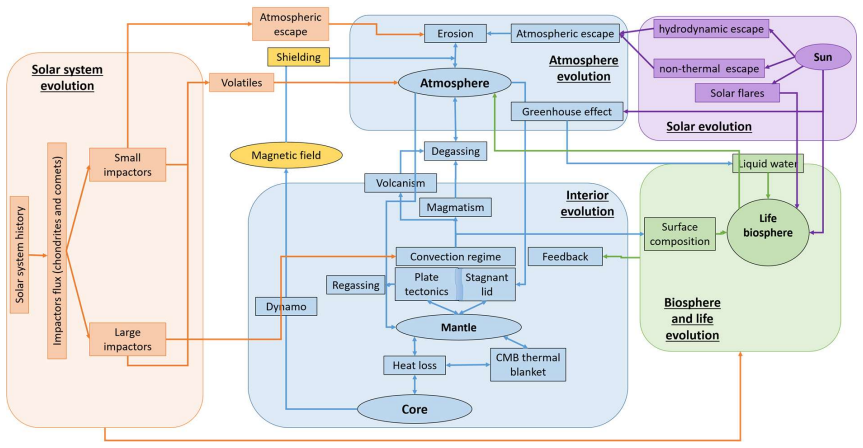
The carrying object is the coupled feedback cycle among mantle convection, volatile outgassing, plate tectonics, weathering, subduction, and the biosphere. The "volatile pipeline" — partial melting and volcanism carrying water, carbon, sulfur, and nitrogen from the mantle to the surface — is the main conduit, and the mantle's oxidation state is a key control on how much of each gas is released. On the return side, the carbonate-silicate cycle, in which weathering removes CO2 and subduction returns carbon and water to the mantle, regulates climate on million-year timescales. Impacts act as an external forcing that can heat the interior, erode or deliver atmospheres, and create transient habitats.
What would settle it
Find an Earth-sized planet at Earth-like insolation in its star's habitable zone with a thick, long-lived CO2-dominated atmosphere. Models built on Earth-like carbonate-silicate weathering and outgassing predict that such a planet should settle into a temperate, low-CO2 climate over geological time; a persistent dense CO2 atmosphere without a runaway greenhouse explanation would falsify the claim that these feedbacks are generic.
Extended reading notes
Core claim
The central claim is that habitability is a whole-planet property. The paper sets out to show that the evolution of a terrestrial planet's core, mantle, lithosphere, crust, atmosphere, and biosphere are interlinked through feedback cycles, and that these cycles determine whether surface conditions can sustain liquid water and life over geological time. Earth is treated as the reference case: its carbonate-silicate cycle stabilizes climate, its plate tectonics recycles water and carbon into the mantle, its mantle redox state controls which volcanic gases reach the surface, and its biosphere enhances weathering and changes atmospheric composition. The authors argue that the same processes are expected on terrestrial exoplanets, so interpreting observations of exoplanets requires this geophysical context; they note, however, that M-dwarf planets may face harsher radiation and tidal locking that need separate assessment.
Load-bearing premise
The argument assumes that Earth's coupled geophysical and biological feedbacks are representative of how terrestrial planets generally behave, so that where those feedbacks are absent, habitability is lost.
Editorial extensions
If this is right
- A rocky planet can sit in the habitable zone and still be uninhabitable if a stagnant lid shuts off volcanism and volatile cycling.
- Venus and Mars are natural experiments: similar starting materials diverged into a runaway greenhouse and a cold desert, so Earth's outcome is not guaranteed for Earth-sized planets.
- Interpreting atmospheric biosignatures requires geophysical context, because abiotic processes such as outgassing and impact chemistry can produce molecules that mimic life.
- Models of exoplanet habitability should couple interior thermal evolution with atmospheric escape, photochemistry, and climate rather than treating the atmosphere in isolation.
- The Earth's present-day continental coverage and climate may be one of several possible equilibria for a plate-tectonics planet, depending on initial conditions and weathering.
Reading between the lines
- A testable extension is to couple interior-thermal and volatile-cycling models to photochemical-climate models and predict atmospheric compositions for stagnant-lid super-Earths, which next-generation transit spectroscopy could check.
- If the paper's coupled-system view is correct, exoplanet target selection should weight bulk density and host-star composition as proxies for mantle state much more heavily than habitable-zone placement alone.
- The Earth-as-reference assumption predicts a strong correlation: same-size, same-insolation rocky planets should mostly converge to similar temperate climates only if they also share plate-tectonic and weathering feedbacks; a survey finding frequent runaway greenhouse or desiccated outcomes would weaken the analogy.
Signed reviews
Editorial analysis
A structured set of objections, weighed in public.
Referee Report
Summary. The paper is a narrative review of geoscience controls on planetary habitability, covering planet formation, impacts, interior dynamics, volatile cycling, atmospheric evolution, the co-evolution of life with Earth's system, and the identification of preserved biosignatures. Its central thesis is that habitability cannot be understood from the atmosphere or surface alone; it emerges from coupled interior–surface–atmosphere–biosphere interactions, and therefore an interdisciplinary geoscience approach is needed for the Solar System and for exoplanets. The paper is scoped to surface conditions capable of sustaining life and deliberately does not treat the central star in detail, although stellar influences on escape and climate are discussed where relevant.
Significance. If the synthesis is accepted, the paper provides a useful and timely interdisciplinary reference: it brings together communities from geophysics, geochemistry, atmospheric science, and astrobiology around a common framework and identifies open questions. It is explicitly a review, so it offers no new quantitative derivations or machine-checked proofs; its value lies in the breadth of cited literature and in making explicit that planetary habitability is a systems problem. The authors repeatedly hedge the extrapolation from Earth to exoplanets (e.g., Section 1 notes that tidal-locking and radiation effects need assessment; Section 7 states that exoplanet processes are 'much harder to constrain without in situ information'), which strengthens the reliability of the synthesis. The paper also candidly acknowledges uncertainties in fields such as the redox state of the early mantle and the initiation of plate tectonics, so its claims are appropriately qualified.
minor comments (6)
- [Section 4] The opening paragraph states 'Figure 2 summarizes these processes', but the figure bearing the caption 'Habitability and heat/interior/atmosphere evolution, and the role of the Sun and atmospheric escape' is numbered Figure 3; the cross-reference should be corrected.
- [Section 2] The final paragraph contains a forward reference to 'Figure 6, which will be fully explained below', but Figure 6 is not introduced until Section 5.4; the reference should either be removed or moved to the later section.
- [Section 1] The parenthetical definition of super-Earths refers to 'the masses of the Solar System's ice giants like Jupiter', which is factually incorrect because Jupiter is a gas giant, not an ice giant; the mass comparison is also numerically confusing (Jupiter is ~318 Earth masses, far more than an order of magnitude larger than 10 Earth masses).
- [Section 3.4] The sentence beginning 'This suggests a CO2-dominated atmosphere during the late Hadean N2' is syntactically garbled; the intended meaning appears to be that the atmosphere was CO2-dominated during the late Hadean and that N2 later became the main constituent.
- [Introduction] The text says the paper addresses questions within 'six main sections' but then enumerates seven items (Sections 1–6 plus the conclusion); the count or the numbering should be adjusted.
- [Section 6.4] The references list 'Astrobioloy' instead of 'Astrobiology' in the entries for Meadows et al. (2018) and Schwieterman et al. (2018); this typo should be corrected.
Circularity Check
No significant circularity: the paper is a scoped narrative review with no fitted quantities, no derived predictions, and no self-citation chain forcing its conclusion.
full rationale
This manuscript is a narrative review, not a derivation. Its central claim is that habitability depends on coupled interactions among a planet's interior, surface, atmosphere, and biosphere, and that an interdisciplinary geoscience approach is therefore required. No new equations are derived, no parameters are fitted to a subset of data and then renamed as predictions, and no quantitative result is claimed to follow from first principles. The candidate premise that Earth can serve as a reference case for terrestrial exoplanets is explicitly hedged in Section 7, which notes that such processes are 'much harder to constrain without in situ information' and that planets around M-dwarf stars may experience harsher space weather. The review frequently cites the authors' own prior modeling work (e.g., Höning and Spohn 2016, Gillmann et al. 2016, Tosi et al. 2017), but these citations are used as external, independently published model results and literature synthesis, not as an unverified self-citation chain that defines the conclusion. No uniqueness theorem is imported from the authors' prior work, and no ansatz is smuggled in via citation in place of derivation. The conclusion would survive even if every self-citation were removed, since it is a qualitative argument for considering coupled geoscience processes rather than a prediction that reduces to its own inputs. Accordingly, the circularity score is 0.
Assumptions & free parameters
assumptions (3)
- domain assumption The carbonate-silicate cycle regulates climate on planets with liquid water and active silicate weathering.
- domain assumption Mantle redox state controls the speciation and efficiency of volatile outgassing from the interior.
- domain assumption Earth's evolutionary history is a representative reference for terrestrial planets in general.
Cite this review
Pith. "Pith review of Geoscience for understanding habitability in the solar system and beyond." pith.science (2026). https://pith.science/paper/4N23RTOH
@misc{pith2026190900362,
  author       = {Pith},
  title        = {Pith review of: Geoscience for understanding habitability in the solar system and beyond},
  year         = {2026},
  howpublished = {\url{https://pith.science/paper/4N23RTOH}},
  note         = {Machine review of arXiv:1909.00362}
}
read the original abstract
This paper reviews habitability conditions for a terrestrial planet from the point of view of geosciences. It addresses how interactions between the interior of a planet or a moon and its atmosphere and surface (including hydrosphere and biosphere) can affect habitability of the celestial body. It does not consider in detail the role of the central star but focusses more on surface conditions capable of sustaining life. We deal with fundamental issues of planetary habitability, i.e. the environmental conditions capable of sustaining life, and the above-mentioned interactions can affect the habitability of the celestial body. We address some hotly debated questions including: - How do core and mantle affect the evolution and habitability of planets? - What are the consequences of mantle overturn on the evolution of the interior and atmosphere? - What is the role of the global carbon and water cycles? - What influence do comet and asteroid impacts exert on the evolution of the planet? - How does life interact with the evolution of the Earth's geosphere and atmosphere? - How can knowledge of the solar system geophysics and habitability be applied to exoplanets? In addition, we address the identification of preserved life tracers in the context of the interaction of life with planetary evolution.
Figures


Figures from the paper (3 more)


Reference graph
Works this paper leans on
-
[1]
Differential melt scaling for oblique impacts on terrestrial planets
Abramov, O., Wong S.M., Kring D.A. (2012) “Differential melt scaling for oblique impacts on terrestrial planets.” Icarus 218, 906-916. Acuña, M.H., Connerney J.E.P., Wasilewski P., Lin R.P., Mitchell D., Anderson K.A., Carlson C.W., McFadden J., Reme H., Mazelle C., Vignes D., Bauer S.J., Cloutier P., Ness N.F. (2001) “Magnetic field of Mars: summary of re...
arXiv 2012
-
[2]
Remote sensing of life: Polarimetric signatures of photosynthetic pigments as sensitive biomarkers
Berdyugina, S.V., Kuhn J.R., Harrington D.M., Šantl-Temkiv T., Messersmith E.J. (2016) “Remote sensing of life: Polarimetric signatures of photosynthetic pigments as sensitive biomarkers.” International Journal of Astrobiology, 15, 45-56. Bierhaus, M., Wünnemann K., Elbeshausen D. (2012) “Numerical Modeling of Basin-Forming Impacts: Implications for the H...
work page 2016
-
[10]
Biological modification of the Earth’s atmosphere
Margulis, L., Lovelock J. (1974) “Biological modification of the Earth’s atmosphere.” Icarus, 21, 471-
work page 1974
-
[11]
Impact erosion of the primordial atmosphere of Mars
Melosh, H.J., Vickery A.M. (1989) “Impact erosion of the primordial atmosphere of Mars.” Nature, 338(6215),
work page 1989
-
[15]
Exoplanet biosignatures: Observational prospects
Fujii, Y., Angerhausen D., Deitrick R., Domagal-Goldman S., Grenfell J.L., Hori Y., Kane S.R., Palle E., Rauer H., Siegler N., Stapelfeldt K., Stevenson K.B. (2018) “Exoplanet biosignatures: Observational prospects.” Astrobiology, submitted. Fulton, B.J., Petigura E.A., Howard A.W., Isaacson H., Marcy G.W., Cargile P.A., Hebb L., Weiss L.M., Johnson J.A.,...
2018
-
[16]
Cartigny, P., Marty B. (2013) “Nitrogen isotopes and mantle geodynamics: the emergence of life and the atmosphere-crust-mantle connection”, Elements, 9, 359-366. Catling, D.C., Glein C.R., Zahnle K.J., McKay C.P. (2005) “Why O2 Is Required by Complex Life on Habitable Planets and the Concept of Planetary ‘Oxygenation Time’." Astrobiology, 5(3), 415-
work page 2013
-
[21]
Hussmann, H., Sohl F., Spohn T. (2006) “Subsurface oceans and deep interiors of medium-sized outer planet satellites and trans-Neptunian objects.” Icarus, 185,
work page 2006
-
[26]
44 Jones, A.P., Kearsley A.T., Friend C.R.L., Robin E., Beard A., Tamura A., Trickett S., Claeys P. (2005) “Are there signs of a large Palaeocene impact, preserved around Disko bay, Greenland- Nuussuaq spherule beds origin by impact instead of volcanic eruption?” In: ‘Large Meteorite Impacts III’, Kenkman K., Hörz F., Deutsch A. (Eds), Geological Society ...
work page 2005
Show all 57 references
-
[29]
Serpentinization and the inorganic synthesis of H2 in planetary surfaces
51 Oze, C., Sharma M. (2007) “Serpentinization and the inorganic synthesis of H2 in planetary surfaces.” Icarus, 186(2), 557-561. Padovan, S., Tosi N., Plesa A.C., Ruedas T. (2017) “Impact-induced changes in source depth and volume of magmatism on Mercury and their observation...
2007
-
[30]
On the Likelihood of Plate Tectonics on Super-Earths: Does Size Matter?
Korenaga, J. (2010) “On the Likelihood of Plate Tectonics on Super-Earths: Does Size Matter?” The Astrophysical Journal Letters, 725(1), L43-L46, DOI: 10.1088/2041-8205/725/1/L43. Kreidberg, L., Bean J.L., Désert J.-M., Benneke B., Deming D., Stevenson K.B., Seager S., Berta- ...
2010 doi
-
[34]
The Chicxulub asteroid impact and mass extinction at the Cretaceous-Paleogene Boundary
Schulte, P., Alegret L., Arenillas I., Arz J.A., Barton P.J., Bown P.R., Bralower T.J., Christeson G.L., Claeys P., Cockell C.S., Collins G.S., Deutsch A., Goldin T.J., Goto K., Grajales-Nishimura J.M., Grieve R.A.F., Gulick S.P.S., Johnson K.R., Kiessling W., Koeberl C., Krin...
2010
-
[37]
Nitrogen speciation in upper mantle fluids and the origin of Earth's nitrogen-rich atmosphere
Mikhail, S., Sverjensky D.A. (2014) “Nitrogen speciation in upper mantle fluids and the origin of Earth's nitrogen-rich atmosphere.” Nature Geoscience, 7(11): 816-819. Monteux, J., Coltice N., Dubuffet F., Ricard Y. (2007) “Thermo-mechanical adjustment after impacts during pla...
2014
-
[40]
Highly siderophile elements in Earth's mantle as a clock for the Moon-forming impact
Jacobson, S.A., Morbidelli A., Raymond S.N., O'Brien D.P., Walsh K.J., Rubie D.C. (2014) “Highly siderophile elements in Earth's mantle as a clock for the Moon-forming impact.” Nature, 508, 84-87. Jacobson, S.A., Rubie D.C., Hernlund J., Morbidelli A., Nakajima M. (2017) “Form...
2014
-
[43]
Most 1.6 earth-radius planets are not rocky
Rogers, L.A. (2015) “Most 1.6 earth-radius planets are not rocky.” The Astrophysical Journal, 801(41), 13 pp., DOI: 10.1088/0004-637X/801/1/41. Rosing, M.T., Bird D.K., Sleep N.H., Glassley W., Albarede F. (2006) “The rise of continents – An essay on the geologic consequences ...
2015 doi
-
[45]
On the relative importance of thermal and chemical buoyancy in regular and impact-induced melting in a Mars-like planet
Ruedas, T., Breuer D. (2017) “On the relative importance of thermal and chemical buoyancy in regular and impact-induced melting in a Mars-like planet.” Journal of Geophysical Research: Planets, 122(7), 1554-1579, DOI: 10.1002/2016JE005221. Ruedas, T., (2017) “Globally smooth a...
2017 doi
-
[46]
Strong Release of Methane on Mars in Northern Summer 2003
Mumma, M.J., Villanueva G.L., Novak R.E., Hewagama T., Bonev B.P., DiSanti M.A., Mandell A.M., Smith M.D. (2009) “Strong Release of Methane on Mars in Northern Summer 2003.” Science, 323, 5917, pp. 1041, DOI: 10.1126/science.1165243. Nakajima, M., Stevenson D.J. (2014) “Invest...
2009 doi
-
[47]
Exoplanet biosignatures: a review of remotely detectable signs of life
Schwieterman, E.W., Kiang N.Y., Parenteau M.N., Harman C.E., DasSarma S., Fisher T.M., Arney G.N., Hartnett H.E., Reinhard C.T., Olson S.L., Meadows V.S., Cockell C.S., Walker S.I., Grenfell J.L., Hegde S., Rugheimer S., Hu R., Lyons T.W. (2018) “Exoplanet biosignatures: a rev...
2018
-
[48]
Projectile identification in terrestrial impact structures and ejecta material
Goderis, S., Paquay F., Claeys P. (2012) “Projectile identification in terrestrial impact structures and ejecta material.” Impact cratering: Processes and products, 223-239. Goderis, S., Chakrabarti R., Debaille V., and Kodolányi J. (2016) “Isotopes in cosmochemistry: recipe f...
2012
-
[54]
Characterization of potentially habitable planets: Retrieval of atmospheric and planetary properties from emission spectra
von Paris, P., Hedelt P., Selsis F., Schreier F., Trautmann T. (2013) “Characterization of potentially habitable planets: Retrieval of atmospheric and planetary properties from emission spectra.” Asstronomy and Astrophysics, 551, A120 Van Zuilen, M.A., Lepland A., Arrhenius G....
2013
-
[60]
Close-in planetesimal formation by pile-up of drifting pebbles
38 Drazkowska, J., Alibert Y., Moore B. (2016) “Close-in planetesimal formation by pile-up of drifting pebbles.” Astronomy and Astrophysics, 594, A105. Drever, J.I. (1994) “The effect of land plants on weathering rates of silicate minerals.” Geochim. Cosmochim. Acta, 58(10), 2...
2016
-
[65]
The fate of water within Earth and super-Earths and implications for plate tectonics
Tikoo, S.M., Elkins-Tanton L.T. (2017) “The fate of water within Earth and super-Earths and implications for plate tectonics.” Phil. Trans. R. Soc. A, 375, 20150394. Tosi, N., Godolt M., Stracke B., Ruedas T., Grenfell J.L., Höning D., Nikolaou A., Plesa A.-C., Breuer D., Spoh...
2017 doi
-
[77]
Composition and chemistry of the neutral atmosphere of Venus
Marcq, E., Mills F.P., Parkinson C.D., Vandaele A.C. (2018) “Composition and chemistry of the neutral atmosphere of Venus.” Space Science Reviews, 214(1),
2018
-
[91]
New analysis of hydrogen and deuterium escape from Venus
Donahue, T.M. (1999) “New analysis of hydrogen and deuterium escape from Venus.” Icarus, 141(2), 226-235. Dorn, C., Venturini J., Khan A., Heng K., Alibert Y., Helled R., Rivoldini A., Benz W. (2017) “A generalized Bayesian inference method for constraining the interiors of su...
1999 doi
-
[108]
Mantle redox evolution and the oxidation state of the Archean atmosphere
Kasting, J.F., Eggler D.H., Raeburn S.P. (1993) “Mantle redox evolution and the oxidation state of the Archean atmosphere.” Journal of Geology 101, 245-257. Kasting, J.F. (2013a) “Atmospheric science. How was early Earth kept warm?” Science, 339, 44-45. 45 Kasting, J.F. (2013b...
1993
-
[113]
The role of impact bombardment history in lunar evolution
Rolf, T., Zhu M.-H., Wünnemann K., Werner S.C. (2016) “The role of impact bombardment history in lunar evolution.” Icarus, 286, 138-152 Roskosz, M., Bouhifd M.A., Jephcoat A.P., Marty B., Mysen B.O. (2013) “Nitrogen solubility in molten metal and silicate at high pressure and ...
2016 doi
-
[125]
Estimates of atmospheric CO2 in the Neoarchean-Paleoproterozoic from paleosols
Kanzaki, Y., Murakami T. (2015) “Estimates of atmospheric CO2 in the Neoarchean-Paleoproterozoic from paleosols.”, Geochimica et Cosmochimica Acta, 159, 190-219. Karato, S.-I., Paterson M.S., FitzGerald J.D. (1986) “Rheology of synthetic olivine aggregates: Influence of grain ...
2015
-
[132]
Oxygen isotopes in meteorites
Clayton, R.N. (2005) “Oxygen isotopes in meteorites.” In: Davis AM (ed), ‘Meteorites, comets and planets’, Vol 1, Treatise on geochemistry, Elesevier-Pergamon, Oxford, 129-142. Cockell, C.S. (2006) “The Origin and Emergence of Life under Impact Bombardment.” Phil. Trans. R. So...
2005
-
[216]
Melting in the mantle in the presence of carbon: Review of experiments and discussion on the origin of carbonatites
Hammouda, T., Keshav S. (2015) “Melting in the mantle in the presence of carbon: Review of experiments and discussion on the origin of carbonatites.” Chemical Geology, 418, 171-188, DOI: 10.1016/j.chemgeo.2015.05.018. Hansen, B.M.S. (2009) “Formation of the Terrestrial Planets...
2015 doi
-
[246]
The dynamics of a highly escaping atmosphere: Applications to the evolution of Earth and Venus
Watson, A.J., Donahue T.M., Walker J.C.G. (1981) “The dynamics of a highly escaping atmosphere: Applications to the evolution of Earth and Venus.” Icarus, 48, 150-166. Watters, W.A., Zuber M.T., Hager B.H. (2009) “Thermal perturbations caused by large impacts and consequences ...
1981
-
[258]
New experimental data and semi- empirical parameterization of H2O-CO2 solubility in mafic melts
Iacono-Marziano, G., Morizet Y., Le-Trong E., F Gaillard (2012) “New experimental data and semi- empirical parameterization of H2O-CO2 solubility in mafic melts.” Geochim. Cosmochim. Acta, DOI: 10.1016/j.gca.2012.08.035. Izidoro, A., Raymond S.N., Pierens A., Morbidelli A., Wi...
2012 doi
-
[298]
The Close-Up Imager (CLUPI) on board ESA ExoMars 2018 rover mission: science objectives, description, operations, and science validation activities
Josset, J.-L., Westall F., Hofmann B.A., Spray J., Cockell C., Kempe S., Griffiths A.D., Cristina de Sanctis M., Colangeli L., Koschny D., Pullan D., Föllmi K., Verrecchia E., Diamond L., Josset M., Javaux E.J., Esposito F., Gunn M., Souchon A.L., Bontognali T., Korablev O., E...
2017
-
[315]
What can Hadean detrital zircon really tell us? A critical evaluation of their geochronology with implications for the interpretation of oxygen and hafnium isotopes
Whitehouse, M.J., Nemchin A.A., Pidgeon R.T. (2017) “What can Hadean detrital zircon really tell us? A critical evaluation of their geochronology with implications for the interpretation of oxygen and hafnium isotopes.” Gondwana Research, 51, 78-91. Wolf, E. T. (2017) “Assessi...
2017
-
[386]
Microfossils
Javaux, E.J., Benzerara K. (2009) “Microfossils.” Comptes Rendus Palevol, 8(7), 605-615. Javaux, E.J, Dehant V. (2010) “Habitability: from stars to cells.” Astron. Astrophys. Rev., 18, 383-416, DOI: 10.1007/s00159-010-0030-4. Javaux, E.J., Marshall C.P., Bekker A. (2010) “Orga...
2009 doi
-
[412]
The Redox State of Earth's Mantle
Frost, D.J., McCammon C.A. (2008) “The Redox State of Earth's Mantle.” Annual Review of Earth and Planetary Sciences, 36(1), 389-420. Frost, D.J., Mann U., Asahara Y., Rubie D.C. (2008) “The redox state of the mantle during and just after core formation.” Phil. Trans. R. Soc. ...
2008
-
[428]
The surface and atmosphere of Venus: evolution and present state
Grinspoon, D.H. (2013) “The surface and atmosphere of Venus: evolution and present state.” In: Towards Understanding the Climate of Venus (pp. 17-22), Springer, New York, NY. Grosch, E.G., Muñoz M., Mathon O., McLoughlin N. (2017) “Earliest microbial trace fossils in Archaean ...
2013
-
[438]
Biogenic methane, hydrogen escape, and the irreversible oxidation of early Earth
Catling, D.C., Zahnle K.J., McKay C.P. (2001) “Biogenic methane, hydrogen escape, and the irreversible oxidation of early Earth.” Science, 293(5531), 839-843. Catling, D.C., Claire M.W. (2005) “How Earth’s atmosphere evolved to an oxic state.” Earth and planetary science lette...
2001
-
[456]
The oxidation state of the mantle and the extraction of carbon from Earth's interior
Stagno, V., Ojwang D.O., McCammon C.A., Frost D.J. (2013) “The oxidation state of the mantle and the extraction of carbon from Earth's interior.” Nature, 493, 84-88. Stamenkovic, V., Noack L., Breuer D., Spohn T. (2012) “The Influence of Pressure-dependent Viscosity on the The...
2013 doi
-
[487]
Vapor plumes: A neglected aspect of impact cratering
Melosh, H.J. (1990) “Vapor plumes: A neglected aspect of impact cratering.” Meteoritics, 25,
1990
-
[489]
Evolution of Titan’s atmosphere during the Late Heavy Bombardment
Marounina, N., Tobie G., Carpy S., Monteux J., Charnay B., Grasset O. (2015) “Evolution of Titan’s atmosphere during the Late Heavy Bombardment.” Icarus, 257, 324-335. Martin, H., Albarède F., Claeys P., Gargaud M., Marty B., Morbidelli A., Pinti D.L. (2006) “Building of a hab...
2015
-
[516]
Detectability of Planetary Characteristics in Disk-Averaged Spectra II: Synthetic Spectra and Light-Curves of Earth
Tinetti, G., Meadows V.S., Crisp D., Kiang N.Y., Kahn B.H., Bosc E., Fishbein E., Velusamy T., Turnbull M. (2006) “Detectability of Planetary Characteristics in Disk-Averaged Spectra II: Synthetic Spectra and Light-Curves of Earth.” Astrobiology, 6, 881-900. Tian, F. (2015) “A...
2006
-
[535]
Terrestrial planet formation with strong dynamical friction
O'Brien, D.P., Morbidelli A., Levison H.F. (2006) “Terrestrial planet formation with strong dynamical friction.” Icarus, 184, 39-58. O'Keefe, J.D., Ahrens T.J. (1977) “Meteorite impact ejecta: Dependence of mass and energy lost on planetary escape velocity.” Science, 198(4323)...
2006
-
[555]
Dynamical accretion of primordial atmospheres around planets with masses between 0.1 and 5 M⊕ in the habitable zone
Stökl, A., Dorfi E.A., Johnstone C.P., and Lammer H. (2016) “Dynamical accretion of primordial atmospheres around planets with masses between 0.1 and 5 M⊕ in the habitable zone.” The Astrophysical Journal, 825(2), 86, DOI: 10.3847/0004-637X/825/2/86. Storme, J.Y., Golubic S., ...
2016 doi
-
[580]
The LUVOIR science and technology definition team (STDT): overview and status
France, K. (2016) “The LUVOIR science and technology definition team (STDT): overview and status.” Space Telescopes and Instrumentation,
2016
-
[659]
Exomoon climate models with the carbonate-silicate cycle and viscoelastic tidal heating
Forgan, D., Dobos V. (2016) “Exomoon climate models with the carbonate-silicate cycle and viscoelastic tidal heating” Monthly Notices of the Royal Astronomical Society, 457,
2016
-
[669]
Origin of precursors of organic molecules during evaporation of meteorites and mafic terrestrial rocks
Mukhin, L.M., Gerasimov M.V., Safonova E.N. (1989) “Origin of precursors of organic molecules during evaporation of meteorites and mafic terrestrial rocks.” Nature, 340(6228),
1989
-
[793]
Prospects for an ancient dynamo and modern crustal remanent magnetism on Venus
O'Rourke, J.G., Gillmann C., and Tackley P. (2018) “Prospects for an ancient dynamo and modern crustal remanent magnetism on Venus.” Earth and Planetary Science Letters, 502, 46-56. Odert, P., et al. (2018) “Escape and fractionation of volatiles and noble gases from Mars-sized...
2018
-
[798]
A model for the thermal and chemical evolution of the Moon's interior: implications for the onset of mare volcanism
Hess, P.C., Parmentier E.M. (1995) “A model for the thermal and chemical evolution of the Moon's interior: implications for the onset of mare volcanism.” Earth and Planetary Science Letters, 134(3), 501-514, DOI: 10.1016/0012-821X(95)00138-3. Hessler, A.M., Lowe D.R., Jones R....
1995
-
[866]
Early sponges and toxic protists: possible sources of cryostane, an age diagnostic biomarker antedating Sturtian Snowball Earth
Brocks, J.J., Jarrett A.J.M., Sirantoine E., Kenig F., Moczydłowska M., Porter S. (2016) “Early sponges and toxic protists: possible sources of cryostane, an age diagnostic biomarker antedating Sturtian Snowball Earth.” Geobiology 14, 129–149 Cadle, R.D. (1980) “A comparison o...
2016
-
[920]
Atmospheric erosion and replenishment induced by impacts of cosmic bodies upon the Earth and Mars
Svetsov, V.V. (2007) “Atmospheric erosion and replenishment induced by impacts of cosmic bodies upon the Earth and Mars.” Solar System Research, 41(1), 28-41. 56 Szostak, J.W. (2017) “The origin of life on Earth and the design of alternative life forms.” Molecular Frontiers Jo...
2007
-
[934]
The Paleoproterozoic fossil record: Implications for the evolution of the biosphere during Earth's middle-age
Javaux, E.J., Lepot K. (2017) “The Paleoproterozoic fossil record: Implications for the evolution of the biosphere during Earth's middle-age.” Earth-Science Reviews, 176, 68-86. Javaux, E.J. (2019) “The earliest traces of life: evidence and challenges.” Invited review, in revi...
2017
-
[1233]
Scaling laws for convection with temperature-dependent viscosity and grain-damage
Foley, B.J., Bercovici, D. (2014) “Scaling laws for convection with temperature-dependent viscosity and grain-damage.” Geophys. J. Int., 199,
2014
-
[2017]
Fossil steroids record the appearance of Demospongiae during the Cryogenian period
Love, G.D., Grosjean E., Stalvies C., Fike D.A., Grotzinger J.P., Bradley A.S. (2009) “Fossil steroids record the appearance of Demospongiae during the Cryogenian period.” Nature 457, 718-721. Luger, R., Sestovic M., Kruse E., Grimm S.L., Demory B.-O., Agol E., Bolmont E., Fab...
2009
-
[2499]
Theoretical spectra of terrestrial exoplanet surfaces
Hu, R., Ehlmann B.L., Seager S. (2012) “Theoretical spectra of terrestrial exoplanet surfaces.” The Astrophysical Journal, 752,
2012
-
[4015]
Evidence that low-temperature oceanic hydrothermal systems play an important role in the silicate-carbonate weathering cycle and long-term climate regulation
Coogan, L.A., Gillis K.M. (2013) “Evidence that low-temperature oceanic hydrothermal systems play an important role in the silicate-carbonate weathering cycle and long-term climate regulation.” Geochem. Geophys. Geosys. 14(6), 1771-1886. Coogan, L.A., Dosso S.E. (2015) “Altera...
2013
-
[4304]
The nature of the TRAPPIST-1 exoplanets
Turbet, M., Bolmont E., Leconte J., et al. (2018) “The nature of the TRAPPIST-1 exoplanets.” Astr. Astrophys., 612, A86, DOI: 10.1051/0004-6361/201732233. Vago, J.L., Westall F., Coates A.J., Pasteur Instrument Teams: R. Jaumann, O. Korablev, V. Ciarletti, I. Mitrofanov, J.-L....
2018 arXiv
-
[9776]
Highly siderophile elements in the Earth, Moon and Mars: Update and implications for planetary accretion and differentiation
Walker, R.J. (2009) “Highly siderophile elements in the Earth, Moon and Mars: Update and implications for planetary accretion and differentiation.” Chemie der Erde / Geochemistry, 69, 101-125. Walker, S.I., Bains W., Cronin L., Dassarma S., Danielache S.O., Domagal-Goldman S.,...
2009
-
[9904]
The onset of plate tectonics: HP- LT metamorphism in the Paleoproterozoic of the DRCongo
François, C., Debaille V., Paquette J.L., Baudet D., Javaux E.J. (2018) “The onset of plate tectonics: HP- LT metamorphism in the Paleoproterozoic of the DRCongo.” Scientific reports. 8, 15452. 39 Fritz J., Bitsch B., Kührt E., Morbidelli A., Tornow C., Wünnemann K., Fernandes...
2018
Reviewed August 14, 2026 · model on record in the stance chip above.
Discussion (0). Continue with ORCID to comment.