REVIEW 3 major objections 4 minor 55 references
A Theoretical Study of Cavity-modulated Topological Anderson Insulators
T0 review · 3 major / 4 minor · reviewed 2026-08-11 · deepseek-v4-flash
Pith's one-line read Cavity photons renormalize hopping amplitudes in a disordered longer-range SSH chain, shifting topological phase boundaries and the critical disorder strength of the topological Anderson insulator.
desk verdict A plausible but unvalidated mean-field extension of cavity-renormalized SSH to disordered chains; the qualitative picture likely holds, but the ultrastrong-coupling ansatz and thin disorder statistics need work. read the letter →
The pith
A machine-rendered reading of the paper's core claim, the machinery that carries it, and where it could break.
The reading
What carries the argument
The mechanism is the mean-field dressed hopping $\tilde J_i = J_i \langle \phi | e^{i(g/\sqrt{L}) l_i (a+a^\dagger)} | \phi \rangle$, obtained from the factorized ansatz $|\Psi\rangle = |\psi\rangle |\phi\rangle$. Because the photonic mean-field Hamiltonian is symmetric under $a \to -a$, the ground state contains only even Fock states and the dressing factor is real; in the parameter regime studied it is close to the vacuum expectation, so the phase angle $\mu(l_i)$ increases monotonically with $l_i$. This makes the cavity act as a range-dependent attenuator: the longer the hop, the more its amplitude is reduced, and it is this ordering that shifts the winding-number boundaries and sets the dressed gaps that govern the topological Anderson transition.
What would settle it
Diagonalize the full light-matter Hamiltonian exactly for a short chain (e.g., $L = 4$ to $8$ unit cells) at $g = 6$, $\omega_c = 1$, with the same three hoppings and no disorder, and compare the exact ground-state expectation of each dressed hopping operator with the mean-field value $\tilde J_i$. If the exact band gap or winding number disagrees with the mean-field clean-limit spectra, the cavity-modulated topological Anderson phase diagram loses its foundation.
Extended reading notes
Core claim
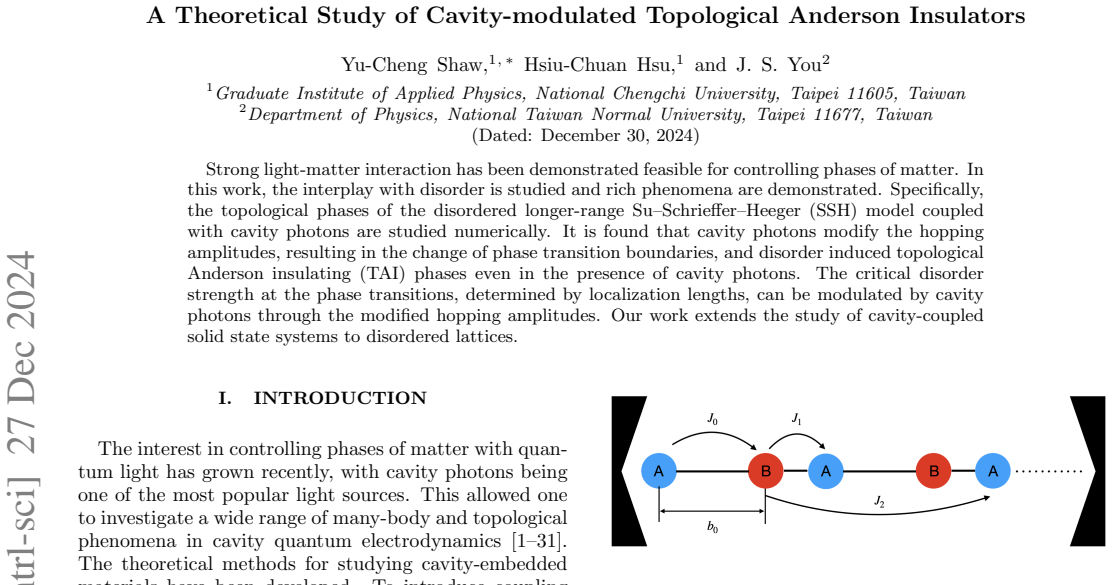
The paper's central claim is that cavity photons alter the topology of a disordered longer-range SSH chain through a geometry-dependent renormalization of the hopping amplitudes. In the clean limit, the dressed hoppings explain every observed shift in the energy spectrum: for $J_2$ far from zero the system favors a lower winding number (toward $n_w = -1$), while for $J_2$ near zero the direction of the shift is set by whether $b_0$ is above or below $0.5$, i.e., by whether the intercell hop or the intracell hop is longer. With disorder, the same dressed hoppings produce topological Anderson insulating phases whose transitions occur at disorder strengths controlled by the photon-dressed band gap and the photon-reduced disorder amplitude; localization-length peaks, computed on the dressed chain, confirm the shifted transitions. The paper thus claims to extend the physics of cavity-modified matter to disordered lattices and to identify the dressed hopping as the single quantity that carries the cavity's influence.
Load-bearing premise
The argument stands on the factorized ground-state ansatz $|\Psi\rangle = |\psi\rangle |\phi\rangle$, which neglects electron-photon correlations; if those correlations are substantial at the ultrastrong coupling $g = 6$, $\omega_c = 1$ used here, the dressed-hopping formula and the phase diagram built from it would not hold.
Editorial extensions
If this is right
- In the clean chain, coupling to the cavity generically pushes the system toward lower winding number, enlarging the $n_w = -1$ region, except in the near-$J_2 = 0$ regime where $b_0 < 0.5$ enlarges the $n_w = 0$ region instead.
- The critical disorder strength for the topological Anderson transition is cavity-tunable: it increases where the photon-dressed gap is larger (as near $J_1 = -0.1$ with $b_0 = 0.8$) and decreases where the dressing shrinks the gap more than it shrinks the disorder.
- Localization-length calculations confirm that away from the shifted transitions the dressed system remains localized, with peaks marking the same phase boundaries as the winding-number calculation.
- Because the intracell hopping disorder is dressed by the same factor as $J_0$ itself, the effective disorder strength is reduced by the cavity, and this reduction competes with the gap change in setting the transition.
Reading between the lines
- An implication the paper leaves implicit is a design rule: cavity photons act as a monotone range filter on hoppings, so any topological model whose phase depends on the ratio between long and short hoppings should have its boundaries pushed in the direction set by stronger suppression of the longer hop.
- The factorization assumption is the main untested link; at $g = 6$, $\omega_c = 1$ the coupling is not small, so exact diagonalization of a few-unit-cell chain would show whether electron-photon correlations alter the dressed-hopping formula enough to move the predicted boundaries.
- If $g/\omega_c$ or the cavity frequency can be swept in time, the model suggests a dynamical route: the topological Anderson transition could be driven back and forth at fixed disorder, making the cavity a switch for these phases.
- The appendix's longer-range disorder case shows little cavity effect away from $U_L = 0$; a testable extension is whether longer-range-correlated disorder, which feeds the hop the cavity suppresses most, would respond more strongly.
Editorial analysis
A structured set of objections, weighed in public.
Referee Report
Summary. The manuscript studies a longer-range Su-Schrieffer–Heeger (SSH) chain coupled to a single cavity mode via a Peierls substitution, with disorder added to the intracell hopping. The electron-photon ground state is obtained from a factorized mean-field ansatz |Ψ⟩=|ψ⟩|ϕ⟩, which leads to effective hoppings J̃_i = J_i ⟨ϕ|e^{i g/√L l_i(a+a†)}|ϕ⟩ (Eq. 4). The authors argue that the Peierls phase grows with hop length l_i, so longer hops are suppressed more strongly, lowering the winding number and shifting topological phase boundaries. In the disordered case, they compute real-space winding numbers and localization lengths, and find that cavity photons modulate the critical disorder strength of topological Anderson insulating phases. The central quantitative claims are the renormalized hopping formula and the resulting phase diagrams in Figs. 2–4.
Significance. If the central mechanism holds, the paper provides a physically transparent picture of how cavity photons modify topological phase boundaries and TAI critical disorder strengths through length-dependent hopping renormalization. The use of a real-space winding number and transfer-matrix localization length is appropriate for the disordered problem, and the manuscript is self-contained rather than tuned to a target result. The main limitation is that the entire analysis rests on the factorized mean-field ansatz and on unquantified approximations in the photon state; without validation of these steps, the predicted phase shifts remain a plausible scenario rather than an established result. A successful small-scale exact-diagonalization benchmark would substantially raise the paper's value.
major comments (3)
- [Sec. II and Eq. (4)] The factorized mean-field ansatz |Ψ⟩=|ψ⟩|ϕ⟩ is the foundation of the effective hopping formula (Eq. 4), but its validity is not established at the chosen ultrastrong coupling regime g=6, ω_c=1, where g/√L≈0.55 for L=120 and the mean-field photonic potential amplitude is comparable to ω_c. In this regime electron-photon correlations can be significant, and the product ansatz discards them by construction. The authors state in Sec. III that the coefficients c_n decrease quickly, but this is not quantified and does not bound the error in ⟨ϕ|e^{i g/√L l_i(a+a†)}|ϕ⟩. Since the phase boundaries in Figs. 2–4 depend entirely on this formula, the central claim is unsupported unless the ansatz is benchmarked against exact diagonalization for small chains (e.g., L=4–8, N_max=8–10) at the same coupling, or against DMRG.
- [Sec. III, paragraph after Eq. (4)] The paper asserts that the phase angle μ(l_i) is real, monotonically increasing in l_i, and lies within [−π/2, π/2], and uses this to predict that the longer hop J_2 is always reduced more than J_1. This monotonicity is load-bearing: it is what produces the 'system favors lower winding number' conclusion in regimes (I) and (III) in Fig. 2. However, no proof or numerical evidence is provided. The authors should either derive this property from the self-consistent photonic ground state or show a plot of the computed J̃_i/J_i as a function of l_i; otherwise the claim is an assumption rather than a result.
- [Sec. IV and Figs. 3–4] The disorder phase diagrams and localization lengths are averaged over only 20 disorder realizations. The paper makes specific claims about shifts of critical disorder strength (e.g., the J_1=−0.1 peak in Fig. 4(b) shifting relative to Fig. 4(a)). With 20 samples, statistical fluctuations can be sizable, and no error bars are given. The qualitative trends might survive, but the quantitative shift of the localization-length peak—which is used to support the central claim—needs error estimates or, ideally, more realizations to be convincing.
minor comments (4)
- [Sec. I] The text contains typos: 'undertand' should be 'understand' and 'Heurst exponent' should be 'Hurwitz exponent' (or 'Lyapunov exponent' as used elsewhere).
- [Sec. II, Eq. (3)] The disorder term is written with summation index N, which should be L (the number of unit cells) for consistency with Eq. (1); also, the uniform distribution range is typeset with a leading minus sign that is unclear (should be [−U/2, U/2]).
- [Sec. III and Fig. 2] The caption of Fig. 2 says 'The x-axis is hopping amplitude J1 and y-axis is energy', but the figure panels appear to show J1 as the variable; please clarify the labeling and the meaning of the green crosses in the caption.
- [Sec. IV] The localization length calculation applies the renormalized J̃_i obtained from a finite chain (L=120) to a much longer chain (L=2·10^4). The finite-size dependence of the mean-field photon state is not discussed; a brief comment on why this transfer is justified would be helpful.
Circularity Check
No circularity: the dressed-hopping renormalization is a self-consistent consequence of the stated mean-field ansatz, and the phase diagrams are computed from the dressed Hamiltonian with independent g=0 controls.
full rationale
The paper's derivation chain is self-contained rather than circular. The central object, the dressed hopping J̃_i = J_i⟨φ|exp(i g/√L l_i(a+a†))|φ⟩ (Eq. 4), is obtained by evaluating the adopted factorized mean-field ansatz |Ψ⟩=|ψ⟩|φ⟩ on the full cavity Hamiltonian; it is not a parameter fitted to any target phase boundary or to the disorder data. The photonic state |φ⟩ is itself obtained by a fixed-point iteration between H_ph^mf and H_el^mf, so the dressed hoppings, energy spectra, winding numbers, and localization lengths are all outputs of the same self-consistent calculation rather than inputs disguised as predictions. The g=0 results (Figs. 3b and 4a) serve as independent controls, and the localization-length peaks computed by the iterative Green's function method provide a separate check of the disorder-driven transitions inferred from gap arguments. The only author self-citation, ref. [49] (H.-C. Hsu and T.-W. Chen), supports a general and widely used statement that midgap states survive until disorder is comparable to the gap; this claim is also supported by refs. [47,54] and is used only to interpret, not to force, the numerical phase diagrams, so it is not load-bearing in a circular way. The factorized-ansatz accuracy concern raised for ultrastrong coupling is an assumption/validation issue, not a circularity: the paper's claims do follow from its stated mean-field equations, so any failure would be an accuracy limitation, not a reduction of the output to the input.
Assumptions & free parameters
free parameters (5)
- g =
6
- omega_c =
1
- N_max =
11
- L =
120
- b0 =
0.1, 0.2, 0.8, 0.9
assumptions (5)
- domain assumption The full ground state factorizes as |Ψ⟩ = |ψ⟩|ϕ⟩ (mean-field ansatz).
- domain assumption Peierls substitution Ji -> Ji exp(i g/√L l_i (a+a†)) captures the light-matter coupling.
- ad hoc to paper The effective hopping can be approximated by the vacuum expectation value ⟨0|...|0⟩ because c_n decay quickly.
- ad hoc to paper The phase angle μ(l_i) is real, monotonic in l_i, and within [-π/2, π/2].
- domain assumption The critical disorder strength is proportional to the band gap of the clean system.
Cite this review
Pith. "Pith review of A Theoretical Study of Cavity-modulated Topological Anderson Insulators." pith.science (2026). https://pith.science/paper/4NHIA3WQ
@misc{pith2026241219508,
  author       = {Pith},
  title        = {Pith review of: A Theoretical Study of Cavity-modulated Topological Anderson Insulators},
  year         = {2026},
  howpublished = {\url{https://pith.science/paper/4NHIA3WQ}},
  note         = {Machine review of arXiv:2412.19508}
}
read the original abstract
Strong light-matter interaction has been demonstrated feasible for controlling phases of matter. In this work, the interplay with disorder is studied and rich phenomena are demonstrated. Specifically, the topological phases of the disordered longer-range Su-Schrieffer-Heeger (SSH) model coupled with cavity photons are studied numerically. It is found that cavity photons modify the hopping amplitudes, resulting in the change of phase transition boundaries, and disorder induced topological Anderson insulating (TAI) phases even in the presence of cavity photons. The critical disorder strength at the phase transitions, determined by localization lengths, can be modulated by cavity photons through the modified hopping amplitudes. Our work extends the study of cavity-coupled solid state systems to disordered lattices.
Figures


Figures from the paper (2 more)


Reference graph
Works this paper leans on
- [1]
-
[2]
T. F. Allard and G. Weick, Phys. Rev. B 108, 245417 (2023)
work page 2023
-
[3]
D. Shaffer, M. Claassen, A. Srivastava, and L. H. Santos, Phys. Rev. B 109, 155160 (2024)
work page 2024
- [4]
- [5]
-
[6]
D. Hagenm¨ uller, J. Schachenmayer, S. Sch¨ utz, C. Genes, and G. Pupillo, Phys. Rev. Lett. 119, 223601 (2017)
work page 2017
- [7]
-
[8]
J. Mochida and Y. Ashida, arXiv:2404.14148 (2024)
work page Pith review arXiv 2024
Show all 55 references
-
[9]
Dmytruk and M
O. Dmytruk and M. Schir´ o, Phys. Rev. B 110, 075416 (2024)
2024
-
[10]
J. B. Curtis, Z. M. Raines, A. A. Allocca, M. Hafezi, and V. M. Galitski, Phys. Rev. Lett. 122, 167002 (2019)
2019
-
[11]
G´ omez-Le´ on, M
´A. G´ omez-Le´ on, M. Schir` o, and O. Dmytruk, arXiv:2407.12088 (2024)
2024 arXiv
-
[12]
Schlawin, A
F. Schlawin, A. Cavalleri, and D. Jaksch, Phys. Rev. Lett. 122, 133602 (2019). 6
2019
-
[13]
M. A. Sentef, M. Ruggenthaler, A. Rubio, Sci. Adv. 4, eaau6969 (2018)
2018
-
[14]
Li and M
J. Li and M. Eckstein, Phys. Rev. Lett. 125, 217402 (2020)
2020
-
[15]
Bartolo and C
N. Bartolo and C. Ciuti, Phys. Rev. B 98, 205301 (2018)
2018
-
[16]
Masuki and Y
K. Masuki and Y. Ashida, Phys. Rev. B 107, 195104 (2023)
2023
-
[17]
Klinder, H
J. Klinder, H. Keßler, M. Reza Bakhtiari, M. Thorwart, and A. Hemmerich, Phys. Rev. Lett. 115, 230403 (2015)
2015
-
[18]
Renate Landig, Lorenz Hruby, Nishant Dogra, Manuele Landini, Rafael Mottl, Tobias Donner, and Tilman Esslinger, Nature 532, 476–479 (2016)
2016
-
[19]
Kuroyama, J
K. Kuroyama, J. Kwoen, Y. Arakawa, and K. Hirakawa, Phys. Rev. Lett. 132, 066901 (2024)
2024
-
[20]
Thomas et al., Nano Lett
A. Thomas et al., Nano Lett. 21, 4365–4370 (2021)
2021
-
[21]
Orgiu et al., Nat
E. Orgiu et al., Nat. Mater. 14, 1123–1129 (2015)
2015
-
[22]
Krainova, A
N. Krainova, A. J. Grede, D. Tsokkou, N. Banerji, and N. C. Giebink, Phys. Rev. Lett. 124, 177401 (2020)
2020
-
[23]
Nagarajan et al., ACS Nano 14, 10219–10225 (2020)
K. Nagarajan et al., ACS Nano 14, 10219–10225 (2020)
2020
-
[24]
G. L. Paravicini-Bagliani et al., Nat. Phys. 15, 186–190 (2019)
2019
-
[25]
Appugliese, J
F. Appugliese, J. Enkner, G. L. Paravicini-Bagliani, M. Beck, C. Reichl, W. Wegscheider, G. Scalari, C. Ciuti, and J. Faist, Science 375, 1030 (2022)
2022
-
[26]
Kn¨ uppel et al., Nature572, 91–94 (2019)
P. Kn¨ uppel et al., Nature572, 91–94 (2019)
2019
-
[27]
Bloch, A
J. Bloch, A. Cavalleri, V. Galitski, M. Hafezi, and A. Rubio, Nature 606, 41-48 (2022)
2022
-
[28]
Schlawin, D
F. Schlawin, D. M. Kennes, and M. A. Sentef, Appl. Phys. Rev. 9, 011312 (2022)
2022
-
[29]
A. F. Kockum, A. Miranowicz, S. De Liberato, S. Savasta, and F. Nori, Nat. Rev. Phys. 1, 19–40 (2019)
2019
-
[30]
H¨ ubener, U
H. H¨ ubener, U. De Giovannini, C. Sch¨ afer, J. Andberger, M. Ruggenthaler, J. Faist, and A. Rubio, Nat. Mater 20, 438–442 (2021)
2021
-
[31]
F. J. Garcia-Vidal, C. Ciuti , and T. W. Ebbesen, , Sci- ence 373, 178 (2021)
2021
-
[32]
Arwas and C
G. Arwas and C. Ciuti, Phys. Rev. B 107, 045425 (2023)
2023
-
[33]
Z. Lin, C. Xiao, D.-P. Nguyen, G. Arwas, C. Ciuti, and W. Yao, Proc. Natl. Acad. Sci. USA 120, e2306584120 (2023)
2023
-
[34]
Ciuti, Phys
C. Ciuti, Phys. Rev. B 104, 155307 (2021)
2021
-
[35]
Ashida, T
Y. Ashida, T. Tokota, A. Imamoglu, and E. Demler, Phys. Rev. R 4, 023194 (2022)
2022
-
[36]
Nguyen, G
D.-P. Nguyen, G. Arwas, and C. Ciuti, Phys. Rev. B110, 195416 (2024)
2024
-
[37]
T. F. Macedo, J. Fa´ undez, R. R. dos Santos, N. C. Costa, and F. A. Pinheiro, Multifractal critical phase driven by coupling quasiperiodic systems to electromagnetic cavi- ties, arXiv:2408.06496 (2024)
2024 arXiv
-
[38]
Nguyen, G
D.-P. Nguyen, G. Arwas, Z. Lin, W. Yao, and C. Ciuti, Phys. Rev. Lett. 131, 176602 (2023)
2023
-
[39]
P´ erez-Gonz´ alez, G
B. P´ erez-Gonz´ alez, G. Platero, and ´A. G´ omez-Le´ on, arXiv:2302.12290 (2023)
2023 arXiv
-
[40]
Bacciconi, G
Z. Bacciconi, G. M. Andolina, and C. Mora, Phys. Rev. B 109, 165434 (2024)
2024
-
[41]
F. P. M. M´ endez-C´ ordoba, F. J. Rodr ´ ıguez, C. Tejedor, and L. Quiroga, Phys. Rev. B 107, 125104 (2023)
2023
-
[42]
Bacciconi, G
Z. Bacciconi, G. M. Andolina, T. Chanda, G. Chiriac` o, M. Schir` o and M. Dalmonte, SciPost Phys. 15, 113 (2023)
2023
-
[43]
M. J. Rice and E. J. Mele, Phys. Rev. Lett. 49, 1455 (1982)
1982
-
[44]
P. W. Anderson, Phys. Rev. 109, 1492 (1958)
1958
-
[45]
Aubry and G
S. Aubry and G. Andr´ e, Ann. Isr. Phys.3, 18 (1980)
1980
-
[46]
Cheraghchi, S
H. Cheraghchi, S. M. Fazeli, and K. Esfarjani, Phys. Rev. B 72, 174207 (2005)
2005
-
[47]
P´ erez-Gonz´ alez, M
B. P´ erez-Gonz´ alez, M. Bello,´A. G´ omez-Le´ on, and G. Platero, Phys. Rev. B 99, 035146 (2019)
2019
-
[48]
Li, R.-L
J. Li, R.-L. Chu, J. K. Jain, and S.-Q. Shen, Phys. Rev. Lett. 102, 136806 (2009)
2009
-
[49]
Hsu and T.-W
H.-C. Hsu and T.-W. Chen, Phys. Rev. B 102, 205425 (2020)
2020
-
[50]
et al., J
Cottet, A. et al., J. Phys. Condens. Matter 29, 433002 (2017)
2017
-
[51]
Mivehvar, F
F. Mivehvar, F. Piazza, T. Donner, and H. Ritsch, Adv. Phys. 70, 1–153 (2021)
2021
-
[52]
Baumann, C
K. Baumann, C. Guerlin, F. Brennecke, and T. Esslinger, Nature 464, 1301–1306 (2010)
2010
-
[53]
Mondragon-Shem, T
I. Mondragon-Shem, T. L. Hughes, J. Song, and E. Pro- dan, Phys. Rev. Lett. 113, 046802 (2014)
2014
-
[54]
M. Inui, S. A. Trugman, and E. Abrahams, Phys. Rev. B 49, 3190 (1992)
1992
-
[55]
MacKinnon and B
A. MacKinnon and B. Kramer, Z. Phys. B: Condens. Matter 53, 1 (1983)
1983
Reviewed August 11, 2026 · model on record in the stance chip above.
Discussion (0). Continue with ORCID to comment.