REVIEW 2 major objections 4 minor 69 references
Simulation of exchange coupling effects in double quantum dot FinFET-like structures
T0 review · 2 major / 4 minor · reviewed 2026-07-10 · grok-4.5
Pith's one-line read Reduced-basis simulations of a 5-gate Si FinFET double quantum dot map exchange coupling and locate magnetic orientations that separately enable native SWAP and CZ two-qubit gates.
desk verdict Solid device-level CI maps of J and magnetic sweet spots for a realistic hole FinFET DQD; the truncation is a real but not fatal soft spot, and the experimental g-tensor mismatch is already owned. read the letter →
The pith
A machine-rendered reading of the paper's core claim, the machinery that carries it, and where it could break.
The reading
What carries the argument
The configuration-interaction Hamiltonian built from Slater determinants of the four highest single-particle hole states lying above the charging energy; its diagonalization supplies the singlet-triplet gap (exchange J) that is then decomposed into transverse and longitudinal components under an applied magnetic field.
What would settle it
Re-running the identical bias and field scan with a substantially larger CI basis (or with measured device-to-device geometric disorder) would show whether the predicted J values and the angular locations of the SWAP/CZ sweet spots remain stable or shift outside experimental error bars.
Extended reading notes
Core claim
A reduced-basis configuration-interaction treatment constructed on self-consistent 6 imes6 k·p Schrödinger-Poisson solutions reproduces the magneto-electrostatic singlet-triplet spectrum and exchange coupling of a 5-gate Si FinFET double quantum dot and locates magnetic-field orientations that separately favor native SWAP (J_perp-dominated) and CZ (J_parallel-dominated with J_perp near zero) two-qubit operations.
Load-bearing premise
The two-particle Hilbert space can be cut off after the four highest single-particle states above the charging energy without changing the extracted exchange or the locations of the magnetic sweet spots.
Editorial analysis
A structured set of objections, weighed in public.
Referee Report
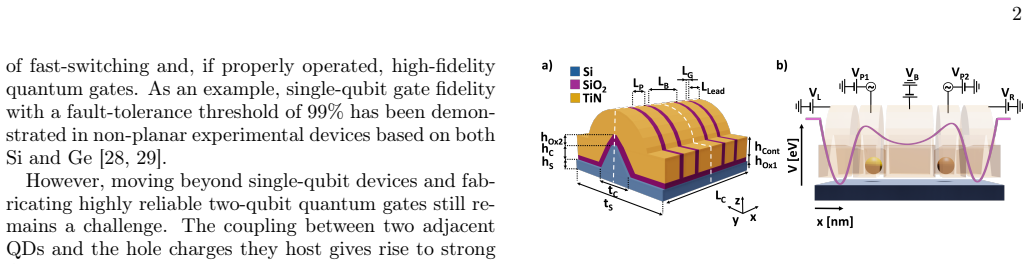
Summary. The manuscript presents a GPU-accelerated 6 imes6 k·p Schrödinger–Poisson solver coupled to a configuration-interaction (CI) treatment of two-hole states for a 5-gate triangular Si FinFET double quantum dot. Self-consistent electrostatic potentials and single-particle eigenstates (including cooling-induced strain via Pikus–Bir) are used to build a reduced Slater-determinant basis; diagonalization yields the singlet–triplet spectrum and exchange J as functions of plunger detuning and barrier voltage. An effective anisotropic-exchange Hamiltonian (Eq. 17) constructed from the same single-particle manifold and experimental spin-orbit parameters is then used to map magnetic-field orientations that separately favor native SWAP (J⊥-dominated) and CZ (J∥ finite, J⊥≈0) gates. Qualitative comparison with the experimental g-tensors and δEZ of Ref. [42] is provided.
Significance. If the reduced-basis CI results and the resulting magnetic sweet spots are robust, the work supplies a concrete, device-level design tool for hole-spin two-qubit gates in industrially relevant FinFET geometries. The combination of a full 3-D SP solver, strain, and CI is a non-trivial technical advance over purely phenomenological Fermi–Hubbard fits, and the explicit identification of field orientations that suppress leakage for CZ while preserving flip-flop for SWAP is of immediate experimental interest. The GPU acceleration and the transparent documentation of the Slater–Condon construction further enhance the paper’s utility as a methodological reference.
major comments (2)
- Section II.C and Figs. 3–5: the central design claims (J(εVP,VB) surfaces and the angular locations of the SWAP/CZ sweet spots in Fig. 7) rest on a CI space truncated to the four highest single-particle states above the charging energy EC≈3.34 meV (K=28 determinants). No systematic enlargement of the basis (six or eight states, or a lower energy cutoff) is reported to demonstrate that the extracted singlet–triplet gap and, more critically, the bonding/antibonding character that enters the g-tensors and the anisotropic ˜J matrix remain stable. Because Eq. (17) and the subsequent J⊥/J∥ maps are built directly from this truncated manifold, a convergence test is load-bearing for the claimed optimal operating conditions.
- Section III.C and Fig. 8: the simulated left- and right-dot g-tensors are nearly identical, while the experimental tensors of Ref. [42] are almost orthogonal; the resulting δEZ angular maps therefore differ quantitatively. The paper attributes the discrepancy to fabrication imperfections but does not quantify how such asymmetries would shift the sweet-spot locations of Fig. 7. Without at least a sensitivity analysis (e.g., artificially tilting one g-tensor), the claim that the simulated orientations remain optimal for real devices is under-supported.
minor comments (4)
- Fig. 5 caption and surrounding text: the numerical noise of order 10−8 eV near zero detuning is acknowledged but not quantified for the exchange values used later; a short statement of the practical lower bound on reliable J would help.
- Eq. (17) and the paragraph that follows: the spin-orbit length λso and axis nso are taken from experiment without listing their numerical values or uncertainty; a brief table or appendix entry would improve reproducibility.
- Fig. 4: the energy labels and the gray-scale coding of the six single-particle states become hard to read once the detuning exceeds ~15 mV; a clearer legend or separate panels would help.
- Throughout: several typographical slips remain (“BowenmV”, “SW AP”, “CP HASE”, inconsistent spacing around units). A careful proof-reading pass is needed.
Circularity Check
No load-bearing circularity: exchange J and sweet spots are computed from SP+CI, not fitted to the target; only minor experimental SO inputs and a non-load-bearing self-citation for strain.
-
self citation load bearing
[Section II.B (Schrödinger-Poisson Solver), strain paragraph; Ref. [48]]
"In Ref. [48], it was found that a contraction of the Si channel is the most likely scenario to occur when the FinFET is cooled down to 1.5 K. Therefore, the same conditions are applied here by fixing the bottom edge of the Si wafer, leading to an overall contraction of the material stack towards the substrate."
The cryogenic strain field fed into the 6×6 k·p Hamiltonian is justified solely by the authors’ prior simulation of a related FinFET, not by an independent measurement or external uniqueness result. The citation is not load-bearing for the exchange spectrum itself (J still comes from CI diagonalization of the microscopic Hamiltonian), so this is only a minor self-citation of a modeling choice.
full rationale
The central chain is self-contained and non-circular. Self-consistent 6×6 k·p Schrödinger–Poisson yields V_DQD and single-particle states; a configuration-interaction Hamiltonian built from Slater determinants of a truncated single-particle basis is diagonalized to obtain the two-hole spectrum and J = E_T − E_S (sign-flipped for holes). That J(ε_VP, V_B) surface is not fitted to the experimental exchange data of Ref. [42]; the later comparison of g-tensors and δE_Z is an independent (and only qualitative) check. Material constants and the Pikus–Bir strain treatment are standard inputs. The only mild self-reference is adoption of the cooling-induced channel-contraction scenario from the authors’ prior FinFET study [48], which sets the strain tensor but does not define J. Separately, λ_so and n̂_so are taken from the same experimental paper [42] when reconstructing the anisotropic exchange matrix Ĵ = J R(−2θ_so) used for the angular J_⊥/J_∥ maps; that imports experimental SO parameters into the sweet-spot locations but does not make the microscopic J or the SP g-tensors circular by construction. CI truncation to states above E_C is an untested modeling assumption (correctness risk), not a definitional loop. No uniqueness theorem, ansatz smuggled via self-citation, or fitted-then-predicted identity of the main claim is present. Score 1 reflects only the non-load-bearing self-citation and the hybrid use of experimental SO length, not a reduction of the claimed result to its inputs.
Assumptions & free parameters
free parameters (4)
- CI energy cutoff EC =
≈3.34 meV
- spin-orbit length λso and axis nso =
from experiment
- cooling-induced strain tensor
- source/drain extension length =
14 nm
assumptions (4)
- domain assumption 6×6 Luttinger-Kohn k·p Hamiltonian plus Pikus-Bir strain term adequately describes the valence-band states of the Si fin at 1.5 K.
- ad hoc to paper Configuration-interaction expansion truncated above the charging energy captures the exchange coupling to the accuracy needed for gate design.
- standard math Slater-Condon rules correctly map the two-particle Coulomb and exchange integrals onto the chosen Slater-determinant basis.
- domain assumption Hole wave-functions vanish at the Si/SiO2 interface (Dirichlet boundary conditions).
Cite this review
Pith. "Pith review of Simulation of exchange coupling effects in double quantum dot FinFET-like structures." pith.science (2026). https://pith.science/paper/4OKIVIY3
@misc{pith2026260708447,
  author       = {Pith},
  title        = {Pith review of: Simulation of exchange coupling effects in double quantum dot FinFET-like structures},
  year         = {2026},
  howpublished = {\url{https://pith.science/paper/4OKIVIY3}},
  note         = {Machine review of arXiv:2607.08447}
}
read the original abstract
By leveraging a GPU-accelerated Schr\"odinger-Poisson (SP) solver, we characterize exchange coupling in a hole spin double-qubit device involving a double quantum dot (DQD) system formed inside a 5-gate silicon fin field-effect transistor (FinFET) similar to real experimental structures. The self-consistent SP simulations rely on a finite difference discretization of the 3D volume and on a Luttinger-Kohn 6x6 kp Hamiltonian accounting for magnetic fields and strain distribution. They return the gate-induced confined electronic states and the corresponding electrostatic potential hosting the DQD. These quantities serve as inputs to a two-particle Hamiltonian that is constructed from single-particle Slater determinants through the configuration interaction (CI) method. By diagonalizing this two-particle Hamiltonian, the eigenstates and eigenenergies of the DQD system are obtained, together with their exchange coupling. We show that our simulation framework, using a reduced number of basis states, is capable of reproducing the magneto-electrostatic behavior of the devices of interest, as predicted from theory and observed experimentally. We finally leverage our approach to determine the optimal operating conditions of a two-qubit quantum logic gate implemented in a Si FinFET structure.
Figures


Figures from the paper (5 more)


Reference graph
Works this paper leans on
- [42]
-
[1]
D. Loss and D. P. DiVincenzo, Quantum computation with quantum dots, Phys. Rev. A57, 120 (1998)
work page 1998
-
[2]
C. Kloeffel and D. Loss, Prospects for spin-based quan- tum computing in quantum dots, Annu. Rev. Condens. 14 TABLE I. List of materials parameters used in the thermal and SP simulations: Young’s modulus (E), thermal expansion coefficient (α), Poisson’s coefficient (ν), Luttinger’s parame- ters (γ1,γ 2, andγ3), split-off spin-orbit energy (∆0), isotropic ...
work page 2013
-
[3]
G. Burkard, T. D. Ladd, A. Pan, J. M. Nichol, and J. R. Petta, Semiconductor spin qubits, Reviews of Modern Physics95, 025003 (2023)
work page 2023
-
[4]
P. W. Shor, Algorithms for quantum computation: dis- crete logarithms and factoring, inProceedings 35th an- nual symposium on foundations of computer science (Ieee, 1994) pp. 124–134
work page 1994
-
[5]
L. K. Grover, A fast quantum mechanical algorithm for database search, inProceedings of the twenty-eighth an- nual ACM symposium on Theory of computing(1996) pp. 212–219
work page 1996
-
[6]
R. P. Feynman, Simulating physics with computers, in Feynman and computation(cRc Press, 2018) pp. 133– 153
work page 2018
- [7]
Show all 69 references
-
[8]
A. R. Mills, C. R. Guinn, M. J. Gullans, A. J. Sigillito, M. M. Feldman, E. Nielsen, and J. R. Petta, Two-qubit silicon quantum processor with operation fidelity exceed- ing 99%, Science Advances8, eabn5130 (2022). Sim. Left Dot Sim. Right Dot X’ Y’ Z’ X’ Y’ Z’ x 0.91 -0.42 -0...
2022
-
[9]
Scappucci, and S
A.Noiri, K.Takeda, T.Nakajima, T.Kobayashi, A.Sam- mak, G. Scappucci, and S. Tarucha, Fast universal quan- tum gate above the fault-tolerance threshold in silicon, Nature601, 338 (2022)
2022
-
[10]
Borsoi, N
F. Borsoi, N. W. Hendrickx, V. John, M. Meyer, S. Motz, F. Van Riggelen, A. Sammak, S. L. De Snoo, G. Scap- pucci, and M. Veldhorst, Shared control of a 16 semicon- ductor quantum dot crossbar array, Nature Nanotechnol- ogy19, 21 (2024)
2024
-
[11]
Petit, H
L. Petit, H. Eenink, M. Russ, W. Lawrie, N. Hendrickx, S. Philips, J. Clarke, L. Vandersypen, and M. Veldhorst, Universal quantum logic in hot silicon qubits, Nature 580, 355 (2020)
2020
-
[12]
S. G. Philips, M. T. Madzik, S. V. Amitonov, S. L. de Snoo, M. Russ, N. Kalhor, C. Volk, W. I. Lawrie, D. Brousse, L. Tryputen,et al., Universal control of a six-qubit quantum processor in silicon, Nature609, 919 (2022)
2022
-
[13]
H. C. George, M. T. Mądzik, E. M. Henry, A. J. Wag- ner, M. M. Islam, F. Borjans, E. J. Connors, J. Corrigan, M. Curry, M. K. Harper, D. Keith, L. Lampert, F. Luthi, F.A.Mohiyaddin, S.Murcia, R.Nair, R.Nahm, A.Neth- wewala, S. Neyens, B. Patra, R. D. Raharjo, C. Ro- gan, R. Sa...
2025 doi
-
[14]
Petkov and G
N. Petkov and G. Fagas, From field effect transistors to spin qubits: Focus on group iv materials, architectures and fabrications, Nanomaterials15, 1737 (2025)
2025
-
[15]
Steinacker, N
P. Steinacker, N. Dumoulin Stuyck, W. H. Lim, T. Tanttu, M. Feng, S. Serrano, A. Nickl, M. Can- dido, J. D. Cifuentes, E. Vahapoglu,et al., Industry- compatible silicon spin-qubit unit cells exceeding 99% fidelity, Nature646, 81 (2025)
2025
-
[16]
Veldhorst, C
M. Veldhorst, C. Yang, J. Hwang, W. Huang, J. Dehol- lain, J. Muhonen, S. Simmons, A. Laucht, F. Hudson, K. M. Itoh,et al., A two-qubit logic gate in silicon, Na- ture526, 410 (2015)
2015
-
[17]
E. J. Connors, J. Nelson, L. F. Edge, and J. M. Nichol, Charge-noise spectroscopy of si/sige quantum dots via dynamically-decoupled exchange oscillations, Nature communications13, 940 (2022)
2022
-
[18]
Winkler,Spin-orbit coupling effects in two- dimensional electron and hole systems: with 26 tables, Springer tracts in modern physics Solid-state physics No
R. Winkler,Spin-orbit coupling effects in two- dimensional electron and hole systems: with 26 tables, Springer tracts in modern physics Solid-state physics No. 191 (Springer, Berlin Heidelberg, 2003)
2003
-
[19]
Kloeffel, M
C. Kloeffel, M. J. Rančić, and D. Loss, Direct rashba spin-orbit interaction in si and ge nanowires with dif- ferent growth directions, Physical Review B97, 235422 (2018)
2018
-
[20]
Milivojević, Electrical control of the hole spin qubit in si and ge nanowire quantum dots, Physical Review B 104, 235304 (2021)
M. Milivojević, Electrical control of the hole spin qubit in si and ge nanowire quantum dots, Physical Review B 104, 235304 (2021)
2021
-
[21]
V. N. Ciriano-Tejel, M. A. Fogarty, S. Schaal, L. Hutin, B. Bertrand, L. Ibberson, M. F. Gonzalez-Zalba, J. Li, Y.-M. Niquet, M. Vinet,et al., Spin readout of a cmos quantum dot by gate reflectometry and spin-dependent tunneling, PRX Quantum2, 010353 (2021)
2021
-
[22]
N. Piot, B. Brun, V. Schmitt, S. Zihlmann, V. Michal, A. Apra, J. Abadillo-Uriel, X. Jehl, B. Bertrand, H. Niebojewski,et al., A single hole spin with enhanced 15 coherence in natural silicon, Nature Nanotechnology17, 1072 (2022)
2022
-
[23]
R. S. Eggli, T. Patlatiuk, E. G. Kelly, A. Orekhov, G. Salis, R. J. Warburton, D. M. Zumbühl, and A. V. Kuhlmann, All-electrical operation of a spin qubit coupled to a high-q resonator, arXiv preprint arXiv:2407.21484 (2024)
2024 arXiv
-
[24]
A. V. Kuhlmann, V. Deshpande, L. C. Camenzind, D. M. Zumbühl, and A. Fuhrer, Ambipolar quantum dots in un- doped silicon fin field-effect transistors, Applied Physics Letters113(2018)
2018
-
[25]
Kloeffel, M
C. Kloeffel, M. Trif, and D. Loss, Strong spin-orbit inter- action and helical hole states in ge/si nanowires, Physical Review B84, 195314 (2011)
2011
-
[26]
Froning, M
F. Froning, M. Rehmann, J. Ridderbos, M. Brauns, F. Zwanenburg, A. Li, E. Bakkers, D. Zumbühl, and F. Braakman, Single, double, and triple quantum dots in ge/si nanowires, Applied Physics Letters113(2018)
2018
-
[27]
Adelsberger, S
C. Adelsberger, S. Bosco, J. Klinovaja, and D. Loss, En- hanced orbital magnetic field effects in ge hole nanowires, Physical Review B106, 235408 (2022)
2022
-
[28]
L. C. Camenzind, S. Geyer, A. Fuhrer, R. J. Warbur- ton, D. M. Zumbühl, and A. V. Kuhlmann, A hole spin qubit in a fin field-effect transistor above 4 kelvin, Nature Electronics5, 178 (2022)
2022
-
[29]
F. N. Froning, L. C. Camenzind, O. A. van der Molen, A. Li, E. P. Bakkers, D. M. Zumbühl, and F. R. Braak- man, Ultrafast hole spin qubit with gate-tunable spin– orbit switch functionality, Nature Nanotechnology16, 308 (2021)
2021
-
[30]
Burkard, D
G. Burkard, D. Loss, and D. P. DiVincenzo, Coupled quantum dots as quantum gates, Phys. Rev. B59, 2070 (1999)
-
[31]
D. P. DiVincenzo, Two-bit gates are universal for quan- tum computation, Physical Review A51, 1015 (1995)
1995
-
[32]
D. E. Deutsch, A. Barenco, and A. Ekert, Universality in quantum computation, Proceedings of the Royal Society of London. Series A: Mathematical and Physical Sciences 449, 669 (1995)
1995
-
[33]
Barenco, C
A. Barenco, C. H. Bennett, R. Cleve, D. P. DiVincenzo, N. Margolus, P. Shor, T. Sleator, J. A. Smolin, and H. Weinfurter, Elementary gates for quantum computa- tion, Physical review A52, 3457 (1995)
1995
-
[34]
Hubbard, Electron correlations in narrow energy bands,ProceedingsoftheRoyalSocietyofLondon.Series A
J. Hubbard, Electron correlations in narrow energy bands,ProceedingsoftheRoyalSocietyofLondon.Series A. Mathematical and Physical Sciences276, 238 (1963)
1963
-
[35]
Jirovec, A
D. Jirovec, A. Hofmann, A. Ballabio, P. M. Mutter, G. Tavani, M. Botifoll, A. Crippa, J. Kukucka, O. Sagi, F. Martins,et al., A singlet-triplet hole spin qubit in pla- nar ge, Nature Materials20, 1106 (2021)
2021
-
[36]
Saez-Mollejo, D
J. Saez-Mollejo, D. Jirovec, Y. Schell, J. Kukucka, S. Calcaterra, D. Chrastina, G. Isella, M. Rimbach-Russ, S. Bosco, and G. Katsaros, Exchange anisotropies in microwave-driven singlet-triplet qubits, Nature Commu- nications16, 3862 (2025)
2025
-
[37]
Stepanenko, M
D. Stepanenko, M. Rudner, B. I. Halperin, and D. Loss, Singlet-triplet splitting in double quantum dots due to spin-orbit and hyperfine interactions, Physical Review B 85, 075416 (2012)
2012
-
[38]
J. C. Abadillo-Uriel, B. Martinez, M. Filippone, and Y.- M. Niquet, Two-body wigner molecularization in asym- metric quantum dot spin qubits, Physical Review B104, 195305 (2021)
2021
-
[39]
C. D. Sherrill and H. F. Schaefer III, The configuration interaction method: Advances in highly correlated ap- proaches, inAdvances in quantum chemistry, Vol. 34 (El- sevier, 1999) pp. 143–269
1999
-
[40]
Szabo and N
A. Szabo and N. S. Ostlund,Modern quantum chem- istry: introduction to advanced electronic structure theory (Courier Corporation, 2012)
2012
-
[41]
M. J. Rodríguez, E. A. Rodríguez-Mena, A. F. Kalo, and Y.-M. Niquet, Dressed basis sets for the modeling of ex- change interactions in double quantum dots, Physical Re- view B112, 115428 (2025)
2025
-
[43]
J. C. Slater, The theory of complex spectra, Physical re- view34, 1293 (1929)
1929
-
[44]
Condon, The theory of complex spectra, Physical Re- view36, 1121 (1930)
E. Condon, The theory of complex spectra, Physical Re- view36, 1121 (1930)
1930
-
[45]
Luisier and A
M. Luisier and A. Schenk, Two-dimensional tunneling ef- fects on the leakage current of mosfets with single di- electric and high-κgate stacks, IEEE Transactions on Electron Devices55, 1494 (2008)
2008
-
[46]
C.R.Anderson,Arayleigh–chebyshevprocedureforfind- ing the smallest eigenvalues and associated eigenvectors of large sparse hermitian matrices, Journal of Computa- tional Physics229, 7477 (2010)
2010
-
[47]
R. B. Lehoucq, D. C. Sorensen, and C. Yang,ARPACK users’ guide: solution of large-scale eigenvalue problems with implicitly restarted Arnoldi methods(SIAM, 1998)
1998
-
[48]
Bouquet, J
I. Bouquet, J. Cao, and M. Luisier, Simulation of a single hole-spin qubit in a strained triangular finfet quantum device, Physical Review Applied23, 054030 (2025)
2025
-
[49]
G. L. Bir and G. E. Pikus,Symmetry and Strain- induced Effects in Semiconductors(Wiley, New York,
-
[50]
A Halsted Press book
translation ofSimmetriia i deformatsionnye effekty v poluprovodnikakh. "A Halsted Press book."
-
[51]
J. M. Luttinger, Quantum theory of cyclotron resonance in semiconductors: General theory, Physical review102, 1030 (1956)
1956
-
[52]
L. M. Willatzen and L. C. L. Y. Voon, The kp method: electronic properties of semiconductors, The k·p method electronic properties of semiconductors (2009)
2009
-
[53]
Csontos, P
D. Csontos, P. Brusheim, U. Zülicke, and H. Xu, Spin-3 2 physics of semiconductor hole nanowires: Valence-band mixing and tunable interplay between bulk-material and orbital bound-state spin splittings, Physical Review B—Condensed Matter and Materials Physics79, 155323 (2009)
2009
-
[54]
Moratis, J
K. Moratis, J. Cibert, D. Ferrand, and Y.-M. Niquet, Light hole states in a strained quantum dot: Numerical calculation and phenomenological models, Physical Re- view B103, 245304 (2021)
2021
-
[55]
F. A. Zwanenburg, A. S. Dzurak, A. Morello, M. Y. Sim- mons, L. C. Hollenberg, G. Klimeck, S. Rogge, S. N. Coppersmith, and M. A. Eriksson, Silicon quantum elec- tronics, Reviews of modern physics85, 961 (2013)
2013
-
[56]
D. C. Mattis,The theory of magnetism I: Statics and Dy- namics(Springer Science & Business Media, 2012) Chap. 4.5
2012
-
[57]
D. M. Zajac, A. J. Sigillito, M. Russ, F. Borjans, J. M. Taylor, G. Burkard, and J. R. Petta, Resonantly driven cnot gate for electron spins, Science359, 439 (2018). 16
2018
-
[58]
Tanttu, W.H
T. Tanttu, W.H. Lim, J. Y.Huang, N.DumoulinStuyck, W. Gilbert, R. Y. Su, M. Feng, J. D. Cifuentes, A. E. Seedhouse, S. K. Seritan,et al., Assessment of the errors of high-fidelity two-qubit gates in silicon quantum dots, Nature Physics20, 1804 (2024)
2024
-
[59]
S. Q. Dots, Coherent manipulation of coupled electron spins in, condensed-matter physics5, 6 (2005)
2005
-
[60]
Meunier, V
T. Meunier, V. E. Calado, and L. M. Vandersypen, Effi- cient controlled-phase gate for single-spin qubits in quan- tum dots, Physical Review B—Condensed Matter and Materials Physics83, 121403 (2011)
2011
-
[61]
M. Russ, D. M. Zajac, A. J. Sigillito, F. Borjans, J. M. Taylor, J. R. Petta, and G. Burkard, High-fidelity quan- tum gates in si/sige double quantum dots, Physical Re- view B97, 085421 (2018)
2018
-
[62]
Brunner, Y.-S
R. Brunner, Y.-S. Shin, T. Obata, M. Pioro-Ladrière, T. Kubo, K. Yoshida, T. Taniyama, Y. Tokura, and S. Tarucha, Two-qubit gate of combined single-spin ro- tation and interdot spin exchange in a double quantum dot, Physical review letters107, 146801 (2011)
2011
-
[63]
H. Asai, S. Iizuka, T. Mogami, J. Hattori, K. Fukuda, T. Ikegami, K. Kato, H. Oka, and T. Mori, Device structure and fabrication process for silicon spin qubit realizing process-variation-robust swap gate operation, Japanese Journal of Applied Physics62, SC1088 (2023)
2023
-
[64]
Hanson, L
R. Hanson, L. P. Kouwenhoven, J. R. Petta, S. Tarucha, and L. M. Vandersypen, Spins in few-electron quantum dots, Reviews of modern physics79, 1217 (2007)
2007
-
[65]
Veldhorst, J
M. Veldhorst, J. C. Hwang, C.-H. Yang, A. W. Leenstra, B. de Ronde, J. P. Dehollain, J. T. Muhonen, F. E. Hud- son, K. M. Itoh, A. Morello,et al., An addressable quan- tum dot qubit with fault-tolerant control-fidelity, Nature nanotechnology9, 981 (2014)
2014
-
[66]
Venitucci, L
B. Venitucci, L. Bourdet, D. Pouzada, and Y.-M. Niquet, Electrical manipulation of semiconductor spin qubits within the g-matrix formalism, Physical Review B98, 155319 (2018)
2018
-
[67]
Nanoacademic Technologies Inc.,QTCAD: Quantum Technology Computer-Aided Design(2025), simulation platform for quantum devices, including finite-element and atomistic modeling
2025
-
[68]
D. C. McKay, C. J. Wood, S. Sheldon, J. M. Chow, and J. M. Gambetta, Efficient z gates for quantum comput- ing, Physical Review A96, 022330 (2017)
2017
-
[69]
Martinez and Y.-M
B. Martinez and Y.-M. Niquet, Variability of Electron and Hole Spin Qubits Due to Interface Roughness and Charge Traps, Phys. Rev. Applied17, 024022 (2022)
2022
Reviewed July 10, 2026 · model on record in the stance chip above.
Discussion (0). Continue with ORCID to comment.