REVIEW 5 major objections 6 minor 3 cited by
AIGV-Assessor: Benchmarking and Evaluating the Perceptual Quality of Text-to-Video Generation with LMM
T0 review · 5 major / 6 minor · reviewed 2026-08-12 · deepseek-v4-flash
Pith's one-line read AIGV-Assessor claims to outperform all existing methods for predicting both MOS and pairwise preferences on AI-generated video quality, across four dimensions.
desk verdict A large, genuinely useful AIGVQA benchmark with a credible but unremarkable assessor; the pairwise-label noise and missing statistics make the pair-ranking SOTA claim the weak point. read the letter →
The pith
A machine-rendered reading of the paper's core claim, the machinery that carries it, and where it could break.
The reading
What carries the argument
AIGV-Assessor combines a 2D vision encoder (InternViT) for per-frame spatial content and a 3D SlowFast network for motion, projects both into the language space of an LLM (InternLM2-Chat-8B), and uses the LLM's hidden states for quality regression. The model is trained in three stages: aligning visual tokens with language, fine-tuning with LoRA and an L1 loss against MOS, and adding a pairwise comparison stage that uses an LPIPS-inspired judge network with cross-entropy loss. This design lets the same model produce quality-level text, numerical scores, and pairwise preferences.
What would settle it
Re-annotate a random subset of about 1,000 pairs with at least ten annotators each; if AIGV-Assessor's pair accuracy on this higher-confidence ground truth is substantially below the level it achieves on the original three-annotator majority labels, the claimed alignment with human preference would be overstated.
Extended reading notes
Core claim
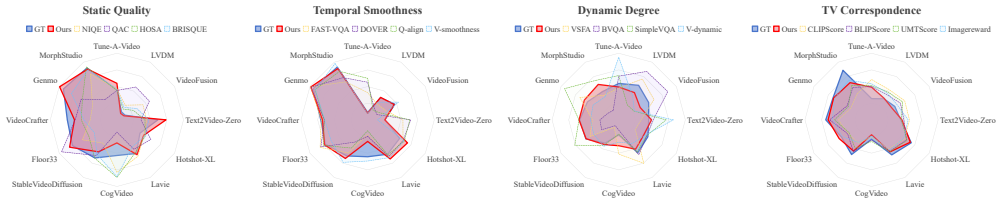
The central claim is that AIGV-Assessor achieves state-of-the-art performance for both MOS prediction and pair ranking on AIGVQA-DB, beating prior handcrafted, deep-learning, vision-language, and LMM-based methods on all four evaluated dimensions. The paper further claims that the model generalizes: it posts the best correlations on the LGVQ, FETV, T2VQA-DB, and GAIA benchmarks, and its predicted model rankings overlap most closely with ground-truth rankings among the compared evaluators.
Load-bearing premise
The pairwise labels are trustworthy enough to serve as both training signal and evaluation ground truth, but each pair is judged by only three annotators with no reported agreement or noise analysis.
Editorial extensions
If this is right
- Text-to-video models can now be ranked automatically on four separate quality axes, not just a single aggregate score.
- The pairwise comparison subset offers a training signal that is complementary to MOS, reducing ambiguity of absolute ratings on high-quality content.
- The dataset's prompt categorization (spatial content, temporal content, attribute control, complexity) allows diagnosing which video generators fail on which prompt types.
- Existing AIGVQA benchmarks without pairwise data can still be evaluated by the model, giving cross-dataset comparisons.
- The reported gains on external benchmarks suggest the method transfers beyond its own training distribution.
Reading between the lines
- If the pair labels are reliable, the three-annotator majority-vote design could be adopted by future dataset builders as a cheaper alternative to full MOS annotation for preference modeling.
- The same spatiotemporal-plus-LMM architecture could be applied to other generative media, such as image-to-video or audio-driven video, where distinct quality axes also matter.
- The prompt categorization could be used to build targeted stress tests for text-to-video models, testing specific failure modes like event-order violations or camera-view control.
- The model's reliance on paired fine-tuning suggests that adding more pairwise data, or using synthetic pairs from strong generators, may further improve alignment with human preference.
Signed reviews
Editorial analysis
A structured set of objections, weighed in public.
Referee Report
Summary. The paper introduces AIGVQA-DB, a large-scale text-to-video quality assessment dataset of 36,576 AI-generated videos from 15 generation models and 1,048 prompts, annotated with MOS and pairwise comparisons across four perceptual dimensions (static quality, temporal smoothness, dynamic degree, text-video correspondence). It also proposes AIGV-Assessor, an LMM-based model that fuses spatial (InternViT) and temporal (SlowFast) features, produces quality-level descriptions and regression scores, and is fine-tuned for pairwise preference prediction. The authors report state-of-the-art performance on AIGVQA-DB and on four external AIGVQA datasets (LGVQ, FETV, T2VQA-DB, GAIA).
Significance. If the results are reliable, the dataset is a substantial community resource: 36,576 videos, 370k expert ratings, 30,000 annotated pairs, and a four-dimension annotation protocol go well beyond existing AIGVQA benchmarks in scale and scope. The proposed architecture is plausible, and the evaluation across five datasets with many baselines is commendable. The authors also release the dataset and code, which supports reproducibility. The central claim, however, rests on the quality of the pairwise labels and on the statistical strength of the reported gains; both need strengthening before the state-of-the-art claim can be accepted.
major comments (5)
- [Section 3.3 and Appendix C.3] The pairwise ground truth is produced by three annotators per pair with majority voting, but no inter-rater agreement statistic, per-annotator accuracy, or label-noise analysis is reported. The description in Appendix C.3 that ties are resolved by 'the average opinions of the three participants' is undefined for an odd number of binary votes. Since the same pairwise labels are used both as the stage-3 training target (Appendix E, Eq. 3) and as the evaluation ground truth for the Pair Acc column of Table 3, the reported pair accuracy is accuracy against this noisy proxy. Please report inter-rater agreement, the distribution of majority margins (2-1 vs 3-0), a label-noise analysis, and, if possible, an external pairwise dataset for validation.
- [Section 5.1 and Tables 3-6] All results are averages over ten random splits, yet no standard deviations, confidence intervals, or significance tests are provided. Several headline gains over strong baselines are small: on LGVQ temporal smoothness AIGV-Assessor improves SRCC from 0.893 to 0.900 and PLCC from 0.907 to 0.920; on T2VQA-DB SRCC improves from 0.7965 to 0.8131. Because the differences are on the order of 0.007-0.02, significance testing is required to support the claim of 'state-of-the-art performance' over the best existing methods.
- [Section 3.1, Appendix D.1, and Table 9] The dataset description is internally inconsistent. The abstract and introduction state 15 text-to-video models, but Section 3.1 says the MOS subset uses 12 generative models and the pair-comparison subset uses 12 generative models. Table 9 lists 15 models, with Gen-2, MoonValley, and Sora appearing only in the MOS subset and MorphStudio only in the pair subset; it is unclear how the 576 MOS videos and 36,000 pair videos combine into the stated total of 36,576, and whether the MOS subset overlaps with the pair subset. Please clarify the exact composition of each subset and the total number of distinct videos.
- [Section 4.2 and Appendix E] The pairwise comparison training stage uses a 'judge network inspired by LPIPS' whose architecture, parameterization, and training status (frozen or trainable) are not specified. This makes it impossible to determine how much of the Pair Acc gain comes from the judge network versus the quality regression head. Please provide the full architecture, input features, and training details of the judge network.
- [Table 3 evaluation protocol] For methods that do not have a dedicated pair-ranking head, it is unclear how Pair Acc is computed: whether each pair is classified by comparing the predicted scores of the two videos, or by feeding the pair into the model. This affects the fairness of the comparison, since AIGV-Assessor has an extra pairwise training stage. Please state the pair-evaluation protocol for all baselines and for AIGV-Assessor.
minor comments (6)
- [References] Reference [16] is cited for 'ITU-R BT.500-14' but the listed reference is a paper on confusing image quality assessment, not the ITU recommendation; please cite the correct standard.
- [References] Reference [68] is cited as InternViT and InternVL2-8B, but the reference is a paper about Charxiv chart understanding; this appears to be the wrong citation for the vision backbone and LLM used in the method.
- [Figure 5] The label 'Temporal smooothness' in Figure 5(a) contains a typo ('smooothness').
- [Table 3] Several entries in Table 3 have formatting errors, such as '55.08%0.4594 0.4701' in the BVQA row and '0.8489' appearing in the simpleVQA row in a position that is inconsistent with the other rows; please correct the table formatting and verify the reported values.
- [Appendix C.1] The heading 'Annotaion Criteria' contains a typo; it should read 'Annotation Criteria'.
- [Figure 17] The text-video correspondence criterion contains a double comma in the description of the 'Bad' level ('either missing or incorrectly represented, , resulting').
Circularity Check
No significant circularity: the model is trained and evaluated on held-out splits of AIGVQA-DB and on external AIGVQA benchmarks, with no fitted quantity relabeled as a prediction.
full rationale
The paper's central claims are empirical rather than derivational. AIGV-Assessor is trained on AIGVQA-DB using human MOS and pairwise labels (Sections 3.2, 3.3, 4.2, Appendix E), then evaluated on held-out splits of AIGVQA-DB (Section 5.1: 'all experiments for each method are retrained on each dimension using the same training and testing split as the previous literature at a ratio of 4:1') and on four external datasets, LGVQ, FETV, T2VQA-DB, and GAIA (Tables 4-6). No equation defines an output quantity in terms of the model's own prediction, and no fitted constant is renamed as a prediction. The frequent references to prior benchmarks from overlapping research groups (e.g., GAIA [11], T2VQA-DB [30], LGVQ [84]) function as external test beds, not as premises that force the reported state-of-the-art result. The weakest link, that pairwise ground truth comes from three-annotator majority votes with no reported inter-rater agreement or label-noise analysis (Appendix C.3), is a correctness or robustness concern about label reliability, not a circularity: using the same noisy labels for training and held-out evaluation is standard supervised benchmarking and does not make the claimed improvement reduce to its inputs by construction. No circular step satisfying the quoted-evidence requirement was found, so the appropriate finding is no significant circularity.
Assumptions & free parameters
free parameters (2)
- LoRA rank and alpha =
not reported
- Quality regression head weights =
learned on AIGVQA-DB MOS labels
assumptions (4)
- domain assumption Z-score rescaling of raw ratings produces an interval-scale MOS comparable across subjects.
- domain assumption Majority vote of three annotators is a sufficient ground-truth label for 30,000 sampled pairs.
- domain assumption The four annotation dimensions are separable and consistently understood by annotators.
- ad hoc to paper InternViT plus SlowFast features and InternLM2 represent the perceptual attributes relevant to human preference.
Cite this review
Pith. "Pith review of AIGV-Assessor: Benchmarking and Evaluating the Perceptual Quality of Text-to-Video Generation with LMM." pith.science (2026). https://pith.science/paper/4ONQT7H6
@misc{pith2026241117221,
  author       = {Pith},
  title        = {Pith review of: AIGV-Assessor: Benchmarking and Evaluating the Perceptual Quality of Text-to-Video Generation with LMM},
  year         = {2026},
  howpublished = {\url{https://pith.science/paper/4ONQT7H6}},
  note         = {Machine review of arXiv:2411.17221}
}
read the original abstract
The rapid advancement of large multimodal models (LMMs) has led to the rapid expansion of artificial intelligence generated videos (AIGVs), which highlights the pressing need for effective video quality assessment (VQA) models designed specifically for AIGVs. Current VQA models generally fall short in accurately assessing the perceptual quality of AIGVs due to the presence of unique distortions, such as unrealistic objects, unnatural movements, or inconsistent visual elements. To address this challenge, we first present AIGVQA-DB, a large-scale dataset comprising 36,576 AIGVs generated by 15 advanced text-to-video models using 1,048 diverse prompts. With these AIGVs, a systematic annotation pipeline including scoring and ranking processes is devised, which collects 370k expert ratings to date. Based on AIGVQA-DB, we further introduce AIGV-Assessor, a novel VQA model that leverages spatiotemporal features and LMM frameworks to capture the intricate quality attributes of AIGVs, thereby accurately predicting precise video quality scores and video pair preferences. Through comprehensive experiments on both AIGVQA-DB and existing AIGV databases, AIGV-Assessor demonstrates state-of-the-art performance, significantly surpassing existing scoring or evaluation methods in terms of multiple perceptual quality dimensions.
Figures


Figures from the paper (14 more)




Forward citations
Cited by 3 Pith papers
-
Human Preference-Aligned Concept Customization Benchmark via Decomposed Evaluation
D-GPTScore, which averages GPT-4o's per-aspect ratings of concept-customized images, correlates with human preference at 0.78 Pearson on the new CC-AlignBench, beating prior metrics.
-
AGAV-Rater: Adapting Large Multimodal Model for AI-Generated Audio-Visual Quality Assessment
AGAV-Rater, an LMM fine-tuned in two stages, achieves state-of-the-art quality scores for AI-generated audio-visual content, text-to-audio, and text-to-music.
-
Towards Holistic Visual Quality Assessment of AI-Generated Videos: A LLM-Based Multi-Dimensional Evaluation Model
AIGVEval combines BLIP, 3D Swin Transformer, and SlowFast features with a LoRA-tuned LLM to predict AI-generated video quality, hitting second place on the NTIRE 2025 Track 2 leaderboard.
Reference graph
Works this paper leans on
-
[68]
Charxiv: Charting gaps in realistic chart understand- ing in multimodal llms
Zirui Wang, Mengzhou Xia, Luxi He, Howard Chen, Yitao Liu, Richard Zhu, Kaiqu Liang, Xindi Wu, Haotian Liu, Sad- hika Malladi, Alexis Chevalier, Sanjeev Arora, and Danqi Chen. Charxiv: Charting gaps in realistic chart understand- ing in multimodal llms. arXiv preprint arXiv:2406.18521 ,
-
[1]
https://github.com/hotshotco/ hotshot-xl, 2023
Hotshot-XL. https://github.com/hotshotco/ hotshot-xl, 2023. 2, 3, 15, 18
2023
-
[2]
https://discord.gg/EuB9KT6H, 2023
Floor33. https://discord.gg/EuB9KT6H, 2023. 2, 3, 15, 18
2023
-
[3]
https://www.genmo.ai, 2024
Gemo. https://www.genmo.ai, 2024. 2, 3, 15, 18
2024
-
[4]
https://research.runwayml.com/gen2 ,
Gen2. https://research.runwayml.com/gen2 ,
-
[5]
https://moonvalley.ai, 2024
Moonvalley. https://moonvalley.ai, 2024. 2, 3, 15, 18
2024
-
[6]
https://www.morphstudio.com ,
Morph studio. https://www.morphstudio.com ,
-
[7]
https://openai.com/research/video- generation - models - as - world - simulators,
Sora. https://openai.com/research/video- generation - models - as - world - simulators,
Show all 87 references
-
[8]
Frozen in time: A joint video and image encoder for end-to-end retrieval
Max Bain, Arsha Nagrani, G ¨ul Varol, and Andrew Zisser- man. Frozen in time: A joint video and image encoder for end-to-end retrieval. In Proceedings of the IEEE/CVF In- ternational Conference on Computer Vision (ICCV) , pages 1728–1738, 2021. 2, 3, 13, 22
2021
-
[9]
Stable video diffusion: Scaling latent video diffusion models to large datasets
Andreas Blattmann, Tim Dockhorn, Sumith Kulal, Daniel Mendelevitch, Maciej Kilian, Dominik Lorenz, Yam Levi, Zion English, Vikram V oleti, Adam Letts, et al. Stable video diffusion: Scaling latent video diffusion models to large datasets. arXiv preprint arXiv:2311.15127, 2023....
2023 arXiv
-
[10]
Videocrafter1: Open diffusion models for high-quality video generation
Haoxin Chen, Menghan Xia, Yingqing He, Yong Zhang, Xiaodong Cun, Shaoshu Yang, Jinbo Xing, Yaofang Liu, Qifeng Chen, Xintao Wang, Chao Weng, and Ying Shan. Videocrafter1: Open diffusion models for high-quality video generation. arXiv preprint arXiv:2310.19512, 2023. 1, 2, 15, 18
-
[11]
Gaia: Rethinking action quality assessment for ai-generated videos
Zijian Chen, Wei Sun, Yuan Tian, Jun Jia, Zicheng Zhang, Jiarui Wang, Ru Huang, Xiongkuo Min, Guangtao Zhai, and Wenjun Zhang. Gaia: Rethinking action quality assessment for ai-generated videos. arXiv preprint arXiv:2406.06087 ,
-
[12]
Videollama 2: Advancing spatial-temporal modeling and audio understanding in video- llms
Zesen Cheng, Sicong Leng, Hang Zhang, Yifei Xin, Xin Li, Guanzheng Chen, Yongxin Zhu, Wenqi Zhang, Ziyang Luo, Deli Zhao, and Lidong Bing. Videollama 2: Advancing spatial-temporal modeling and audio understanding in video- llms. arXiv preprint arXiv:2406.07476, 2024. 6, 7
2024 arXiv
-
[13]
Objective video quality assessment meth- ods: A classification, review, and performance comparison
Shyamprasad Chikkerur, Vijay Sundaram, Martin Reisslein, and Lina J Karam. Objective video quality assessment meth- ods: A classification, review, and performance comparison. IEEE transactions on broadcasting (TBC) , 57(2):165–182,
-
[14]
Measuring the quality of text-to-video model out- puts: Metrics and dataset
Iya Chivileva, Philip Lynch, Tomas E Ward, and Alan F Smeaton. Measuring the quality of text-to-video model out- puts: Metrics and dataset. arXiv preprint arXiv:2309.08009,
-
[15]
Cogview2: Faster and better text-to-image generation via hierarchical transformers
Ming Ding, Wendi Zheng, Wenyi Hong, and Jie Tang. Cogview2: Faster and better text-to-image generation via hierarchical transformers. In Proceedings of the Advances in Neural Information Processing Systems (NeurIPS), pages 16890–16902, 2022. 3, 14
2022
-
[16]
Confusing image quality assessment: Toward better augmented reality expe- rience
Huiyu Duan, Xiongkuo Min, Yucheng Zhu, Guangtao Zhai, Xiaokang Yang, and Patrick Le Callet. Confusing image quality assessment: Toward better augmented reality expe- rience. IEEE Transactions on Image Processing (TIP) , 31: 7206–7221, 2022. 4
2022
-
[17]
Slowfast networks for video recognition
Christoph Feichtenhofer, Haoqi Fan, Jitendra Malik, and Kaiming He. Slowfast networks for video recognition. In Proceedings of the IEEE/CVF International Conference on Computer Vision (ICCV), pages 6202–6211, 2019. 5
2019
-
[18]
Animatediff: Animate your personalized text-to-image diffusion models without specific tuning
Yuwei Guo, Ceyuan Yang, Anyi Rao, Yaohui Wang, Yu Qiao, Dahua Lin, and Bo Dai. Animatediff: Animate your personalized text-to-image diffusion models without specific tuning. arXiv preprint arXiv:2307.04725, 2023. 2
2023 arXiv
-
[19]
Latent video diffusion models for high-fidelity video generation with arbitrary lengths
Yingqing He, Tianyu Yang, Yong Zhang, Ying Shan, and Qifeng Chen. Latent video diffusion models for high-fidelity video generation with arbitrary lengths. arXiv preprint arXiv:2211.13221, 2022. 2, 3, 5, 14, 15, 18
2022 arXiv
-
[20]
Clipscore: A reference-free evaluation met- ric for image captioning
Jack Hessel, Ari Holtzman, Maxwell Forbes, Ronan Le Bras, and Yejin Choi. Clipscore: A reference-free evaluation met- ric for image captioning. In Proceedings of the Confer- ence on Empirical Methods in Natural Language Processing (EMNLP), pages 7514–7528, 2021. 1, 6, 7, 8, 20
2021
-
[21]
Denoising diffu- sion probabilistic models
Jonathan Ho, Ajay Jain, and Pieter Abbeel. Denoising diffu- sion probabilistic models. 33:6840–6851, 2020. 15
2020
-
[22]
Cogvideo: Large-scale pretraining for text-to-video generation via transformers
Wenyi Hong, Ming Ding, Wendi Zheng, Xinghan Liu, and Jie Tang. Cogvideo: Large-scale pretraining for text-to-video generation via transformers. arXiv preprint arXiv:2205.15868, 2022. 1, 2, 3, 14, 15
2022 arXiv
-
[23]
Lora: Low-rank adaptation of large language models
Edward J Hu, Yelong Shen, Phillip Wallis, Zeyuan Allen- Zhu, Yuanzhi Li, Shean Wang, Lu Wang, and Weizhu Chen. Lora: Low-rank adaptation of large language models. arXiv preprint arXiv:2106.09685, 2021. 6
2021 arXiv
-
[24]
VBench: Com- prehensive benchmark suite for video generative models
Ziqi Huang, Yinan He, Jiashuo Yu, Fan Zhang, Chenyang Si, Yuming Jiang, Yuanhan Zhang, Tianxing Wu, Qingyang Jin, Nattapol Chanpaisit, Yaohui Wang, Xinyuan Chen, Limin Wang, Dahua Lin, Yu Qiao, and Ziwei Liu. VBench: Com- prehensive benchmark suite for video generative models....
2024
-
[25]
Musiq: Multi-scale image quality transformer
Junjie Ke, Qifei Wang, Yilin Wang, Peyman Milanfar, and Feng Yang. Musiq: Multi-scale image quality transformer. In Proceedings of the IEEE/CVF International Conference on Computer Vision (ICCV), pages 5128–5137, 2021. 6, 7
2021
-
[26]
Text2video-zero: Text- to-image diffusion models are zero-shot video generators
Levon Khachatryan, Andranik Movsisyan, Vahram Tade- vosyan, Roberto Henschel, Zhangyang Wang, Shant Navasardyan, and Humphrey Shi. Text2video-zero: Text- to-image diffusion models are zero-shot video generators. In Proceedings of the IEEE/CVF International Conference on Comput...
2023
-
[27]
Pick-a-pic: An open dataset of user preferences for text-to- image generation
Yuval Kirstain, Adam Poliak, Uriel Singer, and Omer Levy. Pick-a-pic: An open dataset of user preferences for text-to- image generation. In Proceedings of the Advances in Neural Information Processing Systems (NeurIPS), 2023. 7
2023
-
[28]
Pick-a-pic: An open dataset of user preferences for text-to-image generation
Yuval Kirstain, Adam Polyak, Uriel Singer, Shahbuland Ma- tiana, Joe Penna, and Omer Levy. Pick-a-pic: An open dataset of user preferences for text-to-image generation. In Proceedings of the Advances in Neural Information Process- ing Systems (NeurIPS), pages 36652–36663, 2023. 3, 13
2023
-
[29]
Two-level approach for no-reference con- sumer video quality assessment
Jari Korhonen. Two-level approach for no-reference con- sumer video quality assessment. IEEE Transactions on Im- age Processing (TIP), 28(12):5923–5938, 2019. 7
2019
-
[30]
Subjective-aligned dateset and metric for text-to-video qual- ity assessment
Tengchuan Kou, Xiaohong Liu, Zicheng Zhang, Chunyi Li, Haoning Wu, Xiongkuo Min, Guangtao Zhai, and Ning Liu. Subjective-aligned dateset and metric for text-to-video qual- ity assessment. arXiv preprint arXiv:2403.11956, 2024. 1, 3, 7, 8
2024 arXiv
-
[31]
Large-scale crowdsourced study for tone- mapped hdr pictures
Debarati Kundu, Deepti Ghadiyaram, Alan C Bovik, and Brian L Evans. Large-scale crowdsourced study for tone- mapped hdr pictures. IEEE Transactions on Image Process- ing (TIP), pages 4725–4740, 2017. 7
2017
-
[32]
Blindly assess quality of in-the-wild videos via quality-aware pre-training and motion perception
Bowen Li, Weixia Zhang, Meng Tian, Guangtao Zhai, and Xianpei Wang. Blindly assess quality of in-the-wild videos via quality-aware pre-training and motion perception. IEEE Transactions on Circuits and Systems for Video Technology (TCSVT), 32(9):5944–5958, 2022. 1, 6, 7, 20
2022
-
[33]
Agiqa-3k: An open database for ai-generated image quality assessment
Chunyi Li, Zicheng Zhang, Haoning Wu, Wei Sun, Xiongkuo Min, Xiaohong Liu, Guangtao Zhai, and Weisi Lin. Agiqa-3k: An open database for ai-generated image quality assessment. IEEE Transactions on Circuits and Sys- tems for Video Technology (TCSVT), 2023. 3
2023
-
[34]
Quality as- sessment of in-the-wild videos
Dingquan Li, Tingting Jiang, and Ming Jiang. Quality as- sessment of in-the-wild videos. In Proceedings of the ACM International Conference on Multimedia (ACMMM) . ACM,
-
[35]
Llava-next-interleave: Tackling multi-image, video, and 3d in large multimodal models
Feng Li, Renrui Zhang, Hao Zhang, Yuanhan Zhang, Bo Li, Wei Li, Zejun Ma, and Chunyuan Li. Llava-next-interleave: Tackling multi-image, video, and 3d in large multimodal models. arXiv preprint arXiv:2407.07895, 2024. 6, 7
2024 arXiv
-
[36]
Blip: Bootstrapping language-image pre-training for unified vision-language understanding and generation
Junnan Li, Dongxu Li, Caiming Xiong, and Steven Hoi. Blip: Bootstrapping language-image pre-training for unified vision-language understanding and generation. In Proceed- ings of the International Conference on Machine Learning (ICML), pages 12888–12900. PMLR, 2022. 1, 6, 7, 8, 20
2022
-
[37]
Tgif: A new dataset and benchmark on animated gif description
Yuncheng Li, Yale Song, Liangliang Cao, Joel Tetreault, Larry Goldberg, Alejandro Jaimes, and Jiebo Luo. Tgif: A new dataset and benchmark on animated gif description. In Proceedings of the IEEE/CVF Conference on Computer Vision and Pattern Recognition (CVPR) , pages 4641–4650,
-
[38]
Rich human feedback for text-to-image generation
Youwei Liang, Junfeng He, Gang Li, Peizhao Li, Arseniy Klimovskiy, Nicholas Carolan, Jiao Sun, Jordi Pont-Tuset, Sarah Young, Feng Yang, et al. Rich human feedback for text-to-image generation. In Proceedings of the IEEE/CVF Conference on Computer Vision and Pattern Recognitio...
2024
-
[39]
Video-llava: Learning united visual represen- tation by alignment before projection
Bin Lin, Bin Zhu, Yang Ye, Munan Ning, Peng Jin, and Li Yuan. Video-llava: Learning united visual represen- tation by alignment before projection. arXiv preprint arXiv:2311.10122, 2023. 6, 7
2023 arXiv
-
[40]
Visual instruction tuning
Haotian Liu, Chunyuan Li, Qingyang Wu, and Yong Jae Lee. Visual instruction tuning. In Proceedings of the Advances in Neural Information Processing Systems (NeurIPS), 2024. 7
2024
-
[41]
Evalcrafter: Benchmarking and evaluating large video generation models
Yaofang Liu, Xiaodong Cun, Xuebo Liu, Xintao Wang, Yong Zhang, Haoxin Chen, Yang Liu, Tieyong Zeng, Ray- mond Chan, and Ying Shan. Evalcrafter: Benchmarking and evaluating large video generation models. arXiv preprint arXiv:2310.11440, 2023. 3, 7
-
[42]
Fetv: A bench- mark for fine-grained evaluation of open-domain text-to- video generation
Yuanxin Liu, Lei Li, Shuhuai Ren, Rundong Gao, Shicheng Li, Sishuo Chen, Xu Sun, and Lu Hou. Fetv: A bench- mark for fine-grained evaluation of open-domain text-to- video generation. In Proceedings of the Advances in Neural Information Processing Systems (NeurIPS), 2024. 1, 2,...
2024
-
[43]
Videofusion: Decomposed diffusion mod- els for high-quality video generation
Zhengxiong Luo, Dayou Chen, Yingya Zhang, Yan Huang, Liang Wang, Yujun Shen, Deli Zhao, Jingren Zhou, and Tieniu Tan. Videofusion: Decomposed diffusion mod- els for high-quality video generation. In Proceedings of the IEEE/CVF Conference on Computer Vision and Pattern Recognit...
2023
-
[44]
Video-chatgpt: Towards detailed video understanding via large vision and language models
Muhammad Maaz, Hanoona Rasheed, Salman Khan, and Fa- had Shahbaz Khan. Video-chatgpt: Towards detailed video understanding via large vision and language models. In Pro- ceedings of the Association for Computational Linguistics (ACL), 2024. 6, 7
2024
-
[45]
Blind quality assessment based on pseudo-reference image
Xiongkuo Min, Ke Gu, Guangtao Zhai, Jing Liu, Xiaokang Yang, and Chang Wen Chen. Blind quality assessment based on pseudo-reference image. IEEE Transactions on Multime- dia (TMM), pages 2049–2062, 2017. 6, 7
2017
-
[46]
Blind image quality estimation via distor- tion aggravation
Xiongkuo Min, Guangtao Zhai, Ke Gu, Yutao Liu, and Xi- aokang Yang. Blind image quality estimation via distor- tion aggravation. IEEE Transactions on Broadcasting (TBC), pages 508–517, 2018. 6, 7
2018
-
[47]
No-reference image quality assessment in the spa- tial domain
Anish Mittal, Anush Krishna Moorthy, and Alan Conrad Bovik. No-reference image quality assessment in the spa- tial domain. IEEE Transactions on Image Processing (TIP), pages 4695–4708, 2012. 6, 7
2012
-
[48]
completely blind
Anish Mittal, Rajiv Soundararajan, and Alan C Bovik. Mak- ing a “completely blind” image quality analyzer. IEEE Sig- nal Processing Letters (SPL), pages 209–212, 2012. 6, 7
2012
-
[49]
What and how well you performed? a multitask learning approach to action quality assessment
Paritosh Parmar and Brendan Tran Morris. What and how well you performed? a multitask learning approach to action quality assessment. In Proceedings of the IEEE/CVF Confer- ence on Computer Vision and Pattern Recognition (CVPR) , pages 304–313, 2019. 20
2019
-
[50]
Pieapp: Perceptual image-error assessment through pairwise preference
Ekta Prashnani, Hong Cai, Yasamin Mostofi, and Pradeep Sen. Pieapp: Perceptual image-error assessment through pairwise preference. In Proceedings of the IEEE/CVF Conference on Computer Vision and Pattern Recognition (CVPR), pages 1808–1817, 2018. 13
2018
-
[51]
Hierarchical text-conditional image gener- ation with clip latents
Aditya Ramesh, Prafulla Dhariwal, Alex Nichol, Casey Chu, and Mark Chen. Hierarchical text-conditional image gener- ation with clip latents. arXiv preprint arXiv:2204.06125, 1 (2):3, 2022. 3
2022 arXiv
-
[52]
High-resolution image synthesis with latent diffusion models
Robin Rombach, Andreas Blattmann, Dominik Lorenz, Patrick Esser, and Bj ¨orn Ommer. High-resolution image synthesis with latent diffusion models. In Proceedings of the IEEE/CVF Conference on Computer Vision and Pattern Recognition (CVPR), pages 10684–10695, 2022. 3
2022
-
[53]
Improved techniques for training gans
Tim Salimans, Ian Goodfellow, Wojciech Zaremba, Vicki Cheung, Alec Radford, and Xi Chen. Improved techniques for training gans. In Proceedings of the Advances in Neural Information Processing Systems (NeurIPS), 2016. 1
2016
-
[54]
Laion-5b: An open large-scale dataset for training next generation image-text models
Christoph Schuhmann, Romain Beaumont, Richard Vencu, Cade Gordon, Ross Wightman, Mehdi Cherti, Theo Coombes, Aarush Katta, Clayton Mullis, Mitchell Worts- man, et al. Laion-5b: An open large-scale dataset for training next generation image-text models. InProceedings of the Ad-...
2022
-
[55]
Make-a-video: Text-to-video generation without text-video data
Uriel Singer, Adam Polyak, Thomas Hayes, Xi Yin, Jie An, Songyang Zhang, Qiyuan Hu, Harry Yang, Oron Ashual, Oran Gafni, et al. Make-a-video: Text-to-video generation without text-video data. arXiv preprint arXiv:2209.14792 ,
-
[56]
Blindly assess image qual- ity in the wild guided by a self-adaptive hyper network
Shaolin Su, Qingsen Yan, Yu Zhu, Cheng Zhang, Xin Ge, Jinqiu Sun, and Yanning Zhang. Blindly assess image qual- ity in the wild guided by a self-adaptive hyper network. In IEEE/CVF Conference on Computer Vision and Pattern Recognition (CVPR), 2020. 6, 7
2020
-
[57]
A deep learning based no-reference quality assessment model for ugc videos
Wei Sun, Xiongkuo Min, Wei Lu, and Guangtao Zhai. A deep learning based no-reference quality assessment model for ugc videos. In Proceedings of the 30th ACM Interna- tional Conference on Multimedia (ACMMM), page 856–865,
-
[58]
A deep learning based no-reference quality assessment model for ugc videos
Wei Sun, Xiongkuo Min, Wei Lu, and Guangtao Zhai. A deep learning based no-reference quality assessment model for ugc videos. In Proceedings of the ACM Interna- tional Conference on Multimedia (ACMMM) , pages 856– 865, 2022. 7
2022
-
[59]
Blind quality assessment for in-the-wild images via hierarchical feature fusion and iterative mixed database training
Wei Sun, Xiongkuo Min, Danyang Tu, Siwei Ma, and Guangtao Zhai. Blind quality assessment for in-the-wild images via hierarchical feature fusion and iterative mixed database training. IEEE Journal of Selected Topics in Sig- nal Processing (JSTSP), 2023. 7
2023
-
[60]
Ugc-vqa: Benchmarking blind video quality assessment for user generated content
Zhengzhong Tu, Yilin Wang, Neil Birkbeck, Balu Adsumilli, and Alan C Bovik. Ugc-vqa: Benchmarking blind video quality assessment for user generated content. IEEE Trans- actions on Image Processing (TIP), 30:4449–4464, 2021. 7
2021
-
[61]
To- wards accurate generative models of video: A new metric & challenges
Thomas Unterthiner, Sjoerd Van Steenkiste, Karol Kurach, Raphael Marinier, Marcin Michalski, and Sylvain Gelly. To- wards accurate generative models of video: A new metric & challenges. arXiv preprint arXiv:1812.01717, 2018. 1
2018 arXiv
-
[62]
Chan, and Chen Change Loy
Jianyi Wang, Kelvin C.K. Chan, and Chen Change Loy. Ex- ploring clip for assessing the look and feel of images. InPro- ceedings of the AAAI Conference on Artificial Intelligence (AAAI), pages 2555–2563, 2023. 7
2023
-
[63]
Aigciqa2023: A large-scale image quality assessment database for ai generated images: from the perspectives of quality, authenticity and correspondence
Jiarui Wang, Huiyu Duan, Jing Liu, Shi Chen, Xiongkuo Min, and Guangtao Zhai. Aigciqa2023: A large-scale image quality assessment database for ai generated images: from the perspectives of quality, authenticity and correspondence. In CAAI International Conference on Artificial...
2023
-
[64]
Modelscope text-to-video technical report
Jiuniu Wang, Hangjie Yuan, Dayou Chen, Yingya Zhang, Xiang Wang, and Shiwei Zhang. Modelscope text-to-video technical report. arXiv preprint arXiv:2308.06571, 2023. 1, 2, 3
2023 arXiv
-
[65]
Qwen2-vl: Enhancing vision-language model’s perception of the world at any resolution
Peng Wang, Shuai Bai, Sinan Tan, Shijie Wang, Zhihao Fan, Jinze Bai, Keqin Chen, Xuejing Liu, Jialin Wang, Wenbin Ge, Yang Fan, Kai Dang, Mengfei Du, Xuancheng Ren, Rui Men, Dayiheng Liu, Chang Zhou, Jingren Zhou, and Jun- yang Lin. Qwen2-vl: Enhancing vision-language model’s ...
2024 arXiv
-
[66]
Lavie: High-quality video gener- ation with cascaded latent diffusion models
Yaohui Wang, Xinyuan Chen, Xin Ma, Shangchen Zhou, Ziqi Huang, Yi Wang, Ceyuan Yang, Yinan He, Jiashuo Yu, Peiqing Yang, et al. Lavie: High-quality video gener- ation with cascaded latent diffusion models. arXiv preprint arXiv:2309.15103, 2023. 2, 3, 15
2023 arXiv
-
[67]
Internvid: A large-scale video-text dataset for multimodal understanding and generation
Yi Wang, Yinan He, Yizhuo Li, Kunchang Li, Jiashuo Yu, Xin Ma, Xinhao Li, Guo Chen, Xinyuan Chen, Yaohui Wang, et al. Internvid: A large-scale video-text dataset for multimodal understanding and generation. In Proceedings of the International Conference on Learning Representat...
2023
-
[69]
Fast- vqa: Efficient end-to-end video quality assessment with frag- ment sampling
Haoning Wu, Chaofeng Chen, Jingwen Hou, Liang Liao, Annan Wang, Wenxiu Sun, Qiong Yan, and Weisi Lin. Fast- vqa: Efficient end-to-end video quality assessment with frag- ment sampling. In Proceedings of the European Confer- ence on Computer Vision (ECCV), pages 538–554. Springer,
-
[70]
Exploring video quality assessment on user generated contents from aesthetic and technical perspectives
Haoning Wu, Erli Zhang, Liang Liao, Chaofeng Chen, Jing- wen Hou Hou, Annan Wang, Wenxiu Sun Sun, Qiong Yan, and Weisi Lin. Exploring video quality assessment on user generated contents from aesthetic and technical perspectives. In Proceedings of the International Conference o...
2023
-
[71]
Q-align: Teaching lmms for visual scoring via discrete text-defined levels
Haoning Wu, Zicheng Zhang, Weixia Zhang, Chaofeng Chen, Liang Liao, Chunyi Li, Yixuan Gao, Annan Wang, Erli Zhang, Wenxiu Sun, et al. Q-align: Teaching lmms for visual scoring via discrete text-defined levels. arXiv preprint arXiv:2312.17090, 2023. 6, 7, 21
2023 arXiv
-
[72]
Tune-a-video: One-shot tuning of image diffusion models for text-to-video generation
Jay Zhangjie Wu, Yixiao Ge, Xintao Wang, Stan Weixian Lei, Yuchao Gu, Yufei Shi, Wynne Hsu, Ying Shan, Xiaohu Qie, and Mike Zheng Shou. Tune-a-video: One-shot tuning of image diffusion models for text-to-video generation. In Proceedings of the IEEE/CVF International Conference...
2023
-
[73]
Human preference score v2: A solid benchmark for evaluating human preferences of text-to-image synthesis
Xiaoshi Wu, Yiming Hao, Keqiang Sun, Yixiong Chen, Feng Zhu, Rui Zhao, and Hongsheng Li. Human preference score v2: A solid benchmark for evaluating human preferences of text-to-image synthesis. arXiv preprint arXiv:2306.09341 ,
-
[74]
Better aligning text-to-image models with human preference
Xiaoshi Wu, Keqiang Sun, Feng Zhu, Rui Zhao, and Hong- sheng Li. Better aligning text-to-image models with human preference. arXiv preprint arXiv:2303.14420, 1(3), 2023. 3, 13
2023 arXiv
-
[75]
Msr-vtt: A large video description dataset for bridging video and language
Jun Xu, Tao Mei, Ting Yao, and Yong Rui. Msr-vtt: A large video description dataset for bridging video and language. In Proceedings of the IEEE/CVF Conference on Computer Vision and Pattern Recognition (CVPR), 2016. 2, 3, 13, 22
2016
-
[76]
Blind image quality assessment based on high order statistics aggregation
Jingtao Xu, Peng Ye, Qiaohong Li, Haiqing Du, Yong Liu, and David Doermann. Blind image quality assessment based on high order statistics aggregation. IEEE Transactions on Image Processing (TIP), pages 4444–4457, 2016. 6, 7
2016
-
[77]
Imagere- ward: Learning and evaluating human preferences for text- to-image generation
Jiazheng Xu, Xiao Liu, Yuchen Wu, Yuxuan Tong, Qinkai Li, Ming Ding, Jie Tang, and Yuxiao Dong. Imagere- ward: Learning and evaluating human preferences for text- to-image generation. arXiv preprint arXiv:2304.05977 ,
-
[78]
Imagere- ward: Learning and evaluating human preferences for text- to-image generation
Jiazheng Xu, Xiao Liu, Yuchen Wu, Yuxuan Tong, Qinkai Li, Ming Ding, Jie Tang, and Yuxiao Dong. Imagere- ward: Learning and evaluating human preferences for text- to-image generation. In Proceedings of the Advances in Neu- ral Information Processing Systems (NeurIPS), 2024. 1
2024
-
[79]
Learning with- out human scores for blind image quality assessment
Wufeng Xue, Lei Zhang, and Xuanqin Mou. Learning with- out human scores for blind image quality assessment. InPro- ceedings of the IEEE/CVF Conference on Computer Vision and Pattern Recognition (CVPR), pages 995–1002, 2013. 6, 7
2013
-
[80]
Videogpt: Video generation using vq-vae and trans- formers
Wilson Yan, Yunzhi Zhang, Pieter Abbeel, and Aravind Srinivas. Videogpt: Video generation using vq-vae and trans- formers. arXiv preprint arXiv:2104.10157, 2021. 1
2021 arXiv
-
[81]
The unreasonable effectiveness of deep features as a perceptual metric
Richard Zhang, Phillip Isola, Alexei A Efros, Eli Shecht- man, and Oliver Wang. The unreasonable effectiveness of deep features as a perceptual metric. In Proceedings of the IEEE/CVF Conference on Computer Vision and Pattern Recognition (CVPR), pages 586–595, 2018. 6, 13
2018
-
[82]
Ranksrgan: Generative adversarial networks with ranker for image super-resolution
Wenlong Zhang, Yihao Liu, Chao Dong, and Yu Qiao. Ranksrgan: Generative adversarial networks with ranker for image super-resolution. In Proceedings of the IEEE/CVF Conference on Computer Vision and Pattern Recognition (CVPR), pages 3096–3105, 2019. 13
2019
-
[83]
Blind image quality assessment via vision- language correspondence: A multitask learning perspective
Weixia Zhang, Guangtao Zhai, Ying Wei, Xiaokang Yang, and Kede Ma. Blind image quality assessment via vision- language correspondence: A multitask learning perspective. In Proceedings of the IEEE/CVF Conference on Computer Vision and Pattern Recognition (CVPR), 2023. 6, 7
2023
-
[84]
spatial major content
Zhichao Zhang, Xinyue Li, Wei Sun, Jun Jia, Xiongkuo Min, Zicheng Zhang, Chunyi Li, Zijian Chen, Puyi Wang, Zhongpeng Ji, et al. Benchmarking aigc video quality as- sessment: A dataset and unified model. arXiv preprint arXiv:2407.21408, 2024. 1, 3, 7, 8 Quality Evaluation Qual...
2024 arXiv
-
[85]
Ad- ditionally, StableVideoDiffusion [9] demonstrates notable strength in creating illustrations, highlighting its flexibil- ity in handling stylized and artistic content
consistently leads in producing high-quality outputs for scenery and natural objects, excelling in generating visu- ally appealing and immersive natural environments. Ad- ditionally, StableVideoDiffusion [9] demonstrates notable strength in creating illustrations, highlighting...
-
[86]
In contrast, StableVideoD- iffusion [9] encounters challenges in event order
and VideoCrafter [10] display superior performance in the logical sequence of events. In contrast, StableVideoD- iffusion [9] encounters challenges in event order. Its gener- ative process involves first creating static images and sub- sequently animating them to produce video...
-
[87]
A person is running backwards
Given N action videos, SRCC is computed as: SRCC = 1 − 6 PN n=1 (vn − pn)2 N (N 2 − 1) , (4) where vn and pn denote the rank of the ground truth yn and the rank of predicted score ˆyn respectively. The higher the SRCC, the higher the monotonic correlation between ground truth ...
Reviewed August 12, 2026 · model on record in the stance chip above.
Discussion (0). Continue with ORCID to comment.