REVIEW 3 major objections 5 minor 106 references
Constraints on Neutrino Secret Interactions from Multi-messenger Neutrinos Scattering on C$\nu$B
T0 review · 3 major / 5 minor · reviewed 2026-08-07 · deepseek-v4-flash
Pith's one-line read Astrophysical neutrinos traveling through the cosmic neutrino background set new, generally stronger upper bounds on secret neutrino self-interactions, especially for a vector mediator at low mass.
desk verdict A coherent, modest analytical extension of the Kolb–Turner framework to KM3-230213A; the KM3-based 'new region' is real only if the source is extragalactic, which the paper itself concedes but the abstract does not. read the letter →
The pith
A machine-rendered reading of the paper's core claim, the machinery that carries it, and where it could break.
The reading
For a heavy spin-one mediator coupled to Dirac neutrinos, the authors compute scattering cross sections, mean free paths, and redshift effects, and translate transparency into exclusion curves in the plane of coupling versus mediator mass. They also treat scalar mediators and Majorana neutrinos. They find that a vector mediator gives stronger limits at low mediator mass than a scalar one, and that the KM3 event extends sensitivity to heavier mediators, provided that event came from beyond the local universe. They note the KM3 source is unknown and show results for four assumed distances.
The main caveats are that the constraints are model-dependent, use fixed source energies and distances with no quoted uncertainties, and rely on the simplifying assumption of a flavor-universal coupling. The low-mass vector constraints also depend on how the t-channel singularity is regularized, which the paper explores through a cutoff parameter.
Extended reading notes
Core claim
The central claim is that high-energy astrophysical neutrinos passing through the cosmic neutrino background yield new upper bounds on the neutrino secret interaction coupling g, with "significant constraints on the νSI vector coupling in the low mediator mass region, compared to the scalar coupling scenario," and that "the inclusion of the extreme-energy KM3-230213A event potentially allowed us to probe an entirely new scale of interaction strength." If correct, these curves exclude previously allowed (g, M) values for the vector and scalar mediator models considered.
Load-bearing premise
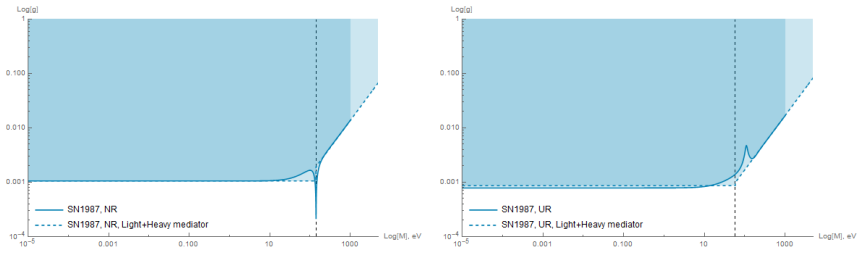
The claim that KM3-230213A probes a previously unconstrained mediator-mass region rests on the assumed distance to the unidentified source. Section V.E states: "As the origin of the event remains yet unclear, we take four representative light-travel distances" (10 kpc, 10 Mpc, 1 Gpc, 4.12 Gpc). If the true origin is galactic or otherwise local, the headline high-energy constraints weaken dramatically and the new parameter space is no longer covered. Separately, all constraints assume an equal-density, universal-mass CνB and flavor-universal coupling, which set the resonance positions in the NR and UR regimes.
Editorial analysis
A structured set of objections, weighed in public.
Referee Report
Summary. The paper derives upper bounds on the neutrino secret interaction (νSI) coupling g by requiring that the optical depth τ = D/λ for high-energy astrophysical neutrinos propagating through the cosmic neutrino background (CνB) satisfies τ ≲ 1. The analysis treats a massive vector mediator coupled to Dirac neutrinos and a scalar mediator coupled to Dirac and Majorana neutrinos, in both non-relativistic and ultra-relativistic CνB regimes, using sources SN1987A, TXS 0506+056, PKS 0735+178, NGC 1068, and the KM3-230213A event. The central new claim is that the 220 PeV KM3-230213A event can probe a previously unconstrained mediator-mass/coupling region, provided that its unknown source is sufficiently distant.
Significance. If the underlying assumptions hold, the paper provides a useful and mostly analytic set of constraints: it includes full mediator-mass dependence rather than only the light/heavy asymptotic limits, compares vector and scalar mediators and Dirac versus Majorana neutrinos, and reproduces the Kolb-Turner result in Fig. 9 as a cross-check. The bounds are not circular: they follow from computed cross sections and the optical-depth condition without fitting any constant to the data. The main significance is conditional, however, because the headline KM3-based exclusion region depends on an unconfirmed source distance, and the NR constraint curves use a neutrino mass below the oscillation-established floor.
major comments (3)
- [Sec. V.E and Abstract/Conclusion] The claim that KM3-230213A probes a previously unconstrained parameter region is conditional on the assumed distance to an unidentified source. Equation (11) gives g ≤ (λ_{g=1}/D)^{1/4}, so moving from the 1 Gpc benchmark to the galactic 10 kpc benchmark weakens the bound by a factor of (10^5)^{1/4} ≈ 18; the 10 kpc curves in Figs. 7 and 8 therefore do not extend the exclusions from TXS 0506+056 or NGC 1068. The text does flag this with 'potentially' in Sec. VI and with the criterion 'beyond the local universe (≳1 Mpc)' in Sec. V.E, but the Abstract states the expansion of limits without that qualification. Please rephrase the Abstract and the 'entirely new scale' discussion so that the strong KM3-based constraints are presented as distance-dependent projections, or redraw the figures to make the galactic benchmark the default reading.
- [Sec. IV.B, Eq. (8)] The ultra-relativistic resonance contribution is computed with the narrow-width approximation, but Eq. (8) is introduced without derivation, and the accompanying statement that the Breit-Wigner propagator 'fails to reproduce the correct heavy mediator scaling s/M^4' is not demonstrated. Because the resonance region controls the dips in the UR exclusion curves (Figs. 2–8), this is a load-bearing element of the central constraints. Please provide a derivation of Eq. (8) or a quantitative comparison with the full Breit-Wigner calculation, including an estimate of the error introduced by combining the NWA rate with the off-resonance amplitude.
- [Sec. IV assumptions and Fig. 2 caption] The NR constraints are computed with a universal neutrino mass m = 10^{-3} eV. This value is below the mass of the heavier mass eigenstates implied by neutrino oscillations (m_2 ≈ 8.6×10^{-3} eV and m_3 ≈ 5×10^{-2} eV), so a common mass for all CνB species cannot be as small as 10^{-3} eV. Since the NR mean free path and the s-channel resonance position depend on m through s ≈ m^2 + 2mE, the curves in Fig. 2 (left) and similar figures are not the limits for a physically allowed common mass, and Sec. V.B itself states that the results are highly sensitive to m. Please present the NR curves for a realistic mass or as an envelope over the allowed mass range, and state in each figure caption which mass is used.
minor comments (5)
- [Table I and Sec. III.d] Table I assigns PKS 0735+178 a redshift z = 0.65, while the text reports z ≈ 0.65 or z = 0.45 ± 0.06 as alternatives; please state which value is adopted in the constraints and, ideally, show the sensitivity to this choice.
- [Figures 2–8] The exclusion curves are drawn as single lines without uncertainty bands; the source distances, neutrino energies, and neutrino mass have nontrivial uncertainties, and the KM3 energy in particular is reported as a median value. A band or a short statement quantifying the induced variation in g would make the constraints easier to interpret.
- [Sec. V.F.3] The claims about numerical inconsistencies in Tables 1 and 2 of Ref. [12] and about an omitted negative sign in Ref. [25] are made without equations or page references; please provide the specific entries and expressions so that these assertions can be checked.
- [Fig. 9 caption] The caption states 'no resonance width is included,' but the main UR calculation uses the narrow-width resonance treatment of Sec. IV.B; please clarify whether Fig. 9 is meant to illustrate only the off-resonance comparison and how it relates to the final UR bounds.
- [References] Some reference entries are incomplete or inconsistently formatted, for example Ref. [14] is missing its year and volume/page details; please audit the bibliography against the journal style.
Assumptions & free parameters
free parameters (5)
- mediator mass M =
scanned over range
- coupling constant g =
excluded above g_bound(M)
- common neutrino mass m =
1e-3 eV (NR main plots), 1e-2 eV in comparison
- t-channel cutoff epsilon =
0 to 0.5 in Figure 10
- KM3-230213A source distance =
10 kpc, 10 Mpc, 1 Gpc, 4.12 Gpc
assumptions (7)
- domain assumption CνB consists of all neutrino and antineutrino species with equal number density 56 cm^-3 and a Fermi-Dirac spectrum with T=1.68e-4 eV.
- domain assumption All neutrino masses are equal and m < 0.1 eV; the NR regime uses m=1e-3 eV.
- domain assumption The interaction is flavor-diagonal and universal, g_alpha_beta = g delta_alpha_beta.
- domain assumption The mediator couples only to active neutrinos; couplings to charged particles are negligible.
- domain assumption Detection of at least one neutrino from a source implies optical depth tau = D/lambda <= 1.
- standard math The differential cross sections in Tables II, III, V, and VI are correct standard QFT results.
- domain assumption The narrow-width approximation for the s-channel resonance, Eq. (8), is valid in the UR regime.
Cite this review
Pith. "Pith review of Constraints on Neutrino Secret Interactions from Multi-messenger Neutrinos Scattering on C$\nu$B." pith.science (2026). https://pith.science/paper/4OSEHHXQ
@misc{pith2026250514332,
  author       = {Pith},
  title        = {Pith review of: Constraints on Neutrino Secret Interactions from Multi-messenger Neutrinos Scattering on C$\nu$B},
  year         = {2026},
  howpublished = {\url{https://pith.science/paper/4OSEHHXQ}},
  note         = {Machine review of arXiv:2505.14332}
}
abstract
We present new constraints on neutrino secret interactions ($\nu$SI) by studying high-energy neutrinos from well-known astrophysical sources, such as SN1987A, the blazars TXS $0506+056$ and PKS $0735+178$, the active galaxy NGC 1068, and the KM3-230213A neutrino event. We expand existing limits by probing a previously unconstrained region of the mediator mass parameter space. Our study focuses on Dirac neutrinos interacting with a massive spin-one boson as they propagate through the Cosmic Neutrino Background, while also examining Majorana and Dirac neutrinos scattering via a scalar mediator. We consider both ultra-relativistic and non-relativistic regimes, establishing bounds on the $\nu$SI coupling constant across the wide $\nu$SI mediator mass range. Our results, obtained using analytical methods, demonstrate significant constraints on the $\nu$SI vector coupling in the low mediator mass region, compared to the scalar coupling scenario.
Figures


Figures from the paper (8 more)




Reference graph
Works this paper leans on
-
[1]
Cutoff role in low mediator mass region 21
-
[2]
Graphical Comparison with the Most Recent Constraints 24
-
[3]
Conclusion 25 Acknowledgments 26 References 26 2 I
Review on discrepancies from earlier studies 24 VI. Conclusion 25 Acknowledgments 26 References 26 2 I. INTRODUCTION In the Standard Model (SM), massless neutrinos interact with each other at tree level only through Z-boson exchange. In SM extension, massive neutrinos can also interact with each other via the Higgs boson and/or electromagnetically via loo...
1987
-
[4]
CνB consists of all neutrino species with equal number density
-
[5]
All neutrino masses are equal andm <0.1 eV
-
[6]
From astrophysical sources, we typically observe two distinct classes of neutrinos depend- ing on the source type and energy scale
The interaction is flavor-diagonal and universal (g αβ =gδ αβ). From astrophysical sources, we typically observe two distinct classes of neutrinos depend- ing on the source type and energy scale. Ultra high energy neutrinos from active galactic nuclei and blazars, such as TXS 0506+056 and NGC 1068, were primarily detected as muon neutrinos and antineutrin...
-
[7]
Regions above the curves represent excluded parameter spaces
Cutoff role in low mediator mass region With the definite choice of parameters, our results can reproduce exclusion limits obtained in the study [12] as illustrated in Figure 9, however inclusion of the full mediator mass 21 Figure 9: Comparison of the full mass range analysis (solid curve) with the limiting cases of massless and heavy mediators (dashed c...
-
[8]
Reference [14] considers Majorana neutrinos interacting via a scalar mediator
Graphical Comparison with the Most Recent Constraints We compare our exclusion limits with the most recent astrophysical constraints on theνSI coupling constant reported in [14], as shown in Figure 11. Reference [14] considers Majorana neutrinos interacting via a scalar mediator. While the overall shape of the exclusion curves is similar, noticeable diffe...
Show all 106 references
-
[9]
While most aspects of the analysis in [12] were presented with notable clarity, we identified an inconsistency in the numerical values reported in Table 1 and Table 2 of [12]
Review on discrepancies from earlier studies In this section, we also point out a few ambiguities and inconsistencies in previous studies that, if clarified, may be helpful for future researchers in this area. While most aspects of the analysis in [12] were presented with nota...
-
[10]
J. M. Berryman, N. Blinov, V. Brdar, T. Brinckmann, M. Bustamante, F.-Y. Cyr-Racine, and et al., Physics of the Dark Universe42, 101267 (2023)
2023
-
[12]
E. G. Flowers and P. G. Sutherland, Astrophys. J. Lett.208, L19 (1976)
1976
-
[13]
Berbig, S
M. Berbig, S. Jana, and A. Trautner, Phys. Rev. D102, 115008 (2020), arXiv:2004.13039 [hep-ph]
2020 arXiv
-
[14]
Blinov, K
N. Blinov, K. J. Kelly, G. Krnjaic, and S. D. McDermott, Physical Review Letters123, 10.1103/physrevlett.123.191102 (2019)
2019 doi
-
[15]
Venzor, G
J. Venzor, G. Garcia-Arroyo, J. De-Santiago, and A. P´ erez-Lorenzana, Physical Review D 108, 10.1103/physrevd.108.043536 (2023)
2023 doi
-
[16]
Abreu, J
H. Abreu, J. Anders, C. Antel, A. Ariga, T. Ariga, and et al., Physical Review Letters131, 10.1103/physrevlett.131.031801 (2023)
2023 doi
-
[17]
Cyr-Racine and K
F.-Y. Cyr-Racine and K. Sigurdson, Physical Review D90, 10.1103/physrevd.90.123533 (2014)
2014 doi
-
[21]
E. W. Kolb and M. S. Turner, Phys. Rev. D36, 2895 (1987)
1987
-
[22]
Bustamante, C
M. Bustamante, C. Rosenstrøm, S. Shalgar, and I. Tamborra, Phys. Rev. D101, 123024 (2020), arXiv:2001.04994 [astro-ph.HE]
2020 arXiv
- [23]
-
[24]
Chang, I
P.-W. Chang, I. Esteban, J. F. Beacom, T. A. Thompson, and C. M. Hirata, Physical Review Letters131, 10.1103/physrevlett.131.071002 (2023)
2023 doi
-
[25]
Wu and X.-J
Q.-f. Wu and X.-J. Xu, Journal of Cosmology and Astroparticle Physics2024(02), 037
-
[26]
Lazo Pedrajas (KM3NeT), PoST AUP2023, 193 (2024)
A. Lazo Pedrajas (KM3NeT), PoST AUP2023, 193 (2024)
2024
-
[27]
Bakhti, Y
P. Bakhti, Y. Farzan, and M. Rajaee, Physical Review D99, 10.1103/physrevd.99.055019 (2019)
2019 doi
-
[28]
J. M. Berryman, A. de Gouvˆ ea, K. J. Kelly, and Y. Zhang, Physical Review D97, 10.1103/physrevd.97.075030 (2018)
2018 doi
-
[29]
Escudero and S
M. Escudero and S. J. Witte, The European Physical Journal C80, 10.1140/epjc/s10052- 020-7854-5 (2020)
2020 doi
-
[30]
G. B. Gelmini and M. Roncadelli, Phys. Lett. B99, 411 (1981)
1981
-
[32]
A. P. Lessa and O. L. G. Peres, Phys. Rev. D75, 094001 (2007)
2007
-
[33]
A. K. Barik, S. K. Rai, and A. Srivastava, Discovering an invisible Z’ at the muon collider (2024), arXiv:2408.14396 [hep-ph]
2024 arXiv
-
[34]
K. J. Kelly and P. A. Machado, Journal of Cosmology and Astroparticle Physics2018(10), 048–048
-
[35]
Heeck, M
J. Heeck, M. Lindner, W. Rodejohann, and S. Vogl, SciPost Phys.6, 038 (2019), arXiv:1812.04067 [hep-ph]
2019 arXiv
-
[36]
Farzan and J
Y. Farzan and J. Heeck, Phys. Rev. D94, 053010 (2016)
2016
-
[37]
Okada, S
N. Okada, S. Okada, and Q. Shafi, Physics Letters B810, 135845 (2020)
2020
-
[38]
K. J. Kelly, M. Sen, W. Tangarife, and Y. Zhang, Phys. Rev. D101, 115031 (2020). 27
2020
-
[39]
C. D. Kreisch, F.-Y. Cyr-Racine, and O. Dor´ e, Phys. Rev. D101, 123505 (2020)
2020
-
[40]
F. F. Deppisch, L. Graf, W. Rodejohann, and X.-J. Xu, Phys. Rev. D102, 051701 (2020), arXiv:2004.11919 [hep-ph]
2020 arXiv
-
[42]
K. Blum, Y. Nir, and M. Shavit, Physics Letters B785, 354–361 (2018)
2018
-
[43]
de Gouvˆ ea, P
A. de Gouvˆ ea, P. B. Dev, B. Dutta, T. Ghosh, T. Han, and Y. Zhang, Journal of High Energy Physics2020, 10.1007/jhep07(2020)142 (2020)
2020 doi
-
[44]
Adachi, K
I. Adachi, K. Adamczyk, L. Aggarwal, H. Ahmed, H. Aihara, and et al. (Belle II Collabora- tion), Phys. Rev. Lett.130, 181803 (2023)
2023
-
[45]
Cortina Gil, A
E. Cortina Gil, A. Kleimenova, E. Minucci, S. Padolski, P. Petrov, and et al., Physics Letters B816, 136259 (2021)
2021
-
[46]
Brdar, M
V. Brdar, M. Lindner, S. Vogl, and X.-J. Xu, Phys. Rev. D101, 115001 (2020)
2020
-
[47]
P. S. B. Dev, D. Kim, D. Sathyan, K. Sinha, and Y. Zhang, New laboratory constraints on neutrinophilic mediators (2024), arXiv:2407.12738 [hep-ph]
2024 arXiv
-
[48]
Bally, S
A. Bally, S. Jana, and A. Trautner, Phys. Rev. Lett.125, 161802 (2020)
2020
-
[49]
Grohs, G
E. Grohs, G. M. Fuller, and M. Sen, Journal of Cosmology and Astroparticle Physics2020 (07), 001–001
-
[50]
Huang, T
G.-y. Huang, T. Ohlsson, and S. Zhou, Phys. Rev. D97, 075009 (2018)
2018
-
[51]
Kamada and H.-B
A. Kamada and H.-B. Yu, Physical Review D92, 10.1103/physrevd.92.113004 (2015)
2015 doi
-
[52]
Ioka and K
K. Ioka and K. Murase, Progress of Theoretical and Experimental Physics2014, 61E01 (2014)
2014
-
[53]
K. C. Ng and J. F. Beacom, Physical Review D90, 10.1103/physrevd.90.065035 (2014)
2014 doi
- [54]
-
[55]
Ambrosone, JCAP2024(09), 075, arXiv:2406.13336 [astro-ph.HE]
A. Ambrosone, JCAP2024(09), 075, arXiv:2406.13336 [astro-ph.HE]
- [56]
-
[57]
V. A. Allakhverdyan, A. D. Avrorin, A. V. Avrorin, V. M. Aynutdinov, Z. Bardaˇ cov´ a, and et al. (Baikal-GVD Collaboration), Phys. Rev. D107, 042005 (2023)
2023
-
[58]
I. R. Wang, X.-J. Xu, and B. Zhou, Widen the resonance: Probing a new regime of neutrino self-interactions with astrophysical neutrinos (2025), arXiv:2501.07624 [hep-ph]
2025
-
[59]
DiFranzo and D
A. DiFranzo and D. Hooper, Physical Review D92, 10.1103/physrevd.92.095007 (2015). 28
2015 doi
-
[60]
Rozhkov and S
V. Rozhkov and S. Troitsky, Multimessenger astronomy (2024), arXiv:2409.11818 [astro- ph.HE]
2024 arXiv
-
[61]
Aiello et al
S. Aiello et al. (KM3NeT), Nature638, 376 (2025)
2025
-
[62]
Omeliukh et al., Multi-epoch leptohadronic modeling of neutrino source candidate blazar PKS 0735+178 (2024), arXiv:2409.04165 [astro-ph.HE]
A. Omeliukh et al., Multi-epoch leptohadronic modeling of neutrino source candidate blazar PKS 0735+178 (2024), arXiv:2409.04165 [astro-ph.HE]
2024 arXiv
-
[63]
Aglietta et al
M. Aglietta et al. (LSD), Europhys. Lett.3, 1315 (1987)
1987
-
[64]
E. N. Alekseev, L. N. Alekseeva, V. I. Volchenko, and I. V. Krivosheina, JETP Lett.45, 589 (1987)
1987
-
[65]
R. M. Bionta et al. (IMB), Phys. Rev. Lett.58, 1494 (1987)
1987
-
[66]
Hirata et al
K. Hirata et al. (Kamiokande-II), Phys. Rev. Lett.58, 1490 (1987)
1987
-
[67]
Scholberg, Annual Review of Nuclear and Particle Science62, 81–103 (2012)
K. Scholberg, Annual Review of Nuclear and Particle Science62, 81–103 (2012)
2012
-
[68]
Abbasi, M
R. Abbasi, M. Ackermann, J. Adams, J. A. Aguilar, M. Ahlers, and et al., Science378, 538–543 (2022)
2022
-
[69]
J. M. Hyde, Constraints on neutrino self-interactions from icecube observation of ngc 1068 (2023), arXiv:2307.02361 [hep-ph]
2023 arXiv
-
[70]
M. G. Aartsen et al. (IceCube, Fermi-LAT, MAGIC, AGILE, ASAS-SN, HA WC, H.E.S.S., INTEGRAL, Kanata, Kiso, Kapteyn, Liverpool Telescope, Subaru, Swift NuSTAR, VERI- TAS, VLA/17B-403), Science361, eaat1378 (2018), arXiv:1807.08816 [astro-ph.HE]
2018 arXiv
-
[71]
Aartsen, M
M. Aartsen, M. Ackermann, J. Adams, J. A. Aguilar, M. Ahlers, and et al., Science361, 147–151 (2018)
2018
-
[73]
V. Y. Dik, in Proceedings of 38th International Cosmic Ray Conference — PoS(ICRC2023), ICRC2023 (Sissa Medialab, 2023) p. 1458
2023
-
[74]
V. B. Petkov et al., PoSMUTO2022, 033 (2022)
2022
-
[75]
Sahakyan, P
N. Sahakyan, P. Giommi, P. Padovani, M. Petropoulou, D. B´ egu´ e, B. Boccardi, and S. Gas- paryan, Monthly Notices of the Royal Astronomical Society519, 1396–1408 (2022)
2022
-
[76]
Falomo, A
R. Falomo, A. Treves, and S. Paiano, Monthly Notices of the Royal Astronomical Society 527, 8746–8754 (2021)
2021
-
[77]
Nilsson, T
K. Nilsson, T. Pursimo, C. Villforth, E. Lindfors, L. O. Takalo, and A. Sillanp¨ a¨ a, Astronomy & Astrophysics547, A1 (2012). 29
2012
-
[78]
A. V. Plavin, Y. Y. Kovalev, Y. A. Kovalev, and S. V. Troitsky, Monthly Notices of the Royal Astronomical Society523, 1799–1808 (2023)
2023
-
[79]
Adriani et al
O. Adriani et al. (KM3NeT, MessMapp Group, Fermi-LAT, Owens Valley Radio Observatory 40-m Telescope Group, SVOM), Characterising Candidate Blazar Counterparts of the Ultra- High-Energy Event KM3-230213A (2025), arXiv:2502.08484 [astro-ph.HE]
2025
-
[80]
Adriani et al
O. Adriani et al. (KM3NeT), Astrophys. J. Lett.984, L41 (2025), arXiv:2502.08508 [astro- ph.HE]
2025 arXiv
-
[81]
Lesgourgues and S
J. Lesgourgues and S. Pastor, Phys. Rept.429, 307 (2006), arXiv:astro-ph/0603494
2006 arXiv
-
[82]
Krnjaic, Phys
G. Krnjaic, Phys. Rev. D103, 123507 (2021)
2021
-
[83]
DiFranzo and D
A. DiFranzo and D. Hooper, Phys. Rev. D92, 095007 (2015), arXiv:1507.03015 [hep-ph]
2015 arXiv
-
[84]
K. Blum, A. Hook, and K. Murase, High energy neutrino telescopes as a probe of the neutrino mass mechanism (2014), arXiv:1408.3799 [hep-ph]
2014 arXiv
-
[85]
Ala-Mattinen and K
K. Ala-Mattinen and K. Kainulainen, JCAP09(09), 040, arXiv:1912.02870 [hep-ph]
1912 arXiv
-
[86]
G. A. Medina-Tanco, E. M. de Gouveia Dal Pino, and J. E. Horvath, Origin and propagation of ultrahigh-energy cosmic rays (1999), arXiv:astro-ph/9901053
1999 arXiv
-
[87]
A. R. Khalife, M. B. Zanjani, S. Galli, S. G¨ unther, J. Lesgourgues, and K. Benabed, JCAP 04(4), 059, arXiv:2312.09814 [astro-ph.CO]
-
[88]
Hu and F.-Y
J.-P. Hu and F.-Y. Wang, Universe9, 94 (2023), arXiv:2302.05709 [astro-ph.CO]
2023 arXiv
-
[89]
Zaborowski, P
E. Zaborowski, P. Taylor, K. Honscheid, A. Cuceu, A. de Mattia, and et al., Journal of Cosmology and Astroparticle Physics2025(06), 020
-
[90]
Y.-H. Pang, X. Zhang, and Q.-G. Huang, Journal of Cosmology and Astroparticle Physics 2025(04), 057
2025
-
[91]
W. Guo, Q. Wang, S. Cao, M. Biesiada, T. Liu, Y. Lian, X. Jiang, C. Mu, and D. Cheng, The Astrophysical Journal Letters978, L33 (2025)
2025
-
[92]
Di Valentino, O
E. Di Valentino, O. Mena, S. Pan, L. Visinelli, W. Yang, A. Melchiorri, D. F. Mota, A. G. Riess, and J. Silk, Classical and Quantum Gravity38, 153001 (2021)
2021
-
[93]
Brinckmann, J
T. Brinckmann, J. H. Chang, and M. LoVerde, Physical Review D104, 10.1103/phys- revd.104.063523 (2021)
2021 doi
-
[94]
Mazumdar, S
A. Mazumdar, S. Mohanty, and P. Parashari, Journal of Cosmology and Astroparticle Physics 2022(10), 011
2022
-
[95]
H. E. Noriega, J. De-Santiago, G. Garcia-Arroyo, J. Venzor, and A. P´ erez-Lorenzana, Reso- 30 nant neutrino self-interactions: insights from the full shape galaxy power spectrum (2025), arXiv:2506.07994 [astro-ph.CO]
2025
-
[96]
Camarena and F.-Y
D. Camarena and F.-Y. Cyr-Racine, Phys. Rev. D111, 023504 (2025)
2025
-
[97]
K.-F. Lyu, E. Stamou, and L.-T. Wang, Phys. Rev. D103, 015004 (2021)
2021
-
[98]
Das and S
A. Das and S. Ghosh, Journal of Cosmology and Astroparticle Physics2021(07), 038
-
[99]
Murase and I
K. Murase and I. M. Shoemaker, Phys. Rev. Lett.123, 241102 (2019), arXiv:1903.08607 [hep-ph]
2019 arXiv
-
[100]
A. D. Dolgov and G. G. Raffelt, Phys. Rev. D52, 2581 (1995), arXiv:hep-ph/9503438
1995 arXiv
-
[101]
Huang and W
G.-y. Huang and W. Rodejohann, Nuclear Physics B993, 116262 (2023)
2023
-
[102]
Faessler, R
A. Faessler, R. Hodak, S. Kovalenko, and F. Simkovic, Search for the cosmic neutrino back- ground and katrin (2013), arXiv:1304.5632 [nucl-th]
2013 arXiv
-
[103]
Ker¨ anen, Physics Letters B417, 320–325 (1998)
P. Ker¨ anen, Physics Letters B417, 320–325 (1998)
1998
-
[104]
A. M. Suliga, P. C.-K. Cheong, J. Froustey, G. M. Fuller, L. Gr´ af, K. Kehrer, O. Scholer, and S. Shalgar, Non-conservation of Lepton Numbers in the Neutrino Sector Could Change the Prospects for Core Collapse Supernova Explosions (2024), arXiv:2410.01080 [hep-ph]
2024 arXiv
-
[105]
Camarena, F.-Y
D. Camarena, F.-Y. Cyr-Racine, and J. Houghteling, Phys. Rev. D108, 103535 (2023), arXiv:2309.03941 [astro-ph.CO]
2023 arXiv
-
[106]
Alduino, F
C. Alduino, F. Alessandria, K. Alfonso, E. Andreotti, C. Arnaboldi, and et al. (CUORE Collaboration), Phys. Rev. Lett.120, 132501 (2018)
2018
-
[107]
Andringa, E
S. Andringa, E. Arushanova, S. Asahi, M. Askins, and D. J. a. Auty, Advances in High Energy Physics2016, 1–21 (2016)
2016
-
[108]
Azzolini, M
O. Azzolini, M. T. Barrera, J. W. Beeman, F. Bellini, M. Beretta, and et al., Phys. Rev. Lett.120, 232502 (2018)
2018
-
[109]
Arnold, C
R. Arnold, C. Augier, J. D. Baker, A. S. Barabash, A. Basharina-Freshville, and et al. (NEMO-3 Collaboration), Phys. Rev. D94, 072003 (2016)
2016
-
[110]
Filippini, G
F. Filippini, G. Illuminati, A. Heijboer, C. Gatius, R. Muller, D. Dornic, F. Huang, S. Le Stum, J. Palacios Gonz´ alez, S. Celli, A. Zegarelli, R. Coniglione, D. Samtleben, Y. Y. Ko- valev, and A. Plavin, The Astronomer’s Telegram15290, 1 (2022)
2022
-
[111]
Acharyya, C
A. Acharyya, C. B. Adams, A. Archer, P. Bangale, J. T. Bartkoske, and et al., Multiwave- length observations of the blazar pks 0735+178 in spatial and temporal coincidence with an astrophysical neutrino candidate icecube-211208a (2023), arXiv:2306.17819 [astro-ph.HE]. 31
2023 arXiv
-
[112]
Escudero, D
M. Escudero, D. Hooper, G. Krnjaic, and M. Pierre, Journal of High Energy Physics2019, 10.1007/jhep03(2019)071 (2019)
2019 doi
-
[113]
T. Liu, S. Wang, H. Wu, S. Cao, and J. Wang, Astrophys. J. Lett.981, L24 (2025), arXiv:2411.14154 [astro-ph.CO]. 32
2025 arXiv
Reviewed August 7, 2026 · model on record in the stance chip above.
Discussion (0). Sign in to comment.