REVIEW 5 minor 38 references
Pushing the Limits of Low-Resource Morphological Inflection
T0 review · 0 major / 5 minor · reviewed 2026-08-14 · deepseek-v4-flash
Pith's one-line read A tag-first decoder plus hallucinated training data lifts low-resource inflection accuracy by 15 points over the previous best system.
desk verdict A solid empirical win on low-resource morphological inflection: the architecture is simple, the ablations are clean, and the 15-point gain over the prior baseline is real; the only real question is a minor provenance detail about the hallucinated data. read the letter →
The pith
A machine-rendered reading of the paper's core claim, the machinery that carries it, and where it could break.
The reading
What carries the argument
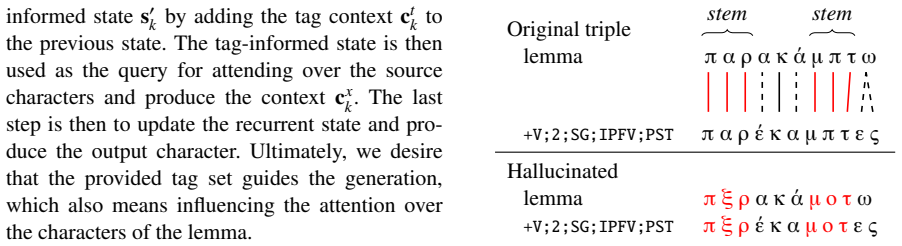
The load-bearing object is the two-step attention decoder: at each output step, the recurrent state first attends over the tag sequence, adds the tag context to form a tag-informed state, and then uses that state to attend over the lemma characters. The second mechanism is data hallucination, which character-aligns lemma and inflected form, labels unchanged runs of three or more characters as stem, and randomly mutates the interior of those runs to create new (lemma, tags, form) triples. The third mechanism is the training schedule: a warm-up copying task substitutes for explicit monotonicity constraints, a cross-lingual phase mixes high-resource and low-resource data, and a fine-tuning phase uses scheduled sampling to combat exposure bias. The paper shows each piece contributes, with hallucination contributing the largest gain.
What would settle it
Train the same pipeline on a language with non-concatenative morphology, such as Semitic verb inflection or an infixing language, using about 100 real examples, and compare accuracy with and without the hallucinated data: if hallucination does not improve or lowers accuracy, the stem-invariance assumption fails.
Extended reading notes
Core claim
The central claim is that a character-level sequence-to-sequence inflector can learn to inflect a low-resource language accurately if the decoder first uses its previous state to attend over the morphological tag sequence, forming a tag-informed state, and only then uses that state as the query to attend over the lemma characters. This ordering lets the tags guide which part of the lemma to copy or modify. Combined with a three-phase training schedule (copying warm-up, cross-lingual training, and fine-tuning with scheduled sampling) and hallucinated data generated by mutating aligned stem regions, the model reaches 63.8 percent macro-averaged accuracy on the 100 test language pairs, surpassing the previous best system by 15 percentage points and every system submitted to the challenge. The paper argues that the largest single gain comes from hallucinating 10,000 synthetic examples per language, and that transfer quality depends on typological similarity and shared scripts.
Load-bearing premise
The pipeline assumes that any run of three or more unchanged characters between the aligned lemma and inflected form is an invariant stem, so mutating its interior yields valid training examples.
Editorial extensions
If this is right
- The full pipeline reaches 63.8% macro-averaged accuracy on the 100-pair test set, beating the previous best system's 48.5% and every system submitted to the challenge.
- Hallucinated data is the largest single contributor, adding roughly 10 accuracy points over the model without it, and its benefit grows as the transfer language becomes more distant from the target language.
- A copying warm-up task makes explicit monotonic-attention constraints unnecessary: the decoder learns monotonic character attention through the copying objective alone.
- Cross-lingual transfer helps only when the source and target languages are genetically similar and share a writing system; script mismatch can erase the benefit and even hurt performance.
- Using only hallucinated data in a monolingual setting is almost as strong as cross-lingual transfer with hallucination, making the method viable for language isolates.
Reading between the lines
- Inference: the fixed threshold of three unchanged characters and uniform random substitution are obvious tuning knobs; a per-language threshold or an n-gram-aware substitution distribution would likely improve the hallucination gain, since the paper notes both choices are arbitrary.
- Inference: the tag-guided two-step attention should transfer to other conditioned character-level generation tasks such as lemmatization, grapheme-to-phoneme conversion, and morphological analysis, where a small tag set also controls what the decoder copies and what it changes.
- Inference: the sharp script-mismatch results suggest that a transliteration preprocessing step, mapping the target language's orthography to the source language's script, could recover parts of the lost transfer signal; the paper leaves alphabet mapping as future work.
- Inference: because hallucination mainly relieves the zero-probability n-gram problem, combining it with other augmentation strategies, such as back-translation or synonym substitution on the lemma side, may yield further gains that the paper does not test.
Signed reviews
Editorial analysis
A structured set of objections, weighed in public.
Referee Report
Summary. The paper presents a sequence-to-sequence model for low-resource morphological inflection with three main contributions: a two-step attention decoder that first attends over the morphological tags and then over the lemma characters; a data hallucination method based on character-level alignment that generates synthetic training examples by mutating stem-internal characters; and a three-phase training schedule (warm-up with a copy task, cross-lingual training with an adversarial language discriminator, and fine-tuning with scheduled sampling). On the SIGMORPHON 2019 shared task benchmark (100 language pairs), the best model achieves 63.8% macro-averaged accuracy, outperforming the previous state-of-the-art (Wu and Cotterell, 2019) by 15.3 points and ranking first among submitted systems by accuracy. The paper reports extensive ablations, single- and multiple-language transfer analyses, and attention visualizations.
Significance. If the results hold, this is a meaningful advance for low-resource morphological inflection. The central empirical claim is evaluated on a fixed external benchmark with a published baseline, the code is released, and the ablations support each component: the warm-up plus copy task raises development accuracy from 31.2 to 48.0, hallucination adds about 11 test points, and multi-language transfer adds about 3 more. The paper also gives a clear analysis of factors for cross-lingual transfer (typological similarity, shared scripts), and honestly discloses the use of dev data for dev-set hallucination experiments. The residual uncertainty identified in review—whether the final test-set hallucinated data were generated from training triples only—is a clarity issue rather than a discovered error, and does not affect the assessment of the central claim.
minor comments (5)
- [Section 3 (Table 1)] The paper does not state explicitly whether the hallucinated data used for the test-set evaluations were generated from the training triples only; given the footnote in Table 2 that dev data were used for the dev-set hallucination experiments, please add a sentence clarifying the data source for the test-set runs (and, if possible, a check in the released code) to rule out any leakage.
- [Section 2.3 and Appendix A] The text states that in the fine-tuning phase the batch size is reduced to a single instance, but the hyperparameter list reports a phase-3 minibatch size of 2; these statements should be reconciled.
- [Section 2.2] The stem-length threshold of three characters is acknowledged as arbitrary; a brief sensitivity analysis on a few language pairs would strengthen the claim that the hallucination component is robust to this choice.
- [Table 2] The label '0st-order hard attention' should read '0th-order hard attention'; also consider adding a pointer to the shared task report for the Levenshtein-distance results that are omitted from this paper.
- [Section 5] There are two typos in Section 5: 'bares similarities' should be 'bears similarities', and 'cosolidates' should be 'consolidates'.
Circularity Check
No significant circularity identified
full rationale
The paper's central claim is an empirical accuracy result on the fixed public SIGMORPHON 2019 benchmark, reported against the external baseline of Wu and Cotterell (2019) and against official shared-task rankings. No fitted parameter is renamed as a prediction: the hallucinated-data column is an ablation, the oracle accuracy is explicitly an upper-bound oracle, and the macro-averaged test accuracy is measured on held-out test pairs. The hallucination procedure relies on external character alignment from the SIGMORPHON 2016 baseline, not on this paper's own model outputs, and the paper explicitly discloses that dev data were used in the hallucination process so those dev numbers are not directly comparable. Self-citations (e.g., DyNet, Neubig and Hu 2018, Zhou and Neubig 2017) appear only as implementation and related-work support, not as load-bearing justification of the accuracy gain. No equation reduces to its own input, no uniqueness theorem is imported from the authors' prior work, and no known result is merely renamed. The derivation chain is self-contained with respect to the empirical evaluation, so the circularity score is 0.
Assumptions & free parameters
free parameters (3)
- stem_length_threshold =
3
- hallucination_size =
10,000
- copy_stop_accuracy =
75%
assumptions (3)
- domain assumption The SIGMORPHON 2019 benchmark splits are a valid measure of low-resource inflection performance.
- domain assumption The character alignment method of Cotterell et al. (2016) identifies the stem regions that can be safely mutated.
- domain assumption Genetic distance from URIEL is a valid proxy for transferability between languages.
Cite this review
Pith. "Pith review of Pushing the Limits of Low-Resource Morphological Inflection." pith.science (2026). https://pith.science/paper/4OZCTFNS
@misc{pith2026190805838,
  author       = {Pith},
  title        = {Pith review of: Pushing the Limits of Low-Resource Morphological Inflection},
  year         = {2026},
  howpublished = {\url{https://pith.science/paper/4OZCTFNS}},
  note         = {Machine review of arXiv:1908.05838}
}
read the original abstract
Recent years have seen exceptional strides in the task of automatic morphological inflection generation. However, for a long tail of languages the necessary resources are hard to come by, and state-of-the-art neural methods that work well under higher resource settings perform poorly in the face of a paucity of data. In response, we propose a battery of improvements that greatly improve performance under such low-resource conditions. First, we present a novel two-step attention architecture for the inflection decoder. In addition, we investigate the effects of cross-lingual transfer from single and multiple languages, as well as monolingual data hallucination. The macro-averaged accuracy of our models outperforms the state-of-the-art by 15 percentage points. Also, we identify the crucial factors for success with cross-lingual transfer for morphological inflection: typological similarity and a common representation across languages.
Figures


Reference graph
Works this paper leans on
-
[1]
URL: " 'urlintro :=
ENTRY address author booktitle chapter edition editor howpublished institution journal key month note number organization pages publisher school series title type volume year eprint doi pubmed url lastchecked label extra.label sort.label short.list INTEGERS output.state before.all mid.sentence after.sentence after.block STRINGS urlintro eprinturl eprintpr...
-
[2]
write newline
" write newline "" before.all 'output.state := FUNCTION n.dashify 't := "" t empty not t #1 #1 substring "-" = t #1 #2 substring "--" = not "--" * t #2 global.max substring 't := t #1 #1 substring "-" = "-" * t #2 global.max substring 't := while if t #1 #1 substring * t #2 global.max substring 't := if while FUNCTION word.in bbl.in capitalize " " * FUNCT...
-
[3]
Judit \'A cs. 2018. https://doi.org/10.18653/v1/K18-3016 BME - HAS system for C o NLL -- SIGMORPHON 2018 shared task: Universal morphological reinflection . In Proc. C o NLL -- SIGMORPHON , pages 121--126, Brussels. Association for Computational Linguistics
-
[4]
Roee Aharoni and Yoav Goldberg. 2017. Morphological inflection generation with hard monotonic attention. In Proc. ACL
work page 2017
-
[5]
Roee Aharoni, Yoav Goldberg, and Yonatan Belinkov. 2016. Improving sequence to sequence learning for morphological inflection generation: The BIU-MIT systems for the SIGMORPHON 2016 shared task for morphological reinflection. In Proc. SIGMORPHON
work page 2016
-
[6]
Antonios Anastasopoulos and David Chiang. 2018. Leveraging translations for speech transcription in low-resource settings. In Proc. INTERSPEECH
work page 2018
-
[7]
Dzmitry Bahdanau, Kyunghyun Cho, and Yoshua Bengio. 2015. http://arxiv.org/abs/1409.0473 Neural machine translation by jointly learning to align and translate . In Proc. ICLR
arXiv 2015
-
[8]
Samy Bengio, Oriol Vinyals, Navdeep Jaitly, and Noam Shazeer. 2015. Scheduled sampling for sequence prediction with recurrent neural networks. In Proc. NIPS
work page 2015
Show all 38 references
-
[9]
Toms Bergmanis, Katharina Kann, Hinrich Sch \"u tze, and Sharon Goldwater. 2017. Training data augmentation for low-resource morphological inflection. Proc. SIGMORPHON
2017
-
[10]
Theresa Breiner, Chieu Nguyen, Daan van Esch, and Jeremy O'Brien. 2019. Automatic keyboard layout design for low-resource Latin -script languages. arXiv :1901.06039
2019 arXiv
-
[11]
Xilun Chen, Yu Sun, Ben Athiwaratkun, Claire Cardie, and Kilian Weinberger. 2018. Adversarial deep averaging networks for cross-lingual sentiment classification. Transactions of the Association for Computational Linguistics, 6:557--570
2018
-
[12]
Trevor Cohn, Cong Duy Vu Hoang, Ekaterina Vymolova, Kaisheng Yao, Chris Dyer, and Gholamreza Haffari. 2016. Incorporating structural alignment biases into an attentional neural translation model. In Proc. NAACL-HLT
2016
-
[13]
McCarthy, Katharina Kann, Sebastian Mielke, Garrett Nicolai, Miikka Silfverberg, David Yarowsky, Jason Eisner, and Mans Hulden
Ryan Cotterell, Christo Kirov, John Sylak-Glassman, G \'e raldine Walther, Ekaterina Vylomova, Arya D. McCarthy, Katharina Kann, Sebastian Mielke, Garrett Nicolai, Miikka Silfverberg, David Yarowsky, Jason Eisner, and Mans Hulden. 2018. https://www.aclweb.org/anthology/K18-300...
2018
-
[14]
Ryan Cotterell, Christo Kirov, John Sylak-Glassman, G \'e raldine Walther, Ekaterina Vylomova, Patrick Xia, Manaal Faruqui, Sandra K \"u bler, David Yarowsky, Jason Eisner, and Mans Hulden. 2017. https://www.aclweb.org/anthology/K17-2001 C o NLL - SIGMORPHON 2017 shared task: ...
2017
-
[15]
Ryan Cotterell, Christo Kirov, John Sylak-Glassman, David Yarowsky, Jason Eisner, and Mans Hulden. 2016. The SIGMORPHON 2016 shared task---morphological reinflection. In Proc. SIGMORPHON
2016
-
[16]
Ben Foley, Josh Arnold, Rolando Coto-Solano, Gautier Durantin, T Mark Ellison, Daan van Esch, Scott Heath, Franti s ek Kratochv \' l, Zara Maxwell-Smith, David Nash, et al. 2018. Building speech recognition systems for language documentation: The CoEDL endangered language pipe...
2018
-
[17]
Yaroslav Ganin, Evgeniya Ustinova, Hana Ajakan, Pascal Germain, Hugo Larochelle, Fran c ois Laviolette, Mario Marchand, and Victor Lempitsky. 2016. Domain-adversarial training of neural networks. JMLR
2016
-
[18]
Robert D Hoberman and Mark Aronoff. 2003. The verbal morphology of Maltese . Language Acquisition and Language Disorders, 28:61--78
2003
-
[19]
Katharina Kann, Ryan Cotterell, and Hinrich Sch \"u tze. 2017. https://www.aclweb.org/anthology/P17-1182 One-shot neural cross-lingual transfer for paradigm completion . In Proc. ACL
2017
-
[20]
Mielke, Arya McCarthy, Sandra K \"u bler, David Yarowsky, Jason Eisner, and Mans Hulden
Christo Kirov, Ryan Cotterell, John Sylak-Glassman, G \'e raldine Walther, Ekaterina Vylomova, Patrick Xia, Manaal Faruqui, Sebastian J. Mielke, Arya McCarthy, Sandra K \"u bler, David Yarowsky, Jason Eisner, and Mans Hulden. 2018. https://www.aclweb.org/anthology/L18-1293 U n...
2018
-
[21]
Guillaume Lample, Alexis Conneau, Ludovic Denoyer, and Marc'Aurelio Ranzato. 2018. Unsupervised machine translation using monolingual corpora only. In Proc. ICLR
2018
-
[22]
Mortensen, Ke Lin, Katherine Kairis, Carlisle Turner, and Lori Levin
Patrick Littell, David R. Mortensen, Ke Lin, Katherine Kairis, Carlisle Turner, and Lori Levin. 2017. http://aclweb.org/anthology/E17-2002 Uriel and lang2vec: Representing languages as typological, geographical, and phylogenetic vectors . In Proc. EACL
2017
-
[23]
Minh-Thang Luong and Christopher D Manning. 2015. Stanford neural machine translation systems for spoken language domains. In Proc. IWSLT
2015
-
[24]
Thang Luong, Hieu Pham, and Christopher D Manning. 2015. Effective approaches to attention-based neural machine translation. In Proc. EMNLP
2015
-
[25]
Andre Martins and Ramon Astudillo. 2016. From softmax to sparsemax: A sparse model of attention and multi-label classification. In Proc. ICML, pages 1614--1623
2016
-
[26]
Arya D. McCarthy, Ekaterina Vylomova, Shijie Wu, Chaitanya Malaviya, Lawrence Wolf-Sonkin, Garrett Nicolai, Christo Kirov, Miikka Silfverberg, Sebastian Mielke, Jeffrey Heinz, Ryan Cotterell, and Mans Hulden. 2019 a . The SIGMORPHON 2019 shared task: Crosslinguality and contex...
2019
-
[27]
McCarthy, Ekaterina Vylomova, Shijie Wu, Chaitanya Malaviya, Lawrence Wolf-Sonkin, Garrett Nicolai, Miikka Silfverberg, Sebastian J
Arya D. McCarthy, Ekaterina Vylomova, Shijie Wu, Chaitanya Malaviya, Lawrence Wolf-Sonkin, Garrett Nicolai, Miikka Silfverberg, Sebastian J. Mielke, Jeffrey Heinz, Ryan Cotterell, and Mans Hulden. 2019 b . https://www.aclweb.org/anthology/W19-4226 The SIGMORPHON 2019 shared ta...
2019
-
[28]
Graham Neubig, Chris Dyer, Yoav Goldberg, Austin Matthews, Waleed Ammar, Antonios Anastasopoulos, Miguel Ballesteros, David Chiang, Daniel Clothiaux, Trevor Cohn, et al. 2017. http://arxiv.org/abs/1701.03980 DyNet : The dynamic neural network toolkit . arXiv :1701.03980
2017 arXiv
-
[29]
Graham Neubig and Junjie Hu. 2018. http://www.phontron.com/paper/neubig18emnlp.pdf Rapid adaptation of neural machine translation to new languages . In Proc. EMNLP
2018
-
[30]
Ben Peters and Andr \'e F. T. Martins. 2019. https://www.aclweb.org/anthology/W19-4207 IT -- IST at the SIGMORPHON 2019 shared task: Sparse two-headed models for inflection . In Proc. SIGMORPHON, Florence, Italy
2019
-
[31]
Lane Schwartz, Emily Chen, Benjamin Hunt, and Sylvia LR Schreiner. 2019. Bootstrapping a neural morphological analyzer for St. Lawrence Island Yupik from a finite-state transducer. In Proc. Comput-EL3
2019
-
[32]
Miikka Silfverberg, Adam Wiemerslage, Ling Liu, and Lingshuang Jack Mao. 2017. Data augmentation for morphological reinflection. Proc. SIGMORPHON
2017
-
[33]
James Neil Sneddon, K Alexander Adelaar, Dwi N Djenar, and Michael Ewing. 2012. Indonesian: A comprehensive grammar. Routledge
2012
-
[34]
Ashish Vaswani, Noam Shazeer, Niki Parmar, Jakob Uszkoreit, Llion Jones, Aidan N Gomez, ukasz Kaiser, and Illia Polosukhin. 2017. http://papers.nips.cc/paper/7181-attention-is-all-you-need.pdf Attention is all you need . In Proc. NeurIPS
2017
-
[35]
Shijie Wu and Ryan Cotterell. 2019. Exact hard monotonic attention for character-level transduction. arXiv :1905.06319
2019 arXiv
-
[36]
Qizhe Xie, Zihang Dai, Yulun Du, Eduard Hovy, and Graham Neubig. 2017. Controllable invariance through adversarial feature learning. In Proc. NeurIPS, pages 585--596
2017
-
[37]
Chunting Zhou and Graham Neubig. 2017. Morphological inflection generation with multi-space variational encoder-decoders. In Proc. SIGMORPHON
2017
-
[38]
Barret Zoph and Kevin Knight. 2016. http://www.aclweb.org/anthology/N16-1004 Multi-source neural translation . In Proc. NAACL-HLT
2016
Reviewed August 14, 2026 · model on record in the stance chip above.
Discussion (0). Continue with ORCID to comment.